Tuesday, September 05, 2006
The Brontë Parsonage website publishes more information about Cornelia Parker's exhibition: Brontëan Abstracts, that we presented some time ago:From September 16 - Brontëan Abstracts - Cornelia Parker In 2005 the Brontë Parsonage Museum commissioned contemporary British artist, Cornelia Parker, to produce new work in response to the museum and its collection. The exhibition, Brontëan Abstracts, is the result.
The parsonage is famous throughout the world as the Brontës’ home and the place where great novels such as Jane Eyre and Wuthering Heights were written. The house is now displayed as a ‘period home’, with the Brontës’ furniture, domestic objects, artworks and personal belongings set out to give an impression of the house in their own time.
Cornelia Parker’s Brontëan Abstracts are displayed throughout the historic rooms of the house alongside these original artefacts to encourage new ways of looking at the museum’s collection and at contemporary art, to celebrate the connections between creativity, past and present, and reflect the way in which the Brontës lives and works have continued to inspire writers and artists across three centuries.
Twenty five works appear in Brontëan Abstracts. These include scanned and electron microscope images of items from the museum’s collection and images of amendments to Charlotte Brontë’s manuscript of Jane Eyre, held in the British Library. In addition there are sound installations in certain rooms which document a visit made by two psychics to the parsonage, and a video recording of Phyllis Cheney who claims descent from Branwell Brontë.
For further information, contact the museum on 01535 642323 / bronte@bronte.org.uk Exhibition included in museum entry price.
Opening times: 10.00am - 5.30pm (September)
11.00am - 5.00pm (October - December)
Categories: Art-Exhibitions, Brontë_Parsonage_Museum
Tuesday, July 18, 2006
The Brontë Parsonage Blog posts a media release about the upcoming (next September) Cornelia Parker's exhibition, Brontëan Abstracts, that will take place in the Brontë Parsonage Museum. Here we only reproduce the essential information. If you want to know all the details and further information about Cornelia Parker's background you have to visit the original post.The Cornelia Parker Exhibition launches the Brontë Contemporary Arts Programme.
An ambitious project to establish the Brontë Parsonage Museum in Haworth as a vibrant centre for the creative arts will be officially launched with a stunning new exhibition by one of Britain's most famous artists, and Turner Prize nominee, Cornelia Parker.
Cornelia Parker's Brontëan Abstracts exhibition will run from Saturday 16 September to Sunday 31 December 2006 and will, most unusually, be displayed within period rooms of the Parsonage. Cornelia has been working with the Museum over the past year developing new work which will offer visitors a unique opportunity to see the Brontës interpreted through the work of a major contemporary British artist.
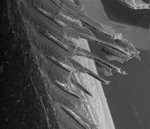
She has been exploring the Museum's collection, viewing original Brontë manuscripts in the British Library and working with the University of Bradford analysing samples of Brontë hair, using electron microscope imaging technology. The exhibition will include a series of images of Brontë artefacts, including samples of hair produced using this method.
“By capturing images of the Brontës' relics through a microscope,” she explained, “I have been using the tools of science to try to understand the power of the myth. Whether it is a split end of Anne's hair (in the picture) or pinholes made by Charlotte or the tines of a comb burnt by Emily, they are abstractions made by them, unconsciously.”
The Brontë Parsonage Museum has, over the years, attracted international artists, authors and film-makers all keen to interpret the lives of one of the most famous literary families of all time. The Museum is seeking to use the historic home of the Brontës in a new and dynamic way to bring the collections to life for visitors and make new connections with the creative arts.
Andrew McCarthy, Parsonage Deputy Director, said, “Exhibiting work by such a prominent artist is very exciting and an historic opportunity for the Museum.
“Cornelia Parker is interested in people, places and objects which have become so established within public consciousness as to have taken on a monumental quality. This is certainly true of the Brontës.
“The problem with monuments is that they can become caricatures and Brontëan Abstracts will challenge some of our preconceptions about the Brontës and give us a new perspective on them”.
(Diane Benn)
Categories: Art-Exhibitions, Brontë_Parsonage_Museum
Sunday, July 19, 2026
3 Jul - 7 Aug 2026Frith Street Gallery17–18 Golden Square, London, W1F 9JJMultiple Narratives brings together works by eight gallery artists. The pieces are linked through their use of repetition, series and classification; some are narrative-driven, while others focus on visual exploration. Spanning drawing, sculpture, photography and found objects, the exhibition ranges from the minimal and abstract to the richly figurative.The show includes Fiona Banner aka The Vanity Press, Anna Barriball, Tacita Dean, Shilpa Gupta, Cornelia Parker, Raqs Media Collective, Thomas Schütte, and Dayanita Singh.Adjacent is Parker’s Brontëan Abstracts (2006) – photographs of Charlotte Brontë’s original manuscripts for Jane Eyre which are held in the British Library. These images give us a direct insight into the immediacy of the progress of the celebrated novel. Here Parker invites the viewer to be present at the author’s elbow, we enter Brontë’s consciousness as she edits her masterpiece and become privy to her ideas as they emerge and recede.
Thursday, May 31, 2007
Kathryn Hughes, who is very well acquainted with the Victorian Era, writes for The Guardian on the nouveau riches' need for butlers. What does this have to do with the Brontës? Oh, you'll see:
In 1841 Charlotte Bronte was employed as a governess by the nouveau riche White family to train up their "wild and unbroken" children. Bronte, a clergyman's daughter and so already a lady, burned with resentment at her lowly position. Mrs White, an excise-man's daughter, was skewered by the acid-tongued Miss Bronte as having a "very coarse unladylike temper". When the kindly Mr White suggested that the Rev Bronte might like to visit, Bronte virtually self-combusted at the thought of being beholden to people whose vowels, despite her best endeavours, remained as flat as an unrisen yorkshire pudding.Didn't Charlotte love being a governess? ;)
The Brontë Parsonage Blog publishes a letter from photographer Simon Warner (who has his own blog: The Collecting Place) about Cornelia Parker's recent talk at the National Portrait Gallery. The talk was mainly on Brontëan Abstracts.
Following an illustrated presentation by the artist herself, she was joined by writer Deborah Levy for a conversation about the inspiration behind the work and the methods she used to pursue different aspects of Brontë mythology.Categories: Art-Exhibitions, Charlotte Brontë
Cornelia was especially eloquent about her unfulfilled ambition to implant strands of the Brontë Sisters' hair into Nelson's (the Duke of Brontë's) hair on Nelson's Column in Trafalgar Square. She felt this was an art intervention whose time has perhaps not yet come.
I was struck overall by how much work she put in to Brontëan Abstracts - not just the electron microscope investigations, but the close-up photographs of the Jane Eyre manuscript, the Plymouth interview with Phyllis Cheney which I filmed for her, and the psychics' visit to the Parsonage. There were other enquiries too that were not followed up for the exhibition, such as the forensic tests offered by West Yorkshire Police on items of Brontë linen.
Thursday, January 03, 2008
ArtCal announces the upcoming exhibition 3 Rooms - Cornelia Parker, Massimo Bartolini, Dario Robleto (05 January 2008 – 09 February 2008) in the D'Amelio Terras Gallery (New York). Cornelia Parker's works are from her Brontëan Abstracts collection:Cornelia Parker’s work often deals with deconstruction of monuments, be it people or places. The photographic works on view are from her series “Brontëan Abstracts” in which she examines the mythology surrounding the Brontë sisters – Anne, Charlotte and Emily. Parker uses an electron microscope to scan artifacts and objects owned by the Brontës such as a lock of hair, a quill pen, a needle. The magnification both abstracts them and reveals their essence. Other photographs focus on both the conscious and subconscious marks left by the sisters — such as ink blots on the lined paper, deletions from the original manuscripts and holes in the pincushion.Picture: Cornelia Parker Brontëan Abstract (Emily Brontë’s hair) 2006 13 7/8 x 11 7/8 inches (35 x 30 cm)framed: 21 1/2 x 20 inches (54.6 x 50.8 cm) SEM image printed as Bromide BW print on fibre based paperEdition 1/5 with 2 AP’s. Source.
L.A. City Beat talks about the Northwest Passage Artic Franklin's expedition (1845-48) and the Brontës' fascination with Polar explorers is quoted:
Franklin’s lead-poisoned, murderous, and ultimately frozen-to-death 1840s voyage will be the subject of the Velaslavasay Panorama’s “An Evening of Arctic Novelty” on Thursday and Friday nights. The program will feature a lecture about the Franklin Expedition by Arctic historian Dr. Russell Potter – but it won’t be any old lecture. (...)Finally, this Russian blog comments Jane Eyre 2006 in Russian.
The saga was so drawn out that it captured even the imaginations of popular writers. “Dickens, George Eliot, and the Brontë sisters were big on polar explorers,” says Potter, who also mentions that Charles Dickens himself mounted panoramas on the fate of Franklin’s crew. (Alfred Lee)
Categories: Art-Exhibitions, Jane Eyre, Movies-DVD-TV, References
Tuesday, February 05, 2008
The Villager reviews Cornelia Parker's Brontëan Abstracts, now on exhibition at the D'Amelio Terras Gallery in New York (just until next February 9):In the picture: Cornelia Parker, “Brontëan Abstract (Charlotte Bronte’s blue pincushion),” 2006 (Source, Courtesy D’Amelio Terras)
Whether it’s the pincushion of Charlotte Brontë or sheet music from the past, relics and reliquaries are fashionable this season. Some shows mine artifacts like Travis Somerville at Caren Golden Fine Art, while some create an imagined, or parallel past. Some recreate significant objects using unusual materials (like pipe cleaners). And some inhabit the present more successfully than others.Douglas A. Martin, author of Branwell: A novel of the Brontë Brother (2006) is interviewed in Bookslut. One question is related to his previous novel:
The doodlings and habitat of genius is the current subject of British artist Cornelia Parker. Parker is associated with Britart and its shock tactics and is known for dramatic installations. Her circular arrays such as “Thirty Pieces of Silver” (using silverware) implode and resurrect familiar tropes. She has said that she is interested in “killing things off and then resurrecting them, so that one set of references is negated as a new one takes its place.” In a three-person exhibition at D’Amelio Terras, Parker presents a news series of works called “Brontëan Abstracts.”
Focusing on the Brontë sisters, Parker uses an electron microscope to alter our perceptions. A pincushion magnified at least a dozen times, is recast as a bright blue field dotted with explosions of white. It’s so active, that at first I thought it was an aerial view of splashing swimmers in a pool. In another photograph redolent with the passage of time, dusty rose blotter paper boasts blobs of black ink, becoming a gorgeous exercise in non-objective aesthetics. By zeroing in so clearly on the minute, Cornelia has found a unique way to view actual things, and in doing so, she has found a new way to import meaning into abstracted art. (Jeffrey Ciphers Wright)
You write fiction and poetry but blur the line between the two. Your novel, Branwell, is incredibly poetic. Your poetry often has a clear narrative thread. Do the practices of writing fiction and poetry feel very different to you? How do they inform each other?The Sydney Morning Herald food critic seems to be reading Wuthering Heights (or maybe he has eaten something in a bad state) because this is how he describes a "vitello tonnato" terrine at the Restaurant Arras:
I’m glad you see Branwell in that light. There’s a poem in the manuscript with which I first knew I could really just write a story if I wanted to. Fittingly, perhaps, the poem is called “Simulation.” In the story version of the same intrigue, another character comes into the frame, from the lyric to the situation’s real world navigation. The story is called “Threshold” and specifically, structurally deals with the connotations of this one word and the one or two or three bodies it comes into contact with, there.
Poems for me used to be impulses, impressions, angers, interventions into my own life, monologues in search of a listener, even; this idea plays into some of the collection’s titlings. These were urgencies that had somehow gone beyond just what I needed to put in the diary I no longer keep in any real, recognizable way.
Once I’d started writing pieces specifically for performance, those pieces started to grow, basically to become stories, though I had always been aware of when I read how I was not only doing a “set,” I was creating a feeling of different stories based on the order I’d read my poems in. “I” always becomes a through thread when you are standing in front of a group of people saying it. In some ways, my work moved from following a thought to following an action or a series of actions. Subjects became less shadowy for me.
I’m supposed to not “just say things” in my poetry, and I’m supposed to “just say things” in my fiction, but there is a dialect between the two for me. Poetry for me has always had a performative dimension. I started writing novels really because I was tired of trying to whip up audiences back in Georgia. The novels I have written, at least in the composing of them, have never seemed to need an audience to justify them in the way that poetry does for me. There’s a little more faith that they might somehow see the light of day outside of my hands. But I also see the novel as its own poetic structure, really, and I don’t think about writing poems anymore, even though I feel myself drifting away from any driving concern to explore the novel, how fine of a line I can walk there. In some ways I’ve gone in my thinking from my earliest notions of what can be a poem more towards now what can just be a book. How small can a book be? I think about conceits more than anything and how language will or won’t fall around that. Poems captured moments, and I still think of moments in my prose like that; narrative sequences manipulate the importance we attach to them. (Lena Dunham)
The Italian classic is deconstructed, inverted and given British spunk. An eye of raw yellowfin tuna runs through the centre of the full-flavoured, gelatinous veal shank terrine. The mayo is presented as a ring of finely chopped hardboiled egg, capers and preserved lemon dressed with olive oil. It's as handsome as Heathcliff striding across the moors. (Simon Thomsen)Normblog interviews author Susanne Gervay. When asked about her favourite writers, she says (among others):
My heart beats a little more quickly when I see my romance collection - Jane Eyre by Charlotte Bronte, Wuthering Heights by Emily Bronte, all the Jane Austen novels, especially my favourite, Pride and Prejudice. My teenage years were filled with these books. I must have read each one 10 times, seeking insights into romantic relationships as they deal with life's adversities and successes. Of course, I was in love with Mr Rochester, Heathcliff and Mr Darcy, with their varying but heroic natures. I was the heroine: courageous Jane Eyre, passionate Catherine Earnshaw and feisty Elizabeth Bennet, respectively.Moviefone has produced one more list of best-of-movies. This time is the 25 best Romance Movies (St Valentine's around the corner, you know). Wuthering Heights 1939 is number 3:
A rich girl (Merle Oberon) rejects her stable boy/true love (Laurence Olivier) but soon realizes her mistake, it's not until she's on her deathbed that the two lovers reconnect. Haunting has never been so romantic.And summarizing has never been so misleading, may we add.
The Brontë Parsonage Blog posts about Dudley Green's upcoming biography of Patrick Brontë: Patrick Brontë, father of genius (with a foreword by the Archbishop of Canterbury). Libby Sternberg (the author of the unpublished but highly recommendable To Love Faithfully and Well..., previously known as Through Nightmare when BrontëBlog posted about it) is interviewed on Favorite PASTimes:
What are you working on now that you’d like us to know about?The BarbellionBlog (devoted to post the complete works of W.N.P. Barbellion (1889-1919), nom the plume of Bruce Frederick Cummings) posts his entry on Emily Brontë.
For several years now, I’ve been laboring on a true “book of my heart,” a novel set in 1934, in California, a story inspired by Jane Eyre. It’s been read by several editors and is still being read by some now. I feel so strongly about this story that I have posted it in its entirety on my web site, so if you’re a Jane Eyre fan, check it out and let me know what you think!
Categories: Art-Exhibitions, Books, Brontëites, Emily Brontë, Jane Eyre, Weirdo, Wuthering Heights
Wednesday, January 07, 2009
Cornelia Parker's Brontëan Abstracts are currently being exhibited at the Galerie Guy Bärtschi in Genève, Switzerland:Cornelia ParkerThe Swiss magazine Le Temps describes the pieces like this:
from November, 15 (2008) until January 23 (2009)
In the picture:
Cornelia PARKER
Brontëan Abstract 2006
(Pinhole made by Charlotte Brontë)
Tirage argentique d'une image SEM sur dibond
51 x 55 cm
20 1/16 x 21 5/8 in
Répondant à une demande du Brontë Parsonage Museum, qui en 2006 l'a invitée à réaliser un travail sur les sœurs écrivains et leur frère Branwell, Cornelia Parker, grande lectrice, a inspecté les objets qui leur ont appartenu.Categories: Art-Exhibitions
Images révélatrices
En quête de traces invisibles à l'œil nu, donc de données en quelque sorte inédites, elle a recouru au microscope électronique et au scanner. En résultent ces images qui révèlent l'usure des becs de plume, le bout fourchu des cheveux, des traces sur le buvard ou des taches sur le mouchoir. Vision tenace d'un passage, de vies qui ont été et qui ne sont plus, et qui pourtant ont laissé leur empreinte non seulement sur les pages de livres, mais sur des objets banals - conservés dans un musée.
Etrange va-et-vient de la vie à l'œuvre et de l'œuvre à la vie, de l'anonymat à la célébrité et de celle-ci au caractère humble et patient des travaux à l'aiguille, celle-ci ayant creusé dans les étoffes des trous qui, grossis, s'apparentent à des gouffres. (Laurence Chauvy) (Google translation)
Thursday, January 18, 2007
Categories: Art-Exhibitions, Brontë Parsonage Museum, In the NewsThousands of people attended an exhibition with a modern take on the Brontës.
Since September, the Brontë Parsonage Museum, in Haworth, has seen a surge in the number of visitors who have taken a modern artistic look at the village's famous literary family.
Former Turner Prize nominee Cornelia Parker's exhibition, Brontëan Abstracts, attracted a different audience to the museum's usual visitors, said director Alan Bentley.
The exhibition, which has just closed, showed images of Brontë artefacts taken with electron microscope imaging technology.
Mr Bentley said: "It's been very successful. As it was a modern exhibition, it brought in younger people and aspiring artists who wouldn't normally come here for that. We aren't used to Cornelia's modern artist perspective so it has been very interesting and made us look at our collections from a completely different point of view.
"I'm pleased the museum's tradition of inspiring people through the works of the Brontës has continued."
For 41 years the Brontë family lived in the building which is now the Parsonage Museum. The museum aims to attract international artists, authors and film-makers to interpret the lives of the Brontës in new ways.
Andrew McCarthy, Parsonage deputy director, said: "Exhibiting work by such a prominent artist has been very exciting and an historic opportunity for the museum.
"The problem with monuments is they can become caricatures and Brontëan Abstracts has challenged some of our preconceptions."
Sunday, September 30, 2007
"She has a different way of working and is totally immersed in the work," says Kay Mellor, scriptwriter of Band Of Gold - the ITV series that made Morton famous for playing a drug-addicted teenage prostitute - and of a 1997 adaptation of Jane Eyre in which Morton played the lead. "Where other actors come in and out of character, and have a laugh and relax, I'm not sure Samantha would," adds Mellor. "I don't know if she still does that, but when she was doing Band Of Gold she instinctively kept in character most of the time. I took her outfor dinner when she was playing Jane Eyre, and I basically went out for dinner with Jane Eyre. It was quite weird, really." (Peter Ross)The Guardian reviews the retrospective on Cornelia Parker - Never Endings - that can be seen at the IKON Gallery, Birmingham until 18 November. Tim Adams - the reviewer - considers Parker's art 'hit-and-miss'. The retrospective includes some of her Brontëan Abstracts:
It is not only Cornelia Parker's exploded shed that sends her work spinning off in every direction. How would you hold these recent adventures of hers together apart from with invisible wires: a filmed interview with Noam Chomsky about American barbarism; the dress worn by Mia Farrow in Roman Polanski's Rosemary's Baby; a tape recording of an inconclusive seance with the Brontes at Haworth; rocks and stones taken from beneath the Leaning Tower of Pisa? Jonathan Watkins, the director of the Ikon Gallery which houses this retrospective of her work of the last decade has a go: Parker, he suggests, is 'engaging with subjects that loom large in popular imagination, universal triggers perhaps of a collective unconscious'. Well, sort of. [...]Personally, we like what we've seen of Cornelia Parker's work and we like her innovative ideas, but we understand she's not everyone's cup of trea. Still, Brontëites in the area which didn't get to see Brontëan Abstracts at the Brontë Parsonage Museum now have a chance of judging for themselves.
She is happy at times to borrow this atmosphere of spookiness from other, more conventional places, which diminishes the surprise. The Bronte room here, with its hyper-magnified photographs of the nib of Charlotte's pen and the surface of Branwell's wallet, is a case in point. Haworth represents readymade ghostliness and Parker's intervention doesn't make it any more spectral.
A Brontëite (?) appears in the Deccan Herald: poet Brian Mendonca.
After doing an MPhil on Charlotte Bronte at the University of Pune, I did my Doctorate on ‘Insanity in the English Gothic novel’ from CIEFL, Hyderabad.Now for a few reviews - all of them linked somehow to Wuthering Heights/Emily Brontë:
Rosa de Fuego reviews Cumbres Borrascosas - Wuthering Heights in Spanish. That Movie Critic Show reviews (in a podcast) Wuthering Heights 1939 and I'm in a Jess Franco State of Mind has published a lengthy, highly interesting post on Abismos de Pasión, Luis Buñuel's take on Wuthering Heights.
The Philadelphia Inquirer has an article on a book called The End of the Alphabet by C.S. Richardson:
Richardson also infuses Ambrose and Zipper with certain endearing characteristics - he cannot stand Wuthering Heights, while it's her favorite book. (Elizabeth Fox)That could be fun indeed.
The State reviews Trespass by Valerie Martin. A book we have already mentioned several times in the past in connection with Wuthering Heights as well:
Chloe Dale is an artist preparing to illustrate “Wuthering Heights” and intrigued by the compelling and troublesome Heathcliff, whom she has decided must be a gypsy. (Claudia Smith Brinson)And finally Amanda McCabe reviews Shaggy Muses on Risky Regencies.
Categories: Art-Exhbitions, Books, Jane Eyre, Movies-DVD-TV, Wuthering Heights
Tuesday, February 12, 2008
It is called Chomskian Abstract, and it consists, quite simply, of footage of Chomsky talking about current affairs. His jersey is scruffy. His hair is grey. His delivery is calm. His words are measured and thoughtful and his opinions are clear and completely uncompromising.This half of BrontëBlog is particularly enthusiastic when it comes to the Brontëan Abstracts and other older projects by Cornelia Parker. This new one does sound intriguing.
Parker wanted to create a portrait of Chomsky. She has certainly experimented with contemporary alternatives to traditional portraiture in the past. In a 1995 collaboration with Tilda Swinton, for instance, she displayed the sleeping actress in a glass case and, in a project at the Brontë Parsonage museum, she tried to create a psychological portrait of Jane Eyre's author by photographing all the tiny alterations that the writer made to her manuscript. She also filmed an interview with a 90-year-old woman who claimed to be Branwell Brontë's great-grandchild. “I needed to capture her story before she died,” Parker says. (Rachel Campbell Johnston)
The Scotsman has one of those articles on romantic literature so typical at this time of the year... with a twist. This one is mainly focused on Scottish literature, landscapes, influences and - uh - men.
[Romance writer Paula] Quinn’s landscape theme is echoed by Edwards who points out that from Byron to the Brontës there is a strong literary tradition of linking wild men with wild landscapes. (Fiona MacGregor)Then again and perhaps more to the point, the Brontës were largely influenced by Walter Scott, too.
The Village Voice reviews the ballet Rococo Variations, now on stange in New York. In case you were wondering a ballet piece can also be influenced by the Brontës.
The woman who appears bearing a candle and pattering numbly around on pointe, with the breeze blowing her filmy white nightgown is a docile version of the madwoman in the attic (see Jane Eyre). (Deborah Jowitt)Some interesting blogs: Have Your Cake and Eat It picks the 'the crème de la crème' of Victorian novels. Villette makes it onto the list just after Charlotte's admired Thackeray's masterpiece. Paul Kerensa wonders about Helen Burns's name. La vie en rose posts her favourite stills and scenes from Jane Eyre 2006. And lastly, La policia grammatica writes about the similarities between Jane Eyre and The Yellow Wallpaper, by Charlotte Perkins Gilman.
One thing that really got me was the parallel of the narrator of this story and Bertha Mason of Bronte's Jane Eyre. Both of them are kept in the attic, and both of them are crazy. However, the similarties stop here. The narrator, I believe, is going insane because of her yellow wallpapered room, whereas Bertha Mason is truly insane and a menace--proved by her setting fire to Thornfield. Maybe people will argue, though, that the narrator is also destructive--basing their argument on page 649, where the narrator begins to destroy the wallpaper, believing that she is seeing people running around on it.Categories: Art-Exhibitions, Books, Dance, Jane Eyre, Villette
Monday, May 07, 2007
If you would like some insight on Cornelia Parker's art, you can read a fascinating interview with her in Sam Stone's blog.You will remember that Cornelia Parker was the artist behind the recent exhbition at the Brontë Parsonage Museum, Brontëan Abstracts.
Find below some Brontë-related extracts from the interview, but we really encourage you to read the whole of it. You won't regret it.
For me as a stand-up comic, whenever I have an idea all I have to do is write it down and perform it, but you have to ask the army to blow things up or talk to NASA about sending a bit of meteorite back into space.Charlotte for one would love that idea. And it would be uniting the Duke of Brontë to the Brontë sisters. You know Patrick Brontë might or might not have changed his name in Nelson's honour.
Most recently I've been trying to get the Greater London Arts Council and City Hall to let me put some hair from each of the Bronte sisters into the 'stone hair' of the newly restored Nelson's Column. The Brontes are iconic and have become part of a mythology and I've tried to find the underbelly of a cliché. I've been looking at the Brontes' split-ends under a microscope. Well actually, Anne and Emily have got them but I can't find any in Charlotte's.
Perhaps she was too fastidious.
Whereas Emily was quite wild and not known for keeping up her looks. I loved looking at these split ends. It's so human and poignant. So one of the things I wanted to do was impregnate this huge statue of Nelson with this feminine DNA. I felt I should give them a ride on Nelson's shoulders.
And are they going to let you give Nelson hair extensions?
Basically, no. The reason they gave was time constraints. I think it's more to do with these Bronte hairs, you know this female DNA, might bring down this hero.
So there is a little of the Anarchist in you?A couple of psychics also visited the Parsonage last September when Brontëan Abstracts had just opened.
Well, I suppose. The other thing I'm trying to do with the Bronte project is to get quite a famous Medium to come to the Bronte Museum and see if they can pick anything up. But this particular Medium hasn't said yes yet. I thought it would be great because Victorian novels are full of that sort of stuff and people believed it like it was a science.
What are you doing tomorrow for your birthday?Which Brontëite wouldn't like that for their birthday? Whenever BrontëBlog is in London we always make a point of looking at the Jane Eyre manuscript at the British Library. There's no words to describe how great that is.
I'm going to the British Library at 8:30am to photograph the original manuscript of Jane Eyre, which shows her 'crossings-out' and last minute changes like where she replaces the word 'purple' for 'crimson'. My favourite is where she's put 'would' and then crossed it out and put 'could' and then she's crossed that out and put 'should. I'm not sure what I'm going to do with it yet but then I'm never quite sure what I'm going to do with these things until the last minute.
Do you ever feel that your inspiration is almost Divine?Fabulous interview.
Yeah definitely. The whole thing with Bronte and Nelson, for example. I was thinking that adding the Bronte hair to Nelson's stone hair was a bit like the principle of Homeopathy at work. You know, here is this Uber-male and then these romantic females get added and together you end up with this super-heroine. So I was on the phone trying to convince the Bronte Museum and the Arts Council and I was asking them to think of it like Homeopathy. I put the phone down and an ex-student called to commission me for some work for her garden. I don't really do stuff for the outdoors except I did once throw a piece of moonrock into a lake and put a sign that said 'at the bottom of this lake is a piece of the moon' and I was telling her about this and about how it was like Homeopathy because you're putting a piece of the real moon into something that reflects the moon. And she said, 'Oh that's fantastic because my husband is Nelson of Nelson's Homeopathic Remedies'. 'Oh Gosh,' I said. Anyway, I was talking about this anecdote at a Conference for the Uncanny a couple of weeks ago and I think mostly when you are immersed in the process of creativity, the more things crop up and these coincidences occur it's only because you are alert and you're on a trail and you don't know what you're going to end up with and it IS almost like an act of faith. I'm sure it is the same thing with comedy.
Categories: Art-Exhibitions
Saturday, October 06, 2007
A series of attractively abstract photographs turn out to be no more than magnified smudges from Einstein’s blackboard or the marks in the margin of Charlotte Bronte’s manuscript for Jane Eyre. (Peter McCarthy)On Margaret Cooter's blog you can find a comment and a photographic tour (no Brontëan Abstracts however) of the exhibition.
The Columbus-Dispatch reviews the film The Jane Austen Book Club and somehow reminds us of those reviews of Pride and Prejudice 2005 that considered the atmosphere of the film more Brontë-like than Austen-like:
As a director, Swicord doesn't have the control she has as a screenwriter. Blunt, in particular, is allowed to darken the mood unnecessarily: She overpowers what ought to be a lightly comic role, as if she had just swept in from Bronte's moors rather than Austen's parlors. (Margaret Quamme)Jools Holland's recently-published autobiography: Barefaced Lies and Boogie-Woogie Boasts is the subject of an interview in The Scotsman. A Wuthering Heights-related anecdote appears:
She [Paula Yates] did come to stay. Once he got out an old movie for them to watch together, Wuthering Heights, which he hadn't realised was all about obsessive love leading to madness and death. She couldn't believe it: "This is in the worst possible taste!" she exclaimed. But they had a laugh. She seemed to be improving and getting herself back together, then came the shocking news of her death. (Jackie McGlone)The Times reviews the recent concert of the Puppini Sisters at Sheperds Bush (London) and their Wuthering Heights cover is highlighted:
Their new single Spooky came with a synchronised dance routine, pitch-perfect harmonies and silly sound effects, but it was their cover of Kate Bush’s Wuthering Heights that raised the first cheer from the seated crowd. “Let me in at your window-ah,” they purred, scratching at imaginary glass with their painted nails. (Lisa Verrico)On the blogosphere: Mam'zelle Poupée brings back an interesting text from 1930 by Daniel-Rops (pseudonym of Henri Petiot) about Emily Brontë: Emily Brontë, poésie et solitude (in French). The Brontë Parsonage Blog reminds us of an upcoming talk by Tamar Yellin, author of Kafka in Brontëland.
And finally, the esoteric quote of the day. This surrealistic gem comes from FoxSports.
BUCS +10 at ColtsCategories: Art-Exhibitions, In the News, Music, References, Weirdo, Wuthering Heights
Haven't we seen this somewhere before? The protagonist is driven from his home, scorned by those he loved and trusted. He rises up in the world, returns, and from the lofty perch of his improved circumstances exacts his bitter revenge. Tony Dungy, you are soooo Heathcliff from Wuthering Heights. Emily Bronte? Anyone? (Poor Donald Penn gets to make his first NFL start at left tackle against Dwight Freeney.) Colts 24, Bucaneers 17 (Kevin Helch)
Wednesday, September 20, 2006
Categories: Brontë_Parsonage_Museum, Art-Exhibitions, TalksWednesday 20th September
Cornelia Parker in Conversation with writer Deborah Levy - 7.30pm - West Lane Baptist Chapel.
Following the opening of Brontëan Abstracts at the Brontë Parsonage Museum, Cornelia Parker will be talking about her collaboration with the museum. The museum will be open from 10.00am to 7.30pm on the day of this event to allow those attending to view the exhibition.
Saturday, January 27, 2007
Susanne, the owner and creator of the excellent Brontë resources website The Brontës of Haworth (check it now) has sent us the summary of the most recent issue of Brontë Studies (Volume 32, Issue 1, March 2007). The issue is not yet available on the IngentaConnect website. As soon as it will be, we will post the abstracts and direct links.CONTENTSEDIT:
Editorial (Amber M. Adams) (iii)
ARTICLES
Reading Books and Looking at Pictures in the Novels of Charlotte Brontë. By Alison Hoddinott (1-10)
Between Nowhere and Home: the Odyssey of Lucy Snowe. By Shanyn Fiske (11-20)
Charlotte Brontë's Jane Eyre, the Female Detective and the 'Crime' of Female Selfhood. By Sandro Jung (21-30)
'It has Devoured My Existence': the Power of the Will and Illness in The Bride of
Lammermoor and Wuthering Heights. By Lakshmi Krishnan (31-40)
The Role of Religion in Wuthering Heights. By Graeme Tytler (41-55)
J. B. Leyland: Sculptor and Friend of Branwell Brontë. By Michael Walker (57-70)
REVIEWS
Justine Picardie, My Mother's Wedding Dress: the Life and Afterlife of Clothes (Juliette Wells) (71-72)
Terence Dawson, '"An Oppression Past Explaining": Wuthering Heights and the Struggle for Deliverance from the Father', in The Effective Protagonist in the Nineteenth-Century British Novel: Scott, Brontë, Eliot, Wilde (Leslie Robertson) (72-74)
Jane Eyre, Television serial (Richard Wilcocks) (74-76)
Charlotte Brontë, The Illustrated Jane Eyre. Illustrated by Dame Darcy (Richard Wilcocks) (76-77)
Philip Lister, Ghost & Gravestones of Haworth (Stephen Whitehead) (78)
Daphne du Maurier, The Infernal World of Branwell Brontë (Bob Duckett) (78-79)
Cornelia Parker, Brontëan Abstracts (Richard Wilcocks) (79-80)
Andrew J. Fenady, Riders to Moon Rock (Carolyne van der Meer) (81-82)
Tamar Yellin, Kafka in Brontëland and Other Stories (Bob Duckett) (82-83)
Claire Raymond, The Posthumous Voice in Women's Writing from Mary Shelley to Sylvia Plath (Juliette Wells) (83-85)
Adam Strickson, Wuthering Heights: The Graphic Novel (script) (Richard Wilcocks) (85-87)
The Year's Work in English Studies, Volume 84, edited by William Baker and Kenneth Womack (James Ogden) (88)
S. R. Whitehead, The Brontës' Haworth: The Place and the People the Brontës Knew (Brian Wilks) (88-89)
Abstracts on this post.
Categories: Brontë Society, Journals, Scholar
Friday, December 29, 2006
A couple of things related to the Brontë Parsonage Museum and the Brontë Society that can be of interest to our readers.First, the Brontë Parsonage Website reminds that these are the last days to visit the Cornelia Parker's Brontëan Abstracts exhibition.
The Bronte Parsonage Museum is open 29, 30 and 31 December (11.00 to 5.00) and 1 January (from 12.00). The Museum is then closed from 2 January reopening on 1 February 2007 with a new exhibition on the Charlotte Bronte and her first biographer Elizabeth Gaskell.We really look forward to have more information on this exhibition about Elizabeth Gaskell and Charlotte Brontë in commemoration of the 150th anniversary of the publication of The Life of Charlotte Brontë (1857-2007).
It is the last chance to see Brontean Abstracts, the criticly acclaimed exhibition by Turner Prize nominated artist Cornelia Parker.
The exhibition has been widely praised and includes images of Brontë relics magnified using electron microscopy, as well as video and sound installations featuring a commentary from two psychics whose responses to the Parsonage Parker recorded. The work is displayed throughout the house alongside the museum’s permanent display.
The Brontë Parsonage Blog also informs about a new initiative: Friends of the Brontë Society.
The Friends of the Brontë Society is the name of a group just formed at the Parsonage, made up of staff members. It will be concerned with raising money for the recently-finalised Forward Plan, intended to take the Society and the Parsonage into the Twenty First Century.Categories: Brontë Parsonage Museum, Brontë Society
Fundraising will be one of the principal concerns of the Society in 2007: plans for a new centre for visitors have been in existence for a long time, needing only a massive injection of funds to make them come true, for example.
The Friends coordinator is Pat Berry. First event is a ceilidh to be held in Haworth on St Patrick's Day in March. More details nearer the date. (Richard)
Thursday, November 22, 2007
Bronte is my dad's pin-up girl while I am a Janeite – a Jane Austen fan.And some of them are also fans of the melodrama queen, may we add.
There has been much vigorous and jocular banter between the two of us about the virtues of our adopted heroines.
So I was determined to hijack today's column about Charlotte Bronte's Jane Eyre with sparkling Austen material.
Even though I am a Janeite I have to admit I really enjoyed the latest version of Jane Eyre (a two-part series starting on the ABC on Sunday at 8.30pm). It was gripping, powerful and intense. Ruth Wilson won a BAFTA nomination as the doe-eyed Jane Eyre while Toby Stephens smoulders as the complex Mr Rochester.
My in-laws were so engrossed they watched the series back-to-back until 1am yesterday.
According to the "Enthusiasts guide to Jane Eyre adaptations", this is the 34th film or television version of Jane Eyre dating back to 1909 and it is one of the best received.
That is enough Bronte talk. Now it is Austen's turn. Bronte had the audacity to complain about Austen's writing: "The Passions are perfectly unknown to her, even to the Feelings she vouchsafes no more than an occasional graceful but distant recognition; too frequent converse with them would but ruffle the elegance of her progress." Ouch!
Austen had been dead about 30 years when Bronte wrote these cutting observations but Austen has had the last laugh because there have been 37 television or film productions inspired by her work or her life including nine this year.
Melodrama queen Bronte may not have understood Austen's depth and subtlety of emotion but obviously millions of fans have. (Fiona Purdon)
We don't know if Chinese author Jiang Rong can be classified as Janeite but at least has some Brontëite trends. From The Guardian:
"I have a liberal character by nature. It comes from my mother. She liked to travel and we moved house a lot - Shanghai, Wuxi, Nanjing and Beijing. She was exposed to western culture through the films she loved to watch. She took me to the movies every week. We saw Russian, Indian and western films. And she bought me lots of western children's books. We loved to read western novels." Among them were Jane Eyre and Wuthering Heights. (Jonathan Watts)The Wuthering Heights Two Hats tour will be in Alcester next November 29th (information on the tour, here) and the Redditch Advertiser carries an article about it:

Picture source: Christopher Dobson (Heathcliff) and Emma Cooper (Catherine Earnshaw).
The play is performed by Two Hats Theatre Company, which has made a splash over the last few years with sell-out shows such as The Servant of Two Masters, One Evening in Russia and Terry Johnson's Hysteria.Seduction at 24 frames per second reviews Mike Leigh's Career Girls with its "Miss Brontë, Miss Brontë" recurring plot device
The story is a passionate and punchy tale that doesn't lose the novel's epic feel.
It uses five Victorian actors to tell the story and play all the characters.
Juliet Barker, a world authority on the Brontës, said: "Of all the adaptations of Wuthering Heights that I've seen - film or theatre - this was the best."
Newcomers Matthew Dudley and Krisha Harman will take the parts of Edgar and Nelly.
Matthew has just finished playing Earnest in the Crescent Theatre's The Importance of Being Earnest.
Krisha is a native Yorkshirewoman and past roles include Antigone, Juliet and Lady Macbeth.
Another clever bit involves using the novel Wuthering Heights as a Magic 8-Ball of sorts: they address the book by in an operatic manner, saying, "Mizzz Bronte, Mizzz Bronte. . . " and then pop a question, letting the book holder point a finger into the book at a random page and use the resulting word or phrase as an answer. One such exchange is along the lines of: "Mizzz Bronte, Mizzz Bronte, will I find a fella soon?" The answer comes up, ". . . must come. . ." and licentious laughter follows.Arkhamite talks about Wuthering Heights and The Dish reviews Wide Sargasso Sea:
As an exploration of an underdeveloped character in another novel, Wide Sargasso Sea is profound and thought-provoking, opening the door to broader questions of how the dominant/submissive dynamic permeates many romantic relationships. Without Jane Eyre to hold it up, however, it’s an unfinished novella that trails off without a proper ending to its linear plot.Curating Discourse talks about Cornelia Parker's Brontëan Abstracts:
Brontëan Abstract functions under the guise of a forensic investigation of the Brontë’s in an attempt to know or understand them more. However, it could equally be claimed that this is not its real function. Parker is instead constructing narratives and possible fictions in the creation of a story that is potentially never-ending. (MFA Curating)Categories: Art-Exhibitions, Brontëites, Jane Eyre, Movies-DVD-TV, Theatre, Wide Sargasso Sea, Wuthering Heights
Sunday, June 10, 2007
The new issue of Brontë Studies (Volume 32, Issue 2, July 2007) is already available. Regrettably it's not on-line yet. We provide you the table of contents and abstracts: Editorial pp. iii-iii(1) Author: Adams, Amber M.Categories: Brontë Society, Journals, Scholar
ARTICLES
A bishop, bed and breakfast, a mystery dessert and a poignant letter: material found among the papers of Dr Charles Longley, Archbishop of Canterbury
pp. 91-95 Author: Wilks, Brian
Abstract
While researching in the archives of Lambeth Palace library to find out just what Charlotte Brontë meant when she told Ellen Nussey that her conscience would not let her be ‘either a Puseyite or a Hookist’ (7 April 1840), I read the Library Committee’s Annual Report for 2004. Quietly the report announced that among the recently acquired papers of Dr Charles Longley , former Archbishop of Canterbury and one time Bishop of Ripon, there was a firsthand description of Charlotte Brontë (1853) and a ‘poignant letter from Patrick Brontë written after the death of Charlotte two years later’. This modest announcement led me to a remarkable clutch of letters written by the Bishop that add uniquely to our knowledge not only of Patrick Brontë’s diocesan bishop, but also of the remarkable parsonage family.
The two faces of love in Wuthering Heights
pp. 96-105 Author: Phillips, James
Abstract
The character of Catherine Earnshaw in Emily Brontë’s novel struggles against misinterpretations of her two loves. It is as though she draws a Kantian distinction between the empirical and the transcendental. Where Heathcliff is the transcendental face of love, Linton is its empirical face. Heathcliff and Catherine are each other’s first as well as last love: this permanence makes it difficult to conceive a difference between the object of love and love itself. Nothing empirical can disturb their love, and Catherine sets out to demonstrate its transcendental status by removing what might be taken for it empirical foundations. She maltreats Heathcliff. She marries Linton. Emily Brontë breaks love down into two parts. In being removed from the moderating effect of its complement, each part shows up in extreme behaviour. Yet in being isolated they shed light on the general experience of love, on the passion and trust that are reducible neither to the empirical nor the transcendental.
Shirley and the politics of personal faith
pp. 106-115 Author: Rockefeller, Laura Selene
Abstract
This article is the core of a chapter on Charlotte Brontë’s novel Shirley from a thesis paper in which I explored the tension between organised religion and personal faith in Charlotte Brontë’s four major novels, The Professor, Jane Eyre, Shirley and Villette. In this chapter, I specifically examine how Shirley combines many of the themes from Charlotte Brontë’s juvenilia and earlier novels, most strikingly the themes of death and resurrection, and the deep connection of Shirley herself to her Mother Earth. Shirley is also distinguished from Charlotte’s other novels by its exploration of Robert Moore’s implied atheism. I also examine the interesting theme of Mariolatry that runs through the novel, both in Caroline’s search for her idolised mother, and Robert’s frequent tendency to liken Caroline to the Virgin Mary. The antagonhism between Dissenters and the Established Church, which is more vividly depicted in Shirley than in any of Charlotte’s other novels and presents and interesting and timely examination of the problematic connection between Church and State, is explored.
A missing link: the Brontës, the Sowdens and the Listers
pp. 116-124 Author: Emberson, Ian and Catherine
Abstract
Many writers have tried to find a link between the Brontës and Anne Lister—but overlooked the obvious connection via the Sowden family. The article focuses on three of the Sowdens—Samuel (1779-1863) and two of his sons—Sutcliffe (1816-1861) and George (1822-1899). It describes Samuel’s clash with Anne Lister over the subject of voting; Sutcliffe’s friendships With John Fennell, Branwell Brontë, Arthur Bell Nicholls and the Brontë sisters themselves; his part in the wedding of Arthur and Charlotte; and finally his tragic death; and lastly George Sowden’s slighter acquaintanceship with the Brontës, and the writing in his old age of Recollections of the Brontës. There is also a description of Anne Lister’s own life, and the discovery of her journals.
‘If This Be All’ and the poetry of statement
pp. 125-131 Author: Butterworth, Robert D.
Abstract
Is Anne Brontë’s poetry only for those willing to be indulgent to her out of their general devotion for her works? She writes the poetry of statement, and if she accomplishes anything noteworthy, it must be in her achievement of the capturing of life and of density of meaning within the constraints of plain language and simple imagery. What she is capable of achieving is demonstrated by the poem ‘If This Be All’. Its subject is a deeply meaningful and powerful one to the poet, as its context reveals. Skillful use of multi-layered language and careful choice of detail to explore her theme enable her to achieve resonance and vividness in depicting her experiences.
The case for Anne Brontë’s marginalia in the author’s own copy of The Tenant of Wildfell Hall
pp. 132-137 Author: Talley, Lee A.
Abstract
This essay examines some of Anne Brontë’s marginalia in the controversial author’s own copy of The Tenant of Wildfell Hall to argue that, based on the revisions to the second volume, we should should consider this edition as significantly contributing to studies on Anne Brontë. Further, this essay asserts that the marginalia make Helen Huntingdon appear to be an even stronger heroine, as well as illuminating Anne Brontë’s writing habits and her belief in the central importance of the diary to the novel.
Deaths and Entrances
pp. 138-144 Author: Daniggelis, Paul Daniel
Abstract
The use of the title-phrase, Deaths and Entrances, is traced and its relationship to John Donne, Dylan Thomas, Martha Graham, Les Ballets Trockadero de Monte Carlo, and the Brontë family described.
Emily Brontë and Emily Dickinson: parallel lives on opposing shores
pp. 145-150 Author: Powers, Wendy Anne
Abstract
The lives of Emily Brontë and Emily Dickinson are seen as paradigms of the problems and responsibility of the biographer of the quiet life or inward world. The similar familial environment of the authors: strong father; lack of maternal influence; devoted siblings enjoying intellectual rivalry; a background of the written word, is examined. Both Emilies found sustenance and defence in their homes and suffered homesickness when absent. The influence of the Brontës, particularly of Emily and Charlotte, on Emily Dickinson and her poetry is investigated.
Exciting recent acquisitions at the Brontë Parsonage Museum: letters bought by the Brontë Society on 4 July 2006
pp. 151-154 Author: Salter, Polly
Charles Lemon, MBE (1914-2007)
pp. 155-156 Author: Duckett, Bob
A Brontë reading list
pp. 157-164 Author: Ogden, James
Abstract
This is a selective annotated bibliography reporting and describing articles on the Brontës in scholarly and critical journals, 2000-2005. I hope to bring the survey up to date in a later issue of Brontë Studies.
REVIEWS
Cornelia Parker, Brontëan Abstracts (Bob Duckett) (165-166)
Ann Dinsdale, The Brontës at Haworth (Brian Wilks) (166-167)
Maureen Peters, The Haunting of Houses (Carolyne Van Der Meer) (167-168)
Keith M. Sagar, ‘Emily Brontë—The Crime Against Heathcliff’, Chapter 12 (pp. 183-94) in Literature and the Crime Against Nature: From Homer to Hughes (Chaucer Press, c. 2005) (Bob Duckett) (168-169)
Sarah Fermi, Emily’s Journal, with Annotations by her Sisters, Charlotte and Anne Brontë, edited by Charlotte Brontë (Edward Chitham) (170-171)
Sue Lonoff and Terri A. Hasseler, eds. Approaches to Teaching Emily Brontë’s Wuthering Heights (Juliette Wells) (171-173)
Martin Danahay, Gender at Work in Victorian Culture: Literature, Art and Masculinity (Juliette Wells) (173-174)
Christine Alexander and Margaret Smith, eds. The Oxford Companion to the Brontës (Jonathan N. Wike) (174-175)
Larry H. Peer, ‘The Discourse of Religious Bildung in Anne Brontë’s Agnes Grey’, in Larry H. Peer and Diane Long Hoeveler, eds. Romanticism: Comparative Discourses (Ashgate, c. 2006) (Yukari Oda) (175-176)
Charlotte Brontë, Tales of Angria, ed. by Heather Glen (Robert Barnard) (176)
Charlotte Brontë, The Secret [and other stories], foreword by Sally Vickers (Bob Duckett) (177)
Wide Sargasso Sea, television drama (Richard Wilcocks) (178-179)
Thursday, November 15, 2007
You know the story: Girl meets boy, boy locks girl in attic, boy promptly moves on to the next bit of stuff that comes along. Next year marks the 160th anniversary of the publication of Jane Eyre, and if the recent BBC adaptation is anything to go by, she's lost none of her ability to fascinate those who encounter her.Check the comments on the blog. It's an interesting discussion. However, we must step in and say that 2007 marks the 160th anniversary of Jane Eyre, not next year!
Furthermore, Charlotte Brontë's seminal novel refreshed the formula for gothic romances, with a spate of copycat triple-deckers soon following "Currer Bell" on to the book market. No popular romance was complete without a fragile heroine in dire need of a good rescuing, a brooding, potentially bad boy but ultimately damaged-soul hero and a vixenish, scheming rival for his affections. A taste of exotic stuff from overseas? All the better. A house, possibly haunted but certainly in possession of a few spine-chilling adornments? Perfect.
Since then, the romance novel has undergone a few significant changes. The mysteries of the strange, foreign land have now been unlocked by Ryanair; as for being haunted by ghosts of your husband's past, all you need to do is hack into his email account. Jane herself, meanwhile, has been magically transformed into a sussed, streetwise single mum/high-powered career woman/girl-about-town with a midlife crisis and a sexy neighbour. Chick lit has taken over.
It would be a mistake to dismiss gothic fiction's offspring as trashy, insubstantial fluff, however. In recent years, romantic fiction has turned into the bully of the literary playground, snapping up more than 25% of the UK fiction market. Around the world Mills and Boon, that powerhouse of heaving bosoms and throbbing manhood, sells a staggering two books every second.
These figures are astonishing, but are as nothing to the true crimes that they conceal: behind a veneer of harmless pap, romantic fiction is gradually offing its progenitor. These days, chick-lit heroines aren't allowed to be damsels in distress; while critics claim that Jane Eyre reproduces patriarchal paradigms, the ladies of escapist literature are busy balancing their successful careers with finding a man. (...)
Following the template of the best gothic romances, the grande dame of melodrama has been made redundant by a younger and more alluring rival. It's a sad passing, but it seems that the fact is we can relate to chick lit in a way that we no longer can to gothic fiction. Who knows, maybe the chick-lit novel will one day have its own head cut off by the next big movement in women's writing. But for now the gothic romance is an inaccessible madwoman locked up in fiction's unvisited attic.
The Daily Trojan talks about Rosanna Gamson's Ravish dance piece, now at the new LATC, as we presented yesterday.
The premise behind "Ravish" is, in itself, the stuff great theater is made of - except that in this case, the story translates itself into an interactive dance piece. It is a modern spin on a classic tale. The production revolves around the lives of the five Bronte sisters, all of whom died of tuberculosis prior to the age of 40, and the dichotomy that existed between their own isolation and the rich, romantic lives of the characters they created.The Journal Live publishes David Almond's top ten books:
Rosanna Gamson, the creator and choreographer of "Ravish," said that though she drew inspiration from various sources, the root of her piece is embedded in her life - the integration of disparate artistic elements a reflection of her own unique experiences. (...)
"Ravish," despite its literary influence, is the next step, a progression into something far more conceptual in both its writing and its execution. The dynamic motion of the five dancers is set off by a 24 square-foot stage, but the physical exterior of the space by no means limits the range of influence the performers have on their environment.
"I'm trying to make movement that has a certain awkwardness, that's very hard to do in terms of stamina," Gamson said. "There's a struggle in it. Imagine trying as hard as you can to find movement that you've never seen before. It's a short show - only one hour. I need the production to feel dense, like a jewelry box. Everything in the box should be unique and flashy and essential to the production."
What Gamson said she wanted, more than anything, was to have a show that fully engaged the audience, allowing viewers to be a part of the show, as opposed to being passive observers. This is where the technological component of "Ravish" came into play.
For the production, Gamson teamed up with former Massachusetts Institute of Technology fellow and researcher Flavia Sparacino to create a completely new form of dance theater, integrating modern know-how into traditional movement to create an ethereal realm of dancing words and a dramatic interplay between the performers and the stage itself.
"One of the great things about working with Rosanna was that she is a choreographer with a vision," said Sparacino, who is the founder and director of Sensing Places, an interactive architecture firm. "A designer is a designer and will always have his or her unique artistic tastes. But with Rosanna, we agreed on a vision, and as a choreographer, she was open to ideas. I see technology as being at the service of art, not dominating it."
The point behind interactive media, Sparacino explained, is examining the relationship between people and the space they are in - and perhaps more importantly, how the people can influence their environments. In "Ravish," the dancers are at once controlling their surroundings and trapped by them: Their movement dictates the direction of the lighting and the way the stage reacts to their actions. It is motion sensors without the markers, special effects in real time.
"There are three components to interactive media: The input, the output and the glue that holds the two together," Sparacino said. "In this case, the dancers' movement provides an input and the reaction of the computer software to this movement is the output. It's everything that happens in between that is the hard part."
At one point in "Ravish," letters projected onstage follow the dancers, seemingly chasing the performers tirelessly as they spell out poignant words. Though Gamson choreographed the dances well in advance, the letters' reactions happen in real time, so there is an interactive component that immediately draws the viewer in.
"My vision is to have art generated as the body moves," Sparacino said. "Just like how skin reacts to how we feel on the inside, I want the environment and the stage itself to react to how the dancers move throughout the stage.
"This is releasing power to the people. This is about allowing dancers to create dynamic art with just their movements, and that's something that I think will appeal to people, this augmented reality." (Joyce Chen)
6. Wuthering Heights, Emily Bronte: It’s the atmosphere and passion she creates but also the northern moorland setting that appeals to me. Also, the poetic language is extremely powerful. It’s certainly one of my favourite English novels and, like all of these books, has had an influence on my writing. (Paul Loraine)Twilight is not good for maidens has a couple of posts of interest: a review of the current exhibition of Cornerlia Parker at the Ikon Gallery in Birmingham that we have previously reported. Her attention was driven to the Brontëan Abstracts pieces:
My attention was particularly caught (unsurprisingly) by Brontean Abstracts, her work which came out of the artist’s time at the Bronte Parsonage Museum in Haworth. The exhibition guide talks of Parker’s "forensic interest in the stuff of the Brontes’ lives", and this section of the exhibition features photographs taken through an electron microscope, displaying in the most minute and scientific detail a pin hole made by Charlotte Bronte, the hair of the three sisters, their nibs and needlework. I was fascinated by the level of detail, presumably representative of a "never ending" search for the essential, real Brontes, the people behind the novels, because that seems to be what we, whether as literary critics or the reading public, want. One might assume it’s a modern obsession, this consuming interest in celebrity, wanting to be close to those in the public eye, but as I have previously mentioned in the case of Tennyson, this has been going on for a long time now. And, of course, wanting to know every minutiae of the life of the Brontes is arguably a very different proposition to wanting to know who Kate Moss is going out with and which moisturiser Victoria Beckham wears; this, one can argue, is a "literary" interest, one for the erudite, the well-read. It isn’t, really, though. I wonder if Parker was really suggesting that we are trying to get too close, that the scrutiny of biography and reworkings of history is all a bit much, extraneous, almost. What impact would that image of the pinhole have had if it had been made by Mrs Jones of Cardiff who lived and died in obscurity? But then, what material value would be placed, at auction, say, on Mrs Jones’ nightdress, for example, when compared to Charlotte Bronte’s? It’s all about association, and Parker is making us question, uncomfortably, if we have over-emphasised these associations – it’s cynical, but celebrity sells; is it right that these anonymous pictures become more interesting because of their associations? (...)The other post covers the recent Victorian Memories conference that we reported some time ago:
What particularly caught my eye here, however, was a framed series of photographs, twelve in all (I think) of deleted words from the manuscript of Jane Eyre. Only academics tend to look at manuscripts in such detail, so it’s thought-provoking to see these deleted words turned to their own use, as art. The materiality of the text is thrown into relief here, as words become meaningless as signifiers, taken out of their context (and some barely legible) but exist purely as pictures, the lines of handwriting becoming strokes of paint on a canvas which exist for the purposes of decoration only. The frames seem to break up the continuity of the text, until one recalls that since these are random, deleted words, they had no continuity and little textual status anyway. It forces the viewer into a different relationship with the text, and provokes discussion about the place of text-as-object, and, in the context of the exhibition as a whole, the object-as-text, in which an inanimate object provides a "text" for the viewer to "read". (Serena)
The panel on ‘Charlotte Brontë and Memory’ lent a psychological focus to the darker, more disturbing facets of memory such as trauma theory and repressed memory. Speakers offered compelling accounts of Villette and Jane Eyre with astute examinations of Brontë’s use of the autobiographical form in rendering experience. (Nazia Parveen)Categories: Art-Exhibitions, Brontëites, Dance, Jane Eyre, Scholar
Thursday, October 11, 2007
Parker takes her excavations a step further in the Ikon's upstairs gallery, where she attempts to unpick the mythology of the Brontë sisters and the modern pilgrimage site of their home at Haworth, West Yorkshire. Using electron microscope photography, she presents a series of images that show in molecular detail the quotidian objects of the sisters' existence: their well-worn quill nibs; the mottled surfaces of their blotting paper; a pinhole made by Charlotte which, under the magnifying eye, becomes a bottomless cavern on the surface of a scarred moon. The photographs, together with a film and an audio piece that follows Parker as she tours the family homestead under the guidance of two psychics, are the product of her residency at Haworth last year. The prints hold a superficial fascination, but the project as a whole lacks the potency of her installations. (Jacky Klein)The Washington Post reviews Liz Workman's Dr. Johnson's Doorknob: And Other Significant Parts of Great Men's Houses. The author of the preface of the book is Germaine Greer, who justifies the absence of women on the list of houses arguing, somehow unaccurately, the following:
"most of the houses in this book were inhabited and run by women, whose influence has been obliterated by history." Greer goes on to explain that even in the "modest dwellings" that would become house museums of accomplished members of her own sex, "there is nothing designated Jane Austen's chair or Charlotte Bronte's desk because these women did not have property or a space of their own." (Annie Groer)What? There's such a space as Charlotte's room or Emily's desk and there most certainly is a Charlotte's writing desk! (usually on display at the Bonnell Room). A most puzzling statement coming from the Honorary Patron of the Contemporary Arts Program at the Brontë Parsonage Museum.
The Minneapolis Star Tribune devotes an article to a couple of very young actors working in professional companies. One of them, Malick Ceesay, is now at the Guthrie's performances of Jane Eyre as Broughton Brocklehurst:
His character, Broughton Brocklehurst, merits only a mention in the book, but producers decided to bring the character to life. It's a nonspeaking role, but once onstage, Mac is required to exude bully. He prepares by making faces backstage and doing vocal exercises ("Toy-boat-toy-boat-toy-boat-toy-boat") to prime the right mean face. (Maria Elena Baca)On this video from WCCO Minneapolis you can see a mini-interview with Stacia Rice, Jane Eyre in the production.
A new Brontëite joins our ranks. Alicya Lane, anchor of CBS 3's Eyewitness News at 6 and 11 p.m chooses as:
Favorite author: All three Bronte' sistersAnother Brontëite is author Steph Swainston, interviewed by Eos Books, where she proves she knows her Brontës quite well.
On the blogosphere, two classic adaptations of Brontë novels are discussed. Indie Quills reviews Wuthering Heights 1939 at length while Olsson's examines the recently-published DVD edition of Jane Eyre 1944. Still on the matter of adaptations, Broadway Blog picks the best 'romantic musicals' and number 1 is no other than Caird's and Gordon's Jane Eyre. The Musical. And finally, Books to the Ceiling posts - with pictures - about Robert Barnard's talk at the Brontë Parsonage Museum a few days ago.
Categories: Art-Exhibitions, Books, Brontëites, Jane Eyre, Movies-DVD-TV, Theatre, Wuthering Heights
Search

Labels
- Advert (13)
- Agnes Grey (358)
- AI (4)
- Alert (1856)
- Anne Brontë (629)
- Art-Exhibitions (1067)
- Arthur Bell Nicholls (45)
- At The... (11)
- Audio-Radio (645)
- Biography (400)
- Books (4221)
- Branwell Brontë (389)
- Brontë 200 (395)
- Brontë Birthplace (89)
- Brontë Parsonage Museum (1772)
- Brontë Society (584)
- Brontëana (812)
- Brontëites (2016)
- Brussels (317)
- Charlotte Brontë (1057)
- Comics (423)
- Contest (34)
- Cottage Poems (9)
- Dance (393)
- Elizabeth Gaskell (265)
- Ellen Nussey (20)
- Emily Brontë (1167)
- Fake News & Blunders (161)
- Fiction (460)
- Games (3)
- Haworth (1988)
- Humour (386)
- Illustrations (177)
- In Memoriam (13)
- In the News (1304)
- Ireland (118)
- Jane Eyre (8238)
- Journals (656)
- Juvenilia (305)
- Maria Branwell Brontë (33)
- Mary Taylor (80)
- Messages from BB (116)
- Movies-DVD-TV (5136)
- Music (2531)
- New Releases (7)
- Opera (238)
- Patrick Brontë (232)
- Penzance (15)
- Poetry (926)
- Red House (64)
- References (2831)
- Reminder (141)
- Review (139)
- Scarborough (87)
- Scholar (1423)
- Sequels and Retellings (1247)
- Shirley (287)
- Software (17)
- Talks (1636)
- The Professor (138)
- The Tenant of Wildfell Hall (569)
- Theatre (3500)
- Thornton (190)
- Top Withens (114)
- Translations (550)
- Unfinished Novels (10)
- Victorian Era (432)
- Villette (588)
- Websites & Apps (197)
- Weirdo (684)
- Wide Sargasso Sea (1116)
- Wuthering Heights (7744)
Recent Posts
Old Labels
Blog Archive
Other BrontëBlogs
-
-
Unexpected – and memorable – day out in Brontë Country - My husband Paul and I headed again to Haworth last month for our annual visit and participation in the June weekend of events organised by the London Bro...4 days ago
-
Ellen Nussey’s First Visit To Haworth - It’s frequently said that behind every great man there has to be a great woman, and I think it’s equally true that behind every great writer there has to b...1 week ago
-
2026年ブロンテ・デイ公開講座が開催されました - 6月6日(土)14:00〜16:10 2026年ブロンテ・デイ公開講座が早稲田大学戸山キャンパにて開催されました。 馬渕恵里大阪大学准教授によるご講演「シャーロット・ブロンテの自伝体小説」と、金谷益道同志社大学文学部教授・同志社大学国際教養教育院所長によるご講演「シャーロット・ブロンテと身体化された ...1 month ago
-
“Wuthering Heights” Review - Emerald Fennell’s adaptation of Wuthering Heights has been much anticipated pretty much since it was first announced a few years back. The idea alone was e...4 months ago
-
A New Adaptation of Jane Eyre In the Works - Image Source: Deadline 1934, 1943, 1970, 1973, 1983, 1996, 1997, 2006, and 2011. These are the years when major film and television productions of Jane E...5 months ago
-
-
ERROR: Database error: Table './rss/feeds' is marked as crashed and should be repaired at /var/www/html/feed.pl line 1657. -1 year ago
-
More taphophilia! This time in search of Constantin Heger's grave in Brussels. - Constantin Heger's Grave Charlotte Bronte Constantin Heger Whilst on a wonderful four day visit to Brussels in October 2024, where I had t...1 year ago
-
Empezando a leer con Jane Eyre (parte 2) - ¡Hola a todos! Hace unos pocos días enseñaba aquí algunas fotografías de versiones de Jane Eyre de Charlotte Brontë adaptadas para un público infantil en f...1 year ago
-
Goodbye, Jane - As two wonderful years come to an end, Piper and Lillian reflect on what we've learned from Jane Eyre. Thank you for joining us on this journey. Happy...2 years ago
-
Hello! - This is our new post website for The Anne Brontë Society. We are based in Scarborough UK, and are dedicated to preserving Anne’s work, memory, and legacy. ...2 years ago
-
Final thoughts. - Back from honeymoon and time for Charlotte to admire her beautiful wedding day bonnet before storing it carefully away in the parsonage. After 34 days...3 years ago
-
Ambrotipia – Tesori dal Brontë Parsonage Museum - Continua la collaborazione tra The Sisters’ Room e il Brontë Parsonage Museum. Vi mostriamo perciò una serie di contenuti speciali, scelti e curati dire...4 years ago
-
-
-
Buon bicentenario, Anne !!!!! - Finalmente annunciamo la novita' editoriale dedicata ad Anne nel giorno bicentenario della nascita: la sua prima biografia tradotta in lingua italiana, sc...6 years ago
-
Two New Anne Brontë 200 Books – Out Now! - Anne was a brilliant writer (as well as a talented artist) so it’s great to see some superb new books…6 years ago
-
Review of Mother of the Brontës by Sharon Wright - Sharon Wright’s Mother of the Brontës is a book as sensitive as it is thorough. It is, in truth, a love story, and, as with so many true love stories, the ...6 years ago
-
Brontë in media - Wist u dat? In de film ‘The Guernsey Literary & Potato Peel Pie Society’ gebaseerd op de gelijknamige briefroman, schrijft hoofdrolspeelster Juliet Ashto...6 years ago
-
Ken Hutchison's devilish Heathcliff - *Richard Wilcocks writes:* Ken Hutchison and Kay Adshead Browsing through the pages of *The Crystal Bucket* by Clive James, last read a long time ago (p...7 years ago
-
Nouvelle biographie des Brontë en français - Même si, selon moi, aucune biographie ne peut surpasser l’excellent ouvrage de Juliet Barker (en anglais seulement), la parution d’une biographie en frança...7 years ago
-
Researching Emily Brontë at Southowram - A couple of weeks ago I took a wander to the district of Southowram, just a few miles across the hills from Halifax town centre, yet feeling like a vil...7 years ago
-
Reading Pleasures - Surrounded by the heady delights of the Brontë Parsonage Museum library archive, I opened this substantial 1896 Bliss Sands & Co volume with its red cover ...8 years ago
-
Link: After that dust-up, first editions are dusted off for Brontë birthday - The leaden skies over Haworth could not have been more atmospheric as they set to work yesterday dusting off the first editions of Emily Brontë at the begi...8 years ago
-
Page wall post by Clayton Walker - Clayton Walker added a new photo to The Brontë Society's timeline.8 years ago
-
Page wall post by La Sezione Italiana della Brontë Society - La Sezione Italiana della Brontë Society: La Casa editrice L'Argolibro e la Sezione Italiana della Brontë Society in occasione dell'anno bicentenario dedi...8 years ago
-
Html to ReStructuredText-converter - Wallflux.com provides a rich text to reStructredText-converter. Partly because we use it ourselves, partly because rst is very transparent in displaying wh...8 years ago
-
Display Facebook posts in a WordPress widget - You can display posts from any Facebook page or group on a WordPress blog using the RSS-widget in combination with RSS feeds from Wallflux.com: https://www...8 years ago
-
charlottebrontesayings: To Walk Invisible - The Brontë Sisters,... - charlottebrontesayings: *To Walk Invisible - The Brontë Sisters, this Christmas on BBC* Quotes from the cast on the drama: *“I wanted it to feel...9 years ago
-
thegrangersapprentice: Reading Jane Eyre for English class.... - thegrangersapprentice: Reading Jane Eyre for English class. Also, there was a little competition in class today in which my teacher asked some really spe...10 years ago
-
5. The Poets’ Jumble Trail Finds - Yesterday I had the pleasure of attending with some friends a jumble trail in which locals sold old – and in some instances new – bits and bobs from their ...10 years ago
-
How I Met the Brontës - My first encounter with the Brontës occurred in the late 1990’s when visiting a bookshop offering a going-out-of -business sale. Several books previously d...12 years ago
-
-
Radio York - I was interviewed for the Paul Hudson Weather Show for Radio York the other day - i had to go to the BBC radio studios in Blackburn and did the interview...13 years ago
-
Short excerpt from an interview with Mia Wasikowska on the 2011 Jane Eyre - I really like what she says about the film getting Jane's age right. Jane's youth really does come through in the film.15 years ago
-
Emily Brontë « joignait à l’énergie d’un homme la simplicité d’un enfant ». - *Par **T. de Wyzewa.* C’est M. Émile Montégut qui, en même temps qu’il révélait au public français la vie et le génie de Charlotte Brontë, a le premier cit...15 years ago
-
CELEBRATION DAY - MEDIA RELEASE February 2010 For immediate release FREE LOCAL RESIDENTS’ DAY AT NEWLY REFURBISHED BRONTË MUSEUM This image shows the admission queue on the...16 years ago
-
Poetry Day poems - This poem uses phrases and lines written by visitors at the Bronte Parsonage Museum to celebrate National Poetry Day 2009, based on words chosen from Emily...16 years ago
-
The Secret Diaries of Charlotte Bronte - Firstly, I would like to thank the good people at Avon- Harper Collins for sending me a review copy of Syrie James' new book, The Secret Diaries of Charlot...17 years ago
Podcasts, Etc..
-
-
S4 E3: With... Murray Tremellen - Sam and Mia are joined by their colleague Murray, who is one of the Museum's curators! Before taking on the role, Murray worked at other Museums and hist...1 week ago
-
Subscriptions
Brontë Parsonage X
Brontë Studies X
Other Stuff

Click to join BRONTE

This work is licensed under a Creative Commons Attribution-Noncommercial-No Derivative Works 3.0 Unported License.
Site archived by the British Library - UK Web Archiving Consortium