Podcasts

  • S4 E6: With... Anthony Delaney - Sam and Mia chat to award-winning historian, broadcaster and author Dr Anthony Delaney! Anthony holds a PhD in 18th-century social and cultural history a...
    2 weeks ago
Showing posts with label Music. Show all posts

Monday, September 14, 2026

Le Monde reviews (sadly, behind a paywall) Lilia Hassaine's JE.
Comme l’écrit Lilia Hassaine, en ouverture de JE, son quatrième roman, où elle s’attache à remettre en lumière un personnage mystérieux évoqué par Charlotte Brontë dans Jane Eyre (1847), le procédé fait du récit d’une « histoire d’hier » une « histoire d’aujourd’hui ». En effet, rappelle-t-elle, Jean Rhys (1890-1979) s’était emparée d’Antoinette, la première femme, enfermée et tenue pour folle, de Rochester. Dans La Prisonnière des Sargasses (Denoël, 1971), l’écrivaine anglaise l’avait, comme Charlotte Brontë elle-même, « regardée depuis son époque » et s’était « racontée à travers [elle] ». (Florence Bouchy) (Translation)
UA News reports that Ghanaian poet Emma Ofosua will take part in the Brontë Women’s Writing Festival later this month.
On September 26, Ofosua will join the Literary Sisters from Accra to Bradford panel discussion as part of the Brontë Women’s Writing Festival. Writers Tabitha Bast, Barsa Rea and Priscilla Adepa will also take part in the discussion. The panel is scheduled at the Old School Room on Church Street in Haworth.
Liam O'Dell didn't enjoy Jane Eyre the Musical in London and gives it 2 stars out of 5. AnneBrontë.org features 'The Earliest Bronte Letter' (23rd September 1829--from Charlotte to Patrick).

Sunday, September 13, 2026

Sunday, September 13, 2026 12:59 pm by M. in , ,    No comments
Crisis Magazine thinks that Jane Eyre is a novel Catholics should read. It's like an Elizabeth Rigby revival in the 21st century:
These questions came to mind when I received an email from a young man who argued that Jane Eyre, by Charlotte Brontë, was an immoral book which Catholics should not read. His argument was rooted in the immoral actions of Edward Rochester, a brooding and Byronic presence in the novel with whom Jane Eyre becomes involved romantically. I’ll let my correspondent state his case:
We see Edward Rochester breaking his wedding vows, poisoning the marital union by his rejection of giving up his life for his wife. He would have been content to continue his infatuation with Jane Eyre had she not discovered he was married; even after she knows this, Edward pleads with her to stay and be with him even though he cannot legally marry her…Edward clearly disregards his marital vow and is indifferent to the moral demand of the value-response his wife merits; he completely disregards the entire sphere of values to pursue his desire for union with Jane. In doing this, he poisons his affection towards Jane.
This is all very true, but the presence of a wicked and prideful character does not make the novel wicked and prideful. On the contrary, the novel exposes Rochester’s prideful wickedness, his neglect of his insane wife, and his deceitfulness. It also shows how his moral relativism has harmful and destructive consequences.
Charlotte Brontë’s classic novel is a great example of what might be called the art of darkness, which paradoxically sheds light on the presence of goodness, truth, and beauty. What, then, is the art of darkness and how does it show us goodness and truth? (...)
Having shown the difference between the art of darkness and the dark arts, there is no denying that Jane Eyre is very much the former. It is a Christian novel written by a devoutly Christian novelist. (Joseph Pearce)
The Star lists some of the Derbyshire places that will open to visitors on Heritage Open Days: 
Literary fans should visit North Lees Hall in Hathersage, believed to be the inspiration for Thornfield Hall, the home of Mr Rochester, in Charlotte Brontë’s novel Jane Eyre. The 16th century hall will be open to the public on September 20, from 11am until 3pm. (Gary Bolton)
A bit late, but Belfast Live announces their own Most Wuthering Heights Day:
Next Friday, September 18 at 7pm, Belfast will host its first mass participatory dance inspired by Kate Bush's iconic Wuthering Heights, as Kitsch Sisters bring Cathy's Call to Culture Night in Belfast. (Lauren Harte)

BookClub's AI thinks that Jane Eyre will turn you into a lifelong reader. The same AI thinks that Jasper Fforde's The Eyre Affair is good for a rainy day. Whatever.

Friday, September 11, 2026

Friday, September 11, 2026 1:03 pm by M. in , , , ,    No comments
Fan Carpet discusses how Paul Gordon's score reimagines Jane Eyre in the current London production of Jane Eyre. The Musical:
One of the biggest challenges in adapting Jane Eyre is that the novel is deeply personal.
Written in the first person, readers experience the world through Jane's thoughts, feelings and reflections.
On stage, those internal monologues cannot simply be narrated.
Instead, they must become performance.
As John Caird explained during the media day, the production solves this by allowing the ensemble to share Jane's narrative voice, preserving the intimacy of Charlotte Brontë's writing while embracing the possibilities of live theatre.
Music becomes another extension of that voice.
Rather than interrupting the story, the songs continue it. (...)
The score also reflects another defining feature of the production.
Rather than functioning as individual showpieces, the musical numbers become part of the ensemble's collective storytelling.
Co-director Megan McGinnis explained that casting focused not only on vocal ability but also on finding exceptional storytellers capable of serving the narrative together.
That collaborative approach was evident throughout the rehearsal room, where every performer contributed to Jane's journey rather than simply stepping forward for individual moments. (...)
Following our rehearsal room visit, one thing became abundantly clear: the music isn't simply accompanying Jane Eyre.
It is helping tell Jane's story.
Having now experienced the completed production, it is fascinating to reflect on how those early rehearsal excerpts formed part of a much larger emotional journey, demonstrating once again why Jane Eyre continues to inspire artists almost 180 years after Charlotte Brontë first introduced readers to one of literature's most remarkable heroines.
And we have some new reviews:

London Theater Reviews (4 and 1/2 stars out of 5):
It feels like one of the closest adaptations to the original novel, encompassing the major themes of love, loss, abandonment, independence and belonging, while also displaying its greatest scenes. Could some have been developed further? Yes, but on the whole, this adaptation by John Caird and Paul Gordon was on point - the mix between music, narrative, stage presence and performance was exceptional. (...)
The music is another huge strength in this adaptation. The songs fit naturally into the storytelling and are beautifully performed, allowing some of Jane's thoughts and emotions to be expressed in a way that are in keeping with the original character. (...)
There is also some intimacy with being at the Southwark Playhouse Elephant because it's small and therefore you feel so much closer to the actors on stage, it makes the energy of the performers feel more intense.
For those who already love Jane Eyre, there is plenty here that will feel familiar. For those coming to the story for the first time, this musical provides an accessible introduction into Jane's world. It's a fantastic adaptation that should definitely not be missed. (Junita Aswal)
Theatre and Tonic (4 stars out of 5):
Upon entering the theatre, the most striking feature is the enormous, thorn-like vine curling around the edge of the stage (Morgan Large). It evokes Rochester’s confinement and the cage-like world surrounding him. Above the stage, a line is carved into the stone: “I am no bird, and no net ensnares me, I am a free human being with an independent will.” This, too, is taken from Jane’s words shortly before she leaves Rochester. Like the earlier quotation, it immediately conveys Jane’s resilience and strength of character. At the same time, it reminds us that everything taking place on stage is a reflection of the book rather than a reality unto itself. Indeed, in this production, every actor seems to function almost like a piece of the text that makes up the novel. (...)
The songs are one of the production’s greatest strengths. I particularly enjoyed the conversational quality of the writing and the delicacy with which it handles emotion. Among the many lyrical and beautiful melodies, Painting Her Portrait and My Hope of Heaven stood out to me. The former captures Jane’s insecurity, her harshness towards herself, and her pain with remarkable clarity. The latter expresses Rochester’s passionate, turbulent, forceful, and at times tender love in remarkably simple and direct language. (...)
Overall, it is a genuine pleasure to see the story of Jane Eyre brought to the London musical stage. Although it is a story born nearly two centuries ago, its emotions and struggles still feel remarkably close to our own, reflected in Rochester, whose heart is caught in the vines, and Jane, who reaches towards freedom. While the production has not yet quite reached its full potential, the delicate emotional world of the original novel is already there within it. With only a few light touches, these words from the page could become much more vivid and alive on stage. (Ziwen)
 A Youngish Perspective (3 and 1/2 stars out of 5):
The show's Jane (Charlie Burn) and Mr Rochester (Ashley Gilmour) give it their all and the pair sparkle as they duet, “Secret Soul” being their standout song. Neither can be described as plain despite all around them claim- the audience’s chuckles confirming this. Gilmour’s Rochester is rakish and playful, making it easy for Burn’s elegantly innocent Jane to fall. Although her character comes to resemble a watered-down Belle of Beauty and the Beast– no fault of Burn’s as all she is given to do is sing pining ballads. When flashes of Jane’s anger and insecurity break through in “Painting Her Portrait” she is electric in her range and colour. It’s a Jane I wish we got to see more of. (...)
A stylish and charming show full of music, Jane Eyre would be better served by trimming its blur of Act 1 songs to allow more direct conversation between its characters. Jane sings of hunger for knowledge and independence in “Sweet Liberty” only for this interest to rarely emerge again And Burn and Gilmour barely let the sexual tension simmer before off singing their attractions. 
Another review comes from British Theatre Guide:
Charlie Burn leads the company as Jane, bringing warmth and emotional depth to one of literature’s most beloved heroines. Ashley Gilmour plays Rochester, and the pair share an engaging chemistry, particularly during their sweeping and heartfelt musical moments. Emily-Rose Samuel also impresses as the young Jane, capturing the character’s determination and spirit.
Gemma Page showcases the prowess of a seasoned actress switching between the contrasting roles of Mrs Reed and Mrs Fairfax. She brings a grounded and assured presence to both. Morgan Large’s striking monochrome costumes, complete with corsets, ruffles and delicate detailing, create a beautiful visual world, while projections of misty moors, graves and barren trees provide the perfect gothic backdrop.
With its excellent cast, outstanding vocals, atmospheric design and timeless romance, Jane Eyre the Musical offers London audiences a passionate and engaging journey into Charlotte Brontë’s unforgettable world. (Zia Trench)
The show is also recommended by Yahoo! Creators:
London theatre does not have to mean booking the biggest production in the West End. Southwark Playhouse Elephant offers a more intimate alternative, and Jane Eyre is an especially appropriate choice for a girls' weekend. The five-time Tony-nominated musical adaptation of Charlotte Brontë's classic makes its UK premiere here, recasting Jane's story of independence, ambition, mystery and passionate love for a contemporary stage. (Olivia Liveng)
Criminal Element lists novels where characters "try to outrun their past":
Jane Eyre by Charlotte Brontë
Jane Eyre might have been published 180 years ago, but it’s still relevant today, telling the story of a woman reinventing her life by falling in love with a man who thinks he can reinvent his life by simply ignoring his past—or, more accurately, locking it away. No spoilers (again, the book is 180 years old, what are you waiting for!), but you might want to check the attic before you crack this open late at night. (Carly Hillman)
India Currents quotes from Midnight's Daughter. A Memoir by Sarita Sarvate:
Meeting Stuart, the Yorkshireman, who becomes the love of the narrator’s life, she writes:
Is it then that I sense in him Mr. Rochester, the love object of Jane Eyre, and the ultimate hero of the English novel?
She expands the reference to include Stuart’s Polish ex-wife Olga: 
When I first met Stuart, Olga had been but a shadowy figure, the ex-wife to thicken the plot of my novel. In Jane Eyre, the governess is vaguely aware of the shadowy presence of Mr. Rochester’s first wife, Bertha Mason, who lives hidden in the attic. (Roopa Ramamoorthi)
Image (Ireland) interviews the author Kevin McManus:
Sarah Gill: What are your top three favourite books of all time, and why?
Kevin McManus: It’s difficult to limit it to three. Wuthering Heights by Emily Brontë has stayed with me for its emotional intensity and unforgettable sense of place. Post Office by Charles Bukowski showed me that literature could be funny, raw and deeply human without being polished or sentimental. Plainsong by Kent Haruf is a novel I return to again and again for the quiet compassion with which it portrays ordinary people finding dignity, community and hope.
Social Samosa interviews Shreya Sachdev, Head of Marketing at PUMA India:
Siddhesh Shirsat: Which book, film, song or piece of art has stayed with you over the years?
Shreya Sachdev
: Jane Eyre, when I need inspiration to remain enterprising; any Agatha Christie novel, when I want to be transported back to childhood afternoons reading with my mother.
Vogue video interviews tennis player Alexandra Eala:
[Interviewer] What are you reading right now?
Wuthering Heights.
Nancy Mugele in The Chestertown Spy describes what she learnt from Jane Eyre
True self-worth and lasting peace come from honoring your moral integrity and self-respect, even when tempted to compromise them for love or security.
The Guardian ranks the best songs of Céline Dion:
1. It’s All Coming Back to Me Now (1996)
Writer Jim Steinman claimed It’s All Coming Back to Me Now was inspired by the scene in Wuthering Heights when Heathcliff exhumes Cathy’s corpse and dances with it on a beach. No such scene exists, but that’s Steinman for you. His songs are so wilfully overblown that they require a singer with total emotional commitment to pull them off without sounding silly – and Dion perfectly fit the bill after a version by the girl band Pandora’s Box flopped. She sings it as if it’s a matter of life and death, her voice supremely powerful and emotive even amid Steinman’s characteristic Wagnerian bombast. The end result is a mad, spectacular triumph. (Alexis Petridis)

The Lancaster Guardian has an article on the upcoming performances of the Conn Artists Theatre Company's new touring Jane Eyre adaptation at Lancaster Grand Theatre on Tuesday, September 22. Both The Yorkshire Post and the BBC discuss the Yorkshire tourist tax project and the possible consequences of its implementation.

Thursday, September 10, 2026

Thursday, September 10, 2026 8:01 am by Cristina in , , , ,    No comments
We have more reviews of Jane Eyre the Musical in London today. The Arts Desk gives it 4 stars out of 5:
"Iconic" must be the most used and abused word in the reviewer’s lexicon - a single in the Top Ten and a slot down the bill at a wannabee Glastonbury festival is enough to secure that sobriquet these days. But Jane Eyre, the novel and the character, is certainly worthy of the descriptor, a lodestar for teenage girls (and, perhaps more quietly, teenage boys) seeking to find their identity and their space in a confusing and hostile world.
What sets Charlotte Brontë’s work apart from the countless coming-of-age stories that followed in its wake, is its date of publication (1847, earlier than both David Copperfield and Great Expectations) and the deep psychological insight it provides into a girl’s transformation into a woman. Readers had seen some of that with Elizabeth Bennet in Pride and Prejudice and in Jane Austen’s Emma, but they had much more going for them than this impoverished, damaged, plain Jane. But our girl has a resilience and resourcefulness that leaps across time and fortifies the spirit.
That’s the very stuff of musical theatre of course, Jane continually delivering "I Want" songs, so it’s a surprise to learn that this is the first London production of Paul Gordon and John Caird’s show, its roots put down in Bill Clinton’s USA. It then went through various iterations, scaling up for Broadway and down for Cleveland, before fetching up on Southwark Playhouse’s Elephant stage, a house that works perfectly in sustaining its romance and its tension with a reduced cast.
Charlie Burn’s Jane is anything but plain, and Ashley Gilmour (both pictured above) goes full unkempt hair, black eyes and heroically unbuttoned shirt as Rochester, the troubled but sexy Lord of the Manor. That’s all a tad unfortunate coming so soon after Margot and Jacob’s Wuthering Heights (social hierarchy albeit gender reversed), but at least Burn looks within a decade of the right age for the role.
She is very good indeed, and she needs to be because Emily-Rose Samuel is fantastic as the tween Jane being bullied at school, and proves equally impressive doubling as Adèle, the ward for whom Jane is employed as a governess. It’s not often that you see a child-actor deliver both crucial emotional development and later find laugh after laugh in a wholly new role. Emily-Rose is a name to look out for.
Burn and Gilmour also need to be excellent, as the score is somewhat anodyne, lacking a really big 11 o’clock number with most songs sounding like Stephen Sondheim had set them aside for another day.
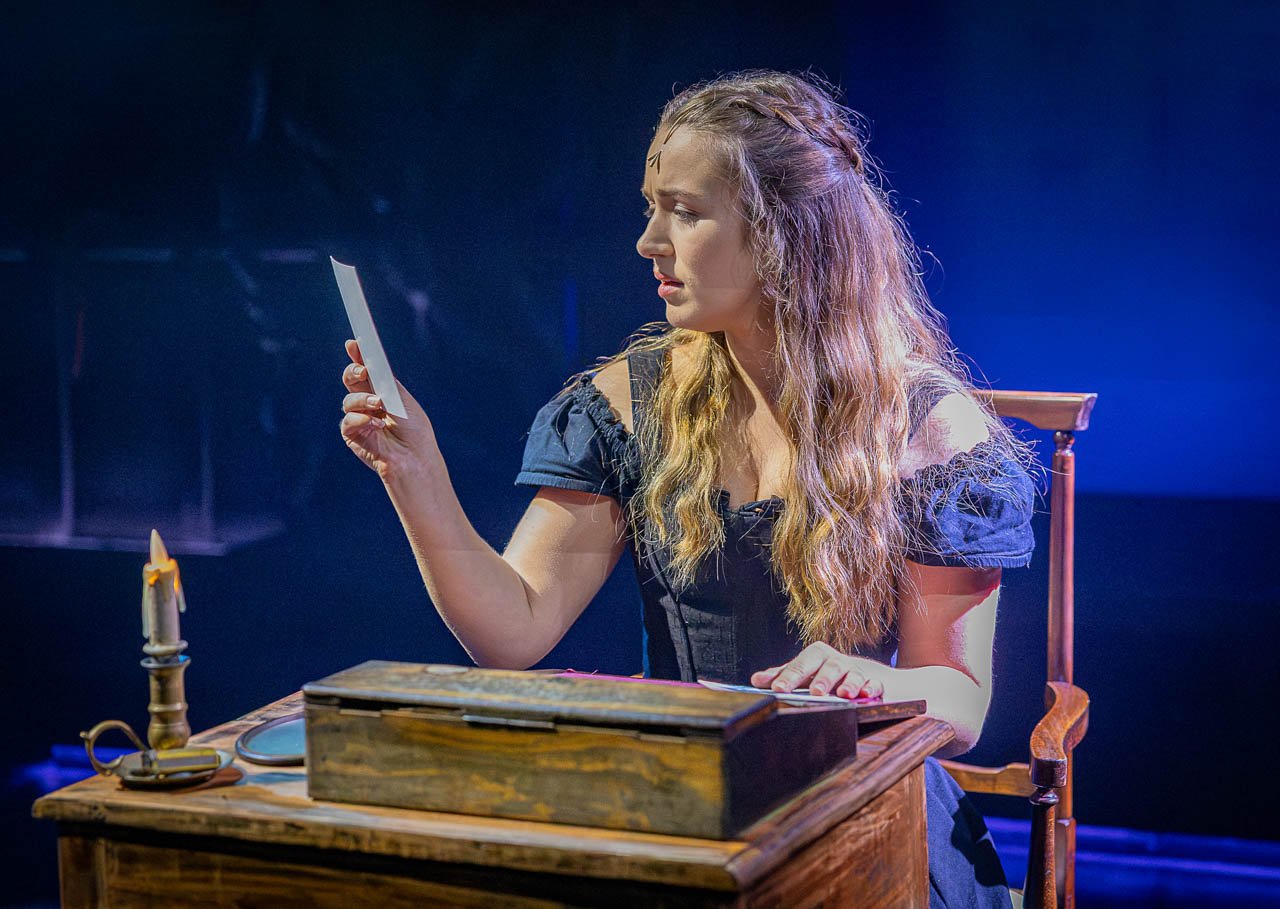
Now there’s plenty of tunes that might not make Sondheim’s cut but will work perfectly well in a musical and we do feel Ben Kubiak’s unseen seven piece orchestra driving the pace of the narrative, especially in a second half that moves more swiftly than the first. “Painting Her Portrait” is a standout. as Jane sits at her desk to paint herself ugly and Rochester’s intended, Blanche (Eve Shanu-Wilson) pretty. She’d need the skills of Picasso to pull off that trick convincingly, but never mind, she’s really only trying to fool herself to ameliorate her (presumed) inevitable rejection.
The ensemble cast double and triple parts, and sometimes sing as a chorus, articulating Jane’s thoughts as she is pulled this way and that by love, by duty, by her own insecurity. Hannah Lindsey impresses as Rochester’s mad wife, locked away on the upper floor, catching the pathos as well as the madness in a character that takes Miss Havisham up to 11.
The somewhat bare stage, supplemented by a few black and white projections, catches a gothic atmosphere, but our imagination has to do a lot of work on creating the cold rooms, the mysterious staircases and the noises off. So too the fire that is so intrinsic to the plot - a red glow and a smoke machine leaves us somewhat shortchanged.
But the heart of the show is the romance between Jane and Rochester and that depends on the burning hot chemistry between the leads. And there is more than enough of that to light up the two hours plus runtime. You’re never in any doubt that they’ll be together, so it’s all very warming watching it happen.
Ultimately, I suspect one’s judgement of the evening will depend on whether one has read the novel and is invested in its iconic status. I confess that I haven’t, but its story is strong (the book so often the weak point of a musical). It took me no time at all to be pulling for Jane and her emotional-intelligence stunted paramour, helped, perhaps, by the absence of any casting gimmicks and the old-school fidelity to the source material.
Treat it as an opera (it’s largely sung through) and grant to it the allowances we do for that oft-overwrought genre and the show works very well indeed, flaws and all. (Gary Naylor)
Also 4 stars from Plays International & Europe:
This musical adaptation of Jane Eyre (music and lyrics by Paul Gordon, book by John Caird) makes its long-awaited British premiere 30 years after it was first staged. Its Broadway production led to five Tony nominations in 2001. Since then it has been revised, with this chamber version now being produced at Southwark Playhouse Elephant. The show adds a spiritual and operatic layer to Charlotte Brontë’s Gothic romance. [...]
Using the cast as narrator/chorus throughout the proceedings adds a warmth that the story may otherwise lack, and the use of the floor space in this venue, with only projections to indicate a change of scene, allows effective blocking and interesting movement from the cast. Choreographer Georgina Lamb, lighting designer James Whiteside, and set/costume designer Morgan Large all add value to the atmosphere.
The story is much stronger in the second half, with Jane’s “Painting Her Portrait” adding drama. As the interval comes at a curious point in the narrative, there is a lot of ground to cover thereafter, including “My Hope of Heaven” (the proposal), what really is on the upper floor (a sweet moment between Jane and the mysterious woman lost in her insanity), and the ending, which “tempers judgement with mercy”.
With direction by Caird and Megan McGinnis, this production opens out the spiritual themes of the story from the start, opening with the mysterious connection between Rochester and Jane, miles apart. Themes of forgiveness, love, and loss thread through from the death of Jane’s parents through to the eventual reconciliation of the two lovers, joined forever by that string from his rib to hers.
Brontë purists will notice a few changes, but they are sympathetic to the original story, while a generous runtime allows scenes often excised in adaptations to be fully explored, such as the fortune-teller. This is not the only musical treatment of Jane Eyre – there have been operas, and even a ballet of the story – but it is perhaps the most sweeping, sentimental, and symbolic. Above the stage, quotations from the novel speak to Jane’s independence, faith, and state of mind, and tree branches suggest the oppressive and mysterious nature of Thornfield.
I might question the pacing of the first half, but the performances are uniformly excellent, especially the lead pair and young Samuel, who has a lot of emotionally charged moments as young Jane. This is a fine adaptation that is well worth your time. (Louise Penn)
3.5 stars out of 5 from a reviewer for The Reviews Hub:
A Victorian-era, feminist, romantic, and gothic musical set in the moors of Yorkshire. How haunting and intriguing! But… can gothic romance and feminism really coexist in that era? And then, how do you sing about it?
Jane Eyre, the musical written by John Caird and Paul Gordon, is based on Charlotte Brontë’s well-known novel, published in 1847. This groundbreaking work, which follows Jane’s life, was at the time one of the first novels to feature a first-person narration, told from a woman’s perspective. In this adaptation, directed by Caird and Megan McGinnis, Jane Eyre’s life story is told with the help of a cast of 12. In it, 10 ensemble members take on various roles throughout the performance to embody over 20 characters, all while sharing the first-person narration and speaking from Jane’s perspective, thus carrying the two leads, Jane (Charlie Burn) and  Mr Rochester (Ashley Gilmour), through their romance.
Act 1 is a fast-paced medley of short ballads, alternating between full choir formation and short solos. This follows Jane from her childhood (with young Jane played by the brilliantly captivating Emily-Rose Samuel) through a whirlwind of events: losing her parents, being mistreated by her aunt, and being forced to attend an impoverished girls’ school. There, she meets Helen (played with beautiful purity by Isabelle Methven), whose untimely death is a harsh lesson, before she takes on her role as governess at Thornfield Hall for a young Adèle (again played with sassy joy by Samuel) and meets her romantic interest Edward Rochester – a strange, brooding and secretive man.
The speed is constant, songs are wordy, and, though the orchestration (Larry Hochman and Brad Haak) is wonderfully nuanced. It leaves little space for spoken text and for full musical numbers, with only Gilmour and Burn’s duet Sirens standing out from the rest.
In contrast, Act 2 changes pace completely, and the audience is regaled with a number of fully developed songs, as well as musical reprises from the first act which give the piece more unity. We finally get a chance to savour Burn’s beautiful voice, notably in Painting her Portrait, and enjoy Gilmour’s comically masterful rendition of Dear Sister. Heartfelt scenes of pain and reconciliation between Jane’s family members and Rochester are poignant, yet the contrast in storytelling is almost a disappointment as we lose the narration so present in Act 1.
The lack of emphasis on this first-person narration, so key to Brontë’s implicit act of feminism,  is unfortunate, and the piece lacks an obvious female voice, making some of the social commentary shallow rather than timeless. This is not helped by the embodiment of the gothic horror through various lacy black costumes, which limit character differentiation, and the use of a background screen, whose images clash with the sombre tone of the piece.
Yet, Jane Eyre remains a beautifully poignant and entertaining story with fitting musicality and a playful gothic sobriety reminiscent of other well-loved musicals. It is enjoyable, though not quite yet on par with the greats. (A. Tran Ngoc)
3 stars out of 5 from West End Best Friend:
The songs consist of soaring ballads with some lovely orchestrations played by the band, led by Ben Kubiak, which conjure images of the rugged landscape of the North Yorkshire Moors that surround Thornfield Hall. Gordon’s lyrics are inspired by the novel’s themes of longing for love and independence, and the presence of the Christian faith and its role in providing moral conundrums for the characters. However, as the show progresses the songs begin to lose their individuality and their lyrics lack anything especially revelatory. There are a few standouts: ‘Sweet Liberty’; Jane’s “I want” song, beautifully sung by Charlie Burn with clear and bright vocals which portray Jane’s hope for something greater, and ‘Brave Enough to Love’; a rousing conclusion to the show. 
The cast is wonderfully led by Charlie Burn and Ashley Gilmour as Jane and Rochester. There are certainly a few chuckles when the pair are described as plain when they could be better compared to a Disney Prince and Princess with intense and emotive vocals to match. Gilmour is a suitably broody and enigmatic Rochester and has great chemistry with Burn’s charismatic portrayal of the feminist literary icon. They are supported by an excellent multi-rolling ensemble, however the casting choice for Bertha is perplexing. The ensemble narrates much of Jane’s story, although we do find it a little odd that they do so in first person. There are brief moments of choreography which could have been utilised further to bring additional drama to the piece but there is no shortage of emotion in the ensemble’s harmonious vocals. 
Jane Eyre is a classic story that has captured generations. Fans of the novel are sure to enjoy this musical production but those looking for a more modern retelling may leave yearning for more. (Sophie Luck)
3 stars from LondonTheatre1:
Jane in adulthood is in the very capable hands of Charlie Burn. She has a very attractive singing voice in the lower part of its register, even if the tone is inclined to spread on higher notes.
Ashley Gilmour has terrific stage presence as Rochester and easily commands the stage; he also looks suitably dashing and is a strong singer, even if he is inclined to sound too American. Burn and Gilmour work seamlessly together and almost make one forget that the dialogue they are given seems nothing like as poetic as Brontë’s original!
The rest of the hard-working ensemble also impresses, especially Claire Greenway as Grace Poole and Jonathan Andrew Hume in the role of Mason, Rochester’s brother-in-law, demonstrating a very pleasing singing voice. Hannah Lindsey is powerful in the role of Bertha, but is given hardly anything to do; for example, we are barely allowed to see her when she sets Rochester’s bed aflame.
There are some strange directorial decisions. For example, although Southwark Elephant has a thrust stage, with the audience on three sides, it seems to have been directed for a proscenium-style auditorium. I was given a seat on one side for Act One but managed to move to one that was forward-facing for the second half and found that I could both see and hear much better! This comment certainly applies to Morgan Large’s set, obviously designed to a limited budget, which does make sense when seen from “straight on” rather than at an angle! It is a shame that grey is the prominent colour as it is inclined to make the whole show quite depressing, especially as nearly everyone wears black!
In addition, Brontë’s novel is set in Yorkshire, Lancashire and the Derbyshire Peak District where everyone, rich and poor, would have spoken using regional accents. In the production under review, everyone speaks in what is almost BBC ‘Received Pronunciation’, apart from one or two of the servants occasionally.
Some of the elements of the original plot are changed or glossed over but, on the whole, John Caird has done well to reduce the playing time to two and a quarter hours: it does certainly not overstay its welcome! Paul Gordon’s music is a cross between the style of Les Misérables and Sondheim. Much of it seems very slow and lacking in energy, but the whole ensemble gives it the best possible chance, as does the excellent seven-piece orchestra under Ben Kubiak. It is a shame that none of Gordon’s melodies even begin to stick in the memory. By the way, full marks for a change to the excellent sound design of Andrew Johnson who has ensured that the result of his efforts always sounds natural and never too loud: perfect – many thanks!
Although I am not sure that a musical about Jane Eyre was really needed, and there is already an opera by Michael Berkeley, I am pleased to have encountered this particular production. (John Groves)
2 stars out of 5 from The Guardian, which deems it 'more Disney romance than Victorian gothic'.
Much like Emerald Fennell’s film of Wuthering Heights, this musical version of another Brontë sister’s literary masterpiece is lovely to look at. Designer Morgan Large’s monochrome palette fashions the women in black corseted dresses with attractive ruffles and delicate mesh detailing. Behind them on a screen, a mist appears to roll over sketches of moorland, graves and barren trees. It’s winningly atmospheric. But also like Fennell’s film, there’s too little beneath the frills in an adaptation (music and lyrics by Paul Gordon, book and additional lyrics by John Caird) that struggles to tap into the substance of Charlotte Brontë’s 1847 novel.
Though smart-mouthed and bolshie as a child (played commendably on press night by Emily-Rose Samuel), there’s scant sense of a strong-willed, independent thinker in Charlie Burn’s adult Jane, who under Caird and Megan McGinnis’s direction is as pure and polite as a fairytale princess. Nor is there anything dark or dangerous about Ashley Gilmour’s courteous, too-charming Rochester.
The songs dilute the story’s grit and hardship with syrupy sentiment. The overuse of twinkly wind chimes and pop-style scoop notes become musical tics, shifting the dial closer to Disney romance than Victorian gothic. Early numbers The Governess and Forgiveness are particularly cloying. But the better songs – including Jane’s Sweet Liberty and Rochester’s As Good As You – contain hints of Schönberg and Boublil’s Les Misérables (the original UK production of which Caird co-directed). And if the material itself is broadly one-note, this is still a fine-tuned production that runs like clockwork.
The cast of 11 – about half the size of the musical’s original Broadway run in 2000 – is packed with West End talent for this long-awaited London premiere. It’s just a shame they’re working with such flimsy material. (Holly O'Mahony)
Also 2 stars from Musical Theatre Review:
Yes, yet another adaptation of Charlotte Brontë’s 1847 novel. They’re like number 11 buses at the moment.
This musical version is imaginatively staged with an ensemble of nine from which most of the roles emerge. They form some interestingly choreographed group shapes when physical theatre takes over at, for example, the moment when Mr Rochester (Ashley Gilmour – fine tenor voice) falls off his horse.
Charlie Burn is suitably passionate and feistily determined as the adult Jane and it’s a strong idea to have her and her child self sometimes on stage at the same time because it adds a multidimensional nuance to the characterisation. [...]
Otherwise the production founders for the oddest of reasons. It tries to adhere too closely to the novel. A surprising amount of the dialogue is pure Charlotte Brontë. Normally I’d applaud that, but here it feels like a constraint as if John Caird (book, additional lyrics, co-director with Megan McGinnis) can’t quite bring himself to reinvent it. It is, though, a good idea to conflate Mrs Reed’s death scene with Jane’s meeting with St John Rivers. It enables the plot to cut to the chase more seamlessly than usual.
There is a problem too with the ensemble concept. Between them they take so many roles that I suspect if you didn’t know the novel intimately you could easily lose track of who is who and what’s going on – which is not to say that each of them isn’t doing a decently competent job as whichever character they are presenting at any given moment.
Brontë wrote Jane Eyre as a first person narrative and this production attempts to retain that but gets it jarringly wrong.  From time to time the ensemble becomes a quasi Greek chorus voicing Jane’s memories in statements, spoken in turn. It doesn’t work at all if Burn and/or Emily-Rose is on stage and silent. Jane Eyre almost more than any other character in fiction can, and should, speak for herself. If she doesn’t the whole point is lost. (Susan Elkin)
3 stars from The Stage.

La Nueva España (Spain) features the Jornadas del Cómic “Villa de Avilés” and the talk that Brontëana author Paulina Spucches gave there:
La cara europea de las Jornadas del Cómic “Villa de Avilés” la completaron ayer, por un lado, la francoargentina Paulina Spucches y, por otro, el español Rubén Fdez. La primera es la autora de “Bronteäna” y también de “Vivian Maier. En la superficie de un espejo”: por un lado, la historia de la tercera de las Brontë -la primera fue Charlotte, después vino Emily y, al final, llegó Anne- [...]
Spucches, cuando tuvo que explicar por qué eligió a Maier y a la pequeña de las Brontë, responde que Maier “ahora sí que es reconocida”, pero que eso no sucedió siempre. “Ella trabajó, digamos, entre las sombras, sin mostrarlo a nadie”, señaló la francoargentina. Lo de Anne Brontë, lo admitió la creadora, viene de un empeño por promover “una visibilización” de una escritora envuelta en los siglos victorianos. “Vi a Maier en un mundo blanco y negro, Anne Brontë en algo muy victoriano, muy cerrado, con poca emoción, y me gusta la idea de poner movimientos y colores a esas vidas: tener un diálogo a través de la historia con esos personajes y me emociona mucho poder compartirlo con los lectores para quizás despertar un deseo en ellos y ellas de aprender más sobre esas historias”. [...]
Spucches, cuando tuvo que explicar por qué eligió a Maier y a la pequeña de las Brontë, responde que Maier “ahora sí que es reconocida”, pero que eso no sucedió siempre. “Ella trabajó, digamos, entre las sombras, sin mostrarlo a nadie”, señaló la francoargentina. Lo de Anne Brontë, lo admitió la creadora, viene de un empeño por promover “una visibilización” de una escritora envuelta en los siglos victorianos. “Vi a Maier en un mundo blanco y negro, Anne Brontë en algo muy victoriano, muy cerrado, con poca emoción, y me gusta la idea de poner movimientos y colores a esas vidas: tener un diálogo a través de la historia con esos personajes y me emociona mucho poder compartirlo con los lectores para quizás despertar un deseo en ellos y ellas de aprender más sobre esas historias”. (Saúl Fernández) (Translation)

Wednesday, September 09, 2026

Wednesday, September 09, 2026 12:24 pm by M. in , ,    No comments
First reviews of Gordon & Caird's Jane Eyre. The Musical London production. Not bad, not exceptional. Good ones, without enthusiasm:

4 out of 5 stars

There are some aspects where the musical doesn't quite work as well from an adaptation standpoint, either straying from the source material or too conscious of its modern audience. Its core message of being "brave enough for love", expressed in the final musical number, feels a tiny bit more moralising than Brontë's novel, which is preoccupied with a woman's search for identity and personal freedom outside the bounds of social barriers. The musical also sidesteps some of the uncomfortable implications around Bertha Mason, who has regularly been assumed to be a woman of colour by many literary scholars, by casting a white actress (Hannah Lindsey) in the role - though ironically, her brother Richard Mason is played by a black actor (Jonathan Andrew Hume), muddying the waters slightly around what the production was trying to imply.
Regardless, where the musical succeeds is in capturing the spirit of Brontë's novel through its aesthetics, musical style, and the cast's portrayal of its often complex characters. What emerges is something quite lovely: hauntingly beautiful in places, emotionally devastating in others. (Shehrazade Zafar-Arif)
3.5 out of 5 stars

The strong ensemble cast is slick and assured, shifting effortlessly between multiple roles. Charlie Burn makes a compelling Jane, balancing quiet determination with moments of defiance, with a voice that soars like a bird. Ashley Gilmour’s Rochester brings brooding charisma and emotional turmoil, with a richly sonorous voice. Isabelle Methven shines in the contrasting roles of saintly Helen and spirited Bessie, while Emily-Rose Samuel (sharing the role with Poppy Jason) impresses as Young Jane/Adele, combining a bright voice with remarkable maturity.
After finally crossing the Atlantic, Caird and Gordon’s ‘Jane Eyre: A Musical’ captures Brontë’s spirit, even if it doesn’t quite match the novel’s force. Still, its ghostly atmosphere and strong performances make it well worth a visit. (Hannah Bothelton)
3 out of 5 stars

Gordon and Caird’s lyrics pay lip service to Jane’s longing for freedom, her evolving religious faith, and the ways in which her love for the enigmatic Mr Rochester challenges her. But too often these themes are explained to us didactically, or expressed in generic terms (Jane sings at one point of wishing to “go where I am not allowed”, a strangely childish plea). The eventual conclusion, involving Jane’s matured love for Rochester, is a trite romantic comedy ending rather than a spiritual reckoning.
This is not helped by some odd pacing choices: the first act ends on a forgettable duet between Jane and Rochester, which offers no real plot advancement and causes an awkward break in momentum. Jane and Rochester’s wedding, interrupted by the revelation that he’s already married, only comes about two-thirds of the way through the show, leaving Jane’s emotional journey to stall at the start of the second act. 
What Gordon and Caird have succeeded, though, is in creating a capital-R Romantic, almost operatic emotional world for their characters. Their best writing is that which embraces the natural lyricism in Charlotte Brontë’s writing; famous images from the novel, including the string tying Jane and Rochester together, feel made for song. Elsewhere, if the lyrics fall short, the accompanying soundscape builds back the story’s emotional force, tapping into Jane’s sense of fear, isolation or passion at any given moment. (...)
This production is not the intellectual powerhouse fans of the novel may come to expect, but it does not hold back when it comes to heightened, moving displays of emotion – obeying not the letter of Charlotte Brontë’s masterpiece, but certainly its spirit. (Clementine Scott)
The music, which is appealingly sung by the ensemble, soars and harmonises nicely, though the songs have a tendency to blend together and the lyrics can’t resist didacticism. It reaches a climax in Jane’s second-act solo “Painting Her Portrait”, which is a powerful song of ideas. Andrew Johnson provides a clean sound design and the seven-piece band, led by Ben Kubiak, is ideally balanced.
As Jane and Edward Fairfax Rochester, Charlie Burn and Ashley Gilmour are an appealing pair who share a convincingly yearning chemistry. Unlike their characters, both are conventionally attractive (as is so often the case in adaptations). Burn's Jane feels closer to Belle in Beauty and the Beast than to Brontë's fey, fiery misfit, but she’s a heroine worth rooting for. (...)
The first act anticlimactically culminates with Jane and Rochester admitting their feelings to themselves; the fortune teller scene, proposal, wedding, and its aftermath all come in the second half. Evangelical clergyman St John Rivers (Melad Hamidi) is dealt with swiftly and the convoluted “We are actually cousins” business is eliminated, as is the legacy from the long-lost uncle in Madeira.
As with most adaptations of classic literature, it’s best enjoyed for what it is, rather than fixating on its shortcomings (even if that can be part of the fun). The book will always be there. Reader, I probably wouldn’t marry this show, but I'd go on a date with it. (Julia Rank)
Gordon’s songs lean heavily on soaring ballads and harmonies, many of which, to be frank, rather blend into each other. There are only so many iterations of Jane’s inner yearnings one needs in order to understand the central point that she’s a woman in love. However, a few of the numbers do make a deeper impression, notably “Painting Her Portrait” and the climactic “Brave Enough for Love”, both of which showcase Burn’s West End calibre vocals (she recently starred in Mean Girls).
Although the character arc of Jane never gets its full expression – she feels more Maria in The Sound of Music than fully-fledged proto-feminist literary icon – none of the blame for that can be laid at the feet of Burn, whose intensity is matched by Gilmour’s. They make a superb central pair with chemistry to burn, so to speak (though they’re anything but the ‘plain’ types they claim to be), and are well supported by a multi-rolling ensemble including Isabelle Methven as Jane’s ill-fated childhood friend, Gemma Page as her vindictive aunt, Jonathan Andrew Hume as her sadistic headmaster and Hannah Lindsey as the infamous and ethereal attic-dwelling Bertha. Mention too should go to the accomplished performance of Emily-Rose Samuel (who rotates with Poppy Jason) as both the young Jane and her French-speaking ward. (...)
However, although it doesn’t quite convince as an overlooked masterpiece, there is no doubt it has merits, together with some stonking central performances, and is one that musical aficionados won’t want to miss. (Theo Besanquet)
The cast are uniformly excellent throughout. Charlie Burn brings determination and intelligence to Jane, while Ashley Gilmour provides a suitably brooding Rochester. Equally impressive is young actor Emily-Rose Samuel, who, at this performance, effortlessly captured both Young Jane and Adèle with remarkable confidence and presence.
This UK premiere tells Brontë’s story with clarity and conviction, supported by strong performances and striking design. Yet despite these accomplishments, it never quite captures the emotional sweep of the great romance at its centre, leaving a production that is engaging, but ultimately less heartfelt than it ought to be. (Greg Stewart) 

You can follow the discussion on Theatre Board or Reddit too. 

Saturday, September 05, 2026

Saturday, September 05, 2026 8:59 am by Cristina in , , , ,    No comments
Many sites are featuring the premiere of Jane Eyre the Musical in London. From Playbill together with some new pictures:
John Caird and Paul Gordon's 2000 musical version of Jane Eyre is getting a long-awaited U.K. debut at Southwark Playhouse Elephant, and Playbill has a first look at the new production. Performances began August 28 and continue through October 24. Opening night is September 8. (...)
The new staging is co-directed by Caird (Les Misérables) and Megan McGinnis, reuniting after the latter starred in Caird's Daddy Long Legs musical. The production is being produced by Adam Blanshay Productions in partnership with the work's original Canadian producers, David and Hannah Mirvish.
The cast is led by Charlie Burn as Jane and Ashley Gilmour as Rochester, with Claire Greenway as Abbot and Grace Poole; Melad Hamidi as St. John and Lord Ingram; Connor Wood as John Reed and Vicar; Jonathan Andrew Hume as Brocklehurst and Mason; Izzi Levine as Agnes, Leah, Jane's Mother, and Mary Ingram; Hannah Lindsey as Scatcherd and Bertha Mason; Isabelle Methven as Helen Burns and Bessie; Gemma Page as Reed and Fairfax; Eve Shanu-Wilson as Blanche and Sophie; and Poppy Jason and Emily-Rose Samuel as Young Jane and Adele. Casting is by Sarah-Jane Price.
The musical premiered in Toronto in 1996, ultimately making it to Broadway in 2000, bringing Brontë's classic gothic romance to the world of musical theatre. The work would go on to earn five 2001 Tony Award nominations, including Best Musical. A starry concert production brought the musical back to NYC with a Manhattan Concert Productions performance at Lincoln Center's David Geffen Hall starring Erika Henningsen and Ramin Karimloo. News of this production also comes just after the launch of a new chamber revision of the musical with theatrical licensor Music Theatre International. Having premiered in 2024 at North Carolina's Theatre Raleigh with a smaller orchestration, reduced casting needs, and changes to the lyrics and book, this edition likely served as the basis for the U.K. premiere at the 310-seat venue.
“I’m so pleased to have the opportunity to explore a new version of Jane Eyre in the beautifully intimate Southwark Playhouse Elephant," said Caird in an earlier statement. "It's always a pleasure to work on this timeless romance but all the more exciting to be collaborating with the brilliant and innovative Megan McGinnis as co-director."
“Charlotte Brontë’s masterpiece is not only a landmark portrayal of a strong female protagonist, but a story that sends audiences out of the theatre feeling better about their own lives than when they walked in," added Gordon.
The production features choreography by Georgina Lamb, music direction and supervision by Ben Kubiak, set and costume design by Morgan Large, sound design by Andrew Johnson, and lighting design by James Whiteside. (Logan Culwell-Block)

Manchester Evening News recommends an autumnal trip to Haworth by describing it as 'The 'witchy' Yorkshire village with cosy pubs and cafes that's straight out of Gilmore Girls, perfect for autumn', which seriously couldn't be sillier.

Glam features Charlotte Brontë and some quotes. Clara (Spain) recommends Wuthering Heights among other classic novels written by women. The Brontë Sisters UK posta a video sharing a walk across the windswept Haworth moors with her daughter and dogs, exploring why this wild landscape meant so much to the Brontë family.

Thursday, September 03, 2026

Thursday, September 03, 2026 10:04 am by Cristina in , , , ,    No comments
Sussex Express reviews the local opening night of Conn Artists' take on Jane Eyre.
Worthing’s Conn Artists once again confirm themselves as a theatrical force be reckoned with, this time with a deeply-impressive stage adaptation of Jane Eyre, directed by Nick Young and produced by Ross Muir who is also our Rochester.
So assured, so confident, so natural were the performances that it was difficult to believe that this was the very first night of the tour that we were watching.
And equally, at the end, it was difficult to believe that we had seen just five actors, so completely and so distinctly did they inhabit the vast array of roles across the evening.
But perhaps most impressive of all was the fluency of the production, a piece of storytelling which beautifully captured the essence of the novel and flowed undeflected until it had delivered it whole – not just the darkness, the cruelty and the damage, but also the lightness and the humour.
This was a night of traditional Conn Artists work, with all their hallmarks, the use of music, a simple set, highly-effective multi-roling, the adaptation of a great classic – all woven together to excellent effect.
Our Jane tonight was Evie Depledge, and it was a remarkable performance she gave, offering us Jane’s vulnerability but more importantly, the sheer strength of her spirit – the little girl who endures such viciousness and cruelty and yet who answers back so forthrightly, ditto the young woman who learns to love but does so on her own terms, always according to her sense of what is right and just.
Opposite her was company founder and tonight’s producer Ross Muir as Rochester. Muir rightly gave us Rochester as a complex and difficult man, damaged and so wrong in so much of what he does, but also a man who starts to see the light and sense just what his life could be. It’s a very finely judged performance.
And around Depledge and Muir (who multi-roles to an extent), the others create the rest of Jane Eyre’s world.
Janna Fox shifts beautifully from Mrs Reed to Mrs Fairfax to Miss Ingram; Erin Maria Walther breaks your heart as Helen and then delights as Adele; Edward Smith is variously the ghastly Mr Brocklehurst and the high-minded St John Rivers.
Put it all together and it’s a terrific evening at the theatre which is about to go far and wide on a major tour – including that crucial home date in Worthing (Thursday-Friday, October 8-9) (Phil Hewitt)
Still on stage, Jane Eyre the Musical makes it onto Love London Love Culture’s theatre picks for September 2026.

Beyond the Bookends includes Jane Eyre on the list of 'Books about Orphans and Foster Care'. El cotidiano (in Spanish) reviews Andrea Arnold's Wuthering Heights.

Sunday, August 30, 2026

Sunday, August 30, 2026 9:32 am by Cristina in , , ,    No comments
BBC News features some of the things that you can catch in the coming days at the Brontë Birthplace in Thornton.
The birthplace of world-famous literary sisters Charlotte, Anne and Emily Brontë is to open to the public, alongside a walking tour and exhibition.
The Brontë Birthplace in Thornton, Bradford, will be free to visitors on 13 September as part of the national Heritage Open Days scheme.
An exhibition at the home on Market Road will explore the history of the building, and what happened after the literary sisters left their birthplace in Thornton to move to the Haworth Parsonage in 1820.
There will also be a free walking tour of Thornton on 19 September to share the "forgotten chapter in the Brontë story", according to the Brontë Birthplace.
Vice Chair of the Brontë Birthplace Thomas Haigh said the building "enjoyed a rich history" after the family's departure.
"We want to share this 200-year story with our visitors as well as showcase the challenges, discoveries and community effort behind the restoration and how this remarkable building continues to evolve and serve a new generation of visitors," he said.
The exhibition will feature photographs, building plans and residents' memories of their time in the house, which has also been a butcher's shop and cafe.
Led by local historian Paul Crossley, the two-hour tour will begin at the Brontë Birthplace and includes the Brontë Bell Chapel ruins, Kipping House and South Square Centre.
Heritage Open Days is England's largest festival of history and culture which takes place annually in September. (Grace Wood)
Some sites are still reviewing Charli XCX's performance at Reading Festival. From Billboard:
and “Dying for You” and “House” from the Wuthering Heights soundtrack went even further in summoning a brooding, intense atmosphere. Not what you expect from a festival headliner, but certainly not unwelcome, either. (Thomas Smith)
featuring three totemic males of music, fashion and film: John Cale (whose disembodied voice heralds a tense rendition of their claustrophobic duet, House), Marc Jacobs and Martin Scorsese. Pretentious? Just a bit. But Nietzsche, I reckon, would have got on board with it – Charli’s current pop era is basically a cosmic battle between her ego and her vulnerabilities, all watched over by serious Big Dick Energy. (Chal Ravens)
From NME:
The set really comes alive after ‘House’, when John Cale’s recorded voice booms out of the PA over black screens, before Charli re-enters the fray for her part of the Wuthering Heights song, crawling across one of the platforms as lights flash artfully around her. As sparks fall from the roof and fire bursts up in the background, it passes the baton to ‘Dying For You’, that soundtrack album’s far poppier cut, before she leans into ‘Brat’ with a megamix that ends with underwear shooting into the sky at the end of ‘Guess’. (Rhian Daly)

Saturday, August 29, 2026

Saturday, August 29, 2026 8:15 am by Cristina in , , ,    No comments
Theatre and Tonic gives 3 stars to Jane Eyre Convention at Just the Tonic at the Mash House.
More or less a reenactment of the Brontë novel, the piece focuses on four fans, well, three and a woman dropped off by her boyfriend because she has the same name as the protagonist, even if spelt differently. As they act out Jane Eyre, they learn about how the book is viewed today, but also its influences on their lives. The cast gel well together, never overshadowing each other and having their distinguishable personalities. But it does have to be said that Eleanor Zeal and Ben Everett Riley stand out as a true highlight, at times almost squabbling to the extent of mother and son.
There isn’t much substance to the piece outside of Jane Eyre, we learn little things here and there but never overtakes the performance of the book. I didn’t really know anything about Jane Eyre going into this show and felt like it was explained well without ever going into high school English territory. The piece might have benefitted by a little more physicality or bringing some more comedy, as there were jokes here and there but I  did struggle to tell if people were laughing or not.
Jane Eyre Convention is an exciting way to learn the story written by Charlotte Brontë without ever diverging off into other plots. You will leave wanting to dawn a bonnet and run through the moors, before heading home for shortbread and a cup of Yorkshire tea. (Kerry)
Still on stage, Londonist recommends Jane Eyre the Musical.
Catch the UK premiere of a musical adaptation of  Charlotte Brontë's novel Jane Eyre, at Southwark Playhouse Elephant. We're promised the chance to "see Jane, the first feminist literary icon, like you never have before" accompanied by a powerful musical score. 28 August-24 October 2026
London Theatre interviews Jonathan Andrew Hume, who plays both Mr Brocklehurst and Mr Mason.
Who do you play in Jane Eyre?
I play two roles in the show: Brocklehurst, who is head of the school that young Jane [attends], as she leaves her home and begins her journey. He shapes the structure that society is asking young Jane to conform to, which later in the show she gets to break away from. He’s this towering inferno of a person. I also play Mason, who is Rochester’s friend and the brother of someone who I’m not going to mention now, as I don’t want to give away any spoilers! When we first meet him, he seems to be this nice, jovial soul, but later in the show he has a moment that shakes things up completely. I’m looking forward to that moment, and I think [writer] John Caird might actually have to keep a lid on some of the drama that I want to put into it!
Why do you think the novel works as a musical?
Jane is the protagonist but also the narrator of the piece. The ensemble, as well as Charlie [Burn, who plays adult Jane], are all the voice of Jane Eyre. So there are parts where the narrative is told by myself, or by somebody else. It really gets the audience to sit in as the character of Jane and go on that journey with her. The book is written from Jane’s point of view, so we can all be Jane and experience these things that happen in her life. [...]
If you could give a character in the show one piece of advice, what would it be?
Run, Jane, run! (Olivia Rook)
Just Watch describes the film adaptation of Victorian Psycho as '‘Jane Eyre’ Meets ‘American Psycho’'.
Everyone loves a good period piece, and there's something to be said about the romance and whimsy of Jane Eyre-style period stories in particular. But while these tales are often lofty and low-stakes, A24's Victorian Psycho (2026) puts a twist on that you have to see to believe. (Nicholas Brooks)
BBC News reports on Charli XCX's show at Reading Festival.
The second act of the performance showcased the breadth of her work, as she moved from pop hit Track 10 from her 2017 mixtape, to the melancholic tones of House, which she co-wrote for the recent Wuthering Heights soundtrack album. (Naomi Clarke)
Also in The Standard and others.

Parade has an article on the release of Kate Bush's Wuthering Heights in 1978.

Friday, August 28, 2026

According to The Telegraph & Argus, the Brontë Birthplace will take part in Heritage Open Days 2026:
An exhibition at the birthplace will delve into the building’s past, tracing its journey through a butcher’s shop, visitor attraction, café, and a community-owned heritage site.
Thomas Haigh, vice chair and marketing and audience development lead at the Brontë Birthplace, said: "While the Brontë Birthplace will always be significant for being the first home of Charlotte, Emily, Anne, and Branwell, we know it enjoyed a rich history after their departure.
"We want to share this 200-year story with our visitors as well as showcase the challenges, discoveries, and community effort behind the restoration and how this remarkable building continues to evolve and serve a new generation of visitors."
The exhibition will feature photographs, plans, memories, and other artefacts that reveal the many lives of the building since the Brontë family lived there.
A free walking tour of Thornton will also be offered as part of the Heritage Open Days programme.
Led by local historian and Brontë family expert Paul Crossley, the two-hour tour will begin at the birthplace and take visitors to key sites including the Brontë Bell Chapel ruins, Kipping House, South Square Centre, and the village’s historic snickets and ginnels.
The tour concludes at the Brontë Birthplace, where visitors can enjoy the café, browse the gift shop, or book a house tour. (...)
The Brontë Birthplace exhibition will be open from 11am to 4pm on Sunday, September 13, with Mr Haigh available to answer questions from visitors.
The walking tour will take place on Saturday, September 19, starting at 11am.
Both events are free to attend. (Harry Williams)
FanCarpet gives the last details before the new production of Jane Eyre opens at Southwark Playhouse Elephant tonight:
Perhaps the production's most distinctive feature is its ensemble-led approach.
Rather than relying solely on Jane to narrate her own story, the entire company shares responsibility for carrying her voice throughout the performance.
It is an imaginative theatrical device that preserves the novel's first-person perspective while embracing the collaborative nature of live theatre.
BookClub reviews Jennifer Vandever's The Brontë Project:
However, having returned to it again, it has been a really good read and one that was unexpectedly so, delivering with its dialogue and its quirkiness as well as educating me a lot more about Charlotte Brontë.
Sara is a research student whose specialism is Charlotte Brontë and in life, she is pretty certain that she knows where it's heading: she's going to get married to Paul and honeymoon in Paris and then, she's going to continue her research study and find undiscovered letters written by Charlotte which will propel her into the academic stratosphere. (Rachel Deeming)
Clarín (Argentina) highlights some romantasy books like The Knight and the Moth
El caballero y la polilla de la superventas Rachel Gillig. Un libro de fantasía oscura y romance que toma referencias de Jane Eyre y Juego de tronos. Una joven clarividente atrapada en una catedral y un caballero grosero, atractivo y sin respeto por las profecías. (Translation)
The Sun's mini crossword contains a Brontë-related question today:
Yorkshire town where the Brontë family lived.
Islands explores Wycoller Hall and mentions its connection to the Brontës. The Brontë Society's next year's conference already has a topic and a call for papers:
CALL FOR PAPERS! 📝
We're inviting proposals for papers on The Brontës and the Supernatural for a one day, in-person symposium in Haworth. 👻
This symposium seeks to broaden the parameters of Gothic scholarship on the Brontës by exploring the diverse supernatural traditions, beliefs and cultural narratives that informed the family’s imaginative and everyday worlds. We welcome new and original symposium paper proposals from academics, postgraduates and enthusiasts on topics that have perhaps received less attention.
Proposals (of no more than 300 words) for 20-minute papers should be submitted to bronte@bronte.org.uk with the subject 'Symposium' by 31 December 2026.
2:48 am by M. in , ,    No comments
And here it is: the London premiere (well, technically it's next September 8th; these are previews, but...) of the Gordon & Caird Jane Eyre musical:
Adam Blanshay Productions and David & Hannah Mirvish present
Music and Lyrics by Paul Gordon
Book and Additional Lyrics by John Caird
Co-Directed by John Caird and Megan McGinnis
Georgina Lamb, Choreographer 
James Whiteside, Lighting Designer
Southwark Playhouse - Elephant
28 Aug - 24 Oct 2026

With 
Charlie Burn as Jane
Ashley Gilmour as Rochester
Claire Greenway as Abbot / Grace Poole
Melad Hamidi as St John / Lord Ingram
Jonathan Andrew Hume as Brocklehurst / Mason
Izzi Levine as Agnes / Leah / Jane’s Mother / Mary Ingram
Hannah Lindsey as Scatcherd / Bertha Mason
Isabelle Methven as Helen Burns / Bessie
Gemma Page as Reed / Fairfax
Eve Shanu-Wilson as Blanche / Sophie
Connor Wood as John Reed / Vicar
Poppy Jason as Young Jane / Adele
Emily-Rose Samuel as Young Jane / Adele

The iconic tale reimagined for its UK premiere.
“I am no bird; and no net ensnares me: I am a free human being with an independent will.” 
This five-time Tony nominated musical retelling of Charlotte Brontë’s revolutionary novel makes its UK premiere.
A story of ambition and independence, gothic mystery and great passionate love, Jane Eyre has enchanted generations and is brought into the 21st century with this new production.
Accompanied by an epic sweeping score, prepare to see Jane, the first feminist literary icon, like you never have before.
Co-directed by John Caird, best known for international hit Les Misérables, and Broadway veteran Megan McGinnis, with music by Daddy Long Legs’ Paul Gordon.

Thursday, August 27, 2026

Thursday, August 27, 2026 5:37 am by M. in , ,    No comments
Just one day before, the new London production of Gordon & Caird's Jane Eyre. The Musical, another student production (with the lazy, unavoidable AI poster), opens in Tomball, TX:
Music and Lyrics by Paul Gordon
Books and Additional Lyrics by John Caird
Lone Star College - Tomball Campus - Performing Arts Center
August 27, 28, and 29, 2026, 7:00 PM
August 29 2:00PM

The epic story of Jane Eyre, told alongside a gorgeous musical score, is on the Lone Star College - Tomball stage starting August 27 - 29! We’d love for the Tomball community to come on out and enjoy a remarkable evening.
Jane Eyre tells the story of an orphaned child who, after experiencing great adversity, comes face-to-face with the power of forgiveness. Through many colorful characters and incredible writing, the audience journeys with her and is the ultimate witness to the transformational power of friendship and real love. This larger-than-life story will be performed by members of the LSC-Tomball Artist Development program alongside members of the Tomball community.

Wednesday, August 26, 2026

Wednesday, August 26, 2026 10:53 am by Cristina in , , , , , , ,    No comments
The Fan Carpet shares 'Five Things [They] Learned at the Jane Eyre Rehearsal Day'.
1. This production has been decades in the making
For producer Adam, bringing Jane Eyre to the UK is much more than another production.
Having first fallen in love with the musical as a young theatre fan in Toronto before seeing it on Broadway, he spent years hoping to one day help bring it to British audiences.
That passion was evident from the moment he welcomed the media into rehearsals, making it clear this is very much a labour of love.
2. Jane's voice belongs to the whole company
Perhaps the most fascinating creative decision is the production's ensemble-led approach.
Rather than limiting the narration to Jane herself, the entire company shares responsibility for telling her story.
As John Caird explained, Charlotte Brontë's novel is written almost entirely from Jane's perspective, and this theatrical device allows that first-person narration to remain central while creating something uniquely suited to the stage.
3. Casting wasn't just about finding great singers
One theme emerged repeatedly throughout our conversations.
This company wasn't assembled simply because its members have exceptional voices.
Co-director Megan McGinnis explained that every performer needed to be an outstanding storyteller capable of carrying both dialogue and music with equal conviction.
Watching rehearsals, it quickly became clear why that mattered. Every member of the ensemble contributes to telling Jane's journey.
4. The children are central to the story
Many productions might have asked adults to portray Jane as a child.
Instead, this production places genuine young performers at the heart of its opening chapters.
Emily-Rose Samuel and Poppy Jason share the roles of Young Jane and Adèle, bringing an authenticity that immediately grounds Jane's early experiences.
As the creative team explained, seeing Jane's childhood through the eyes of a real child was considered essential to the emotional impact of the story.
5. Respecting Charlotte Brontë doesn't mean avoiding change
One thing became clear throughout the afternoon.
Nobody involved is trying to recreate Charlotte Brontë's novel word for word.
Instead, every creative decision has been made with the same goal: preserving the heart of Jane Eyre while allowing musical theatre to tell the story in its own language.
Whether through the ensemble narration, the intimate staging or the symbolic design, this production appears determined to honour the novel while embracing everything theatre can uniquely offer.
Explosion Network reviews the film adaptation of Victorian Psycho.
Victorian Psycho is an odd film that I never really felt knew how funny, tonally offbeat, or scary it wanted to be. There’s a commitment from the cast to make this ‘Norman Bates’ crossed with Jane Eyre work, but instead of a successful transfusion of genre, it’s just a bit odd. (Dylan Blight)
Wrexham interviews The Most Wuthering Heights Day Ever organiser Moira Gleed.
Hundreds flocked to Plas Newydd, Llangollen, on June 20, to take part in The Most Wuthering Heights Day Ever.
Organised by Moira Gleed and her daughter Rowen, attendees donned red dresses and outfits after Kate Bush’s iconic look in the Wuthering Heights 1978 music video to learn and record the song’s dance routine.
The event was open to those of all experience and the practice in the morning was led by two local choreographers: Karen Lyon and Sarah Bright.
We’ve recently caught up with Moira Gleed to chat about her experience of this event.
250 tickets were sold, and they sold out within days of being advertised. Moira said she’d never have dreamt such a fantastic opening.
“It exceeded expectations, exceeded hope.”
Yorkshire Live recommends a ''Cosy' Yorkshire walk with waterfall and quaint village', ie. Haworth, that is perfect for autumn. Chronicle Live recommends a trip to Haworth too. Digital Spy suggests streaming Frances O'Connor's Emily on the BBC.

Tuesday, August 25, 2026

Tuesday, August 25, 2026 11:27 am by M. in , , , , , ,    No comments
ITV News has a piece on the premiere of the production of Gordon & Caird's Jane Eyre. The Musical in London.

Another Jane Eyre theatrical adaptation that will tour England this Autumn is the Mercury Theatre Colchester, Rose Theatre and Storyhouse co-production (in association with Northern Stage), performing Sally Cookson, Mike Akers and the original company's adaptation of Charlotte Brontë's novel. WhatsonStage and others publish the cast:
Olivia Marcus and Gabriel Akuwudike will lead the cast of a new touring production of Jane Eyre, directed by 2025 Royal Theatrical Support Trust Sir Peter Hall Director Award winner Lily Dyble.
The production, based on Sally Cookson, Mike Akers and the original company’s adaptation of Charlotte Brontë’s novel, will premiere at Mercury Theatre Colchester from 26 September to 10 October 2026 before touring to Rose Theatre Kingston, Northern Stage in Newcastle and Storyhouse in Chester. (...)
The creative team includes set designer Anna Yates, costume designer Khadija Raza, movement director Natasha Harrison, lighting designer Lucía Sánchez Roldán, composer and sound designer Joseff Harris, fight director Rachid Sabitri, intimacy director Haruka Kuroda and casting director Helena Palmer.
Dyble said: “What is at the very heart of Jane Eyre is courage in the face of the unknown. I’m thrilled to be delivering this story to audiences with bravery and risk, made possible by this phenomenal cast and creative team.” (Alex Wood)
Positive News asks for rewilding Britain to fight against the recent wildfires:
The purple, treeless moors found across Britain’s uplands can look timeless and wild. In Jane Eyre, Charlotte Brontë described “the purple moors” as “a wilderness of heath”. Yet these moors have been shaped by clearance, drainage, grazing, pollution and burning.
Peat records from Keighley Moor in West Yorkshire, not far from Brontë country, reveal a longer story. For most of the past 1,000 years, this landscape would have been much wetter, with abundant peat-forming Sphagnum moss, rather than today’s extensive heather-dominated vegetation created through rotational burning. (Joe Glentworth)
Far Out Magazine thinks that Anna Calder-Marshall's Cathy was one of the worst miscasts of 70s movies:
Anna Calder-Marshall as Cathy Earnshaw, ‘Wuthering Heights’ - 1970
Wuthering Heights has been subjected to adaptations that are good, bad, and highly controversial, but none of them has been as dull and uninspired as the 1970 version directed by Robert Fuest.
While Timothy Dalton does have the stoic, stony gravitas needed to play Heathcliff, there’s little he can do when paired with Anna Calder-Marshall’s take on Cathy Earnshaw. This is a literary character known for her unbridled passion, venomous rage, and repressed sexuality, but Calder-Marshall depicts her as a soapy hero only defined by the tragedy that the story concludes with.
Even if the G-rated version was not going to go to the extremities seen in the Andrea Arnold and Emerald Fennell versions of the story, it still needed to be interesting as a romantic drama. Sadly, Calder-Marshall doesn’t even have a dose of chemistry with Dalton. (Liam Gaughan)
La Información (Spain) celebrates the 136th anniversary (August 24th, 1890) of Jean Rhys: 
Jean Rhys, 136 años después: la escritora que rescató a una mujer recluida en un ático de Jane Eyre.
Se cumplen 136 años de su nacimiento, una efeméride que devuelve la atención a la autora que convirtió a una figura secundaria de la literatura victoriana en protagonista de su propia historia (...)
Sin embargo, su mayor reconocimiento llegó décadas después con Ancho mar de los Sargazos, publicada en 1966, tras un largo periodo apartada de la escena literaria. Un ejemplo de cómo los años de pausa o alejados de la actividad literaria más visible no implican un alejamiento del verdadero oficio del escritor.
La obra dialoga directamente con Jane Eyre, el clásico que Charlotte Brontë publicó en 1847. Rhys recuperó a Bertha Mason, la esposa criolla de Rochester recluida en el ático, y reconstruyó su historia como Antoinette Cosway. El cambio de perspectiva permite abordar el pasado colonial caribeño, la identidad y las relaciones de poder que atraviesan al personaje. (Carmen Tomàs) (Translation)
El Debate (México) recommends readings according to your month of birth. For the January ones:
Jane Eyre
Enero tiene algo de comienzo. Después de las fiestas, muchas personas sienten la necesidad de ordenar su vida, cerrar ciclos y pensar qué quieren hacer diferente durante el nuevo año. Por eso, Jane Eyre puede ser una lectura especialmente atractiva para inaugurar el calendario.
La novela de Charlotte Brontë sigue a Jane, una joven que atraviesa pérdidas, dificultades y relaciones complejas mientras intenta construir una vida en la que pueda conservar su independencia y dignidad. No es solamente una historia de amor: también habla de identidad, autonomía y de la búsqueda de un lugar propio. 
Es un libro ideal para quien quiere empezar el año con una historia intensa y clásica, pero que todavía puede sentirse sorprendentemente moderna en sus preguntas sobre libertad y decisiones personales.
Si naciste en enero, este podría ser tu libro: una historia sobre empezar de nuevo sin renunciar a quién eres. (Ciria Alarcón) (Translation)
The Herald Sun (Australia) publishes something about a hen party of someone who is marrying someone else sometime in 2026. The party was supposed to be Wuthering Heights-themed or something:
As the wedding of the year fast approaches, Bec Harding was in full hen’s mode at the weekend.
[Rebecca] Harding and Andy Lee are set to tie the knot in New York in October.
She looked ravishing in red as her Wuthering Heights-themed hen’s party took place on Saturday in Melbourne. (Jackie Eptstein)