Podcasts

  • S3 E8: With... Corinne Fowler - On this episode, Mia and Sam are joined by Professor Corinne Fowler. Corinne is an Honorary Professor of Colonialism and Heritage at the University of Le...
    3 months ago
Showing posts sorted by relevance for query classical comics jane eyre corzine. Sort by date Show all posts

Wednesday, October 22, 2008

Wednesday, October 22, 2008 12:05 am by M. in , ,    2 comments
Our thanks to Classical Comics Ltd. for sending us a review copy of each of these books.
Jane Eyre. The Graphic Novel
Charlotte Brontë
Script Adaptation: Amy Corzine
Artwork: John M Burns
Lettering: Terry Wiley

Design & Layout: Jo Wheeler & Carl Andrews
Publishing Assistant: Joanna Watts
Additional Information: Karen Wenborn
Editor in Chief: Clive Bryant

UK Publication Date: 29th September 2008
Format: 144 pages
full colour, paperback
246x168mm
Versions: Original Text (abridged) and Quick Text (2 different books)
Cover Price: £9.99


This comic adaptation of Jane Eyre belongs to an ambitious project carried out by Classical Comics whose aim is to bring to young people great works of British literature (following the guidelines of the UK syllabus) in a more attractive and exciting format. But we know what you are thinking - this is not the first time that we have heard of something similar. And you are right. However, this is not just one more honest (or not) effort. What Classical Comics is trying to do is not only entice young readers to read, giving them a glimpse of the classics, but trying to do all that with quality and high standards in the art department as well as in the scripts. All their releases appear at least in two versions: Original Text, where the original novel or play is abridged but most of the times quoted almost verbatim and a Quick Text version which might be more controversial in its editorial decisions(1).

Focusing now on Jane Eyre, the first thing we realises as soon as we had the graphical novel in our hands was that this adaptation was one of the Brontë events of the year. It is a long (long) way from other comic adaptations of Jane Eyre(2). Not only because the book is beautifully presented but also because, despite the unavoidable abridging, this adaptation is over 130 pages (which clearly shows the scope and ambition of this enterprise) divided into 38 chapters, exactly like the original novel(3).

We have been pleasantly surprised by the Original Text script adaptation which manages to aptly quote not just dialogues but also several descriptions and as much of Charlotte Brontë's beautiful, unique prose as possible. Of course, this also constitutes one of our main concerns about the Quick Text version (and about many other juvenile/abridged adaptations). If you extirpate Charlotte’s own memorable words from the story, what are you left with exactly? Only the bare bones of the story, which may retain some of the grace of the full body, but are not as exciting or interesting to look at and examine.

Both the script adaptation by Amy Corzine and the artwork by John M. Burns are highly respectful to the original novel, something which was practically a must in a collection named Classical Comics. There is no trace of any of the many critical readings which the novel has known since its publication. There are no parallels between the Red Room scene (which is somewhat of a disappointment in the final version of the comic(4)) and Bertha's imprisonment, and Bertha is treated in a pre-Wide Sargasso Sea fashion. She's nothing but the mad woman in the attic, the maniac... even her character profile is nothing short of a beast. The absence of a personal reading of the novel should not be understood as a drawback but as a conscious choice. Nowadays we are so used to subjective interpretations in most adaptations that an objective one is quite a rara avis(5).

As opposed to other comic adaptations of the novel meant for young readers (like the 1941 or 1962 Classics Illustrated versions) the structure of this version doesn't overdo Jane Eyre's childhood. For instance, Norbert Bachleitner shows in Jane Eyre For Young Readers. Three Illustrated Adaptations(6) how the 1941 Classics Illustrated version devotes 50% just to describe the childhood episodes. Classical Comics Jane Eyre devotes just 23% (as compared to 17% in the original novel). The other main stages of Jane Eyre's story are distributed like this: Thornfield Hall: 42% in the comic vs 51% in the novel, Moor House: 13% vs 22%, and probably the most relevant difference in this new version: the Ferndean Manor scenes represent 18% of the comic, whereas they are a mere 7% of the novel. This may be a conscious decision, taking into account that rushed endings are among the most common criticisms to different Jane Eyre adaptations.

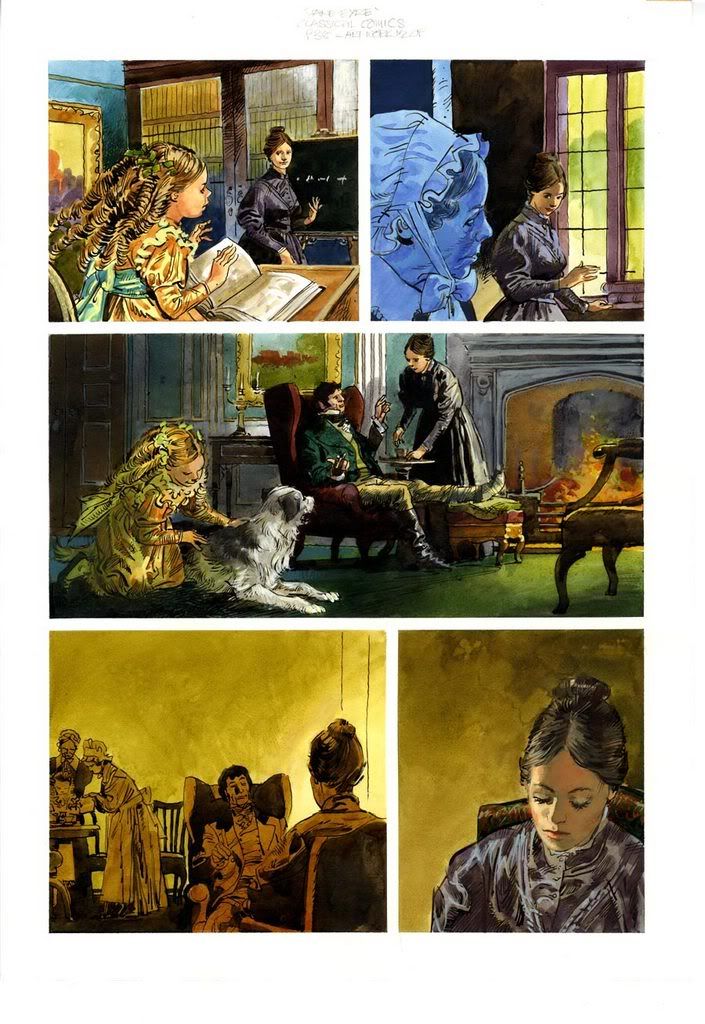
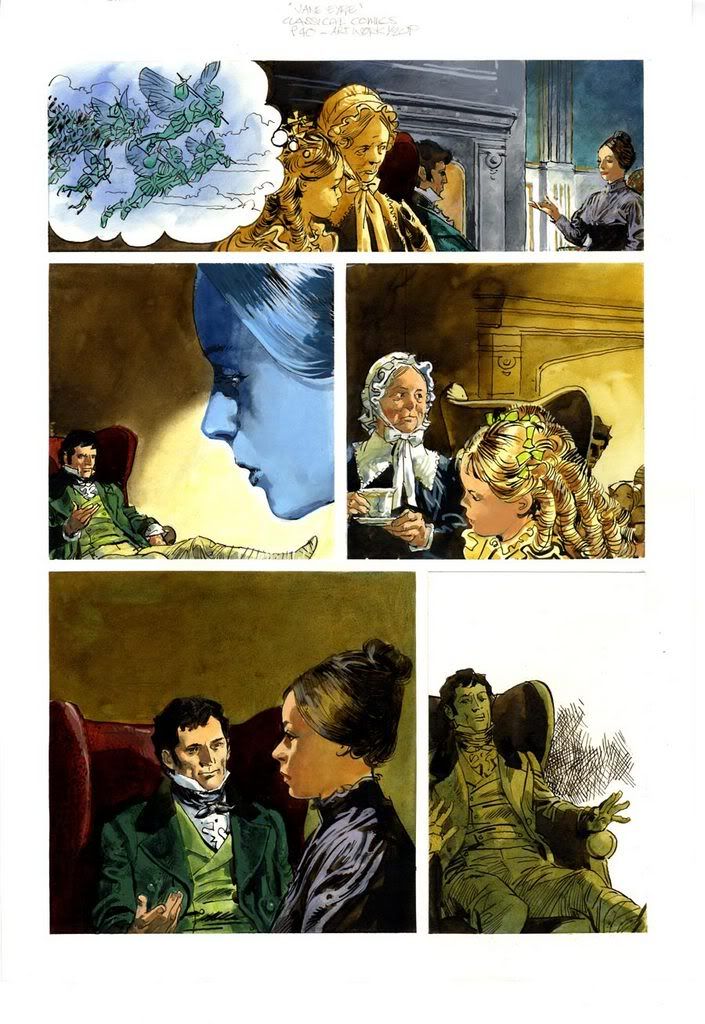
The watercolours by John M. Burns are completely in keeping with the script adaptation. His artwork is beautiful, clear and always illustrative(7). His choice of colours and general style evoke even a period-look not at all unrelated to the traditional kind of drawing and colouring used by Mr Burns as opposed to other more modern techniques, such as the one used by Dame Darcy in her illustrations of Jane Eyre. As Bear Alley has noticed in his review, Burns's work tries to bring to life not only the main events but also the imagery of fairies and green men with which Jane is associated by Rochester or the many bird metaphorical allusions of the novel(8) as well as Jane's drawings or dreams.

We have noticed, however, that this Jane Eyre is somewhat beautified in some of the illustrations, but not so much so that it interferes with the narrative. Along this line, we have also observed that her eyes are depicted à la Rochester, that is, hazel rather than green(9). Like Jane, we also excuse the mistake.

Both editions include a short but rather good biography on Charlotte Brontë(10), a Brontë family tree, a chronology and a letter from Charlotte to her publisher dated 24th September 1947, concerning the first part of Jane Eyre.

It is said that a book review should judge the book for what it set out to achieve, not for what the reader expected of it. In this case, we can confidently say that Classical Comics have both achieved, by and large, what they aimed at when they conceived this project, and have earned - or should earn - any lover of Jane Eyre's respect by treating this well-loved novel with such respect and care. But it doesn't stop there: they are also paving the way for future lovers of Jane Eyre who will find - to their amazement, no doubt - that the classics in general and Jane Eyre in particular are not dead things of the past, but stories very much alive and enjoyable. For our part, what can we say? We are extremely looking forward to Classical Comics' forthcoming Wuthering Heights, but preferably in the Original Text edition.

Notes

(1) The Shakespeare adaptations are also published in plain text editions.
(2) An incomplete list would include such titles as Classics Illustrated, No 39, Illustrated by Harley M. Griffiths, 1947; Classics Illustrated No 39, Illustrated by H.J. Kihl, 1962; Jane Eyre, Limewire Graphics, Ed. Philip Page & Marilyn Petit, Hodder & Staughton, 2003.
(3) Except for the prologue (not in the original novel) which recounts the facts pertaining to Jane Eyre's parents and Mrs Reed's promise to keep her as her own daughter.
(4) Somewhat unexpected because the scene both visually and dramatically leaves a lot to the imagination.
(5) We are aware that this is a naïve interpretation because even an objective reading is a reading of sorts. Furthermore, the script - consciously or unconsciously - excises some of the best-known quotations from the novel. The comic doesn't begin with the famous There was no possibility of taking a walk that day... and, though rephrased, the Quick Text version is more similar to the original opening than the Original Text version. The women feel just as men feel speech is absent as well. There isn't even a Reader, I married him -it has been subsituted by a more laconic I married him in the Original Text version and by a more to-the-point We had a quiet wedding in the Quick Text version. Also on the negative side we can quote several French typos in Adèle's speeches (p. 40). By the way, in the Quick Text version Adèle's French becomes a laughable parody of English with French accent.
(6) A Breath of Fresh Eyre. Intertextual and Intermedial Reworkings of Jane Eyre. Edited by Margarete Rubik and Elke Mettinger-Schartman,
Rodopi, Amsterdam/New York, NY, 2007.
(7) Curiously enough this wasn't the first Brontë experience of John M Burns in his long career in the comics world. He adapted Wuthering Heights for the comic publication Diana for Girls (No 42. 7th December 1963).

(8) Interestingly, the famous I'm no bird... quotation has been left out.
(9) As Rochester says in the novel (ch. XXIV): "... This little sunny-faced girl with the dimpled cheek and rosy lips; the satin-smooth hazel hair, and the radiant hazel eyes?" (I had green eyes, reader; but you must excuse the mistake: for him they were new-dyed, I suppose.)
(10) Curiously, and although it is stated that Charlotte Brontë was pregnant when she died, her death is attributed to tuberculosis, thus overlooking other, most probable causes, particularly hypemeresis gravidarum.

Categories: , ,

Saturday, October 20, 2007

Saturday, October 20, 2007 12:45 pm by M. in , , , ,    2 comments
Jane Eyre is all over the news today:

The Brontë Parsonage Blog publishes an interview with Amy Corzine, the script adaptor of the upcoming Classical Comics adaptation of Jane Eyre that has appeared previously on BrontëBlog:

Picture Source.
Writing the graphic adaptation of Jane Eyre for Classical Comics gave me a fantastic excuse and tremendous opportunity to immerse myself in its author’s mind. It quickly became obvious that Brontë was propounding the belief, perhaps gleaned from her Irish forebears, that real spirituality arises from a natural goodness in human beings that is inextricable from Nature.

A potent mixture of Christianity and British folklore established a powerful psychological background for the love affair between Jane Eyre and Mr. Rochester. Symbolism made the novel sparkle. Jane’s show of strength was linked with the moon rising. Mr. Rochester was described as a bird of prey. He often called Jane a tiny bird of one sort or the other, or a fairy sprite. (Amy Corzine)
Check some of the illustrations that we posted some months ago and you will understand more clearly how these symbolisms are treated.

Book Outlook posts about Confinement in Jane Eyre. The article introduces some interesting points in need of a further discussion:
(...) But of the veritable prisons Jane Eyre is forced to endure, many of these confinements do more to protect her than they keep her from liberty. If she hadn’t been locked away from Mrs. Reed and her cousins, she may have suffered a similar fate; she may have become as shallow, as wayward, as stilted or as resentful as any in the class of her “superiors”. If she had not endured the confinements of reason, she might have fulfilled the reputation of her childhood, and if she had not learned to control her reason she could have become as deranged as Bertha. (...)
Rare Finds, the blog of Bauman Rare Books, informs about this magnificent first edition of Jane Eyre, available for just 68000$:
(BRONTË, Charlotte) BELL, Currer. Jane Eyre: An Autobiography. Edited by Currer Bell. London: Smith, Elder, 1847. Three volumes. Octavo, contemporary three-quarter brown calf gilt, raised bands, red morocco labels, marbled boards and endpapers. Housed in custom half-morocco clamshell box. $68,000.

First edition of one of the greatest and most popular novels in English literature in contemporary binding.

Charlotte Bronte’s decision to publish under the pseudonym “Currer Bell” aroused great public curiosity regarding the author’s true identity. Thackeray, Bronte’s literary hero, was sent a pre-publication copy, prompting this reply: “It is a fine book... Some of the love passages made me cry... I have been exceedingly moved & pleased by Jane Eyre . It is a woman’s writing, but whose?” (Barker, 535). The demand for Jane Eyre “was almost unprecedented. The first edition... was published on 16 October 1847; it had sold out within three months... By any standard, Jane Eyre was a resounding success” (Barker, 535-37). Bronte “had learned to combine extraordinary power of expressing passion with an equally surprising power of giving reality to her pictures which transfigures the commonest scenes and events in the light of genius” (DNB). Bound without half titles in Volumes I and II; and without publisher’s advertisements in Volume I. Wolff 826. Smith 2.

Page 13 of Volume I with repaired closed tear, occasional light foxing to text, binding about-fine. A rare classic, exceptional in handsome contemporary binding.
Darque Reviews interviews Lilith Saintcrow, author of the Dante Valentine series, who among very different influences confesses that:
I also am a big Stephen King fan, and I reread Jane Eyre and Sleeping With The Enemy at least once a year.
Finally, the only non-Jane Eyre item today: some days ago we presented the current performances of Roberto Pieri's adaptation of Wuthering Heights, Cumbres Borrascosas in Spanish, in Buenos Aires, Argentina. Here you can find a non official blog about the production.

Categories: , , , ,

Saturday, October 11, 2008

Saturday, October 11, 2008 12:05 am by M. in ,    No comments
As we have been informing, Classical Comics has just released a Jane Eyre graphic novel in two versions: Original Text (abridged) and Quick Text. It's certainly one of the most expected Brontë events of the year and BrontëBlog will publish a review in the coming days.
Jane Eyre. The Graphic Novel
Charlotte Brontë

"I scorn your idea of love and the counterfeit sentiment you offer.
And I scorn you when you offer it."

The Bronte classic from 1847, is brought to vibrant life by the artist John M Burns. His sympathetic treatment of the classical romance will delight any reader with its strong emotions and wonderfully rich atmosphere.

Script Adaptation: Amy Corzine
Artwork: John M Burns
Lettering: Terry Wiley

UK Publication Date: 29th September 2008
Format: 144 pages
full colour, paperback
246x168mm
Versions: Original Text (abridged) and Quick Text (2 different books)
Cover Price: £9.99

Charlotte Bronte's classic Jane Eyre is brought to vibrant life by legendary artist John M Burns. Perhaps best known for his daily newspaper comic strips (such as The Seekers, Modesty Blaise, Danielle, and George and Lynne), John has also worked on Dan Dare, Judge Dredd, and Trueno; he co-created Bendatti Vendetta for the Judge Dredd Megazine, and is lead artist of Nikolai Dante. John's sympathetic treatment of this classical romance from 1847 perfectly matches Amy Corzine's inspired script adaptation. (Booktrade)
The two versions include a biographical account of Charlotte Brontë, a Brontë Family Tree, a Chronology, a letter from Charlotte Brontë to W.S. Williams concerning Jane Eyre (the original and a transcription) and a brief 'making of' of a page creation.

As a complement to the publication, Classical Comics also releases a Study Guide, aimed at upper Key Stage 2 and above.
Classical Comics Study Guide: Jane Eyre
Black and white,
spiral bound A4 (making it easy to photocopy)
Price: £19.99
ISBN: 978-1906332-12-9
Published: October 2008
Categories: ,

Monday, April 13, 2009

Monday, April 13, 2009 12:02 am by M. in , , ,    1 comment
We are very grateful to The Salariya Book Company for sending us copies of these comic books.

Wuthering Heights (Graffex)
(Paperback)
by Jim Pipe (Adapter), Nick Spender (Illustrator)

  • Paperback: 48 pages
  • Publisher: Book House (1 April 2009)
  • ISBN-10: 1906370133
  • ISBN-13: 978-1906370138
Jane Eyre (Graffex) (Paperback)
by Fiona MacDonald (Adapter), Penko Gelev (Illustrator)
  • Paperback: 48 pages
  • Publisher: Book House (1 May 2009)
  • ISBN-10: 1906370117
  • ISBN-13: 978-1906370114
Comic adaptations of Brontë novels have never ceased to be published in the last decades, normally linked to some sort of educational purpose. As a way to introduce children to the pleasures of reading, as a sort of magical key to make classical literature appealing to teenagers. Usually following the local curriculum guidelines. The quality of the adaptations is usually proportional to the ambitions and original purposes of the enterprise. As a general rule, the more focused on just being a complement to the general syllabus, the more mediocre the results. More than just be faithful or not to the text, a successful adaptation has to be able to offer an original view, a raison d'être, a coherent approach to, and interpretation of, the original novel.

We have recently seen very ambitious approaches to Jane Eyre (the Burns & Corzine Classical Comics adaptation) and other very modest in ambition and results (Paper Movie Books). Concerning Wuthering Heights, Classical Comics is preparing its own adaptation, a new French adaptation by Édith & Yann has just been published in France(1). Classics Illustrated is preparing UK reissues of the original 1947 Jane Eyre(2) and the 1960 Wuthering Heights for this summer. The two new proposals discussed here are somehow in between of these two poles. They constitute honest and original adaptations but their scope and target(3) is clearly more reduced than the Classical Comics approach.

Each comic in this collection is introduced by a quotation from the original work on a full two-page spread trying to capture the soul of the approach. For Wuthering Heights Jim Pipe uses the well-known "You said I kill you -haunt me then" whereas Fiona Macdonald recovers the poignant soliloquy when Jane Eyre is wandering around the moors after running away from Thornfield Hall: "Shall I be an outcast again this night?". The adaptation is divided into minichapters two-pages long with a heading summarising the action which takes place. The story advances basically through simple explanations and basic drawings of the characters' psychologies accompanying each of the (sometimes much too small) panels. Very little original text is preserved in the speech bubbles whose intention is not to explain the action but to punctuate several particular moments and feelings. Footnotes defining vocabulary are used with moderation.

Wuthering Heights is retold by Jim Pipe and illustrated by Nick Spender. Emily Brontë's novel certainly isn't the easiest of books to be reduced into a 41-page comic adaptation (which portrays both generations even) and the result is not altogether convincing. We wonder if a reader unfamiliar with the novel, as the potential public target are, will be able to understand not only the motivations behind the characters' behaviour but some of the twists and turns of the action. Nick Spender works with vivid colours, bright shapes and a highly contrasted inking. Generally focused on faces and expressions, backgrounds and settings are just barely sketched. In a novel which integrates so deeply the landscape (the moors) into its own characters this is a drawback that weighs on the work. The comic is completed with some information about Emily Brontë, a background of the book with some trivia and interesting details, a timeline of Emily Brontë which places Emily's life events into her historical and social context and an incomplete and highly arbitrary commentary of other adaptations of Wuthering Heights.

Jane Eyre is retold by Fiona Macdonald and illustrated by Penko Gelev. This is, in our opinion, a more satisfying adaptation. Fiona Macdonald makes a good work, with the obvious limitations of the enterprise, retelling Charlotte Brontë's narrative. More fragments of the original wording are retained and this contributes to the coherence of the approach. Penko Gelev's palette is quite restrained: greys and muted colours which added to a very idiosyncratic and peculiar style weave a very particular, and charming, atmosphere. The extra contents in this case are a biography of Charlotte Brontë(4), a timeline with the main British Women's Education and Legal Rights events in the whole 19th century, a list with the other novels by Charlotte Brontë and some contemporary reactions to the first edition of the novel. Finally, another selection (again arbitrary and incomplete) of other Jane Eyre adaptations.

Notes:
(1) Les Hauts de Hurlevent d'Emily Brontë, Volume 1; Artwork by Édith, Adaptation by Yann, Éditions Delcourt, Collection: Ex-Libris, April 2009, ISBN: 978-2756013800
.
(3) We don't know yet which version: Classics Illustrated, No 39, Illustrated by Harley M. Griffiths, 1947 or Classics Illustrated No 39, Illustrated by H.J. Kihl, 1962.
(3) Which is Key Stage 2/3 (UK) or Grades 5-8 (US) more or less. We wonder if with several obvious modifications these comics could not be also addressed to students learning English as a foreign language.
(4) With a couple of drawbacks. Charlotte Brontë's cause of death is given as a fact to have been due to typhus and no mention is made of the more 'popular' hyperemesis gravidarum hypothesis. And Branwell's death is placed in 1849 after Anne's and Emily's deaths. This is wrong. Branwell was the first one to die in 1848.

Categories: , , ,

Friday, November 14, 2008

Friday, November 14, 2008 3:42 pm by M. in , , , ,    1 comment
The Yorkshire Post talks about new films or TV series shot in Yorkshire. There's a passing mention of the upcoming Mammoth Screen's adaptation of Wuthering Heights:
More is to come. In 2009, look out for an ITV adaptation of Wuthering Heights, a Channel 4 drama trilogy inspired by the Yorkshire Ripper murders called Red Riding and The Damned United, a film about the doomed manager of Leeds United, Brian Clough. (Annalise Culid)
We have received confirmation from the WGHB Press Office that the reported broadcast dates in the US are correct:
In winter 2009, MASTERPIECE CLASSIC returns with a feast of new adaptations:
January 18 and 25
Wuthering Heights (2.5-hour mini-series) at 9pm ET on PBS
A thrilling new adaptation of Emily Brontë’s haunting classic, which chronicles the
passionate spiritual bond between Heathcliff, an abandoned Gypsy boy adopted by
the Earnshaw family of Wuthering Heights, and the family’s daughter, Cathy. Published in 1847, the novel was condemned by one critic as “abominably pagan”
for the dark passion throbbing in the heart of its irredeemable hero-villain. Tom Hardy (The Virgin Queen) is Heathcliff, newcomer Charlotte Riley is Cathy, and Burn Gorman (Bleak House) is Cathy’s brother Hindley.
Nevertheless, the ITV has not confirmed the April broadcast in the UK:
Unfortunately we are unable to offer any scheduling information at this time. Sorry I cannot assist further on this occasion.
ITV Viewer Services
More Wuthering Heights. Now the theatrical version by April de Angelis is on stage at the Chichester Theatre Festival. The Chichester Observer talks with Amanda Ryan:
"I have not done as much theatre as I have done TV and film," Amanda says. " In my last job Shameless I was very very clear that the next job I would do would be theatre. It was a couple of years since I had last done any, and I was longing to do some.
"I wanted the rehearsal process. I wanted something really challenging. I had been doing Shameless which is such a big cast. You are called every now and again to do a scene. It's great fun, and it is bold work with a lovely cast and crew. But it was a bitty and sporadic.
"I really wanted to fully use myself, to find something that is totally all-consuming, and I couldn't have wished for a better part than this.
It was proper graft, and I loved every minute of the rehearsal process."
Wuthering Heights, Emily Brontë's only novel, is considered a classic of English literature and one of the greatest romantic stories ever written. The stage version comes from award-winning playwright April de Angelis, the story of the wildly-passionate but doomed love between Heathcliff and Catherine - a passion which eventually destroys them both.
"It was kind of daunting, the thought of taking on this iconic character from literature that people know so well and have so many expectations about, but I approached it like you would any other character.
"I began to really look at all the qualities that Catherine has – very attractive qualities. She is a very free spirit, she is very impulsive. She is wild and she runs wild through the moors. She is a child of the landscape that she comes from, and she is different.
"And she is passionate" – which means that you have got to throw yourself into her character: "She flies into tempers all the time. You have got to be inside that. I am of the feeling that acting is about putting yourself immediately in the situation and surrounding yourself with all the impulses and emotions."
Booktrade informs about the recent disclosure of the British Book Design and Production Awards 2008. Editions by Classical Comics, including Jane Eyre, are mentioned:
Following on from the success of their first book, Henry V (which won a Silver IPPY this year), the second book in the series, Macbeth Original Text, has scooped a first prize at Wednesday night's ceremony for the British Book Design and Production Awards 2008.
The event was a great success overall for Classical Comics. Macbeth Original Text was the winner of the Secondary Education category and was also Highly Commended (2nd place) in Literature; while Henry V Quick Text achieved the shortlist for the Secondary Education category. The award for Macbeth, presented by Gyles Brandreth, marked a significant achievement - not only for the book itself, but also for the company as both gain recognition from the mainstream book industry.
Following the success of its pioneering three-tier dialogue treatments of Shakespeare's Henry V and Macbeth, Classical Comics continues its series of graphic novel adaptations of literary classics with the publication of multi-text versions of Charlotte Bronte's Jane Eyre, Mary Shelley's Frankenstein, and Charles Dickens' A Christmas Carol.
All three of the latest books, plus Macbeth, have been nominated for the 2009 Cybil Awards.
Charlotte Bronte's classic Jane Eyre is brought to vibrant life by legendary artist John M Burns. Perhaps best known for his daily newspaper comic strips (such as The Seekers, Modesty Blaise, Danielle, and George and Lynne), John has also worked on Dan Dare, Judge Dredd, and Trueno; he co-created Bendatti Vendetta for the Judge Dredd Megazine, and is lead artist of Nikolai Dante. John's sympathetic treatment of this classical romance from 1847 perfectly matches Amy Corzine's inspired script adaptation.
The Hour, The Stamford Times and The Hickory Daily Record comment the recent release of the Studio One Anthology boxset which includes Wuthering Heights 1950.

In the blog world: dragonclouds posts several Jane Eyre 2006 icons on the LiveJournal thornfield community.

Categories: , , , ,

Friday, November 02, 2012

Friday, November 02, 2012 11:46 am by M. in , , , ,    No comments
The Berkshire Eagle reports a fascinating story with a happy Brontë ending. The return of Edith Wharton's own copy of Jane Eyre to The Mount:
Thanks to the generosity of a resident of Lincolnshire, England, and a friend with access to the internet, Edith Wharton's copy of "Jane Eyre" has come back safely to rest among the books in Wharton's library at The Mount.
Charlotte Brontë's masterpiece -- her story of suspense and madness and wild nights on the moors -- traveled on a still-unknown route from a trove of works Wharton had collected in The Mount, the home she built in 1902, to the far side of the Atlantic. Wharton lived in Lenox for 10 years before she left for France, where she died in 1937.
Susan Hiddleston of Lincoln shire has recovered "Jane Eyre" and given it to The Mount. Hid dleston told her story in a recent letter to the Eagle. (She does not have email.)
"An aunt gave me that a copy of Jane Eyre on my 14th birthday," Hiddleston wrote. "She had bought it for [about a dollar] in a wonderful, rambling second-hand bookshop in Guildford, Surrey. Sadly this shop is long gone. This would have been in 1952. Edith Wharton was unknown here. And my aunt, who was a great reader of English literature, never made anything of Edith's name plate. We just saw her as someone who had once owned the book.
"However, when I came upon EW years later, as did my aunt, we were both quite overawed to think she had once held it and read it and put it on her shelf. I often showed it to people who read. I felt proud to own it. I felt sure there must be an Edith Wharton society somewhere, and I thought ‘one day I'll try to find out.' But life went on and it remained a thing to do one day.
"I don't have the internet, but most of our friends do, so I asked one to seek it out for me. And we were all surprised and excited at the amount of information that came forth."
With the help of her friend, Priscilla Shead, Hiddleston learned that Wharton had willed her entire library to two young sons of wealthy friends. Half of the volumes were dedicated to art, architecture and gardening. The rest, mainly literary works, included "Jane Eyre."
The nonfiction treasures were destroyed by German bombs in World War II. That left 2,700 books that were stored in an English castle until they were bought by the Mount in 2005 for $1.6 million. Somewhere in the literary world, a number of Wharton's books vanished. One of them was "Jane Eyre."
Hiddleston made arrangements for the return of the book in an exchange of letters with Nynke Dorhout, the Mount's librarian. Hiddleston originally sought payment, but after she learned about Wharton and the Mount, she offered to the book to the museum; the Mount paid only the $14 cost of the postage.
Dorhout said the gift is a librarian's dream come true -- "to really have somebody approach you and say ‘I have a book for your collection and then be willing to donate it.'"
"We should put out a call for more Wharton books," she said. "Some people who have Wharton books might not realize or appreciate their importance."
"Jane Eyre" is the Mount's lone representative, so far, of a seven-volume set of "The Life and Work of the Brontë Sisters." The Mount believes Wharton may have owned the complete set, Dor hout said, and would love to find Emily Brontë's "Wuthering Heights," which is still among the missing. Hiddleston's "Jane Eyre," published in 1920, bears a Wharton book plate.
Philadelphia Weekly likes the concept of Wuthering Heights 2011 but not its final result:
There is much to admire in Arnold’s genre twist; I’ve neglected to mention the smudgy DV cinematography and the recasting of Heathcliff as a black immigrant, which is a maybe. (Brontë imagined him as a gypsy. Both would have faced persecution.) The story is still there, but there are few show-offy, tony set pieces: just a collection of brief scenes, with Arnold reimagining the novel as though she was rewriting it with her camera.
Despite all the visible mud and sweat, the pleasures remain mostly hypothetical. The grimy attack strategy has a way of diluting the source, making it elemental and, alas, thin. The first half, when Catherine and Heathcliff are kids (played by Shannon Beer and Solomon Glave) are its best moments, in part because Arnold’s instinctive style is a better fit with children. (And because the kids rather mop the floor with their adult analogues.) But also because at that point, Arnold’s shtick—and it is, ultimately, shtick—still seems fresh. (Matt Prigge)
Ronald Frame lists the best literary sequels and prequels for The Guardian:
 Wide Sargasso Sea by Jean Rhys
The non-pareil. A (largely) first-person memoir by Mrs Rochester: the exotic Caribbean pre-existence of the pyromaniac locked in the attic of Thornfield Hall. A highly distinguished novel by any reckoning, 'homage' or not. Imaginative, incisive, innovative. Even Charlotte Brontë would have been hard-pressed to do better.
A man named Branwell in The Northampton Chronicle:

I attended the first 50th birthday party of my generation at the weekend.
By my generation I’m referring to the group of people I socialised with over 20 years ago when I was a trainee reporter on The Biggleswade Chronicle.
In those days a senior reporter was assigned to mentor the green recruits and my guardian angel was Branwell Johnson.
He was named after the Brontë brother and warned me solemnly he had
learned how to fight defending his name on the play-
grounds of his hometown Liverpool. (Steve Scoles)
The Times of India speaks of what you can learn from classic novels. This, taken from Jane Eyre, is a bit weird:

Jane Eyre by Charlotte Brontë
Situation: Mr Rochester hides the fact that he has an ex-wife locked away in his attic.
Lesson: When important details are kept from each other, it's bound to have an adverse effect on your relationship in the long run. When it comes to dealing with your partner's ex, learn to deal with your insecurities. It's okay if your partner is friends with his/her ex, but they should maintain a distance. (Melissa D'Costa)
Female First's Friday's Five for Travel lists Haddon Hall:
Haddon Hall is a firm favourite with film makers. This house dates back to the 12th Century and both the house and its grounds have appeared in three versions of Jane Eyre. As one TripAdvisor traveller commented, “It is a truly beautiful house set in gorgeous surroundings.”
 Entertainment Weekly talks about the latest short film by Kanye West, Cruel Winter:
What does it all mean? Is this Kanye’s attempt to one-up Wuthering Heights ? Beats me. All I know is that, at this point, we have literally no idea what to expect from the man who would be Mr. Kardashian. (Josh Stillman)
KSL mentions the Classical Comics's take on Jane Eyre:

"Jane Eyre" by Charlotte Brontë, adapted by Amy Corzine and illustrated by John M. Burns, Terry Wiley
Another classic that has been adapted over and over, this version of the beloved tale of heroine Jane Eyre and the man she loves, Mr. Rochester, is a brilliant way to experience the story. This adaptation contains the original text alongside unique, eye-catching illustrations. (Teri Harman)
Books'n'Kisses interviews the writer Morgan Kelly:
 How did you come with the idea for this story?
I’ve always loved stories that are tied to a great and eerie house in the wilds of England—books like Jane Eyre, Wuthering Heights, Rebecca, and The Little Stranger are like oxygen to me! 

A Brontëite in Consultor Jurídico (Brazil); Sarah's Novel Blog and Forrest for the Trees post about Wuthering Heights; Lynn's and Lecture et cie... (both in French), Escolhendo Seu Livro (in Portuguese) and Book Worms review Jane Eyre; moviemandu and Welcome to My World talk about Wuthering Heights 2009; The Gotta Have It Girl posts about Jane Eyre 2011; The Eye of Arms reviews The Flight of Gemma Hardy; Paranormal Romance Author Kate McKeever compares Rochester and Mr Darcy.

Friday, December 26, 2008

Friday, December 26, 2008 12:04 pm by M. in , , , ,    No comments
The Hindu reminds its readers of the upcoming broadcast (next Friday Jan 23 & Jan 30) of Jane Eyre 2006 in the Indian channel Zee Studio:
Zee Studio presents television adaptations of some of the popular classics of English literature – “Pride and Prejudice”, “The Hound of the Baskervilles”, “Vanity Fair”, “Jane Eyre”, “The Other Boleyn Girl”, and “Madame Bovary”. These will be telecast at 10.30 p.m. every Friday night.
The Brazilian band Je rêve de toi has recorded another cover of Kate Bush's Wuthering Heights. Here you can watch a video of the recording session and here a set of pictures of the videoclip. The cover features in the film Morgue Story by Paulo Biscaia.

Fashionista Piranha reviews the Classical Comics's edition of Jane Eyre:
Amy Corzine, the script adapter for Jane Eyre, did a wonderful job capturing the characters' emotions in abbreviated form. (...)
John M. Burns' did a stunning job with the art. Instead of the usual inked panels we see in comic books, Jane Eyre is lushly painted in an older style of art that reminds me of the old Nancy Drew covers. (After Googling Nancy Drew's art in an attempt to understand this connection, I must be remembering the second generation artist Bill Gillies or third generation Rudy Nappi.) The use of heavy shadows and rich color really capture the mood of the gothic story. Dark greens and greys give Lowood School a unhealthy pallor, while Thornfield Hall's brightly decorated walls, so lovely during parties and special events, become dimly lit and vaguely threatening when Rochester's mood is low.
Finally, LipRing Inspired: A ZiggyGurl Production includes a brief comment about Jane Eyre.

Categories: , , , ,

Sunday, August 19, 2007

Sunday, August 19, 2007 12:26 am by M. in ,    3 comments
Classical Comics has sent us new artwork from their upcoming edition of Jane Eyre (John M. Burns in the artwork and Amy Corzine in the script), which will be released next Spring. This is a work-in-progress and it has not been lettered yet. Click in the pictures to enlarge them.


Photo Sharing and Video Hosting at PhotobucketPhoto Sharing and Video Hosting at Photobucket
Photo Sharing and Video Hosting at Photobucket Photo Sharing and Video Hosting at Photobucket
More examples can be found on this previous post of ours.

Classical Comics
are also featured in this article on Daily Mail. Jane Eyre will appear in two versions: Original Text (obviously abridged) and Quick Text.

Categories: ,

Monday, July 12, 2010

Haworth Parish Council chairman John Huxley replies to the English Heritage report which considered Haworth a conservation zone at risk:
John Huxley, chairman of Haworth, Cross Roads and Stanbury Parish Council, said English Heritage had overstated the issues in its Heritage at Risk report.
The report, published last week, included Haworth for the first time. It said some shopfronts were too modern and the Brontë village was cluttered with advertising signs.
Mr Huxley said: “This is a lot of hysteria and rubbish by people who should know better.
“They must be walking around with their eyes closed. Haworth has its share of problems but it is not a dump.
“A place that can bring in 25,000 on a day can’t be dying.
“Some signage might not be appropriate but most of the shopfronts were in keeping.” (Clive White)
The New Zealand Herald interviews author Charity Norman about her first novel Freeing Grace:
"It's what I'd always wanted to do," she explains. "Right from the start if I saw a blank piece of paper I wanted to scribble terrible poetry on it. I used to think I was Emily Brontë. I tried to emulate her in every way."
A vicar's daughter, Norman was raised in a draughty vicarage on the edge of the Yorkshire moors, hence the Brontë fixation. (Nicky Pellegrino)
The Telegraph's Sunday's quiz includes a question which will be easy for our readers:
Which Dominican-born writer published nothing between 1939 and 1966, when she wrote a prequel to Jane Eyre?
Articles about summer readings are typical of these months. Deseret News includes some platitudes:
Suggestions are great, but no two people are the same. Just because you loved "Wuthering Heights" as a youth doesn't mean your teenager will love it, too. (Jessica Harrison)
Seth Lakeman is again compared to Heathcliff in the Guardian:
The fiddle-playing top 10 star is a dark, brooding presence, something like Heathcliff played by Oliver Tobias. (Dave Simpson)
Here comes again... Twilight zone:
And yes, just as you'd promised me, Edward (Robert Pattinson) came across as some sort of James Dean-Heathcliff-Sir Gawain hybrid, all furrowed brow and stormy demeanour and unflinching chastity. (Karl Quinn in The Sidney Morning Herald)
A boutique mall in Cape Town which sells old copies of Wuthering Heights in The Sidney Morning Herald, About.com recommends Jane Eyre and Wuthering Heights, Les Brontë à Paris posts about the Brontës in Brussels (in French) and translates into French a fragment from The Tenant of Wildfell Hall, Temper der Filmkunst posts about the broadcast in Netherlands of Wuthering Heights 2009 divided in three parts (Check our sidebar for more details). The novel itself is reviewed on The Plum Bean Project, neilson's blog posts about Jane Eyre and several of its adaptations, Little Bonobo's Book Cafe reviews very positively The Tenant of Wildfell Hall, The Squeee devotes a post to the John M. Burns & Amy Corzine's Classical Comics's Jane Eyre. Finally Joan Slings Words interviews author Cynthia Wicklund:
Who are your writing influences?
I read a lot of Victoria Holt in the day. I think that’s where I learned to love the Gothic-style, darker, moody stories. Of course, Jane Eyre by Charlotte Brontë is top of my list in that category.
Categories: , , , , , , ,

Monday, April 28, 2008

Monday, April 28, 2008 12:03 am by M. in ,    No comments
The people of Classical Comics has sent us the first pages of the upcoming (September 2008) adaptation of Jane Eyre (John M. Burns in the artwork and Amy Corzine in the script). It is described as still rough, but it our opinion it seems quite promising.

Click on the pages to enlarge them.


More sample pages on this post on the Brontë Parsonage Blog.

Categories: ,

Saturday, May 12, 2007

Saturday, May 12, 2007 12:19 am by M. in ,    No comments
BBC News publishes about upcoming comic adaptations of Shakespeare plays. We have come across a particularly (for a blog like ours) interesting passing comment:
Another new publisher, Classical Comics, is working on full-colour comic versions of some of the plays, starting with Henry V and Macbeth, but taking a different approach to accessibility.

Each comes in three versions: original text, "plain text" and "quick text". (...)

Publisher Karen Wenborn said the rationale behind the series, which also aims to include other writers beginning with Bronte and Dickens, was unashamedly educational. (Gary Eason)
On the Classical Comics's website more information and some illustrations can be found:
Jane Eyre
Charlotte Brontë

"I scorn your idea of love and the counterfeit sentiment you offer.
And I scorn you when you offer it."


The Charlotte Bronte classic from 1847, is brought to vibrant life by the artist John M Burns. His sympathetic treatment of the classical romance will delight any reader with its strong emotions and wonderfully rich atmosphere.

Script Adaptation: Amy Corzine
Artwork:: John M Burns


UK Publication Date: Spring 2008
Format: 132 pages (approx)
full colour
paperback
246x168mm
Versions:
(click here for info)
Original Text (abridged)
Quick Text
(2 different books)
Sample Pages (click on thumbnail to view full page)

Coloured Artwork

Categories: ,

Friday, November 07, 2008

Friday, November 07, 2008 3:55 pm by M. in , , , , , ,    No comments
Several news websites report the following anecdote concerning Jane Eyre 1970 from the recently published biography of George C. Scott, Rage and Glory: The Volatile Life and Career of George C. Scott, written by David Sheward.
GEORGE C. Scott seemed indomitable in movies like "Patton," but love scenes made him nervous. "Claire Bloom, Shirley MacLaine, Faye Dunaway and Carlin Glynn would all report Scott's discomfort," writes David Sheward in his new bio "The Volatile Life and Career of George C. Scott." Susannah York, who starred with Scott in "Jane Eyre," tells the author: "We were doing a love scene and he was being rather avuncular, paternal, and I said to him, 'No, no, George. You are my one true love and I am yours. Don't be paternal. Don't act like my father' . . . I would tease him a bit. But he didn't seem to be a person who would take very much teasing." (New York Post)
Booktrade repors that the recently published Classical Comics edition of Jane Eyre (illustrated by John M. Burns, text by Amy Corzine) has been nominated for a Cybil in the Young Adult graphic Novel section.

The actress Sally Hawkins, now in Mike Leigh's Happy-Go-Lucky, seems to know her Brontës in this interview for The Sacramento Bee:
Excited about visiting the Bay Area for the first time, she's delighted to hear that the fog that often shrouds the Golden Gate Bridge, which she is about to cross for a Mill Valley Film Festival-related event, can sometimes create a Brontë- esque effect. "Oh, fantastic! I'll be out there, wailing at night, with my big scarf, calling for Heathcliff." (Carla Meyer)
The Independent talks about the so-called new literature of atonement:
India Knight has many such "cutting back" tips to share in The Thrift Book (Fig Tree, £14.99). I once saw "The India" in her pomp, in full pink silk sail, her paintwork fresh and her brass gleaming. I was grubbing around on the foreshore of literary life and she was a gallant rig. It's a shame to see her now, trimming her sails to the economic wind and carrying a cargo of craft-work, free food and cheap-date tips. (...)
Reading Knight's money-saving hints, by the light of an energy-saving bulb while a damp, diseased log sulks on the fire, I think of all those half-starved Brontë heroines, swatting up on their German grammar beside cold, empty grates. (Susan Jeffreys)
The Guardian's film blog posts about the cinematic adaptation of Stephenie Meyer's Twilight and the Brontë connection is, as usual, mentioned:
According to author Meyer, vampire Cullen is based on Jane Eyre's Rochester. (Lisa Marks)
More Brontëites, Sakaal Times discovers the author Sonja Chandrachud:
So was fantasy something that always attracted her? “I’ve been a day dreamer. Also, every time I read Wuthering Heights as a child, my mind used to wander. Then I remember throwing a party where I went with a ‘Tantra’ theme. So the house was done up accordingly in black and red, the food had peculiar names. It was great fun,” she remembers. (Sandhya Iyer)
The Village Voice makes a reference to a very bizarre cover of Kate Bush's Wuthering Heights, Jah Wurzel's:
The utter turkeys (Jah Wurzel covering “Wuthering Heights” springs to mind, as does anything featuring Ben Watt) merely make the unexpected gems all the more pleasurable
And finally, the Readerville Journal devotes a post to... erm... us:
A compendium of all things Brontë-related—all the Brontës—it is a bit overwhelming at first glance. And in fact, I haven’t been able to figure out who’s behind it. (...) Pretty it is not, but if you have a thing for the Brontës, you’ll find all that you could want and more. (Karen Templer)
Categories: , , , , , ,

Friday, May 09, 2008

Friday, May 09, 2008 12:02 am by M. in , ,    No comments
As we have published in the past, Classical Comics will release a Jane Eyre comic adaptation next September. Amy Corzine is the author of the script and John M. Burns has made the artwork. If you are interested, read the following alert:
Bristol International Comic Expo
9th-11th May 2008

SATURDAY - 10.00am - 6.00pm..
S
UNDAY - 10.30am - 5.00pm

Classical Comics will have Jon Haward at the Bristol Expo to sign copies of the wonderful Macbeth, as will Nigel Dobbyn. Kat and Jason will be up for signing Henry V - and the brand new, just off the press ELT version of Henry V will be on their stand. This is the 'fourth' version of the book, designed to teach English to students across the globe. The book has 2 audio CDs in the back too. It's produced by Cengage Learning. Declan will be at the Bristol Expo to talk about Frankenstein, John M Burns has his own table, so if anyone wants to know more about the very beautiful Jane Eyre, he will be delighted to have a chat. Finally, Mike Collins has had some stunning postcards printed - Scrooge at his best! A Christmas Carol is going to be one stunning book!! (Kevin Powers in Comics Bulletin)
Categories: , ,

Tuesday, January 01, 2008

Tuesday, January 01, 2008 12:25 am by Cristina in , , , , , , , ,    1 comment
The BrontëBlog Team would like to wish everyone a very happy new year!

Only in the Brontë field we can almost guarantee that it's going to be a good year. Take a gaze into the crystal ball with us:

Let's first direct our glances to the centre of the Brontë universe: the Brontë Parsonage Museum will reopen in February after its usual closed period displaying the most recent acquisitions (such as these items) and we have heard rumours that Emily's presence will be very strong in her former home too, since 2008 marks the 160th anniversary of her death.

As for books, it looks like we'll have a handful of new and exciting releases. To name just a few in chronological order: Justine Picardie's awaited new book, Daphne, is coming out around February/March and it will explore Daphne du Maurier's work on Branwell's biography, as the Guardian reminded us only a few days ago (but last year already!). Around that time too, in March, Laura Joh Rowland's new novel, The Secret Adventures of Charlotte Brontë, will be published. By April we hope to see the definitive (or as definitive as these things get) biography of Patrick Brontë in print, as told by Dudley Green, whose knowledge of the Brontë father is very well founded after compiling and editing his letters a couple of years ago. Scheduled for the same date (though perhaps subject to change) is yet another biography of a key man in Brontë history: Arthur Bell Nicholls's story will be told by a family descendant, Alan H. Adamson, and whose possible cover we have only just discovered today. On a more lighthearted, though equally serious, note, Classical Comics is expected to release their Jane Eyre with artwork by John M. Burns and adapted by Amy Corzine around May. These are, of course, just a few. Stay tuned to BrontëBlog and you'll see how many more are released, both directly and tangentially Brontë-related.

The Brontës will be present in other formats as well. A new stage adaptation of Jane Eyre by N.G. McClernan will open in New York on February 14. And the successful adaptation of Jane Eyre which went on stage at the Guthrie Theatre will reopen again on March 8. On April, BBC4 will broadcast Judith Adams's Monsieur, I Believe I Have Genius.

And there are a few things that might or might not see the light in 2008. Will the re-think of Caird and Gordon's Jane Eyre The Musical go on stage before the end of the year? We certainly hope so, for we are rather curious. Will there be a new musical by Norman and Simon named Heathcliff? Will we hear the Wuthering Heights music project, Cime Tempestose in its Italian version, by Fabio Zuffanti? Will the Canadian playwright Vern Thiessen give birth to his own take on Wuthering Heights (Somewhere at Vimy)? And Sean Cannon's theatre play on the Brontë Irish origins? Will the ITV broadcast a brand new version of Emily Brontë's only novel? Or will the French channel FR3 do so instead? Will we watch the hard-to-imagine Brontë sitcom? Will we read Sheila Kohler's Brontë-inspired book? And Syrie James's? Siân Griffiths's novel Borrowed Horses? What about the always-to-be-done Brontë movie? Will it at least start actually shooting in 2008? Which will be the cast? Will Shirley make it onto the silver screen? And The Brontë Project? And ...?

At the end of these twelve months we will have all the answers and, we are sure, more questions regarding other future projects. In the meantime, we hope, we will have enjoyed a very Brontë year.

Categories: , , , , , , ,

Wednesday, February 01, 2017

The Brontë Parsonage Museum opens again today. The museum's Facebook page lets us see the gorgeous poster for Branwell's exhibition and on the museum's Twitter we see the last touches to Anne's costume from To Walk Invisible and the first visitors of the season.

Coincidentally, for some reason, these two pictures from 1963 and a similar date have turned up on today's news round and we find them worth sharing. They are by Eileen Ganly and show a 'Still Life of Emily Brontë's Belongings' and 'Branwell Brontë's Corner at the 'Black Bull''.

AmReading has selected '12 Literary Classics Reinvented As Stunning Graphic Novels' and two of them are Brontë-related:
1. Masterpiece Comics by R. Sikoryak
If you don’t know where to start when it comes to the classics, this book is a great launching pad. Sikoryak parodies the gamut, from Dante to Brontë. [...]
6. Jane Eyre The Graphic Novel by Charlotte Brontë adapted by Amy Corzine, illustrated by John M. Burns and Terry Wiley
A team of talented artists, working with Classical Comics, collaborated to make this beautiful adaptation of one of Brontë’s most enduring works. (Trish Parsons)
Repubblica (Italy) features actress Alba Rohrwacher, who reads Jane Eyre in a new Italian audiobook.
“Leggi una pagina e quella pagina già esiste, a prescindere dalla volontà che tu vuoi imporre a quel testo. La letteratura è più forte, fa di te un tramite per esistere”, dice Alba Rohrwacher in una pausa in sala di registrazione, di fronte alle telecamere che Emons ha voluto puntarle addosso per sapere che cosa del romanzo l’abbia stregata.
Non che sia stato facile. All’inizio quella ragazza maltrattata dalla zia, umiliata nel terribile collegio dove studiava per diventare insegnante, un luogo da incubo simile al collegio dove due delle sorelle della Brontë furono sterminate ancora bambine dalla febbre tifoide, l’aveva persino irritata: “La sua integrità, il suo restare fedele a se stessa, il suo andare avanti senza spostarsi mai, in alcuni momenti mi ha fatto rabbia, quella integrità sembrava trasformarsi in ottusità, volevo dirle cedi, dimentica… E invece aveva ragione lei, proprio comportandosi così è riuscita a coronare il suo sogno d’amore”.
Dopo seicento pagine Alba Rohrwacher, come le milioni di lettrici che ancora sospirano insieme a Jane Eyre per Rochester, uomo selvaggio ed enigmatico, con un terribile segreto nascosto nelle stanze dell’attico della casa, finisce con il dire: “Ho fatto questa traversata oceanica insieme a Jane e mi sono riconosciuta in lei. A cosa può aspirare una donna? A credere fortemente in qualche cosa e passando attraverso un oceano di dolori, peripezie e rinunce, arrivare a ottenere ciò che si è sognato all’inizio della propria avventura”. (Stefania Parmeggiani) (Translation)
There is also a video interview with the actress.

Times Square Chronicles tells about a recent event based on this concept:
Take about a dozen of the freshest faces and emerging talents on the Windy City musical theater scene and have them revisit the entire 2001 Broadway season songbook in concert. [...]
While Suessical was a hit that year, the next show featured was decidedly not. Jane Eyre the Musical brought Charlotte Brontë’s most popular character to life in a musical drama that played just 36 previews and 209 performances. While this show struggled to find an audience, for one night “Sirens” was lovingly revisited by Lauren Paris  & Matthew Hunter. (Stephen Best)
Which we still find unfair, by the way.

Still on the stage, GoodTimes reviews Jewel Theatre Company’s The Book Club Play:
Rounding out the club is Jen (Sierra Jolene, in a sweet, wistful performance), a shy bookworm type with a surprisingly scandalous past who’s never gotten over her childhood crush on Heathcliff. (Lisa Jensen)
More from the stage as The News-Press features Lab Theater's 'Burn This'.
Burn This” is special, she says, partly because it was one of the first U.S. plays to feature an openly gay character.
“No one writes outsiders as well as Wilson,” she says. “His characters are fully dimensional and flawed. They are real and layered.
“He is such a literate playwright. In this play there are references to Chekhov, Nordic myths, Wagner, Norman Mailer, John Waters, Puccini, Springsteen, Wuthering Heights and Poe. He doesn't tie things up in pretty boxes. He leaves you guessing.” (Charles Runnells)
The National (Arab Emirates) has an article on 'one of the most cherished literary treasures of the Arab world': the Mu‘allaqāt.
Comprising around 571 abyat (lines), the Muaallaqat were composed by accomplished authors of the pre-Islamic era, including: Imru’ Al Qays, the wandering king; Tarafa, a pleasure-seeking youth; Zuhayr, a moralist; Antara, a black knight and Heathcliff-like romantic hero; the centenarian Labid; grief-stricken knight Amr ibn Kulthum, a regicide who laments over loss and grief; and Al Harith Ibn Hillizah, a leper who offers a tribal commentary.
Together, they offer insight into a colourful and forgotten time. (Rym Ghazal)
The Times has an obituary for The Dowager Marchioness of Anglesey, who
was born Elizabeth Shirley Vaughan Morgan in 1924, being named after Charlotte Brontë’s heroine.
And the sexist remark of the day comes from Portland Tribune. Behold:
Portland Public Schools boys are still significantly less likely to graduate high school in four years than their female counterparts. [...]
Physical activity is a huge part of boys' learning and processing, agrees Janet Allison, a Portland-based consultant.
Allison says teachers need gender-specific training on what boys need to succeed. A former elementary teacher, she found success having recess before desk lessons, providing hands-on activities, using clear behavior expectations and clear explanations of why this is relevant to boys, as well as an understanding that certain concepts — such as emotions and human relationships — are going to be more difficult. For example, boys may struggle much more with "Wuthering Heights" than they would with a sports biography, but that doesn't mean they aren't good at reading. (Shasta Kearns Moore)
Daisy Does Reviews posts about Wuthering Heights.

Sunday, December 28, 2008

Sunday, December 28, 2008 12:59 pm by M. in , , , , , , ,    No comments
The recent publication of William Grimshaw: Living the Christian Life by Paul & Faith Cook,
Living the Christian life
from the original writings of William Grimshaw
Paul & Faith Cook
ISBN: 9780852346914
Evangelical Press

William Grimshaw of Haworth in Yorkshire, born 14 September 1708, was regarded by J C Ryle as one of the three greatest men of the eighteenth century Evangelical Revival; the other two being John Wesley and George Whitefield. And yet he is little known today.
One reason for this is that he left behind no printed sermons - nothing that posterity could read and profit from after his death - or so it was thought until the Methodist historian Frank Baker unearthed four manuscripts which Grimshaw had prepared for publication. Baker used these for his doctoral thesis on Grimshaw, published in 1963, two hundred years after the preacher’s death.
Sometimes preaching up to thirty times a week in towns and villages throughout Yorkshire and beyond, William Grimshaw had little time and perhaps available finance to see his work through the press. On his death at the age of fifty-four, his manuscripts were retained in the family and eventually sold to an earlier Methodist historian, Luke Tyerman. Tyerman arranged for them to be stored in the Methodist archives and a full century would pass before these pithy and wise comments would be rediscovered. Then, surprisingly, they appeared to be lost once more. Anxious to obtain them for my forthcoming biography on William Grimshaw in 1996, I made urgent enquiries regarding them. Eventually they were discovered among unclassified material at the John Rylands University Library of Manchester, passed there from the Hartley Victoria College.
is the subject of an article in The Telegraph & Argus:
A preacher who stamped Haworth’s fame across the north 80 years before the Brontes arrived, is being celebrated in the first published book of his writings.
It has been released to mark the 300th anniversary of the birth of the fiery cleric William Grimshaw, who spent 16 years in the village, from 1742.
His legend is still recalled by some in Haworth, especially his no-nonsense approach to tipplers in the Black Bull, later a favourite haunt of Branwell Bronte. They were said to leap out of the window on his approach.
The Reverend Patrick Bronte, Branwell’s father, did not arrive from Thornton, Bradford, with his brood, including Charlotte, Emily and Anne, until 1820.
Ann Dinsdale, of the Bronte Parsonage museum, said: “Haworth has become very much associated with the Brontes, but the village had already attracted fame a century before because of Grimshaw.
“It’s good to see important new material relating to this largely forgotten figure finally coming to light.’ Preaching up to 30 times a week, Grimshaw kept a ledger with his sins on one side and good deeds on the other, but never had time to publish his work.
But joint author, Faith Cook, unearthed his manuscripts which had been stored among unclassified material at the John Rylands University library in Manchester.
She said: “It was a treasure trove of new information which had hardly been explored apart from by a few academics. It was great – literally an open field for me,”
The result is “William Grimshaw Living the Christian Life” a biography of his life and a collection of his writings.
He was in charge of Haworth church until his death at 54, and he was one of the main figures in the 18th century evangelical revival, his name equal to John Wesley and George Whitfield. It was said his preaching could make a nation tremble.
Starting with a congregation of only 12 when he arrived in the village, the church was later filled with hundreds inside and out.
People would travel miles to hear him preach and at times scaffolding had to be put up in the graveyard to accommodate the thousands..
Mick Lockwood, Minister at Hall Green Baptist Chapel, Haworth, said: “He was mega-famous at the time – hundreds walked miles to hear him preach. What he did was terrific.
“Reading this little book is like taking a short brisk walk on the Haworth moor. It is invigorating and refreshing. A no-nonsense exhortation to Christians, full to the brim of simple wholesome bible food.” (Clive White)
The Birmingham Mail publishes a very positive review of Burns & Corzine Classical Comics adaptation of Jane Eyre:
I've been fortunate enough to view copies of John M Burns's black and white art for this book for well over a year now, and quite a few of the coloured pages too. Every time I see them I come out with the same old line to the people at Classical Comics, "This one's an award-winner - Put it up for as many as you can!" I know I'm like a broken record (that's something they used to make out of vinyl, kids!) but quite frankly I don't care.
John M Burns, for those unaware, is a master craftsman of the comic strip medium. Schooled in our proud British illustrative tradition, perfectly at home on the comic book page as much as the now neglected newspaper comic strip, he is also well versed in both adventure and romance and to some degree both skills are called upon in this graphic novel adaptation.
Period dramas are big news on our terrestrial television stations, and the film world continues to see their currency. It's not just some romantic link for more innocent times, it's the fact that stories of an elder pedigree were put together to work, to be read and enjoyed by as wide a populace that could read.
Personally I have a problem with anything that lingers around the parameters of being a bodice ripper but there you go, each to their own. (...)
Some may find the turns of phrase and colloquialisms in the full version a little hard to grasp - not that the words are difficult but the unfamiliarity of the way they are expressed - and for that reason I can see where the abridged text using more modern expressions could prove the more popular read. However, I much enjoyed the full-bodied text, rich in its language, with Jane giving as good as she gets, thus showing the first flowering of women' s emancipation in an admirable, subtle manner.
These dialogues add tremendously to the humour that can be found deep in this romance, and tragedy.
I'll not give the game away but even as the couple express their love openly tragedy does indeed wait to stab them from the wings. This twist in the tale takes place roughly half way through the story and there are more changes of fortune for Jane before the end of the story.
As the reader will find for themselves from the various supplementary text features at the rear of this book, a substantial amount of the novel's plot was derived from Charlotte Bronte's own ordeals in life, but equally so her own life followed suit with some of the chapters; as if she was either channelling her own future life or living out her own fantasies in the real world.
I have to say the novel itself, as noted before, with its affectations towards subdued bodice ripper romance doesn't always grab me, but the fine persuasive lines of conversation between the action certainly engages my attention and so I forgive the former.
A few points, again, on Mr Burns's art: whether it is the script adaptation or his own presence of style, he reclaims comic book storytelling for storytelling sake. The use of a surprise/shock page ending to induce enthusiasm to turn over to the next page has been taken for granted as a pre-requisite, Burns gives us moments within the page itself that are just a vital, startling and positively rewarding in their artistic merit.
While the fully painted art that is published is admirable, there is a great part of me that wishes this were printed in black and white - while the colour doesn't hide the detail it does disguise the fact that these were drawings created in pencil then ink, with attention to detail in the folds of a curtain as much as the flaring nostrils of a horse. This is not slick work this is consummate drawing with thought and concentration given before a pencil line is delivered. People should be impassioned enough to want to take up drawing themselves, for the sheer pleasure of it as its own reward.
Burns is an artist's artist and doesn't fail to deliver, picture the scene: it's early Sunday evening and the Birmingham International Comics Show 2008 has just finished so there's a handful of comic book creators in need of a stiff drink, once deposited in the nearest city centre public house someone brings out a copy of this book, and it's not me, it's followed swiftly by a chorus of: "I've got that!" from most of the artists gathered. Simply put the book caught their eye at the show and they bought it.. Professionals they were and are, and talented ones too, but the level of expression they had for Classical Comics' Jane Eyre proved that even these seasoned stars paid their venerable due respect to a master of the form.
If this doesn't find its way into graphic novel award nominations some serious questions about why not have to be asked. (Paul Birch)
The Times (South Africa) reviews Catherine Hardwicke's film Twilight and mentions the compulsive Wuthering Heights reference:
He gets a real Wuthering Heights vibe going, which is exactly right because Emily Brontë’s saga of the headstrong Cathy and the brooding Heathcliff is an obvious ancestor of Twilight.
Mark Zimmer begins a review (for Digitally Obsessed) of the extraordinary John M. Stahl's film Leave Her to Heaven with the following (misleading) words:
Two classics of literature, Wuthering Heights and The Count of Monte Cristo are enjoyable to the misanthrope for completely different reasons. In Emily Bronte's novel, it's because all the characters are vile and deserve everything terrible that happens to them; in the Dumas adventure it's the frisson of delight at seeing an utterly Machiavellian plot come together. This classic picture from 20th Century Fox combines these two themes in a memorable vehicle for the stunning Gene Tierney that, while not quite standing up to these literary antecedents, is certainly memorable and vicious in its own right.
The Scotsman interviews Amanda Ryan who was Catherine in the recent Birmingham Repertory Theatre performances of April de Angelis's Wuthering Heights and gives us this (colourful but only mental) image:
When were you last naked in front of another person?
In my dressing room doing a quick change for my last show, Wuthering Heights.
Categories: , , , , , , ,