Podcasts

  • S4 E8: With... Rebecca Marks - For the final episode of series 4, Sam and Mia are joined by historian, author and content creator Dr Rebecca Marks! Rebecca holds a Master's in Art Hist...
    2 days ago
Showing posts sorted by relevance for query justine Picardie. Sort by date Show all posts

Thursday, February 15, 2007

Thursday, February 15, 2007 12:02 pm by Cristina in    No comments
Justine Picardie generously sent to BrontëBlog a copy of her book My Mother's Wedding Dress, which includes a chapter called 'Charlotte Brontë's Ring'. Justine Picardie is currently working in her book Daphne, scheduled for May 2008.

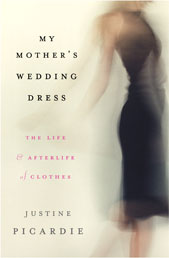
The complete title of this book is My Mother's Wedding Dress: The Life and Afterlife of Clothes. As you can see at first sight this book has nothing to do with the Brontës. A connection can be found through Charlotte's remaining dresses and complements and other Brontë family items of clothing. That wouldn't be too far fetched. The book, however, is not just about clothes in themselves, but about the events and people they evoke. It's that connection that Justine Picardie uses to write this unique book. Clothes evoke family, friends, writers, books, arts, stories, tales, journeys and, of course, fashion designers and trends.

The premise of the book is very original and varied. What starts as a family memoir threaded together by clothes, develops into much more than that. Brontë mentions are not only confined to the chapter called 'Charlotte Brontë's Ring' but appear everywhere throughout the book, showing Justine Picardie to be the Brontëite that we know her to be. It hardly seems possible that Emily Brontë, known to have said, 'I wish to be as God made me' when her dressing style was scorned at by other, more fashionable, pupils in Brussels features in the same chapter as Karl Lagerfeld. But Justine Picardie makes it not just possible but coherent too.

The Brontë-mentions are on all kinds of subjects and for all types of occasions. Justine Picardie is very familiar with the Brontë story. This is not a book where the Brontës have been made to fit in, rather the opposite. The Brontës drift coherently into Justine Picardie's fabulous gift for story-tealling, inextricably woven into the fabric (to borrow one of the many metaphors aptly used by Ms. Picardie).

Justine Picardie explores connections and themes to their very end. Be it a ring or feather, be it a dress or a colour, she picks at the knot until it finally gives way to a fascinating subject. Said subject is then illustrated by quotations and anecdotes springing from family letters, poems by Emily Dickinson, short stories by Charles Dickens, Gothic settings by Daphne du Maurier or conversations with her former Vogue colleagues, to name just a few.

In 'Scarlet Women' Justine Picardie reflects about the colour red in narratives and looks into Jane Eyre at length. Jane, Bertha, the fire, the red room are all carefully examined in their own context as well as that of fairy tales for instance, leaving readers with questions they might have never even considered but which are suddenly there, unavoidable. My Mother's Wedding Dress was released about a year before Jane Eyre 2006 was broadcast and we know it was Sandy Welch who came up with the idea of Bertha's red scarf and Andrea Galer who made it possible, but Justine Picardie could have come up with the same thing, and we are pretty sure that she must have liked the resource in the series.

And so we get to what we initially thought would be the only Brontë-related chapter in the book. 'Charlotte Brontë's Ring' was a family heirloom that was sadly stolen in a burglary. Justine Picardie, after a conversation with her mother, decided to try to find out how a ring which had supposedly belonged to Charlotte Brontë had ended up in her family. Thanks to the ring, she takes us in a journey through a fascinating piece of family history. Justine Picardie is descended from a, now obscure but not so in her own time, Victorian writer and lecturer called Clara Lucas Balfour. Her journey takes her into Clara Lucas Balfour's carefully kept archives as well as into the Brontë Parsonage Museum, library and storeroom, with no other than Juliet Barker as her guide. Everything in the book comes together when Justine Picardie pauses to read a newly-discovered, incomplete letter written by Charlotte Brontë to an unknown recipient, possibly Mrs Gaskell. BrontëBlog has long cherished this letter and found it extremely easy to relate to what Justine Picardie was feeling, especially after having read the rest of the book.

So did the now-lost family heirloom actually belong to Charlotte Brontë? You have to read the book to find out. We can guarantee that you will love it. Reading this wonderful book is like meeting up with an old friend for a cup of tea while she tells you about her extremely moving and fascinating family history, about her worries and her favourite things, about books and childhood, about fashion and trends, about secrets and discoveries. In short, about everything in life, with the Brontës cropping up in the most unexpected places. By the time you turn the last page you will have been subtly advised on how to dress better and you will feel that glowing feeling you have when you say goodbye to a dear friend after an unforgettable evening.

Categories: ,

Monday, March 10, 2008

Monday, March 10, 2008 12:11 am by M. in , ,    No comments
The radio programme Open Book on BBC Radio 4 had Justine Picardie as a guest in yesterday's edition. The programme can be listened online or repeated Thursday March 13th at 16:00.
Justine Picardie

Mariella Frostrup talks to Justine Picardie about her obsession with Daphne du Maurier. Picardie’s new novel Daphne is a fictional depiction of a period in the writer’s life when she was pursuing her interest in Branwell Bronte, the less well-known brother of Charlotte and Emily Bronte. Justine Picardie tells Mariella how she found her own life reflecting Daphne du Maurier’s literary quest.

Daphne: Justine Picardie
Publisher: Bloomsbury
It's a very interesting, lively interview where Justine Picardie explains why and how she came to write Daphne. Click here to listen to it.

Categories: , ,

Saturday, May 10, 2008

Saturday, May 10, 2008 12:04 am by M. in ,    No comments
Justine Picardie, author of Daphne will give today, May 10, a talk at the 2008 Daphne du Maurier Festival (May 8th-17th May):
Justine Picardie - Daphne

Date: Saturday 10th May 2008
Time: 11:45 - 13:00(Doors open: 11:15)
Venue: Festival Marquee, Fowey, PL23 1ET
Standard Price: £7.50

Description

Justine Picardie, the author of ‘Daphne’, a novel about Daphne du Maurier, will be talking to Rupert Tower, Daphne’s grandson, and Henrietta Llewelyn Davies, the great grand-daughter of Sylvia Llewelyn Davies (Daphne’s aunt, who was played by Kate Winslet in ‘Finding Neverland’). They will be discussing the extraordinary legacies - both literary and emotional - of the du Maurier family.
You can read Justine's pre-conference thoughts on her own blog.

This is not the only Du Maurier's Festival activity in which the author of My Mother's Wedding Dress will take part:
Book Group Session - Reading My Cousin Rachel - With Justine Picardie

Date: Saturday 10th May 2008
Time: 15:30 - 16:30(Doors open: 15:00)
Venue: Fowey Hall Hotel, Hanson Drive, Fowey, PL23 1ET
Standard Price: £5.50

Description

Join a ‘book group’ to talk about one of Daphne du Maurier’s Cornish novels with the experts. Only 18 places available on each session. Please bring a copy of the novel with you.
Justine Picardie’s novel, Daphne, is based on research into episodes in du Maurier’s life that may have influenced the writing of My Cousin Rachel.
She will be leading the discussion about this endlessly intriguing book, and asking whether we can trust the narrator’s version of events, and what is the truth about Rachel?
Categories: ,

Wednesday, March 05, 2008

Wednesday, March 05, 2008 12:01 am by Cristina in , , ,    3 comments
Daphne
by Justine Picardie
Bloomsbury Publishing 2008
ISBN 9780747587026
Format Hardback 416 pages. 216x135 mm.

We found out that Daphne was in the making over two years ago. The plot at once seemed innovative and interesting. From that moment onwards, we looked forward to the day Daphne would be in our hands.

That day came last week courtesy of the people at Bloomsbury who kindly sent us a review copy, and we plunged into the book at once. Justine Picardie immediately landed us in 1957, in a critical point in Daphne du Maurier's life, when her husband is in a nursing home after a breakdown and she herself is drowning in a sea of doubts. In that moment of desperation she turns to the Brontës, and when Branwell Brontë looks like her lifeline, she tightly holds onto him, as if by helping Branwell become a literary figure in his own right she will also be making right everything that is at odds in her own life. Thus she gets in touch with A. J. Symington, a Brontë scholar whose reputation - unbeknownst to Daphne - suffered from both his association with the notorious forger T. J. Wise and his own liberal management of Brontë manuscripts at the Brontë Parsonage Museum and the Brotherton Collection, where he was a librarian. Decades after his glorious days, Daphne's first letter finds an old Symington struggling to save his marriage, Branwell Brontë and his precious (albeit of dubious origins) manuscript collection and trying to come to terms with the sad reality of his situation.

The third story in the book takes place in our day and age, when a young du Maurier enthusiast finds herself in a situation not unlike Daphne's nameless heroine's in Rebecca - by her own admission even -, stuck in a marriage in which she feels her husband drifting away from her. Her route of escape is by way of tracking down and immersing herself in Daphne's and Symington's correspondence. She's also leading a battle similar to Daphne's own in trying to prove that just because Daphne's books are best-sellers, that does not make them bad and of poor literary quality. Critics didn't treat Daphne well in her lifetime and usually dismissed her as a popular writer, in the worst sense of the word. This somehow reminded us of the critics (?) who nowadays state belittingly that the Brontës are the grandmothers of chicklit or the Mills & Boon romances. Yet we find that this young woman incoherently makes the same mistake when in a passing comment she complains about Charlotte Brontë getting 'too priggish about religion' in Jane Eyre and affirms that, 'everyone [...] ignore[s] the preachy Christianity in the final pages, with St John Rivers leaving England to be a missionary in India, as if anyone cares about him by then; all they want to know is that Jane has married Rochester, and they've had a baby, and look set to live happily ever after, for ever and ever, amen.'

These three (or four, if we choose to count Branwell, whose shadow is very long) characters in these three overlapping, interwoven stories have more traits in common that meet the eye. For one thing, they are all eyeing literature as a means of escaping reality. All three - Daphne, Symington, the young woman - place their belief in the power of the written word as, one character describes when discussing the poems of Emily Brontë, 'if the act of reading her handwriting is an unintenional way of summoning up her spirit.' They are also fighting for their marriages (some more than others) and against third persons. The three of them show just how easy it is to lose one's grip on reality in the face of literature and the literary world.

Anyone who likes a good mystery, and even more if it is a literary mystery, will instantly appreciate the premise of the book. The tree characters take us on a stroll around the first decades of Brontëmania and the collectors' race to get first to manuscripts by the sisters, which led T.J. Wise to (in)famously pass Branwell's writings as Emily's or Charlotte's and which subsequently caused years of confusion.

Thus follow Daphne's efforts to champion Branwell - something Symington has been trying to do for years - to save him from himself so to speak and in the meantime saving herself as well from breaking down. She hopes to find Branwell's unpublished masterpiece and she finds herself grasping at straws in the form of 'And the Weary Are at Rest' or 'Morley Hall'. Daphne's exasperation at not finding any masterpiece, only juvenile writings and a few poems, are clearly seen in The Infernal World of Branwell Brontë.

She not only has Branwell to wrestle with but also Symington's elusive help and the fact that Winifred Gérin is writing a biography of Branwell at the same time (a rivalry we were expecting to see mirrored in the modern story). Not to mention Daphne's mental landscape as depicted by Justine Picardie, who seems to have effortlessly ingrained in the narrative the inner workings of the du Mauriers' family life, including those relating to the Llewellyn Davies boys (and 'Uncle Jim', J.M. Barrie himself) and Daphne's marriage, all easily navigated thanks to the family tree included at the end of the book.

The depictions of Daphne and Symington are particularly vivid and - as far as we can possibly judge - true to life, at least within the context of the book. Their anguish, sadness or frustration seep into the reader. As for the modern young woman, she seems enveloped by a mist, probably because however clearly she might see into the minds of Daphne or Symington, she is unable to see herself clearly, thus - as the only first-person narrator - she never totally reaches the reader.

From what we can tell and Justine Picardie - who like her modern-day character, visited several archives and second-hand bookshops to try and get to the bottom of the matter - explains, Daphne's and Symington's stories and correspondence are very much based on reality although slightly fictionalised to obtain a more fluent narrative(1).

It is not that we want the magician to reveal how the trick works, but sticklers for reality that we are, we would have appreciated an epilogue stating clearly what is fact and what is fiction, and what is new and what was previously known, where the correspondence can be read, etc. On a similar note we find the book to lack a final correction before going to the press. There are typos, spelling mistakes (Luddendon Foot instead of Luddenden Foot in some instances) and errors (a letter dated 1957 when it should be 1959) which we hope to see corrected in future editions.

These few drawbacks do not prevent Justine Picardie from piquing one's curiosity in each and every topic she touches on. Thus while reading the book we have found ourselves immersed in the Llewellyn Davis boys' stories, the du Mauriers' family relationships, Daphne's biography, Daphne's novels, Branwell's poetry, the afterlife of the Brontë manuscripts (such as the intriguing Honresfeld manuscript (Emily Brontë's notebook of non-Gondal poems), whose facsimile appeared in the Shakespeare Head edition of the Brontë works, and which vanished after that and remains unlocated to this day. The theory Justine Picardie raises in the novel concerning this manuscript is absolutely hair-curling for a Brontëite), etc.

This seems to be a characteristic trait of Justine Picardie's style, for she had the same effect on us while we were reading My Mother's Wedding Dress. Indeed, she is second to none when it comes to juggling a good many topics. She never takes a false step or loses sight of any of them and manages to turn them into a beautiful, self-sufficient global image, never chaotic at all, where even the tiniest detail ends up being absolutely relevant to her story. But that's not the only similarity with that book. As she did in My Mother's Wedding Dress, Justine Picardie manages to slip into the pages - on what seems like tiptoe - a few (Brontë-related) theories - each one like a breeze of fresh air - which you find yourself ruminating a long time after reading that short cue she has placed.

In short, Daphne - with its beautiful cover by Alison Lang - is, in spite of its fictionalised take on real events, a substantial addition to the shelves of any self-respecting plain reader, du Maurier aficionado or Brontë enthusiast, more, if anything, for the questions it poses than for the answers it gives.

(1) This fictionalisation, however, has Daphne awkwardly mixing the writing process of Villette with that of Jane Eyre, given that Charlotte had to nurse her father on both occasions: Jane Eyre was born in Manchester when Patrick Brontë was being operated on his eye and Patrick suffered a stroke - with inflammation of the eye - while Charlotte was trying to get on with Villette. In the actual letter Daphne had the timeline correctly when she just wrote, 'I feel rather like Charlotte Brontë when nursing the Rev. Brontë and finding it difficult to get on with Villette' while in the fictionalised one Daphne has 'Charlotte Brontë [...] nursing her father, during his convalescence from an eye operation, and she was finding it difficult to get on with 'Villette'.'

Categories: , , ,

Tuesday, December 02, 2008

Tuesday, December 02, 2008 1:40 pm by Cristina in ,    No comments
Here's the chain of events: The Yorkshire Post publishes an article on Justine Picardie's Daphne, which Brontë biographer Julie Barker sees and brings to Justine Picardie's attention, who links to it on her blog introducing it as follows:
Juliet Barker (author of a brilliant history of the Brontes) has just told me about a piece in the Yorkshire Post about my stint as a literary detective whilst researching 'Daphne'. Here's the link, if anyone is interested... It's a nice twist that the story has ended up in the Yorkshire Post, for as readers of 'Daphne' may have noticed, the newspaper itself -- or rather, its former editor, Sir Linton Andrews -- played a pivotal part in my novel...
We pick it up from there.
For her latest fiction, Justine Picardie became a literary detective among the true stories at the home of the Brontës. Yvette Huddleston talked to her.

When writer Justine Picardie came across a literary mystery a few years ago, she felt compelled to try to solve it. It led to her latest novel, which is about Daphne du Maurier, one of the world's great literary successes, and her obsession with Branwell Brontë, one of its great failures.

"I have always been a great admirer of Daphne du Maurier," she explains. "I first read Rebecca when I was about 12 years old and, like a lot of girls, I read it just before Jane Eyre and Wuthering Heights. I loved all of them, but I re-read Rebecca, then I read my way through the rest of du Maurier's books and I found them completely involving and wonderful."

Studying English at Cambridge, her teachers made it clear that du Maurier had no standing in academe.

"At that time, even the Brontës were only just about seen as respectable. I remember one of my university tutors – almost certainly a man – telling me that the Brontës were just 19th-century Mills and Boon."

But du Maurier remained part of her undergraduate reading – although she "knew not to mention her" – and she has been a devoted fan ever since. During the writing of another book, My Mother's Wedding Dress, Picardie found herself intrigued by a story linking du Maurier and the Brontës. "I was researching the Brontë connection with our family – a ring my mother had was supposed to have belonged to Charlotte Brontë at one time – so I was spending a lot of time at the Brontë Parsonage.

"I got to know Juliet Barker, who wrote a wonderful biography of the Brontës, and we became friends. I was with her one evening and I said to her 'this name JA Symington comes up a lot in the papers I've been looking through,' and her response was really interesting..." Barker told Picardie that while she had been researching her own book, there were certain files that she had not been allowed to read, particularly those relating to Symington.

He was a former curator and librarian at the Brontë Parsonage but had left his post in 1930 amid accusations that he had stolen manuscripts from the museum, along with a set of library keys. Although Symington lost his job, he never returned the manuscripts or the keys, and the Brontë Society took no further action against him.

Picardie says that it remains unclear whether the society wanted to avoid a scandal or whether Symington's membership of the masons protected him in some way. What is known, however, is that Symington subsequently fell into obscurity, his reputation further tarnished by his association with TJ Wise, a former president of the Brontë Society.

Wise's name is also associated with controversy. After his death, in 1937, it was revealed that a large proportion of the extensive collection of rare books and manuscripts he had bequeathed to the British Library were forgeries.

Picardie was fascinated by this tale. A further coincidence persuaded her to turn literary detective. "At about the same time, Virago were printing new editions of Daphne du Maurier's books and I was approached to write a foreword to a reissue of a little-known work of hers – a biography of Branwell Brontë."

She was sent an old copy of the book, The Infernal World of Branwell Brontë, and was intrigued. "The book was dedicated to Symington," she says. "And that was it – I was hooked."

Du Maurier's dedication states that Symington's "life-long interest in Patrick Branwell Brontë stimulated my own, and encouraged me to undertake the present study". Picardie's imagination was piqued. Was Symington a fraud, or a dedicated Brontë scholar whose immersion in his subject had led him to make misguided decisions?

In the late 1950s, du Maurier began a lengthy correspondence with Symington. Picardie knew that du Maurier's own life at this time was quite complicated.

"Her marriage was going through a difficult patch. Her husband, Tommy, had been having an affair and had had some kind of a breakdown as a result. I wondered, for example, whether Daphne might have fallen in love with Symington..."

These were the kind of questions that led Picardie to begin her own book about du Maurier's passion to discover the truth about Branwell and to bring his true worth to public attention.

In childhood and adolescence, Branwell seemed to promise much. In 1840, he took a job on the railways, earning £75 a year as assistant-clerk-in-charge at Sowerby Bridge station. But his drinking and poor accounting got him sacked within a couple of years. Taken on as a tutor to the Robinson family, this also ended badly after his affair with his employer's wife was discovered.

"Daphne du Maurier was a best-seller and a great success, but she herself believed that because of this, she was never forgiven by the critics. I think Daphne was drawn to Branwell because there is something very attractive about rescuing a failure and rehabilitating somebody's reputation. Somehow, you are redeemed yourself.

"A myth has grown around the Brontës that is as powerful and intriguing as their books. Whether or not it's true doesn't matter. The power of that mythic quality to their lives – up on the moors, the terrible school, the death of their mother and older sisters – continues to have an enormous hold over us."

Branwell, in particular, as the one failure in a creative family, draws people in. "He became part of the Brontë myth. A lot of it is true, however – he was an alcoholic and a laudanum addict and he didn't display any of his sisters' capacity for sustained creativity." Many Brontë scholars believe, as Symington did, that Branwell wrote a great novel – it has just not been found yet. Some even think he wrote Wuthering Heights.

"I don't believe that," says Picardie. "But what is true is that he was capable of writing good poems." In fact, some of the manuscripts of his poems were wilfully attributed to his sisters – signatures were forged – because the manuscripts would sell to collectors for greater amounts.

"I think the fascination with Branwell is that maybe, just maybe, he did do something really interesting."

When it came to writing up her own extensive research, Picardie decided on
a novel rather than a non-fiction account. Her decision was influenced largely by her admiration for du Maurier and the Brontës.

"Du Maurier constantly blurred the boundaries between fact and fiction in her work. There was always some autobiographical truth in her novels – as with the Brontës. So, for me, the only true way to do it was to do it the way they did it."

With her novel now published – and it's an absorbing, intelligent read – Picardie's stint as literary detective is over, but her time at the Brontë Parsonage, she feels, was particularly special.

"There's something really potent and unexpectedly vivid about being able to handle the sisters' manuscripts – the paper they actually wrote on. It was the same with Symington's letters and papers. There were times when I would be opening up those files and thinking – nobody has looked at these since they were put away. It's been the most wonderful adventure."
Categories: ,

Friday, April 25, 2008

Friday, April 25, 2008 7:48 pm by M. in , ,    No comments
Both our winners of the our latest contests (Justine Picardie's Daphne and Laura Joh Rowland's The Secret Adventures of Charlotte Brontë) have been so kind to forward us their reviews. Furthermore, it seems that both of them have enjoyed their reads, therefore our delight is double.

Christine from book-a-rama has published her Daphne review on her blog:
Daphne by Justine Picardie is a little hard to describe. It's about a college grad researching Daphne duMaurier while she was researching Branwell Bronte. Are you following me? The narrator (who remains nameless until the end of her story), let's call her Nar, is married to a douche a professor much older than herself. Oh, he thinks he's right smart, he does. Nar loves all things Daphne and is working on a paper about her obsession with the Brontes. Paul, the professor, poo-poos the idea. Daphne is, afterall, just a writer of bestsellers, a romance writer. Paul and Nar grow colder towards one another and Nar suspects Paul's attitude has more to do with his mysterious ex-wife Rachel than anything else.

At the same time, Daphne's own story runs parallel to the narrator's. Daphne's husband, Tommy, has just had a nervous breakdown and her own mental health is questionable. To distract herself she throws herself into writing a biography of the short life of Branwell Bronte. She starts a correspondence with a disgraced currator, a gollum-like hoarder ("my precious") of Bronte documents, J.A. Symington. He's an odd character with delusions of grandeur mixed with periods of extreme self-doubt.

Not a lot happens during the book, no car chases or running from museum to museum a la Dan Brown. The story is told through the letters of Daphne and Symington as well as their own thoughts. The letters hide more than they tell. Daphne's crumbling marriage and her paranoid thoughts aren't revealed to Symington. Symington wants Daphne to feel he's superior to her a mere novelist, when he's actually a thief. I found Daphne so fascinating. She had a family connection to J.M. Barrie, the creator of Peter Pan. Her family also had a history of depression and mental illness. At times, I wondered how much of what Daphne perceived was real or a figment of her imagination. Echoes of her books and stories are sprinkled throughout the book; some subtle, some obvious. I found myself thinking, "Oh, that's where she got Don't Look Now."

There were echoes of Daphne's stories in the narrator's tale as well. She's almost like the second Mrs DeWinter only with more balls. Her husband's ex is named Rachel. She's much like Rebecca only without the evil. She's a charismatic woman. She was very well written by Picardie. Daphne and 'Nar's ' story isn't exactly circular. It's more like Picardie shoved them and the Brontes in a blender and poured them onto the page. And it works.

Even though, I was left with some questions, I really enjoyed this quiet novel that's not quite a biography. I'm definitely going to read more of DuMaurier's work including The Infernal World of Branwell Bronte. (...) Recommended.
Incidentally, BookBath (no relation to our contest) has also posted a positive review of Justine Picardie's book:
This book was beautiful, haunting, lovely and engrossing - one of those books you can't put down but at the same time you don't want the end to come. (...) The similarities to the constructs of "Rebecca" are obviously present - but the author is not attempting to hide or disguise these in any way - it is clear that Rebecca - both character and book - is a fourth character in Daphne. Each of the characters are compelling and true - you feel connected to their lives and their choices. In the acknowledgements at the end of the book Justine Picardie talks about becoming "utterly possessed by the story" involving the Bronte manuscripts - I can see why! It is a wonderful mystery that is gorgeously told by Picardie. It has inspired me to read further in the du Maurier and Bronte world.
Our other winner, Michael, has also sent us his views on The Secret Adventures of Charlotte Brontë:
I have not had time to a write a detailed review of "The Secret Adventures of Charlotte Bronte" but I finished it rather quickly. I very much enjoyed it although I echo the comments from other reviewers who stated CB tended to fall for every man she runs into and as with conspiracy based stories one needs to have bigger suspenses of belief as the conspiracy grew more elaborate. Also, Mr. Rowland tended to focus a lot on the unsanitary conditions of life in mid-Victorian England. She makes loss of references to cesspits, etc. I really enjoyed the scenes of CB walking with Arthur Bell Nicholls knowing inside this is her future husband although this is the only man in the story she does not fall for, the meeting with M. Heger, for me you could how much he was used as a template for M. Paul Emanuel, and her conversation with Mr. Slade regarding Jane Eyre. I very much enjoyed the real historical figures incorporated into the story especially Queen Victoria and Prince Albert. Ms. Rowland seemed to capture from what I understand as their personalities and their relationship. Based on your posts, especially regarding the Polly Teale play, Ms. Rowland appeared to capture the popular perception of the personalities of the Bronte siblings. Although I was rather shocked at some of CB's thoughts when she runs into Mr. Slade on the moors and sends her dog after him.

I want to add Ms. Rowland's research into the Victorian era really shined in the book. She was able to incorporate China's humiliation at the hands of the British, the revolutionary agitation of 1848 including the Chartists, the industrial revolution, and CB makes references to her and Mr. Slade as representative of the new and growing middle class. I thought her characterizations of Victoria's and Albert's children Princess Royal Victoria and Bertie, future Edward VII, seemed to be accurate from my limited understanding and of course foreshadowing of their future reputation especially Bertie as the son who would rebel against his parents' morals in terms of his rather promoscious lifestyle and fondness for living the "good life" including smoking. Although she did make one minor blunder when CB was referred to as a "citizen" before Queen Victoria instead of "subject". The epilogue was very poignant and melancholy. (Michael Kim)
Categories: , ,

Monday, March 03, 2008

Monday, March 03, 2008 12:03 am by M. in ,    No comments
Two alerts for this week where Justine Picardie will present her brand new book, Daphne:
Calcot Manor Hotel Meet-the-Author Lunches
Monthly lunches followed by author talk and book-signing in this beautiful Cotswold hotel and spa near Tetbury, Gloucs.
Date: 3 March 2008
Justine Picardie will be talking about Daphne at a literary lunch in Calcot
University of Exeter
Date: 5 March 2008
Du Maurier novel 'Daphne' To celebrate the publication of the new novel ‘Daphne’ by author and journalist Justine Picardie there will be an ‘in conversation with’ Professor Helen Taylor
in LT1, Queen’s Building, at 5.00 p.m. on Wednesday 5th of March. She will read from the novel and signed copies will be for sale.
Justine Picardie delved into the Du Maurier archive held at Exeter University and came up with a brilliant new novel, ‘Daphne’. It uses the fascinating correspondence between Daphne du Maurier and the Bronte family to illuminate the story of a young woman, a PhD student in the present day, who is newly married after a fleeting courtship. She is trying to make herself at home in a large house in Hampstead and finds that her research throws up disturbing parallels with her own life…AND - earlier in the afternoon, she will give a talk in the archive itself. This is a unique opportunity to book a place to see Daphne du Maurier’s original manuscripts and to hear Justine Picardie talk about how she used the letters between du Maurier and the Brontes in the novel.
Numbers are restricted to just 20 people so please call 01392 263879 or email libspc@exeter.ac.uk to book your place.
The correspondence between Daphne du Maurier and the Brontë family - now that would make quite an interesting read. Not to mention the possibilities that writing to someone in the future/past opens up.
Wed Mar 12 Muswell Hill Bookshop, 72 Fortis Green Road, N10 3HN, London
Reading from and talking about her novel 'Daphne'.
Categories: ,

Sunday, May 24, 2009

Sunday, May 24, 2009 12:02 am by M. in ,    No comments
A press release and a job offer:
Writers to Appear in Haworth as part of Brontë Weekend 5-7 June 2009

A programme of literary events will take place in Haworth between 5 – 7 June as part of the annual Brontë Society festival. Writers Joanne Harris and Justine Picardie will be amongst those taking part in author readings and discussions as part of the weekend of events.

The Infernal World of Branwell Brontë

To coincide with the new special exhibition focusing on Branwell Brontë, which opens at the Brontë Parsonage Museum on Monday 1 June, writer Justine Picardie and Brontë biographer Juliet Barker will be discussing the life and legacy of Branwell Brontë on the afternoon of Friday 5 June, at 3.30pm in the West Lane Baptist Centre, Haworth. As a child Branwell was considered the greatest genius of the Brontë family, but while his sisters went on to write great novels, Branwell died aged 31 after declining into alcoholism and with a string of failed career attempts behind him. Juliet Barker and Justine Picardie will be debating whether this description of Branwell is fair and discussing some of the remaining mysteries that surround him. Justine Picardie is the author of the novel Daphne, which tells the story of the author Daphne du Maurier’s obsession with Branwell Brontë. Tickets are £5 and can be bought on the door.

The Brontës and Romance

An evening panel event on Saturday 6th June will see authors Joanne Harris, Amanda Craig, Jude Morgan and Mills & Boon author Kate Walker discussing the Brontës and romance novels. Jane Eyre and Wuthering Heights are often described as being amongst the greatest love stories in literature and this discussion, chaired by Justine Picardie, will look at the ways the novels have inspired romance writers. Huddersfield-based writer Joanne Harris is the author of the bestselling novel Chocolat (which became an Oscar-nominated film starring Johnny Depp and Juliette Binoche). Jude Morgan’s latest novel, The Taste of Sorrow, is a fictionalised account of the life of the Brontës, while Kate Walker has based one of her recent Mills & Boon novels on the story of Wuthering Heights. This event takes place at 8pm at the West Lane Baptist Centre, Haworth. Tickets cost £10 and can be booked from jenna.holmes@bronte.org.uk / 01535 640188.
“We have a great line up of events for this year’s Brontë Society weekend. Everyone is welcome to attend the events and we hope that lots of people will join us to find out more about the Brontës and to hear these inspiring writers in conversation”. (Jenna Holmes, Arts Officer, Brontë Parsonage Museum)
Also published on the Brontë Parsonage Blog.

We read on the Arts Council England list service, the following post:
Brontë Parsonage Museum: Women Writers Wanted

Closes Mon 08 Jun 2009 Paid (£10k-15k pro rata) Part time
Contact Jenna Holmes jenna.holmes@bronte.org.uk

Description:

The Brontë Parsonage Museum in Haworth, West Yorkshire is home to a flourishing contemporary arts programme and has featured projects with major artists and writers in recent years.
The museum has now received Arts Council funding to develop a series of events that celebrate and showcase women’s writing. As part of this programme, we would like to hold a series of creative-writing event days for visitors, run by women writers, to take place at the museum during August.
We are looking for drop-in activities rather than formal writing workshops, and for imaginative responses to the Brontë Parsonage from writers who can be sensitive to the complexities of creating events for a museum environment and can work with the general public to deliver their event. Events might take the form of writing trails, activities, or prompts for visitors to respond to as they look around the museum, and we are open to creative ideas.
The project will most likely involve a day on site per writer and there is a fee available.
Please send a CV and a brief proposal or idea to: mailto:jenna.holmes@bronte.org.uk
The deadline is Monday 8 June.
Categories: ,

Thursday, February 28, 2008

Thursday, February 28, 2008 4:59 pm by Cristina in , , ,    2 comments
The Los Angeles Times publishesfurther information on Robert Fox's film deal concerning Justine Picardie's new novel Daphne.
The book:
'Daphne' by Justine Picardie

The buyer:
Robert Fox

The deal
Robert Fox options Justine Picardie's "Daphne," a tale of author Daphne du Maurier's midlife crises and literary obsession with the Brontës, told against the haunting backdrop of her classic novel "Rebecca."

The players
Fox (executive producer of "Atonement" and "Closer," producer of "The Hours," "Notes on a Scandal" and "Iris") producing. Picardie represented on literary rights by Grainne Fox at Ed Victor Limited in London and on film rights by Geoffrey Sanford at RWSH literary agency in Los Angeles. The book will be published by Bloomsbury USA in August.

The back story
The path from book to screen can be filled with twists and turns, false starts and random luck. But sometimes the path to an option deal -- the beginning of the process -- is no less surprising. Consider Picardie's forthcoming novel, which begins in 1957 as Du Maurier's marriage is falling apart. Plunging into her work, the distraught novelist begins relentless research into the life of Branwell Brontë, a tormented painter and alcoholic who was the only son born into the literary family. "Daphne" is the story of a famed British novelist on the verge of a breakdown, weaving in the strands of her most famous book, a literary whodunit and a troubled, modern character heavily influenced by the writer's work.
Is this "The Hours" meets Daphne du Maurier? Picardie, a highly respected author, wrote "a very different book, but there are certain elements that are not dissimilar," said Fox, who produced the 2002 film about Virginia Woolf. What's more remarkable is how he got involved in the project. Picardie spent years researching Menabilly, the famed seaside estate that inspired "Rebecca." Then she learned Fox had met the writer at the estate when he was a boy, and that his 100-year-old aunt also knew her. Through friends, she sent him an early draft of the book, and he was instantly smitten.
"I know the world this story takes place in incredibly well, I was maybe 5, 6 years old when I met Du Maurier and it's indelibly imprinted on my mind," Fox said. "It will be a very compelling story." For Picardie, the coincidence of selling a book option to a filmmaker who has intimate knowledge of her story is astonishing. "I couldn't have wished for a better fit, as an author." (Josh Getlin)
The coincidence is indeed amazing. Although the American market has to wait until August for Daphne, the novel is released in the UK next Monday March 3rd. Expect a review of it here on BrontëBlog soon!

And now for a case of a highly misunderstood, out-of-context quotation from Jane Eyre. This Day - a Nigerian newspaper - publishes this:
Any falling currency can be likened to an ugly woman, who in the words of Jane Eyre "is a blot on the fair face of creation." (Josef Omorotionmwan)
Does that sound like something the PLAIN, timid governess would say? Or does it sound like something Blanche Ingram - spoiled, proud, rich and pretty - would say instead? A quick glance at chapter XVII answers the question:
Miss Ingram, who had now seated herself with proud grace at the piano, spreading out her snowy robes in queenly amplitude, commenced a brilliant prelude; talking meantime. She appeared to be on her high horse to-night; both her words and her air seemed intended to excite not only the admiration, but the amazement of her auditors: she was evidently bent on striking them as something very dashing and daring indeed.
"Oh, I am so sick of the young men of the present day!" exclaimed she, rattling away at the instrument. "Poor, puny things, not fit to stir a step beyond papa's park gates: nor to go even so far without mama's permission and guardianship! Creatures so absorbed in care about their pretty faces, and their white hands, and their small feet; as if a man had anything to do with beauty! As if loveliness were not the special prerogative of woman -- her legitimate appanage and heritage! I grant an ugly woman is a blot on the fair face of creation; but as to the gentlemen, let them be solicitous to possess only strength and valour: let their motto be: -- Hunt, shoot, and fight: the rest is not worth a fillip. Such should be my device, were I a man." [Our bold]
So, dear journalists, do not boast of your literary knowledge when it's simply not there. You will make your point better if you stick to what you know. Thanks.

A couple of blogs. Random Jottings of a Book and Opera Lover posts a very touching letter Charlotte Brontë wrote to her friend Ellen Nussey shortly after Emily's death. And on an altogether different subject, The Beauty and Lace Shopping Guide reviews The Virago Book of the Joy of Shopping - previously mentioned on BrontëBlog - which includes a reference to Jane Eyre.
As people began to shop more, novelists imagined them doing it. Jane Eyre cringes at Mr Rochester’s pre-wedding excess, while Undine Spragg’s spending drives her husband to despair.
Categories: , , ,

Sunday, April 30, 2006

Sunday, April 30, 2006 10:26 am by M.   No comments
My Mother's Wedding Dress: The Life & Afterlife of Clothes by Justine Picardie appears in May in the US in a hardcover edition published by Bloomsbury. We already posted about this book when it was first published in Britain. Here's a brief summary of the book:

Beginning with the story of her mother’s wedding dress, a perfect black French cocktail dress bought in 1960, writer and former Vogue editor Justine Picardie affirms what all of us may have suspected: that the real value of our wardrobes lies in the history and associations woven into our clothes. Combining tales of her own family and friends, intimate stories from the fashion business, and reflections on clothes in literature and pop culture, Picardie uncovers the truths that lie underneath what we wear. She reflects on the strange disappearance of garments we love; the allure of uniforms; the house that Chanel built; the bridal and ghostly qualities of women in white; the fate of a ring belonging to Charlotte Brontë; the power of scarlet clothing; how Donatella Versace, Karl Lagerfeld, and Claude Montana dress themselves; and how the clothes we inherit from loved ones link us to the departed. Rich with fascinating stories from the public and private worlds of fashion, My Mother’s Wedding Dress is a gorgeously written book about what clothes cover up, and what they reveal.

The LA Times reviews it today. This is part of what they say about it:

Picardie's method, to allow her thoughts to move from object to memory to culture, fits her madness perfectly. She muses on the terrifying nature of the white dress (think of Emily Dickinson housebound for decades, or Jane Eyre in shades of gray); on the color red and its tendency to lead to fun or adventure; and, of course, on the power of wearing black. She includes lists of the best-dressed characters in literature (Pippi Longstocking is at the top), "Disappeared Clothes (A Familiar Lament)" and "How to Wear Red Lipstick (The Gospel According to Chanel)." She hops; she skips; she jumps.

We have read so many reviews on this book by now that we are becoming very interested in it! We'd just like to take this opportunity, though, to remind her that - also very significantly - Jane closes her book dressed in blue.

Also a reminder that Ms Picardie is very active in the Brontë world these days. She will be at Haworth on June 2 for the Brontë Society AGM Weekend:

Fri, 2 Jun Novelist Justine Picardie will be speaking about her latest book 'My Mother’s Wedding Dress' – West Lane Baptist Chapel – 2.30pm - £2.00 – For further information contact the Audience Development Manager, 01535 640194.

And about a month before that, on May 4, the classic The Infernal World of Branwell Brontë will be finally republished with an introduction by her.

Categories: , ,

Monday, March 03, 2008

Monday, March 03, 2008 2:11 pm by Cristina in , , , , , ,    No comments
The Financial Times has recently carried articles on a couple of Brontëites. First of all, Barbara Taylor-Bradford - who has been featured previously on BrontëBlog - writes about Wuthering Heights:
I first read Wuthering Heights when I was about 12 or 13 years old. It was a favourite of my mother's, and she bought me a copy.
I remember finding the novel strange, mysterious, dramatic and compelling.
Most of all, it was very touching.
As I grew older, I came to understand that it was a story of revenge, and not a great love story, as so many think it is.
I became addicted to the books of the Bronte sisters - Emily, Charlotte and Anne. Often, my mother would take me to Haworth, where the sisters grew up with their brother, Branwell, at the Haworth Parsonage. Their father was the parson. This is a museum now. My mother also took me over the wild, windswept moors to Top Withens, supposedly the site of Wuthering Heights, which is of course, the name of the house where Catherine Earnshaw lived, not a place.
I grew up in Yorkshire, and Haworth is about two hours from Leeds, the city of my birth. This book, more than any other, influenced me and my writing.
I believe Emily Bronte to be one of the great geniuses of English literature. So influenced am I by the Brontes, I invented a play called Charlotte and Her Sisters, which I used in my novel The Triumph of Katie Byrne. Katie is an actress and appears in the play, but before this happens, I ''take'' her to Haworth to visit the parsonage.
What is so extraordinary about Wuthering Heights is that Emily Bronte used two narrators to tell her story. Also, Heathcliff is the great Byronic hero. Even today, I find the book unputdownable.
Barbara Taylor Bradford is author of ''Heirs of Ravenscar'' (HarperCollins).
And secondly Helen Dunmore - much loved here at BrontëBlog - is interviewed by Anna Metcalfe.
Have you ever imitated another writer’s style?
I’ve been influenced by a large number of writers. I copied the patterns in the poetry of Keats and T.S. Eliot in my teens. I aspire to F. Scott Fitzgerald for precision in writing, and Charlotte Bronte for her daring.
Let's continue with Brontëites and the news du jour. Today's Justine Picardie's Daphne release date and both Justine Picardie and Daphne du Maurier can be clearly classified as Brontëites of the highest order.

Ann Willmore, owner of the bookshop Bookends of Fowey, which specialises in Daphne du Maurier - has published her review of Daphne on Amazon.co.uk. She gives it 5/5 stars!
I have a major interest in all things relating to Daphne du Maurier and I love Justine Picardie's writing so I had been waiting eagerly for Justine's new novel `Daphne'. I was not disappointed, once I started reading I could not put it down. The story has an involved plot, which provides the reader with masses of detail and information, making the book a compelling read.
The story is told by three people Daphne du Maurier, Alex Symington and a young woman. Despite the three narratives, each of which interweaves with the other two, it is not an unnecessarily complicated novel. The way the story moves chapter by chapter through the different areas of the novel, helps you to hold on to everything that is happening. I think the story about the young woman is what held me the most, probably because, for me, she was the unknown quantity. She was so isolated from all the affection and comfort that most people take for granted...she was lost and alone and when she eventually found herself and we found out her name I was very moved. I like to think that she was called Jane after Wendy's daughter in Peter Pan. There were many other moments that really touched me - references to Guy du Maurier, Gerald du Maurier and the birds, the fact that inevitably Peter Llewelyn Davies was going to throw himself under that train, the young woman in the grounds of Menabilly. There was so much that had to be told and it was done brilliantly.
The elements of the novel that relate to Daphne du Maurier and Alex Symington have been well researched and are very strong factually and the fiction which is the young woman's story brings the whole narrative together beautifully. I lived and breathed every word and I hope other readers will appreciate the detail and complexity of this book as well as enjoying its content. I am sure this will be a book that provokes much interest and discussion and that it will give the author the recognition that she deserves.
The Sigla Blog also writes on the subject of Daphne. The blog owner hasn't read it yet but posts a reflection on it all the same, discussing the idea behind the book and Justine Picardie's recent articles in the press.

Now for something else. N.G. McClernan's stage adaptation of Jane Eyre in New York closed yesterday but reviews are still being published, such as this one from Talking Broadway:
What sort of person deserves love? Is it someone whose face resembles the ethereal quality that the symbol of affection embodies? Is it someone whose character is blameless? Is it someone accustomed to hard labor or someone used to riches and leisure? These are some of the questions posed in N.G. McClernan's theatrical adaptation of Jane Eyre. And while the talented cast try their best to paint a portrait of love, far more things than breaking through the bridled, Victorian era stand in their way. [...]
The 23 characters from the novel are reduced to 16, with four actors taking on various, memorable roles. Bruce Barton, resembling Kelsey Grammar in appearance, recycles his bombastic speaking voice for all the roles, but still manages to entertain. Alice Connorton and Annalisa Loeffler are both chameleons, deserving mention for their versatility. Unlike the novel, the production spends a great deal of time on Jane's experience with St. John Rivers, her cousin and potential mate. As Rivers, Nat Cassidy is much harsher and religious law-abiding that his character is in the novel, but it also helps us to understand why Jane runs back to Rochester. She not only still loves Rochester, but committing to Rivers is clearly a fate that she doesn't want for herself. The audience doesn't want that for her either. As Jane, Murphy is appropriately meek and blunt at the right times. Although her interactions with Bodine can't be wholly described as fiery, when they do get comfortable with each other and their declarations of love, they do come alive together. Bodine, sometimes rigid and humorless for Rochester's restraints, is debonair when he needs to be.
Jane Eyre is an ambitious effort to stage a highly respected, 400 page novel. The fact that they were able to encapsulate the gist of the novel in a two-hour presentation is a feat unto itself. However, some of the technical elements need to be smoother, and some of the staging choices need to be revisited before it can be called a success. And while it does shine in some parts, it won't be winning any new fans of Victorian fiction with the dry and tiresome beginning. Still, there are explorations of views on important themes such as social class, gender relations, morality and religion that are still pertinent today. While you may not be able to identify with corsets and Victorian restraint, the themes discussed in the novel and in this production should be familiar to you as components of the upcoming presidential election. (Cindy Pierre)
Here is a complex image from an article on fashion in the French newspaper Le Figaro:
À ces néo-George Sand, on préfère les passages plus « loose » où le grand manteau d’officier ceinturé évoque joliment l’allure racée d’une Lauren Bacall qui se serait égarée dans un roman des sœurs Brontë. (Caroline Rousseau)
It basically says that the item is reminiscent of Lauren Bacall lost in a novel by the Brontë sisters. Complex, as we said.

In brief: Meghan Curran continues posting about Wuthering Heights. Cupcake Chronicles posts about Shirley and what the book says about March among other things. And RecipeZaar has the recipe for 'Brontë Pie', supposedly 'Emily Brontë's favourite meat pie'. This is obviously to be taken with a grain of salt (no pun intended) as the explanation of why this would be Emily Brontë's favourite isn't at all accurate (for a start it was Charlotte writing to Emily from Brussels, not the other way around).

Categories: , , , , , ,

Monday, March 30, 2009

Monday, March 30, 2009 1:34 pm by Cristina in ,    No comments
Apart from today's meagre newsround we have this hot-from-the-oven press release from the Brontë Parsonage Museum:
BRONTË PARSONAGE MUSEUM ANNOUNCES NEW CONTEMPORARY ARTS PROGRAMME

The Brontë Parsonage Museum has announced a new contemporary arts programme to run from April to September 2009. The new season will include Ghosts, an exhibition of landscape photographs of the moors around Haworth by major British artist Sam Taylor-Wood. A series of photographs of Writers’ rooms, serialised in The Guardian each Saturday by photographer Eamonn McCabe, will also be exhibited at the Parsonage.

The museum will also be developing its programme of literary readings and events, following recent funding from Arts Council England to develop literary events that showcase and celebrate women’s writing. Bestselling author Kate Atkinson will begin the new programme on Thursday 23 April, reading from her latest novel When Will There Be Good News? Writers Justine Picardie, Joanne Harris, Amanda Craig and Jude Morgan, along with Mills & Boon author Kate Walker will be taking part in literary events in June. Playwright and critic Bonnie Greer will be reading from her new novel at the Parsonage in September.

“The contemporary arts programme is going from strength to strength and continues to inspire artists and writers of the highest calibre to work with us. What is more, the Arts Council funding marks an exciting new stage for the arts programme. The Brontë sisters were pioneering women writers and this project will enable the museum to celebrate their legacy by working with both established and emerging women writers and supporting a new Writer in Residence scheme at the museum”.
Jenna Holmes, Arts Officer

As part of the literature project, the museum will also be launching a new monthly book group on Wednesday afternoons to discuss contemporary fiction and the work of visiting authors.

Brontë Parsonage Museum’s Contemporary Arts Programme April – September 2009, full programme details:

Kate Atkinson
Thursday 23 April, 7.30pm
The Old Schoolroom, Church St, Haworth

Kate Atkinson’s first novel, Behind the Scenes at the Museum won the 1995 Whitbread Book of the Year Award. She is the author of a collection of short stories, Not the End of the World (2002), and of the critically acclaimed novels Human Croquet (1997), Emotionally Weird (2000), Case Histories (2004) and One Good Turn (2006). Case Histories introduced her readers to Jackson Brodie, former police inspector turned private investigator, and won the Saltire Book of the Year Award and the Prix Westminster. Her latest novel, When Will There Be Good News, also features Jackson Brodie.

Tickets are £5 and should be booked in advance.
Bookings: 01535 640188/ jenna.holmes@bronte.org.uk

Writers’ Rooms
Friday 1 May until Monday 6 July
Brontë Parsonage Museum

Renowned photographer Eamonn McCabe publishes the series Writers’ Rooms, documenting the writing spaces of novelists, biographers and poets, in The Guardian each Saturday. This exhibition of prints from the series offers a fascinating glimpse into the desk spaces of some of the most important writers working today.

Eamonn McCabe made his name as a sports photographer for The Observer in the late 1970s and 1980s. In 1988 he became Picture Editor of The Guardian and has been awarded Picture Editor of the Year six times. In 2001 he returned to full-time photography, specialising in portraiture. A selection of photographs from his series Artists and their Studios was exhibited at the National Portrait Gallery, London in 2008.

Free on admission to the museum

The Infernal World of Branwell Brontë
Friday 5 June, 3.30pm
West Lane Baptist Centre, Haworth

To coincide with the museum’s new special exhibition focusing on Branwell Brontë, Juliet Barker and Justine Picardie discuss the life and creative legacy of the reprobate Brontë brother.

Juliet Barker was educated at Bradford Girls' Grammar School and St Anne's College, Oxford, where she obtained a doctorate in medieval history. From 1983 to 1989 she was the curator and librarian of the Brontë Parsonage Museum. Her books include The Brontës, which won the Yorkshire Post Book of the Year Award and was short-listed for both the AT&T Non-Fiction Prize and the Marsh Biography Award, The Brontës: A Life in Letters, Wordsworth: A Life and, most recently, Agincourt: The King, The Campaign, The Battle and The Tournament in England 1100 – 1400. In 2001 she was elected a Fellow of the Royal Society of Literature.

Justine Picardie is the author of Daphne (2007) which tells the story of Daphne du Maurier’s obsession with Branwell Brontë; If the Spirit Moves You (2001); Wish I May (2004) and My Mother’s Wedding Dress (2005). She has also written introductions to the Virago Modern Classics editions of Daphne du Maurier’s The Infernal World of Branwell Brontë (2004) and The King’s General (2004). Formerly the features editor of British Vogue, she is a columnist for the Sunday Telegraph Magazine and writes for Harpers Bazaar.

Admission is £5.00 and advance booking is not required.

The Brontës and Romance
Saturday 6 June, 8pm
West Lane Baptist Centre, Haworth

The Brontës’ novels are often described as being amongst the greatest love stories of English literature. This discussion, chaired by Justine Picardie, examines the influence of the Brontës’ works on the romance genre.

Amanda Craig is the author of six novels, including Love in Idleness (2003), a modern retelling of A Midsummer Night’s Dream, and most recently Hearts and Minds (2009). Amanda contributes regularly to The Independent on Sunday and The New Statesman and is a columnist for the Sunday Times. She has written and contributed to several articles on romantic fiction, describing it as one of the oldest and most distinguished genres in literature.

Joanne Harris was born in Barnsley and has published eight novels including Chocolat (1999), which was shortlisted for the Whitbread Novel of the Year Award and made into an Oscar-nominated film starring Juliette Binoche and Johnny Depp; Holy Fools (2003), Gentlemen and Players (2005) and The Lollipop Shoes (2007). Her books are published in over 40 countries and have won a number of British and international awards. Her novel Five Quarters of the Orange (2001) was shortlisted for the 2002 Parker Romantic Novel of the Year award.

Jude Morgan studied on the University of East Anglia MA Course in Creative Writing under Malcolm Bradbury and has published five critically acclaimed historical novels, Symphony (2006); Passion (2005) and The King’s Touch (2002). His nineteenth-century romances, An Accomplished Woman (2007) and Indiscretion (2006), have been likened to the works of Jane Austen and Georgette Heyer. Jude Morgan’s most recent book, The Taste of Sorrow, is published in May 2009 and tells the extraordinary story of the Brontë family.

Kate Walker has written over fifty books for Mills & Boon. A huge admirer of the Brontës, she wrote her MA thesis on the work of Charlotte and Emily Brontë and one of her most recent novels, Bedded by the Greek Billionaire (2008) is loosely inspired by Wuthering Heights. Kate is also the author of The 12 Point Guide To Writing Romance which won a Cata Romance award and she lectures on romance writing.

Tickets are £10 and should be booked in advance.
Bookings: 01535 640195 / peter.morrison@bronte.org.uk

The Brontës in the World of the Arts
Friday 3 July, 7.30pm
West Lane Baptist Centre, Haworth

The Brontës were passionate about the visual arts, but little critical attention has been paid to the influence of music, theatre and material culture on their lives and literature. This panel discussion, chaired by Patsy Stoneman, brings together the contributors of a newly published collection of essays The Brontës in the World of the Arts, which presents new research on the Brontës’ relationship to the arts more widely. Christine Alexander, Sandra Hagan, Meg Harris-Williams and Juliette Wells discuss the significance of the creative arts on the Brontës’ writings.

Admission is £5 and should be booked in advance.

Ghosts
Friday 17 July until Monday 2 November
Brontë Parsonage Museum

Sam Taylor-Wood’s landscape series, Ghosts, was shot on the moors around Haworth, where the fictional Wuthering Heights is set, and documents her own emotional response to that landscape and the novel’s brutal take on desire and suffering that she finds expressed within it. Ghosts was originally exhibited as part of Sam Taylor-Wood’s most recent exhibition Yes I No at the White Cube Gallery, London in October 2008 and the museum has worked with the artist to create new prints of the photographs for exhibition at the Brontë Parsonage Museum.

Sam Taylor-Wood was born in London in 1967 and has had numerous group and solo exhibitions, including the Venice Biennale (1997) and The Turner Prize (1998). Solo exhibitions include Kunsthalle Zurich (1997), Museo Nacional Centro de Arte Reina Sofia, Madrid (2000), Hayward Gallery, London (2002), State Russian Museum, St Petersburg (2004), MCA, Moscow (2004), BALTIC, Gateshead (2006), MCA Sydney (2006) MoCA Cleveland (2007) and the Contemporary Art Museum, Houston (2008).


Bonnie Greer
Wednesday 9 September, 2pm
The Old Schoolroom, Church St, Haworth
Bonnie Greer is a playwright, critic, broadcaster and novelist and she will be reading from and discussing her new novel, Entropy (2009), as well as the influence of the Brontës. Born in America, Bonnie Greer studied theatre in Chicago with David Mamet and in New York with Elia Kazan and wrote a number of plays for American theatres in Chicago and New York. She has won the Verity Bargate Award for best new play and has had numerous plays produced for BBC Radio 3 and Radio 4. Her previous novel is Hanging by Her Teeth (1994).

Admission is £3 and advance booking is not required.
Quite a remarkable series of events, we think.

Categories: ,

Sunday, March 02, 2008

Sunday, March 02, 2008 2:12 pm by M. in    No comments
Peter Parker reviews (?) Justine Picardie's Daphne in The Times:
In the late-1950s, Daphne du Maurier began work on a biographical study of Branwell Brontë in the hope of establishing herself as a writer that the critical establishment would take seriously. She dedicated her book to the scholar JA Symington, from whom she had bought various manuscripts, some of which had been fraudulently attributed to her subject’s more famous sisters by the crook and forger TJ Wise. Symington had been the curator and librarian of the Brontë Parsonage Museum and the Brotherton Collection, but was dismissed from both posts after various items went missing.
In Justine Picardie’s novel, a strenuously contrived secondary narrative, concerning a young woman carrying out research into the Brontës for a PhD, has been bolted on to the far more interesting story of du Maurier and Symington. As we are frequently reminded, this unnamed woman’s personal circumstances echo those of the nameless heroine of du Maurier’s most famous novel, Rebecca. Like the author’s, her marriage is in difficulties and she shares her sexual ambivalence, but she remains a cipher. Forgery, theft, adultery, lesbianism, incest and suicide ought to provide plenty of scope for fiction, but this misconceived book never really comes to life.
Although Picardie is capable of the occasional deft touch (“There’s nothing like being lectured on Henry James by one’s husband to put you off both of them”), much of the book appears to have been written on autopilot, its situations and prose equally hackneyed. It is the sort of novel in which people talk aloud to portraits and photos and have “illuminating” dreams. Mistresses are expected to sport “blood-red talons”, and copies of the TLS containing unwelcome headlines about rival biographies are thrown down with force. In order to clear their minds, people stride off into the countryside – though if du Maurier is “hoping to be soothed by the wild anemones in the woods” in November, she is in for a long wait.
Far too many sentences and paragraphs end with a row of dots. These don’t indicate interruptions or omissions, but are a crude typographical shorthand intended to add “significance” or “tension”. Those parts of the book devoted to du Maurier and Symington, meanwhile, suffer the usual faults of fiction about real people, notably characters telling each other things they already know because the reader may not. Thus, in a letter to du Maurier, Symington has to identify Arthur Bell Nicholls as Charlotte Brontë’s widower, something of which his correspondent, “a keen member of the Brontë Society”, is unlikely to have been unaware.
The need to keep readers informed also provides several catastrophically false notes, as when du Maurier’s cousin Peter Llewelyn Davies talks to her about “Jim Barrie”. As this inattentively edited novel later states, JM Barrie “had always been Uncle Jim to [du Maurier] and her sisters, just as he was to her cousins”, and they certainly wouldn’t have referred to “Jim Barrie” in conversation with each other. Famous published remarks about Peter Pan are regurgitated as dialogue, and anyone who knows Llewelyn Davies’s eventual fate will groan inwardly when a depressed du Maurier stands on the platform of Sloane Square Underground station “thinking how easy it would be to jump in front of the next train”.
Picardie has clearly undertaken considerable research into her potentially fascinating biographical story, raising all manner of worthwhile questions about the integrity of writers, collectors and manuscripts. It is therefore all the more regrettable that instead of writing a factual account she has produced this baggy, repetitive and inert slab of pseudo-fiction.
As we said a couple of days ago, we are currently immersed in Daphne, which means we don't have absolute power (yet!) to disqualify this review, but we'd like to caution our readers against it all the same. The points the reviewer picks on are obviously out of context and most of them can easily be smoothed away by reading the book. For instance, when Daphne and Peter Llewellyn Davies refer to 'Uncle Jim' as 'Jim Barrie' they are referring to the author in his literary context, just as Daphne du Maurier refers to her father alternatively as Gerald - when she is not strictly speaking of him as just her father - or Daddy.

Much more balanced is this other review by Mark Bostridge in The Independent:
Justine Picardie's new novel, Daphne, is a rum concoction which comes wrapped in one of the most attractive jacket designs, based on an illustration by Alison Lang, that I've seen in a long time. As the book opens, we encounter the writer Daphne du Maurier, 50 years old and at a particularly low point in her life. Her husband, Tommy "Moper" Browning, is recovering from a breakdown, brought on by drink and his affair with the woman Daphne calls "The Snow Queen". At Menabilly, her Cornish home, Daphne is consumed by regret, and haunted by the ghostly presence of her most famous fictional creation, Rebecca.
To combat her feelings of desolation, Daphne immerses herself in the book she is trying to write, a biography of Branwell Brontë. She enlists the scholarly help of J A Symington, an editor of the Brontës' writings and a collector of their manuscripts. But is Symington as trustworthy and respectable as his reputation suggests? And can Daphne rescue Branwell from the century of belittlement he has suffered at the hands of his sisters' admirers, and bring evidence of his true genius to the fore?
Picardie's novel is buttressed by an impressive amount of research, so much so that one sometimes wishes that she'd concentrated on a non-fictional treatment of her major themes. As background, she has been guided by Margaret Forster's 1993 biography of Daphne du Maurier, and by the host of other critical and biographical writing about du Maurier which has accompanied the swift revival of interest in her life and work since her death in 1989. She's also investigated the tangled web surrounding the dispersal of Brontë manuscripts, and the sale of some of Branwell's writings with forged signatures in Charlotte's or Emily's name to ensure a better price. Symington's involvement is murky here. In the 1920s, he was instrumental in shaping the Brontë collections at both the University of Leeds and at the new Brontë Parsonage Museum at Haworth. But in 1930, Symington left the Brontë Society under a cloud, after it was discovered that various prized items were missing from the museum.
Picardie creates a convincing portrait of Symington in the most assured sections of the novel. Like the other major Brontë collectors with whom he was involved, T J Wise and Clement Shorter, Symington was a self-made man, conscious of his humble beginnings, and prepared to stray into nefarious practices if a precious manuscript was in his reach. His relationship with du Maurier, she burdened by feelings of inadequacy but wanting to write something "serious", he in awe of her fame, but increasingly unable to separate the truth from the imaginary as he looks back over his past, is very nicely done.
Much less successful is a sub-plot, set in the present, in which a latter-day PhD student becomes absorbed in Daphne's 50-year-old quest for Branwell, partly as a defence against her husband's continuing obsession with his first wife, Rebecca. Here the plotline of secret meetings and stolen letters barely limps along, while the clunky parallels with du Maurier's Rebecca are wholly devoid of the light, transforming touch that they need.
Unfortunately, the novel can't help but end on an anti-climactic note. Despite all the effort that du Maurier put into her research, her resulting biography about Branwell Brontë hardly helped to restore his reputation, concluding that Branwell had exhausted all his literary talent by the time he reached 21. Picardie has Daphne fearing that she may have succeeded in killing off Branwell, smothering him within the pages of her book.
More of our insights into the book will appear here shortly, but please don't believe everything you read - just read for yourself.

Categories:

Friday, February 01, 2008

Friday, February 01, 2008 1:35 pm by M. in , , ,    No comments
More film projects. Booktrade informs of another Brontë-related one: Justine Picardie's upcoming book Daphne.
Bloomsbury Publishing is delighted to announce a film deal for Justine Picardie's forthcoming novel, Daphne, to be published in March 2008.
The option has been bought by Robert Fox, producer of the films - Iris, The Hours, Notes on a Scandal and executive producer of Closer and most recently the Golden Globe winning, Oscar nominated Atonement. Daphne will be his next project.
Fox's family had ties with the Du Mauriers and as a child Robert himself visited Daphne at Menabilly, Fowey, the house that would go on to inspire so much of her writing. Justine Picardie is thrilled to have a producer so in tune with this book and its history.
The deal was done through Gráinne Fox at Ed Victor Limited, Picardie's Literary Agents, with film co-agent Geoffrey Sanford at RWSH in LA.
Daphne is published on March 3rd 2008, priced £14.99
The Huddersfield Examiner reproduces today the Film Squared press release concerning the Brontë biopic's status that we have already posted several times:

A HOLMFIRTH film maker is shooting a £5m movie about the Bronte sisters that could become a global hit thanks to film star Mel Gibson.
Nick Wild and his Film Squared production company are due to start filming Bronte in May.
But funding cuts means they are £350,000 short and are now offering local companies and investors a slice of the action.
Bronte is being backed by Mel Gibson’s Icon Entertainment production company at the Berlin Film Festival next month. (Joanne Douglas)

The Independent talks with Helen Dunmore, a favourite of BrontëBlog, and a Brontë reference slips in:
There is a long tradition for the heroes of children's books to be orphans, of course. But, I wonder, does the modern step-family open up new relationships for writers to explore? Not necessarily, says Dunmore. "I think cases such as Anna's, in which she accidentally becomes a parent [when her mother dies in childbirth] are historically quite accurate. There were lots of occasions when people were not brought up by their two biological parents. Maybe the family has no money, so the child is brought up elsewhere. Even in Jane Austen's family the children were essentially given away [in Jane's case to a wet nurse]. Charlotte Brontë's mother died and the aunt moved in to look after them... I think my stories are reflecting a historical reality." (Katy Guest)
The Lindsay Post gives some reasons to visit Yorkshire, one of them, of course, the Brontë legacy:
Lovers of literature will be tempted to follow the footsteps of their favourite authors and poets. This windswept land of heather and wild moors was the inspiration for the classic works of the Bronte sisters, Charlotte, Emily and Anne. You can tour the Parsonage, home to the Bronte family, and see the sofa upon which Emily died; Charlotte's work-basket just as she left it; and the books, barely an inch square, that the children wrote in secret. (Julia Bryan)
The Washington Post reviews Over Her Dead Body and quotes Wuthering Heights as a possible antecedent:
Is there love after death? Around Hollywood, that's like asking if there's valet parking at Mr. Chow's. Even a cursory survey of the available research material -- "Topper," "Blithe Spirit," "Wuthering Heights," "Ghost," "Heaven Can Wait," "Close to Heaven," the recent "P.S. I Love You" -- nullifies the notion that mere mortality might ever get in the way of romance. After all, it's not as if life comes with end credits. (John Anderson)
On the blogosphere: normblog interviews blogger Anna Waits:

What is the best novel you've ever read? > Charlotte Brontë's Villette. I did declare it 'the dullest book I've ever read' after a couple of pages, but quickly changed my tune.

And this is a very special blog: Extreme Rowing is the blog of the Catherine Allaway and Margaret Bowling, both participants in the Atlantic Rowing Race 2007. From some place in the Atlantic Ocean:
The conditions are reasonably calm so I spent a very pleasant few hours this afternoon sitting out on deck reading my all time favorite tale of moody melancholy romance, Wuthering Heights, as well as doing some laundry (well timed after the super rinsing it just got) and munching my way through some more chocolate salvaged from the grab bag which, after almost 2 months in the heat, now resembles rock dust. (Cath Allaway)
Brontëites are truly everywhere.

Categories: , , ,

Thursday, September 11, 2008

Thursday, September 11, 2008 12:36 am by M. in ,    No comments
The upcoming Ilkley Literature Festival (Oct. 3rd - Oct. 19th 2008) contains several interesting Brontë-related events:
Charlotte, the Brontes and Passion: Lyndall Gordon
Lyndall Gordon
Ilkley Playhouse Wildman
Saturday 4th October
3:15 PM - 4:15 PM
₤4.00 (Full Price) ₤3.00 (Concessions)
Lyndall Gordon the highly respected biographer of Charlotte Bronte (and, incidentally, of Mary Wollstonecraft, Eliot's early years and Henry James) turns her attention to Charlotte and her family. An acknowledged Bronte expert and winner of the James Tait Black Memorial Prize for Biography, Gordon is a Senior Research Fellow at St Hilda's College, Oxford and currently working on a biography of Emily Dickinson.
Lyndall Gordon the highly respected biographer of Charlotte Bronte turns her attention to Charlotte and her family
Incidentally, Lyndall Gordon's Charlotte Brontë. A Passionate Life has been republished this month by Virago Press. These are the details:
Author(s): Lyndall Gordon
ISBN: 1844084728
ISBN-13: 9781844084722
Publication Date: 04 Sep 2008
Pages: 480 (198 x 126)
Format: Paperback
Published Price: £9.99
Daphne: Justine Picardie
Justine Picardie
Ilkley Playhouse Wildman
Saturday 4th October
6:00 PM - 7:00 PM
₤4.00 (Full Price) ₤3.00 (Concessions)
Justine Picardie makes a welcome return to talk about her latest novel, Daphne, which, blurring fact and fiction, unravels the intriguing story of Daphne du Maurier’s obsession with renegade Bronte brother, Branwell.
Picardie, a former editor of the Observer Magazine and British Vogue and now a Sunday Telegraph Magazine columnist, was inspired by letters she discovered in the archives of the Bronte Parsonage at Howarth.
Please note the revised time of 6pm on Sat 4th October for this event.
Bells by Eddie Lawler
Saturday 4th October
9:15 PM - 10:15 PM
Free no need to book
Saltaire’s young team of bellringers went to Haworth this year to ring the bells in the Church where most of the Brontë family lie buried in a vault. They rang so loud they managed to waken the dead, briefly……..
They tell the tale in this cameo version of Eddie Lawler’s Brontë musical Bells, which tries to catch the Bronte characters in song.
Ilkley at the Time of Charlotte Bronte (WALK)
Alex Cockshott
Outside Rombalds Hotel

Sunday 5th October and 12th October
2:00 PM - 3:30 PM
Sold Out Online
₤3.00 (no concessions)
Charlotte Bronte visited Ilkley in September 1853, liking it ‘exceedingly’ and longing to return. Local historian Alex Cockshott leads a fascinating historical walk around the Ilkley Charlotte knew, bringing to life the ‘wide streets and grand new hotels’ Charlotte and her friend Miss Wooler admired and revealing the subject of their intimate conversations..
This is a circular walk lasting 90 minutes.
Parking at Darwin Gardens.
Three Quartets: The Rossettis, the Mendelssohns and the Brontes
Ian Emberson
St Margaret's Church Hall - Ilkley
Saturday 11th October
6:30 PM - 7:30 PM
Free no need to book
Ian M. Emberson, writer, artist, former music-librarian and author of one book and many articles about the Brontes, focusses on the childhoods of three gifted families -discussing how this background influenced their later achievements. In each case we have four exceptional children, slightly apart from their immediate surroundings, yet ultimately blending different cultures in their mature creative activities.
Free fringe event.
Our thanks to Mr. Emberson for having alerted us to his appearance at the festival.

Categories: ,