Podcasts

  • S4 E8: With... Rebecca Marks - For the final episode of series 4, Sam and Mia are joined by historian, author and content creator Dr Rebecca Marks! Rebecca holds a Master's in Art Hist...
    2 weeks ago
Showing posts sorted by relevance for query matute. Sort by date Show all posts

Tuesday, July 11, 2006

Tuesday, July 11, 2006 12:04 am by M.   No comments
From June 29 until July 2, the Spanish PEN Club organized the 1st International Congress "La mujer, artífice y tema literario" (The woman, author and literary topic). In the opening conference, the Spanish writer Ana María Matute said, according to El País:

With regard to the great women writers of history, Matute highlighted from Spain a Emilia Pardo Bazán, "an out-and-out author, very complete", and from the rest of the world, Virginia Wolf and above all, the Brontë sisters, "something extraordinary and unusual in their time. They had a bad time because of their courage and the talent they had."

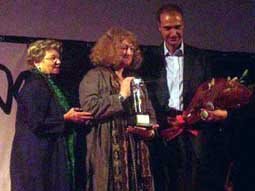
V@altesinanenews (in Italian) covers the retrospective of Jenny Beavan, costume designer of Zeffirelli's Jane Eyre, that took place in the recent Sannio Film Festival (more info on this post of ours and on this other one from the Brontë Parsonage Blog) (picture)

The Italian weekly magazine Sorrisi e Canzoni TV releases a collection of books with the name "I Capolavori" (The Masterpieces) for just sixty cents (of euros) to be bought with the magazine. July 3 was the date for Cime Tempestose (Wuthering Heights). The translation is from "Classici Oscar Mondadori".

And finally the Munich StadtMuseum in Germany organizes a series of projections under hte common denominator Filmadaptionen nach Romanen von Jane Austen & Co. (Film adaptations of novels by Jane Austen & Co.). Today, July 11 is the day for Die Waise von Lowood (i.e. Robert Stevenson's 1944 Jane Eyre). Last Sunday Stürmische Höhen (William Wyler's 1939 Wuthering Heights) was projected.

Categories: , ,

Saturday, April 23, 2011

KnightArts informs that the April 21st performance of Bernard Herrmann's Wuthering Heights at the Minnesota Opera was the chosen to be filmed in HD. There's a video where you can see the arrangements:
Tuesday night the Minnesota Opera did an eight camera High Definition video shoot of its production of Wuthering Heights. The HD video made for a night of many firsts—a first for any Twin Cities major cultural organization, a first for the Minnesota Opera and a first for this major work of art by one of the greatest composers of the 20th century. (Patrick Deware)
Still about Hermmann's Wuthering Heights. Next year (March 18, 2012) the American Symphony Orchestra will present a concert version of the opera at the Carnegie Hall, New York.

The Guardian reviews the Withering Looks tour by Lip Service:
More than just a potted version of Wuthering Heights, it's a witty send-up of Emily and Charlotte's novels featuring strange moans coming from the attic, lost souls, and a wind machine. The award-winning show has been around for a good few years and remains one of the most popular plays in the repertoire of a company whose comedy-theatre style has seldom been bettered. (Lyn Gardner)
Jane Eyre 2011 is reviewed by

Inside Pulse:
What people should take away from this umpteenth adaptation of Jane Eyre is that it is possible to cut the fat of a classic novel and have it retain its heart and soul. Also, it helps when you have two comparable leads, as is the case with Mia Wasikowska and Michael Fassbender. Wasikowska is so good at expressing much when expressing very little. The moments where hand-held cameras are walking with her are visual proof. Jane Eyre, while not a complete cure all for box office malaise at the moment, is still worth your time and should appease those who at the very least enjoyed Joe Wright’s stellar interpretation of Jane Austen’s Pride and Prejudice.  (Travis Leamons)
Albany Times-Union:
I’d also love to recommend Jane Eyre (you can link to my earlier entry here and my full review here). This gorgeously-filmed and brilliantly-acted adaptation of Charlotte Brontë’s classic novel of gothic romance is my pick for best film of 2011 so far. (Peg Aloi)
The Portuguese premiere triggers some articles and reviews in the local media:

IOnline talks about the Brontë sisters with the usual mix of facts, legend and blunders:
Se a família Brontë fosse um prato de comida chinesa, não poderia constar no menu como "família feliz". Dos seis irmãos, órfãos de mãe, atenção, sobraram quatro: Charlotte, Branwell (o único rapaz), Emily e Anne.
Juntos criaram um mundo imaginário chamado Angria e encheram caderninhos com histórias passadas nesse universo alternativo.
As três manas, mais amigas das letras, chegaram mesmo a editar um livro de poemas em conjunto, sob os pseudónimos masculinos de Currer, Ellis e Acton Bell.
A tragédia chegou em 1848, com a morte de Branwell, alcoólico e viciado em ópio, e de Emily, que sucumbiu à tuberculose. No ano seguinte seria a vez de Anne, que ficou tísica por causa da irmã. Uma desgraça nunca vem só.
Charlotte, a resistente, só morreria em 1854, grávida do primeiro filho, de desidratação, consequência de uma pneumonia. Dizem as más línguas que a escritora poderá ter-se deixado morrer. Com tantas tragédias acumuladas, quem somos nós para julgar? (Diana Garrido) (Translation)
Let herself die? Charlotte? ... Anyway, she died in 1855. You can read the rest of the article here.

The film is also presented on Tvprime, Diário Digital, Correio da Manhã,

RTP-Cinemax (3 out of 5 stars)
A nova adaptação cinematográfica de "Jane Eyre", dirigida por Cary Fukunaga ("Sin Nombre"), é fiel a essa energia romântica, ao mesmo tempo confirmando-nos a admirável subtileza de Mia Wasikowska, uma actriz que, não tenhamos dúvidas, se vai impor como um talento realmente invulgar. (...)
Fukunaga percebeu isso mesmo e faz um filme que renova as nossas esperanças no romantismo, ao mesmo tempo demonstrando que a relação com a literatura não tem que ficar presa das convenções que dominam muitas "reconstituições históricas" de raiz televisiva.  (João Lopes) (Translation)
Las Horas Perdidas reviews Dario Marianelli's soundtrack in Spanish.

And the blogosphere: Ardith's Quest, An Extrordinary Machine, Seongyong's Private Place, A última sessão (in Portuguese), A Lovely Inconsequence, thumbsupordown?. 

The Commercial Appeal (Memphis) talks with Candace Bushnell who admits to her Brontëiteness:
And what does Candace Bushnell read when she's not writing? Right now, she says, "A Widow's Tale" by Joyce Carol Oates, and next, "Jane Eyre" by Charlotte Brontë. "I've read it three times, but I'm one of those people, I read the same book again and again." (Peggy Burch)
Edward Champion reviews Wide Sargasso Sea on Reluctant Habits. He likes Jean Rhys's prequel far better than Jane Eyre:
As someone who has recently confessed his own blind spots and “allergies” in relation to Jane Eyre (along with a willingness to confront this aesthetic resistance), I feel it incumbent to report that Jean Rhys’s masterpiece placed me in such a great trance that approaching it like some notch to be etched on my belt or miscomprehending the first part never entered my mind. If anything, I wished to comprehend it more. It could very well be that the silly ambition of this project has forced me to become obsessed with some of the individual volumes. But when I read Wide Sargasso Sea a second time, I had to stop myself from reading it a third time. (Read more)
The South Florida Sun-Sentinel's TV Q&A column talks about Elizabeth Taylor's role in Jane Eyre 1944:
Q. I have been a fan of Elizabeth Taylor for many years and have watched all her movies. Whenever her movies are mentioned, her role as Helen Burns in the 1939 version of "Jane Eyre" is not. She is not on the credit roll but one cannot deny that it is her. Why? -- R.M., Sunrise
A. The version of "Jane Eyre" you are referring to was made in 1943. Liz Taylor is listed as playing Helen Burns on the Internet Movie Data Base (IMDB.com, a great resource) but it is noted "uncredited." Actors choose not to take a credit for many reasons, often because the role is not prominent or because they don't want to mislead their fans. (Tom Jicha)
Iowa Press-Citizen interviews the poet Robert Pinsky:
Jeff Charis-Carlson: How is reading a poem on a Kindle different than reading it in a book, journal or magazine?
RP: I've never bonded with my Kindle -- I use it to read a chapter or two of Dickens or Brontë or Elmore Leonard on airplane rides.
The Daily Hampshire Gazette publishes an obituary of the local author Athena Warren:
She loved to edit her children's and grandchildren's essays for errors of grammar. In the last few years of her life, Athena became especially enamored of Charlotte Brontë and her work "Jane Eyre," which she read and underlined, and reread and annotated, and reread, etc.
The Spanish writer Ana María Matute recommends Wuthering Heights once again:
La Matute no se olvida de los cuentos de los hermanos Grimm, Perrault y Andersen, sobre todo los de este último «porque era un escritor»; no olvida 'Huckleberry Finn' «con el que me asomé al mundo de los adultos», ni tampoco las obras de Chejov, Kafka -«una lección del literatura»-, Emily Brontë -«cada vez que he leído 'Cumbres borrascosas' he sentido que estaba dentro del libro»[.] (Gontzal Díez in La Verdad) (Translation)
Otro de sus héroes literarios fue Faulkner, «al que no pude conocer»; y, remotándonos en el tiempo, cita a Emily Brontë. «Ella fue quien me abrió los ojos. Me di cuenta que se podía escribir de todas las maneras... Y me arranqué con “Los Abel”. Si no hubiera leído “Cumbres borrascosas” no habría realizado ese libro. Me dio alas para escribir de una familia desgarrada». (Ángel de Antonio in ABC) (Translation)
El Nuevo Herald (Spain) visits Haworth and talks about it:
Imagínense esta escena de hace más de 150 años. En el pueblo de Haworth, en Yorkshire, tres diminutas mujeres están sentadas en el comedor de su casa, escribiendo novelas con la esperanza de publicarlas. Su padre, de humilde origen irlandés, ha llegado a ser el Reverendo Patrick Brontë, gracias a su gran educación. También ha publicado libros de poesía, y alienta a sus hijos -incluyendo a las hijas- a educarse. Branwell, el único hijo y talentoso poeta y pintor, otrora esperanza de la familia, está adicto al opio y al alcohol. Las tres hijas, al fín, logran publicar sus novelas bajo los seudónimos de Currer, Ellis y Acton Bell. Jane Eyre se convierte en éxito comercial y literario. Otra, la genial Cumbres borrascosas, alarma a los críticos por su salvaje pasión y amoralidad. Ambas son obras clásicas de la literatura mundial. Hablamos de una de las familias literarias más famosas de la historia: los Brontë. (Aida Levitan) (Read more) (Translation)

We wonder what this columnist from La Opinión de Málaga has in mind when he uses the Brontë sisters as examples of Holy Week devotion ("that honest Popish superstition"):
A veces pienso, ¿y si no se acuerdan? ¿Y si se equivocan? Pero no, los nazarenos llevan la lealtad hasta un nivel que espantaría por excesivo a las mismísimas hermanas Brontë.  (Lucas Martín) (Translation)
Le Monde reviews La Fuite en Egypte by Michel Chaillou and quotes from the novel:
"La littérature, c'est mon muscadet : avec elle, je prends la route. J'ai découvert, grâce à ce livre, que j'étais un Rom. Or, chose curieuse, Bertrand Poirot-Delpech disait que j'étais le Heathcliff de la littérature contemporaine. Et, dans Les Hauts de Hurlevent, Heathcliff est un Gitan ramassé à Liverpool par un pasteur." (Translation)
The readers of La Vanguardia (Spain) and Nosotras recommend Wuthering Heights for this year's Sant Jordi; Some reviews: Shelf Love reviews Shirley; My Love-Haunted Heart  Wuthering Heights and The Rimless Reader Jane Eyre, Reading for Sanity publishes the winner of their Café Press Brontë contest, Movie Matinee!.

Categories: , , , , , , ,

Wednesday, March 10, 2021

Wednesday, March 10, 2021 10:43 am by Cristina in , , ,    No comments
Source

Daily Mail reports that starting today Poets' Corner in Westminster Abbey will be used as an NHS Covid vaccination centre. Can you imagine anything more glorious these days than getting vaccinated by the Brontë memorial that says 'with courage to endure'?
Poets' Corner has been the tomb of some of the UK's most famous authors and poets for hundreds of years, starting with Geoffrey Chaucer in 1400.
Classic writers including Charles Dickens, Jane Austen, Charlotte and Emily Brontë, Rudyard Kipling, Lord Tennyson and Robert Burns are all either buried or commemorated there. (Sam Blanchard)
It's the last line of Emily's poem The Old Stoic, by the way.

Actualidad Literatura (Spain) asks writer Toni Hill about his favourite writers.
AL: ¿Y ese escritor favorito? Puedes escoger más de uno y de todas las épocas.
TH: Muchos. Desde Irving, a quien he citado antes, a clásicos como Tolstoi o las hermanas Brontë, Ana María Matute, Mercè Rodoreda o autores más recientes como Philip Roth, Coetzee o Jonathan Franzen… Tengo gustos muy variados y sería incapaz de escoger un solo libro o autor. (Mariola Díaz-Cano Arévalo) (Translation)
Causeur (France) likens Meghan Markle to a Brontë heroine.
Meghan a repris le scénario : enfermée dans un château comme quelque héroïne des sœurs Brontë, oubliée de tous (son mari fidèle disparaissant du tableau de manière aussi mystérieuse que commode), elle se serait inquiétée de sa « santé mentale » et aurait pensé au suicide. (Jeremy Stubbs) (Translation)

Sunday, November 25, 2007

Sunday, November 25, 2007 12:17 pm by M. in , , , , ,    No comments
Tonight, BBC1 will broadcast the second episode of Cranford, and The Independent (Ireland) publishes a nice article about it and Gaskell's life and work:
Seduced by Cranford, I fed my own addiction with the Life of Charlotte Bronte, that flagrantly and dangerously partisan but marvellous biography which I am convinced only a loving and passionate friend could have written. (Mary Leland)
Also tonight, ABC airs the first part (episodes 1 and 2) of last year's big BBC costume drama, i.e. Jane Eyre. Several newspapers publish alerts:
As she has done in 17 previous filmed productions, the young and supposedly plain Jane (Ruth Wilson) makes her escape from life at an orphanage to become the governess at Thornfield Hall. There she is put in charge of the illegitimate daughter of Edward Rochester, the great and moody romantic character created by Charlotte Bronte 160 years ago and played forcefully by Toby Stephens in this superbly seductive adaptation by Sandy Welch, directed by Susanna White for the BBC and WGBH Boston.
This is a fine yet tortuous romance. Though everyone is certain Mr Rochester is about to marry the local beauty Blanche Ingram (Christine Cole), he has become irresistibly drawn to Jane's wit and independence. Plain Jane, did we say? Bronte insisted on that but while it is impossible to place Wilson in this category, the make-up department does scrub her down nicely, particularly during the second escape, when Jane wanders onto the moors after the mysterious Richard Mason (Daniel Pirrie) disrupts her marriage to Mr Rochester at the altar.
There is tragedy, mystery, horror and madness here. It is an exceptional story and though Welch has just two episodes, he stays true to the original.
This handsome version was filmed on location in and around the medieval Haddon Hall in Derbyshire. (Robin Oliver in The Age)
The publishers have released a new edition of Charlotte Bronte's classic novel with the actress Ruth Wilson, in the title role tonight, on the cover.
It would be interesting to know how many viewers go on to buy the book.
The eldest of three Bronte sisters, Charlotte has on occasion been unfavourably compared to her sister, Emily, author of Wuthering Heights; her Jane Eyre, according to one critic, "a romanticised self-portrait".
Yet 160 years after its publication, this story of a Yorkshire orphan who becomes a governess and finds love with a troubled lord has proven one of the most enduring English novels.
Wilson, in her first major role, is a fresh and engaging not-so-plain Jane. Toby Stephens is more mannered and self-conscious as Edward Rochester.
This Jane Eyre might polarise some viewers. Some will marvel at the evocative setting. But others might wonder if the two-hour episode in this two-part series is not too long and the narrative too slowly paced. (Larry Schwartz in Brisbane Times)
By the way, remember Toby Stephens's hair extensions? Well, The Village Voice makes a passing comment in this article:
My affection for Toby Stephens is also based on film, or more properly, television miniseries. A few years ago he played a dashing Kim Philby in Cambridge Spies and a brooding Rochester (with really unfortunate hair) in the latest Jane Eyre adaptation. (Alexis Soloski)
The Baltimore Sun points out the Jane Eyre references in Peter Ackroyd's The Fall of Troy:
Ackroyd weaves these elements together with allusions to Jane Eyre as well as A Midsummer Night's Dream. There are several not-too-subtle references to Charlotte Bronte's Mrs. Rochester vis-a-vis Obermann's Russian wife. (Diane Scharper)
Girlebooks adds Anne Brontë's The Tenant of Wildfell Hall to its etexts catalogue.

And a new appearance of the Brontës melting pot virus. This time in The Charleston Post & Courier:
And Charlotte Bronte's "Wuthering Heights," which has the tortured love story between Heathcliff and Cathy. (Rebekah Bradford)
Finally, the Spanish newspaper ABC includes an article on the winner of the Spanish National Literature Award: Ana María Matute, who names Emily Brontë's Wuthering Heights as one of her favourite books when young. This is not new, however, for she has mentioned it in the past as well.

Categories: , , , , ,

Monday, October 15, 2018

Monday, October 15, 2018 10:07 am by Cristina in , , , ,    No comments
The Telegraph has compiled a 'definitive guide to Britain's best villages', including
Derbyshire
Designer: Hathersage
This historic village is nestled in the Peak District's Hope Valley, and is associated with literary figures such as Charlotte Brontë. Nearby North Lees Hall is thought to have inspired Thornfield Hall in Jane Eyre, and the grave of Robin Hood's right-hand man Little John is in the churchyard. (Anna White)
The Huffington Post (Spain) reviews the Madrid performances of Carme Portaceli's Jane Eyre.
Aunque es el cuerpo y la voz de Ariadna Gil, que hace de Jane Eyre, vestida de negro, la que con su presencia y su estar en escena va poniendo, metafóricamente hablando, las comas, los puntos y comas, los signos de admiración y los interrogantes de esta narración. E incluso los acentos. Signos de puntuación necesarios y significativos en toda obra que como esta, pretende tener un sentido.
Frente a los que Abel Folk, como Rochester, va colocando los versos sueltos de esta historia de amor, los versos que mueven y conmueven a la espectadora e igualmente al espectador. Como lo hacen con Jane Eyre, a la que los prejuicios, en forma de inamovibles principios, se agarra para sostenerse en pie. Para mantenerse.
Personaje rebelde que mantiene la sempiterna lucha moderna entre razón y corazón. Entre lo razonablemente bueno frente a lo deseablemente bueno. Lucha en la que se debaten las personas, incluso ahora, que se dice que estamos de vuelta de todo. Más cuando se habla de eso tan frágil, que tanto se rompe (a tenor de las estadísticas) como es el amor. Preguntas tan difíciles de responder como son las de ¿qué quiero? y ¿a quién quiero? que no se refieren a la orientación sexual de cada cual, sino a personas concretas que nos rodean. Pues el amor, tal y como lo cuenta esta novela romántica, no es para nada instrumental. ¿Que qué es? Un ámbito (im)posible de libertad, de igualdad y de responsabilidad. Emocionante ¿no? (Antonio Hernández Nieto) (Translation)
Apparently, it's Women Writers' Day in Spain and a couple of websites mention the Brontës, and particularly Emily's bicentenary.
La celebración este año del bicentenario del nacimiento de Emily Brontë ha inspirado el título de la actividad con la que Avilés celebrará el Día de las Escritoras: 'Té con las hermanas Brontë: rebeldes y transgresoras'.
La actividad consistirá en la lectura de breves fragmentos de textos escritos por autoras, propuestos por la Biblioteca Nacional. Se leerán fragmentos de Juana Manso, Carmen de Burgos, Delmira Agustini, Victoria Ocampo, Magda Donato, Idea Vilariño, Ana María Matute, Carmen Martín Gaite, Josefina Aldecoa, Alejandra Pizarnik, Esther Tusquets y Teresa de Jesús. (Cope) (Translation)
A pesar de los muchos nombres de escritoras que los especialistas conocen y estudian anteriores al siglo XIX,​ rara vez aparecen mencionadas en los manuales de estudio y ni siquiera en los programas de historia literaria de la universidad en España. En el siglo XIX, gran parte de las mujeres escritoras tenían que publicar con un seudónimo de hombre para ser tomadas en serio. Émily(sic) Brontë y sus hermanas fueron muestra manifiesta de ello. Cumbres Borrascosas fue publicada bajo el seudónimo de "Ellis Bell" ningún editor se atrevía a publicar, pues consideraban que ellas solamente escribían novelas de corte romántico.​ (Zamora News) (Translation)
Le Figaro (France) interviews artist Paula Rego mentioning in passing her Jane Eyre work. Rachel Sutcliffe reviews Samantha Ellis's biography of Anne, Take Courage, and finds the same fault with it that we did. AnneBrontë.org interviews DM Denton about her book Without The Veil Between, Anne Brontë: A Fine And Subtle Spirit.

Saturday, January 15, 2011

Saturday, January 15, 2011 7:18 pm by M. in , , , , ,    No comments
Janet Todd complains in The Guardian about Sebastian Faulks's author selection in Faulks on Fiction:
He scorns feminist criticism and pays no attention to recently excavated female writers such as Aphra Behn, stoutly declaring Defoe the first British novelist. He chooses some female authors from recent times – Monica Ali and Zoë Heller – but from the 19th century omits Charlotte Brontë and George Eliot. He has heard that students nowadays don't have the patience to read Middlemarch, although surely even an impatient student might manage The Mill on the Floss.
The Guardian also gives ideas for holidays and short breaks in 2011:
Now in its 21st year, The Oxford Experience (01865 270360, conted.ox.ac.uk/courses) at Christ Church from 10 July offers more than 50 residential five-day courses, covering topics as diverse as The Brontës and Warfare in the Modern World. (Joanne O'Connor)
The Ophiuchus zodiac sign discussion is a subject of debate in The Patriot Ledger:
Also, it turns out there’s a 13th zodiac sign, Ophiuchus, that we’ve been keeping locked up in the attic Jane Eyre-style all this time. (Dan Medeiros)
 The Guardian also traces a profile of Ted Hughes:
The Yorkshire Moors are as much a character in Wuthering Heights as they are in Hughes's poetry; many of Plath's poems are echoed or responded to in Birthday Letters.
Pipoca Moderna (Brazil) reviews the film Cracks by Jordan Scott:
Lançado direto em DVD no Brasil, “Sedução” acompanha o cotidiano de uma escola não muito diferente da frequentada por Jane Eyre no célebre romance gótico de Charlotte Brontë, embora sob uma orientação mais progressista, onde as estudantes fantasiam o tempo inteiro com aventuras românticas, em contraste à educação rígida e atmosfera austera de seus dormitórios. (Marcel Plasse) (Microsoft Translation)
Curiously, the author of the novel in which Cracks is based on is Sheila Kohler, who wrote recently Becoming Jane Eyre.

La Voz (Spain) compares again the Arjona sisters to the Brontës:
Es el primer libro para Remedios pero no para Teresa y Rosa María, que ya tienen otras publicaciones y premios literarios en su trayectoria poética. «Cuando lo enviamos a la Editorial Torremozas nos dijeron que nos habíamos pasado de versos, que eran demasiados». Hicimos una gran poda y luego nos lo definieron como un libro mágico e inédito en el mundo de la poesía, tipo hermanas Brontë». (V. Montero) (Microsoft translation)
El Diario Montañés and Periodista Digital find parallels between the TV series Bandolera and the Brontës:
Su protagonista es la actriz cántabra Marta Hazas que, tras su paso por el internado más famoso de la televisión, se viste de época para encarnar a «una mujer de armas tomar» que puede recordar a las heroínas de las novelas de las hermanas Brönte (sic). (Gema Martínez) (Microsoft Translation)
Il Giornale (Italy) makes a reference to Jane Eyre's Gytrash:
In questo romanzo che in patria ha avuto un successo immediato, infatti, si mischiano le tradizioni letterarie, il folklore - il cane nero rappresenta nelle leggende gallesi il demonio e compare in un'infinità di libri, da Jane Eyre sino al Gramo di Harry Potter, passando per Il mastino dei Baskerville di Conan Doyle - e la capacità di raccontare uno dei grandi mali del presente. Per di più sfruttando un testimonial d'eccezione come Churchill, il quale contro questa bestia nera dell'anima ha combattuto davvero, per tutta la vita. (Matteo Sacchi) (Microsoft translation)
Népszava (Hungary) has an article about the Brontë sisters:
Sikeres női írók: A Bronte nővérek
A lányok Yorkshire-ben (Anglia) születtek egy ír-anglikán pap, Patrick Bronte és Maria Branwell gyermekeiként. 1820-ban a család Haworth-ba költözött, ahol édesapjukat káplánná nevezték ki. A következő évben édesanyjuk rákban halt meg, maga mögött hagyva öt lányát és egy fiát, akikre nővére Elizabeth Branwell vigyázott. (Read more) (M. Kovács Ágnes)(Microsoft translation)
ADN (Spain) interviews Ana María Matute and the writer points again to Wuthering Heights as one of her favourite books; Suite101 reviews (in German) a 2000 audiobook edition of Sturmhöhe (Wuthering Heights) read by Gert Westphal; Nothing of Importance posts about Jane Eyre 2006; The Brussels Brontë Blog posts about Jolien Janzing's novel project about the Brontës stay in Brussels (more information on this previous post of ours). Matin (Canada) and Télérama (France) are eager to watch Jane Eyre 2011.

Categories: , , , , ,

Wednesday, October 26, 2005

Wednesday, October 26, 2005 7:04 pm by Cristina   No comments
Apparently one Charles Allen from The Corsair considers the Brontës to be one of God's tortures:

Besides, God has already tortured us enough with soap operas, the recording career of Bjork, each of the Bronte sisters, dog shows, Yanni, Julia Roberts movies, the Ford Pinto, every boy band ever created, and that lady who works at the Tom Thumb down the street from me.

Hmph!!

But on the other hand, Spanish writer Ana María Matute discovered Wuthering Heights at 17 and really liked it:

A los 17 me marcó «Cumbres borrascosas» de Emily Bronte.

(Which in Brontë language is: At 17 Wuthering Heights by Emily Brontë made an impression on me. And in Yorkshire dialect is: A' 17 Wutherin 'Eights by wee Emily Brontë made an impression on uz ;) ).

Categories: , ,

Saturday, October 03, 2009

Saturday, October 03, 2009 9:51 am by M. in , , , , ,    No comments
Paul Whitington compares recent Austen adaptations with Brontë ones in The Independent (Ireland) and reaches misled conclusions. Although we can more or less accept (though not agree with) the first one:
The fascination with Austen seems unstoppable, and it's interesting to contrast the fortunes of her novels with adaptations of the work of her near contemporaries, the Brontës.
Back in August, for instance, ITV screened a two-part adaptation of Emily Brontë's Wuthering Heights, starring Tom Hardy and Charlotte Riley. And while it was not without its qualities, it highlights the near-impossibility of turning Brontë's wildly gothic novel into a successful and coherent drama.
Thus far, Wuthering Heights has resisted all attempts to capture its atmosphere satisfactorily on film,
But the other one is simply wrong:
and while Charlotte Brontë's Jane Eyre has been more successfully adapted, it remains a period piece, a gothic romance with little relevance to today.
As any BrontëBlog reader can easily see day after day, Jane Eyre is VERY much present today and has a huge relevance.

A new review of Brian Dillon's Tormented Hope is reviewed in The Independent (Ireland):
As he scrutinises the illnesses of nine famous hypochondriacs -- Andy Warhol, Marcel Proust, Florence Nightingale, Glenn Gould, Charles Darwin, Charlotte Bronte, James Boswell, Alice James and Daniel Paul Schreber -- he is constantly trying to explain them by the light of that far from simple sentence. "You're only imagining it" is, after all, a mysterious concept, not least when you ask why humans should want to imagine being sick.
And in the Guardian:
Charlotte Brontë's hypochondria, he shows, was displaced on to Lucy Snowe or Jane Eyre, and how Proust's was an essential aspect of his art. Dillon is a self-confessed hypochondriac and his conclusion that "the power of imagination . . . is in itself a kind of pathology" has profound implications for literature. (Ian Pindar)
The Newspaper Tree (El Paso) announces the screening of Jane Eyre 1944 at the Film Salon at Trinity-First (check our sidebar for more details):
The Film Salon at Trinity-First continues its Orson Welles series with a presentation of the 1944 romantic melodrama Jane Eyre, at 7:30pm, Saturday, October 3. (...)
The Film Salon at Trinity-First meets the first Saturday of every month at 7:30pm in the Resler Hall Chapel (use the Montanan Avenue entrance). A nursery is provided with two days advanced reservations. All screenings are Free. 915-533-2674.
For more on the history and programs of The Film Salon, logon it our website at www.filmsalon.org
Allen Abel relates for The Globe and Mail a funny/scary anecdote from his days in China which has an unexpected Jane Eyre reference, Sarah Waters traces a profile of Angela Carter in the Guardian reminding us of her unfinished project:
At the time of her death, apparently, she was working on a sequel to Jane Eyre. I would have loved to have been able to read it.
The Hollywood Reporter informs about the death of Jewell Jordan, who was Merle Oberon's stunt in Wuthering Heights 1939:
Jewell Jordan Mason, who was Luise Rainer's stunt double for her Oscar-winning performance in 1937's "The Good Earth" and Merle Oberon's on "Wuthering Heights" two years later, died Sept. 24 in Camarillo, Calif. She was 92. (Mike Barnes)
We read in the New Zealand Herald how Hayley Westenra is not the only kiwi singing Kate Bush's Wuthering Heights, Miriam Clancy has her own version:
With that she launches into Wuthering Heights, the Kate Bush hit, expertly navigating its vocal acrobatics. Soon Clancy has Cathy fogging up Heathcliff's windows all over again.
Wuthering Heights can be used as a concept to review whatever you want: a romantic Filipino movie or an exhibition in New York of Austé:
Black cats, castles, forest huts and malnourished trees are often sighted on the horizon, rendered in calligraphic, folk-art flourishes. Titles in a “Wuthering Heights” tone contribute to the mood: “From This, No One Will Save Me!” (Roberta Smith in The New York Times)
Diario Sur (Spain) talks about femmes and hommes fatales:
En lo que respecta a 'l'homme fatal', si bien no se ha incidido tanto en su presencia en la literatura universal, sí que se encuentra en ella y no de modo esporádico, y tal vez habría que preguntarse por qué su existencia se ha tratado de un modo diferente a la de su variante femenina. Por no retroceder demasiado en el tiempo ¿Qué hay del Heathcliff de 'Cumbres borrascosas' y de la mayoría de los héroes de Byron e incluso del James Bond de Ian Fleming? (María Teresa Lezcano) (Bing translation)
We read in El Norte de Castilla (Spain) about Ana María Matute and Ángeles Caso's talk at the Segovia Hay Festival. It is well known the passion for Wuthering Heights of the author of Paraíso Inhabitado:
Sí dejó caer durante su charla algunas de esas lecturas casi sagradas para un escritor: Tolstoi, Dostoievski, Proust -al que adjudicó una sensibilidad femenina a la hora de escribir, para disgusto de un oyente- Flaubert... Ángeles Caso echó aquí una mano: «Sé que la encanta una novela por la que compartimos admiración: 'Cumbres borrascosas'». (Angélica Tanarro) (Bing translation)
Techinsight (Japan) finds echoes of Wuthering Heights in the Hiroyuki Nakano film Tajomaru (2009). Books, Comics, Writing and Other Misc Meanderings and Every Day is a Miracle post about Jane Eyre (this last one also reviews Jasper Fforde's The Eyre Affair), The Feminist Texican has been seduced by Ruben Toledo's new cover for Wuthering Heights, Bella's Bookshelf discusses briefly the influence of Jane Eyre in the Twilight saga, Horas Buenas has finished Charlotte Brontë's sampler and Doveygreyreader has received a very nice and Brontëan birthday gift.

Let's finish with a competition going on in Radio Times (just for UK residents):
We've got three copies of the DVD to give away, as well as a Philips portable DVD player worth £80 for one lucky winner, courtesy of ITV DVD!
For your chance to win, just correctly answer the multiple-choice questions opposite. The closing date is Thursday 15 October.
Please note that this competition is open to UK residents aged 18 or over only.
Categories: , , , , , ,

Saturday, June 26, 2010

Saturday, June 26, 2010 3:27 pm by M. in , , , , ,    No comments
Stevie Davis reviews for The Guardian Michèle Roberts's Mud: Stories of Sex and Love:
Feminist themes prevail: through invoking and subverting classic Victorian texts – Madame Bovary, George Sand's novels, Jane Eyre – the collection examines women's freedoms from provocative angles. (...)
The short story is an intimate, subtle and enigmatic form: Michèle Roberts reminds us in this virtuoso collection that she is one of our foremost practitioners of the art.
Another book in reviews of which appear Brontë references often (due both to the topic and the author) is Lyndall Gordon's Lives Like Loaded Guns: Emily Dickinson and Her Family's Feuds. In the Washington Times:
Nevertheless, enough of the record remains for the reader to learn about the poet's tastes: She loved the Brontës and Shakespeare. "She was drawn early to Jane Eyre, and Maggie Tulliver, George Eliot's provincial girl 'whose eyes were full of unsatisfied intelligence and unsatisfied, beseeching affection,' " Ms. Gordon writes. (Carol Herman)
John Inverdale chooses for The Sunday Express his favourite books:
Wuthering Heights: Another classic which is a wonderfully passionate book and is set in one of my favourite parts of the country.
I read it at school and have revisited it on several occasions since and every time I read it I get something new from a novel rightly held in such high regard.
We have to agree with Joanna Kavenna in The Guardian - the Brontës are probably not the best writers to turn to for advice in pregnancy:
So I started rereading. I went through a few books by Henry James, Knut Hamsun, Nietzsche, Jane Austen, Emily Brontë, Charlotte Brontë, Thomas Mann, but found them unforthcoming. Some writers had a lot to say about love and marriage but less about what might happen later.
True Brontëites will notice the (involuntary) irony of this comment from an article in The Guardian about current soap-operas, particularly Coronation Street:
Fickleness of the heart is all well and good when you're nubile like Tina, but the years fly by and quickly you're Mary Taylor, literally begging Norris to accompany you on a campervan excursion to Brontë country before slashing the phone wires and holding him captive until he agrees to wed. (Grace Dent)
Of course, now that The Twilight Saga: Eclipse hits the screens all over the world the whole Twilight-Brontë references stuff is reappearing again:
EDWARD = HEATHCLIFF?: Rent "Wuthering Heights." (We like the 1939 version with Laurence Olivier, Merle Oberon and David Niven.) Emily Brontë’s story, with its classic love triangle, was an inspiration for the Bella-Edward-Jacob relationship in the "Twilight" saga. In "Eclipse," Bella actually compares herself to Bronte’s heroine, Cathy, who’s torn between her feelings for two men. (Mary Colurso in The Birmingham News)
Say what you will about Meyer as a writer, she has an easy-to-read style and has created characters straight out of the great romances of classic literature—and that can’t be bad. Just look at the two men who inspired Edward’sname— the tormented Mr. Rochester in Charlotte Bronte’s “Jane Eyre” and the loyal and selfless Edward Ferrars in Jane Austen’s “Sense and Sensibility.” Do those traits sound familiar? Plus there are multiple references to Shakespeare, especially “Romeo and Juliet,” as well as Emily Bronte’s “Wuthering Heights.” Start reading. (The Buffalo News)
"Edward's always going to have a bit of a lead as he does in the story, as well," said Mark Englehart, senior editor of IMDb editorial.
"Edward personifies that kind of romantic hero from Gothic novels of the 19th century. He's kind of a little like Mr. Rochester in 'Jane Eyre,' the moody, attractive, mysterious man on horseback who comes to sweep the heroine away. ... The whole vampire thing almost seems like icing on the cake with this type of character: It enhances his appeal 10 times more." (Christy Lemire in Associated Press)
Ну а для тех, кому и этого мало, писательница активно вплетает в свое повествование литературные аллюзии: кроме "Ромео и Джульетты" в "Затмении" упоминается такая классика любовного романа, как "Гордость и предубеждение", а главным образом — "Грозовой перевал" Эмилии Бронте, составляющий основное чтение героини "Сумерек" не только из-за отсутствия в доме другой литературы, но и из желания Стефани Майер примазаться со своей политкорректной вампирской сагой к почтенной традиции готического романа. (Лидия Маслова in Коммерсантъ) (Google translation)
LA Weekly presents the L.A. performances of Lin-Manuel Miranda's The Heights with an (obvious) play of words:
WUTHERING "HEIGHTS"
"Wuthering" actually means windy not withering. Though the former is prevalent, the latter also applies to Lin-Manuel Miranda's Latino-rap-calypso musical about living and dying in Washington Heights, and trying to get out of a barrio that's poised for gentrification. (Steven Leigh Morris)
Today's The Mirror's Quizword Crossword contains a very easy Brontë question:
Charlotte Brontë novel featuring the character Helen Burn.
Spanish writer Ana María Matute doesn't miss a chance of reminding us of her Brontëiteness. In an interview in Diario Sur (Spain):
Creo que ya desde niña pensaba en ser como Brontë o Andersen.
-Sí. Primero, porque me contaban cuentos; luego porque los leía, y después porque con cinco años empecé a escribir. Imagina si lo tenía claro. (Marina Martínez) (Google translation)
Lost in Manchester posts about the Blue Plaque that Charlotte Brontë has in Manchester (in Boundary Street where she began writing Jane Eyre while his father was recovering from his cataract operation). Bad Wolf Day recasts Brontë adaptations.

Categories: , , , , ,

Saturday, October 12, 2019

The Yorkshire Post is looking forward to next week's event discussing the possible influence of Anne Lister on Emily Brontë.
It was over in a heartbeat, and it was doubtful that anyone in church even noticed it.
But the exchange of glances across the pews between Emily Brontë and Anne Lister may have been a seminal moment in literature.
On the outskirts of Halifax, two miles from where it happened, authors and historians will gather on Monday to consider just how deeply Gentleman Jack influenced Wuthering Heights.
It was in the autumn of 1838 that the 20-year-old Emily left home in Haworth for a seven-month teaching residency at Elizabeth Patchett’s progressive Law Hill School at Southowram, some 12 miles over the moors and in the shadow of Shibden Hall, Ms Lister’s family home.
During the harsh winter that followed, the sight of the oddly-dressed, aloof and sexually promiscuous Ms Lister awoke in the repressed and homesick Emily a rebellious streak that would characterise her work.
“They would absolutely have been in the same place at the same time, not least in church,” said Claire Harman, the author of five literary biographies, including Charlotte Brontë.
“The school had a pew at church and Anne Lister had a pew, and she would have heard all the gossip about her, not least from Miss Patchett, who was running a girls’ school right next to Shibden. She was known as Gentleman Jack even then.”
The snobbish Ms Lister is unlikely to have noticed the “downtrodden, underpaid, miserable assistant teacher” across the church, but the encounter left a lasting impression on Emily’s work, said Ms Harman, who is one of the speakers at Monday’s event inside Halifax’s Bankfield Museum, where costumes from this year’s TV series about Ms Lister are also on show.
“Emily Brontë was actually much more of a free and untrammelled spirit than even Anne Lister. She was not somebody who bothered about conventions at all,” she said.
“She had a heretical and an amoral mind, which is what makes her a great and very unusual poet.
“I‘ve thought for a long time that Wuthering Heights is a homo-erotic novel, or at least a non-heterosexual one. Heathcliff is not my idea of a romantic hero.
“Its stirring-up comes from Emily’s experience at Law Hill, and Anne Lister’s strangeness and power was a big part of that.”
Nick Holland, another Brontë author, also said Emily would have been impressed by Ms Lister. “I think she felt a kindred spirit – not sexually, but as a unique, intelligent woman who struck out on her own. That’s the sort of person Emily was,” he said.
Angela Clare, collections manager at Calderdale Museums, who has organised Monday’s public event in partnership with the Brontë Parsonage at Haworth, said Ms Lister’s current TV fame, after two centuries hidden from the world, had caused literary historians to now consider her work considered alongside the Brontë sisters.
“Anne Lister never published, but her achievement of 5m words of diaries can’t really be overlooked,” she said.
“There are lots of crossovers with the Brontës in the type of lives they led, in the same area at around the same time, so we wanted to experiment and bring them together for a conference.”
Helena Whitbread, the historian who transcribed Ms Lister’s coded text, will also speak at Monday’s all-day event, for which tickets at £45 are on sale at bronte.org.uk. (David Behrens)
Via The Outline, we have come across this Instagram post by Flea (of Red Hot Chili Peppers fame).


Book Riot has an article on 'Jane Heir: Writers, Families, and Writer Families', including of course
The Brontë Sisters: Anne, Emily and Charlotte
Arguably the most famous group of sibling writers of the literary canon, these ladies wrote some of the most beloved British classics. With Jane Eyre, Agnes Grey, The Tenant of Wildfell Hall, and Wuthering Heights, the sister Bronte may prove that literary talent is genetic. (Corin Balkovek)
Prensa Libre (Guatemala) features the #LeoAutorasOct movement, which is about only reading women writers during October.
“En octubre, lea solo a escritoras. No importa el género, edad o el siglo. Desde Mary Shelley a Dolores Redondo, desde Virginia Woolf a Mariana Enríquez, desde Anne Brontë a Ana María Matute. Si lo ha escrito a una mujer, atrévete a leerlo” (Astrid Morales) (Translation)
Le Devoir (Québec, Canada) reviews the novel Les Foley by Annie-Claude Thériault.
À travers la voix des narratrices, dont certaines sont adolescentes ou à peine sorties de l’enfance, on se rappelle les jeunes héroïnes en communion avec la nature, posant un regard lucide sur leur injuste condition et sur la cruauté de la société envers elles, que l’on rencontre chez les sœurs Brontë. Le souffle poétique traversant chaque récit évoque également la douce révolte ayant animé Emily Dickinson. (Manon Dumais) (Translation)
Sensacine (Spain) recommends watching Jane Eyre 2011 this weekend.
'Jane Eyre': Brontë, Romance, Fantasmas y Fassbinder
Por qué la recomiendo: Reconozco que soy más de ver las adaptaciones cinematográficos de clásicos literarios que de leerlos y también que terminé viendo Jane Eyre por una entrevista en The Graham Norton Show a Michael Fassbender en la que el actor contaba que el caballo que montaba en la película se excitaba cada vez que se subía encima de él. Pero la cinta, dirigida por Cary Joji Fukunaga -sí, el mismo de la nueva James Bond-, me sorprendió para bien. El romance entre el misterioso Edward Rochester y su heroína protagonista engancha. También el fantasma que ronda por la mansión de Thornfield Hall y el estilo visual con el que Fukunaga cuenta esta historia. Película perfecta si tu plan es un "sofá y manta" en toda regla.
Te gustará sí... te apuntas a todas las adaptaciones de Charlotte Brontë o Jane Austen, a las historias románticas con aire gótico o al trabajo de los actores Michael Fassbender y Mia Wasikowska. (Andrea Zamora) (Translation)
MD Theatre Guide reviews a local stage production of Agatha Christie's And Then There Were None.
Of all the characters, Sara Bennett’s Emily Brent, is at once the most enigmatic and the most obvious. This is a woman who would have thought that the judges at the Salem witch trials were soft on crime. And, she doesn’t believe that her crime—driving a 17-year-old pregnant, unwed girl (this is set in the late 1930s) to suicide is a crime. She was upholding society’s standards and morals, and if people have to die for that, then that’s acceptable. She embodies all the repressed women from Jane Eyre through any of Henry James’s characters, yet you don’t sense any vulnerability or reason for this extreme rigidity. In fact, one thought was that she’d make an excellent serial killer, so unflinching is her personal code. One doesn’t see the fun in watching this character die for the mysterious Mr. or Mrs. Owen—and in fact, she’s simply stung with a hypodermic needle (stand-in for a bumblebee) and goes to sleep, permanently. It’s as if she was removed because, in some ways, she’s the most dangerous of any of the alleged murderers. (Mary Ann Johnson)
Hip Hop Corner (France) features French rapper pone and his album Kate & Me.
S’il ne renie évidemment pas son héritage passé, cet album est avant tout centré autour de Kate. Comprenez, l’auteure-compositrice-interprète britannique Kate Bush, pour qui l’artiste voue une profonde admiration. « Elle est très inspirante et je suis à des années-lumières de son talent. Sa musique représente tout ce que j’aime, la profondeur, la beauté, la singularité, l’émotion et l’innovation« .
Pour illustrer tout ça, Pone lui dédie son album, mais surtout le premier morceau « It’s Me Cathy », en étirant un sample de son titre « Wuthering Heights », sorti en 1978. « J’ai trouvé que la façon dont elle disait « Its me Cathy » dans son morceau avait quelque chose de profondément hip-hop, et que ça irait bien avec Biggie. Aussi, il faut savoir que c’est elle qui a utilisé le premier sampler, donc on est forcément liés », affirme l’artiste. Forte du début à la fin, cette introduction lance le projet en fanfare avec un feu d’artifice sonore. Un véritable spectacle durant lequel le beatmaker clame haut et fort son retour triomphal aux machines. Il faut que Kate Bush entende ça. Où es-tu Cathy ? (Jérémie Leger) (Translation)
Express looks into the financial struggles of music/entertainment retailer HMV.
Mr Hyman continued: “When you want to buy a Charlotte Brontë novel, a Shostakovich piece or Cinema Paradiso they are going to be the same wherever you buy them from.
“If you’re selling something which is unique you’ve got something to defend there.”
HMV has been fighting against online giants such as Amazon which often offer the same products, readily ordered straight to the customer’s front door.
The retail analyst also explained that “the economic model of retailing is under unprecedented challenge”.
He said: “In order to make money you have to add value – adding value to a product that is made by somebody else is really difficult because where can you differentiate yourself? (Kate Nicholson)
The Times has published the obituary of John Chapple, scholar and biographer of Elizabeth Gaskell, who completed the monumental task of compiling the letters of such as prolific letter writer as Mrs Gaskell was.

Sunday, May 22, 2016

Aftenposten (Norway) has an article on Anne Brontë:
Kanskje var hun for ærlig for sitt eget beste
Hvorfor blir vi aldri ferdig med Brontë-søstrene? Det enkle svaret er vel at de står bak to av 1800-tallslitteraturens mest pasjonerte og høydramatiske kjærlighetsfortellinger, om Jane og Rochester, Catherine og Heathcliff (se sidesak).
Det litt mer kompliserte svaret handler om at romanene de skrev er formmessig avanserte og kan leses på en rekke ulike måter. Emily Brontës Wuthering Heights fra 1847 er visstnok det mest analyserte verket i engelsk litteraturforskning
Litteraturhistorien har ikke fart like pent med den yngste av de tre prestedøtrene fra Yorkshire, Anne – hun er blitt mer eller mindre avskrevet som den uten talent. Men er det bare mangel på begavelse som gjør at hun er glemt, eller er forklaringen mer sammensatt? (Translation) (Anne Merethe K. Prinos)
TheGay UK reviews Northern Ballet's new Jane Eyre production:
At times the choreography was beautifully done, leaning far more towards the contemporary rather than the traditional, with a lot of delicate lifts, floor work and precise movement, contrasting moments of tender intimacy with complex ensemble pieces. Both Dreda Blow and Javier Torres’ performances were more than noteworthy and displayed their professional competence; whilst overall, the supporting company’s movements were of their usual high quality. (...)
Overall, adapting Jaye (sic) Eyre is a huge task and one which is beautifully staged and performed, but the juxtaposition of the contemporary dance and the period setting, coupled with the rushed narrative amounts to a production which is enjoyable, but doesn’t quite come together to be more than the sum of its parts. (Paul Szabo) 
An auction in Bradford with Brontë echoes. In The Telegraph & Argus:
A leisure complex in Bradford city centre is up for auction with a £1 million price tag.
Glydegate Square in The Chester Street - which houses the Tequila nightclub and was formerly home to the Walkabout pub chain, was built in 2002.
Also included in the auction is Fountain House site, a grade II listed Victorian facade of the former Fountain Hall Quaker meeting house in Fountain Street in the city centre.
The lot also includes a gated 16-space car park, and is next to the site where Branwell Bronte, brother to Charlotte, Emily and Anne, took lodgings between 1838 and 1839, and earned a living as a portrait artist, before he took to drink and drugs. (Mark Stanford)
The Sunday Leader (Sri Lanka) has an article vindicating Wide Sargasso Sea:
One of my favourite books of all time, Wide Sargasso Sea, is a powerful novel by Jean Rhys’ published in 1966 as a prequel to Charlotte Brontë’s ‘Jayne Eyre’(sic), published in 1847. Why write a prequel to such a classic book over 100 years later? Rhys noticed that the character of Bertha Mason (the infamous mad woman in the attic) had no voice, people spoke on her behalf. Rhys felt that Brontë’s treatment of the character of Bertha Mason was a little unfair. Bertha deserved to have her story told just as much as Jane did. (Read more) (Sadhana Senanayake)
The Stuff (New Zealand) reviews Caitlin Moran's Moranifesto:
The eldest of eight children, with an astonishingly impractical father whose health issues prevented him from working and a mother who kept everyone alive, Moran also drew inspiration from Miss Piggy, Anne of Green Gables, Jane Eyre and Judy Garland. Strong, awkward females who wanted more from life than anyone thought they should have – who had the gall to think they could be leading ladies too. (Eleanor Black)
Justin Chang in Los Angeles Times lists several of the films seen at the Cannes Film Festival. Including Park Chan Wook's The Handmaiden:
A sort of “Gaslight”-meets-“Jane Eyre” with a big ol' splash of “Diabolique,” “The Handmaiden” has predictably generated a lot of ink over its explicit lesbian love scenes — a touch that might well have been decried as exploitative (just as “Blue is the Warmest Color” came under attack here at Cannes three years ago), if not for the righteous narrative primacy that Park grants his leading ladies.
Still in Cannes. Todd McCarthy (The Hollywood Reporter) is not a fan of Andrea Arnold's Wuthering Heights 2011:
I liked Arnold's initial film work, up to a point, but her dreadfully misjudged Wuthering Heights and now this reveal the extreme limits of her talent.
The film is mentioned in a review of Sophie Barthes's Madame Bovary in El País (Spain):
Una cualidad que acaba emparentándola con otra adaptación de novela clásica adaptada recientemente con renovada fuerza por una mujer, las Cumbres borrascosas de Andrea Arnold, y que queda articulada como prolongación de la naturaleza interior del personaje ("yo solo quería emociones, no disciplina"): un junco salvaje en tiempos de ataduras sociales. (Javier Ocaña) (Translation)
And El Mundo (Spain) returns to Cannes comparing Wuthering Heights 2011 and Andrea Arnold's latest films American Honey:
En el centro, la historia de amor entre la protagonista interpretada por Sasha Lane y el personaje de Shia Labeouf trae a la memoria algunos de los instantes mejor definidos, arrebatados y profundamente libres de Cumbres borrascosas. (Luis Martínez) (Translation)
La Huella Digital (Spain) interviews the writer Nieves Abarca:
P.: ¿Cuál es tu novela favorita y de qué autor? ¿Te gusta releerte un libro si te ha gustado mucho? ( Marta Morales Regacho )
R.: Tengo muchas y muchos autores favoritos. Me fascinan Cumbres borrascosas y Jane Eyre. Y de españolas: Olvidado Rey Gudú de Ana María Matute y No llames a casa de Carlos Zanón. (Translation)
Diário de Notícias (Portugal) interviews Paula Rego who highlights the deep Portuguese substrate of her works:
Há uma nova exposição da mais famosa pintora portuguesa anunciada para esta quinta-feira. Que mesmo sendo o título da exibição em inglês, Old Meets New, é o mais portuguesa possível. Ora não confessasse a própria Paula Rego isso mesmo na entrevista que concede ao DN a propósito desta nova apresentação em Cascais de quatro séries de trabalhos, quando afirma que enquanto artista se sente assim: "Todo o trabalho que faço é de alguma maneira português. Até a Jane Eyre." (João Céu e Silva) (Translation)
Wymarzona Książka (in Polish) posts about a Polish edition of Elizabeth Gaskell's The Life of Charlotte Brontë.

Thursday, June 26, 2014

Thursday, June 26, 2014 10:32 am by Cristina in , , , ,    No comments
The Telegraph and Argus features the street artist who created the Brontë sisters stencil in Haworth.
A street artist has created a life-sized stencil of the Brontë sisters riding a bike - in celebration of the Tour de France coming to Yorkshire.
The work, by a mysterious Bristol-based artist known as Stewy, is on the side of Haworth Fire Station. The Brontë siblings lived in Haworth.
Stewy, who has offered to donate half of the money made from sales of the print to The Fire Fighters Charity, said: "I wanted to give something back to The Fire Fighters Charity as a thank you for allowing me to use Haworth Fire Station as a canvas and I really hope the locals and visitors to the area enjoy the stencil.
“I have been doing this subject matter for 20 years, British identity as a theme, but I’ve been doing stencilling since 2007.”
The artwork is part of a series of images of musicians, artists and writers who have popped up in the places with which they are associated across Yorkshire.
Stewy said: “It works on so many levels. People go to Haworth because they know of the Brontës. Kids can graffiti but might not be good at English or be a bit troubled. You might find some kids who might pick up Wuthering Heights because they have looked at street art and there’s a picture of the Brontës.
“I like to be spontaneous. There’s something quite nice about going to do it, leaving it and letting it go so it belongs to everybody."
The Telegraph and Argus also has an article on Haworth... on the other side of the pond.
Haworth needs help to expand its library – but not Haworth in West Yorkshire!
A representative for a library in the small suburb of Haworth in the North American state of New Jersey, has broadcast an appeal to locations and businesses which are named after this iconic village.
Beth Potter, co-president of the Friends of Haworth New Jersey Library, said: "We've begun construction on an expansion to our library.
"I'm approaching any entity that has the name Haworth associated with it, so therefore might have some Haworth pride.
"We do know for a fact that our town of 3,000 people is named for Haworth, England. One of the financiers who helped bring a railroad through our town in 1872 was himself a novelist and a fan of the Brontë sisters, and so he named our little station stop Haworth."
Councillor John Huxley, chairman of Haworth, Cross Roads and Stanbury Parish Council, said: "I'm happy to put their appeal to our council's finance committee.
"We're happy to talk to them and further our links."
People can visit haworth.bccls.org to find out more about Haworth New Jersey's library.
The Atlantic discusses where genius comes from.
Francis Galton, a cousin of Charles Darwin, took a much more rigorous approach to the topic. In his 1869 book, Hereditary Genius, Galton used careful documentation—including detailed family trees showing the more than 20 eminent musicians among the Bachs, the three eminent writers among the Brontës, and so on—to demonstrate that genius appears to have a strong genetic component. He was also the first to explore in depth the relative contributions of nature and nurture to the development of genius. (Nancy Andreasen)
This Roanoke Times reviewer has written a disclaimer on religion and books.
I intended to do a formal review of the book, but when I read the back, I glanced down and saw its categories: fiction, romance, Christian. I panicked slightly, because while I'm not areligious, religion really isn't my subject. It interests me from historical and cultural perspectives, but I consider religion to be a personal, private subject. Even writing this blog post is making me uncomfortable.
Perhaps an example is in order, because I don't want anyone to think I drop a book the second it mentions anything to do with religion. I'm all right reading, say, "Jane Eyre" in which God, prayer and religion play important parts, but are not starring roles. They are woven into the fabric of Jane's culture and are dealt with as matter-of-factly as I'd expect from a 19th-century novel. There is a historical aspect to this, too; Christianity permeated society much more back then, and I assume Charlotte Brontë assumed there was no chance her novel would offend anyone from a religious standpoint because that's just how life was. (Suzanne Wardle)
However, the Little Rock Books Examiner dwells on the Gothic aspect of both Jane Eyre and Wuthering Heights.
One of the most popular Gothic novels of all-time, the beloved Jane Eyre by Charlotte Brontë, features Edward Rochester, who appears to be a mild anti-hero early on because of his brutish manner and surly disposition but as the story unfolds, Rochester is driven to immoral and shockingly deceptive behavior. However, when the reader discovers how tortured the character is, as a result of burdens beyond his control, it is easy to sympathize with him and understand his actions. Creating sympathy for an anti-hero is a very effective way to endear the reader to him. [...]
It is almost impossible to talk about anti-heroes of Gothic fiction without mentioning Wuthering Heights by Emily Brontë. Although the very conflicted heroine, Cathy, is far from the killers or unscrupulous criminals featured in many such books, her greed and arrogance destroys Heathcliff’s life and her own. The fact that she suffers so greatly and meets with a tragic end makes her naturally sympathetic to readers. The price she pays for her actions utilizes another highly effective technique for dealing with anti-heroes: punishment and repentance. (Jennifer Lafferty)
Misiones Cuatro (Argentina) mourns the death of Spanish writer Ana María Matute and describes her as a Brontëite.
En aquellos años, se deleitaba con «La recherche» de Proust y las «Cumbres borrascosas» de Bronte, que leyó a los 17 años. Todavía conservaba el libro en su biblioteca. Colección La Nave: «Se cae a trozos, no se puede ni tocar… A veces pienso: ‘¿Para qué escribir? ¡Que escriban otros! ¡A mí lo que me gusta es leer!» (Translation)
10 things writers can learn from Jane Eyre on Helping Writers Become Authors. Bring My Books posts about the novel and  The Phantom Paragrapher reviews Always Emily by Michaela MacColl. The Brontë Parsonage Twitter asks about your favourite Brontë quotes.