Sunday, July 14, 2019
An Evolution of Jane and Lizzie: Adaptation Studies Need to Accommodate for the Rise of Internet-Based Media
by Katherine Anne Bryce
The University of Vermont, 2019
Adaptation studies have been a part of film studies since the beginning of cinema itself. However, there is a need for a push in a new direction to incorporate and acknowledge internet-based, web-series adaptations. The purpose of this paper was to come to terms with the current status of adaptation studies as a field and to determine how to best incorporate internet-based media into the previously established framework. Combining a study of adaptation studies with a study of transmedia and the specificities of internet-based media, I looked at two web-series adaptations of classic novels: The Lizzie Bennet Diaries, an adaptation of Pride and Prejudice by Jane Austen, and The Autobiography of Jane Eyre, an adaptation of Jane Eyre by Charlotte Brontë. Using these two case studies, I outlined the distinctive characteristics of web-series adaptations - their benefits and their drawbacks - as a means of showing how adaptation studies could benefit from an expansion to incorporate the new media our technology is producing.
Riscrivere Jane Austen e le sorelle Brontë: Emma Tennant e il romanzo intertestuale
by Marinella Ferri
Università degli Estudi di Modena et Reggio Emilia, 2019
The aim of this work is to investigate the main characteristics of the “intertextual novel”, adapting the famous definition of Gèrard Genette, through an analysis of some novels by the contemporary Scottish author Emma Tennant. In particular, we will focus our attention on her rewritings of Pride and Prejudice, Emma, Wuthering Heights and Jane Eyre, each of them exemplifying a particular type of intertextuality. The dissertation is divided into three parts. The first one will present the different kinds of intertextuality, while the other two will discuss Tennant's works. The theoretical frame of the thesis is informed by Gérard Genette’s notion of transtextuality, in particular the categories defined as intertextuality and hypertextuality. In postmodernism, they are very popular practices, and they are also used by Tennant, who, like other contemporary writers, resorts to textual strategies such as pastiche, sequel and forgery. In the first part of the Nineties, Tennant rewrote various novels by Jane Austen. This dissertation will analyze Pemberley, A Sequel to Pride and Prejudice (1993) and Emma in Love, Jane Austen's Emma Continued (1996). The first one is a sequel of the famous novel of Austen; the narration begins one year after the conclusion of the hypotextual story and it is set during the Christmas period in Pemberley. Tennant uses the main characters of Pride and Prejudice with their main characteristics; for example, Elizabeth Bennett is, once again, victim of prejudice and Mr Wickham plays the role of the villain. In Tennant’s novel the House of Pemberley is like a stage on which all the characters have their moments to appear. In the sequel of Emma, Tennant maintains the original plot, which once again has at its core a capricious heroine who, in this case, never achieves her maturity, not even at the end of the novel. We see the new heroine organizing a marriage between her brother-in-law Mr John Knightley and Miss Jane Fairfax, until she meets an enigmatic French Woman who creates in her a lot of curiosity. The third part of this work examines Tennant’s rewritings of Wuthering Heights and Jane Eyre. Tennant's aim is to give voice to minor characters of the hypotexts. Heathcliff's Tale (2005) and Thornfield Hall (2006) are composed by complex narrative structures and different versions of the same story. For example, in Heathcliff's Tale the narration is given in Chinese boxes all linked together by the figure of the editor. In Thornfield Hall the author gives voices to different characters who narrate the story following Brontë's hypotext but adding new parts.
Thursday, October 05, 2006
Today is the release date of the new book of Emma Tennant: The French Dancer's Bastard, published by Maia Press. The bastard is Adèle, from Jane Eyre.Emma Tennant is well-known for her sequels and rewritings of Brontë and Austen books mainly (but not only, check her bibliography. This half of BrontëBlog read some years ago a fictionalized version of the marriage of Ted Hughes and Sylvia Plath, The Ballad of Sylvia and Ted). Almost a year ago, we published an article covering the recent publishing of her, until now, latest Brontë approach: Heathcliff's Tale.
Six years ago, she published a first approach to the Jane Eyre background story with Adèle: Jane Eyre's Hidden Story. And now, Emma Tennant revisites her own book and presents a slightly modified version. According to the editors:
This novel is a revised version of 'Adèle', which was published earlier in the USA but not in the UK.The details are the following (you can compare with Adèle's synopsis):
‘What do you mean, Jane? I told you I would send Adèle to school; and what do I want with a child for a companion, and not my own child, – a French dancer’s bastard?’ from Jane Eyre by Charlotte Brontë.Next year is scheduled to appear Thornfield Hall: Jane Eyre's Hidden Story, that we assume is another title for the same book.
In her new novel Emma Tennant tells the story of the shadowy character, Adèle Varens, from Jane Eyre. Little Adèle is only eight when she comes to Thornfield Hall to live with the forbidding Mr Rochester, who may or may not be her father. She longs to return to the glitter of Paris and to the mother who has been lost to her. Her loneliness would be complete were it not for the young governess who arrives to care for her, although Adèle at first regards her with suspicion and dislike.
But there is another shadow hanging over their lives: the dark secret locked away in a high garret. Adèle’s curiosity will imperil them all, shatter their happiness and finally send her fleeing, frightened and alone, back to Paris.
Published to coincide with this autumn’s major four-part drama of Jane Eyre starring Toby Stephens as Mr Rochester and Ruth Wilson as Jane Eyre, Emma Tennant’s new novel casts a surprising new light on Charlotte Brontë’s ever-popular masterpiece.
Categories: Sequels, Books, Jane_Eyre
Monday, September 26, 2005

Further on books, there was a new one published last spring that because of the author's history deserves a mention.
Emma Tennant seems to specialise in sequels. She has written several to Jane Austen books and a couple of them to Brontë novels.
The newest one is Heathcliff's Tale published in April 2005. It takes the reader both back to Wuthering Heights and the Haworth Parsonage uniting fiction and fact. This is how Amazon.co.uk summarises it:
Emma Tennant's new novel, Heathcliff's Tale, brings together a chilling ghost story, a literary mystery, and a satire of Bronte academic studies. It is the story of the haunting of Henry Newby, a hapless young lawyer despatched to Haworth Parsonage shortly after the death of Emily Bronte to retrieve a novel by Ellis Bell for his uncle, publisher of Wuthering Heights. He soon finds himself adrift in a sea of possibilities: are the pages which burn on the study fire the work of fiction which his uncle awaits, or, as he believes, do they comprise the confessions of a wicked man, a murderer who has brought destruction and misery to all he meets? Who is this Heathcliff who spills his black soul among the flames and ashes? Fact and fiction are intertwined as we are confronted with the enigma of Emily Bronte. How could a young woman with no apparent experience of passion or knowledge of evil, have summoned up Heathcliff? Can evil be passed from one generation to the next? Or is it born out of deprivation and despair? Does it linger, long after the death of the evil-doer - and can it haunt chillingly through the pages of a book? Heathcliff's Tale is grippingly atmospheric and a rattling good read, and should appeal to the general reader, literary aficionado and ghost story enthusiast alike.
It seems to have had a nice reception among readers too.
The other Brontë book by Emma Tennant is Adèle - Jane Eyre's Hidden Story:
The daughter of a celebrated Parisian actress, Adèle is a homesick, forlorn eight-year-old when first brought to Thornfield Hall by Edward Fairfax Rochester, her mother's former lover. Lonely and ill at ease in the unfamiliar English countryside, she longs to return to the glitter of Paris ... and to the mother who has been lost to her. But a small ray of sunshine brightens her eternal gloom when a stranger arrives to care for her: a serious yet intensely loving young governess named Jane Eyre.
As time passes, Adèle watches with wonder as an unexpected romance blossoms between her governess and her guardian -- even as her curiosity leads her deeper into the shadowy manor, toward the dark and terrible secret that is locked away in a high garret. And on Jane and Rochester's wedding day, it is Adèle who brings about the fiery catastrophe that will shatter her "family" and send her fleeing, frightened and alone, back to Paris.
We are wondering whether she will eventually write one more sequel to one of Anne's novels juts to make it 3 out of 3.
Categories: Books, Jane_Eyre, Wuthering_Heights, Charlotte_Brontë, Emily_Brontë
Tuesday, January 24, 2017
Several news outlets report the death of the writer Emma Tennant (1937-2017). She was a prolific author of novels, editor of journals (with quite a colourful life which deserves its own novel) and a conspicuous writer of post-modern (or so they were often described) sequels of Jane Austen novels. She also entered the Brontë arena with a couple of sequels of both Jane Eyre and Wuthering Heights.
In 2002 she published Adèle. Jane Eyre's Hidden Story which retells the story of Jane Eyre from Adèle's perspective:The daughter of a celebrated Parisian actress, Adèle is a homesick, forlorn eight-year-old when first brought to Thornfield Hall by Edward Fairfax Rochester, her mother's former lover. Lonely and ill at ease in the unfamiliar English countryside, she longs to return to the glitter of Paris ... and to the mother who has been lost to her. But a small ray of sunshine brightens her eternal gloom when a stranger arrives to care for her: a serious yet intensely loving young governess named Jane Eyre.The novel was republished in 2006 as The French Dancer's Bastard. The Story of Adèle from Jane Eyre and yet again in 2007 as Thornfield Hall. Jane Eyre's Hidden Story. In a way it is surprising that there were so many editions after the rather appalling reviews that the novel received quite systematically.
As time passes, Adèle watches with wonder as an unexpected romance blossoms between her governess and her guardian -- even as her curiosity leads her deeper into the shadowy manor, toward the dark and terrible secret that is locked away in a high garret. And on Jane and Rochester's wedding day, it is Adèle who brings about the fiery catastrophe that will shatter her "family" and send her fleeing, frightened and alone, back to Paris.
Somewhat more critically successful was her Wuthering Heights sequel: Heathcliff's Tale published in 2005:Emma Tennant's new novel, Heathcliff's Tale, brings together a chilling ghost story, a literary mystery, and a satire of Brontë academic studies. It is the story of the haunting of Henry Newby, a hapless young lawyer despatched to Haworth Parsonage shortly after the death of Emily Brontë to retrieve a novel by Ellis Bell for his uncle, publisher of Wuthering Heights. He soon finds himself adrift in a sea of possibilities: are the pages which burn on the study fire the work of fiction which his uncle awaits, or, as he believes, do they comprise the confessions of a wicked man, a murderer who has brought destruction and misery to all he meets? Who is this Heathcliff who spills his black soul among the flames and ashes?
Fact and fiction are intertwined as we are confronted with the enigma of Emily Brontë. How could a young woman with no apparent experience of passion or knowledge of evil, have summoned up Heathcliff? Can evil be passed from one generation to the next? Or is it born out of deprivation and despair? Does it linger, long after the death of the evil-doer-and can it haunt chillingly through the pages of a book?
Sunday, November 26, 2006
Emma Tennant has carved a highly productive niche for herself as an extender of classics, having written sequels to Pride and Prejudice, Emma, Wuthering Heights and Tess of the d'Urbervilles. Now comes her reworking of Jane Eyre, which focuses on Adèle, Mr Rochester's French ward. Jean Rhys got there first, of course, nabbing the mad Mrs Rochester for Wide Sargasso Sea, but Tennant puts plenty of flesh on the bones of eight-year-old Adèle, brought to Thornfield Hall after her mother abandons her. Much is made of the sophisticated and sensual Parisian milieu in which the child spent her first years, but Adèle's overwrought narration has too little of the child about it to be convincing. Weaving her psychologically ambitious tale into the loose threads of Brontë's original, Tennant creates a zigzagging drama in which Jane Eyre herself barely features. Yet the disjointed sentences, with their maddening parentheses, are like the endless secret stairways of the hall- it's never certain where they will end up and you are more than likely to get lost on the way. Lovers of Gothic, though, might enjoy the breathless twists and turns. (Jane Housham)Nylon Magazine in its November issue reviews the recent edition of Jane Eyre illustrated by Dame Darcy (check our own review here). It can be read on economics... blog:
(...)Re-titled The Illustrated Jane Eyre and published by The Penguin Group, the drawings are a result of comic book artist’s, Dame Darcy’s hard work and legendary style. (...) She is best known for her scratchy, gothic illustrations despite the fact that she also has her own band and couture clothing line. Her artistic interpretation of the book is indisputably her own style, but somehow manages to capture the elegance and poetic quality that the original Jane Eyre was originally intended to have.Categories: Books, Jane Eyre, Sequels, Comics
I think re-vamping the classics is a tastefully modern and edgy idea. Adding a certain “zing” to the book, the illustrations are not only beautiful on their own, but add an extra attraction and appeal to the younger set displeased at the prospect of t reading the novel for school. It’s a nice juxtaposition of the new and old and really is a celebration of a magnificent classic. Though changing some aspects, adding new illustrations only changes the face of the book and preserves the subject and writing. I think it enhances and compliments the text as a whole. (Andrea Cusick)
Saturday, December 02, 2006
BrontëBlog goes tabloid:
Emma Tennant, the author of Heathcliff's Tale and the recent Jane Eyre sequel The French Dancer's Bastard, is tired of bankers and moves to Notting Hill...
One of Notting Hill’s remaining genuinely arty types — novelist Emma Tennant — has decided to cash in on property values in the west London enclave. Tennant, author of a sequel to Jane Austen’s Pride and Prejudice and a spin-off of Emily Brontë’s Wuthering Heights, has put her three-bed maisonette in the area on the market with Bective Leslie Marsh for £1.3m. Tom Stoppard wrote one of his early plays in the house, but, Tennant tells me, the area is now “full of bankers”. Meanwhile, she and her other half, Tim Owens, plan to buy a smaller flat in Notting Hill and spend more time at their place on the Greek island of Corfu. (John Elliott in The Times)And news from Keizer, Oregon, where a deputy city recorder is publishing pictures of her recent trip to England, including Brontë country.
She also got to fulfill a dream, walking on the English moors a place lovingly written about in the book "Jane Eyre" by Charlotte Brontë."I could picture Jane Eyre walking them, her long skirt blowing in the wind. It was wonderful," she said. (Erica A. Howald in Keizer Times)
BrontëBlog goes Thirteenth Tale's blog:
Because two new mentions appear on the press of Diane Setterfield's book:
[Diane Setterfield ] now lives in Harrogate, Yorkshire, and is, like the eccentric author depicted in this first novel, a denizen of wildest rural England. (...)The Times insists:Like the Brontes, though, who shared the region, her imagination is all aflame with the feral Midlands traditional, gothic perversities. It is possibly for this reason that she has gone down a storm in the US, whereas Britain has been a touch more blase in its reception of her work. (...)
The novel shamelessly genuflects, whenever possible, before such idols as the Brontes, Charles Dickens, Wilkie Collins, Henry James, Arthur Conan Doyle, Daphne du Maurier.(...)Seriously, she is a literary fundamentalist, an evangelist, and she knows it. You will find the expression of this in The Thirteenth Tale either invigorating or weird, according to taste.
At one stage, Margaret is in the library ready to listen to Vida's story. She finds a fanatical collection of editions, from rare to throwaway rubbish. Bizarrely, she asks Margaret to picture a conveyor belt about to carry editions of Jane Eyre plus all her favourite tomes into a furnace; all she has to do to stop it is shoot the operator. It's not so much Margaret's response as the question itself that brings you up short. It is indicative of that thread of provocative, bookish extremism that runs through the story. (Stella Clarke in The Australian)
Anybody glued to the BBC’s recent Brontë adaptation will enjoy giving themselves up to Diane Setterfield’s acclaimed debut novel, in which an old novelist enlists a biographer to record her life story. A gloriously gothic, romantic tale about storytelling itself, it is steeped in the riches of Victorian literature. If they liked...Categories: In the News, Books
Thursday, October 05, 2006
The genre has gained serious momentum in recent years. Once copyright laws have yellowed with age anyone can have a go at disinterring the corpse of a fictional randee and making it dance to their particular tune.
Works by the Brontes and Jane Austen are favourites, with one website listing 17 sequels and spin-offs to Pride and Prejudice alone.
It's all because of that Mr Darcy ;)
Philip Womack, from the Literary Review, said: "It is incredibly hard to effectively write something like this. "There is simply no way of stepping back into the mindset of someone from the 18th or 19th Century.Very true. But some novels do manage to come as close as possible to it. Others - well - fall short of having the servant microwave the meals :P
"These books seem to be written because either the authors feel an irresistible draw to the characters or simply there is an undeniable demand from the public." The results, while often popular, have received mixed responses. Scarlett attracted reviews such as "Frankly, it's damnable", while Jean Rhys's The Wide Sargasso Sea - a prequel to Jane Eyre - won awards and praise in equal measure.Some of these prequels/sequels sometimes belong to the realm of fan fiction. And the opposite is true as well, some fan fiction belongs in the world of published books.
Emma Tennant is arguably the queen of the historical spin-off, having written books inspired by Pride and Prejudice, Sense and Sensibility, Emma and Wuthering eights.You can read more about Emma Tennant's new book if you scroll down a few posts or - more easily - by clicking on this link.
She has just completed The French Dancer's Bastard, which also revisits Jane Eyre.
For her the reason for the classic sequel is simple. "It's about characters. There hasn't been a really powerful literary character written in decades. "These figures from the classics have such depth and potential that there is a need to find out more about them.
"It's a mistake to take on the task if you don't have a deep personal feeling for the book and its people and that feeling is what you have to tap into."
She also rejects any suggestion readers are annoyed about familiar books being rewritten.
Something else that should be discussed is the morality of comparing too many recently-published books to the Brontë novels, the obvious stars being Jane Eyre and Wuthering Heights. Today's example are:
How Nancy Drew Saved My Life by Lauren Baratz-Logsted which is described as 'part Charlotte Bronte, part chick-lit and part Nancy Drew.'
We are very happy to see so many people influenced by such great novels and so many literate reviewers comparing the books they review to the classics but most of the time it's sadly nothing but one more commercial ploy. (And we are not talking about this book reviewed today in particular!)
Categories: Books, Jane_Eyre, Sequels
Sunday, January 28, 2007
The Boston Globe reviews Rachel Cusk's Arlington Park. We already posted about the Brontë connections of this book. This review insists on them:
Not much to recommend the blissful notion of the nuclear family here, but then, as one adolescent girl puts it, "Marriage is just another word for hate." (That she has just finished discussing "Wuthering Heights" only underscores her point.) Because "Arlington Park" is hideously funny, I suppose you could call it a domestic comedy, in the way that a bad day atThe Scotsman talks about sequels and spin-offs and Wide Sargasso Sea and Emma Tennant's novels get a mention:Wal-Mart or Kafka's "Metamorphosis" might be comic with the right ironic voiceover. (Gail Caldwell)
Yet there is the potential for superb literary spin-offs. Jean Rhys's Wide Sargasso Sea cleverly gave us the back-story of the first Mrs Rochester; and Emma Tennant has frequently set her works in the margins of other stories. (Stuart Kelly)The Historical/Present blog posts an interesting article about mesmerism (animal magnetism in the Brontës' days), using John Sutherland's Is Heathcliff a Murderer?: Puzzles in 19th-Century Fiction:
(...) Looking back now, we see the connection between mesmerism and science as unacceptably thin, but apparently Brontë believed she was reporting realistic possibility rather than magical invention. This is a difficult distinction to grasp, since throughout Jane Eyre we have been hearing about fairies and goblins and fantastical tales, as Brontë consciously contrasts the real and the fanciful. Whereas we would place mesmerism on the imaginary side of the spectrum, Brontë wants the reader to accept it as a real phenomenon. (Fay Sheco)We can see the John Eshton of the new BBC take on Jane Eyre clapping in enthusiasm.
A curiosity. The promotion of this catalogue of self-help/inspirational books uses a Charlotte Brontë's quote:
'A depressing and difficult passage has prefaced every new page I have turned in life.' - Charlotte BrontëCategories: Charlotte Brontë, Books, In the News, Jane Eyre, Movies-DVD-TV, References, Wide Sargasso Sea
Monday, August 25, 2008
Our thanks to Sourcebooks, Inc. for sending us a review copy of this book.Elizabeth Newark first published this novel in 1999. Now Sourcebooks republishes it with both a beautiful new cover and very nice artwork - not illustrations - in the inside, before each chapter, as well as an appropriately chosen quotation from one of the novels by Charlotte Brontë.Jane Eyre’s Daughter
By: Elizabeth Newark
Product ISBN: 9781402212376
Price: $12.95
Publication Date: September 2008
The book opens with Jane Eyre's daughter recalling a moment of her mother's life: Jane Rochester (née Eyre) is in church with her two children but, as the Reverend Pimlico-Smythe insists on expounding on the necessity of women bringing 'forth [their] children in pain', she takes them by the hand and leads them calmly out of the church. This episode acts as a prologue, it introduces us to this new, mother-of-two Jane, whom we left writing her memoirs after her marriage and - to our knowledge - with only one child who looked like his father.
But Jane Rochester has left the spotlight in this new novel, and save for this episode and a few others, it is her daughter, Janet Rochester, who is at the forefront of the narrative. When we meet her, and she tells us her story firsthand, just like her mother did before her, she's on the cusp of womanhood, takes after both her parents, and is about to go to a finishing school in London. When Janet speaks of her mother, it is quite remotely. She says her mother has always been a distant figure to her, more preoccupied with her brother Oliver than with her daughter. It is this and other small things that make us think that Elizabeth Newark either didn't like the character of Jane Eyre originally or she has portrayed her erroneously - at least as far as our perception of this heroine goes. But that isn't of much importance as this is her daughter's tale.
Despite the title, Jane is, as we say, barely there. The book would have been more appropriately called - and equally marketable - Rochester's Daughter. For it is Edward Rochester who is closer to his daughter and certainly it is his daughter who truly idolises him, to the point sometimes of nursing a certain degree of Electra complex. We all like Mr Rochester, even if he's maimed and blinded, but there are things we would rather not hear his daughter say! This middle-aged Agamemnon is now an enthusiast of landscape gardening, which falls in nicely with the fact that he was an avid botanist in Jane Eyre 2006.
Janet struggles to find her role in her tightly knit family and thus - although she goes reluctantly - will derive much benefit from attending a finishing school and developing her true character. It is when she's free from her parents and brother and - on another level - when Elizabeth Newark lets go ever so slightly of the well-known characters when the narrative gets better. Janet's story is not without its intrigues and adventures and, though certainly not similar in style to its parent book, these chapters of Jane Eyre's Daughter make for some quick, entertaining, grabbing reading.
In a similar vein, it is our opinion that the book would have actually benefited from a further detachment from the original novel. Sometimes the amount of characters (or characters related to characters), places, parallels and sentences lifted from the original is a little too overwhelming. And there are also a few nearly subliminal references to other Brontë works. But, as before, it is the episodes which are freer from the influence of Jane Eyre which are, in our humble opinion, best of all.
Jane Eyre's Daughter can be read from several perspectives. We suppose it's being sold as a sequel, given the characters and sequence of events, but a large part of it also reads like a retelling. Lovers of Jane Eyre will be able to amuse themselves by tracing parallels with the original novel. But it doesn't stop there. The book can also be read as fan fiction, of course. Up until now, and with a few - very few - exceptions, Emma Tennant has reigned supreme in the field of Jane Eyre romance-oriented sequels. And both these writers - Emma Tennant and now Elizabeth Newark - have opted for following an almost exclusive romantic approach in their books, with just a few lazy stabs at something a little deeper in their novels. And, less unexpectedly, as a 'sequel' to Charlotte Brontë's juvenilia. We are unaware whether Elizabeth Newark had this in mind when she put pen to paper, but many instances of Jane Eyre's Daughter - some of the characters and their relations to each other, some of the settings, some of the actions, some of the personalities and trains of thought - are highly reminiscent of Brontë's juvenilia. And this, strange as it sounds, is the most interesting, as well as our favourite, viewpoint to approach the novel.
It all boils down to this: if you like Jane Eyre and don't need your reads to be all highbrow all the time, if you're looking for the kind of book which you can read in one sitting accompanied by an endless supply of hot tea, then this is it.
Categories: Books, Jane Eyre, Review, Sequels
Saturday, May 25, 2013
Characters migrateMore information here.
Université de Caen Basse Normandie, France - 7-8 February 2014
Deadline for proposals: 1 September 2013
This international conference follows the two previous ones organized by ERIBIA on Happy Endings and the Unfinished in 2009 and 2011: next we shall deal with these characters that "live on" beyond the endings written by their authors and who overstep the limits of the work in which they have been created.
"Characters migrate," Umberto Eco wrote, explaining that some characters (by no means all of them) leave the text in which they were "born" to migrate to a space in a universe which is very difficult to delineate. Thus Little Red Riding-Hood, d’Artagnan or Ulysses "become individuals with a life apart from their original scores" and "even those who have never read the archetypal score can claim to make true statements about them". They have become "true for the collective imagination because over the course of centuries we have made emotional investments in them". Some form of fixity is necessary for these migrating characters who can become "role models for our life". In the postmodern novel studied by Brian McHale, borrowing a character is used for breaking the realist framework and highlighting the intertextual dimension of a text.
For Eco and McHale, these migrations do not alter the literary entities since their very characteristics, known by everyone, inform the text and/or the reader. The question of this transposition as a writing strategy will be addressed. The conference will also study characters that evolve as they migrate from one text to the other and will also discuss what is at stake when a fictional character is thus revisited or rewritten. Papers will focus on the different transformations or non-transformations of these migrant characters. These can appear in another text by the same author at another stage of their fictional lives, like Federica Potter in the universe invented by A.S. Byatt in her tetralogy (The Virgin in the Garden, Still Life, Babel Tower, A Whistling Woman) but also Juliet, the protagonist in Alice Munro's three short stories in the collection Runaway. While being part of the same narrative universe, some characters can also move from the foreground to the background: this is the case for Philip Swallow and Morris Zapp, the main protagonists in Changing Places, who reappear in a minor role in Small World, a Romance and Nice Work by David Lodge. Conversely, Jane Gardam makes one of her secondary characters in Old Filth the main protagonist of The Man in the Wooden Hat.
Characters can also go on evolving within their own narrative universes but in allographic texts. Thus sequels, the function of which, according to Genette, is to exploit the success of a work often considered as complete when it was first published, and to set it going again with new episodes (Palimpsestes, 223), to the adventures of a famous character take up endless pages of contemporary novels: for example, some of Emma Tennant’s many novels, but also more recently, Peter Pan in Scarlet by Geraldine McCaughrean and Death in Pemberley by PD James. In the same vein, new insights and interpretations on canonic characters abound: the March sisters' father in Geraldine Brooks' March, Jane Eyre’s pupil in Emma Tennant's Adèle. For its part, Ronald Frame’s Havisham puts the spotlight on the most famous of Victorian fiancées. The migration to an allographic text can also take the form of a "trans contextualization" (Linda Hutcheon, A Theory of Parody, 12), when a character reappears in another context, in another period, like in Will Self's Dorian, another place or even another sub-genre, like Elizabeth Bennett as a zombie huntress in Seth Grahame-Smith's Pride and Prejudice and Zombies.
Character migrations can also be studied in filmic adaptations and their successive remakes. Within the framework of this intermedial praxis, as director Patricia Rozema said in an interview about her Mansfield Park, "interpretation is impossible to avoid. It must be openly declared by the filmmaker (writer and director) but 'imposing meaning' is impossible to avoid". Thus the choice to have two coloured actors play Heathcliff in the latest Wuthering Heights by Andrea Arnold is a good example of this somewhat radical re-interpretation of the main character in Emily Brontë’s novel when he migrates to another media.
Papers on one of the above-mentioned characters or other migrant-characters in contemporary anglophone literature are especially welcome, as well as those dealing with the following topics:
- the character in a cycle or series,
- the character in a prequel/sequel/coquel,
- the character in a transposition/rewriting,
- the character in a cinematic adaptation.
Saturday, December 23, 2006
Why did Brontë introduce Varens into her novel? She needed a child for Eyre to teach, a reason for her going to Thornfield Hall and meeting Rochester, certainly. But Brontë was also enough of a craftswoman to realise that another intriguing back story for Rochester, besides his stay in the Caribbean, would not only add to the exotic nature of his past, it would add another nail in his coffin of dubious moral values - values that Eyre ultimately restores to him.Tennant is not happy to rest with Adèle as either plot device or moral counterpoint. As she tells Adèle's story, we see the Paris where she spends her early childhood, a bohemian, artistic Paris that is about as far from industrialising Yorkshire, hemmed in by wild moors, as it is possible to get.
It is here, in this convivial atmosphere, that Adèle lives with her adored mother, Celine, a beautiful actress and performer who flirts with counts and has mime artists and political agitators for friends. The haphazard presence of the dour Englishman, Rochester, who pops up from time to time, disrupts this easygoing life for little Adèle, who doesn't approve of his attentions taking her mother away. But this is nothing compared to the moment when her mother leaves Paris. Adèle is abandoned and only Rochester can look after her now - there's a clear implication that he is the child's true father.
But Adèle never adapts to Yorkshire; the meek little girl obsessed by ribbons and bows that Brontë paints, hides a vengeful, angry child in Tennant's re-visioning. (...) And so it is back to Paris that Adèle runs, after Thornfield Hall is destroyed by fire, returning to a much more politicised city, where her mother's friend, Jenny, introduces her to the feminist cause.This is an interesting and ingenious twist - Jane Eyre has long been read as a proto-feminist text, full of symbolism about a young girl's adolescence (...) Now Adèle becomes the independent woman, making a living for herself on the high wire ("I was also ecstatic in my new career, neither woman nor child as I swung and pirouetted above the crowd"). This is the time of radical clubs and George Sand, easy to remain ignorant of out in the wilds of the Yorkshire moors. (...)
Fans of Brontë's classic can be assured that Tennant's story - even when she gives new interpretations of well-known events - is a fascinating complement to the great original. (Amy Mathieson)
The Toronto Star interviews director Guillermo Del Toro that is presenting his new film El Laberinto del Fauno (Pan's Labyrinth). The Mexican director remembers his first cinematic experience:
It really seems an impacting memory because this is not the first time that he explains this storyQ Wow. I know you've been drawing since you were a child. But do you remember the first movie you saw? (Geoff Pevere)
A I was a very young kid because my mother took me. It was Wuthering Heights – the Laurence Olivier version. It was beautiful, black and white, really dramatic. There was something in it. I slept through half of the movie on my mother's bosom then I woke up and continued watching. There was something sort of dreamlike about it.
Categories: In the News, Movies-DVD-TV, Wuthering Heights, Sequels
Sunday, August 24, 2008
Then there is Heathcliff’s Tale and Thornfield Hall (the story of Adele, Mr Rochester’s French ward in Jane Eyre). The sequels are playful and knowing — Pemberley begins: “It is a truth universally acknowledged, that a married man in possession of a good fortune must be in want of a son and heir — although Tennant describes them as “more of a ventriloquism, really”.The Independent traces a fashion profile of Yunus Ascott, a jewellery designer described like an urban Heathcliff:
That does them down. Tennant pulls off a clever balancing act, keeping to the much-loved voice of the original while addressing questions that would never have occurred to Austen or Charlotte Bronte. “The mores have changed,” she says. “Then, marriage was the end and happy ever after. Now we want to know: what would this marriage actually have been like, having to run this huge great house while being sneered at by Lady Catherine de Bourgh.” (Anna Burnside)
James Sheridan : I'd say you're the Heathcliff de nos jours – an urban Heathcliff. Would you say that's an accurate assessment?The Cleveland Plain Dealer uses the Brontës to illustrate an article about an art gifted family:
YA: I have to confess I have no idea what you're talking about, but Eliza thinks that you're spot-on.
Get the 'Wuthering Heights' look
Cape, £180, by Ted Baker, 0845 130 4278
Scarf, £15, by Topman, 0845 121 4519, www.topman.com
Cardigan, £65, by Monsoon, 0844 811 0068
If you're looking for proof that artistic talent gets passed genetically, along with the family cheekbones or red hair and freckles, a handful of famous relatives come to mind. The Bronte sisters. Woody and Arlo Guthrie. Singer-actress Judy Garland and her singer-actress daughter, Liza Minnelli. (Karen Sandstrom)Categories: References, Sequels
Sunday, November 04, 2007
How frequently do you read books or see movies? What are your favorite books and movies?We don't leave India yet as The Times of India publishes a digression about ghosts/hauntings and makes the following statement:
Reading to me is a passion; something I do constantly, books are my escape and my love. Reading feeds me and is essential for my sense of self. Movies are my life and inspiration and my way to bond with my friends. My favorite books are Unbearable Lightness of Being, Perfume, Wuthering Heights, Jane Eyre, Pride and Prejudice, The Fountain Head, Atlas Shrugged, Sister of my Heart….
Stories of hauntings seem to follow the same patterns and, whether fictions derive from them or they derive from fictions in a chicken-and-egg succession or even in a ghostly, ever-more-twisted spiral, they belong together in the misty realm of folk memory. As literature, the Woman in White and part of Wuthering Heights and the stories of Edgar Allan Poe and H G Wells, seem to make points about life, memory, feeling, our relationship to the past and the cycle of moral cause and effect. (Farrukh Dhondy)The Further Adventures of DeLuzy has finished Emma Tennant's Thornfield Hall and has a very definite opinion on its qualities:
Reader, I finished it. As dreadful as it was at the start and in its mid-zone, it became perfectly, unspeakably awful by the finish.Proven Wrong is the name of an article from the 20th issue of Scribbulus, posted at The Leaky Cauldron. It looks again into the similarities between Heathcliff and Snape in the Harry Potter series.
In addition to the wildly inconsistent characterizations within sections, the tendency to tell rather than unfold the narrative, and the previously mentioned purple prose style, there's a conclusion which evokes arch references to Daphne Du Maurier's Rebecca. Now, this would not be a problem in and of itself, and in the hands of a more competent writer, it might even have been rather clever. (...)
But really, when Mrs. Fairfax suddenly morphs into a parody of Dame Judith Anderson doing Mrs. Danvers, it's all a bit too much. I'm as fond of Du Maurier's tale as the next person, not to mention the 1940 Alfred Hitchcock film of the same title -- but there's just no organic character or plot development in Tennant's novel. It borders on camp, and I don't think camp is what she was aiming for. Intertextuality, undoubtedly, but not camp.
I wanted a nice distracting book that would be nothing like Deathly Hallows – something to take my mind off it completely while I recovered emotionally. I decided to pick up Wuthering Heights by Emily Brontë. I’d never read the book or watched the film, but I had a vague idea that it was about a brooding man and his long-dead love.Do read the whole article if you're a fan of Harry Potter or if you simply like to read about this unexpected literary connection.
I quickly realized I hadn’t escaped Deathly Hallows at all; I had stumbled upon a literary precedent of the flawed lover/hero that is Severus Snape. Heathcliffe is, if anything, even more despicable than Snape, but they do share that ironic combination of sadism and undying love. Bronte had more “page time” to show this strange contrast in Heathcliffe. The readers are aware of his love for Catherine early on in the 336-page novel. Jo used only 31 pages of her 4,136-page epic to reveal the obsessive love Snape had for Lily. [...]
I’m glad Jo created such a complex character, and I hope Severus Snape joins Heathcliffe in the halls of historical literary characters that elicit conflicting emotions in readers for centuries to come. (RavenPuff)
The Tacoma News Tribune reviews Judith Thurman's Cleopatra's Nose, recently presented on this blog. Tales of the Heliosphere recommends Wuthering Heights 1992. Une Princess... In & Out The City introduces the three sisters in French.
Tales from the Crypt posts about the history of Hollywood adaptations of Wuthering Heights in Norwegian.
Finally, The Independent (Ireland) has one of those Brontë mentions that, out of context, can be a little bit bizarre:
The yard's Halfway To Heaven would not be running in the Irish Stallion Farms EBF Fillies Maiden had she not been so unlucky on her bow on Monday. It looks as though compensation awaits, though Charlotte Bronte will be greatly feared if the betting suggests stable confidence. (Irish Preview)Of course, we are talking of horses here - an old BrontëBlog favourite.
Categories: Books, Brontëites, Movies-DVD-TV, References, Sequels, Weirdo, Wuthering Heights
Sunday, September 10, 2006
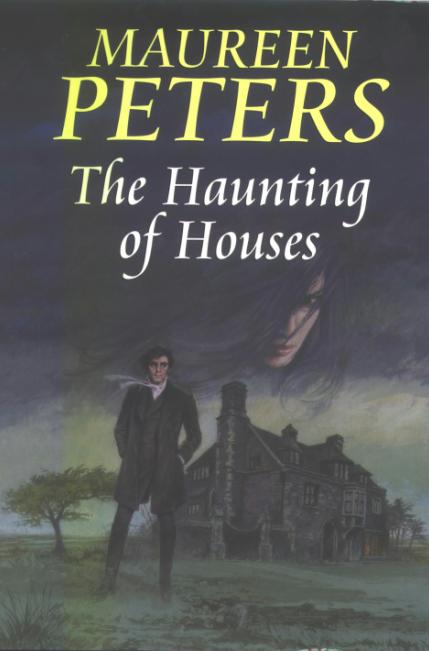
Some months ago, we talked about Maureen Peters' new book The Haunting of Houses. The editors, Robert Hale Ltd Publishers, kindly forwarded us a copy and now that we have read it, we can properly review the book.We will try to do so without spoilers, but this will be somehow difficult. The novel can be pigeon-holed as a sequel of Wuthering Heights. Not exactly a pure continuation of the story ( as Return to Wuthering Heights by Nicole Thorne (aka Anne L'Estrange) ), Maureen Peters's novel explores Heathcliff's character inside a narrative that works in different metaliterature levels.
The novel mixes the Brontë's background (in particular the Irish origins of the family) with the narrative itself in a way that somehow brings to mind Emma Tennant's Heahcliff's Tale but with a completely different approach. If Tennant's intention was to build a fiction supported by real characters and real settings, Peters's novel inserts the Brontë sisters, Haworth and the Pruntys background inside the geography and the story of Wuthering Heights as fantastic elements that destabilize the narrative. The reader is left with an unstable feeling. Different realities coexist but you have only a glimpse of them.
Of course, the novel fills the holes about Heathcliff's runaway and how he became rich. But Maureen Peters gives meaning to her options. That is, without revealing anything. What Heathcliff did in those years is of most importance concerning what happens after Heathcliff dies, in particular about the future of Hareton and Catherine. But Ms Peters doesn't try to answer all the questions and fill all the gaps. She suggests and slips clues around the novel so that you can infer what the origins of Heathcliff are or the reason of the solid attachment of Nelly Dean to the Earnshaws.
The novel does not always accomplish the same level of fluidity. There are some tedious repetitions (especially when the events of Wuthering Heights have to be retold time and time again), some shocking, out-of-context metaphors (the sky was a pale azure, blank and featureless, like the eyes of murdered children) and the reasons behind some actions of the main character, Aspen Stewart, are not always properly explained.
Nevertheless, we have here a pleasant reading for all Brontë and particularly Wuthering Heights lovers. And of course, and more importantly, you can discover what happened to Emily Brontë's second novel!
Categories: Books, Wuthering_Heights, Review, Sequels
Saturday, August 05, 2017
Charlotte BrontëLegacies and afterlivesEdited by Amber Regis and Deborah Wynne
ISBN: 978-1-7849-9246-0 (hardback)
ISBN: 978-1-5261-1985-8 (ebook)
Manchester University Press
July 2017
Charlotte Brontë: legacies and afterlives is a timely reflection on the persistent fascination and creative engagement with Charlotte Brontë's life and work. The new essays in this volume, which cover the period from Brontë's first publication to the twenty-first century, explain why her work has endured in so many different forms and contexts. This book brings the story of Charlotte Brontë's legacy up to date, analysing the intriguing afterlives of characters such as Jane Eyre and Rochester in neo-Victorian fiction, cinema, television, the stage and, more recently, on the web. Taking a fresh look at 150 years of engagement with one of the best-loved novelists of the Victorian period, from obituaries to vlogs, from stage to screen, from novels to erotic makeovers, this book reveals the author's diverse and intriguing legacy. Engagingly written and illustrated, the book will appeal to both scholars and general readers.
Table of Contents:
Introduction: picturing Charlotte Brontë - Amber K. Regis and Deborah Wynne
Part I: Ghostly afterlives: cults, literary tourism and staging the life
1 The 'Charlotte' cult: writing the literary pilgrimage, from Gaskell to Woolf - Deborah Wynne
2 The path out of Haworth: mobility, migration, and the global in Charlotte Brontë's Shirley and the writings of Mary Taylor - Jude Piesse
3 Brontë countries: nation, gender and place in the literary landscapes of Haworth and Brussels - Charlotte Mathieson
4 Reading the revenant in Charlotte Brontë's literary afterlives: charting the path from the 'silent country' to the seance - Amber Pouliot
5 Charlotte Brontë on stage: 1930s biodrama and the archive/museum performed - Amber K. Regis
Part II: Textual legacies: influences and adaptations6 'Poetry as I comprehend the word': Charlotte Brontë's lyric afterlife - Anna Barton
7 The legacy of Lucy Snowe: reconfiguring spinsterhood and the Victorian family in inter-war women's writing - Emma Liggins
8 Hunger, rebellion and rage: adapting Villette - Benjamin Poore
9 The ethics of appropriation; or, the 'mere spectre' of Jane Eyre: Emma Tennant's Thornfield Hall, Jasper Fforde's The Eyre Affair and Gail Jones's Sixty Lights - Alexandra Lewis
10 'The insane Creole': the afterlife of Bertha Mason - Jessica Cox
11 Jane Eyre's transmedia lives - Monika Pietrzak-Franger
12 'Reader, I [shagged/beat/whipped/f****d/rewrote] him': the sexual and financial afterlives of Jane Eyre - Louisa Yates
Appendix: Charlotte Brontë's cultural legacy, 1848-2016 - Kimberley Braxton
Friday, June 05, 2009
Had Jane Eyre still been in copyright when Jean Rhys published Wide Sargasso Sea, Charlotte Brontë could presumably have prevented publication. But would readers have really wanted her to?The Guardian also mentions sequels and prequels of Jane Eyre in an article about the same subject:
Once well-known figures are out of copyright, they fall very rapidly into other hands. By now, the minority of Sherlock Holmes's appearances are in stories by Sir Arthur Conan Doyle. Charlotte Bronte's Jane Eyre is neatly book-ended by both a prequel (Jean Rhys's Wide Sargasso Sea) and a sequel: DS Thomas's Charlotte. Emma Tennant has been the most active heroine smuggler, transplanting heroines from Jane Austen and Thomas Hardy into her own fiction. (Mark Lawson)The Film Music Society reports about the recent Motion Picture Academy Tribute to the legendary lyricists Alan and Marilyn Bergman:
Michel Legrand flew in from Paris for the event, playing the piano and singing "I Was Born in Love With You" from Wuthering Heights (1970). The evening's highlight for many, however, was the stunning duet of Legrand and Alan Bergman on one of their most famous songs, "The Windmills of Your Mind" from The Thomas Crown Affair that also included footage of Steve McQueen's glider sequence that inspired it. (Jon Burlingname)The New Statesman reviews the latest book by Sarah Waters's The Little Stranger and talks about country-house novels:
There are two main traditions of country-house novel. One of them, the one these novels have in mind, is the Gothic tradition, which extends back to what is usually thought of as the first Gothic novel, Horace Walpole’s preposterous The Castle of Otranto, and takes in Edgar Allan Poe’s House of Usher, Bartram-Haugh in Sheridan Le Fanu’s Uncle Silas, Thornfield Hall in Jane Eyre, Bly House in The Turn of the Screw, Manderley in Rebecca, et al. (John O'Connell)Now, a gem of random thinking. In the Indian Financial Chronicle we find a paragraph which is able to link together running naked (among wolves, sic), Titanic and Wuthering Heights:
For some, passion is running naked with the wolves… it’s so extreme! I remember this one scene from the movie Titanic, when Kate Winslet jumps out of her lifeboat, just as happy to sink or swim with Leonardo Di Caprio. In that moment any woman would have traded places with her. Remember the movie Wuthering heights? Certainly passion gripped the audience hearts as much as the actors. (Bubbles Shabharwal)Also in The Independent Elaine Showalter's latest book (A Jury of Her Peers) is reviewed, The Portsmouth News and The Leamington Spa Courier have a reminder of the current Tamasha Theatre's performances of Wuthering Heights (with a wrong picture, though).
Brontës.nl informs of a new Dutch theatrical adaptation of Wuthering Heights which will be premiered next October 20 in Den Bosch by the Theater Artemis company. The adaptation has been written by Jeroen Olyslaegers and will be directed by Floor Huygen.
Nöja posts a brief review of Agnes Grey in Swedish, Collected Works of Richard C Mather publishes an extract from an original (and juvenile) parody of Wuthering Heights and Paxton Holley converts Jane Eyre into a sort of Beatrix Kiddo, ...borgs hjørne talks about Wuthering Heights in Norwegian, PageTurner posts about Jane Eyre, Erodiade2008 uploads a video of Emily Brontë's poem I'm Happiest When Most Away and The American Scene reproduces the (in)famous Charlotte Brontë's eliminated preface to Shirley: A Word to the Quarterly.
Categories: Agnes Grey, Humour, Jane Eyre, Music, Poetry, References, Theatre, Wuthering Heights
Wednesday, October 24, 2007
At the time I traveled to a lot of business meetings with a woman named Louise McNamee, who was the president of my ad agency, and who would constantly be reading Jane Eyre. I'm convinced that she read Jane Eyre because if the plane crashed, she wanted her obituary to read, "When the plane crashed, Ms. McNamee was reading Jane Eyre, while her disgusting traveling companion, Jerry Della Femina, was reading a filthy book called The Steamy Sluts of Singapore."
I was always careful to rip the front cover off of my book, which always seemed to have a blonde opening the fourth and last button of her blouse. I also loved to look at Ms. McNamee primly reading Jane Eyre and whisper to her, "Have you gotten to the 'hot' parts yet?" (Jerry Della Femina)
To continue with the humourous note, we have come across this cover of Daphne du Maurier's The Infernal World of Branwell Brontë. It's truly priceless. Not only do we love Branwell's look but also the greenish/blueish halo around him, probably the artist depicting Branwell's opium addiction. Or something else altogether - who knows.A couple of blogs talk about Brontë-related things.
Brontëite blogger, well-known to BrontëBlog readers: The Further Adventures of Deluzy. Today she writes a few lines on Emma Tennant's Thornfield Hall, which is another name for both Adèle: Jane Eyre's Hidden Story and The French Dancer's Bastard: The Story of Adèle from Jane Eyre. We look forward to hearing what she thinks about it when she reads it.
Siberian Iris stops to think about imaginary characters.
(Right, don’t tell me you don’t have imaginary characters in your own head. Wasn’t it Charlotte Bronte who played Angria until she was 29? A psychologist called it traumatic play, or over-play, but plainly the psychologist was never a writer. Dear sweet goodness, if having imaginary characters inhabit our psyches is over-play, I believe every single author is an over-player.)That was actually Emily Brontë playing Gondal, though. And most scholars tend to agree that Wuthering Heights is probably an extension of Gondal itself. But despite this small correction we believe her argument to be quite right.
Categories: Books, Branwell Brontë, Jane Eyre, Juvenilia
Wednesday, April 04, 2007
Dario has written to us, pointing us to the recent Italian paperback edition of 'La bambinaia francese' (The French Nanny) by Bianca Pitzorno. The book was first released in 2004.If some months ago it was Emma Tennant who (re)told the story of Jane Eyre through Adèle's point of view, now Bianca Pitzorno gives voice to Sophie:
La Bambinaia FranceseA review published in Il Manifesto can be read here.
Bianca Pitzorno
Mondadori (Oscar Bestsellers)
ISBN 8804554746 (paperback)
(Babelfish Translation, revised by BrontëBlog)
Paris, 1832. On a winter evening Sophie, nine-year-old, knocks at the door of the 'star' of the Opéra Céline Varens in order to deliver her some garments manufactured by her mother in their poor Montmartre attic. It is the beginning of a great friendship between the dancer and the orphan, who with the passing of the years becomes the favourite student of an old Enlightenment aristocrat, survivor of the French Revolution, the disappointment of the Empire and the Restoration. At his school, where he is addressed as Citzen Marquis, Sophie meets the most outlandish contemporaries, but her favourite is the Haitian Toussaint, a small black slave who was a gift to Céline from her English lover. Together, Toussaint and Sophie will have to face dangerous adventures, in France and England, in order to save their protector (Céline) from her pursuers and litte Adèle, her daughter, from the mysteries of an English house named Thornfield Hall.
Categories: Books, Sequels
Thursday, January 21, 2010
Our thanks to Éditions Bénevént for providing us with a review copy of this book.Edward F. RochesterWhen Charlotte Brontë gave voice to a little, young, plain governess and invested her with revolutionary qualities normally associated with the (male) hero (courage, independence of thought, determination, honesty... ), she also created a counterpoint in the figure of the moderately dark, certainly broody and mostly Byronic, Rochester. In all probability when she was delineating his character it never even occurred to her that more than a hundred years afterwards there would be authors with the necessity to explore Jane Eyre's story from Rochester's point of view. After all, when the eldest of the siblings was imagining Jane in Manchester, Rochester's POV was the norm, the contemporary literary mainstream.
by Christine Paris Bruyère
Editions Bénévent
ISBN : 9782756313320
Pages : 132
Publication : 8/2009
And we have seen Jane's story retold from Adèle's perspective, the French nurse story or even Céline Varens's misdemeanours(1). Works that walk the permeable frontier between fan fiction and literature. Sometimes so thin a frontier that the main difference between one and the other is not the quality but whether they have been published or not (a notion that the rising of the vanity publishers has begun to question). Rochester's views have been particularly cultivated in the fan fiction world(2) and his young voice was one of the narrators of that (angry) "fan fiction" masterpiece that is Jean Rhys's Wide Sargasso Sea.
Christine Paris Bruyère's approach has, nevertheless, nothing to do with Jean Rhys's. She is not trying to vindicate any character (Rochester is in no need of redemption as Charlotte Brontë already redeemed him at the end of the novel). Her intention is to retell the known elements of the story from a masculine perspective. Her devotion to the story is so total that her Edward F. Rochester scarcely introduces new elements to the original narrative(3). She even respects the structure of chapters of the original novel (the ones were Rochester appears). Hardly a visit to the Eshtons (previous to his return to Thornfield Hall with the Ingrams and co.) or an escapade to London when Jane is attending the deathbed of her aunt do not add anything really important in order to understand Rochester's character. There's also no intention of explaining his life before Jane, besides what is already known from Charlotte Brontë's novel.
After reading this short but intense book, one realises that the author was not looking to explore any background but simply to picture Rochester's responses to his meeting with such a strange and inspiring creature as he perceives Jane Eyre to be. She does not try to mimick Charlotte Brontë's style. After all, Charlotte's writing is Jane's writing. Christine Bruyère's tries to reproduce Rochester's writing. Short sentences, always in present, addressed to an unnamed reader that at the end represents us, the actual readers. One wonders if this stylistic approach wouldn't be more appealing in English than in French where it sometimes sounds a bit forced.
The main problem is not that Christine Paris's Rochester could not be the Rochester imagined by the reader (one can disagree with Jean Rhys's vision of Rochester and, at the same time, recognise the enormous literary merits of Wide Sargasso Sea), the problem is that Jane Eyre's vibrant story transforms itself in a rather dull one from Rochester's perspective. Is this the Rochester whose love for Jane is expressed time and time (and time and time) again in a very unByronic way. His love for Jane does not only redeem him but transform him into a sort of hard-but-sensitive male avant la lettre.
Edward F. Rochester may not the book that captures Rochester and gives him a true entity separated from Jane. But Christine Paris Bruyère's effort is an honest, and not easy, attempt to tell his story not as we would love it, but as Charlotte Brontë's character would have written it. No more but no less.
NOTES
(1) Adèle, Jane Eyre's Hidden Story by Emma Tennant (2000); La Bambinaia Francese by Bianca Pitzorno (2004) or Adèle, Grace & Céline. The Other Women of Jane Eyre by Claire Moïse. Talking about Grace Poole it's only fair to mention Pam Ferris's Grace Poole's story published on the BBC website of Jane Eyre 2006.
(2) For instance, AvinWaters's story A Wondrous Shock of Feeling (2007): http://www.fanfiction.net/s/3451692/1/A_Wondrous_Shock_of_Feeling. Or the still incomplete: Team Guy of Gisborne's Jane Eyre Mr Rochester Side of the Story (2009) http://www.fanfiction.net/s/4904029/1/Jane_Eyre_Mr_Rochester_Side_of_the_story and
Edward Fairfax Rochester's Love for Jane Eyre (2008) by A True Janian Reply.
EDIT: Or the recently (vanity) published: Rochester: A Novel Inspired by Charlotte Brontë's "Jane Eyre" by J.L. Niemann.
(3) Nevertheless one wonders if the author isn't sometimes more faithful to some TV adaptations of the novel than to the real thing. For instance, just before the fire incident:
Un soir, mes pensées se sont tournées un peu plus que d'habitude sur la tour Nord, je me suis laissé aller à boire plus que de raison et la tête embrumée je me suis affalé sur mont lit, mes bottes encore au pied et ai sombré dans un sommeil lourd et plein de rêves fantasmagoriques.Something that appears in the 2006 adaptation but not in the book. This fact was pointed out by C. de Villemer on The Inn at Lambton.
Categories: Books, Jane Eyre, Review, Sequels
Tuesday, July 06, 2010
We are very grateful to University of Toronto Press for sending us a review copy of this book.Bluebeard GothicThe influences and legacy of Jane Eyre have been explored from many different perspectives and using all kinds of critical approaches. Its alleged adherence to a particular trope or tropes of stories and how these tropes intersect in its interior have been profusely studied. In the last decades the further spreading of its influence in other novels has also been explored and it's currently an active field of research.
Jane Eyre and Its Progeny
Heta Pyrhönen
University of Toronto Press
ISBN 9781442641242
Among the aforementioned influences we can list the Bluebeard myth and the generic conventions of that slippery genre known as Gothic. Their intersection inside the text of Jane Eyre - the Bluebeard Gothic intertext - creates a whole new dimension of meanings and textures to explore. Heta Pyrhönen in Bluebeard Gothic. Jane Eyre and its Progeny attemps such an analysis together with a study of its long shadow over ulterior English literature.
The author argues that although scholarship has dealt in many occasions with the Gothic elements/influences/developments in Jane Eyre, the Bluebeard intertext and particularly the common ground on which both tropes converge (the Bluebeard Gothic) have not been properly studied in Charlotte Brontë's novel. But in the author's opinion, its importance as one of the core elements of the novel have emerged in the subsequent adaptations that such a story has generated(1).
Her critical machinery is Psychoanalytic Criticism. Therefore, the author is not particularly concerned with Charlotte Brontë's conscious intentions (similarly to New Criticism approaches but in a radically different way). Her focus is on the decoding of the text using the tools of Psychoanalysis (particularly Lacanian criticism) and always centering the discussion on the self-imposed boundaries of the Bluebeard Gothic(2). Of course this means that a familiarity with the terminology and a basic understanding of the strategies used is required. This is not a book addressed to a general audience.
After an introduction that clearly exposes the critical coordinates in which this book has to be placed, the first chapter deals with the main subject of the book: Jane Eyre as a Gothic Bluebeard tale. The author starts with the narrative itself(3) to investigate symmetries (Jane's Red Room experience with Rochester's account of his suicide attempt in Jamaica), the physical and mental spaces of the novel and analyses the ways Bluebeard affects the different layers of discourse in Jane Eyre using Lacanian discourse theory. The chapter is dense, fascinating in the hidden associations and superposed layers revealed by Heta Pyrhönen; but also constantly on the verge of the over-semantisation of the original text (a psychoanalytic trademark?).
The following chapters are concerned with the analysis of several novels that in some way or other can be labelled as Jane Eyre progeny always looking for the Bluebeard Gothic common ground. In doing this the author looks for what she calls the Brontë effect of the Jane Eyre legacy:
I am mostly interested in the Brontë effect that this novel has had on the adaptations it has spawned, because I claim that they provide the first-hand critical reception where the workings of this effect are best evident. In anticipation, adaptors tend to seize on what they think are the blind spots, contradictions and discrepancies in Jane Eyre, thus demonstrating the effects it has on them and on their culture. We may in advance wager that these effects are precisely what have turned Jane Eyre into a mnemonic symbol not only in Britain but also worldwide. (p. 14)The second chapter discusses novels that can be read as testimonies to Jane's narrative of trauma: Anna Leonowen's The Romance of the Harem, Jean Rhys's Wide Sargasso Sea and Emma Tennant's Adèle: Jane Eyre's Hidden Story. In order to show how adaptors act as witnesses to their inmediate literary heritage, the author reads their discourse within the (Lacanian) symbolic register(4).
The third chapter analyses a series of novels characterised for being Bluebeard Gothics merging romance and perversity (mainly seen as probably the only contemporary meaning that Bluebeard Gothic can still assume): Daphne du Maurier's Rebecca, its sequel Rebecca's Tale by Sally Beauman (which makes many of the Bluebeard elements present in the original novel much more explicit), Diane Setterfield's The Thirteenth Tale and (rather too obviously) D.M. Thomas's Charlotte.
The highly interesting fourth chapter is concerned with two novels that address the Bluebeard Gothic elements from a religious point of view: Jeannette Winterson's Oranges Are Not the Only Fruit (from a Christian perspective) and Sarah Waters's Fingersmith (exploring mechanisms of sacrifice and scapegoating). Both writers propose a sort of non-heterosexual exit from Bluebeard's vault which in a way places "lesbian literature in the continuity of British tradition, including Jane Eyre".
The final chapter is, in this reviewer's opinion, the less interesting. It is an opaque and particularly dense chapter devoted to Angela Carter's Bluebeard tales, analysed in light of Harold Bloom's mythicopsychoanalytical theory of literary anxiety. The author concludes that Angela Carter is one of the few authors, if not the only one, who "bids farewell to the tradition associated with Brontë in order to steer the 'Bluebeard' literary legacy into new directions". Probably it is this reviewer's poor knowledge of Angela Carter's opus but we were unable to decipher the keys of such a conclusion.
After reading the book one has the feeling that although the first and last chapters are probably the most scholarly valuable ones by themselves, it is in the other ones where the book finds its place within the current Brontë scholarship linking Pyrhönen's Bluebeard Gothic with Patsy Stoneman's Brontë Transformations: The Cultural Dissemination of Wuthering Heights and Jane Eyre or the most recent A Breath of Fresh Eyre(5). Heta Pyrhönen's book is no doubt destined to be in all the university libraries of any English Literature department worthy of such a name.
Notes
(1) In a (not serious) psychoanalitical reading we could say that even as the scholars have not recognised the Bluebeard Gothic elements submerged in the novel, the intertext has been recovered subconsciously in the many adaptations (confessed or not confessed) of Jane Eyre.
(2) In this field, there are certainly other psychoanalytical readings of Jane Eyre centered on the Oedipal conflict between Jane and Rochester as a personal manifestation of an Oedipal conflict between Charlotte Brontë and her father. The present study does not go so far and limits itself to the analysis of the text of Jane Eyre. It's a credit to the author that she was not tempted by the (too) easy association of Bluebeard Gothic and Patrick Brontë-The Parsonage.
(3) From Jane Eyre, Chapter XI:
Mrs. Fairfax stayed behind a moment to fasten the trap-door; I, by drift of groping, found the outlet from the attic, and proceeded to descend the narrow garret staircase. I lingered in the long passage to which this led, separating the front and back rooms of the third storey: narrow, low, and dim, with only one little window at the far end, and looking, with its two rows of small black doors all shut, like a corridor in some Bluebeard's castle.(4) Which generates an altogether pedantic and condescendent statement when the author says:
Characterizing adaptations of Jane Eyre in terms of the discourse that governs the rewriting appears to suggest a concomitant aesthetic evaluation: the texts that prize symbolic discourse seem to score lower points than the other two [hysteric and analytic]. To some extent this is true; yet all studied texts certainly have merits.(5) This reviewer finds many possible future objects of research. The book follows Bluebeard Gothic rewritings of Jane Eyre but can we filter this trope and find out how previous novels (i.e. Ann Radcliffe's The Mysteries of Udolpho) have also been used as a precedent which Jane Eyre reformulates and resignifies? And what about how Michael Berkeley's Jane Eyre opera envisions Bluebeard Gothic elements? Such a discussion will involve interesting connections with other operas such as Paul Dukas's Ariane et Barbe-Bleue or Bela Bartók's Bluebeard's Castle.
Categories: Books, Jane Eyre, Review, Scholar
Search

Labels
- Advert (14)
- Agnes Grey (360)
- AI (7)
- Alert (1880)
- Anne Brontë (635)
- Art-Exhibitions (1074)
- Arthur Bell Nicholls (45)
- At The... (11)
- Audio-Radio (654)
- Biography (405)
- Books (4247)
- Branwell Brontë (394)
- Brontë 200 (395)
- Brontë Birthplace (101)
- Brontë Parsonage Museum (1804)
- Brontë Society (590)
- Brontëana (814)
- Brontëites (2028)
- Brussels (318)
- Charlotte Brontë (1069)
- Comics (425)
- Contest (34)
- Cottage Poems (9)
- Dance (394)
- Elizabeth Gaskell (269)
- Ellen Nussey (20)
- Emily Brontë (1187)
- Fake News & Blunders (163)
- Fiction (470)
- Games (3)
- Haworth (2018)
- Humour (389)
- Illustrations (177)
- In Memoriam (14)
- In the News (1324)
- Ireland (120)
- Jane Eyre (8336)
- Journals (659)
- Juvenilia (307)
- Maria Branwell Brontë (34)
- Mary Taylor (80)
- Messages from BB (117)
- Movies-DVD-TV (5194)
- Music (2581)
- New Releases (7)
- Opera (239)
- Patrick Brontë (236)
- Penzance (15)
- Poetry (937)
- Red House (64)
- References (2849)
- Reminder (143)
- Review (139)
- Scarborough (89)
- Scholar (1437)
- Sequels and Retellings (1265)
- Shirley (290)
- Software (17)
- Talks (1662)
- Talsk (1)
- The Professor (139)
- The Tenant of Wildfell Hall (572)
- Theatre (3569)
- Thornton (194)
- Top Withens (115)
- Translations (556)
- Unfinished Novels (11)
- Victorian Era (433)
- Villette (591)
- Websites & Apps (198)
- Weirdo (688)
- Wide Sargasso Sea (1130)
- Wuthering Heights (7828)
Recent Posts
Blog Archive
Other BrontëBlogs
-
-
Intertextuality in Adaptations - Mr. Rochester - This is the second post in my series talking about how the novel Jane Eyre is re-shaped in the many film and TV adaptations that have followed it. In th...16 hours ago
-
Harvest Poetry By Emily Bronte - It was on this week in 1845 that literary history was changed forever, after a seemingly innocuous event. On 9th October 1845 Emily wrote her fine poem ‘Th...3 days ago
-
“The Lost Brontë” – a spellbinding Gothic story - If you love the Gothic side of the Brontë novels you are certainly going to love “The Lost Brontë” by Catherine Friend. Moreover, it is the perfect time ...1 week ago
-
The Madwoman Upstairs by Catherine Lowell - I’ve been a bit quiet on here lately. However, I haven’t been completly slacking. I’ve made a couple of trips to Haworth and I’ve had my article on a piece...3 weeks ago
-
第41回大会のご案内 - 10月17日(土)に日本ブロンテ協会第41回大会を関西外国語大学中宮キャンパスにて開催いたします。プログラムはこちらをご覧ください。ポスター 参加される方はこちらから*9月末日まで*にお申し込みください(*10月9日までに延長いたします)。2 months ago
-
Les hauts de Hurlevent | Documentaire | ARTE - Paru en 1847 sous le pseudonyme masculin d’Ellis Bell, "Les hauts de Hurlevent" sidéra la critique. Dans ce conte d'amour, de vengeance et de mort, Em...2 months ago
-
-
ERROR: Database error: Table './rss/feeds' is marked as crashed and should be repaired at /var/www/html/feed.pl line 1657. -1 year ago
-
More taphophilia! This time in search of Constantin Heger's grave in Brussels. - Constantin Heger's Grave Charlotte Bronte Constantin Heger Whilst on a wonderful four day visit to Brussels in October 2024, where I had t...1 year ago
-
Empezando a leer con Jane Eyre (parte 2) - ¡Hola a todos! Hace unos pocos días enseñaba aquí algunas fotografías de versiones de Jane Eyre de Charlotte Brontë adaptadas para un público infantil en f...1 year ago
-
Goodbye, Jane - As two wonderful years come to an end, Piper and Lillian reflect on what we've learned from Jane Eyre. Thank you for joining us on this journey. Happy...2 years ago
-
Hello! - This is our new post website for The Anne Brontë Society. We are based in Scarborough UK, and are dedicated to preserving Anne’s work, memory, and legacy. ...3 years ago
-
Final thoughts. - Back from honeymoon and time for Charlotte to admire her beautiful wedding day bonnet before storing it carefully away in the parsonage. After 34 days...3 years ago
-
Ambrotipia – Tesori dal Brontë Parsonage Museum - Continua la collaborazione tra The Sisters’ Room e il Brontë Parsonage Museum. Vi mostriamo perciò una serie di contenuti speciali, scelti e curati dire...4 years ago
-
-
-
Buon bicentenario, Anne !!!!! - Finalmente annunciamo la novita' editoriale dedicata ad Anne nel giorno bicentenario della nascita: la sua prima biografia tradotta in lingua italiana, sc...6 years ago
-
Two New Anne Brontë 200 Books – Out Now! - Anne was a brilliant writer (as well as a talented artist) so it’s great to see some superb new books…6 years ago
-
Review of Mother of the Brontës by Sharon Wright - Sharon Wright’s Mother of the Brontës is a book as sensitive as it is thorough. It is, in truth, a love story, and, as with so many true love stories, the ...6 years ago
-
Brontë in media - Wist u dat? In de film ‘The Guernsey Literary & Potato Peel Pie Society’ gebaseerd op de gelijknamige briefroman, schrijft hoofdrolspeelster Juliet Ashto...6 years ago
-
Ken Hutchison's devilish Heathcliff - *Richard Wilcocks writes:* Ken Hutchison and Kay Adshead Browsing through the pages of *The Crystal Bucket* by Clive James, last read a long time ago (p...7 years ago
-
Nouvelle biographie des Brontë en français - Même si, selon moi, aucune biographie ne peut surpasser l’excellent ouvrage de Juliet Barker (en anglais seulement), la parution d’une biographie en frança...7 years ago
-
Researching Emily Brontë at Southowram - A couple of weeks ago I took a wander to the district of Southowram, just a few miles across the hills from Halifax town centre, yet feeling like a vil...7 years ago
-
Reading Pleasures - Surrounded by the heady delights of the Brontë Parsonage Museum library archive, I opened this substantial 1896 Bliss Sands & Co volume with its red cover ...8 years ago
-
Link: After that dust-up, first editions are dusted off for Brontë birthday - The leaden skies over Haworth could not have been more atmospheric as they set to work yesterday dusting off the first editions of Emily Brontë at the begi...8 years ago
-
Page wall post by Clayton Walker - Clayton Walker added a new photo to The Brontë Society's timeline.8 years ago
-
Page wall post by La Sezione Italiana della Brontë Society - La Sezione Italiana della Brontë Society: La Casa editrice L'Argolibro e la Sezione Italiana della Brontë Society in occasione dell'anno bicentenario dedi...8 years ago
-
Html to ReStructuredText-converter - Wallflux.com provides a rich text to reStructredText-converter. Partly because we use it ourselves, partly because rst is very transparent in displaying wh...8 years ago
-
Display Facebook posts in a WordPress widget - You can display posts from any Facebook page or group on a WordPress blog using the RSS-widget in combination with RSS feeds from Wallflux.com: https://www...8 years ago
-
charlottebrontesayings: To Walk Invisible - The Brontë Sisters,... - charlottebrontesayings: *To Walk Invisible - The Brontë Sisters, this Christmas on BBC* Quotes from the cast on the drama: *“I wanted it to feel...9 years ago
-
thegrangersapprentice: Reading Jane Eyre for English class.... - thegrangersapprentice: Reading Jane Eyre for English class. Also, there was a little competition in class today in which my teacher asked some really spe...10 years ago
-
5. The Poets’ Jumble Trail Finds - Yesterday I had the pleasure of attending with some friends a jumble trail in which locals sold old – and in some instances new – bits and bobs from their ...11 years ago
-
How I Met the Brontës - My first encounter with the Brontës occurred in the late 1990’s when visiting a bookshop offering a going-out-of -business sale. Several books previously d...12 years ago
-
-
Radio York - I was interviewed for the Paul Hudson Weather Show for Radio York the other day - i had to go to the BBC radio studios in Blackburn and did the interview...13 years ago
-
Short excerpt from an interview with Mia Wasikowska on the 2011 Jane Eyre - I really like what she says about the film getting Jane's age right. Jane's youth really does come through in the film.15 years ago
-
CELEBRATION DAY - MEDIA RELEASE February 2010 For immediate release FREE LOCAL RESIDENTS’ DAY AT NEWLY REFURBISHED BRONTË MUSEUM This image shows the admission queue on the...16 years ago
-
Poetry Day poems - This poem uses phrases and lines written by visitors at the Bronte Parsonage Museum to celebrate National Poetry Day 2009, based on words chosen from Emily...16 years ago
-
The Secret Diaries of Charlotte Bronte - Firstly, I would like to thank the good people at Avon- Harper Collins for sending me a review copy of Syrie James' new book, The Secret Diaries of Charlot...17 years ago
Podcasts, Etc..
-
-
S4 E8: With... Rebecca Marks - For the final episode of series 4, Sam and Mia are joined by historian, author and content creator Dr Rebecca Marks! Rebecca holds a Master's in Art Hist...2 weeks ago
-
Subscriptions
Brontë Parsonage X
Brontë Studies X
Other Stuff

Click to join BRONTE

This work is licensed under a Creative Commons Attribution-Noncommercial-No Derivative Works 3.0 Unported License.
Site archived by the British Library - UK Web Archiving Consortium