Podcasts

  • S4 E8: With... Rebecca Marks - For the final episode of series 4, Sam and Mia are joined by historian, author and content creator Dr Rebecca Marks! Rebecca holds a Master's in Art Hist...
    2 days ago
Showing posts sorted by relevance for query ian emberson. Sort by date Show all posts

Friday, February 15, 2008

Friday, February 15, 2008 1:55 pm by M. in , , , , , ,    No comments
The Times has an article about Scarborough's (property) renaissance. And Anne Brontë's love for the place is not forgotten:

Can you name Britain's first seaside resort? Congratulations to those who said Scarborough. Established as a spa town in the 1620s with the discovery of a mineral spring, the resort took its next step a few decades later when a local physician, Dr Wittie, recommended the benefits of a bracing dip in the sea. By the 19th century, Scarborough was the queen of British resorts, rivalled only by Brighton. Victorians flocked to its imposing spa complex (still there) and fine beaches, while three million came each year into the 1950s. The rise of foreign travel in the 1960s, however, hit Scarborough in the same way it did other UK seaside destinations.
The town's renaissance is driven not only by a renewed appreciation of the British seaside but also by new money from northern financial centres such as Leeds, along with an influx of creative types. Its appeal is clear enough. Wide, sandy beaches curve around the town's two bays - the smarter South Bay, with its backdrop of shops, restaurants and hotels, and the North Bay's more bucket-and-spade appeal. A headland divides the two, topped by a 12th-century castle that overlooks a tiny harbour.
Scarborough has culture, too. Not many seaside towns have four theatres, including the acclaimed Stephen Joseph Theatre, where Alan Ayckbourn has premiered most of his 60-odd plays. You can add a well-regarded jazz festival and Britain's last seaside orchestra. Anne Brontë loved the town and used it in Agnes Grey and The Tenant of Wildfell Hall. I look down on the bay from the balcony of the Crown Hotel, whose Victorian elegance is typical of the town's finest buildings. The nearby Grand Hotel is being restored, while Scarborough has its first boutique hotel: Beiderbecke's. (Norman Miller)

With some delay we report the January meeting of the Todmorden Ladies’ Probus Club where Ian Emberson made a talk. From Todmorden News:
The continuing search for unpublished material surrounding the world-famous Brontë family could throw up some welcome "finds" in the Todmorden area, a local expert believes.
Speaking at the January meeting of the Todmorden Ladies’ Probus Club, Ian Emberson, said that the Brontë sisters had some considerable links with the area.
Their mother’s uncle, the Rev John Fennell, was vicar of Cross Stone during their young lives and Charlotte’s husband, the Rev Arthur Bell Nicholls, was a friend of the Rev Sutcliffe Sowden, who was Mr Fennell’s curate before becoming vicar of Hebden Bridge.
Mr Emberson, a retired music librarian, said it was highly probable that the literary sisters had made a number of visits to the Cross Stone vicarage and that the descendants of people living in the parish at the time could reveal some interesting information that had never before been published.
Mr Emberson and his wife, Catherine, have published “Recollections of the Brontës” by George Sowden, who succeeded his brother, Sutcliffe, at Hebden Bridge. His article had remained virtually forgotten for more than 100 years. They came across the material by chance while researching for an article on Mr Fennell (Brontë Studies 2005).
At the Probus meeting, Mr Emberson, a member of both the Gaskell and Brontë Societies, was assisted his by wife, and together they presented a carefully-crafted talk about Todmorden’s Brontë links, interspersed with readings from letters and other material penned by the Brontës or their friends and acquaintances.
It proved the perfect combination, with Mr Emberson explaining the Brontë story and his wife reading the passages that so brilliantly illustrated the theme.
Mr Fennell was vicar of Cross Stone from 1819 until his death in 1841 at the age of 67. An eloquent tribute by Mr Fennell to his first wife, Jane (Mrs Maria Brontë’s aunt), inscribed on her gravestone at Cross Stone, and Charlotte’s letter to her father while staying with Mr Fennell with Emily, Anne and Branwell were included in the presentation.
Mr and Mr Emberson were thanked on behalf of the Probus Club by Mrs Liz Gore.
A week ago, Mr Emberson gave another talk in Mytholmroyd:
Mytholmroyd Methodist Church, Historical Society 7.30pm, speaker Ian Emberson on The Brontes. (Halifax Evening Courier, February 8)
On The Loy we can read more comments about The Heights, the contemporary setting of Wuthering Heights performed in Dublin by The Playgroup Company:
"I like to call is "making up" rather than devising," says director, Tom Creed, of his latest show, The Heights, a brand new stage version of Emily Bronte's Wuthering Heights.
Or almost a version of Bronte's novel, because according to Creed, the play is as much a homage to movie version of the book, and even Kate Bush's hit single version of the story.
"I think a lot of people feel they know the story of Wuthering Heights, but they haven't actually read the book. Kate Bush, for instance, hadn't read the book when she wrote the song…and the idea for the play came from thinking about the Merle Oberon / Lawrence Olivier film version."
All the same, Creed and company did get the book off the shelf too, although leafing through it has not exactly produced a facsimile version. For a start, The Heights is set in a city…
"The characters in the book have the moors running through their veins. And for a 19th century audience, the moors will have represented something cool and romantic, the sort of place where you could go and just get lost. Today, it is the city that has that quality for me, this place where you can go and disappear..."
And then there is the little business of period. The Heights is set in the 1980s…
"The story is told by the decedents of Heathcliff and Cathy, who we imagine to be living today, so then we imagine that the love story happened more than twenty years ago, which leave us…in the 1980s." (Luke Clancy)
The National Post talks about zombies in films. Our very own Brontë zombie movie (Jacques Tourneur's 1943 I Walked with a Zombie) is mentioned:
The next significant zombie film was refined at its roots; I Walked with a Zombie, a 1943 collaboration between director Jacques Tourneur and producer Val Lewton, is a loose retelling of Charlotte Brontë's Jane Eyre. The story of a Canadian nurse who travels to the Caribbean to cure a woman suffering from a strange ailment is free of the genre's more blunt elements, relying on mood and atmosphere to create suspense. (Joel McConvey)
And...
The Pace Press discusses Jasper Ffforde's seminal novel 'The Eyre Affair'. The Tuscaloosa News reviews the performances of Charles Ludlam's The Mystery of Irma Vep at the University of Alabama that we mentioned some days ago. Jane Eyre is analyzed in LeerGratis.com (in Spanish). Also in Spanish, La tormenta en un vaso reviews the recently edited Artemisa edition of Wuthering Heights in Spanish with Balthus's illustrations:
En suma: una cuidada edición, una novela inolvidable y el lujo de contemplar los dibujos de Balthus. Todo un placer. (Banda aparte)
Categories: , , , , , ,

Friday, November 28, 2008

Friday, November 28, 2008 1:35 pm by Cristina in , , , , ,    No comments
The Todmorden News carries an article on Ian Emberson's new book of Brontë-inspired poetry, Mourning Ring:
A book of poems relating to the famous literary Bronte sisters, their lives and the landscapes which influenced them, has been published by a Calder Valley author this month.
Mourning Ring: Bronte Related Poems is the latest work by artist, author and poet Ian Emberson, although some of the poems had their genesis in the past and three have appeared before.
But with extra poems added and illustrations completely reworked, the new volume finally sees them published in the way the Todmorden-based author is very happy with.
"It's a collection gathered over the years, some of the poems were written 30 years ago and the latest a few months ago. It wasn't originally planned as a whole," he said.
Some years ago Ian had produced a slim volume called Three Bronte Poems, which came from a reading at Haworth in connection with the 100th anniversary of the Bronte Society in 1993.
But he was never really happy with it from an illustrative point of view and these years later decided to rework it.
"I like unified illustrations and the like and decided to revamp the whole thing.
"The illustrations, apart from the cover, I did in water soluble pencil and the cover in ink.
"Some of the ideas are ones I am using again but they have all been done this year," he said.
Ian said he wanted to thank Chris Hall at Lambert's Printers for the work he had done to realise the book exactly as he wanted it.
Some of the poems, such as "Anne" and "Cross Stone Vicarage" (the latter is a strong local link with the Brontes) relate directly to the sisters, while others, including "Mourning Ring" and "Ignus Fatuus" are inspired by their work.
Aspects of the Yorkshire and Lancashire landscapes which featured in the lives of the sisters are present in virtually all of the poems.
At the end of the nine-poem work Ian has included a short page of brief notes which explain where the inspiration for many of the poems came from.
This serves not only to enhance enjoyment of the poems themselves but also to send readers back to original Bronte texts to read again the context.
Lovers of the powerful landscapes which shaped Bronte lives will enjoy them too as they are very evocative.
Composer Robin Terry is already working on a song-cycle based on the poems which it is hoped will be debuted at Haworth next year.
Mourning Ring: Bronte Related Poems costs £3 and is published by Ian's Angria Press imprint. It is available from the Border Bookshop, Todmorden, Todmorden Tourist Information Centre and Lyall's Bookshop, Todmorden, The Bookcase, Hebden Bridge, Hebden Bridge Visitor and Canal Centre and from the Bronte Parsonage gift shop in Haworth.
Stay tuned for our review of Mourning Ring.

Mr Emberson's book could be a nice Christmas present for a Brontë, although The Times does not feature it on its 'Christmas Books 2008: Gifts'. However, it does feature White's Books Jane Eyre:
I was pleased to receive a copy of one of my favourite novels, Jane Eyre, produced by White's Books (£19.95; www.whitesbooks.com). Designed by David Pearson, the man responsible for Penguin's dashing “Great Ideas” series, these clothbound hardbacks with stylish covers are a treat. (Erica Wagner)
The Guardian Books Blog touches on the topic of happy endings vs not so happy endings.
But it made me wonder which stories would suffer most from a tacked-on happy ending. Anna is saved from the train by Vronsky! It was all a big misunderstanding – Oedipus isn't really part of the family! Cathy and Heathcliff enjoy a long and happy marriage! Over to you… (Alison Flood)
We are very sorry for Heathcliff, Cathy and the rest of them all but that would have indeed been Mills & Boon-y.

The Australian newspaper The Age apparently has Heathcliff currently inhabiting the Snowdonia area in Wales:
There's nobody else up here. Listen and you can almost hear Gollum snuffling around the perimeter. "Yesssss, my precioussss." Well, it's him or that chap Heathcliff. (Keith Austin)
Because, you know, Gollum and Heathcliff are like two peas in a pod.

The Boston Globe alerts us to a new production of Irma Vep - with its Wuthering Heights connections - going on stage tonight at the Lyric Stage through December 21.

Categories: , , , , ,

Monday, December 08, 2008

Monday, December 08, 2008 9:00 am by M. in ,    No comments
Our thanks to Mr. Emberson who kindkly sent us a copy of this chapbook.
Mourning Ring.
Brontë related poems

by Ian M Emberson,
Angria Press, 2008, 20 pp. £3.00
ISBN 978 0 9521693 6 9

Angria Press, 1 Highcroft Road, Todmorden. UK. OL14 5LZ; telephone (01706) 812716;
e-mail ianemberson@aol.com.
Website www.ianemberson.co.uk
Just some months ago we celebrated the appearance of a poetry chapbook inspired by Jane Eyre, Rita María Martínez's Jane-in-a-Box, and now we are delighted to present just another one, Mourning Ring by Ian M. Emberson(1). Even if both are poetry collections inspired by the Brontës they could not be more different, which, once again, shows the wide range of artistic responses that the Brontës works are able to generate.

The first thing that must be said about Mourning Ring is that, like other works by the author, this is not a book with poems but a work of art in itself. The illustrations by the author are not (only) complements to each poem but a coherent and complete (from cover to cover) setting in which, as a matter of fact, the poems are inserted. Except for the cover made in ink, the artwork is made with water soluble pencils which create an eerie atmosphere where we can discern familiar landscapes from Brontë country (the Brontë bridge, Ponden Kirk, Pendle Hill...), images from the poems - symbolic images like the snake and the ring that open accompany the poem that lends its name to the book - which link visually together Jane Eyre and Milton's Paradise Lost(2).

Mourning Ring and Ignis Fatuus? are explorations of the poetic landscape left in the interstices of a very poignant moment of Jane Eyre's story. When Jane Eyre flees from Thornfield Hall and Mr Rochester to an uncertain future. Both poems abound in references to moments of the novel (from Mr Briggs's 'twelve calm words' to the extensive bird imagery present in the novel and in the poems), but Mourning Ring goes further tracing parallels effortlessly with Milton (through the 'colossal head with hollow eyes' which was one of Jane's illustrations which Rochester found so interesting(3)) and Bunyan's Pilgrim's Progress(4).

Anne, Life's Lone Wilderness and Cross Stone Vicarage introduce biographical elements of the Brontës' lives to recreate some particularly important moments of the Brontë legend. Anne, devoted to the youngest of the Brontë sisters' last visit to Scarborough mixes echoes of The Tenant of Wildfell Hall, Gondal and well-known biographical details (like the donkey episode in the sands of the Scarborough beach) to create an emotive account of Anne's last days. Life's Lone Wilderness((5)) is more ambitious when describing the loneliness of Charlotte Brontë just concluding Villette with the very vivid and present images of her dead sisters. A poignant poem which uses Brontë's own words, through Gaskell's biography. Finally, Cross Stone Vicarage puts a beginning to Charlotte Brontë's literary creativity describing the writing of her first surviving letter in 1829.

Haworth Dusk and West Riding try to integrate explicitly the Brontë opus into the landscape. Wuthering Heights and Jane Eyre are invoked when trying to establish a narrative which superposes past and present, fiction and fact. West Riding is particularly successful in creating this kind of suspended time.

The book includes two descriptive poems: Pendle and Harbour Hill and some useful contextualizing notes.

Notes:
(1) Ian M. Emberson is a writer and artist, member and collaborator of the Brontë Society and author of other Brontë-related books like Three Brontë Poems in 1993. The present book contains those poems and several more with revamped illustrations. For more information check The Todmorden News (27 November 2008)
(2) Another of Mr. Emberson's publications is Pilgrims from Loneliness who is described like
an exploration of Jane Eyre and Villette in terms of a possible basic mythology - largely drawn from The Bible, Paradise Lost and The Pilgrim's Progress - all early influences on Charlotte Brontë's mind.
More snake imagery: Ian M. Emberson's prose poems 2003 collection, The Snake and the star.
(3) It has been suggested 'that the colossal head' can be a symbol of death or a premonitory image of St. John Rivers. More information can be found on Lisa Denney's Toward an Interpretation of Jane's Three Watercolors.
(4) The author's allusion to Jane Eyre's pilgrimage is the prelude to the poem's inspired ending:
And what's beyond
a pilgrimage - eternal - without shrine?
- perhaps a binding hell
- or fragile heaven?
(5) This poem has been set to music by Robin Terry. According to the Todmorden News article mentioned before, the composer is working on a song-cycle based on the poems.


Categories: ,

Monday, February 20, 2006

Monday, February 20, 2006 12:02 am by M. in , ,    1 comment
With some delay we post this information concerning a couple of talks that have been given at the heart of the Brontë country. Ian Emberson, writer and artist well-known by Brontë lovers as the author of several articles, and Catherine Emberson have given a conference with a very shirley-ish name An abundant shower of curates. - Local links with the Brontes.

The talk has been given at the Hebden Bridge Lit. Society (January 12) and in the Todmorden Antiquarian Society, Lancashire (February 7).

EDIT:
We have found more information on this talk in this article published in The Todmorden News

THE title of a fascinating talk to Todmorden Antiquarian Society came from the first paragraph of Charlotte Bronte's book 'Shirley' which depicts emerging industrial life in this area.

‘An Abundant Shower of Curates’ was the talk given by Ian and Catherine Emberson who are well known locally and belong to various societies including the Antiquarian and Bronte Society. While leading a Todmorden walk for the Bronte Society, a chance remark led them to discover some previously unknown documents describing the Bronte family.

Ian began by setting the local scene; assuming we already knew of the Halifax Road shop run by Bronte relatives, the Parker family, and of Branwell Bronte’s employment along our railway line at Luddenden Foot and Sowerby Bridge.

John Fennell was great uncle to the Bronte children and Vicar of Cross Stone Church. The children came to stay at the vicarage in 1829, soon after their mother had died. A surviving letter form 13-year-old Charlotte to her father tells of the poor weather preventing outings and records their reading, their lessons, Branwell’s nature sketches and some copying of Lakeland pictures. Catherine read these excerpts during the evening.

Patrick Bronte had been a young curate with John Fennell in Wellington, Shropshire. John Fennell married Jane Branwell and took up headship of Woodhouse Grove School near Leeds. Meanwhile Patrick Bronte was at nearby Hartshead, together with William Morgan in Bradford, these three clergymen remained

lifelong friends. William Morgan fell in love with Fennell’s daughter Jane. Maria Branwell had come from Cornwall to help at the school run by her Aunt and Uncle; it was there that Patrick Bronte entered a `mazed’ courtship with her. In 1812 there was a double wedding with intricate arrangements of which curate officiated and which curate was married! John Fennell gave away both his daughter and niece and bridesmaids were shared. The romantic sequence sealed further ties of loyalty and family between the three friends all living in West Yorkshire.

Subsequently, John Fennell, abandoned teaching to become a curate in Bradford, then Keighley, then here at Cross Stone. The `new’ church was begun in 1833 whilst Todmorden was expanding with industry. The Bronte family made a second visit to Uncle Fennell at Cross Stone in 1840 when they admired the architecture of the Church. John Fennell remarried Elizabeth Lister in his 60s and had six children. Incidentally, Ian and Catherine have received Emails from Fennell and Lister relatives from all over the world. John Fennell died in 1841, aged 79 years, and his grave is an obscure spot at Cross Stone. Both the church and vicarage are now private residences.

Ian next described the two curate brothers, George and Sutcliffe Sowden, who were sons of a farmer at Hipperholme, tenants of Ann Lister from Shibden Hall. Together these two gentlemen served for 60 years at the Parish of St James in Hebden Bridge. Their friend, Arthur Bell Nicholls, was appointed curate at Haworth Church.


Categories: , ,

Friday, November 08, 2013

Friday, November 08, 2013 12:30 am by M. in    2 comments
Richard Wilcocks shares extremely sad news on the Brontë Parsonage Blog. Artist, composer, writer and Brontë scholar Ian M. Emberson (1936-2013) died last Monday. From his website:
Ian Emberson was born at Hove in Sussex in 1936, and is proud to have been christened by the poet Andrew Young. After moving around quite a bit, he now lives with his wife Catherine in the small town of Todmorden - just within the Yorkshire boundary, despite the postal address.
For many years he was Music Librarian at Huddersfield, but has now retired in order to concentrate on writing and art. He also enjoys walking and swimming and is a life-member of the Gaskell and Brontë Societies. His daughter Beth lives in France.
He was indeed very much involved with the Brontë Society and he was a frequent contributor to Brontë Studies(1) (and its predecessor, Brontë Society Transactions). His last contribution can be found in the latest issue: Passages in the Life of Which Individual?, Brontë Studies, Volume 38, Number 3, September 2013 , pp. 240-244(5).

He published essays about the Brontës: Pilgrims from Loneliness. An interpretation of Charlotte Brontë's Jane Eyre and Villette (2005); he rescued forgotten literary accounts about the Brontës:  Recollections of the Brontës by George Sowden. He even published and illustrated a poetry book inspired by the Brontës: Mourning Ring. Brontë Related Poems in 2008.

(1) A list with his contributions:
'Often rebuked, yet always back returning' — The Poem Itself
Brontë Society Transactions: The Journal of Bronte Studies, Volume 26, Number 1, April 2001 , pp. 68-70(3)
'And I am so Plain …'
Brontë Studies, Volume 27, Number 1, March 2002 , pp. 67-67(1)
Turns in the Circle of Friendship: 'Uncle Fennell', 1762–1841
‘My Spirit's Sky’: Astronomy and the Brontës
Brontë Studies, Volume 29, Part 3, November 2004 , pp. 253-256(4)
Brontë Studies, Volume 30, Number 2, June 2005 , pp. 141-150(10)
A Necktie and a Lock of Hair: The Memories of George Feather the Younger
Brontë Studies, Volume 31, Number 2, July 2006 , pp. 159-162(4)
A Missing Link: The Brontës, the Sowdens and the Listers
Brontë Studies, Volume 32, Number 2, July 2007 , pp. 116-124(9)
'The Likeness of a Kingly Crown': John Milton's Influence on Charlotte Brontë
Brontë Studies, Volume 32, Number 3, November 2007 , pp. 207-216(10)
Three Quartets: the Rossettis, the Mendelssohns and the Brontës
Brontë Studies, Volume 34, Number 3, November 2009 , pp. 247-254(8)
The Broken Tree: Symbol and Actuality
Brontë Studies, Volume 36, Number 4, November 2011 , pp. 336-343(8)
‘A Wreck Just Sinking’: The Beginning of Jane Eyre and the Ending of Villette
Brontë Studies, Volume 28, Part 1, March 2003 , pp. 89-90(2)

Saturday, November 16, 2013

Todmorden News publishes an obituary of writer, artist and Brontëite Ian M. Emberson:
He took to painting and writing in early childhood, and pursued those activities all his life, drawing creatively on his life’s experiences in whichever form his work took. The results were always of high quality.
Following National Service (Royal Signals, Cyprus, 1955-57), he went on to earn a living in both horticulture and librarianship in different parts of the country, settling in Huddersfield in 1971 on becoming Music Librarian. He retired in 1986 to concentrate on painting and writing.
His work as an artist is best known through postcards and book illustrations. His publications include eight books of poetry and prose-poems, as well as many journal and magazine articles. In 1996 Bradford Playhouse produced his one-actor play Cockerel Crowing Dawn, based on the life of the Russian composer Mussorgsky. Ian also wrote the libretto for Daniel Bath’s opera The Forest, performed at the Hebden Bridge Arts Festival in 2003. Four other composers have set his poetry to music.
Ian met Catherine through the Brontë Society in 1988, and despite his love for his home village of Thurstonland, and the many musical interests of Huddersfield, he moved to Todmorden to be with her. Ian initially found it difficult to adjust, but soon came to love the town, its wonderful walking country and its swimming pool. He became well known at literary, artistic and musical events. He was a patron of Todmorden Orchestra and an enthusiastic member of Todmorden Antiquarian Society. His talk ‘A Comer-In’s View of Yorkshire’ - based on his semi-autobiographical book Yorkshire Lives and Landscapes - was due to be given to that organisation shortly.
Ian and Catherine worked together on various pieces of Brontë research. One of these led to the discovery of George Sowden’s Recollections of the Brontës – which had lain virtually forgotten for over one hundred years. The Brontë Society have published Ian’s book Pilgrims from Loneliness: an interpretation of Charlotte Brontë’s “Jane Eyre” and “Villette” .
Ian had two children by his first marriage – Beth, who lives in France, and the late Robert, who died in 2012.
His funeral will be at 1.30pm on Monday, November 18, at St Mary’s Church, Todmorden, and from 3pm to 5pm friends are invited to gather at the Bear Cafe to chat about Ian and hear some of his works. (John Greenwood)
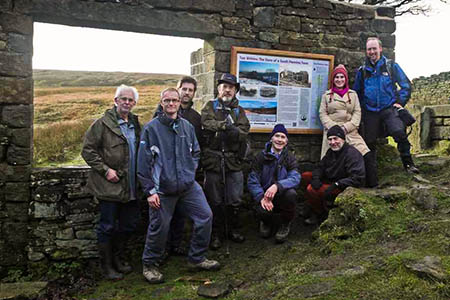
Steve Wood and other members of the Top Withins board
(Source)
Grough informs that a new information panel has been placed at Top Withens:
A ruined farmhouse with literary connections high on the Pennine Way has a new information panel offering walkers a glimpse into its history. (...)
The building, which is owned by Yorkshire Water, also has a small, rudimentary bothy attached.
Local historian Steve Wood researched the background to the building which has no direct links with the Victorian author or her works, but has been held by many to match the location of the Earnshaw dwelling in the Bronte novel.
The panel tells the story of farming high above Haworth, going back at least 400 years with the first written record of a William Bentley dividing his estate amongst his three sons.
Their tough livelihood had to be supplemented by income from other activities including quarrying and weaving.
The panel has been placed in the ruins at Top Withins, also sometimes known as Top Withens, as part of the Watershed Landscape Project, managed by Pennine Prospects and funded by the Heritage Lottery Fund and South Pennine Leader.
Alastair Harvey, countryside and recreation manager at Yorkshire Water, said: “As the owner we have carried out restoration works to the building to ensure it is able to withstand the erosive nature of the sometimes vicious upland weather.
“We are grateful for funding from Pennine Prospects and Heritage Lottery Fund that enabled us to protect the ruin for years to come.”
Robin Gray, Watershed Landscape project manager, said: “So many visitors come up to this romantic ruin but until now there has been little information.
“We hope that visitors will now feel better informed not just about the ruin but about the significance of this unique landscape.
“We have even provided a translation into Japanese for those visitors who come from across the globe to visit this iconic site.” (Liz Roberts)
The Philippines Daily Enquirer interviews the composer John Williams. He choose Jane Eyre 1970 as one the compositions he would like to be remembered for:
When we asked him for at least three film scores that he’d like to be remembered for, one of John’s picks was a surprise.
“I always remember certain passages in ‘Close Encounters…’ that I particularly enjoy playing with orchestras, away from film, so that may be indicative of something.”
He added, “And several movements of ‘Star Wars’ I also continue to have interest in as a performer. I did a television version of ‘Jane Eyre’ years ago (1970), directed by Delbert Mann. I wrote that new score in London many years ago. I have continued to enjoy revisiting that. So, in my case, that’s been a good measure of what I like that I have done in the past. If I don’t pick it out of the library and don’t want to perform it, it means that I don’t particularly want to return to it.” (Ruben V. Nepales)
USA Today imagines what the Brontës (and other writers) could tweet today:
10. The Brontë sisters: Charlotte, Anne and Emily Brontë were as close as sisters can be. They would've been each other's biggest Twitter fans, favoriting/retweeting each other every five minutes, spamming the hell out of their followers. Sweet? We guess. Annoying? Yeah, kinda.
Anne Brontë would tweet: "RT @JaneEyre 'You know full well as I do the value of sisters' affections: There is nothing like it in this world.' CC @wutheringgirl" (Daniel Lefferts and Kristen Mascia)
The Telegraph reviews All Change, by Elizabeth Jane Howard.
Clary, the Duchy’s granddaughter, born in 1925, the same generation as Howard herself, is a talented novelist, struggling to bring up children and help support her husband, an impecunious artist. Before the children, she wrote two novels that were well received, but since then she has sobbed into the kitchen sink and taken on proofreading to pay the rent. There are fleeting references to Charlotte Brontë and Jane Austen: both childless. (Ruth Scurr)
The Wall Street Journal reviews several retellings of classical novels, including Minae Mizumura's A True Novel:
Minae Mizumura's "A True Novel" (Other Press, 854 pages, $29.95) is a fascinating example of a cross-cultural adaptation. In one of the sizable passages of meta-commentary that frame the narrative, the author explains that the rewriting of Western novels has been "a central project in the modern literary history of Japan." Here she tells a story that is a mix of "Wuthering Heights" and "The Great Gatsby."
It centers on the magnetic Taro Azuma, recounting his bumpy rise in postwar Japan. In the highlands of Karuizawa (since converted to a popular resort town), the orphan Taro is taken in by a family of servants and supported by the aristocratic Saegusa clan. A perpetual outsider because of his low rank and half-Manchurian bloodline, he has no friends except Yoko, the sickly daughter of his employers. But though the two are in love, Yoko rejects Taro for a husband with better prospects. The spurned youth moves to Long Island and works his way up from chauffeur to "the most successful Japanese businessman in America." Despite his wealth, he moves back to the decaying cottage of his childhood, intent on reclaiming Yoko.
Ms. Mizumura's writing, smoothly translated by Juliet Winters Carpenter, doesn't have anything close to the pitched intensity of Emily Brontë's, though her depiction of Taro contains elements of Heathcliff's consuming resentment: "His youth was no longer fresh and vigorous," she writes of Taro when Yoko throws him over, "but had settled like a thick sediment, with a stale smell to it." When, years later, Taro tries to lure a married Yoko to live with him in a mansion on Long Island's north shore built early in the 20th century by an "American nouveau riche," he summons the restless apparition of Jay Gatsby. (Sam Sacks)
Zoë Triska chooses 'the biggest heartbreakers' in literature for The Huffington Post:
Edward Fairfax Rochester Rochester from "Jane Eyre"
Where to even begin with Rochester? We know some people like to think of "Jane Eyre" as a romantic story, but it certainly doesn't begin that way. I have always thought that Rochester KNOWS from the beginning that Jane has feelings for him, but that he toys with her intentionally. It honestly does appear that Rochester was courting Blanche Ingram, and not Jane. Who could blame Jane for thinking so? Also, when he proposes to Jane, he forgets to mention that he has his wife locked up in the attic. Yikes. (...)
Catherine Earnshaw from Emily Brontë's "Wuthering Heights"
Despite Catherine's love and adoration for her childhood best friend, Heathcliff, she decides that he's too low class for her and goes off and marries another. Heathcliff pines away for her, going so far as to leave in order to become a "gentleman." Catherine dies prematurely. Even after she DIES, she haunts him! How cruel is that?!
Of course Rochester toys with Jane intentionally and... well, Heathcliff asks Catherine to be haunted by her.

Also in The Huffington Post, Sarah Barness has been seduced by Mark Grist's 'I want a girl who reads' poem:
Mark, you can totally call us. We'll just be over here tearing through our copy of Jane Eyre.
Financial Times talks about the evolution of the Oxford English Dictionary:
He talks also of the potential to embed OED content in ereaders so the meaning of a word such as “plisky” (a trick or an awkward situation) in Wuthering Heights (1847), not found in most dictionaries of current usage, could be revealed to the reader as he or she went along. (Lorien Kite)
Kpopstarz mentions the including of a Wuthering Heights-inspired song in the soundtrack of the Korean TV series, Secret:
The highly successful melodrama Secret came to an end, this week, with actor Ji Sung providing vocals for the final soundtrack. Heights of Windstorms or Wuthering Heights draws inspiration on the prevailing theme of betrayal, secrets, and love lost that dominate both Secret and the novel,Wuthering Heights. Secret concluded with a strong ratings lead and with Ji Sung proving that his acting talent transcends into singing.
Haaretz quotes from Eva Illouz's Why Love Hurts: A Sociological Explanation:
From the Introduction:  The Misery of Love
"Wuthering Heights” (1847)‏ belongs to a long literary tradition portraying love as an agonizingly painful emotion. The novel’s notorious protagonists, Heathcliff and Catherine, develop a strong love for each other while growing up together, yet Catherine decides to marry Edgar Linton, a socially more appropriate match. Humiliated when he accidentally overhears Catherine claim that she would degrade herself in marrying him, Heathcliff runs away. Catherine looks for him in the fields, and when she does not find him, she falls ill to the point of near-death.
France Info (France) reviews  Lady Hunt by Hélène Frappat:
Un roman qui marche sur les pas de chefs-d'oeuvre anglais comme Les Hauts de Hurlevent ou Rebecca, avec beaucoup de talent mais aussi de distance et d'humour. (Philippe Vallet) (Translation)
YA? Yeah, Yeah! interviews the author Laura Summers:
Who was your first fictional crush?
When I was a teenager I don’t really remember there being many books written particularly for my age group so when I ran out of books at the library (the Narnia series, Swallows and Amazons, Just William and masses of legends and fables were some of my childhood favourites), I jumped straight into books by Agatha Christie and classics like Jane Eyre. I definitely didn’t fancy Hercule Poirot so I think my first fictional crush has got to be Mr Rochester.
El Correo (Spain) lists films about love and passion including Wuthering Heights; St Margaret's Community Website has an interesting post on James Chesterton Bradley, the curate that inspired Charlotte Brontë's Mr Sweeting in Shirley quoting from original sources; Gedankengerüste, Gedankengelüste (in German) has not loved Wuthering Heights; Salmagundi recommends re-reading Jane Eyre; Practically Marzipan reviews one of its retellings, Tina Connolly's Ironskin; ARD (Germany) announces the airing the documentary Yorkshire - Land der Geister und Legenden (directed by Peter M. Kruchten) (3sat, November 16, 16.15 h) which includes mentions to the Brontës.

Thursday, September 11, 2008

Thursday, September 11, 2008 12:36 am by M. in ,    No comments
The upcoming Ilkley Literature Festival (Oct. 3rd - Oct. 19th 2008) contains several interesting Brontë-related events:
Charlotte, the Brontes and Passion: Lyndall Gordon
Lyndall Gordon
Ilkley Playhouse Wildman
Saturday 4th October
3:15 PM - 4:15 PM
₤4.00 (Full Price) ₤3.00 (Concessions)
Lyndall Gordon the highly respected biographer of Charlotte Bronte (and, incidentally, of Mary Wollstonecraft, Eliot's early years and Henry James) turns her attention to Charlotte and her family. An acknowledged Bronte expert and winner of the James Tait Black Memorial Prize for Biography, Gordon is a Senior Research Fellow at St Hilda's College, Oxford and currently working on a biography of Emily Dickinson.
Lyndall Gordon the highly respected biographer of Charlotte Bronte turns her attention to Charlotte and her family
Incidentally, Lyndall Gordon's Charlotte Brontë. A Passionate Life has been republished this month by Virago Press. These are the details:
Author(s): Lyndall Gordon
ISBN: 1844084728
ISBN-13: 9781844084722
Publication Date: 04 Sep 2008
Pages: 480 (198 x 126)
Format: Paperback
Published Price: £9.99
Daphne: Justine Picardie
Justine Picardie
Ilkley Playhouse Wildman
Saturday 4th October
6:00 PM - 7:00 PM
₤4.00 (Full Price) ₤3.00 (Concessions)
Justine Picardie makes a welcome return to talk about her latest novel, Daphne, which, blurring fact and fiction, unravels the intriguing story of Daphne du Maurier’s obsession with renegade Bronte brother, Branwell.
Picardie, a former editor of the Observer Magazine and British Vogue and now a Sunday Telegraph Magazine columnist, was inspired by letters she discovered in the archives of the Bronte Parsonage at Howarth.
Please note the revised time of 6pm on Sat 4th October for this event.
Bells by Eddie Lawler
Saturday 4th October
9:15 PM - 10:15 PM
Free no need to book
Saltaire’s young team of bellringers went to Haworth this year to ring the bells in the Church where most of the Brontë family lie buried in a vault. They rang so loud they managed to waken the dead, briefly……..
They tell the tale in this cameo version of Eddie Lawler’s Brontë musical Bells, which tries to catch the Bronte characters in song.
Ilkley at the Time of Charlotte Bronte (WALK)
Alex Cockshott
Outside Rombalds Hotel

Sunday 5th October and 12th October
2:00 PM - 3:30 PM
Sold Out Online
₤3.00 (no concessions)
Charlotte Bronte visited Ilkley in September 1853, liking it ‘exceedingly’ and longing to return. Local historian Alex Cockshott leads a fascinating historical walk around the Ilkley Charlotte knew, bringing to life the ‘wide streets and grand new hotels’ Charlotte and her friend Miss Wooler admired and revealing the subject of their intimate conversations..
This is a circular walk lasting 90 minutes.
Parking at Darwin Gardens.
Three Quartets: The Rossettis, the Mendelssohns and the Brontes
Ian Emberson
St Margaret's Church Hall - Ilkley
Saturday 11th October
6:30 PM - 7:30 PM
Free no need to book
Ian M. Emberson, writer, artist, former music-librarian and author of one book and many articles about the Brontes, focusses on the childhoods of three gifted families -discussing how this background influenced their later achievements. In each case we have four exceptional children, slightly apart from their immediate surroundings, yet ultimately blending different cultures in their mature creative activities.
Free fringe event.
Our thanks to Mr. Emberson for having alerted us to his appearance at the festival.

Categories: ,

Wednesday, January 24, 2007

Wednesday, January 24, 2007 2:47 pm by M. in    No comments
Yorkshire Lives & Landscapes is the new book of Ian M. Emberson (active member of the Brontë Society and author of several Brontë-related books).

The Halifax Evenign Courier publish today:
TODMORDEN author Ian M Emberson unveiled his new book, Yorkshire Lives and Landscapes.
The semi-autobiographical book, which was launched at the Bear Cafe in Rochdale Road, Todmorden, also attracted singer and composer Daniel Bath, who performed a specially composed song. He was accompanied by Anthony Brannick.
Mr Emberson, who has already written nine books, said: "The story is set within the framework of my life over the past 35 years.
"There are chapters on Yorkshire culture, walks, gardening, Asian arts, the Brontes and Todmorden. It is quite lavishly illustrated with photographs."
Mr Emberson, who has had poems and a study on Charlotte Bronte's works published said: "I am not quite sure how the idea grew in my mind. I have worked on it at intervals over the years.
"I was born in Essex, but I moved to Yorkshire 35 years ago and I would like to consider myself a Yorkshireman now."
Mr Emberson read extracts of his book at the launch and visitors enjoyed refreshments.
More information in The Todmorden Today.

Categories:

Monday, November 10, 2008

Monday, November 10, 2008 12:03 am by M. in ,    No comments
A new Brontë-inspired poetry collection has been published, Ian M. Emberson's Mourning Ring:
Mourning Ring: Brontë related poems
by Ian M Emberson,
Angria Press, 2008, 20 pp. £3.00
ISBN 978 0 9521693 6 9

Mourning Ring: Brontë related poems by Ian M Emberson was published on October 1st 2008, and is a small collection of poems relating to the Brontës – their lives, writings and the landscapes associated with them. It is an expanded version of a previous publication Three Brontë Poems, and is lavishly illustrated by the author, with a picture on each page. The composer Robin Terry is working on a song-cycle based on the poems, and it is hoped that this will have its first performance in Haworth next year.

It is available from the Gift Shop, Brontë Parsonage Museum, Church Street, Haworth, Keighley, West Yorkshire. UK. BD22 8DR – telephone (01535) 642323; fax (01535) 647131; e-mail sales@bronte.org.uk

or direct from the publishers:

Angria Press, 1 Highcroft Road, Todmorden. UK. OL14 5LZ; telephone (01706) 812716; e-mail ianemberson@aol.com.
Website www.ianemberson.co.uk
A Dutch version of this information can be read on The Brontës.nl

Categories: ,

Saturday, September 13, 2008

Saturday, September 13, 2008 1:44 pm by M. in , , , , , ,    No comments
Let's begin our newsround with some local papers which mention recent Brontë-related events. Keighley News covers the recent performance of the puppetry theatre company Frolicked at the Brontë Parsonage Museum (in the picture, Frolicked puppeteer Beka Haigh at work in the Bronte Parsonage Museum with the 'ghost' of one of the literary family's servant, source)
Visitors to a Brontë shrine enjoyed a bonus — with no strings attached.
Outdoor puppet theatre company Frolicked presented a specially commissioned show, at the Parsonage Museum, in Haworth.
Informal interactive performances were given in the Parsonage and its grounds.
Huddersfield-based Frolicked specialises in creating puppets and performing at interesting and unusual locations.
Currently on show at the parsonage is “My Life Dreams” — an exhibition of digitally manipulated photographs based on the Brontës by Swiss artist Annelies Strba.
And visitors also have a rare opportunity to see the famous portrait — on loan from the National Portrait Gallery — of Emily Brontë, painted by her brother Branwell.
And the Hebden Bridge Times reports a recent talk by Ian M. Emberson (who will also appear in the upcoming Ilkley Literature Festival)
AT the latest Heptonstall Women's Institute meeting Ian Emberson spoke about the Brontes.
Some Brontëites now. From a member of the Creativesports's website staff:
I read Middlemarch when I was in graduate school and loved it, along with Eliot's The Mill on the Floss. But, then, the Victorian novel was my specialty genre, and I pretty much loved anything from that period, be it Coleridge or Dickens or the Brontë sisters or Thackery (sic) or whomever. (Lawr Michaels)
Locus Magazine (September 2008) recommends Galen Beckett's The Magicians and Mrs. Quent:
A first novel, and first in a series, mingling Jane Austen-style comedy of manners with the Victorian gothic of Charlotte Brontë — and just a hint of Lovecraftian cosmic menace. The daughter of a mentally ill magician tries to keep her family together and find love while dealing with the disapproval of polite society and her demanding mother.
And Stephenie Meyer's Twilight saga and its Brontë references have arrived even in India:
But that reading may in fact be not all true. If anything, Meyer’s work is a romance. There are echoes from Austen and the Brontes (not just Charlotte, whom the author lists as a favourite, but Emily too).
The atmosphere is Wuthering Heights and if you didn’t get that, there are enough references to the classic to drive home the point. But more than that the Twilight Saga most definitely reminded me of Mills & Boon. (Anoothi Vishal in Business Standard)
The National Review manages to slip a Brontë mention in a review of The Lincolns. Portrait of a Marriage:
A man who thought himself damned by a “devilish passion” for a girl would not only have been morbidly sensitive, as Lincoln was always to be, to that which is hellish in life, he might also have adopted, as his own pet theory, the Romantic idea that the syphilitic sufferer, though foredoomed to madness, receives compensatory gifts of creative power and visionary insight. Byron’s Manfred, Poe’s Roderick Usher, and the heroes of Hugo, Balzac, and the Brontë sisters are variations on the 19th-century theme that genius is in many cases allied to diabolic depravity. (Michael Knox Beran)
A couple of Australian news sites review the ongoing performances of Polly Teale's Brontë in Brisbane. Let's begin with the positive one. Amy Hyslop on Australian Stage (picture source)
Just like being rich and thin it seems that the Brontë sisters will never go out of style and thank God for that. Presented by ThreeSisters Productions, a group aiming to “shine light on female voices and characters”, Brontë is the second play written by Brontë obsessive Polly Teale to be performed in Brisbane this year.
It examines the short lives of sisters, Charlotte, Emily and Anne, and the complex reasons behind the desire of three such naturally reclusive women to write works of passionate, uncompromising fiction. Removing the sisters from their mythology and placing them squarely in the domestic, Teale’s script brims with real human warmth, passion and humour without sacrificing any of the romanticism without which any play about the sisters would be incomplete.
Sue Rider’s direction is excellent and she has elicited wonderful performances from her young cast who all rise to the considerable challenges of Teale’s densely packed, demanding script. Rebecca Roberts is engaging as the unworldly Anne and Hannah Levien brings a stern, passionate pragmatism to ambitious Charlotte.
Ron Kelly delivers wonderfully nuanced performances in a number of different roles including Patrick Brontë and Mr Rochester (Jane Eyre) and Kerith Atkinson brings a disturbing undercurrent to Cathy (Wuthering Heights) and Bertha (Jane Eyre).
But the standout performances come from Kevin Spink and Kathryn Marquet as Branwell and Emily. In the difficult role of the lost brother who of all the siblings most desired celebrity but was least blessed with talent Spink is totally convincing, showing us not only Branwell’s rage but his vulnerability too. Kathryn Marquet, who I last saw as Bertha Mason in Harvest Rain’s recent production of Jane Eyre, really delivers as the complex Emily, the deeply reclusive sister with one foot in the grave and her head in the clouds.
Considering the challenges of size and location the Sue Benner theatre presents to any production, let alone one seeking to impart a gothic Victorian atmosphere, Brontë is remarkably atmospheric. The set design by Kitty Taube makes the most of the tiny stage cleverly placing the audience inside a recreation of a recreation of the Brontë household.
Stephen Brodie’s sound design is hauntingly beautiful and the costumes by Carolyn Taylor-Smith are a refreshing departure from the usual period fare being thoughtfully designed to harmonise with every element of the production without slavishly copying period style.
If I have one criticism it would be that no one managed a real Yorkshire brogue but it’s a small point in the scheme of things. Brontë is a wonderful production showcasing some of Brisbane’s most talented new performers and is a must for any Brontë fan.
And now the negative one by Sue Gough in The Courier Mail:
POLLY Teale is an English playwright and director who has a fascination for bringing the works of the revered Bronte sisters to the stage. (...)
In this more recent work, Bronte, she narrates the tragic history of the entire family.(...)
It is appropriate that the production is directed by Sue Rider because she has a long list of credits for writing, directing and acting in plays about women and women's issues.
Set designer Kitty Taube's backdrop is a blown-up page of handwritten manuscript that doubles as a clever screen behind a simple kitchen setting and Jason Glenwright's lighting creates the perfect mood.
The ambience is completed by composer Kylie Morris's hauntingly atmospheric soundscape.
Having set the scene so well, it's a pity the play can't live up to its introduction.
The trouble is that Bronte is first and foremost educational, sometimes tediously so, even though Teale, while remaining fairly faithful to the historical facts, attempts to spice things up by taking some liberties with both characterisation and motivation and also with suggestions of incest, smouldering sexual frustration and sibling envy.
This does not get around another fault: The play feels as if it was written 30 years ago.
The extended exposition - the repetition rather than reworking of feminist critique - and the endless philosophical rhetoric do nothing to explain the central mystery of how the Bronte sisters, who lived all their lives in extreme isolation on the Yorkshire Moors, conjured up such wild passion in their work.
Teale tries to show how domestic torments caused by their alcoholic brother Branwell (Kevin Spink) provided inspiration, but this is somewhat facile.
The least-famous of the sisters, Anne (Rebecca Roberts), is the quieter foil for the ambitious Charlotte (Hanna Levien) and the wildly melancholic Emily (Kathryn Marquet).
As their frustrations multiply, we see these projected into their written characters and Kerith Atkinson, doubling as Cathy from Wuthering Heights, and the lunatic Bertha from Jane Eyre, invades the action, one moment a frail creature in white, the next a writhing lost soul in scarlet rags.
While the London production opted, accurately, for Irish accents for the sisters - such was their isolation that they spoke like their father - Rider has settled for a Yorkshire burr and the actors handle this well.
Ron Kelly is outstanding in his multiple roles and Kathryn Marquet has the dramatic endurance to sustain a very believable Emily.
It may well be the fault of the playwright that the remaining actors seem trapped in a rather mediocre melodrama.
The National Post thinks that the fashion designers' autumn creations are somewhat gloomy:
When preparing for their autumn collections, fashion designers must have been boning up on Wuthering Heights and Edgar Allan Poe, because their collections plumb the inky depths of black on black on black. (Nathalie Atkinson)
And we have a Heathcliff sighting on an article in The Independent Love & Sex section:
As a child, I was always drawn to the tortured rogues like Heathcliff in literature, even though he was cruel to animals, beat his wife and wound up miserable and dead. Despite the fact that I was a confident, independent woman who has succeeded in many facets of life, in the past I have been emotionally immature when it comes to relationships. (Catherine Townsend)
On the blogosphere, Mademoiselle J briefly posts about Jane Eyre 2006 (in Swedish), nastia: pretty in pink posts about Charlotte Brontë and things mean a lot devotes a post to Jane Eyre.

Categories: , , , , , ,

Tuesday, May 20, 2014

Tuesday, May 20, 2014 12:03 am by M. in ,    No comments
The latest issue of The Brontë Society Gazette is now out (Issue 63. April 2014. ISSN 1344-5940).
ARTICLES

Letter from the Editor by Helen Krispien
Letter from the Chairman by Sally McDonald, Chairman The Brontë Society Council
Report from the Executive Director by Ann Sumner, Executive Director of the Brontë Society
Brussels, Brontë, Jenkins: a descendant of Evan Jenkins visits Brussels by Helen MacEwan, Brussels Brontë Group
The Parsonage Garden
The Riots at S- by Ian M. Emberson.
Ian Emberson 1936-2013 by Bob Duckett, former editor of Gazette and Brontë Studies
Parsonage People: Charlotte Derry, Membership and Development Officer
Poetry Corner:  The Moor by David Havens
Why I Dislike Heathcliff by Andy Mydellton, CEO Foundation for Endangered Species & Wildlife Zone
Membership News: Dame Margaret Drabble will pick best short story; Launching the year-long 120th anniversary programme of the oldest literary society in the English speaking world, at Christie's in London; Study Day: Words of War; In Memoriam: Frank Kilner; Last Reminder: Brontë Society Conference 2014; New book on the Brontës in Brussels: The Brontës in Brussels by Helen MacEwan; The Brussels Brontë Group takes a virtual walk through the Isabelle Quarter with Eric Ruijssenaars.

Monday, October 30, 2006

Monday, October 30, 2006 12:13 am by M.   No comments
The Brontë Parsonage Blog publishes an article about the recent Brontë Society Weekend Conference, The Brontës and their Background. There's a difference from the programme that we published last month:
Tom Winnifrith was in hospital so unfortunately could not contribute. Instead, a forum took place in his time slot, chaired by Robert Barnard.
The conference is summarized by Marcia Zaaijer like this:
Every speaker impressed me with something to do or to remember. So many details of life in the Brontës’ Haworth, that both Steven Whitbread and Ian Dewhurst were able to present! Ian Dewhurst spoke in the kind of language, that in my Dutch imagination I like to think sounds like the language the Brontës heard around them. (...)

Really, maybe I should go and attend school in South Africa: I love the way Elisabeth Leaver championed Anne and The Tenant of Wildfell Hall. With a bit of luck some Afrikaners might understand my Dutch.
In the picture (from left to right) Stephen Whitehead, Brian Wilks, Robert Barnard, Elizabeth Leaver, Ian Emberson during the forum. More pictures on the Brontë Parsonage Blog post.

AustLit News publishes sad news. It's always sad to report the disappearance of a Brontëite. The life and work of Vera Newsom (1912-2006) is remembered with a special mention to her book of poems on Emily Brontë: Emily Brontë Recollects and other poems, published in 1995.

Two poems of this work can be read here:

Making Bread from Emily Bronte Re-collects

The floured board, accustomed fingers
kneading dough - how I love
to make the bread, as Tabitha once did.
I made her teach me. I was a mere child then.
It seemed a ritual and still does.
Why then does the mind stray
when making bread? It leaves behind
this fire-lit kitchen and is free to wander.
It always did. Poems come best
roaming the moors or kneading dough. (Read
more)


Categories: , , ,

Saturday, October 01, 2011

Saturday, October 01, 2011 1:13 am by M.   No comments
The latest issue of The Brontë Society Gazette is now out (Issue 55. September 2011. ISSN 1344-5940).
ARTICLES
In the Autumn edition... by Helen Krispien
My Favourite Brontë...  by Paloma Ríos Prieto, Constance Renfrow and Pat Marshall.
Letter from the Chairman by Sally McDonald, Chairman of Council and Doreen Harris, Council Secretary.
Brontë Society AGM Weekend:
Interview with Salley Vickers by Rosemary Waxman
Michael Lofthouse and Friends by Ken and Beryl Snape
Annual Lecture by Ian Dewhirst by Doreen Harris
Withering Looks at the Brontë Society by Judith Bland
Walk to Ponden Hall by Brian Speak
Miss Branwell's Companion Saves the Day by Alexandra Lesley
Concert in Haworth Church by Isobel Stirk
Excursion to Kildwick and Gawthorpe Hall by Chris Went
Stop Press- Ireland Excursion by Ruth Battye
Poetry Corner: The Tenants by Melissa Parker; The Peewits by P H Holtam; Top Withins by Sue Benwell; The Fire of Emily Brontë by Sharon Marshall
Membership News:Spring Walk by Judith Yeadon and Judith Bland
A Visit to Northern Ireland by Sally McDonald
The Making of The Brontë Boy by Michael Yates.
Truth is stranger than Brontë fiction by Mary A. Haigh.
Parsonage People: Judith Bland
Anglo-Japanese Brontës by Judith Bland
Save the Lost Dance... by Amanda J. Hadleigh
Fathers and Faces: Brussels Brontë Group Weekend  by Emily Waterfield.
A Price above Rubíes by Pat MarshallIn Memoriam: Mabel Ferrett by Ian Emberson
Mrs Olive Richardson
Brontë Studies: online Following up members requests at the AGM by Sally McDonald
Jane Eyre : contrasting the book and film by Helen Krispien
Brontë Studies online (3/24)
Categories: ,

Friday, June 03, 2011

Friday, June 03, 2011 12:01 am by M. in    No comments
Brontë Society AGM Weekend Haworth
Friday 3rd June - Monday 6th June 2011


Friday 3 June


1pm Donors Event.
Finger buffet with wine. Baptist Centre, West Lane. By invitation only.


3.30pm  Novelist Salley Vickers reads and discusses her work, including her most recent novel, Dancing Backwards. Salley Vickers is the author of six novels including the bestseller, Miss Garnet's Angel. An admirer of the Brontës, she has written the introduction to the Hesperus Press edition of Charlotte Brontë's The Secret. The Baptist Centre, West Lane.


6.30pm  A supper of cheese and wine. Followed by a great evening of light entertainment provided by Haworth's Gilbert & Sullivan group. The Baptist Centre, West Lane.

Saturday 4 June

11.00am Annual Brontë Society Lecture by Mr. Ian Dewhirst, speaking on Haworth and the Brontës.  
To be followed by the announcement of the Literary competition winners.

2.00pm: Annual church service at the Parish Church, to commemorate the 150th anniversary of the death of Patrick Brontë. Address given by Rev. Paul Slater. Collection in aid of church funds.


3.00pm Afternoon Tea, Ashmount Mews.


4.30pm Annual General Meeting of the Brontë Society.
The Baptsit Centre, West Lane


8.00 pm  Lip Service: Withering Looks. West Lane Baptist Centre.


Sunday 5 June


10.30am  Angela Crow will talk about her latest book Mrs. Brontë and answer questions about the Branwell family. Parsonage Cellar


12 noon Ann Dinsdale will be leading a walk to and around Stanbury and Ponden. The afternoon will include a tour of Ponden Hall, and tea at Ponden House, for half the party at a time.


5.00pm Ian Emberson & Musicians performing his Brontë Song Cycle. Parish Church of St.Michael's and All Angels.


From 6.30pm: Informal Evening and Quiz.  The Old White Lion.


Monday 6 June

Excursion to Stonegappe, Lothersdale, Kildwick and Gawthorpe Hall.
Morning coffee at Kildwick, a short entertainment from Angela Crow and Richard Wilcocks, and a talk from Isobel Stirk about Lothersdale Church. Guided tour of Gawthorpe, home of Sir James Kay-Shuttleworth.


Tuesday 7 June

11.00am onwards. Angela Crow will be in the Art Gallery, South Square, Thornton. You might like to bring a sketch or picture on a Brontë theme. 
Categories:

Monday, October 15, 2007

Monday, October 15, 2007 2:35 pm by Cristina in , , , , ,    No comments
As they say: better late than never. Today we rescue an article published a couple of weeks ago in the Todmorden News on Ian Emberson, who was set to appear at this year's Ilkley Literature Festival, which began on September 28 and ran until October 14.
[T]his Saturday, September 29, he presents one of the fringe events held at the town’s St Margaret’s Church Hall at 6 pm.
He gives a talk called The Likeness of a Kingly Crown: John Milton’s Influence on Charlotte Bronte. Ian has a life-long interest in the work of the Brontes and is the author of many articles on the subject.
This talk develops themes from his 2005 Bronte Society publication Pilgrims From Loneliness: An Interpretation of Charlotte Bronte’s Jane Eyre and Vilette - the strong influence of John Milton’s writing on Charlotte Bronte.
Indeed, his talk could be the same one he gave at last year's Brontë Conference and which can now be read in the latest issue of Brontë Studies as it has the same title.

Returning to the present, The Age has a column on imagination.
Imagination makes us aware of limitless possibilities. How many of us haven't pondered the concept of infinity or imagined the possibility of time travel? In one of her poems Emily Bronte likens imagination to a constant companion, but I prefer to think of it as a built-in entertainment system. (Alexandra Adornetto)
The full poem can be read here.

Open Writing has published a very complete article on Jane Eyre together with some very useful background information on the Brontë family.

Shared Darkness reviews the Brontë Collection.
Presented in full-screen, both Wuthering Heights and Jane Eyre come housed in individual slimline snap cases, and are in turn jointly housed in an attractive, single cardboard slipcase. Jane Eyre’s bonus features include interviews with the cast and crew, a small collection of deleted scenes, hour-long audio commentaries for two of the episodes, and trailers from the program’s original British broadcast on BBC. [...] B+ (Movies) B- (Disc)
This answers the questions BrontëBlog readers had regarding the Brontë Collection, though we had already been told by the WGBH Customer Care Center that Jane Eyre did indeed include the deleted scenes as well as the rest of the extras included on the original British DVD (unlike on the PBS DVD)

Book Addicts reviews Wide Sargasso Sea (the novel).

On a final note, BrontëBlog has now listened to PJ Harvey's so-called 'Brontë album', White Chalk, and while we think it's a very good album we wonder whether music critics would have come up with the Brontë connection had PJ Harvey wore another dress on the CD cover. These could indeed be the songs sung by a woman locked in the attic or a woman rambling on the moors.... just like they could be the songs sung by a woman lost at sea. Highly recommended but just goes to show how fond of flashing their 'knowledge' critics are.

Categories: , , , , ,

Friday, September 22, 2006

Friday, September 22, 2006 12:08 am by M.   No comments
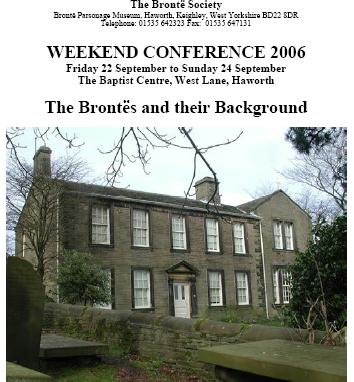
This weekend is full of Brontë-related events. Not only the Radical Brontës festival is still going-on, not only the new Jane Eyre will be aired by the BBC... the Brontë Society also celebrates its 2006 Brontë Society Weekend Conference.

The whole programme of events and conferences can be found here. These are the list of speakers and the lecture titles:
Friday 22 September to Sunday 24 September
The Baptist Centre, West Lane, Haworth

The Brontës and their Background
Speakers and provisional lecture titles
  • Stephen Whitehead The Haworth the Brontës knew
  • Bob Duckett Where did the Brontës get their books?
  • Ian Dewhirst The real Haworth, Myths and Anecdotes
  • Ian Emberson John Milton's influence on Charlotte
  • Yukari Oda ‘Wuthering Heights’ and the Waverley novels: Scott’s influence on Emily
  • Elizabeth Leaver Why the Brontës wrote as they did
  • Tom Winnifrith The Brontës and their foreground: Religion and the Brontës
  • Brian Wilkes Charlotte Brontë and the Two Churches
Plus, an afternoon visit to Thornton and the Shirley country or a guided walk around
historic Haworth.
Categories: , ,