Podcasts

  • S3 E8: With... Corinne Fowler - On this episode, Mia and Sam are joined by Professor Corinne Fowler. Corinne is an Honorary Professor of Colonialism and Heritage at the University of Le...
    3 months ago

Monday, October 31, 2011

Monday, October 31, 2011 12:12 pm by M. in , , , ,    No comments
The Yorkshire Post is looking for Yorkshire's Greatest Creative People. And Charlotte and Emily are two of the contenders:
More than 160 years after they put down their pens, Charlotte Brontë’s “Jane Eyre” and Emily’s “Wuthering Heights” are among the major film releases of the Autumn showing their enduring appeal for millions.
It makes it impossible to ignore the sisters’ claims for greatness but, before we settle for a two-way battle between them, let’s not overlook our other contenders. (...)
Charlotte Brontë
It's not just a gripping storyline that has won Charlotte’s “Jane Eyre” so many millions of admirers.
There’s also the fact that Jane was a heroine ahead of her time – a self-sufficient young woman not that traditional damsel in distress.
The times meant that the author was named as Currer Bell - for a woman to write was not seen as respectable.
Charlotte had also produced “The Professor” in 1847, but it was rejected and only appeared after her death.
Shirley” came out in 1849 while “Villette” appeared in 1853.
Born in 1816 at Thornton, near Bradford, she outlived her sisters, but died of pneumonia in 1853.
The three women’s tragic lives make a story almost as gripping as anything they came up with in their books and have lent them an extra appeal to fans from around the world.
Emily Brontë
Haworth is the only place I’ve seen footpath signs in Japanese, directing walkers to the Brontë Waterfall and Top Withens.
It’s down to “Wuthering Heights”, the only book written by Brontë sister Emily and loved by millions around the world.
Merle Oberon and Laurence Olivier in 1939 and Juliette Binoche and Ralph Fiennes in 1992 are the stars who have already played Cathy and Heathcliff and who can forget the Kate Bush song of the title.
Emily, who also wrote some poetry, published under the name Ellis Bell.
She, too, was born at Thornton. Only a year after the publication of her great book in 1847 (like Jane Eyre) she complained of breathing difficulties and died aged only 30.
She is believed to have been working on a second book, but if so it has never come to light. (Richard Catlow)
Global Comment reviews Andrea Arnold's Wuthering Heights, seen at the recent London Film Festival:
Arnold shoots the Yorkshire Moors like an inhospitable alien world. The wind is remorseless, the breath of giants blasting the boggy earth to pieces. Rocks jut forth like Pagan stones, a hotline to the ancient gods that stalked the land before Christianity. Rain threatens to find a second Noah. The young Heathcliff is dumbstruck, awestruck by his new surroundings. Catherine is his only connection to this hostile environment; an almost wordless relationship perfectly captured by Arnold’s undoubted visual genius. Every creak of a door, every stone in a wall, every bead of sweat from the horses tells Heathcliff and Catherine’s story.
Solomon Grave and Shannon Beer as the young Catherine are faultless for the first hour or so and so is Arnold’s film. What a shame then that this perfection is stunted when the older actors take over the reins. James Howson and Kaya Scodelario seem to be in a different adaptation all together. Any chemistry has been washed away on the Moors, any sympathy for their doomed affair tucked away in the drawing rooms of Thrushcross Grange. We simply don’t care about them any longer and their brooding pain plays like a couple of spoilt brats throwing a tantrum.
Both older actors don’t seem to have picked up on the idiosyncrasies of their younger counterparts. Small links to the past would help the audience connect with their characters despite the radical evolution in class both experience in the narrative. A bolder casting choice would have been to have the younger actors portray Heathcliff and Catherine throughout the entirety of the film. As it stands Andrea Arnold’s Wuthering Heights is very nearly a great film, its starkly beautiful setting highlights sexual repression and lust in a way reminiscent of the Japanese film, Onibaba. Still a flawed Andrea Arnold movie is always worth considering such is her talent. (Mark Farnsworth)
Nevertheless, the Morning Star is even less enthusiastic:
But Andrea Arnold's rather laboured reimagining of Wuthering Heights failed to fully impress.(Maria Duarte)
The Lake Tahoe News covers a local Halloween party with a Brontë reference:
The 2nd annual Scary Slam emceed by Reno slam poet Benjamin Arnold at Bona Fide Books in Meyers on Oct 29 was an opportunity for local writers and literary aficionados to play dress up as creepy literary greats as they battled each other for a cash prize for scariest poem and costume.
Jan Smith came dressed as the deceased, mentally ill, mid-century Sexton. Suzanne Roberts was Charlotte Brontë’s “madwoman in the attic” of Jane Eyre. (Jenniffer Eddy)
More Halloween. The Irish Times looks for ghoulish stories:
Emily Brontë’s Wuthering Heights (1848) could be seen as a ghost story in which many of the themes preoccupying the Victorians preoccupy the fiction they read. For all the terror and the ambivalent satisfaction in being frightened, the Victorian ghost story ultimately elevated fear and dread into regret and lamentation.  (Eileen Battersby)
Mark Smith in The Sunday Herald includes the Brontës' books among the books to show off:
You’re impressed, aren’t you? Dickens. Brontë. Hardy. And yes, I know there aren’t many creases on the spines but I’ve read all of them. Well, most of them. OK, some of them. Or at least, a few of them.
But hang on a minute. Your eyes are wandering to the bottom shelf. The one with the Jeffrey Archers and the Dan Browns. You’ve seen through me, haven’t you? You’ve spotted my bookshelf trickery – my shame.
The New York Times goes to Wisconsin following the tracks of Frank Lloyd Wright:
T. C. Boyle’s eloquent “The Women” (2009) follows Wright through three complicated marriages and makes Wisconsin feel akin to the storm-lashed moors of Wuthering Heights. (Deborah Solomon)
Matt J. Horn interviews Sally Reeve who played Martha, Thornfield's cook, in Jane Eyre 2011. She unveils some of the parts that never made it into the final cut:
Martha is the cook at Thornfield and is married to John, (played by the wonderful Ewart James Walters), who is Rochester’s right hand man – the only member of staff who came with Rochester from Jamaica. They have a daughter together who also works in the Thornfield kitchens. I had a great time with all the period props that were in the location – I spent a whole afternoon plucking pigeons and am now a dab hand at it! There was a huge sub-plot that Cary (Fukunaga) worked out with all the actors playing the staff – about whether we “knew” the big secret of Thornfield; and although none of it made the final cut of the film, we all worked really hard on it. My character particularly had a shock when she discovered her husband was aware of it, and had kept it from her. As is often the way with a film shoot, so much of this footage wasn’t included in the final edit – I’m waiting for the director’s cut to see if he puts it back in! (...)
My first day’s work involved rehearsing with Mia and Ewart, helping Mia with her Yorkshire accent (which is brilliant in the film) and doing improvisations with Romy to help develop our characters.
Snadzmatazz regrettably hated Villette; The Hairpin posts about the Brontë tiny books (via Eyresses); Voice of the Valleys celebrates Halloween in a Brontë way... Hawortheen and Abigail's Ateliers posts a nice collection of winter Brontë-related pictures.
12:07 am by M. in ,    No comments
Celebrate Halloween with a Brontë (sort of) ghost story. Charlotte Brontë's juvenilia story The Green Dwarf (1833) contains an episode where the emperor Napoleon encounters an spectre (not surprisingly renamed in anthologies, Napoleon and the Sceptre). Not really very spooky but very nice to read considering that Charlotte was 17 years old when she wrote it. Being by the author of Jane Eyre and not forgetting that it is in the public domain it is not rare to see it included in various Ghost Stories compilations. Like this one, recently published:
The Best Ghost Stories Ever Told
Edited by Stephen Brennan
Skyhorse Publishing
Paperback
ISBN-10 1616083646
ISBN-13 978-1-61608-364-9
Publication Date: September 2011

Are you sure that chill on the back of your neck is just a breeze?
When “gut feelings” have been replaced by a thirst for proof and hard evidence, it’s good to know that you can still be spooked by a collection like this one. Best Ghost Stories is a creepy group of over forty tales by some of the most impressive names in the writing world. Terrifying, bone-chillingly eerie, and good fun, these haunting narratives give vivid descriptions of creepy characters and happenings that will make you hesitate before turning out the light!
More than just a niche product, ghost stories hold a bewitching appeal for all kinds of writers and readers—some of the truly great authors of the nineteenth and twentieth centuries have lent their horror stories to this collection, including Arthur Conan Doyle, Louisa May Alcott, Joseph Conrad, Robert Louis Stevenson, H. G. Wells, and many more. Count on our Best Stories series for entertaining tales that you won’t soon forget.
12 black-and-white illustrations
The book is reviewed on the Dayton Daily News.

Sunday, October 30, 2011

Sunday, October 30, 2011 7:40 pm by M. in , , , , ,    1 comment
The Holllywood Reporter interviews Mia Wasikowska (audio here) and thinks that
[T]here is an outside shot that she might score a best actress Oscar nod for her critically acclaimed take on the oft-attempted title character in Jane Eyre. (Scott Feinberg)
Blake Morrison's We Are Three Sisters is going to be performed in Newscastle and the Chester Chronicle announces it:
Against the backdrop of a dark, remote northern town, three remarkable young women live their lives brightly. Haworth 1840s, in a gloomy parsonage where there are neither curtains nor comforts, Charlotte, Anne and Emily Brontë light up their world with outspoken wit, aspirations, dreams and ideas. Anyone who has read a Brontë novel cannot fail to be stirred by their overwhelming humanity, charged emotion and brooding and prescient unease with the status quo. With exquisitely drawn characterisations, a nod to Chekhov and a touch of poetic license, this pearl of a play - written by Blake Morrison and presented by Northern Broadsides - evokes with piercing clarity the life and distinct personalities of these three spirited individuals. (Michael Green)
The Vine thinks that Wuthering Heights 2011 was one of the best things to be seen at the London Film Festival:
Oscar-winning director Andrea Arnold’s Wuthering Heights featuring Skins actress Kaya Scodelario and newcomer James Howson. Despite Wuthering Heights author Emily Bronte describing Heathcliff as a “dark skinned gypsy”, “Spanish gypsy” and a “little lascar” (19th century term for Indian saliors - according to the Guardian) in the novel, this adaptation is the first time ever that a dark skinned actor has played the male lead, making this story more about race than class. (Kel Griff)
The Sunday Times reviews Why Be Happy When You Could Be Normal? by Jeannette Winterson and the anecdote that was the seed of her Oranges Are Not the Only Fruit is retold:
Mrs Winterson [her mother] read Jane Eyre to her but changed the ending so Jane becomes a missionary. (Daisy Goodwin)
The Philippine Star interviews the actress Lovi Poe:
“My favorite books have female characters whom I would love to play one day,” she said.
They are:
1. Wuthering Heights by Emily Brontë. “The love story of Cathy and Heathcliff was stormy and traumatic, yet it can be real. I was devastated.” (Girlie Rodis)
The Sydney Morning Herald reviews the Maldesons Guesthouse in Goulburn, Australia:
It feels almost like walking into a Brontë novel and I feel a strong urge to use words such as "indubitably" and "forthwith" until my wife tells me to knock it off and talk properly. (Nick Galvin)
The Star (Malaysia) reviews Jeffrey Eugenides's The Marriage Plot:
The “marriage plot” categorises a storyline that typically centres on the courtship between a man and a woman and the obstacles faced by the potential couple on their way to the altar. You’ll find it in the works of Jane Austen and the Brontë sisters, in most rom-coms and Bollywood productions. (Alan Wong)
The Guardian reviews What it Means to be Human: Reflections from 1791 to the Present by Joanna Bourke:
As Bourke seems to accept when she recounts the exchange, this may have been the message of an unidentified man interviewed by an American journalist in Rwanda not long after the genocide in which around a fifth of the country's population was killed. The man, who is described only as "a pygmy", asked the journalist if he had read Wuthering Heights, and went on to endorse what he described as the principle of the book – the idea that all humanity must unite together in the struggle against nature, "the only way for peace and reconciliation". After a pause, the journalist observed: "But humanity is part of nature, too." Unfazed, the "pygmy" replied, "That is exactly the problem." (John Gray)
The Runcorn and Widnes World talks about a local school initiative to promote the love of learning:
Enthusiastic children are sharing their passion for Jane Eyre at a classic reading club – before school.
They debate politics after lessons, keep thinking journals and plan to edit their own newspaper and become radio producers.
It is all part of a new approach to inspire students at St Peter and Paul Catholic College in Widnes.
The Independent on Sunday tries to understand why some writers are forgotten and others not:
This year there are new film versions of both Wuthering Heights and Jane Eyre. Holmes is back, Count Dracula is always around, Oz and Wonderland are painfully overfamiliar. (Christopher Frawley)
EDP24 suggests having your wedding in Yorkshire:
The wild moors of the Yorkshire Dales inspired one of the most romantic novels of all time, Wuthering Heights by Emily Brontë. If you choose to celebrate your wedding in Brontë Country you can be sure of a mysterious, wild, windswept celebration, with your very own Heathcliff.
 SouthCoast Today vindicates women's history:
OK, so I know it's not March and technically we're not allowed to talk about women's history except for that one month of the year, but ... all this got me thinking about the importance of having a central learning pool for a much-ignored facet of history. I say ignored because, Eleanor Roosevelt aside, I just don't remember many stirring portraits of women in my history books. I generally found my heroines in works of fiction, like "Jane Eyre." (Alexis Hauk)
Abigail's Ateliers posts pictures of her attendance the Jane Eyre 2011 pre-release event at the Brontë Parsonage and the BBC filming at the Parsonage for the Breakfast News; the film is reviewed on Maati.tv, Squarise; Shertown Studios and Knihovna (in Czech) post about Wuthering Heights.
12:30 am by M. in    No comments
1. Euphemism’s Usefulness: Elusive Eros in the Novels of Charlotte Brontë
Kelly, Sharon E., M.A.
Directed by Dr. Mary Ellis Gibson.
The University of North Carolina-Greensboro, 2011
103 pp.

In this project, I examine the uses of euphemistic language and concealed erotic content in Charlotte Brontë’s novels Villette and Jane Eyre with additional support from Shirley. Based on historicized readings of repression, I argue that the author includes non-traditional gender roles and sexualities in her novels to question the status quo. Because of the culture of publishing in the mid-nineteenth century, however, she was not free to write openly about sexual activities. Instead, Brontë used figurative language and sensual imagery to convey non-traditional gender performance and moments of eroticism. 
2. The creative soul of Emily Brontë: What "Wuthering Heights" reveals about its author
Crosier, Janet A., Ph.D.,
Advisor: Francis, Bruce
Capella University 2011, 206 pages

The influence that self-reflective learning theory has played in the lives of individuals throughout the ages can be seen most powerfully in their own written words. Nineteenth-century British author Emily Brontë received little formal education in her life, but she made the most of self-reflection in order to grow, both as a nineteenth-century woman and as a nineteen-century writer. It is through the words of Emily Brontë that this research study examines self-reflective learning theory in action. This study unveils the portrait of Emily Brontë that she created in her personal writing, poetry, and fiction. This study examines Bronte's use of self-reflection in her learning process, both formally and informally. Brontë tells her own life story through her own words in letters, journals, and essays, offering a better understanding of her life as a nineteenth-century woman. Brontë shares her life story as a writer and as someone who made the most of self-reflective learning theory in her poetry and her novel, Wuthering Heights . This study is designed as a content analysis of Emily Brontë writings. As such, it examines both personal writings, including diaries written with her younger sister, Anne, as well as more formal pieces of writings. The more formal writings include essays written as academic assignments, poetry written throughout her lifetime, and one novel, Wuthering Heights . Research shows that self-reflection was used as a means for self-analysis and self-improvement by Emily Brontë throughout all of her brief life. Brontë's self-learning practices offer great value to home schooling families today, who value the importance of self and of being able to direct their own learning processes. Through her writing, Emily Brontë also provides an example that might be followed by current students of all ages, proving that even with limited formal education, learning can take place when a person uses writing as honest self-reflection.

Saturday, October 29, 2011

Saturday, October 29, 2011 4:47 pm by M. in , , , , , ,    1 comment
Alice Jones in The Independent talks about Mumford and Sons' song 'The Enemy', specially written for Wuthering Heights 2011:
It's official: Marcus Mumford is the new Kate Bush. The London folkie has perhaps the most consecutive lines of anyone in Andrea Arnold's bleak and determinedly taciturn new version of Wuthering Heights. The film, out next month, closes with a song, "The Enemy”, specially written by Mumford and Sons after Arnold saw the band in concert and asked them to contribute. Coming after twoand- a-bit hours of spare dialogue, long silences and no soundtrack, Mumford's robust tones come as rather an anachronistic shock. Bush's histrionics would probably have been less jarring.
Thinking Faith didn't enjoy Wuthering Heights 2011 at the London Film Festival but the journalist from Sveriges Television at the Valladolid Film Festival (Seminci) did:
Vad har du mer gjort?
- Jag har sett ett par filmer på festivalen. Den ena är "Wuthering Heights", regisserad av Andrea Arnold.
Hur var den?
- Spännande och vacker, men lite pretto också... Men Andrea Arnold är en gedigen filmberättare. (Fredrik Sahlin) (Translation)
The film has also obtained some awards at the Seminci Festival: Best Photography for Robbie Ryan (who also was awarde in the latest Biennale) and a Special Mention to the young actors Shannon Beer & Solomon Glave for Wuthering Heights ex aequo with Thomas Goret for Le gamin au vélo.

The Toronto Star reviews Kate Beaton's Hark! A Vagrant:
Her version of Napoleon has a bean shaped body, the Brontë sisters are boy mad for broody weirdoes, Batman is sexy and gay and her Mystery Solving Teens are the Hardy Boys if all they cared about was being jerks and smoking behind the rink. (Raju Mudhar)
GQ interviews the actress Kat Dennings:
"Maybe it's a movie thing? I want to see as many movies as I can and I covet a lot of weird influential movies. I have a lot of favorite authors...Douglas Adams and Charlotte Brontë and Richard Brautigan. I get obsessed. (Lauren Bans)
The writer Alice Hoffmann is another known Brontëite. The Independent asks her:
Choose a favourite author, and say why you admire her/him
Emily Brontë, and 'Wuthering Heights' is my favourite book. I think she was a psychological genius. If I had to choose someone living rather than someone dead, it would be Toni Morrison. I feel I could read just one sentence and know it was her. She creates a world in the most spectacular language that you know is hers. (Arifa Akbar)
And The Monitor (Ugandas) asks the writer Sneha Susan Shibu:
Which are the most memorable books you have read?
I still remember what I read in college, but besides that, Emile (sic) Bronte’s Wuthering Heights is an all time favourite. (Beatrice Lamwaka)
An upcoming exhibition on the Liverpool Tate following the history of Alice in Wonderland's illustrations is discussed in The Guardian:
The Tate show reveals a lineage of art works that have not been explored before: the long interest, especially in this country from the early Victorian era onwards, in graphic illustration. The future Lewis Carroll was born during the heyday of a form of British art that has been sidelined as minor for too long, and the story of Alice's rise to mythic status also belongs to this history of a great 19th-century enterprise: the picture book. Thomas Bewick, a pioneer of the form, is vividly remembered, for example, by Charlotte Brontë in Jane Eyre (1847). In the novel, Jane is also a little girl at the beginning and we see her happily mind-voyaging through the pages of Bewick's History of British Birds: Jane confides to us how "Each picture told a story; mysterious often to my undeveloped understanding and imperfect feelings, yet ever profoundly interesting: as interesting as the tales Bessie sometimes narrated on winter evenings … and when, having brought her ironing-table to the nursery-hearth, she allowed us to sit about it, and … fed our eager attention with passages of love and adventure taken from old fairy tales and other ballads …"With Bewick on my knee, I was then happy: happy at least in my way."
Charles Dodgson was 15 when Brontë's novel exploded into Victorian consciousness, but he doesn't have to have known this book directly for us to imagine that he knew and even shared the heroine's feelings. When Alice thinks crossly, at the beginning of Wonderland, about her sister's reading matter, "What is the use of a book without pictures or conversation?" she speaks as a Victorian child from a similar background as young Charles Dodgson. (Marina Warner)
We sincerely hope that this Daniel Fisher's prophecy about Las Vegas (published in Forbes) doesnt't turn into reality... ever:
If these people thought a Charlotte Brontë-themed casino would make money, they’d build it  tomorrow.
Global Grind recommends an 'American classic':
We're keeping it digital today because we know how broke you are!
If you're bored and have a smartphone, why not get off Twitter and read a book? Specifically Emily Brontë's Wuthering Heights which is available for a free download here.If you don't want to download it, then browse it online.
So, why read this American classic? For one, it's filled with romance, fashion and old school ideals, something we're sure you are curious about. Plus if you want to learn about suffering and being strong, this is the book for you.
The Southwestern Minnesota Independent has a curious way of contextualising a local children arts festival:
While they might not ever be a Tae Kwon Do champion, pop star or the next Emily Brontë, Michelangelo, Emily Dickinson, Charles Schulz or Fred Astaire, Westbrook-Walnut Grove students in grades K-6 got to imagine what it would be like as they explored a number of art forms at the 16th annual Elementary Prairie Winds Art Festival on Thursday in Walnut Grove. (Jenny Kirk)
Tim Robey in The Telegraph thinks that
With Lynne Ramsay’s We Need to Talk About Kevin, Steve McQueen’s Shame and Andrea Arnold’s Wuthering Heights, 2011 is shaping up as a terrific year for British cinema.
Financial Times reviews The Gentry. Stories of the English by Adam Nicolson:
Similarly powerful are the love letters written in the 1810s by the feckless Harriet Capel to the dashing Baron Trip. Her passionate prose suddenly takes us round the corner from Jane Austen to Charlotte Brontë. Unfortunately for Harriet, Trip was showered packets of similar letters from other women, left them all unanswered, and eventually committed suicide. (Lucy Worsley)
Yestarday, October 28, took place the 21st annual Dead Writer’s Party in Fairbanks, Alaska. In the Fairbanks Daily News-Miner:
It’s not limited to strictly writers, though. Many people come as characters from the writer’s achievements. 
“One year, someone came dressed up as Bertha, the crazy wife from Jane Eyre,” said Christie Van Laningham, the public relations assistant for the University of Alaska Fairbanks English department. The department organizes the event each year. (Molly Lane)
University News defends the use of the Oxford comma:
The Oxford comma is essential to the sentence. When it is omitted it can lead to ambiguity within the sentence. For example, if I said: I love my sisters, Jane Eyre and Catherine Morland, there is ambiguity about the meaning of the sentence. Am I saying that my sisters are Jane Eyre and Catherine Morland? (Lindasy Adams)
Página 12 (Argentina) reviews Robert Goolrick's A Reliable Wife:
Bien comparada con la escritura de Brontë o Du Maurier, la historia de Una esposa de fiar se desliza en sentido contrario al amor. (Laura Galarza) (Translation)
Back to SaloLand, thinkerviews, Il Faro, Paperblog (in Italian) and Helsinborgs Dagblad (in Swedish) post about Jane Eyre 2011; ABC (Spain) presents the film which will be premiered in Spain next December 2; Paperblog reviews Agnes Grey (in Italian).
12:38 am by Cristina in    No comments
A new book featuring the Brontës' home has just been published:
A Dream House.
Exploring the Literary Homes of England

Carol Chernega
Dog Ear Publishing
ISBN: 978-145750-246-0

How often have you strolled through the villages of Sense and Sensibility, climbed the windswept moors of Wuthering Heights, or raced down dangerous alleys in Oliver Twist’s London? These classic scenes are memorable because their authors used their own homes and surroundings to create them.
A Dream House takes you on a journey to sixteen homes of English writers. Follow Carol Chernega as she admires the table where Jane Austen polished her masterpieces, explores the boathouse that was the inspiration for Agatha Christie’s Dead Man’s Folly, and meets Tricki Woo and Mrs. Pomfrey in James Herriot’s surgery.
Each chapter includes a brief biography of the author (or authors) that lived in that home, travel directions, and what you’ll find when you arrive. Whether you’re an armchair traveler or planning a trip, Carol’s humorous adventures and thoughtful insights will entice you into entering the world of literary England.
Here it can be found the book's press release confirming that one of the chapters is devoted to the home of the Brontës.

Friday, October 28, 2011

Friday, October 28, 2011 6:33 pm by Cristina in , , , ,    No comments
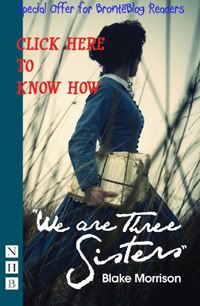
The Huddersfield Daily Examiner features the play We Are Three Sisters (don't forget about our special offer concerning the play script!).
For what Blake Morrison has done is shed light on the lives of the Brontë sisters through the text of Russian playwright Anton Chekhov’s play, Three Sisters.
It is not quite the left field idea it might at first seem. After all, Chekhov wrote about three sisters and their brother living in a remote part of Russia and the Brontës were three sisters and their brother who lived in a bleak, exposed part of Yorkshire.
One admittedly is fiction, the other the real lives of a group of women who have become iconic figures.
But the use of one story to shed light on the other has created a remarkable new theatre piece, one that arrives in Huddersfield next week.
“It’s taken me by surprise in terms of the absolute praise its had across the board,” said Barrie Rutter.
And he means from the outset when members of the Bronté Society sat in on the first read through of We Are Three Sisters, held in the parsonage in Haworth where the 19th Century novelists lived, to the play’s reception by both audiences and critics. [...]
“It’s been terrific so far,” said Barrie. “One review said this play had been waiting to be written for a long time.”
Barrie is an eloquent admirer of three women who despite the isolation of their surroundings led remarkable lives.
“They were superbly well educated by their father but they knew they had to work because the house belonged to the church.
“They were independent and the early suffragette was in them. My knowledge of them has been increased.
“It’s very funny this play as well. It has good ironic humour. I think people won’t expect that.
“Mrs Gaskell (an early biographer of Charlotte Brontë) did a dis-service to them. Her biography is all doom and gloom. It’s to that we owe a lot of the misconceptions about the girls and the times in which they lived,” said Barrie.
In this new Broadsides’ production, the sisters are played by actresses Catherine Kinsella, Sophia di Martino and Rebecca Hutchinson.
And according to Barrie, all three are beautifully cast.
The are, perhaps, the perfect sister act indeed.
The Yorkshire Evening Post takes a look at Leeds International Film Festival wchih opens next November 3rd with Andrea Arnold's Wuthering Heights.

More Brontë-related things to do, also on the other side of the pond, as The Spokesman-Review suggests Jane Eyre in Concert in Spokane, WA.
Paul Gordon’s 2000 Broadway musical version of Charlotte Brontë’s gothic romance is this year’s annual in-concert fundraiser for the Civic.
“In-concert” means that it is not fully staged. But don’t let that fool you. “Jane Eyre” will be even more elaborate, musically, than most of the Civic’s offerings, according to director Yvonne A.K. Johnson.
Between the singers and the musicians, there will be 60 people on stage. The orchestra, under the direction of Michael Saccomanno, will be 14 strong, more than twice the size of a usual pit orchestra.
The vocalists will include 10 members of the Spokane Area Children’s Chorus, singing the parts of the schoolgirls.
And because this is an in-concert show that doesn’t require busy singers to commit to months of rehearsals, the Civic is able to attract even more impressive vocal talent than usual.
Steven Mortier, one of the area’s most in-demand operatic baritones, sings the role of Rochester. Mortier has been in many opera productions over the years, and has also performed with the Spokane Symphony and other classical institutions. Yet he has rarely, if ever, performed in regional musical theater.
The role of Jane Eyre will be covered by Andrea Dawson, who has proven to be one of the area’s finest vocalists in many settings – musical theater (“White Christmas”), classical music (Windsong) and light opera (“The Pirates of Penzance”).
Sophia Caruso, who was a sensation as Helen Keller in “The Miracle Worker” at Interplayers last spring, will be Young Jane.
Other notable voices: Darnelle Preston as Mrs. Fairfax and Tamara Schupman as Blanche Ingram.
This fundraiser will also support a good musical cause: “the continued professional excellence of our Civic orchestras,” according to the theater.
And the show itself? Variety said it has an “intelligent sung-through score” which tells the “complex story with twists and turns intact.”
The $30 ticket includes a post-show reception catered by Europa and Clinkerdagger. (Jim Kershner)
Rick Schwartz wonders in The Huffington Post 'Why do movies suck?' and states,
And don't even think of blaming the big bad studios. Yes, they spent an obscene amount of money on Green Lantern and Green Hornet, but they also gave us Bridesmaids, Jane Eyre, and the last Harry Potter. Bad movies are not the sole domain of the studios -- I invite any of you to go to your local film festival and sit through truly independent films made for microbudgets.
The Sentinel (Staffordshire) reviews the restaurant Miller & Carter at Harecastle Farm:
Prices here have reached the wuthering heights of £20-plus for a T-bone or fillet steak, while a Chateaubriand for two is £40.95.
The reference above to Wuthering Heights was deliberate, by the way, because the listed Jacobean farmhouse at Talke always reminds me of Heathcliff's gaff in the Brontë novel. [...]
e ate, by the way, in one of the original rooms, with thick stone walls and a massive period fireplace.
Others seemed to prefer to sit in banquettes in the modern extension to the original building, which are hardly ever frequented by the ghosts of Heathcliff and Cathy. (Alan Cookman)
The Sacramento Bee suggests a couple of Brontë texts for wedding ceremonies. Are we alone thinking that maybe - just maybe - a text from Jane Eyre isn't quite right for a wedding?
4. Literature: From "Jane Eyre," by Charlotte Brontë
"I have for the first time found what I can truly love - I have found you. You are my sympathy - my better self - my good angel - I am bound to you with a strong attachment. I think you good, gifted, lovely: a fervent, a solemn passion is conceived in my heart; it leans to you, draws you to my centre and spring of life, wraps my existence about you - and, kindling in pure, powerful flame, fuses you and me in one." [...]
9. Literature: From "Wuthering Heights," by Emily Brontë
...he's more myself than I am. Whatever our souls are made of, his and mine are the same.... If all else perished and he remained, I should still continue to be, and if all else remained, and he were annihilated, the universe would turn to a might stranger.... He's always, always in my mind; not as a pleasure to myself, but as my own being. (Merrie Leininger)
The Huffington Post reports that Lady Bunny has sung Kate Bush's Wuthering Heights and interviews her:
And this month, New Yorkers are celebrating as Bunny makes her first local cabaret appearance in more than a decade, presenting "That Ain't No Lady" every Tuesday through November at Escuelita. The outrageous evening is beyond vulgar, in Bunny's time-honored way, and pits a new Peggy Lee cover and a devastating "tribute" to Amy Winehouse against classic Bunny numbers such as her extraordinary rendition of Kate Bush's "Wuthering Heights". . . [...]
JS: How did "Wuthering Heights" become a staple of your act? It's so left-field.
LB: I took my A-levels in England at a Quaker boarding school, believe it or not, and that's how I heard that song. It goes over a storm in the U.K., but you need to be a little alternative to know it here. It's a beautiful song, but of course my shrieking gives it a new tone. (John Sanchez)
Wuthering Heights 2011 is reviewed in Spanish by Pucela Project and Jane Eyre 2011 is also reviewed in Spanish by Oráculo. Bokmalande posts in Swedish about Classical Comics Jane Eyre.
12:01 am by M. in , ,    No comments
Two different Jane Eyre performances are on the stage today, October 27 and tomorrow October 28:
1. In Spokane, WA:
Jane Eyre in Concert
Based on the Novel by Charlotte Brontë
Music & Lyrics by Paul Gordon
Book & additional lyrics by John Caird
Directed by Yvonne A.K. Johnson
Conducted by Michael Saccomanno
Spokane Civic Theatre
Oct 28 - 29
7.30 PM

In Concert Fundraiser
A dramatic musical presentation of the Charlotte Brontë novel. Numbers: '"Children of God," "Forgiveness," "Sweet Liberty," and "Brave Enough For Love." The 7th Annual In Concert fundraiser will feature over 50 live instrumentalists and vocalists for two nights only.
The Spokane Civic Theatre tumblr publishes an interview with Yvonne A.K. Johnson:
Cheryl Johnsen: How is an in concert different from a musical?
Yvonne AK Johnson: The focus is on the music with 60 instrumentalists and vocalists. Everyone is on stage together which creates different production values as we have representational sets, lights, costumes and props but not to the full scale that we normally do when a musical runs five weeks.
Cheryl Johnsen: What made you choose Jane Eyre?
Yvonne AK Johnson: An in concert is first chosen as a production that we may not have the opportunity to produce for a full five week run for various reasons. There is a certain combination of the degree of music complexity that plays a factor as well as cast/orchestra size.
Cheryl Johnsen: What do you like about the music of Jane Eyre? Yvonne AK Johnson: The first time I heard the score I was mesmorized by the beauty of the musical phrasing and the intensity of the piece in general. (Cheryl Johnson)
2.  In Cumming, GA, a high school performance of the musical:
Jane Eyre. The Musical
Music & Lyrics by Paul Gordon
Book & additional lyrics by John Caird
Saturday October 29th @ 9:00 a.m.
West Forsyth High School 4155 Drew Road, Cumming GA

Our internet site is a gateway to the many happenings related to dramatic arts and musical theatre at West Forsyth High School in Cumming, Georgia (Forsyth County). Studio West produces several stage productions each year and boasts a strong drama department and active Thespian troupe. With awards and accolades on regional, state levels, and a dedicated group of students, parents, and advisors, West Forsyth Fine Arts is a standout organization in the Georgia theatre community.

Thursday, October 27, 2011

Thursday, October 27, 2011 9:05 am by Cristina in , , ,    1 comment
Nothing much to report today. PopMatters discusses Cary Fukunaga's Sin Nombre and says about him:
Director Cary Fukunaga has been making headlines these past few months. If it’s not his rumored love affair with Michelle Williams that keeps him on the radar of gossip journalists all over the world, it’s his well-received adaptation of Jane Eyre, starring Mia Wasikowska, Michael Fassbender, and Judi Dench that keeps him in the spotlight. This star-studded cast is quite a change from his directorial debut, Sin Nombre, for which he contractually arranged the cast to consist entirely of Central Americans. (Suzanne Enzerink)
And Pedestrian TV finds similarities between Jane Eyre and Lisbeth Salander (of Stieg Larsson's The Girl With The Dragon Tattoo fame).
The Girl With The Dragon Tattoo's Lisbeth Salander is the Jane Eyre of the 21st Century. I don't think that's a stretch. Just take a look at their similarities for a moment (with no spoilers, I promise). Both are unconventional heroines. Both have troubled pasts. At a young age both were abused by family members (no spoilers, don't worry). Both are strong, independent women with trust issues...
Maybe Lisbeth Salander has a few more years to put in before she reaches Jane's legend-status on the hierarchy of Iconic Female Literary Characters, but there's already evidence of her growing relevance in pop-culture.
YouTube user arcanus121 is sharing extracts from Charlotte Brontë's letters.

Front Row Reviews gives a 2 out of 5 to Andrea Arnold's Wuthering Heights. And Norma Jean Magazine (in Spanish) has a post on the Brontës' juvenilia.

Wednesday, October 26, 2011

Wednesday, October 26, 2011 10:50 pm by M. in ,    No comments
Wuthering Heights 2011 has been screened at the Seminci Film Festival in Valladolid, Spain, and we have several widely varied reactions. Check, for instance this twitter hashtag with opinions ranging from a serious contender for the best film award to a very tedious film.

The published reviews are also highly differing. Europa Press says that the film was received with applauses, but Ruta42 and Estrenos.com says that the screening only generated a collective yawn.

But the most bizarre thing is this (positive) review from El Mundo, illustrated with the above picture which features Andrea Arnold and... Emily Brontë. Why the newspaper selects a painting by Dante Rosetti of  Marie Spartali Stillmann to put a face to Emily Brontë is beyond our understanding.

EDIT: More reviews: El Norte de Castilla, Globemedia, La Mirada de Ulises, ABC, Leonoticias ...
Vogue's The Culture Edit reviews Andrea Arnold's Wuthering Heights:
The film starts with a young Heathcliff and Cathy (Solomon Glave and Shannon Beer), showing how the pair first fell in love - through almost animalist expression. A scene where Cathy licks the wounds of Heathcliff was particularly moving. There isn't much talking, this is more about the emotion, action and the all-consuming, life-changing experience of teenage love. [...]
The key to this story is chemistry - you have to believe these characters loves each other enough to do the gut-wrenching, horrible things they do to one another and to themselves, and both actors convinced me.
This isn't a traditional, cosy period drama, but the original never was intended to be either, and that -as it was when Brontë first wrote the novel in 1847 - is exactly the basis of its appeal.
Vogue also interviewed Kaya Scodelario:
The actress says audiences will not be left wanting of an opinion, good or bad, upon seeing the new version of Wuthering Heights - directed by Andrea Arnold and out next month.
"It will provoke some sort of reaction," she said. "It isn't an old fashioned period drama. As soon as I saw Andrea's Fishtank film, I knew it was never going to be stiff. It's anything but boring." (Ella Alexander)
In the meantime PopMatters reviews the previous screen take on the novel:
The dark, atmospheric mood that falls over the production feels as brooding as Heathcliff (Tom Hardy). The tumultuous tale of tortured lovers Heathcliff and Cathy (Charlotte Riley), Wuthering Heights is perhaps the most completely committed to showing the full consequences of doomed love.
Adopted by Cathy’s father as a child, Heathcliff is never fully able to shed his gypsy past. As Heathcliff is driven mad by his obsession with Cathy, his coldness and cruelty drive all others away from him, adding to his already very isolated existence. The secrets surrounding their love affair and Cathy’s subsequent marriage to Edgar Linton (Andrew Lincoln), are soon discovered by her daughter. The story is told in flashbacks and the shifts back and forth further lend the adaptation an air of confusion and mystery. [...]
With Brontë’s Wuthering Heights, Heathcliff is a more complicated character in that he’s not exactly likable, at least in traditional terms, but it’s to Hardy’s credit that he comes off dark and gloomy, but still charismatic enough to make the viewer understand why Cathy fell in love with him. (J.M. Suarez)
The New York Times City Room reports that some of the inhabitants of Villa Charlotte Brontë haven't been able to return to their homes yet after 'Tropical Storm Irene caused a landslide at the building'.

Les Soeurs Brontë writes in French about a 2010 trip to Haworth and the Brussels Brontë Blog has a post on a recent talk by Dr Sandie Byrne putting Jane Eyre in context.
Another art exhibition with obvious Brontë references closes today, October 26, in Bassano del Grappa, Italy:
Paolo Giaretta
Cime Tempestose
27 settembre - 26 ottobre 2011
Piccola Galleria Arte Contemporanea
Bassano del Grappa, Vicenza, Italy
The exhibition is described in Il Giornale di Vicenza:
Attraverso immagini dipinte l'artista costruisce e proietta film: a volte autobiografici a volte documentari, a volte surreali parodie della realtà, altre citazioni liberamente tratte dalla letteratura. Stavolta è "Cime tempestose " il motivo letterario pertinente/impertinente che sostiene la dozzina di acrilici su tela esposti alla Piccola Galleria di Bassano: «Gli ho dato il cuore e lui lo ha preso soltanto per stritolarlo a morte e scagliarmelo sulla faccia...», dice Isabella, una delle protagoniste del romanzo di Emily Brontë. E non si sa se compatire, immedesimandosi nella storia, oppure sorridere dell'immagine tragico-granguignolesca. (Giovanna Grossato) (Translation)
Picture:
..Dopo aver cercato di capire la vita dai libri ebbe dei dubbi… Un hiver chez elle acrilico su tela 140 x 90- 2011

Tuesday, October 25, 2011

Tuesday, October 25, 2011 9:20 am by Cristina in , , , ,    No comments
Highland News adds one more festival where Andrea Arnold's Wuthering Heights will be screened: Inverness Film Festival (9-13 November).

And Just Jared Jr. shares a picture of Kaya Scodelario and Nicola Burley at the London Film Festival screening last Saturday. The picture on the right hand side is courtesy of lazygirls.

The Case for Global Film, Celluloid Heroes Radio and Glam UK review the film.

Rope of Silicon begins looking at scripts with Oscar odds and shares a link where Moira Buffini's screenplay for Jane Eyre 2011 can be read/downloaded. Coincidentally, Grantland's Hollywood Prospectus broaches the subject as well:
But The Help (let alone hopefuls The Ides of March, Jane Eyre, Drive, and The Skin I Live In) may have trouble surviving an onslaught of high-profile year-end releases: Tinker, Tailor, Soldier, Spy, War Horse, The Descendants, The Girl With The Dragon Tattoo, Hugo, A Dangerous Method, Carnage, We Bought A Zoo, and Extremely Loud and Incredibly Close all qualify in this category and collectively, their authors have amassed 18 nominations for earlier scripts. This category feels crowded with potential best picture contenders, and as the writing branch narrows the field, the overall appeal of the movie, not just the writing, may make the difference. (Mark Harris)
Public Opinion has an alert for this weekend in Chambersburg, PA:
Franklin County Library System's Fall Book and Bake Sale will be held this weekend in the Norlo Park community building off U.S. 30 in Guilford Township.
The sale has more than 20,000 items, including 100 collectible books. Proceeds will benefit library improvements at all Franklin County Library System locations.
A silent auction features first editions and notable items such as a 1905 ten-volume set of the works of the Brontë sisters, valued at more than $1,000; The Carpenter's New Guide, 1854, featuring designs by Samuel Sloan, 19th century architect, valued at $600; and a 1928 collection of gospel poetry written by Rev. Walter R. Gobrecht, pastor of St. John's Reformed Church, Chambersburg. Bidding closes 1:30 p.m. Saturday.
The sale will be held from 4 to 8 p.m. Friday and 8 a.m. to 2 p.m. Saturday and Sunday.
The London Screenwriters' Festival posts the second installment of the Guru in the Attic saga (first installment is here).

Finally, AbigailsAteliers has a post on governesses, 'the real Jane Eyres'.
1:28 am by M. in ,    No comments
A new exhibition opening this week in London features paintings inspired by Jane Eyre:
Jennie Ottinger
Chances, Choices, Chases
Eleven Fine Art, London, UK

28th October to 3rd December 2011
Private view: 27th October, 6-8pm

Eleven is pleased to present Jennie Ottinger’s first UK exhibition in Chances, Choices, Chases whereshe has created paintings and abridged novels from classic literature. Despite the fast pace of life, thereremains an impulse to read classic books. With numerous forms of media constantly competing for ourattention, it is an overwhelming task to try to keep up with all the books, music, and movies that interestus. We are reminded of our own mortality as there is a finite amount of time in which to engage ourdesired experiences.

Ottinger creates a quick solution to digesting well known novels. Using the casual vernacular of ourmodern time, she summarises synopses of classic tales. Creating an even more succinct summary, theplot and character descriptions are stripped down to their bare essentials. Ottinger glues together thepages of hard cover classic novels, cuts out the centre of the blocks of pages and places her hand writtensynopses in the empty space. Reinterpreting the book covers but drawn in verisimilitude, the books canbe used for fooling those around you into believing you are engrossed by the novel in its entirety. Heradaptations of the stories allow the reader the pleasure of absorbing the main points of the novel in amere few minutes. The title of the exhibition Chances, Choices, Chases serve as categories to furtherreduce literary masterpieces to single words.

Presenting paintings of scenes from the classic tales she gives viewers a snap shot of the book’s contentswhere a few words and images suggest the infamous story lines. Like Grant Wood, she presents thecharacters more as archetypes than individuals, relying on costume, prop and setting cues for theiridentity. Similar to the loose unfinished qualities of Marlene Dumas’s paintings, Ottinger leaves muchto the viewer's own ability to fill in the blanks. This newest body of work sees her characters animatedand expressive, visually bringing to life stirring plot points from the novels along with the more subtlenarrative defining scenarios. We rely on her own dedication to reading the classics as she selects scenesfor her paintings which relate to significant moments in each story.

The tales she depicts are part of a collective cultural consciousness and have been adapted into movies,plays, and other forms of media. The viewer is drawn to the familiarity of characters, identifyingwith their personas and plight. Exploring the themes of chases, choices, and chances in the characterslives, Ottinger draws parallels to the critical crossroads in our own lives where we are forced to makedecisions and thereby live with the outcomes.

Jennie Ottinger was born in 1971 and lives and works in San Francisco. Her recent solo exhibitionsinclude Due By (2010), Johansson Projects, Oakland, USA and Due Process (2010), Kantor Gallery, LosAngeles, USA.
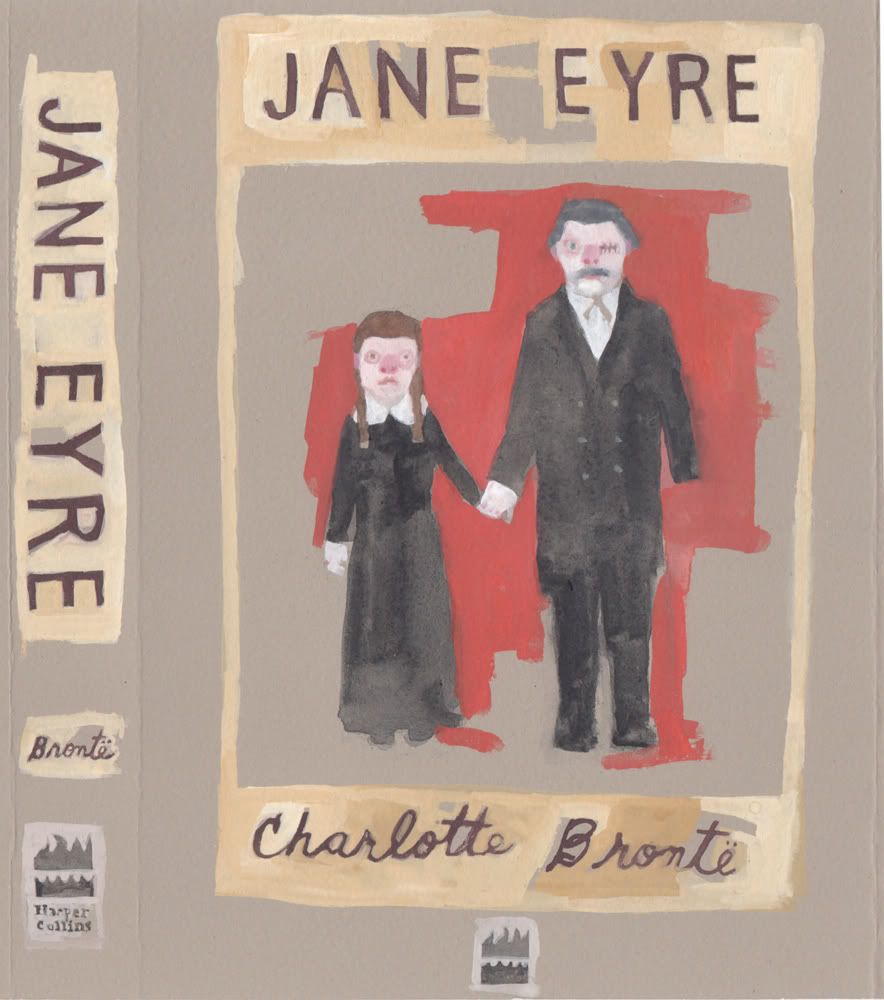
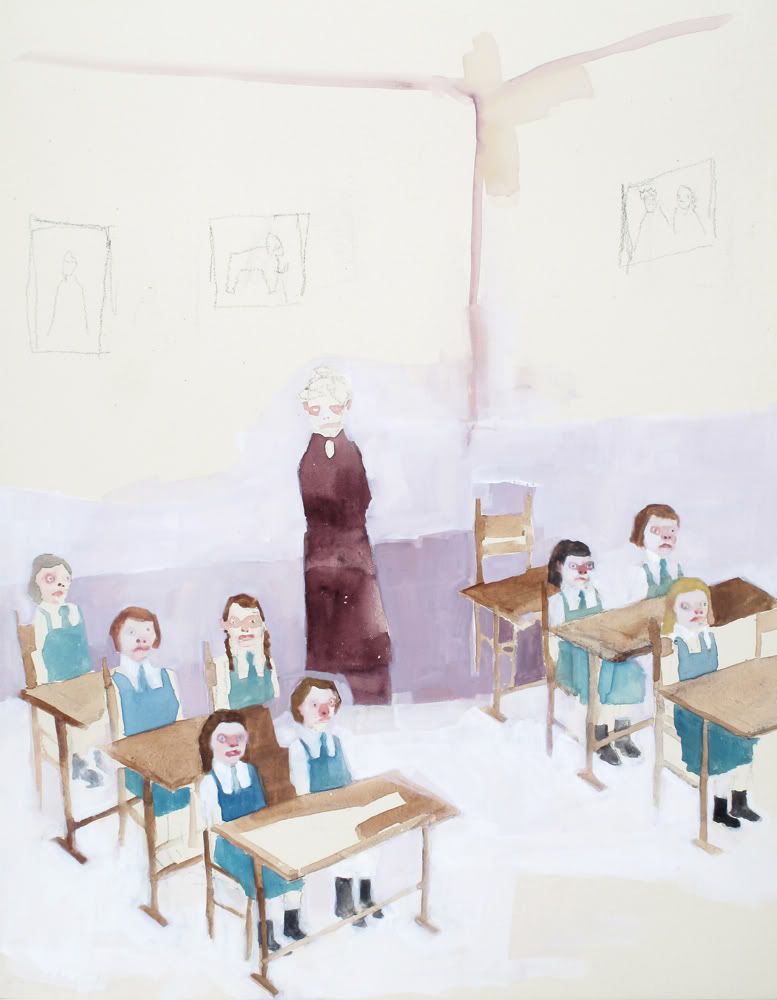
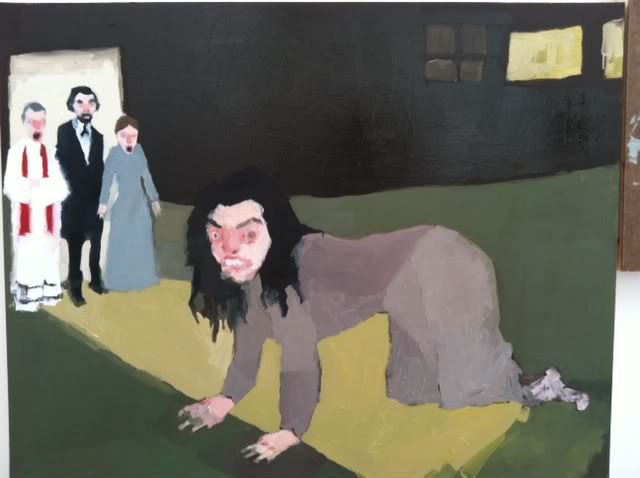
Jane Eyre is one of the classic tales explored (click in the pictures to enlarge them):
Jane Eyre, 2011
Gouache and graphite on paper (cover), summarised and hollowed book
9 x 6 in / 23 x 15 cm
Classroom (Scene from Jane Eyre), 2011
Gouache and graphite on paper mounted on panel
14 x 11 in / 36 x 28 cm
Meet My Better Half (Scene from Jane Eyre), 2011
Oil on panel
16 x 20 in / 41 x 51 cm

All images are courtesy of Eleven, London – www.elevenfineart.com
Thanks to Susannah Haworth for sending us this information.

Monday, October 24, 2011

Monday, October 24, 2011 3:30 pm by Cristina in , , , , , ,    1 comment
Digital Spy reviews Andrea Arnold's Wuthering Heights and gives it 4 out of 5 stars:
The latest Wuthering Heights is down-and-dirty, with Arnold employing the same kind of handheld camerawork and boxey 4x3 screen ratio as her BAFTA-winning predecessor Fish Tank. The stylistic immediacy jars at first given the built-in genre expectations, but viewers accustomed to Arnold's directorial approach will certainly find it a rewarding experience. [...]
Brontë purists may scoff at Arnold's radical approach to the 19th century novel, but in truth this overhaul completely re-energises the story for a new generation. This Wuthering Heights casts black actors as Heathcliff, giving the tale a layer of racial tension on top of its class friction.
Heathcliff arrives to the Earnshaws with whip marks on his back and a branding scar, hinting at a painful slave upbringing. It's wise to wave goodbye to romanticism, too, as this incarnation is intense, no more so when a wealthy Heathcliff returns in his 20s.
Moving and tender performances from first-time actors Glave and Beer carry the film for the first hour before the older actors take over. It's the younger duo that make the bigger impression, playfully frolicking through the moors as Arnold's camera explores the rolling Yorkshire landscape. With the tragic romance and keen eye for nature, there's a streak of Terrence Malick's '70s classic Badlands running through the heart of the film.
Scodelario and Howson get less screen time than their younger counterparts, and consequently their bond never feels quite as strong. She, still married to Edgar, is keeping her emotions in check, while he, somewhat cruelly, plays with the affections of Isabella Linton (Nichola Burley) to torture Cathy.
Wuthering Heights is challenging and has moments that are tough to watch (animal lovers may find themselves squirming) - and those art house sensibilities will mean its audience remains limited - but its darkness and brutality make it a totally unique take on the costume drama. (Simon Reynolds)
And the Liverpool Daily Post reviews Withering Looks:
Withering Looks uses high-brow, classic literature to create innovative comedy, which is delightfully clever and silly.
The two-woman show is a whistle-stop history of the lives of Charlotte and Emily Brontë and their novels.
With tongue firmly in cheek, Maggie Fox explains the third sister, Anne, is missing due to Government cut backs in the arts but they’ve put in a lottery application and hope to add her to the production soon.
The show’s style is charmingly informal and when a prop malfunctions or Fox fluffs a line it adds to the comedy and endears them to the audience.
It’s a manic mixed bag of comedy from witty one-liners to giddy song and dance routines, slapstick to the purely random.
One scene is introduced as Brontë exam tips for students. After a hair-brained routine demonstrating how the sisters wrote so much and why their writing was so similar, Fox quips: “That’ll give you ammunition for anything Michael Gove throws at you.”
Sue Ryding, as Emily, treats the audience to a batty run-through of Wuthering Heights’ plot using cardboard cut-outs.
She explains to sister Charlotte, played by Fox, that Heathcliff likes to dig up Cathy’s dead body for a cuddle sometimes.
Dressed in ripped sheets, the duo also performs a sketch as lost souls wandering the moors. Although it includes a jolly song called It’s No Fun Being a Ghost, these bits are a little slow and if any improvement were to be done to the production, it should be here.
Sporting wild wigs, the crack-pot twosome perform their interpretation of the 1939 MGM film of Wuthering Heights to end the night.
This is superbly silly and definitely leaves the audience wanting moor... (Jo Kelly)
The Haworth church roof is still in need of repairs, as The Telegraph and Argus reports:
One of the most visited churches in the UK has issued a fresh appeal for funds to carry out repairs on its leaking roof.
Haworth Parish Church, the burial place of the Brontë sisters, needs to raise £1.25 million to carry out essential repairs and improvements.
But after almost a year of fundraising the church has raised only £15,000.
Now church leaders are pleading for people to dig deep to safeguard the historic church’s future.
The Reverend Peter Mayo-Smith said: “The roof is really in a bad state of repair. It is old and had come to the end of its life, but repeated lead thefts haven’t helped.
“We have got to get this building sorted. The water runs through the ceiling and down the walls and we clean up puddles of it every time it rains.
“In the south aisle there has been a tarpaulin fixed to the ceiling over the organ for more than two years to protect it from the water coming in.”
English Heritage has agreed in principal to pay 60 per cent of the £250,000 needed to fix the leaks. However, the church still needs to find at least £185,000 before the building can be made watertight and further funds will be needed for internal improvements.
Mr Mayo-Smith said: “It became very obvious to me through conversations in the village that people weren’t aware of the seriousness of the state of the building.
“Since we have announced it people have been incredibly generous, but we have still got a long way to go.”
Visit haworthchurch.co.uk to donate to the restoration fund.
The Guardian mentions Kate Bush's Wuthering Heights in connection to Florence and the Machine:
These are songwriters who seem considerably more stewed, more sensual, more sinewy, who quite unabashedly draw their inspiration from mythology, artistic movements, historical figures, fables, fairytales, politics and literature. Think of Kate Bush, for instance, using Emily Brontë's novel for her 1978 hit Wuthering Heights, or of PJ Harvey's Let England Shake seizing on the poetry of Pinter and Eliot, British military history, and the art of Goya and Dalí. Think of the fact that Florence's new album offers songs about devilry, science lessons and horses, while Marina and the Diamonds has promised that her next record will involve a character named Electra Heart, and tackle subjects such as female sexuality and corruption of the self. (Laura Barton)
And a Twitter timeline of the International Rugby Board Awards 2011 reports that
IRB Chairman Bernard Lapasset and New Zealand Prime Minister John Key have welcomed the assembled guests and Hayley Westenra has wowed them withe two songs - World in Union and Wuthering Heights.
The Time Out blog suggests a trip to
The Costume Studio, 159-161 Balls Pond Road, N1 4BG (020 7923 9472)
An impressive selection of authentic-looking costumes and trimmings but at a price: around £80 an outfit for a week’s hire. Their attention to detail makes them a popular choice for costume drama inspired dress. If you’re channeling Downton Abbey or Jane Eyre, The Costume Studio can help.
Diario di una lettrice posts in Italian about Cary Fukunaga's Jane Eyre.

Sunday, October 23, 2011

Sunday, October 23, 2011 11:55 pm by M. in ,    No comments
Two new scholar books:

The Ecocritical Psyche 
Literature, Evolutionary Complexity and Jung
Susan Rowland
Taylor & Francis,Routledge
19th October 2011
Paperback: 978-0-415-55094-9
Hardback: 978-0-415-55093-2

The Ecocritical Psyche unites literary studies, ecocriticism, Jungian ideas, mythology and complexity evolution theory for the first time, developing the aesthetic aspect of psychology and science as deeply as it explores evolution in Shakespeare and Jane Austen.
In this book, Susan Rowland scrutinizes literature to understand how we came to treat 'nature' as separate from ourselves and encourages us to re-think what we call 'human'. By digging into symbolic, mythological and evolutionary fertility in texts such as The Secret Garden, The Tempest, Wuthering Heights and The Lion, the Witch and the Wardrobe, the book argues that literature is where the imagination, estranged from nature in modernity, is rooted in the non-human other.
The Ecocritical Psyche is unique in its interdisciplinary expansion of literature, psyche, science and myth. It develops Jungian aesthetics to show how Jung's symbols correlate with natural signifying, providing analytical psychology with a natural home in ecocritical literary theory. The book is therefore essential reading for seasoned analysts and those in training as well as academics involved in literary studies and Jungian psychology.
Contains the chapter: The Problem of Heaven and Hell for Emily Brontë. 
Romantic Sobriety
Sensation, Revolution, Commodification, History 
Orrin N. C. Wang
ISBN: 9781421400662
The Johns Hopkins University Press

This book explores the relationship among Romanticism, deconstruction, and Marxism by examining tropes of sensation and sobriety in a set of exemplary texts from Romantic literature and contemporary literary theory.
Orrin N. C. Wang explains how themes of sensation and sobriety, along with Marxist-related ideas of revolution and commodification, set the terms of narrative surrounding the history of Romanticism as a movement. The book is both polemical and critical, engaging in debates with modern thinkers such as Paul de Man, Jacques Derrida, Walter Benn Michaels, and Slavoj Žižek, as well as presenting fresh readings of late eighteenth- and early nineteenth-century writers, including Wordsworth, Kant, Shelley, Byron, Brontë, and Keats.
Romantic Sobriety combines deeply complex, close readings with a broader reflection on Romanticism and its implications for literary study. It will interest scholars who study Romanticism from a number of perspectives, including those interested in bodily and social consumption, the roles of addiction and abstinence in literature, the connection between literary and visual culture, the intersection of critical theory and Romanticism, and the relationships among language, historical knowledge, and political practice.
The Guardian discusses adaptations of children's books:
But isn't there a risk that all the bells and whistles take away from the original book, restricting the limits of the young reader's imagination – especially with films? "There can be the danger that the visual impact takes over," says Elv Moody, the editorial director of Classic Puffin. "But sometimes it can work the other way. Film can be a great way into a book that might have seemed too grown-up to read." She thinks this autumn's films of Jane Eyre, Wuthering Heights and The Three Musketeers will attract a new audience to those books, and points out that Tim Burton's Alice in Wonderland prompted a massive uplift in sales of Lewis Carroll's original book – even the Puffin edition, which had no film tie-in. (Michael Hann)
It doesn't look like the new Wuthering Heights is addressed to children, though.

The Sunday Times reviews the performances of The Country Girls by Edna O'Brien in the Imagine Arts Festival (Wateford, Ireland):
A century earlier, Mr Rochester was a martyr for locking his unstable wife in the attic (unbeknownst to Jane Eyre) instead of casting her aside. (...) The best stage adaptations — such as Jane Eyre and A Christmas Carol — are those that risk disappointing readers. (Eithne Shorthall)
The Pilot reviews The Ballad of Tom Dooley by Sharyn McCrumb:
In her notes afterward, McCrumb says she fashioned the book on Emily Brontë’s “Wuthering Heights.” She has captured the mystical feel of that classic and the events and characters continue to stir the reader, long after the novel has been put back on the shelf. A remarkable book from a writer at the top of her game. (Anne Barnhill)
Fredericksburg.com reviews Jeffrey Eugenides's The Marriage Plot (and adds a bit of a spoiler):
Madeleine ultimately decides that she's going to go to graduate school and study the great novels of Austen and Brontë, because, unlike real life, they almost always have a marriage plot and a happy ending. (Drew Gallagher)
One more Coronation Street Wuthering Heights reference, this one reported in the New Zealand Herald:
For example, Norris plays Kate Bush's Wuthering Heights as he sets off to the West Yorkshire moors. (Deborah Hill Cone)
The Playlist reviews Michael Winterbottom's Trishna (an adaptation of Thomas Hardy Tess of the D’Ubervilles set in India):
It’s a flip of the coin to another film bowing tonight at the BFI London Film Festival —Andrea Arnold‘s “Wuthering Heights.” Arnold takes a similar approach to Winterbottom, a bold reinvention of a classic that places just as great an emphasis on its environment as its characters. But where Arnold uses it as an extension of the savagery of Heathcliff and co, here you feel like you’re watching Winterbottom’s holiday video, that happens to have some actors wandering in and out of it.  (Oliver Lyttelton) 
Bella Online mentions the male pen names of the Brontës; Let's Read posts about The Tenant of Wildfell Hall; notes to my muses writes about Jane Eyre; kişisel depresyon anları film (in Turkish), The Numbers and Miracles & Madness review Jane Eyre 2011.
2:23 am by M. in , ,    1 comment
We swear that this is not a joke. Believe it or not, this has just been published:
The Lennon - Brontë Connection
Jewelle St. James 
Foreword by Judy Hall
Paperback: 162 pages
Publisher: St. James Publishing; 1st edition (October 14, 2011)
ISBN-10: 0973275243
ISBN-13: 978-0973275247

Is ex-Beatle John Lennon the reincarnation of Branwell Brontë, troubled brother to England's most literary sisters? The untimely death of John Lennon in 1980 prompted a Canadian woman, Jewelle St. James, to investigate life after death and other spiritual phenomena. Research spanning thirty years, and ten journeys to England, was necessary to unravel past-life mysteries and other surprising connections. 
Shelley Germenaux interviews the author in the Examiner:
What was the clue for you that Lennon was the reincarnation of Brontë?
JSJ:  Well, what happened, and I also talked about this in AYNIL-- was that a friend and I were playing a psychic game…(laughs) we were young and just goofing around, and  I said “who’s this?” I mean this was over 25 years ago. I was holding up a photo of a woman. She said “John Lennon was her sister in a former life!” She didn’t even know it was Emile Brontë (sic). Well I thought nothing of it, we were just playing around. But seven years later I was talking to another woman, a psychic who channeled John Lennon—and she said the same thing—that John was Emile (sic) Brontë’s  brother. Well that gave me chills. So I decided to take it more seriously and started looking into it. I decided to acquaint myself with the Brontë family further, start researching, and everything started falling together. I took a trip to Yorkshire and it was amazing.
Is this meaning that Yoko Ono could be the reincarnation of Lydia Robinson?

Saturday, October 22, 2011

Saturday, October 22, 2011 8:39 pm by M. in , , , ,    1 comment
Reviews of the screening of Wuthering Heights 2011 at the BFI London Film Festival are appearing:
Wuthering Heights' most successful aspect is the eponymous place itself. Whereas previous versions could easily have been re-titled 'Cathy and Heathcliff', Arnold's new version is very much about Wuthering Heights itself, rather than simply being set there. Winds blow, rains lash down and the nights are as black as the inside of a buried corpse. The film isn't just earthy - it is muddy and soiled. Arnold is fantastic at conveying a tactile world of rough edges - wood grain, bracken and rock - a gritty world inhabited by moths, beetles and watched over by hovering birds of prey.
Despite Brontë's passionate original text, the film itself almost refuses to present passion. There are no startling scenes which will really move you, and Arnold has perhaps consciously downplayed the text's melodrama. If this was her aim, then she has succeeded. Her Wuthering Heights is a film which will certainly beguile and interest, and demands at least one revisit - given the magnitude of any adaptation's task, perhaps that is enough. (John Bleasdale in CineVue)
[T]he most striking element of Wuthering Heights is the sound design. There's no score at all; events are solely accompanied by the rush of the wind blowing across the sparse Yorkshire hills. It’s a lonely soundtrack, which immerses you completely in the environment, weathered by the relentless onslaught of nature.
The script, sound and cast combine to make a spectacular production that channels the animalistic emotions of Brontë’s novel. You’ll be so caught up in the language, the look, and the wild lust of it all, that any memories of Timothy Dalton or Ralph Fiennes in long expensive coats will swiftly disappear; this costume drama could easily have taken place last Tuesday. Rarely before has a period tale felt so modern. (Ivan Radford in I-Flicks)
Tola Onaguga in The Guardian's Film Blog is more concerned with the casting of the film and particularly, the presence of a non-Caucasian Heathcliff:
Arnold was clearly unwilling to compromise on her vision: she declined to audition well-known actors in favour of open casting calls and at one point even scoured a Romany camp in search of her dark-skinned Heathcliff. Sticking with tradition is usually seen as the safe option as far as adaptations are concerned, but Arnold has actually taken a calculated risk by casting an unknown actor in such a high-profile role.
Arnold deserves praise for taking such a positive step into territory where many others have refused to tread. But will the first mixed-race Heathcliff be hailed as a landmark move by filmgoers? Or will audiences continue to accept the film industry's whitewashing of minority ethnic characters at face value?
The List interviews Kaya Scodelario:
The ghostly Cathy is one of literature’s quintessential tormented women. Did you feel under pressure playing such a well-known gothic heroine?
‘I didn’t read the book before shooting the film, and I didn’t watch any of the previous film or TV versions. Andrea said not to drive myself crazy worrying about how somebody did the role 20 years ago. We weren’t even given full scripts, just the lines the day before. Once it came out that the actor playing Heathcliff, James Howson, was black, I realised what a big thing the story was. I realised that this version was going to divide people, but I’d much rather do something that gets people thinking and stirs things up a bit.’
As a 19-year-old in 2011, how did you connect to the 19th century Cathy?
‘To me the story isn’t the fairytale romance that people perceive it to be. It shows that love is a kind of disease. Actually, going to this tiny village in Yorkshire in the middle of nowhere and being surrounded by the moors and the fog and the mud and the rain and the snow really helped in understanding how the teenage Cathy would feel love so intensely. I felt her sense of being trapped in a world where she either marries the wealthy Edgar or runs off with this wild boy Heathcliff. I didn’t want to judge her. Deep down she knows that Heathcliff will kill her, in the sense that her love for him will drive her crazy.’ (Tom Dawson)
The Guardian also recommends We Are Three Sisters by Blake Morrison, now in Richmond. By the way, don't forget that you can buy a copy of the script with a tempting special offer if you are a reader of this blog.

The Welwyn Hatfield Times recommends Jane Eyre 2011 for Halloween:
As if that wasn’t enough, you can also go a bit Gothic and catch a visit from the original Madwoman in the Attic, when Jane Eyre (PG) is shown on Saturday, October 29.
Digital Spy interviews Mia Wasikowska and Cary Fukunaga who says about Judi Dench:
"There was no ego or 'this is how it's done' attitude. It was like, this [is] the characters how we see it, this is happening before, this is happening after and she would do it. I'd have maybe a little adjustment but she was pretty much delivering the gold." (Mayer Nissim)
The film is reviewed in the Italian media: Il Sussidiario, CineZapping. Nieuwsblad (Belgium) talks about the screening of the film at the Gent Film Festival. In Poland, an interview with Mia Wasikowska in Wisokie Obkasy and articles in Olsztyn Gazeta, SE.pl, Plejada, students.pl

The Lodi News-Sentinel talks about zombies and interviews Sarah Juliet Lauro, an English professor at the University of California, author of  Better Off Dead: The Evolution of the Zombie as Post-Human:
“I don’t really know why I was pulled to this topic,” Lauro said in a phone interview Wednesday. “I think it’s because I grew up in Africa (through her father’s job). She referred to the novel “Jane Eyre,” which has a character who is very zombie like, before anyone knew about zombies. The character happens to be from she happens to be Creole, the same island where the zombies were reported to be. (Ross Farrow)
There's this quite stupid comment on NYULocal:
Reading books, for the most part, makes you look intelligent. The line between intelligence and pretentiousness, however, is thin. If you’re just starting a classic, don’t take the book in public. Everyone can get through the first chapter of Wuthering Heights, but few people finish it. This doesn’t stop me from telling people every year that I’m just saving it for the winter. (Olivia Loving)
Few people finish it?

Tessa Hadley reviews the new biography of Virginia Woolf by Alexandra Harris and makes the following comment in The Guardian:
Writing a little introductory book about Woolf – a "first port of call for those new" to her, and "an enticement to read more" – why would one begin by foregrounding the life rather than the writing? Perhaps Woolf is becoming one of those authors – like the Brontës – whose work can't be untangled any longer, in our collective mythology, from her own story.
On the box lists Ralph Fiennes's Heathcliff in Wuthering Heights 1992 as one of his best villains:
In 1992 Fiennes took on the role of the unrelenting and contemptuous Heathcliff and played him in all of his bastardly glory. Heathcliff targets all those that he felt did him wrong, ruining their lives and the lives of their children just because the girl he liked wouldn’t marry him. He is the worst kind of jerk, a rich one. (Peter Chawaga)
Página 12 (Argentina) talks about the actress Rachel Elisabeth Fénix and mentions how she was the inspiration behind Villette's Vashti:
Charlotte Brontë pensó en Rachel cuando escribió su novela Villette (dicen que Brontë enloqueció cuando la vio actuar en Londres). (Marisa Avigliano) (Translation)
La Opinión de Málaga (Spain) thinks that the French politics is like Wuthering Heights:
Les confieso que adoro las novelas decimonónicas inglesas pero es que, ante las intrigas y líos de alcoba de los líderes políticos franceses palidece hasta Cumbres Borrascosas. (Isabel Vicente) (Translation)
Persinsala (Italy) reviews the performances of Tomaso Sherman and Patrizia La Fonte's Ellen Dean:
L’ambiente raccolto creato per l’allestimento di Ellen Dean facilita l’ascolto. L’eccellente interpretazione di Patrizia La Fonte e Stefano Gragnani riporta in scena l’intimità del rito ripristinando forme dialogiche tipiche del teatro greco. Stefano Gragnani sembra parte del coro, spettatore, un attore brechtiano.
L’effetto sonoro della tempesta riecheggia a più riprese all’interno dello spettacolo e risulta talvolta fastidioso, ma non riesce comunque a scalfire l’attenzione dello spettatore, immerso pienamente in un contesto storico ricostruito con cura e dovizia di dettagli, anche nei costumi di pregiata manifattura. (Germana Marchioni) (Translation)
Paperblog (Italy) has posted several posts about Jane Eyre: 1, 2, 3 and 4.

День (Ukraine) interviews the writer Marina Lewycka who says how at the beginning she tried to imitate the Brontës among others:
Все время до этого я носила в своем сознании идею, как писатель должен писать: очень серьезно, имитируя великих писателей прошлого. Я выбрала своими образцами Джейн Остин, Шарлотту Бронте, даже Льва Толстого, но, конечно, если вы пытаетесь так писать сегодня, это выглядит немного старомодно. (Дмитрий ДЕСЯТЕРИК) (Translation)
The Renton Reporter publishes about a local production of The Mystery of Irma Vep; Macomb Daily Tribune makes a reference to Jane Slayre in an article about mash-ups; History and Other Things posts about Patrick Brontë and ThinkerViews about Villette; The Books of My Life has not enjoyed Jane Eyre; From Krypton with Love reviews Wuthering Heights; She's Got the Book posts a review of Jane Eyre 2011; the Anne Rice YouTube channel posts a video of the writer visiting the Brontë Parsonage this October; Le Nouvel Observateur (France) remembers the cameo of Roland Barthes as Thackeray in Les Soeurs Brontë 1979;

And we cannot end this post without quoting this unforgettable tweet by @theucannyalex:
Someone has just asked me for (and I quote) "Wuthering Heights, by Jane Eyre"