Podcasts

  • S4 E4: with... Eliza Goodpasture - On this episode, Mia and Sam sit down with art historian and writer Eliza Goodpasture! Eliza has written the introduction to a new edition of Emily Bront...
    5 days ago
Showing posts with label Software. Show all posts

Saturday, August 31, 2024

Saturday, August 31, 2024 11:14 am by M. in , , , , ,    No comments
Ruth Leon's Theatrewise recommends Underdog. The Other Other Brontë, now in streaming at the National Theatre at Home.
Sarah Gordon’s new play at the National Theatre online is an irreverent retelling of the life and legend of the Brontë sisters, Charlotte, Emily and Anne, and the story of the sibling power dynamics that shaped their uneven rise to fame. (Ruth Leon)
This letter in The Guardian by Michèle Roberts, author of Reader, I Married Him, clarifies some points: 
Sarah Moss, discussing the need for white literary heroines to be thin, asserts that “Jane Eyre, invited to join dinner parties at Thornfield, skulks in corners black-clad and skinny” (‘Hunger numbed my shame and humiliation’, 24 August). Not so. Jane is not invited to those dinners, as she is the governess. She wears black as an indication of her class status and has to keep out of the way. Starved as a child in an orphanage, she is indeed “little”, as Charlotte Brontë puts it, but is able to recognise her appetite, nipping down the back stairs at Thornfield to forage in the larder for supper for herself and her charge, returning with “a cold chicken, a roll of bread, some tarts”.
The Straits Times (Singapore) interviews the fashion designer Esther Choi: 
A book that I find myself returning to multiple times is Wuthering Heights by Emily Brontë. Every time I reread it, I gain new insights into the characters, and their personalities and emotions.
Today, August 31, in BBC Two, Jane Eyre 1944 (10.25 h). The Telegraph recommends it:
Orson Welles smoulders in this brooding Gothic adaptation of Charlotte Brontë’s 1847 novel. Robert Stevenson directs, though Welles’s hand is clear in the casting (Agnes Moorehead), the writing credit for John Houseman (shared with Aldous Huxley) and the score by Bernard Herrmann. Joan Fontaine tries valiantly to look plain as the heroine, and little Elizabeth Taylor glows in her uncredited role as a doomed school friend.
The Times reviews The Virago Book of Friendship, edited by Rachel Cooke: 
Among other literary greats, Cooke looks to Charlotte Brontë, who in her 1849 novel Shirley tries to capture the magic of female connection: “The minds of the two girls being toned in harmony, often chimed very sweetly together.” Membership in a close-knit group is like “a dance of belonging with no private space in it, all inside-out intimacy,” Lorna Sage says in Bad Blood. (Ceci Browning)
Queen City The Nerve reviews a production of The Mystery of Irma Vep in Charlotte, NC:
Yet by the time Lady Enid sashays into view, numerous other parodies have already been set into motion in Ludlam’s wicked mockery of the “penny dreadful” style of Victorian England. Sleuthing, sarcophagi, werewolves, vampires, witches, and a Wuthering Heights heath are all mixed into this undeadly brew. Plus the obligatory mummy. (Perry Tannenbaum)
Gasteiz Hoy (Spain) reviews the novel Hasta Morir la Muerte by Verónica García Peña:
Las hermanas Brontë están presente en el libro, así como Gaskell, Wilde o Collins. También Henry James o Poe, pero "por encima de todos ellos, la gran fuente de inspiración de esta novela es Pío de Baroja. " (Sara Esteban) (Translation)
Wuthering Heights 1939 features in a bizarre quiz on BuzzFeed on classic films and European cities you need to visit. Love messages 'straight from the heart', including one by Emily, on Today. Les Soeurs Brontë (in French) returns after a long hiatus with a post that plays with portraits of the sisters generated by IA.

Thursday, February 02, 2017

Source
ITV News features the temporary exhibition at the Brontë Parsonage Museum in honour of Branwell's bicentenary and gives us this glimpse into the recreation of Branwell's room at the Parsonage. It's thrilling to see a picture of it so it must be terribly atmospheric to stand right there.

The Irish News has a short review of Samantha Ellis's Take Courage.
Emily Brontë wrote Wuthering Heights, Charlotte Brontë penned Jane Eyre, even their brother Branwell has become infamous for his attempts at poetry and equally his perpetual drunkenness. But Anne Brontë? Can you name what she wrote? The target of playwright Samantha Ellis's Take Courage is just that, history's unfair dismissal of youngest Brontë Anne's work, her relegation to the role of the ignored "other sister". It's a robust, emotionally charged defence of the writer, whose death aged 29 left us with just a handful of poems and two novels to read, Agnes Grey and The Tenant Of Wildfell Hall. Ellis's main problem is that there is very little information on which to build a whole picture of Anne but the one she does manage to draw is of a woman misunderstood by historians and obscured by her sisters, despite a mind blindingly sharp and progressive. Take Courage certainly begins to right the balance; however, Ellis distractingly puts a bit too much of herself in at times. (Ella Walker)
Foyles features the authors of the six latest 'Galaxy® Quick Reads' and two of them pick Jane Eyre as one of the three books that first inspired their love of reading.
Amanda Craig [...]
Jane Eyre by Charlotte Brontë. One of my best friends is severely dyslexic, and the story of this classic novel is so powerful that she read it, sentence by sentence, and it changed her life. If you've ever been bullied at home or at school, or fallen in love with someone, this is the one for you. It's about a girl who is hated and rejected, like Cinderella, and by her courage and personality becomes loved and valued. Mad, bad and dangerous people try to trick, scare and even kill her. But she wins. [...]
Rowan Coleman [...]
Jane Eyre by Charlotte Brontë. I love Jane, from a frightened child to a courageous and independent young woman, I love this story of an ordinary person doing her best to find happiness and freedom.
Heatstreet thinks its 'Time To Scrap Women-Only Book Prizes' and argues that,
Jane Austen, all three (female) Brontës, Mary Shelley, Elizabeth Gaskell, George Eliot, Virginia Woolf, Agatha Christie… I could go on but I’d be typing all day… have all proven that women not only write great books – they write them better than men. (Emily Hill)
Verily Magazine reviews the The Lady's Choice, a computer game described as 'choose-your-own-Regency-era-adventure'.
While at times the plot might lend itself to scenes that have a touch of Brontë—depending on your choices, there’s a mischievous man in a mask, or a brooding gambling-affiliated Lord—it’s still very much carried in an authentic spirit of Jane [Austen], leaving you breathless with its twists and turns over the course of several hours. I, for one, was absolutely enchanted. (Maria Walley)

Tuesday, May 06, 2014

Tuesday, May 06, 2014 8:39 am by Cristina in , , , ,    No comments
Picture source
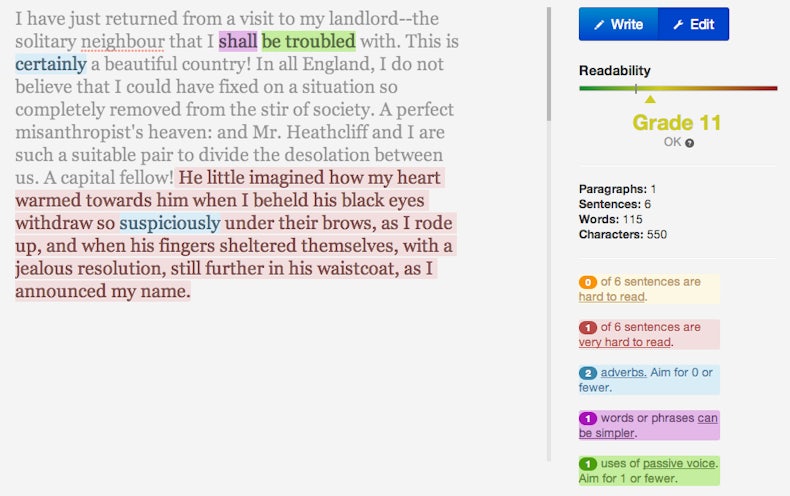
Well, this is quite fun. Bustle has used the Hemingway writing app to see what it says about several well-known authors. The image shows the verdict on the opening lines of Wuthering Heights.
Though Emily’s sister Charlotte gets all the attention for her novel Jane Eyre, every literary geek worth her salt knows that Wuthering Heights is by far superior. In fact, I once had a professor declare it to be one of the most subversive novels ever written in English. Whether or not you believe it (or think Jane Eyre is better — I’m not here to start any lit wars), let’s see how the Hemingway App ranks its opening paragraph.
Well, it may be subversive, but it isn’t quite up to Hemingway standards of clarity, I guess. The app rates this opening as just “Okay.” (Emma Cueto)
The Hartford Books Examiner has a Q&A with Michaela MacColl, author of Always Emily.
1) What inspired you to write Always Emily – and what hope or intent do you have in featuring the Brontë sisters as protagonists for your readership?I find the Brontë sisters were fascinating, both as writers and as young women in the mid-19th century. For me the first goal is always to try and tell a good story but I have a secret hope that if I can hook my readers on the Brontës as people, I’m halfway to putting to Jane Eyre or Wuthering Heights in their hands! [...]
3) Tell us about your research process. Also, how do you endeavor to balance fact with fiction – and what do you find to be the key(s) to bringing history alive for readers?The research seems to be the thing that people think is most daunting. It’s odd for me because I find the research the most fun and by far the easiest part of writing historical fiction. I used to over-research – it is possible to learn too much. It becomes too much to organize and difficult to use in a story. But the more experienced I get, the better I am at understanding what I’m going to need. The trick is to be efficient, but also to keep your mind open for that little detail that defines your story.
When I wrote Always Emily, I started with the biggest most definitive biography I can find. In this case, it was The Brontës: Wild Genius of the Moors, The Story of a Literary Family. The paperback version of this is 1184 pages (that’s not a typo). After that, I read all the other credible biographies looking for little tidbits that might inform the story. I find that I develop a clear understanding of the character through her biography. Finally, I research all the extra bits I need based on my story. I spent a lot of time on bog bursts, the Freemasons and hydrophobia (rabies) for Always Emily. (John Valeri)
Andy Miller writes in The Independent about his book The Year of Reading Dangerously: How Fifty Great Books Saved My Life.
I recently wrote a book about the year I spent reading 50 of the greatest and most challenging books in the canon – Jane Eyre, Moby-Dick, War and Peace and so on. As a full-time working and commuting parent, most of this reading was done on trains. Every morning I would board the 6.44am to London and try to focus my pre-office energies on, say, Catch-22 or The Epic of Gilgamesh.
It soon became clear that the challenge lay not just in engaging with the books in question but also in keeping the babble of the carriage at bay: the bing-bong of train manager announcements, the tish-tish-tish of leaky white earbuds, the honking of comedy ringtones, the repetitive beats of the slow-rolling refreshments trolley – TEAS! COFFEES! LIGHT SNACKS! – or the snores emerging from the occupant of an adjacent seat. The perfect sound to accompany Jane Eyre would probably be silence. But silence was not an option.
Mother Nature Network mentions briefly working at a library.
Growing up, my town's library was a home-away-from-home (I loved it so much it was a no-brainer that my first job ever, at age 14, was as a library page—a person who puts the books away). Walking through the stacks, I would mentally wave to old friends like Jane Eyre, Danny Torrence and Laura Ingalls Wilder, while having the comforting thought that just as many other characters (who could and would also change my life) were waiting for me to find them. To this day I'm more comfortable surrounded by books than anything else; I find people with bookless homes quite suspicious.
The Telegraph and Argus reports on the Ilkley Carnival with a 'Tour of Yorkshire' theme where
Children dressed as the Brontë sisters, Vikings and York Minster choristers to pay tribute to Yorkshire’s heritage. (Amanda Greaves)
The Guardian discusses how the Giro d'Italia passing through Northern Ireland during the weekend is more needed than the Tour de France passing through Yorkshire because
Yorkshire may be hosting the start of the Tour de France in June, but that county already has its dales, its Brontës and, in York, the second-most popular city in England for tourists. (Esther Addley)
Mi Serve una Vacanza (Italy) has an article on a cruise where one of the stops is Antigua:
Il giorno dopo si va ad Antigua, la splendida località esotica decantata ne “Il Gran Mare dei Sargassi” il noto romanzo postcoloniale di Jean Rhys del 1966 e prequel del più celebre Jane Eyre di Charlotte Brontë. E’ un luogo ricco di storia, vivacità culturale e dinamismo intellettuale. La musica è presente in ogni piazza e spiaggia, assieme a localini tipici e architetture tradizionali. Il settimo giorno è il turno di Martinica, foresta tropicale circondata da numerose baie vivaci e ricche di natura rigogliosa. Tra le spiagge più belle spicca quella di Salines con i suoi pittoreschi pesci colorati. (Translation)
Digital Journal via Labels4Kids credits Charlotte Brontë with the popularisation of the name Charlotte.

Wednesday, September 25, 2013

Wednesday, September 25, 2013 8:55 am by Cristina in , , , , , ,    No comments
The Telegraph and Argus has published an obituary of Robert Barnard:
A former chairman of the Bronte Society, author and compiler of  A Brontë Encyclopaedia, has died.
Dr Robert Barnard was also a prolific crime writer as well as being a “mine of information” on Haworth’s most famous residents.
He died on Friday at Grove Court Nursing Home in Leeds, at 76.
Along with his wife Louise, he compiled A Brontë Encyclopaedia in 2007, referred to by the society as “a cornerstone for modern Bronte scholarship.”
He was chair of the society twice and also wrote a book on Emily Brontë’s life.
Essex born and Leeds based, Mr Barnard spent lots of time at the Brontë Parsonage and around Haworth.
He started writing crime novels in the 1970s, writing over 40 books and short stories and receiving the Cartier Diamond Dagger award in 2003 for services to crime fiction.
Marcel Berlins, critic at The Times, called Mr Barnard: “One of our most original and versatile bloodspillers.”
The Brontë Society’s Richard Wilcocks said: “Well known in the Brontë Society, he was a professor, a scholar and an award-winning crime writer.”
It was us who described A Brontë Encyclopedia like that, although we must obviously add that we are in no way affiliated with the Brontë Society.

Sally McDonald, Chair of the Brontë Society does write about him on the Brontë Society website:
Members of the Brontë Society worldwide will be deeply saddened to hear of Bob's death. Dr. Robert Barnard, known to everyone as Bob, was greatly liked and much admired sharing with members a lifelong enthusiasm for the lives and works of the Brontës. Twice chairman of Council and a frequent contributor to Brontë Studies, author of a fine biography of Emily Brontë and co-author with his wife, Louise, of a Brontë Encyclopaedia, Bob has made a significant contribution to the Society and to our knowledge and understanding of the Brontës.
A distinguished academic, Bob also enjoyed an internationally successful career as a crime writer and if you asked him how the next book was coming along he would modestly reply "seems to be going ok" but he always seemed more interested to check how life was trundling along for you too. Bob had that rare gift of being able to chat happily and easily with anyone and was as much at home on a 48 seater coach visting Brontë sites with members as he was delivering a scholarly lecture to a packed hall or accepting accolades for his fiction writing.
The first time I met Bob we chatted about writing and talked about the art of writing short stories. He mentioned that he'd just written something and would let me have a copy if I'd be interested. True to his word it arrived in the post by the end of the week with a note asking if I would mind letting him know if I thought it was any good. From that chat about short stories began a friendship I came to treasure but it was years before I learned just who he was!
I count myself privileged to have enjoyed the incalculable benefit of Bob's friendship, support and wisdom these past years. A man who loved literature and music Bob was always himself and that self was erudite, brilliant and good fun.
Yahoo! Lifestyle (UK and Ireland) talks to Richard and Judy about their search for a new best-selling author.
Need more inspiration? Judy picks Jane Eyre as her perfect book, while Richard waxes lyrical about Jonathan Strange and Mr Norrell, his ‘desert island book’. (Kim Hookem-Smith)
The Guardian Books Blog wonders which classic novels could have received 'the Fifty Shades of Grey treatment'. (Meaning by their own authors, not by current writers, as some of them already have).
You can imagine a modern-day Charlotte Brontë writing embarrassing confessional scenes about masturbation, Lena Dunham-style, or a bit like Sheila Heti – and not understanding why other people found it all a bit much. But then she'd provide some good, loving rumpy-pumpy when Jane Eyre is reunited with Mr Rochester, to keep everyone happy. Emily Brontë paints a vivid and convincing picture of overpowering sexual attraction in Wuthering Heights, but her apparently virginal imagination might have faltered at the final description. (Moira Redmond)
Entertainment (Ireland) claims that Jane Eyre 2011 is one of '10 period drama films you need to see before you die'.
8. Jane Eyre (2011)
Period dramas are, by their very nature, over the top. The costumes, the designs, the acting - everything is supposed to be over-the-top. So to take one of the most famous period novels - namely, Jane Eyre - and strip it back to the bone is pretty ballsy. And yet, this interpretation of Jane Eyre completely works. Michael Fassbender, in an underrated performance, plays Mr. Rochester. Closed off and monosyllabic, he hires a young woman to act as an au pair for his children. The title character, played by Mia Wasikowska, is sent to his draughty, dust-ridden home to see to the children. Fassbender demonstrates here why he's the greatest living Irish actor of our generation, by infusing a scene with genuine emotion with a single look or glance. The director, Cory Fukunaga, previously worked on crime drama Sin Nombre and will be seen again on Matthew McConaughey's HBO drama, True Detective. (Brian Lloyd)
CNet (Australia) features Ubisoft's new role-playing game Child of Light.
The story was developed nearly a year ago, in October, starting with Aurora. "We imagined a young girl who could fly. Then I began developing her personality," Yohalem told CNET Australia. "Since all the dialogue in the game rhymes, I wanted her to speak using interesting diction, to have a broad lexicon. So, at that point, the daughter of a duke from 1895 Austria came into the mix. She's mischievous but grounded in her time, restrained but precocious, struggling to become something new. She's classic but evolving into something different. She has the aura of Jane Eyre as a young child: Jane at the beginning of the book."
For a world that's used to the fainting ladies of Perrault and Disney, who sit in the background waiting to be rescued, it's a refreshing twist — for those who might not understand the reference, one of the key parts of the character of Jane Eyre is her refusal to be subdued by those who would crush her and her absolute refusal to depend on anyone to make her destiny for her. (Michelle Starr)
More software today, as the Guardian features a 'Minecraft map of Britain created by Ordnance Survey'.
It starts with the OS's head office in Southampton, through which Minecraft players can enter and explore the geographically-accurate 3D representation of Great Britain.
Users can then recreate real-life man-made features on the map, such as Stonehenge or the Shard in London, iconic landmarks from fiction such as Hogwarts school or Wuthering Heights, or construct their own buildings and monuments with their imagination the only limitation. (Samuel Gibbs and Keith Stuart)
The Grimsby Telegraph writes about a recent council meeting where
By the time the evening was done, Charlotte Brontë, Nye Bevan, Aristotle, Winston Churchill and Ronald Reagan had all been quoted.
Wiadomości24 (Poland) reviews the biography Charlotte Brontë i jej siostry śpiące. YourGlenRoseTX features a local student discussing Jane Eyre. No Map Provided has put together a look based on Jane Eyre. Examiner has a review of Wuthering Heights and Rosie's Period Journal posts about the 1939 adaptation of the novel. Kate Bush Radio Show shares a poem inspired by Kate Bush's song Wuthering HeightsPaperBlog (in Spanish) has uploaded many literary-inspired stamps, including one of Charlotte Brontë. Yesterday the Brontë Parsonage Facebook page marked Branwell Brontë's death anniversary by sharing his funeral card.

Friday, March 08, 2013

Friday, March 08, 2013 9:15 am by Cristina in , , , , ,    No comments
We somehow guessed that yesterday wouldn't be the last time we would hear about the News Corp's school tablet with its Tom Sawyer vs the Brontës game. From The Telegraph:
 It will know if a child isn’t paying attention, warning users to keep their eyes on the teacher (how scary is that?) More worrying is that children will be able to use it to play games – such as one in which “Tom Sawyer battles the Brontë sisters.”
AVPT is sorry, but it fails to understand how that can be in the least bit educationally useful, since a) Tom Sawyer is a fictional character, and b) the Brontë sisters are real and, er, from a slightly different time period? It would be like having a mash-up game in which Sherlock Holmes fought Jeanette Winterson. But hey, that doesn’t matter, does it, if you’re a technology person. It doesn’t matter if children grow up without any sense of context or chronology – because they’re using your tablet. (A Very Private Tutor)
The MIT Technology Review is not so sure about it either:
My second and perhaps more sweeping qualm came from this sentence in the Times report: “Outside the classroom, children can use it to play games, like one in which Tom Sawyer battles the Brontë sisters.” While that demonstration video shows that Amplify offers an almost Godlike control over what apps students can and can’t use at any moment, it’s hard to see the educational value of some sort of Street Fighter rebranded with literary figures. Not to say that this has happened yet, but I worry that in the constant quest to make education fun, we might lose some of what makes education educational. (David Zax)
To be honest, and without having seen anything else about the game itself, we would say it's just a game. Children are playing games full of fictional characters such as SuperMario or whatever - is it really so bad to get acquainted with a couple of literary names even if they're out of context, etc.? Adults are reading mash-ups of classics and zombies and eroticised retellings of the classics and they didn't even play Tom Sawyer vs the Brontës when children.

Coincidentally, The Telegraph also has an article on getting teenagers to read.
Reading isn’t a race, and the child who is forced to read above their age, or to tick off titles on a list, is likely to become one of those who prefers to stick to simple texts. If you ask a child where they are in a book and they answer “Page 101”, then they have got the wrong idea. But continuing to read to your child at bedtime long after he or she has learnt to read is ideal. Too many parents seem to feel that once a child can read, they should be abandoned. Would you expect them to run a marathon as soon as they learn to walk? Go on reading together until your child asks you not to (usually aged 11). Children’s literature, including picture books, contains some of the greatest works ever written. Find what you both enjoy, give them a choice, and you’ll treasure the time together.
This also has the advantage of being able to introduce children to more challenging classics, many of which start slowly. If you can get them into, say, King Solomon’s Mines, A Study in Scarlet or Jane Eyre, and then stop at a crucial moment, you will have them desperate to carry on reading. (Amanda Craig)
It's International Women's Day today and there are articles such as '10 books every woman must read' in the Times of India:
Wide Sargasso Sea by Jean Rhys
A stunning novel that acts as a prequel to Jane Eyre and re-imagines Charlotte Brontë's devilish madwoman in the attic (Prema Naraynen)
Onlymyhealth discusses 'Women Empowerment through Popular Culture'. We are sorry to say this as it was clearly not intended but overall it's a very funny piece of writing, full of blunders and weird-sounding statements.
The most famous of all the women authors who has captured public imagination are the Brontë sisters. It has been documented in history that the Brontë sisters have had tragic lives, and all three of them had died young. Charlotte, Emily and Anne have created major literature works in their short life time with women as the lead characters in them. Charlotte Brontë’s most famous work is Jane Eyre; Emily Brontë’s most famous is Wuthering Heights that has even been made into a film, and the youngest Anne Eyre had written a largely autobiographical novel entitled Agnes Grey. The Brontë sisters brought women’s literature to the limelight, and through their protagonists had given voice to the issues of women. (Arka Roy Chowdhury)
Area Press (Italy) shares the results of a survey carried out in order to find the best-loved literary female character.
Elizabeth Bennet, protagonista di “Orgoglio e pregiudizio” e creata dalla penna di Jane Austen, e’ risultata il personaggio letterario femminile piu’ votato dalla community di oltre 11mila booklovers di Libreriamo (www.libreriamo.it), il social book magazine diretto da Saro Trovato. Seguono in questo speciale podio dedicato alle grandi protagoniste della letteratura la celebre Rossella O’Hara (12%) e la tenace Jane Eyre (9%). [...]
Sul gradino piu’ basso di questo speciale podio dedicato alla Festa della Donna, troviamo Jane Eyre (9%), protagonista dell’omonimo romanzo di Charlotte Brontë. Jane, bambina orfana e sottoposta fin da piccola a umiliazioni e ai rigori di una disciplina troppo severa, decide pero’ di continuare a studiare, di coltivare i propri talenti, fino a diventare l’educatrice privata di una bambina all’interno della tenuta di Mr. Rochester. Molti gli ostacoli che renderanno davvero arduo il conseguimento della serenita’ da parte della giovane Jane, ma la ragazza riuscira’ ad affrontare anche i momenti piu’ difficili con rettitudine e determinazione.
Le altre eroine della letteratura scelte dai nostri booklovers sono donne altrettanto famose e affascinanti, come Jo March di “Piccole Donne”, Catherine Earnshaw di “Cime tempestose”, Anna Karenina, Elsa Morante, Madame Bovary, Penelope de l’ “Odissea”, Bertha Tompson, Eva Luna, Sao di “Controvento”, Emerenc di “La Porta”, Clorinda dalla celebre “Gerusalemme Liberata” e Lady Machbeth. (Translation)
Old Gold & Black suggests books for spring break.
For those of you looking for richness and complexity, you might try dusting off that old classic you’ve always wanted to read, but never had the time. Some of my favorites include Jane Eyre, Pride and Prejudice or Ernest Hemingway’s The Sun Also Rises.
However, the works of Charlotte Brontë and Jane Austen might not satisfy your craving for a mindless beach read. (Elizabeth Dalrymple)
Wait - weren't they the grandmothers of chicklit and the mothers of Mills&Boon?

Picture source
The New York Times features the MoMA exhibition ‘Bill Brandt: Shadow and Light’.
He also explored the gritty industrial towns in the north of England, like Halifax and Jarrow, shrouded in Dickensian gloom, and he took to the open countryside to capture images of Hadrian’s Wall, Stonehenge and a ruined farmhouse on the edge of a windswept moor that is thought to have figured in Emily Brontë’s “Wuthering Heights.(Roberta Smith)
Sky News has fun reporting David Cameron's extremely short visit to Brontë country.
"I know things are tough right now," he said at the beginning of his big speech on the economy in a smart, modern workshop at the Cinetic Landis factory, heading up hill out of Keighley towards the moors.
"Families are struggling with the bills at the end of the month. Some are just a pay cheque away from going into the red. Parents are worried about what the future holds for their children."
Spoken with Brontë-like passion.
This speech came just a few days after Mr Cameron pledged in a Sunday Telegraph article that there would be no "lurch to the Right".
And yet here he was repeating Mrs Thatcher's "There is no alternative" slogan.
But then Margaret Thatcher has always been David Cameron's heroine, in true Wuthering Heights style.
Was Maggie Catherine Earnshaw to Dave's Heathcliffe, I wonder? No, it was Gordon Brown who was likened to the brooding Heathcliffe.
Wait a minute, the PM also talked here about "tough choices", a Tony Blair phrase.
Perhaps Dave is Jane Eyre to Blair's Mr Rochester? No, Frank Field compared Gordon Brown to him too.
Many Tory MPs see the Prime Minister as a flawed hero these days, however.
No wonder he only stayed in Brontë country for about an hour and a half. (Jon Craig)
The Wall Street Journal features young actress Julia Garner:
Ms. Garner, now 19, is inarguably flesh and blood, even if her pale skin, blue eyes and corona of blonde ringlets suggest a Tim Burton fantasia or an Emily Brontë adaptation in her near future. Anyone looking to cast her, however, will have to take a number. (Steve Dollar)
If you are nearby, the Brontë Parsonage Facebook page invites you to their Lunchtime poetry reading for International Women's Day
Celebrate the Brontë genius - and International Women's Day - by dropping in to our lunchtime reading of poetry both by, and inspired by, the Brontës. Actress Geraldine Bell reads. Copies of her DVD 'Haworth Through the Lens of History' will be available to purchase. 
Dirigido Por (Spain) reviews Great Expectations 2011:
En segundo lugar, y coherente con el sencillo tono naturalista de la puesta en escena, el realizador intenta, y a veces consigue, darle cierto aire realista y bastante cotidiano a un relato que, sobre todo en las escenas que transcurren en el campo, recuerdan, por su subrepticio empleo de la cámara en mano y la iluminación verosímil de los interiores a base de claroscuros, el experimento hiperrealista (aunque, en el fondo, estilizado) llevado a cabo por Andrea Arnold en su lectura de otro gran clásico de la literatura británica del siglo XIX: Cumbres Borrascosas, según Emily Brontë. (Tomás Fernández Valentí) (Translation)
The Brontë Sisters has visited Cowan Bridge via Google Earth. The Paperback Princess chooses both Austen and the Brontës. Manga Forever reviews Hiromi Iwashita's take on Wuthering Heights. Flickr user feathers chapman has uploaded a Wuthering Heights-inspired litograph.

Thursday, March 07, 2013

Thursday, March 07, 2013 8:42 am by Cristina in , , , , , , ,    No comments
(First of all, beware of spoilers if you haven't read Villette). The Guardian features Lynn Shepherd's top 10 fictional drownings:
10. Monsieur Paul in Villette
In conclusion, an inconclusive. In the last lines of Charlotte Brontë's novel, the heroine Lucy Snowe writes of her lover, Monsieur Paul, returning to her by sea from three years' enforced exile in the West Indies. But then there's a sudden "wild south-west storm" that leaves the Atlantic strewn with wrecks. So is it a happy ending, or a tragic one? Are they reunited, or does he drown? I'll let you decide. "… Leave sunny imaginations hope. Let it be theirs to conceive the delight of joy born again fresh out of great terror, the rapture of rescue from peril, the wondrous reprieve from dread, the fruition of return… "
The Hollywood Reporter looks at News Corp's school tablet, which
will come with education-themed games, such as a fighting game, in which Tom Sawyer battles the Brontë sisters, the Times said. (Patrick Brzeski and Georg Szalai)
Victoria Glendinning reviews Daphne du Maurier and Her Sisters: The Hidden Lives of Piffy, Bird and Bing by Jane Dunn for The Spectator.
Jane Dunn is something of a specialist on sisterhood. She has — we learn from the dedication — five sisters of her own; she has already written a book about the sisters Virginia Woolf and Vanessa Bell, and another about the cousins Elizabeth I and Mary, Queen of Scots. Now the du Maurier sisters are in line to capture the public imagination like the Brontës or the Mitfords, their group celebrity fortified by genuine claims to fame. The fascination for readers is the different character and destiny of each sister, plus their relationships with one another and with the dynamics of the family romance —  and few family romances have been more potent than that of the du Mauriers. 
Ystads Allehanda (Sweden) calls Jane Austen and the Brontës the 'forerunners' of feminism while the Indiana Daily Student complains about the fact that Indiana University seems to have overlooked Women's History Month:
Women’s History Month is being celebrated all across the country — except at IU. [...]
Employees at the Willkie Quad Movies, Music, & More, a library for Residential, Programs and Services  residents, assembled a list of film recommendations based around the theme of Women’s History Month.
Andrew Lewis, an employee at the library, said they tried to find films with female characters who were powerful or historically significant.
Included on that list were “Jane Eyre,” an adaptation of the classic novel, and “Frida,” a biography of artist Frida Kahlo.
“Unfortunately, we don’t have enough movies about historically significant women to fill a recommendations shelf,” he said. (Tori Fater)
The Equinox discusses the classics and their screen adaptations.
Jane Austen, Charlotte Brontë and F. Scott Fitzgerald each have their place in today’s society. However, it may not be what they envisioned.
Instead of being regarded for their classic novels, their detailed storytelling and character development, these authors’ names are recognized in a different capacity, all thanks to the jump from page to screen.
These famous books are no longer commonly read by our generation; many are more likely to see a film based off of the book rather than reading the book. [...]
I still believe that reading the classics–”Pride and Prejudice,” “Jane Eyre” and “The Great Gatsby”–before they debut on the big screen will allow you to develop a sense of the characters and plot in a way that is specific to your stream of thinking.
This way, nothing will influence your opinion on one of the classics–something a film and our generation have the potential to do. (Sam Norton)
Consequence of Sound reviews the album Soft Opening by Parl Necklace.
Why Toto” adds what sounds like another vocal layer to the formula, although it could just as easily be another breed of synth or some recorded wind. It plays like the soundtrack to a postmodern Wuthering Heights, and while it does a great job of setting a scene, Cathy and Heathcliff never emerge with any of the action. (Katherine Flynn)
The Dorchester Reporter informs of the death of 'elections guru' Billy McDermott, who seems to have been a fan of Wuthering Heights.
“Even during the 2004 [Democratic National Convention] —the biggest political event in four years being hosted in his home city—he opted to spend the week on the Cape at the beach with Deirdre, re-reading ‘Wuthering Heights’ during the day and watching the convention with her on TV at night,” [his son] Liam recalled. (Gintautas Dumcius)
The Gloucestershire Echo recommends a trip to Brontë country.
Landscapes sometimes inspire great literature, just as a town can be the central character in a drama – and it's these themes which are explored in this choice of holidays.
Take the Yorkshire Dales where lush green valleys are crested with white cliffs and ancient farmland is divided by dry stone walls. This area has featured in many TV series and films. The charming village of Haworth, a place of cobbled streets and alleyways, is where Jane Eyre and Wuthering Heights were created by the Brontë sisters, while Ilkley Moor is celebrated in the well known traditional song.
WAtoday looks at the most popular baby names in Western Australia.
WA's most popular girls' names for the year read like a "who's who" of Jane Austen and Bronte sisters' period dramas.
Charlotte aside, Emily also made the top four, followed by Isabella at number 12, Sophia, Matilda, Hannah, Emma and Lucy ran consecutively from number 17 to 21.
Perth mother Alanna Mell was one of the 193 women to name her baby girl Charlotte in 2012.
"We chose Charlotte because we like traditional feminine names," Ms Mell said. "Simple to pronounce and spell was important to us also.
"Having a name like Alanna, I've had to spell it and pronounce it over and over all my life and people still get it wrong - I didn't want that for Charlotte.
"Charli for a shortened version we love too and had she been a boy, it was going to be Charlie also."
Ms Mell said she and her partner knew Charlotte was growing in popularity, but were still shocked to discover it was the most popular.
"I guess more people are going back to old fashioned, pretty names," she said. (Rania Spooner)
The Independent talking about cricket:
After the opening day of England's Test series against New Zealand was washed out without a ball bowled, he talked of being confined to the attic at home like some latter-day Bertha Rochester and not allowed out until the whole thing was done, with his two-year-old Wilf running about downstairs. (Stephen Brenkley)

On the Brontë Parsonage Facebook page you can see Brontë Parsonage Museum director Ann Sumner at the opening of sculptor Diane Lawrenson's exhibition at Conwy. Kill Me If I Stop gives a 2.5 out of 5 to Wuthering Heights while To the Lighthouse writes in German about the 2011 adaptation of the novel. Posts on Jane Eyre over at Tranquil Dreams and Kokoba. Bookishness compares the actual novel to April Lindner's Jane while Reflections of a Book Addict simply reviews April Lindner's novel. Books: A True Story posts about Eve Marie Mont's A Breath of Eyre.

Friday, May 18, 2012

Friday, May 18, 2012 12:02 am by M. in , ,    No comments
Trajectory Inc. has released a collection of Classics Illustrated comics for Ipad, Iphone and Ipod Touch. Including the 1947 Jane Eyre issue, illustrated by Harley M Griffith and adapted by Harry Miller:
Jane EyreBy Charlotte Bronte
Genre: Romance
Number of Original pages: 48
One of the world's most beloved novels, Jane Eyre is a startlingly modern blend of passion, romance, mystery, and suspense. Immediately recognized as a masterpiece when it was first published in 1847, Jane Eyre is an extraordinary coming-of-age story featuring one of the most independent and strong-willed female protagonists in all of literature. Poor and plain, Jane Eyre begins life as a lonely orphan in the household of her hateful aunt. Despite the oppression she endures at home, and the later torture of boarding school, Jane manages to emerge with her spirit and integrity unbroken. She becomes a governess at Thornfield Hall, where she finds herself falling in love with her employer-the dark, impassioned Mr. Rochester. But an explosive secret tears apart their relationship, forcing Jane to face poverty and isolation once again. Beautifully illustrated, this classic tale will capture children's interest and spark their imagination inspiring a lifelong love of literature and reading.


Thursday, April 26, 2012

Thursday, April 26, 2012 10:05 am by Cristina in , , , , , , ,    No comments
We are quite intrigued by this new development concerning this portrait said to be of the Brontë sisters. As reported by the BBC (and quite a few others):
The portrait of three women was due to be auctioned in Northamptonshire this week.
But it was withdrawn from sale after a collector came forward about a similar Brontë portrait by the same artist.
The auctioneer said this could prove there was a link between the sisters and the artist, Sir Edwin Landseer.
Auctioneer Jonathan Humbert said: "In light of the new information and its potential significance, we have postponed the sale and will evaluate the strength and implications of what has now come to light.
"This could help prove beyond doubt, the important link between Landseer, one of the 19th century's greatest artists, and the Brontë sisters, English literature's most perennial siblings."
He added: "We can only do our best to prove beyond doubt, and obviously the more information we have the better our conclusion can be."
Now, Mr Humbert has revealed that a collector has come forward with information about a related pastel portrait of the same era – a copy of which is held on file at the National Portrait Gallery, thought to be the same subjects by the same artist.
“In light of the new information and its potential significance, we have postponed the sale of this picture until May 24 and will evaluate the strength and implications of what has now come to light,” he said.
“Any additional information supporting the historic story of this picture will help ensure the portrait goes to an appreciative home.”
"We are appealing to the purchaser of a pastel sketch of 3 Females With Guitar purchased at the NEC in the 2009 Antiques for Everyone to contact us. This could help prove beyond doubt, the important link between Landseer, one of the 19th century's greatest artists - and the Bronte sisters - English literature's most perennial siblings."
The wind farm plans for Brontë country are still in the news. The Telegraph shows that Prime Minister David Cameron is 'committed to wind farms':
He backed plans for 70 turbines off the North East coast and gave his support to an onshore wind farm being built by the same company that wants to put up turbines in Bronte country. (Louise Gray)
The Telegraph and Argus has a letter from a reader discussing the subject.

Margaret Atwood is interviewed about her book Payback on Salon.
You make no claim to prescience about the financial crisis that hit just as the book version of “Payback” came out. What inspired it instead? In a former life I was a student of Victorian literature, which you can’t be without coming smack up against money to an even greater extent than if you are, for instance, an Elizabethan scholar. The 19th century is the one where money becomes the big determinant. The big story is the industrialists, who are making kajillions of dollars some of the time, and at other times are undergoing big busts in which they close factories and everyone’s thrown out of work.
That’s when investment in the stock market became a thing. People didn’t really understand it. (And they still don’t!) Little old ladies would put their money in and they’d get an income, but then something would happen, as in “Cranford,” and they’d lose all their money.
Wuthering Heights,” when you’re 20, is about the mad passion of Cathy and Heathcliff. When you’re 50, it’s about, “Where did Heathcliff make his money? How did he get so rich?” (Laura Miller)
This is My Joystick argues the case for game character Kaidan Alenko being a 22nd century Jane Eyre.
Having now completed Mass Effects 1 through 3 and found Alenko to be the character with whom I could empathise the most, I decided to take an in-depth look at him, how he fits with the Mass Effect world, and what makes him a Jane Eyre for the 22nd Century. [...]
The development arcs of Jane Eyre and Kaidan Alenko are remarkably similar. Kaidan is shy, reserved, and excessively self-controlling, and like Charlotte Brontë’s heroine, he built his persona on a traumatic event from his youth. Jane Eyre snapped early in life, and suffered the consequences of her aunt’s rage for much of the rest of her life. Kaidan’s suffering, or at least his inability to relax and release his emotions, came as a result of his own turmoil.
He also snapped and suffered the consequences for many years to come. Jane Eyre’s story and Kaidan’s mirror each other further, as they both felt betrayed and let down by those to which they had respectively opened up. However, they did not let Shepard nor Mr Rochester get the better of them, and they both found the means and strength of character to pull themselves together, learn from their experiences and return as the equal of their former mentors. [...]
That I am able to draw a meaningful comparison between Jane Eyre and Kaidan Alenko serves to highlight the current quality and depth of game writing. Yes, I am slightly tongue in cheek, but the analogy is valid. Kaidan Alenko is a complex enough character with a story arc developed sufficiently well for him to be compared to a classic character from English Literature. Surely now you can see how important, misunderstood and well written he is. (Bryony Stewart-Seume)
The Huffington Post's Artwork of the week is a 1960s photograph of Queen Elizabeth II by Cecil Beaton, described as follows:
This particular photograph was Beaton's last sitting with the Queen and, with its kind of Wuthering Heights, wild and windy vibe, very much presents the Queen as a lone individual, deep in contemplation. (Jen Bayne)
Broadway World Florida features a local production of The Mystery of Irma Vep, mentioning its Jane Eyre influences. Rambles of a Writer posts about Edward Chitham's Life of Emily Brontë.

Tuesday, July 12, 2011

Kotaku interviews Simon Meek, alma mater of the Digital Adaptations project which was on the news some weeks ago. Here he explains what a Digital Adaptation with Wuthering Heights could look like as an example:
There's something seemingly scandalous, irreverent about Simon Meek's notion of "playing through" novels like Crime and Punishment or Wuthering Heights.
But in practice, Meek's work transforming the world's great literature into something experienced on a gaming console is more akin to performance art or theater than it is video games.
Meek seems to want to do for the video game generation what public broadcast television did for the television generation, adapting great works of literature into something that could expand the reach of a book.
What Meek and Scottish-based TernTV are creating to be experienced on computers, iPads and game consoles isn't video games, not really. The group is creating digital adaptations, works that put readers inside the scenes of a classic and asks them to experience the story from the inside out. (...)
Since Meek couldn't talk about the spy novel they are currently adapting, I asked him to explain one such setting for a book they're considering working on next, Wuthering Heights.
In one explorable scene in the Emily Brontë classic, players would find themselves in Cathy Linton's room.
"At this point they can see everything that is described in the book, filled out with all manner of objects that we know are in fitting for a room of that sorts," Meek said.
In the original work we read that the "whole furniture consisted of a chair, a clothes-press, and a large oak case, with squares cut out near the top resembling coach windows."
Words pulled directly from the book float into view at the appropriate times, like "In vapid listlessness I leant my head against the window," when the book's narrator, Lockwood, moves into the box bed.
Players would hear the wind outside, described in the book as howling.
"From there, the player gets to pick up the books (Myst style) from within the box bed room," Meek said. "In these books the player finds the text that is alluded to in the book."
In this case, that means viewers can expect to find "an excellent caricature of my friend Joseph, - rudely, yet powerfully sketched" and "faded hieroglyphics."
They would also come across this entry: "An awful Sunday, I wish my father were back again. Hindley is a detestable substitute - his conduct to Heathcliff is atrocious - H. and I are going to rebel - we took our initiatory step this evening.... " (Brian Crecente)
The publisher Peter Owen talks with The Sunday Herald about his career:
Although they were old friends, it became impossible to contact Spark, he says, after he published her anthology, Essence Of The Brontës (1993), and she moved to Tuscany, where she lived with the sculptor and painter Penelope Jardine. (Jackie McGlone)
The Sun has a list of six books for beach reading:
Fame by Tilly Bagshawe
One of the best books of all time, Wuthering Heights is to be made into a film and with the talents of hotshot producer Dorian Razmirez at the helm it looks set to be the movie of the year.
Sabrina Leon is struggling to save her career and when she is cast as Cathy it's the lifeline she needs, if only she could appreciate it. Viorel Hudson plays the brooding Heathcliff - but can he handle the stress of being on location?
Naughty and glam, Tilly is my guilty pleasure. (Natasha Harding)
Curiously enough, The Telegraph (India) recommends Wuthering Heights in a list for rainy days:
Wuthering Heights — Emily Brontë
This dark and delightful tale of all-consuming passion between the brooding Heathcliff and the lovely Catherine is best read sitting by the window on a stormy night, with a steaming mug of coffee for company. Guess what, ‘wuthering’ in Yorkshire means ‘turbulent weather’! (Kushaly Nag, Mohua Das, Priyanka Roy and Saionee Chakraborty)
The Irish Times tells the story of how a retired school teacher fought back depression with her love for theatre:
“It all started with Jane Eyre at the Gate Theatre in 2003. When the show was over the person who left the show was a different person. I was transformed by the experience and my love affair with theatre had begun,” she says. (Sylvia Thompson)
Hollywood.com prefers Robert Pattinson's role as Cedric Diggory in the Harry Potter saga to his Edward Cullen for Twilight:
He speaks like he’s still stuck in a former century and retains those difficult qualities of other literary characters like Edward Rochester from Jane Eyre, who’s romantic in theory, but not practice. (Kelsea Stahler)
The Huffington Post vindicates William Wyler's career as film director:
I cannot overlook one of the director's finest works, 1939's Wuthering Heights, just because -- incomprehensibly -- it is currently unavailable on DVD. Wyler's adaptation of Emily Brontë's novel remains one our great tear-jerkers, and made a star (in America) out of Laurence Olivier, whose then wife, Vivien Leigh, was simultaneously shooting a little feature called Gone With The Wind. David Niven, who had third billing behind Olivier and the stunning Merle Oberon (as Cathy), relates in his memoir, The Moon's a Balloon, why the director was known as "Once More Wyler": He would habitually insist on endless re-takes, often while reading a newspaper, which drove actors mad. On Heights, Olivier finally complained he'd tried a certain scene a hundred different ways, and needed more direction on how to play it. From behind the paper came the quiet but steady reply: "Just do it... better." (John Farr)
The eternal book versus film controversy continues in the Wall Street Journal. Jane Eyre 1944 is one of its subjects:
Reading "Jane Eyre," I took Charlotte Brontë's physical clues about her heroine ("I was so little, so pale, and had features so irregular and so marked") and filled in the gaps: I created my own portrait of Jane. Her fellow inmates at Lowood wore "brown stuff frocks of quaint fashion"; I designed some simple dresses for them. Jane looked out at "still green fields"—I colored those fields dark green.
Once I saw the movie of "Jane Eyre" with Joan Fontaine, the image of Joan as Jane was stuck in my head. As much as I admired Miss Fontaine's performance, she looked nothing at all like my Jane Eyre. And while that film version of "Jane Eyre" was relatively spare, in some English period films, Roger Ebert has noted, "Laura Ashley seems to have dashed in to dress everyone, while Martha Stewart was in the kitchen."Joan Fontaine also starred as the second wife in Alfred Hitchcock's adaptation of "Rebecca." Reading the book, I had pictured the narrator as a mousy brunette ("The reflection stared back at me, sallow and plain"); here was the beautiful Miss Fontaine again. She won an Academy Award for the role, but I was glad I had my own interpretation of Mrs. de Winter before I saw hers. (Cynthia Crossen)
Corina Walbert posts on Associated Content about her Favorite Novelist: Charlotte Brontë; more on Charlotte and Arthur Bell Nicholls's Irish honeymoon on the Brontë Sisters; Felice's Log reviews Jane Eyre 1983; Rats Penats briefly posts about Wuthering Heights 1939 (in Spanish) and The Literary Gothamite reviews the Hesperus Press edition of Tales of the Islanders by Charlotte Brontë.

Categories: , , , , , ,

Sunday, July 03, 2011

Sunday, July 03, 2011 2:12 am by M. in ,    No comments

To celebrate its 65th anniversary, Penguin has launched a new iPhone app, the Penguin Classics Complete Annotated Listing:
For sixty-five years Penguin Classics has been the leading publisher of literature in the English-speaking world, providing readers with a global bookshelf of the best works throughout history and across genres and disciplines. Now, in an effort to further enhance the discovery of great literary content, comes the Penguin Classics Complete Annotated Listing iPhone App.
This exciting Web-based app connects you to the classics like never before, putting the complete, annotated descriptions of all Penguin Classics currently in print right in your pocket!

Unique features include:

• The Complete Annotated List of the Penguin Classics library, searchable by title or author.
• “Discover the Classics” section which lets you populate books based upon Subject, Genre, Time Period, and Region. Feeling lucky? Give your iPhone a shake and see what the App finds for you.
• Quizzes that will test your knowledge of over 60 Penguin Classics.
• Facebook integration so you can share you quiz scores, as well as Penguin Classics you’ve read and Penguin Classics you want to read, with your Facebook friends.
• An Essential Classics section, a must for any Classics aficionado!
• The app will be continually updated with news, additional quizzes and lists, events info, and the latest Penguin Classics titles.
Among the Penguin Classics we can find Jane Eyre and although we don't have any confirmation we suppose other Brontë classics as well.

Categories: ,

Friday, June 24, 2011

Friday, June 24, 2011 9:56 am by Cristina in , , , ,    1 comment
First of all, great news for those who haven't got themselves a copy of Libby Sternberg's Sloane Hall yet. As she herself wrote to let us know,
my novel Sloane Hall is being offered for a limited time for 99 cents in E-Book format. It's part of the Istoria Books Gift of Summer Reading sale.
The book is available here.

The Wuthering Heights video game project seems to be quite interesting for some news outlets. G4TV, Kotaku and Geekology all echo the news.

In the meantime, the Telegraph-Journal sticks to the novel's more traditional 'usage' as a school read.

In an article for The Independent, Margaret Drabble finds traces of Heathcliff in Jules Verne's Captain Nemo:
The flying fish and sharks and giant squid of Verne's novel entranced me. I was in love with Captain Nemo, the brooding cultured misanthrope of the deeps, who combined the romantic qualities of Heathcliff and Byron with the ruthlessness of Macbeth.
The Times discusses boarding schools:
Just as they weren't ever like Malory Towers, perhaps they are no longer like those in Jane Eyre or Nicholas Nickleby either. (Sarah Ebner)
Hopefully not, although Carus Wilson's new school is still standing and functioning as a boarding school.

Acuadoiro posts in Portuguese about Jane Eyre and, also in Portuguese, Cinema e Argumento discusses Dario Marianelli's soundtrack for the 2011 adaptation.

Categories: , , , ,

Tuesday, June 21, 2011

Tuesday, June 21, 2011 12:05 pm by Cristina in , , , , , , , ,    1 comment
SBS Television tells us a bit more about the reception of Jane Eyre 2011 in Australia as part of the Sydney Film Festival:
Among the programming coups were Tabloid (a new Errol Morris documentary is always an event) and the new Jane Eyre, which turned out to be a triumph – as bleakly Gothic and windswept as required, with Mia Wasikowska a magnetically intense and properly young-looking Jane, and Michael Fassbender suitably glowering as Rochester. Having Wasikowska as a guest was a plus. (Lynden Barber)
A reader of the Abilene News-Reporter recommends the film to those who don't want to 'to cover your eyes and ears' while seeing a movie.

As far as we know, the newest and 'suitably glowering' Rochester, didn't encounter the same troubles as his predecessor Orson Welles who, according to the Guardian's Tanya Gold,
When he made Jane Eyre he was so fat he had to wear a corset.
Apart from having the forthcoming Wuthering Heights film to look forward to, we might as well end up looking forward to a Wuthering Heights video game, as Metro reports that,
There are currently talks between developers and Sony to adapt other classic novels such as Emily Brontë's Wuthering Heights.
[Simon] Meek [from Tern Digital] added: 'We don't want to touch the beauty of reading. This is not trying to do away with books. We know what books look like on screen, in the theatre, in print, so how do they look on gaming platforms? That's never been done before.'
That might make it a bit more appealing to all those students struggling with it, such as those described by The New York Times's The 6th Floor as
the kind of person, though, who preferred the “Wuthering Heights” Cliffs Notes to the all-night reading experience before the exam (Matt Bai)
The Kirkland Reporter suggests reading Wuthering Heights as a 'fun way to improve your teen’s SAT score during summer'. Which brings us to more summer reading lists as those mentioned by the MerrimackPatch or this 'un-suggestion' from a summer reading list seen on Business Insider:
Ham on Rye by Bukowski. I happen to think this is the greatest American novel ever written. Not sure why it’s not taught in high school literature classes while meanwhile the un-aborted Brontë Sisters/Jane Austen (aren’t they all the same creature?) continue to bore generation after generation of people out of reading. (James Altucher)
Entertainment Online's The Awful Truth would seem to agree:
Well, that's definitely not literature you'd get from boring old Charlotte Brontë! (Ted Casablanca)
Fortunately - we think - that is a snarky comment after quoting the Pulitzer-deserving prose of Khloé Kardashian.

Well, on to other books now. Carmela Ciuraru, author of Nom de Plume, has written an article on pseudonyms for The Huffington Post and also has her book reviewed by The Millions.
Ciuraru chooses, curating 18 of these pseudonymous authors in 16 tidy sketches that shed light on the many and various motivations for pseudonymous writing. The book is a good exhibit across space, time, and material, combining the old standards (Blair/Orwell, Brontë/Bell) with some less well-known names (Sheldon/Tiptree, Pessoa/Campos et al.). Ciuraru sifted through biographies and autobiographies and published works, and here she synthesizes her research nicely. She has a gift for organizing and presenting information and an ear for the money quote from a novel or letter. (Lydia Kiesling)
The JC reviews Natasha Solomons's The Novel In The Viola and mentions its Jane Eyre influences:
The novel is full of references to romantic fiction, especially Jane Eyre: a passionate young woman who against all odds finds love and happiness in a forbidding country house.
But this has none of Brontë's beautiful writing and is indeed closer to "chick lit". (David Herman)
Rebecca Walker's words on her mother Alice Walker continue causing reactions. She is quoted by Dagblog as stating,
I was 16 when I found a now-famous poem she wrote comparing me to various calamities that struck and impeded the lives of other women writers. Virginia Woolf was mentally ill and the Brontës died prematurely. My mother had me - a 'delightful distraction', but a calamity nevertheless. I found that a huge shock and very upsetting. (Orion)
The Fuquay-Varina Independent suggests travelling by books. One of the suggested reads/journeys is Wide Sargasso Sea:
Wide Sargasso Sea by Jean Rhys (The Caribbean)
In a prequel to Jane Eyre, Creole heiress Antoinette Cosway lives in Dominica and Jamaica in the 1830s before she travels to England, becomes Mrs. Rochester and goes mad.
Coincidentally, Music OMH reviews Stevie Nicks's album In Your Dreams and mentions her Wide Sargasso Sea-inspired song:
Combined with the second track, the Landslide-esque For What It’s Worth, it makes up a perfect duo to draw you in to the album. On some of what follows (My Heart, Italian Summer, Wide Sargasso Sea) the poetics of her anguished heart can get quite repetitive within the lyrics, and the music arrangements can be so laid back as to be barely there. In these moments it’s a good job Nicks’ voice is the main instrument here; to imagine the majority of these songs working for literally anybody else is hard. (Farah Ishaq)
And now for a question that could have made millionaires (well, send them on their way to becoming so) of hundreds of Brontëites/Austenites. Bloomfield Life reports:
Bloomfield resident Monika Pollick, 48, made it to the fifth question on ABC's "Who Wants to be a Millionaire?" June 17 before picking an incorrect answer. She walked away with $1,000. [...]
Question Five, under the category "Woman of Words," was as follows: Which of the following is the title of an annual journal issued by the Jane Austen Society of North America? A: Eyre Letter; B: The Middlemarch; C: Persuasions; or D: Wuthering Writes.
Pollick guessed Eyre Letter but the answer was Persuasions. (Jeff Frankel)
Well - duh!

Now for a couple of alerts. The Ottawa Morning reviews the play Every Story Ever Told, on stage until June 25th as part of the Ottawa Fringe Festival.
Written and performed by Ryan Gladstone from Vancouver. This fellow is quite amazing, He is part stand up comic, part mime, part professor of comparative literature, popular culture, of theories of Narrativity, and he is also a very smooth actor. He did hilarious capsules of War and Peace, Great Expectations, Cinderella, Carmen, Greek classics, Tales of the Arabian Nights, the Brontë sisters, and really horrible authentic versions of Grims fairy tales. (Alvina Ruprecht)
And an alert for later today, at 8 pm local time, the Classical Minnesota Public Radio will look
at some of the films of 1939: Gone With the Wind, Stagecoach, Wuthering Heights, Of Mice and Men, Mr. Smith Goes to Washington, and The Wizard of Oz. (Marianne Combs)
Click here for further info.

A Reader's Nook posts about Jane Eyre and A Book Blog. Period. reviews April Lindner's Jane.

Categories: , , , , , , , ,

Tuesday, March 08, 2011

Tuesday, March 08, 2011 12:03 am by M. in ,    No comments
One of the most popular apps for iThingies is the iFlow Reader by Beamitdown Software:
Beamitdown Software scrolls text similarly to a teleprompter, as opposed to using paging. You can choose the color of the page and text, as well as the font size.
In their catalogue it can be found all of Brontë books and several others like Elizabeth Gaskell's The Life of Charlotte Brontë, Syrie James's The Secret of Charlotte Brontë, Shirley Kohler's Becoming Jane Eyre, Sarah Gray's Wuthering Bites or Laura Joh Rowland's The Secret Adventures of Charlotte Brontë.

Via The Huffington Post.

Categories: ,

Wednesday, February 16, 2011

Wednesday, February 16, 2011 3:21 pm by Cristina in , ,    No comments
Michael Fassbender talks a little about Jane Eyre in Irish Voice:
Although Fassbender’s at the Waldorf this week promoting his latest film Jane Eyre (which is possibly the most atmospheric and involving version of the classic tale ever filmed), he admits he hasn’t had a minute to himself because of his filming schedule.
“I haven’t seen it yet!” he laughs. “I’m waiting for the premiere here. But making it was a fantastic experience.
“I just wanted to try and understand all the complexities of the character (the conflicted Mister Rochester). I have to say the Brontes wrote some cracking characters, both female and male. I love the idea of this Byronic hero with a shady past. We see his courage and his self-destructiveness, his intelligence and everything else.
“What I wanted to show is that he really doesn’t like himself. He tries to sabotage things for himself. I thought he was quite bi-polar in fact. One minute he can be happy and by the end of the scene he switches.
“The sins of his past are with him all the time too. I’m sure he’s visited brothels, and the fact that he leaves his mansion all the time are all things I dealt with.
“And Mia (the film’s co-star Mia Wasikowska) is just f***ing brilliant. We worked on scenes for hours and it would have been impossible to get that level of intensity without her.” (Cahir O'Doherty)
Word&Film features him as 'The Byronic Man: Michael Fassbender Reinvents Rochester for Contemporary Audiences'.
In the pantheon of romantic icons, Edward Rochester occupies the central podium among the other smoldering, wounded nineteenth-century iconoclasts like Heathcliff, and Fitzwilliam Darcy, and Newland Archer. Put another way: If there were a Lollapalooza-like festival for literary romantic heroes, Edward Rochester would be the headlining act, with his set kicking off sometime after the guys from Arcade Fire and Radiohead had already cleared the stage.
That’s a lot to live up to for any actor who takes on the role of Rochester. Fortunately, Michael Fassbender, the thirty-three-year-old German-born, Irish-bred actor tasked with embodying the brooding aristocrat in the the latest big-screen iteration of “Jane Eyre,” not only embraces the pressure to perform — he seems to thrive on the stuff. “What I liked about Rochester in particular is that he’s not a good guy or a bad guy; there’s ambiguity there,” says Fassbender. “I realized I was taking on the Byronic hero. And once I locked onto that, I had everything I needed for the role. There’s intelligence, there’s self-destructiveness, there’s this idea of a shady past. There’s a flawed personality. There’s someone who doesn’t like the conforms of society. There’s a rebel, really.” [...]
However, he’s arguably already passed the first and greatest test of his ability to handle mythic figures by creating a very modern humanized version of Rochester, who is equal parts yearning, loneliness, arrogance, and charisma. “Rochester doesn’t have any friends. It’s the classic thing that he doesn’t like himself much. So he does damaging things to himself,” Fassbender says. “He’s got so many layers up when Jane comes along and she just starts peeling them off one by one and starts to heal this guy. I think it’s quite beautiful when two human beings can come together and start to heal each other.” (Christine Spines)
Via the BBC Costume Drama community we have come across a bunch of interviews with the cast of Jane Eyre on Trailer Addict.

Cary Fukunaga
Mia Wasikowska
Michael Fassbender
Judi Dench
Jamie Bell
Imogen Poots
Holliday Grainger
Tamzin Merchant
Sally Hawkins
Moira Buffini (screenwriter)
Alison Owen (producer)
There are also a few B-rolls showing behind-the-scenes footage:
Worth watching it all!

The Washington Post's BlogPost in an article about a Nintendo-style Great Gatsby game, mentions something that didn't happen but would have been brilliant:
They considered a full literary classics arcade, with their next submission being Jane Eyre (which would be amazing), but instead they put the source code online for any other developer hankering to create another classic NES game. (Melissa Bell)
So, all you developers out there, what about that Nintendo-style Jane Eyre for us Brontëites?

A columnist at The Tutfts Daily discusses literacy and admits something that many people wouldn't be willing to say:
I also couldn't tell you the difference between Jane Austen and Charlotte Brontë.
Law of Sympathy and The Fill in the Gaps: 100 project both post about Jane Eyre and Mary and Me is looking forward to seeing the new adaptation. Fictionista Workshop and 90s Born Reader's Blog write about Wuthering Heights. Les Soeurs Brontë writes in French about Tabby Aykroyd.

Categories: , ,