Thursday, July 30, 2026
Two hundred and eight years since Emily was born in Thornton, and she's had the kind of year we don't usually get: a box-office hit and an auction record, back to back, both loud enough that you didn't need to be a Brontëite to notice.
On screen. Emerald Fennell's adaptation opened in February to the kind of divided reception this novel seems to specialise in provoking — a middling critical consensus, a lukewarm CinemaScore, and audiences who showed up anyway. It topped the box office on debut and kept climbing, eventually closing out around $242 million worldwide, making it one of the biggest releases of the year regardless of what anyone thought of Margot Robbie's Cathy or the liberties taken with the source. Whatever your verdict on the film itself, it did the one thing adaptations rarely manage: it got people who hadn't opened the book since school arguing about it again.
Under the hammer. Then, on 30 June, Christie's put the record to rest on a question that's lingered for a while: what is a first edition of Wuthering Heights actually worth now? The three-volume 1847 set — bound with Anne's Agnes Grey, still in its original publisher's cloth, one of only a handful of surviving copies in that condition since a copy last came to auction in 1908 — sold for £1,206,500. That's not just a record for Emily; Christie's confirmed it as the highest price ever paid at auction for a printed book by a woman, and the most expensive piece of 19th-century literature to change hands, full stop. The Ellis Bell pseudonym on the title page suddenly reads very differently against that number.
Oh, the irony. A book published under a man's name because nobody in 1847 believed a woman could write something this unruly just set the price record for any book by a woman, ever. Emily never saw a second printing, never mind a seven-figure hammer price. She'd probably have found both the film and the auction faintly ridiculous — but she'd have taken the money.
Monday, June 29, 2026
Ministers have announced a £47m funding boost for projects aimed at protecting some of peatlands, which are vital for absorbing and storing planet-heating carbon from the atmosphere.The money, announced by the Environment Department (Defra) today, will be divided between three pots, each supporting projects related to either building wetting infrastructure, growing wetland crops and bulrush, or receiving peatland restoration training.Farmers, land managers, drainage boards, water companies and environmental organisations can apply for grants from these different schemes depending on which action suits them best.Peatlands store more than half of the carbon found in England’s land-based ecosystems.This makes them a powerful nature-based solution against climate change, which is mostly driven by carbon dioxide and other greenhouse gases being released into the atmosphere by burning fossil fuels.However, 80 per cent of England’s peatlands have been degraded after centuries of drainage to make way for farming caused the soils to dry out and the organic matter they contain to decompose, releasing stored carbon into the atmosphere. [...]Defra’s announcement comes amid plans to build a huge wind farm on Walshaw Moor, in Calderdale, the wild landscape that inspired Wuthering Heights.Despite its legal protections, Saudi-backed developers are pushing ahead with plans to build 34 wind turbines – at 200m more than 40m higher than the Blackpool Tower – and a battery energy storage system.MPs from Labour and the Conservatives have objected to the project, highlighting the fact that the scheme would cover more than 2,300 hectares of protected peatland. (Ralph Blackburn)
Friday, June 26, 2026
It’s safe to say that we’ve been well and truly spoiled for choice this year when it comes to period dramas. Whether it’s Wuthering Heights, The Other Bennet Sister, The Forsytes or Little House On The Prairie, if you’re a fan of the genre, there are plenty of titles vying for a much-coveted spot on your watchlist. (Abby Allen)
This is no Wuthering Heights wild interpretation, but the film, directed by Georgia Oakley (Blue Jean), looks like it has more than a whiff of award season prestige – while also offering up a few surprises. (Tori Brazier)
Charli XCX, Wuthering HeightsCharli’s Wuthering Heights soundtrack sonically mirrors the film’s penchant for bodice-ripping bombast and grief while standing on its own. It’s often loud and discordant, filled with droning synths and screeching strings that underlie Charli’s digitally manipulated vocals. And yet, somehow the album manages to be as startling and satisfying as a clandestine carriage-house hook-up. Many of its highlights spring from the production styles crashing up against or bleeding into one another. The strings, arranged by Gareth Murphy, prove a welcome addition to Charli’s usual soundscape, bringing a wry grandeur to her hyper-pop instincts that anachronizes and cinematizes her music a la early Lana del Rey. In less than 90 seconds, the interlude “Open Up” nearly wordlessly evokes the fatalistic heartache forever embedded in the rock walls of Wuthering Heights—the kind of tragedy that feels both timeless and as pressing as ever. (Savio)
It started when she was working on the song “House,” for the Wuthering Heights soundtrack, and remembered Cale saying, in a documentary, that he wanted to make his strings sound “both elegant and brutal.” Given that she’d had a similar goal for “House,” she suddenly had an idea. “I thought, Do you think I could reach out to John Cale?” she says to host Bella Freud. “I started asking the question out loud, not sure what the answer would have been.” She found a way to get into contact with him, and they set up a call.Unfortunately, on the day of the chat, she forgot it was happening. “The day that we were supposed to speak, I was having a really bad day,” Charli recalled. “I was my very unregulated self.” In the midst of crying with her husband, George Daniel, she got a call. “I picked up the phone, and there was this voice on the end that was gravelly and deep and Welsh,” she said. “I was like, ‘Who is this?’” It was John Cale. “I was like, Oh my God, John Cale is calling me mid-breakdown,” Charli remembered. “I told him, ‘I’m having a bad day, John, but speaking to you on the phone is making me feel so much better.’” Clearly, it worked out. (Jason P. Frank)
Even the classics are getting explicit. Emerald Fennell’s Wuthering Heights (2026) wraps both Margot Robbie and Jacob Elordi in yearning, with BDSM scenes featuring one woman getting whipped in a horse bridle, another chained to the fireplace, crawling on all fours as a willing pet. None of this was in Emily Brontë’s book. Neither was the pink bedroom that we’re told it’s the exact colour of Cathy’s naked skin. (Kritika Kapoor)
Thursday, May 28, 2026
On the Death of Anne BrontëBy Charlotte BrontëThere's little joy in life for me,And little terror in the grave;I 've lived the parting hour to seeOf one I would have died to save.Calmly to watch the failing breath,Wishing each sigh might be the last;Longing to see the shade of deathO'er those belovèd features cast.The cloud, the stillness that must partThe darling of my life from me;And then to thank God from my heart,To thank Him well and fervently;Although I knew that we had lostThe hope and glory of our life;And now, benighted, tempest-tossed,Must bear alone the weary strife.
A Charlotte Brontë biography is tipped for a prestigious international book award.The debut book by Graham Watson, titled The Invention of Charlotte Brontë, was shortlisted from more than 200 international titles.It is among only two UK nominees for the Plutarch Award, which recognises the best English-language biography of the past year.The award is judged by a panel of historians and biographers in the Biographers International Organisation.The book, which focuses on the last five years of Charlotte Brontë's life and the first Brontë biography, Elizabeth Gaskell's The Life of Charlotte Brontë, has also been named a Book of the Year by The Washington Post and The Wall Street Journal.The biography has received high praise from reviews across the USA and was awarded the coveted Kirkus Reviews star for excellence. The New York Review of Books described the biography as "immersive", whilst the Wall Street Journal called it "a gripping testimony into the twists and turns, revelations and silences, and endless revisions by which literary legends endure".The Plutarch Award winner will be announced at the Biographers International Conference in New York City on May 29.Graham Watson said: "My book is the result of a life-long passion I’ve had for the Brontës and Yorkshire."Being nominated for such a prestigious award is an incredible honour." (Harry Williams)
Classic literary heroines are having a moment. With Margot Robbie starring as Cathy in February’s much-talked-about Wuthering Heights adaptation, Emma Corrin taking on the role of Lizzie Bennett in Netflix’s Pride and Prejudice series, Daisy Edgar-Jones headlining a new Sense and Sensibility flick out this fall, and Aimee Lou Wood starring as Jane Eyre in a television adaptation of the novel, the classics — particularly those written by women — are no longer solely the domain of high school English syllabuses and libraries. Even the hosts of the New York Times podcast The Book Review declared their resolution to read more classics this year, rather than dedicating their reading time to new releases. [...]Hot take? The popularity of romantasy books — set in a fantastical world, where a love story is central to the plot — including such blockbusters as Sarah J. Maas’s A Court of Thorns and Roses and Rebecca Yarros’s Fourth Wing, has something to do with it. It might seem like the two genres couldn’t be more different, but romantasy has trained us, for one, to root for the morally gray hero. In the classics, that might look like Heathcliff imprisoning a young woman in his home in a fit of selfish passion. What’s more, Wuthering Heights is the epitome of a story centered around the fated mates trope, where two people are destined to be together because of a bond that defies even the finality of death, a trope revitalized by the romantasy genre. [...]In The Chateau on Sunset, readers can live vicariously through Aria, the Jane Eyre character, who sets fire to the Hollywood casting couch, igniting an inferno that burns down all Weinstein-like men in its path. If only!Romantasy novels have reminded us how much we love fierce heroines. Yes, there are strong women to be found in other genres, but fierceness is different — fierceness is strength buttressed by wild fury, and it’s almost compulsory in the romantic-fantasy mash-ups crafted by the likes of Maas and Yarros. The women in both Austen’s and the Brontë sisters’ classic novels don’t swoop into battle on the back of a dragon with a knife in hand as they do in Yarros’s stories; instead, they use their ferocious voices when it matters most. Who can forget Lizzie Bennett telling Darcy that he’s the “last man in the world whom I could ever be prevailed upon to marry”? Who didn’t cheer aloud at the bravery it took for her to do that at a time when women were supposed to just nod and say yes?And what about poor, penniless Jane Eyre, in an era when feminism was at least a century away from gaining any traction, declaring to Rochester that she was his equal, that “I am no bird; and no net ensnares me”? Who didn’t love the unapologetic, almost relentless, ambition of Kat Shaw in Fargo’s novel The Favorites? Haven’t we all wanted to declare our independence or our dislike of a man in our past, or to chase after what we desire without being made to feel unwomanly?All these books could only have been written by women because only a woman can understand the fierce desire in our hearts to speak up, to take action, to stop apologizing. The power in these novels and screen adaptations is all woman, and we’re here for it.So, for those who think the resurgence in interest in the classics is simply because, in their known plotlines and characters, we find comfort and familiarity, I say: that’s not the whole story. These new adaptations offer us access to fantasy, and who doesn’t want to escape from this world and into another realm from time to time? They remind us to speak out. And they also show us that we can dream and we can hope — and, more importantly, if we use our own ferocious voices, we have the power to make our dreams and our hopes come true.
With all that said, it’s hard to imagine an easier ‘yes’ than when Willis was approached to complete a trilogy of Fennell collaborations for one of 2026’s biggest films thus far, Wuthering Heights. It sees him scoring another Elordi performance, who takes on the timeless Heathcliff character from the beloved Emily Brontë novel, with extra star power coming from Margot Robbie.Little surprise that Willis says, “I was so thrilled to come back. Emerald was gracious that she wanted to bring a lot of the team from Saltburn back. Margot Robbie had been a producer on Promising Young Woman and Saltburn, but this time, her coming to star in it was really exciting. I was determined to go to the Wuthering Heights set to start that creative process and get an eye for what Emerald was thinking. I went over when they were filming the downstairs scenes for Thrushcross Grange. Really, it was the sorrow and the sadness that the early conversations about the music wanted to capture. The kissing montage sequence is absolutely gorgeous; the first version was about six or seven minutes long.”As with Saltburn, Willis went for a very elegant, classical sound in this film that also has a fragile sheen of opulence, with the true intent being on the darkness and emotional toil bubbling beneath it. One of his standout cues is Isabella’s Dollhouse, in which he uses a felted piano that sounds almost like a toy, amidst gorgeous swells of flutes, harp, and strings.“You could almost say it’s a kind of prepared piano, because we would put different things into it to change the tone. Gavin Greenaway came and played that for us. We also use that same sound in the more emotional piano cues, almost like a folk piano, because you’re muting the typical resonances you might hear in a modern upright. It gives it some history, some character, and some age. It takes out the clean part and gives it that folk element. The doll’s house is how Cathy wants to be seen; all dressed up with frills and lace. But tracks like Again and Again, You’re Not Enough for Her, and Be With Me Always have that folk piano tune that represents Cathy’s true heart and her soul.”Music formed a significant part of the film’s marketing campaign; as well as Willis writing the full orchestral score, a certain person behind the Brat Summer phenomenon also released a new album of songs for, and inspired by, the movie. Charli XCX played a key part in the hype machine, releasing the first single House featuring John Cale of the Velvet Underground, ahead of Wuthering Heights hitting cinemas. The film’s main trailer prominently used the ‘Fall in love again and again’ refrain from Everything is romantic, one of many behemoth tracks from her ultra-successful record Brat.“Charli made an incredible album for this film as a companion experience. I’ve loved her music as long as I’ve known about it, and I really think this is her most interesting work. Her producer, Finn Keane, did a great job. What Finn and I both latched onto early on was the relationship of placing strings near the bridge — sul ponticello. You get this overtone that lives in a sweet spot between being dark and ethereal. It’s both enticing and a little bleak. Especially for Cathy and Heathcliff, that’s what their relationship is: is it desperately sad, or is it actually beautiful? That was where Emerald wanted to live for a lot of the music, and it became the bridge between the Charli album and the score.”As he travelled between the Yorkshire Dales filming locations and back to London to work, Willis curated a minimalist set-up with the power to create a film score on the go. He says, “I was able to work on this film with one rig that I could take back and forth to London and have in the edit, thanks to the power of the new chips in the MacBook Pro. I use Vienna Ensemble Pro, Logic, and a lot of Cinematic Studio Strings. I also use Spitfire libraries and the Una Corda sample from Native Instruments, which was useful for the original version of the music box piano. I loved working with the LCO (London Contemporary Orchestra) in London and the incredible team at AIR Studios. While I have a lot of tools to help me write, the score itself really comes to life in the final chapter when we go into the recording sessions.“It’s a nerve-wracking thing because you’ve been living with this sample-based music, and then you replace 98 per cent of it sonically in a single week. I get very involved with that process. Emerald and I chose the takes in the recording together. I’d play her an edit of the recording before we mix it so that she’s on board and feels it captures the way she felt during the recording session. It takes a lot of people to put these scores together; it really is a huge job.” (Adam Protz)
Tuesday, April 21, 2026
Brontë expert, author and scholar Deborah Lutz is flying in from the USA to share her new biography with Scarborough audiences at Queen Street on the Friday at 10am..Her This Dark Night is the first full biography of Emily Brontë in more than 20 years. Emily was 27 when she started writing Wuthering Heights. Three years later, she was dead.Out of step with her own time and remembered as the strangest of the three Brontë sisters, she has always been hard to know, especially given the destruction of her papers.Deborah is one of the few people who has felt and examined much of the Brontë’s surviving material including letters, desks, chairs and books and all of the tiny poetry manuscripts and notebooks.These include the hand-written manuscript of Emily’s poems rediscovered in 2021 at Honresfield House near the Brontë family home, Haworth Parsonage.At the opening event, Deborah will reveal the politics and events of the era as well as the delights and tragedies of the Bronte family’s life, including Emily’s sisters Anne and Charlotte, which directly inspired much of Emily’s writing.It’s a fresh take on her short but momentous life which shows why so many of us are still fascinated by the Brontë family.Deborah will be in discussion with festival patron and former head of BBC Radio Helen Boaden.The Emily Brontë theme continues with Essie Fox, the Sunday Times best-selling author of seven historical novels, including The Somnambulist which was shortlisted for the National Book Awards. She is the host of the podcast Talking the Gothic.She will be talking about her reimagining of Wuthering Heights at Queen Street on the Friday at 12.30pm. Essie Fox’s new novel Catherine, told through the narrative voice of Catherine Earnshaw, is already being hailed as a classic in its own right.Heather French, festival organiser, said: “Essie’s retelling of Wuthering Heights is haunting and atmospheric, and I was glued to it."It’s also topical as we’re now seeing a renewed cultural fascination with all things gothic – in books, films and fashion. I’m really looking forward to these two Brontë-themed events and of course we have very strong Brontë connections here in Scarborough."Anne Brontë stayed in Scarborough and is buried in St Mary’s Churchyard. (Sue Wilkinson)
While she credits Daphne du Maurier and Charlotte Brontë as inspiration – “Rebecca and Jane Eyre were the original domestic thrillers,” she told the Times – her contemporary favourites include Verity by Colleen Hoover, Room by Emma Donoghue, and The Green Mile by Stephen King. (Ella Creamer)
Friday, April 17, 2026
The Brontë Birthplace in Thornton is giving free admission to anyone named Charlotte on Saturday, April 25 and Sunday, April 26, in celebration of Charlotte Brontë’s 210th birthday.Charlotte Brontë, author of Jane Eyre, Shirley, Villette and The Professor, was born at the house on Market Street on April 21.Thomas Haigh, audience development and marketing lead at the Brontë Birthplace, said: "It was here in this very house that Charlotte’s story began, long before Jane Eyre and long before her name became famous across the world."We want to mark this special day by doing something a bit unexpected."We would love to get as many Charlottes as possible to step inside the place where her life began and to be part of a shared, living tribute to her legacy."The house will be open from 11am to 4pm, with visitors invited to explore the museum, bring family members, and enjoy the on-site café.Visitors will also be entered into a prize draw to stay in Charlotte’s room, which is now an Airbnb. (Harry Williams)
One morning in early June, 1850, Charlotte Brontë finally met her literary hero, William Makepeace Thackeray. To do so, the 4ft 8in writer - recently unmasked as Currer Bell, the author of Jane Eyre, published in 1847 - chose to wear her “power gown”, a vibrant blue-and-white floral print dress made in a fine alpaca fabric woven in her native Yorkshire.The meeting took place in the drawing room of her publisher George Smith. Thackeray was impressed, later recalling: “New to the London world, she entered it with an independent, indomitable spirit of her own.”From experience, Charlotte knew that appearance and favourable first impressions mattered. She had been stung by criticism when she joined the stylish young ladies of Roe Head School in Mirfield in 1931, told that she was “very ugly” by one pupil, Mary Taylor, who later described her as wearing “very old-fashioned clothes, and looking very cold and miserable”.A surviving drawing by Charlotte, of a young woman wearing a highly fashionable, early 1930s-style puff-sleeved gown, shows how much she had noticed and been influenced by the Roe Head girls.This is highlighted by historian and costume consultant Eleanor Houghton, whose new book, Charlotte Brontë’s Life Through Clothes, examines how surviving pieces from the author’s wardrobe give remarkable insight into her experience, her feelings and her work.The book is illustrated by Eleanor’s own beautiful drawings which capture the detail of the dresses, shawls, bonnets, boots, combs, corsets and more.Charlotte made her own clothes, with housekeeper Martha Brown, using fabrics from Yorkshire mills. The gown that later became known as the “Thackeray Dress” was made in a cloth called Alpaca Orleans, a blend of alpaca and cotton, woven by Sir Titus Salt who had mills in Bradford just nine miles from Haworth (Salts Mill in Saltaire opened later in 1953).ir Titus was a fabric pioneer, and managed to transform fine alpaca fleece into a lustrous but hardwearing fabric that quickly became a rival to silk. Printed (probably in Accrington) in a vibrant blue and white pattern of leaves and flowers, Charlotte bought the fabric around 1848 - and the blues retain their bright quality to this day.Charlotte left most of her wardrobe to her husband, Arthur Bell Nichols, and some also to Martha. Pieces were acquired by fans down the years, but many found their way home to the Brontë Parsonage Museum at Haworth, which now looks after around 150 items.The Thackeray dress was given to Martha’s niece, who made significant alterations, adding a brown collar and removing fabric from its full skirt.Charlotte’s clothing reveals a woman more body and fashion-conscious than suspected. In Brussels, she bought a corset measuring just 18.5 inches around the waist. It became a staple, and later caused concern to her publisher George Smith. Eleanor Houghton writes: “Nearly forty years after her death, still impacted by what he had seen, Smith told his friend, the novelist George Gissing, that Charlotte was ‘very vain of her narrow waist … and laced herself so tight as to injure herself’.”Pointing out that tight lacing at the time was the practice of a minority of women, Eleanor suggests that Charlotte, always conscious of her perceived lack of beauty, was “deliberately and blatantly exhibiting her femininity”. The corset might also have served as an armour as she sought strength and protection while nursing a heart broken by her unrequited love for M Heger in Brussels.On display now at the Brontë Parsonage is a paisley print dress Charlotte wore in the 1840s, exotic and vibrant in shades of duck egg blue, mint, red and black. One Haworth resident, who recalled seeing them many times in the village, said: “I don’t know that I ever saw them in owt but print - I’ve heard it said they were pinched - but it was a nice print … They looked grand.”Born on April 21, 1816, this Tuesday marks the 210th anniversary of Charlotte Brontë birth. The Brontë Parsonage Museum and the nearby Brontë Birthplace in Thornton are hosting special events, including performances and talks.Eleanor has been a consultant for many TV and film historical dramas including the BBC’s To Walk Invisible, written and directed by Sally Wainwright, and Frances O’Connor’s 2023 biopic, Emily.In 2022, in collaboration with the Brontë Parsonage Museum, she curated a large exhibition of Charlotte’s surviving wardrobe. “The museum has become a second home. The staff have been endlessly patient and helpful and always willing to clamber to the back of the Bonnell Store or to upend the library in search of a particular garment or record,” she says.“I considered why Charlotte had chosen each piece, what it revealed of her taste, the challenges she faced, and the sartorial conventions and codes of 19th‑century society.”She traced how and where the clothes were worn, how they were changed, and how they shaped Charlotte’s daily experience, studying them alongside letters and diaries, to uncover a rich, complex picture of Charlotte and her ever-changing world.“The village’s surviving mills and weavers’ cottages are reminders, too, that Charlotte lived in a landscape shaped by the Industrial Revolution and by the textile economy that produced so many of the fabrics in her wardrobe.“These gowns, bonnets, bags, and boots have presented to us a very different Charlotte Brontë,” she says. “She is a woman who is more rounded, more three-dimensional and braver, bolder, and yet somehow more vulnerable. She is less isolated and more globalised. She is more fashion-conscious and defies long-held preconceptions.“She shows herself to be very self-critical, but also provocative and tenacious. By hearing the clothes’ testimonies, we encounter Charlotte not simply as a writer but as a real, thinking, feeling, breathing woman.“Yet these clothes reveal more than Charlotte alone. They bring the world she inhabited vividly into view — nineteenth-century Yorkshire, with its rugged moors and sprawling villages; the networks of makers, merchants, and markets; the drive and creativity of industrial innovation; and the global routes that brought fabrics, fibres and influences from France, Peru, Mexico, Canada, and the United States to a little parsonage in the West Riding."They allow us to see how Charlotte navigated her social and material world, balancing expectation, personal comfort, and self-expression — and in doing so, they let us step closer to the woman behind Jane Eyre, behind Lucy Snowe, and to see beyond them to the life she really lived. (Stephanie Smith)
A lost manuscript which had been hidden for more than a century has uncovered a teenage Charlotte Brontë's fascination with "very naughty" Parisian society.The Journal of a Frenchman was the missing part of a series of The Young Men's Magazine, which Brontë edited and wrote aged 14.It belongs to the Brontë Parsonage Museum and has been analysed for the first time by the University of Chester's Professor Deborah Wynne, who said she was honoured to be chosen.On reading the magazine Wynne said she discovered aspects to Charlotte Brontë she "hadn't really encountered before"."It's written as though Charlotte herself is a French young man who's a dandy. He gets drunk and disorderly."So you've got this Yorkshire clergyman's daughter, who seems so respectable, but she seems to know all about being drunk and disorderly in Paris in this journal entry."And you realise she had this sense of humour, which doesn't always come out in quite the same raucous way in her novels."She's more ladylike in the way she writes in her novels, whereas she gave herself this freedom to write as a man and really went to town with that," she said.In 2019, the magazine was discovered and purchased by the Brontë Parsonage Museum in Haworth, where the sisters lived and wrote their novels, such as Jane Eyre and Wuthering Heights.The museum had all other issues of The Young Men's Magazine and bought the September 1830 issue when it appeared in a Parisian auction house.The museum set up a fundraising campaign, which Wynne donated to, and it returned to Haworth where it has now been examined and preserved.Six scholars were invited to analyse the work the results of which were published in The Journal of the Brontë Society last year.Wynne said discovering the manuscript was "fitting together this piece into a jigsaw"."It was an amazing experience to see that manuscript and know it had been hidden away for over a century," she said."To know I was the first person to actually push all of that jigsaw together, as it were, it was really exciting. So it's been one of the best projects I've ever worked on."She said themes in the manuscript reappear in Brontë's later more well-known works, such as Jane Eyre and Villette."She really presents the aristocratic characters in France negatively. And later in her novels, a lot of the aristocratic characters are presented negatively too," she said."So you can sort of see how she's already a little bit disapproving of her Frenchman. And in the end, he loses all of his money and he becomes a tavern keeper. And he says he's much happier drawing pints for the people who come into his tavern."There is this sense that France is a very naughty sort of place. It's a place where things go on that don't in Yorkshire parsonages."Measuring just 3cm by 6cm the magazine is part of a series of works the Brontë children wrote on scraps of paper because of the high cost of paper in the Victorian era.Principal curator at the Brontë Parsonage, Ann Dinsdale, explained the little manuscripts were meant to look like printed books and magazines produced at the time."These tiny little books have got title pages, they've got contents pages, they contain all the kinds of stories, reviews, poetry that you'd expect to find in Blackwood's magazine."Some of them have even got advertisements in the back. So these were the first publications by the Brontës really."She said the children would have created them using quill pens."It would have taken a fair amount of practise to kind of devise this almost sort of italicised style of writing that they developed for the little books," she said."It became like a secret code among the siblings because they must have realised that if their father or their aunt came across any of these tiny manuscripts they wouldn't have been able to read them."Which is probably quite a good thing because some of the content is not the kind of thing you would expect from the minister's children." (Grace Wood)
Alongside the biblical references are literary greats: the figure of Jane Eyre, less straightened than sturdy, as well as the young and handsome Mr Rochester; Orpheus and the maenads, wild and free; Germaine Greer sitting with her knees apart and the soles of her feet together. (Chloë Ashby)
Spanish filmmaker Pedro Almodóvar is weighing in on Jacob Elordi’s rapid rise and questioning whether the actor has yet proven his full range. [...]Almodóvar acknowledged Elordi’s growing star power, saying he believes the Australian actor is “without doubt” on track to become a major star. Still, he admitted he remains uncertain about how to define him, raising the question of whether Elordi is primarily a sex symbol or a performer with deeper dramatic range.“I’ve been wondering whether he’s just a sex symbol or a respected actor,” Almodóvar said, adding that he would need to see Elordi in a role that demands more before reaching a clear conclusion.The director also critiqued some of Elordi’s recent projects, arguing that they do not fully showcase the actor’s abilities. He pointed to “Wuthering Heights” and “Frankenstein,” suggesting the material limits the opportunity for more layered performances. Almodóvar candidly characterized “Wuthering Heights” as “very bad,” while noting that neither Elordi nor his co-star Margot Robbie were to blame. (Kennedy French)
3 Wuthering HeightsWhere? Yorkshire DalesYorkshire’s raw, wild, moody moors are as much a character in Emily Brontë’s 1847 novel as Cathy and Heathcliff. So where else could filming for Emerald Fennell’s movie version take place? The production used spots around rippling Swaledale, one of the loveliest and least-touched valleys in the Yorkshire Dales National Park. Scenes were shot amid Low Row’s comely stone cottages and in the untamed moors above, around Old Gang Smelt Mill and Surrender Bridge – which, incidentally, also starred in the opening credits of All Creatures Great and Small. There’s great walking country all around. (Sarah Baxter)
Ever watched a movie and wondered what the main character would smell like? [...] Margot Robbie’s Barbie would go for a sugary pink gourmand scent, while her Catherine Earnshaw in Wuthering Heights would reek of mud, rain and zero closure. (Kritika Kapoor)
Tuesday, March 17, 2026
7 The Professor (written 1846; published 1857) by Charlotte BrontëThis was the first novel that Charlotte Brontë completed. It was rejected by publishers nine times. Written in the voice of a male narrator, William Crimsworth, it offers a downbeat story of everyday middle-class striving as the protagonist travels to Brussels to establish his career as a teacher. But the last publisher to see it thought it showed promise, despite being too short and insufficiently “striking and exciting”. Had the author anything else to offer? Luckily, Jane Eyre – which amply supplied the earlier book’s deficiencies – was already in train and was soon accepted with alacrity. Although The Professor remained unpublished in Charlotte’s lifetime, she continued to believe that it was “as good as I can write”; its subtly ironised male voice reveals her underlying literary sophistication.6 Agnes Grey (1847) by Anne BrontëIn 1846, the three Brontë sisters had – at their own expense – published a joint poetry collection under the pseudonyms Currer, Ellis and Acton Bell. It sold just two copies. Realising that fiction was more saleable, they decided that each should write a novel under the same pen names. While Charlotte toiled over The Professor, the youngest sister, Anne, was working on Agnes Grey. It also sought to portray everyday life, but the result has a more authentic ring since she drew so directly on her personal experience working as a governess in well-to-do families. The first-person heroine is initially excited at the thought of earning her own living. But she finds herself underpaid and unappreciated by the snooty parents, while her tantrum-prone charges include a vile little boy who likes pulling the legs off baby sparrows. Had it not been overshadowed by Jane Eyre and Wuthering Heights when it came out in 1847, it might perhaps have caused more of a stir as a Nanny Diaries-style exposé.5 Shirley (1849) by Charlotte BrontëThis flawed follow-up to Jane Eyre was written under trying circumstances. Charlotte’s brother Branwell and both her sisters sickened and died in quick succession during the writing of it, so it was abandoned for a while before being resumed by the bereaved author. That’s not, however, the only reason why this “condition of England” novel – which announces itself on page one as “something unromantic as Monday morning” – has failed to entrance readers as much as its predecessor Jane Eyre. Its third-person narrative does not focus on a single hero or heroine and as a result the book feels comparatively diffuse, though Charlotte herself might have defended it on the grounds that real life is diffuse. Set during the Luddite riots of 1811-12, it explores social unrest, capitalism and the “woman question”. Because of her proto-feminism, Charlotte’s ideological position has often been called progressive, yet she was in fact a political conservative.4 The Tenant of Wildfell Hall by Anne Brontë (1848)In feminist terms, Anne’s second novel is the most radical and socially engaged of all the sisters’ books. The eponymous tenant, Helen Huntingdon, is hiding out at Wildfell Hall with her young son after leaving her abusive husband. At the time, unequal marriage laws meant that it was very hard for a woman to get a divorce at all and nigh impossible for her to get custody of her children. In Jane Eyre, Charlotte had made Mr Rochester a sexy Byronic rake; Anne, in reply, exposed the toxic masculinity behind that character type. Despite the novel’s strong Christian message, its unvarnished portrayal of addiction and adultery shocked Victorian readers more than any of the other Brontë books. More interested in the real than the ideal, Anne was drawing on her experience as a witness to Branwell’s chaotic behaviour.3 Jane Eyre by Charlotte Brontë (1847)The first of the Brontë novels to be published, Charlotte’s melodramatic tale of the poor plain governess and the madwoman in the attic became a bestseller on first publication. Its genius, in fact, lies less in the plot than in what George Eliot’s future partner GH Lewes, who was one of its first reviewers, called its “strange power of subjective representation”. Ditching the distancing device of a male narrator for a female voice proved Charlotte’s creative breakthrough: it enabled her to inject a then unprecedented first-person intensity into the novel form. However, Jane Eyre proved controversial at the time among sexist critics. Correctly surmising that the author behind “Currer Bell” was a woman, they decried the book as “coarse” and the heroine as too assertive for a female.2 Wuthering Heights by Emily Brontë (1847)It is mind-boggling to think that Wuthering Heights was written alongside The Professor and Agnes Grey, quite literally on the same dining room table in Haworth Parsonage at which all three sisters sat together working on their first novels. Emily’s masterpiece was called “a strange book baffling all regular criticism” on publication; it remains enigmatic, completely sui-generis and totally outside the norms of Victorian fiction. Justly regarded as one of the greatest works in the western canon, it’s far from the cliched love story it later became in popular culture. Though grisly with violence, it’s oddly devoid of sex. The writing is astonishing: scarcely any adjectives and not a purple passage in sight. The Victorian poet Swinburne was right to compare it to Greek tragedy.1 Villette by Charlotte Brontë (1853)Less famous than Jane Eyre or Wuthering Heights, Villette is Charlotte Brontë’s masterpiece and deserves to be better known. Here, she goes back to the Brussels material that she had already used at a tangent in The Professor – and which was rooted in her real-life experience of studying and teaching there in 1842-4. Reworking those memories from a first-person female perspective, she now incorporated her own secret into the story: the unrequited love she had felt for her Belgian writing tutor Constantin Heger. Yet the result is anything but naïve autobiography. Instead, it shows Charlotte push the classic realist Victorian novel in new, artistically experimental directions. The unreliable narrator, Lucy Snowe, has intimacy issues and sets a challenge for the reader. Long before Freud, Charlotte was exploring questions about repression and the unconscious in a complex, self-knowing psychological novel whose generic status hovers ambiguously between naturalism, gothic and autofiction. The extent to which Villette mined and refracted her own inner life was only discovered posthumously by her biographers.
Modern artists like Manet, who portrayed purely modern scenes without conforming to the “grain,” provoked viewership fury. French critic of the time, Émile Zola, argued in an essay titled “Édouard Manet”, originally published in 1867, that public outrage simply reveals how tightly audiences cling to expectations of what art ought to resemble. The public, up until this point, had maintained neoclassical values in art: to flatter, narrate, and moralize. Manet refused all three of those familiar imperatives by producing art that felt uncomfortable and bluntly new — a choice that is now heavily applauded. True art, a point Zola returns to time and time again, does not come from a desire to conform to norms or follow the “grain” but from individual temperament and personal vision.Nearly two centuries later and across the Atlantic, my girlfriends and I visited the Cineplex on Rue Sainte Catherine to watch Emerald Fennell’s 2026 “Galentines” adaptation of “Wuthering Heights”. The reaction to the film was generally varied. Some praised it, while lovers of the novel jumped to Twitter and Reddit to vent their anger over yet another inaccurate adaptation. To give credit to these bibliophiles, Fennell abandons many of the themes that make this story so impactful by portraying a narrative based on her initial impression of the book as a 14-year-old girl. In depicting this youthful interpretation, Fennell centres the film around a glorified toxic romance between Catherine and Heathcliff. Frustrated viewers were appalled at Fennell’s tone-deafness in foregrounding obsessive love while sidestepping and softening the harsher themes of the novel, particularly those pertaining to Heathcliff’s racial marginalization and the systemic class violence in the setting.In reading tweets alleging the film’s negligence, just as I did in December when choosing my winter semester electives, I turned to modern art history. Two hundred years apart, both Manet and Fennell have something in common: they’ve both committed to their personal visions and rejected traditional expectations. Manet counters aesthetic norms and produces art that depicts the tensions of modern life in a way that is truthful to himself. Similarly, Fennell abandons the expectation that adaptations be reflective of their source material to create a film rooted in her own experience, a decision Zola might have applauded. Whether or not you enjoy or even “agree with” either of these artist’s work, they both made the choice to commit to their personal truths and abandon external expectations. In practicing artistic autonomy, they choose their own temperament as an anchor in their work.If these two artists are correct and individual temperament is the “True North” of art, it leads us to question: are there traditions or expectations that artists must uphold, or is personal vision all that truly matters? Between these contexts, “tradition” is understood very differently. For Manet, “traditions” are expectations set by the Art Academy surrounding what defines academically valid (and objectively good) art. For Fennell, “tradition” underlines the source material from which she draws her film: Emily Brontë’s Wuthering Heights. Both these artists abandon tradition in their works, making audiences question: where is the line drawn between artistic autonomy and deviations from tradition?In deviating from tradition, one can question the difference between innovation and avoidance.If artists do have a responsibility to uphold a certain tradition, both Manet and Fennell have failed to do so. Yet we celebrate Manet as a transformative turning point in modern art history. Why? In my opinion, it is because Manet’s work denies the comfort of ignorance and bluntly presents his audiences with uncomfortable social realities, forcing them to analyze their own lives through his work. In contrast, Fennell’s Wuthering Heights does exactly the opposite. While she also deviates from “tradition”, she does so by refusing to inherit the uncomfortable and darker themes of the novel. She allows her audiences to find comfort in the avoidance of difficult themes surrounding the intersection of violence, race, and class. If Manet makes audiences question how closely art should adhere to academic standards, Fennell forces them to question how much personal vision we are willing to accept in interpretations of classic narratives.In some cases, we respond well to moving away from tradition when artists depict their personal visions because it feels honest and revealing, confronting you with art rooted in social reality. This is what Manet did in pulling at the seams of academic art to reveal true modern life. On the other side of the coin, moving away from tradition can feel dishonest if viewers don’t feel it is rooted in these social truths — the very social truths that made Emily Brontë’s novel so impactful in the first place.Now, as I wrap up this article in my student apartment a few streets from campus, I have to conclude that this argument is somewhat of an open-ended question. I think that is because there is no universal line that separates avoidance from innovation in art. That line is unstable by design, and artists have always toed it by pushing their own personal vision forward while balancing a respect for tradition. Perhaps this tension is what produces great art. That being said, in my art history class, we are still marveling at Manet’s impact on the evolution of modern art two centuries later. But as I left the Cineplex on Sainte Catherine after seeing Fennell’s Wuthering Heights, I got the impression that this particular adaptation might not make it onto the syllabus of a film class in another two hundred years. (Lyla Burt)
Contemporary psychology doesn’t view their relationships as “tragic lovers divided by social class and circumstance.” Instead, people agree that this story is about two deeply wounded people who cannot escape each other’s influence.Behind the perfect visuals and stunning costumes, it’s still possible to get the idea that this movie is a “psychological horror,” as often described on Reddit. Catherine, Heathcliff, and nearly every supporting character become trapped in a cycle of resentment and revenge.
Wuthering HeightsWe went to see Wuthering Heights within the last two weeks, and we totally loved it. I know that a lot of people felt really mixed about it, but we loved it, and so I took the opportunity to see if she might be into listening to Jane Eyre on Audible. I thought she might want to hear what another Brontë sister was writing, but I got sort of a mixed reply on it. We listened to her for a little bit, but I’m still trying. (Padma Lakshmi as told to Marah Eakin)
Saturday, January 17, 2026
Charli XCX has offered “Wall of Sound,” the latest song from her upcoming album Wuthering Heights.
While its title suggests a massive onslaught of noise, “Wall of Sound” takes a more restrained and evocative route; backed almost entirely by strings, Charli pinpoints a fraught, heavy feeling brought on by desire. “Unbelievable tension/ Wall of sound/ Monolithic/ So I’m gonna stay still,” she narrates, later describing a war between “love and hatred,” between acting on her feelings and retreating. Meanwhile, the strings beneath her escalate and build with tension. Listen to the new track below.
“Wall of Sound” follows prior singles “Chains of Love” and “House” (feat. John Cale), the latter of which actually features something much closer to a “wall of sound” compared to the new track. All three songs will appear on Wuthering Heights, Charli’s new companion album to Emerald Fennell’s upcoming film adaptation. Both the album and film will arrive on February 13th. We also named Wuthering Heights one of the Most Anticipated Pop Albums of 2026. (Paolo Ragusa)
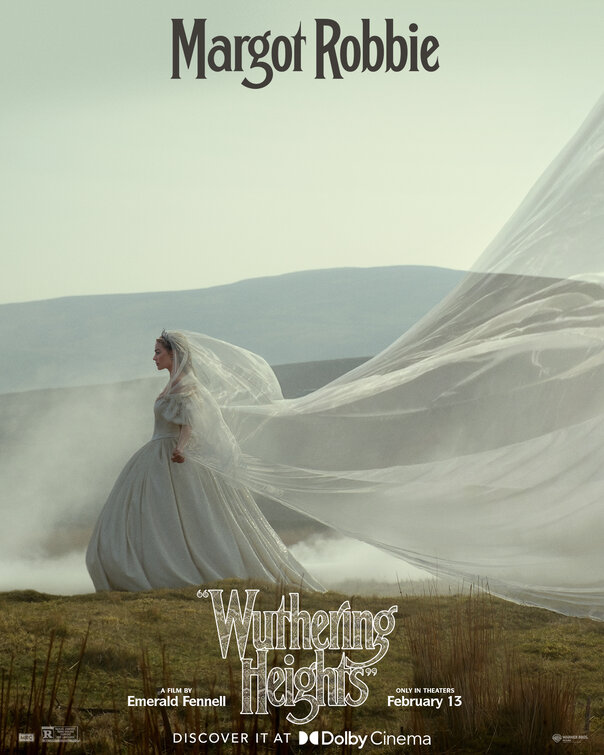
After some rather underwhelming key art for Emerald (Saltburn) Fennell's upcoming adaptation of Bronte's cult-lit classic, Wuthering Heights, the character posters come through with a cold and tactile pair of character posters. I have highlighted Margot Robbie's Catherine Earnshaw here for the layers of gauze and fog and sky.
As she walks along the Yorkshire Moors in an elaborate wedding dress, she surrounded by the hazy mists; her train uplifted by the languid morning air. You can see the hills in different shades in the background, further framing her form. It is grim and cold. Against the angst and the passion of a potential coupling, this is about as a succinct an image as one might get for the story. Robbie, of course, has just the right poise here.
The title card is framed by the director's credit and release date. (I suppose you could classify this as a teaser poster, given the lack of main credit block, even as the film is releasing in a couple of weeks, and several other posters and key art have been released).
Given it's UK setting, one wonders why there is not a QUAD style poster released (point me to it if you know of one) given the horizontal framing and lines here. (Kurt Halfyard)
Wuthering Heights tells us that love should hurt. Actually, it should burn. Lacerating your heart and excavating your soul, it will, in the words of Emily Brontë herself, drive you mad. Fans of the 19th-century classic were reminded of this when the first full-length trailer for Emerald Fennell’s highly contentious but much-anticipated adaptation, which stars Margot Robbie and Jacob Elordi, came out in the fall.
The trailer depicts Cathy (Robbie) and Heathcliff (Elordi) meeting as children before becoming embroiled in what it describes as “the greatest love story of all time.” While it’s not clear how far Fennell has strayed from the 1847 novel—the film has raised eyebrows among literary types who’ve pointed out that Heathcliff is described as “dark-skinned” in the book, while Cathy wears a shiny red dress, among other things in the film—it’s set to be a major cinematic event, with original songs by Charli XCX and a Valentine’s Day release date.Make no mistake: Wuthering Heights—which focuses on the intense bond that develops between Cathy and Heathcliff and the subsequent devastation that occurs when social mobility prevents them from being together—is a heart-wrenching tale, one that offers up meaningful commentary on everything from class and revenge to generational trauma. For me, though, it has always been about one thing and one thing only, and that’s Heathcliff, a.k.a. literature’s original fuckboy. Brooding, handsome, and troubled beyond repair, he epitomizes everything straight women are supposed to run from, and yet tend to run towards. I do, at least.Unfortunately, I’ve got a long history of fancying terrible men. The highly functioning alcoholics who pledge sobriety after an argument, only to get hammered a week later? Tick. The self-destructive avoidants who are addicted to you one minute and repulsed the next? Tick. The tormented artists who haven’t discovered bed frames and trade on empty promises and incessant love-bombing? Tick, tick, and then a few more ticks.
I blame all of this on Brontë—partly because it’s more convenient than analyzing my own self-destructive patterns, but mostly because I remain convinced that the precedent for chasing toxic love stories was one set out for me as a teenager, by Heathcliff. To be clear, in the book he is a truly abominable character. This is a man who not only speaks in growls and terrorizes children, but who also hangs dogs and beats women (character traits that we should all skip when it comes to dating prospects, obviously).
And yet he is often upheld as a romantic antihero, which I suspect has something to do with the fact that two of the most popular Wuthering Heights adaptations (William Wyler’s 1939 classic starring Laurence Olivier and Andrea Arnold’s stark but stunning 2011 version) conclude with Cathy’s death, neatly glossing over the second half of the book, which sees Heathcliff going full sociopathic mode.For me, though, the allure of Heathcliff was always less about the man himself than what he, and his relationship with Cathy, represented: a love so deep and destabilizing that it could hardly exist. Given they are—spoiler!—never actually together, their dynamic is defined by absence, possibility, and longing, which are arguably the most romantic things of all. Their love never becomes a reality, confining it to the realm of fantasy, where everyone and everything feels so much better because you made it all up inside your head.
This is the trap I’ve fallen into many times, creating my own epic Cathy-and-Heathcliff love stories with men who couldn’t be less interested in me. There was the boy at school who, in my mind, was stringing me along for years, but in reality just never wanted to be with me. The filmmaker who told me quite clearly that he “didn’t want anything serious,” which I took as a challenge to change his mind. And several others I won’t mention to save a little face.There’s also something about Cathy and Heathcliff’s relationship being rooted in childhood that holds a certain amount of appeal. They know each other so well. They grew up together. They have history. After yet another disappointing experience with a man, I often find myself craving the comforts of familiarity, returning to exes I’ve romanticized and convincing myself that someone I dated two years ago was actually the one for me.
It makes sense why I—and others like me, I’m sure—might be craving Brontë’s maddening breed of passion. I can’t tell you how many mediocre dates I’ve been on recently, swapping the same insipid stories about siblings and pets, hoping for a sudden spark of excitement and settling for it not being a complete disaster. The bar is absurdly low; these men will get a round of applause for texting us back or booking a restaurant. Where are the ones who’ll cry for us on the moors and dig up our graves? They might not be healthy, but at least they’re interesting.
I know in reality that nobody should conflate drama with romance. We all know that real love is supposed to be quiet, stable, and safe, and that it also probably shouldn’t extend into the afterlife—least of all with a raging psychopath. But when dating feels so relentlessly and desperately dire, can you blame the toxic girlies for occasionally wanting something a little spicier? If not to inject a little energy into our dating pursuits, then to give us something a little more compelling to talk about in the group chat?
With this in mind, I personally cannot wait to watch Fennell’s Wuthering Heights. I’ll admit, as a dedicated fan of the book, I was skeptical at first. But now I no longer care about accuracy. Give me madness on the moors. Snogs in a storm. And the kind of love story that will ruin my life. It’s probably a little wiser to experience it on screen than off, anyway. (Olivia Petter)
The Brontë Society unveiled a packed programme to mark the 200th anniversary of the birth of Charlotte Brontë. (Natasha Meek)
Jane Eyre
Widely regarded as one of the greatest novels of all time, Charlotte Brontë’s Jane Eyre was an instant bestseller upon its release in 1847. Over the years, Brontë’s beloved work has been adapted for the small screen countless times, including the acclaimed 2006 miniseries of the same name.
The series follows the early life of Jane (Ruth Wilson), who is hired by the housekeeper of Thornfield Hall, Mrs. Fairfax, to be a governess at the country estate. But when she becomes entangled with the brooding master of Thornfield Hall, Edward Fairfax Rochester, his dark past threatens to destroy their relationship. The four-part period drama has a perfect rating on Rotten Tomatoes and has been hailed a "true masterpiece". (Jennie Buzaglo)
Friday, December 19, 2025
Audible is delving into the backstory of literature’s most infamous romantic anti-hero in audio drama Heathcliff, with Daryl McCormack in the title role.The star (Good Luck to You, Leo Grande) has just wrapped filming on Dolly Alderton’s Pride & Prejudice, and Heathcliff will bow on Audible next February. The team behind it promised a “feverish re-imagining of literature’s most infamous romantic villain .”The Emily Brontë classic Wuthering Heights is the inspiration for the drama, which is penned by Gracie Oddie-James. She is also in the cast, alongside Arinzé Kene (The Pass), Charlie Rowe (Slow Horses), Sagar Radia (Industry), Raffey Cassidy (The Brutalist) and Tanya Moodie (Silo).The Heathcliff audio production will depict how the man generations of readers know from the novel came to be. Per the synopsis: Before his descent into revenge, there were three missing years; a time of possibility, freedom and a different kind of love.“This original story follows him on his missing years and his journey of self-discovery and internal redemption, which I think will allow the listener to have compassion for him despite his flaws,” McCormack said. “He truly is the epitome of an anti-hero, and in our Heathcliff, I think your heart may break for him.” [...]“We know that Audible listeners around the world love classic literature and ‘Wuthering Heights’ needs no introduction,” Aurelie de Troyer, Head of Regional Content Europe, Audible. “Heathcliff is such an iconic character and by exploring his roots, and those three missing years, we’re excited to give listeners a different perspective on his story.” (Stewart Clarke)
Wuthering Heights by Emily BrontëOne has to be living under the rock to have missed the trailer for the new film adaptation of Wuthering Heights, directed by Emerald Fennell and starring Margot Robbie and Jacob Elordi was released earlier this year. Its steamy trailer caused quite the controversy with litterateurs criticising Elordi’s casting as Heathcliff, who has been described as a “dark-skinned gypsy” in the novels. The actors are significantly older than the characters, and the trailer romanticises the story through erotic imagery. The film, slated to be released across theatres on February 13, right in time for Valentine’s Day is one of the most anticipated films of the year. I have already re-read the novel, and look forward to see Robbie’s version of this classic come to life on screen. (Aishwarya Khosla)
After kicking off the year with the magic-packed RISE in City Park, Bradford 2025 is now preparing for its final act at Myrtle Park.But the months in between that start and end point have seen a rainbow foam party, aerial dancers performing near Shipley Clocktower, unique exhibitions, and so much more.It’s been the year when sculptures appeared on the moors that inspired Emily Brontë’s Wuthering Heights, film screenings at Ilkley Lido and Thornton Viaduct, and the ultimate crossover - Bassline and classical - took place at the historic St George’s Hall. (Natasha Meek)
Thursday, October 16, 2025
1. Putting The Title In Quotation Marks - Wuthering HeightsSaltburn director Emerald Fennell's new adaptation of Emily Brontë's classic novel Wuthering Heights faced a tidal wave of controversy from the moment its two lead cast members were announced.Many bristled against the fact that a 34-year-old Margot Robbie will be playing Catherine Earnshaw, who is in her late teens at the end of the story, while a 27-year-old Jacob Elordi portrays Heathcliff, who is said to be around 40 years of age and of ambiguous ethnicity in the novel.Fennell is clearly taking some bold creative liberties with the source material then - a fact clarified by the film's recent first trailer, which also made the curious choice to include its title within quotation marks.This is basically a cute visual shorthand for Fennell to instantly tell anyone who stumbles across the trailer or poster that this is an intentionally loose, radical take on Brontë's text rather than an ultra-faithful adaptation.Again, setting the right audience expectations is always important, and this is a sly way to do it without talking incessantly about how far it strays from the source.
Wednesday, September 24, 2025
Heathcliff, Wuthering Heights – Emily BrontëFor me, Heathcliff even beats bad-dads King Lear and Agamemnon. Most readers won’t remember that Heathcliff is a dad at all, which is part of what makes him so bad. The sadistic, dysfunctional passion between Heathcliff and Catherine dominates Brontë’s novel, leaving young Linton, the kid Heathcliff has with another woman, Isabella, neglected, abused and dominated by his terrifying father.Heathcliff doesn’t even meet his son until he’s 13, after Isabella dies. Linton is then forced to live in tormented isolation and tortured into marrying his first cousin, Cathy. All this so Heathcliff can take revenge on Cathy’s father Edgar, who married his beloved Catherine Earnshaw. (Sophie Gee)
Amongst all the drama in the Wuthering Heights trailer, we saw glimpses of jewellery that beautifully reflect its time.The story’s setting falls between the late Georgian and mid-Victorian period (spanning the 18th and 19th century), so pieces draw influence from both eras.In the mid-Victorian era, popular gemstones included amethyst, diamond, garnet, jet, onyx, opal, pearl, ruby, sapphire and turquoise. Popular cutting styles of the time included rose cut, old mine cut and cabochon, which is a rounded top and flat bottom.High-carat yellow gold (21, 22 and even 24) was common. This was often paired with silver to enhance the sparkle of the diamonds, which were then hand-cut into an old mine cut.An old mine cut is a pre-modern diamond cut characterised by its cushion-like, softly square shape with rounded corners, high crown, and large, often irregular facets, leading to a distinctive, softer sparkle.Pearls also make an appearance in the Wuthering Heights trailer, and these would almost certainly have been natural, as cultured pearls weren’t developed until much later in the 19th century.It’s also fascinating that jewellery in that time wasn’t just for women – men wore important pieces too. Garnets and amethysts were hugely popular, often set in bold brooches, chokers and rings inspired by classical Greek and Roman motifs or romantic floral designs. These jewels were worn for meaning as well as for appearance in this era.As for the value of the jewellery seen in the trailer, if you use 22ct prices of today, you would not be far from the price of jewellery in late Georgian to mid-Victoria era.
What were other movies or books that became influences for I Love You, Bunny?There were a couple of texts that became really important for the writing of the creation. I had COVID when I started writing the Bunny Boy’s voice. I was in a dreamy state. And my reason faculties were just gone. I was able to tap into this voice without too much second-guessing. The voice was drawn from a few different sources in my head. For the Bunnies, Jane Eyre is a holy text. And so the Bunny Boy says, “Dear Reader,” a lot, and has kind of a Romantic sensibility. That’s drawn from Jane Eyre’s narration of her own story (Keziah Weir)
Wednesday, July 30, 2025
Today we celebrate the birthday of Emily Jane Brontë, born 30 July 1818. When they were teenagers, Emily and her younger sister, Anne, began writing diary papers together (and later, separately), and they eventually established the practice that these papers should be written every four years, on Emily's birthday, and stored away, to be read four years later.
Keighley Civic CenterAugust 13, 20:15
Several speakers will contribute, including author and journalist Sharon Wright, Brontë Parsonage Museum curator Ann Dinsdale and history society committee member Tim Neal.Ann says: "When I first read Austin Lee’s Miss Hogg and the Brontë Murders, I was intrigued by the author’s knowledge of the Haworth area."This, combined with the book’s 'Golden Age' atmosphere, led me to read all the Miss Hogg books. I then set about learning more about Austin Lee’s colourful and unconventional life." (Alistair Shand)
TMWHDE is still on the news: Ross-shire Journal (Cromarty), Donegal Live (Donegal), Augusta-Margaret River Mail (Busselton)... WGBH lists adaptations of 'controversial' books, including Wide Sargasso Sea.
Thursday, June 26, 2025
In the novels of André Aciman, characters are rarely burdened with anything so tawdry as an office job. If they do have one, as in the case of two well-heeled lovers in Room on the Sea, the central novella in his middling new collection of three, it hovers lightly in the background, providing ample funds to spend in cafés and on seaside hotels. Paul, a recently retired lawyer, and Catherine, a therapist, meet in New York City at jury duty, that wearisome disruptor of routine. Their first exchange recalls a pair of teenagers testing each other’s recently acquired knowledge of moderately successful indie bands. Paul, who is leafing through the Wall Street Journal, tries to glimpse the title of the novel resting on Catherine’s knee. It’s Wuthering Heights, she tells him, “thinking perhaps that he’d probably never heard of it.”As it turns out, Paul has read it—twice. He shares with Catherine his insider tricks for subtly evading jury selection, and soon they’re eating lunch together at a Chinese restaurant nearby, making thinly veiled digs at their respective spouses and exchanging banalities with disproportionate giddiness. (“Life, he said with a light chuckle. Life indeed, she repeated.”) Like so many of Aciman’s characters, they are seized by attraction but proceed to spend much of the narrative hesitating, equivocating, and musing on the ambivalent nature of desire. They pine and wallow against scenic, expensive backdrops. Removed from any significant limitations, they have no choice but to invent their own. (Crispin Long)
The House of Brontë publishes a video about Haworth's St. Michael And All Angels' Church.
Tuesday, May 06, 2025
“I am very happy, Jane; and when you hear that I am dead, you must be sure and not grieve: there is nothing to grieve about. We all must die one day, and the illness which is removing me is not painful; it is gentle and gradual: my mind is at rest. I leave no one to regret me much: I have only a father; and he is lately married, and will not miss me. By dying young, I shall escape great sufferings. I had not qualities or talents to make my way very well in the world: I should have been continually at fault.” (Jane Eyre, chapter IX)
For nearly 200 years, only a select few people had read the contents of a tiny collection of poems written by an author who later became a household name.Charlotte Brontë was just 13 when she compiled her Book of Rhymes in 1829 - misspelling the word "rhymes".In 2022, the original volume was purchased for £983,000 at auction and the winning bidder donated it to the Brontë Parsonage Museum in Haworth, West Yorkshire.The museum has now teamed up with a publisher to release £20 paperback copies of the anthology, which contains 10 works by the future writer of the novel Jane Eyre.Ann Dinsdale, the museum's principle [sic] curator, said: "Charlotte was hugely ambitious."She'd grown up seeing poetry published by her father on the parsonage bookshelves."So that idea of being a published author had kind of always been present."She'd been steeped in the works of Wordsworth and Lord Byron and she saw her true vocation as being in poetry."The tiny manuscript - measuring just 3.8in x 2.5in (9.7cm x 6.4cm) - was one of six "little books" written by Charlotte but never published.The eldest of the three Brontë sisters, Charlotte went on to write her classic Jane Eyre 18 years later. The girls grew up in the Haworth parsonage.She died in 1855 aged 38 and the booklet was kept by her husband Arthur Bell Nicholls until his death.It was put up for sale in 1915 in London, and again a year later in New York, before disappearing from public view for more than a century before being auctioned for a third time.Ms Dinsdale said: "We worked with a publisher called the Tartarus Press, they're based in Leyburn, so it's a very Yorkshire project."And we published the edition of the Book of Ryhmes (sic)."These tiny, early manuscripts are so important in that they chart her development as a writer."She's trying to establish her own style, her own voice."It was one step in the process that went into her eventually producing Jane Eyre."The original 15-page manuscript, stitched in brown paper covers, is on display in the museum.It was bought by Friends of the National Libraries (FNL), a UK charity devoted to saving the nation's written and printed heritage.
This time I was headed farther afield, to explore the elfin mysteries of Wales. It was a sojourn fit for one of the Brontë heroines I had always loved (or so I thought, not realizing the difference between the moors of Yorkshire and the Celtic rain forests of Powys—a place that Charlotte, Emily, and Anne had likely never visited. Like me, the Brontës were homebodies.)
The Yorkshire Post reports on the recent Haworth Steampunk Weekend.
Friday, January 17, 2025
12. Bradford, EnglandThe northern English city of Bradford is finally poised to step out from the long shadow cast by its giant Yorkshire neighbour, Leeds, as it takes its place as the 2025 UK City of Culture. A fabulous year-long programme of events includes the re-opening of the National Science and Media Museum, plus innovative celebrations of local cultural icons: more than 400 works by Bradford-born artist David Hockney held in a Unesco World Heritage 1850s mill; new digital takes on a fantasy world dreamed up by the famed literary Brontë sisters; and a musical programme mixing an electronic bassline symphony, old factory folk music, brass bands and South Asian sounds.
Haworth was the home of the famous Brontë Sisters. The parsonage that was their home is now a fantastic museum open to visitors. From their home, visitors can walk in the footsteps of the Brontes, exploring the wild moors and ruined houses that inspired them to create a collection of memorable Gothic novels. Wuthering Heights, written by Emily Bronte in 1847 is the one most embedded in the landscape of Haworth today as a ruined farmhouse ‘Top Withens’, reputedly the inspiration for ‘Wuthering Heights’, can be found on the desolate moor. (Lauren Jones)
When you think of the Gothic genre, you probably picture ominous weather, crumbling manor houses, and women fleeing in flowy nightgowns, candelabras clutched in their trembling hands. But Gothic isn’t simply a dark and stormy aesthetic. Like so many things in art—and life—it’s about power. Who has it, and what they’ll do to hold onto it. Who doesn’t, and what they’ll do to acquire it.That, perhaps, is why Gothic themes work surprisingly well in so many types of stories. When I first came up with the idea to retell Gothic classic Wuthering Heights with elite figure skaters, I—in true Gothic heroine fashion—thought I was losing my mind. The idea seemed unhinged at first, but Emily Brontë’s themes of oppressive power structures, class differences, and family secrets mapped seamlessly onto the glamorous, scandalous skating world. And so my glittery and Gothic novel The Favorites was born.
A Farewell to Arms by Ernest HemingwayHemingway’s first best-seller has all the big Ernie tropes: spare style, courageous and conflicted men, and beautiful and tragic and tragically beautiful women. The novel follows an ambulance driver working on the Italian Front in WWI, as he grapples with war, God, and his love affair with a British nurse. Pretty standard stuff, I think we can do better.Any of the women in this book would be excellent characters for an Ahab’s Wife or Wide Sargasso Sea treatment, or could serve as the emotional center of a quiet, introspective novel where the nurse, Catherine, survives the war and her American lover, to live at the foot of the Swiss Alps with her child. (James Folta)
Thursday, December 19, 2024
In the European tradition, carollers were a group of musicians who went from house to house to spread some festive cheer in exchange for food and drink.Emily Bronte wrote about this in Wuthering Heights.“[These carollers] go the rounds of all the respectable houses, and receive contributions every Christmas, and we esteemed it a first-rate treat to hear them,” related Mrs Dean, the main narrator of Wuthering Heights. (Ria Andriani)
The very best way to start your day in Haworth is to walk on the moors. It’s good for the soul. Whether you delight in trekking for hours, or just want to go a short way and breathe in some Yorkshire air before breakfast, there’s routes to suit everyone. If the weather is wild and wuthering, then you’ve hit the jackpot, as that’s just how the Brontës describe it in their writing. If it’s beautiful sunshine (we get more sun than you might think!), then you’re also a winner. One thing is for sure, the dramatic scenery will never let you down. [...]A visit to the The Bronte Parsonage Museum is a must. The former home of the famous literary family now houses the world’s largest collection of Brontë works. (Josie Price)
Search
Labels
- Advert (13)
- Agnes Grey (358)
- AI (4)
- Alert (1858)
- Anne Brontë (630)
- Art-Exhibitions (1067)
- Arthur Bell Nicholls (45)
- At The... (11)
- Audio-Radio (646)
- Biography (404)
- Books (4224)
- Branwell Brontë (389)
- Brontë 200 (395)
- Brontë Birthplace (90)
- Brontë Parsonage Museum (1773)
- Brontë Society (584)
- Brontëana (812)
- Brontëites (2016)
- Brussels (317)
- Charlotte Brontë (1058)
- Comics (423)
- Contest (34)
- Cottage Poems (9)
- Dance (393)
- Elizabeth Gaskell (266)
- Ellen Nussey (20)
- Emily Brontë (1175)
- Fake News & Blunders (162)
- Fiction (461)
- Games (3)
- Haworth (1994)
- Humour (386)
- Illustrations (177)
- In Memoriam (13)
- In the News (1305)
- Ireland (118)
- Jane Eyre (8246)
- Journals (657)
- Juvenilia (305)
- Maria Branwell Brontë (34)
- Mary Taylor (80)
- Messages from BB (116)
- Movies-DVD-TV (5142)
- Music (2540)
- New Releases (7)
- Opera (238)
- Patrick Brontë (234)
- Penzance (15)
- Poetry (927)
- Red House (64)
- References (2836)
- Reminder (142)
- Review (139)
- Scarborough (87)
- Scholar (1424)
- Sequels and Retellings (1248)
- Shirley (288)
- Software (17)
- Talks (1637)
- The Professor (138)
- The Tenant of Wildfell Hall (569)
- Theatre (3507)
- Thornton (190)
- Top Withens (114)
- Translations (550)
- Unfinished Novels (10)
- Victorian Era (432)
- Villette (589)
- Websites & Apps (197)
- Weirdo (685)
- Wide Sargasso Sea (1116)
- Wuthering Heights (7752)
Recent Posts
Blog Archive
Other BrontëBlogs
-
-
Two Gifts For Patrick Bronte - I hope that, wherever you are in the world, you had a Happy Yorkshire Day yesterday on the 1st of August. I always think it would be nice if people exchang...2 days ago
-
Les hauts de Hurlevent | Documentaire | ARTE - Paru en 1847 sous le pseudonyme masculin d’Ellis Bell, "Les hauts de Hurlevent" sidéra la critique. Dans ce conte d'amour, de vengeance et de mort, Em...1 week ago
-
Unexpected – and memorable – day out in Brontë Country - My husband Paul and I headed again to Haworth last month for our annual visit and participation in the June weekend of events organised by the London Bro...1 week ago
-
2026年ブロンテ・デイ公開講座が開催されました - 6月6日(土)14:00〜16:10 2026年ブロンテ・デイ公開講座が早稲田大学戸山キャンパにて開催されました。 馬渕恵里大阪大学准教授によるご講演「シャーロット・ブロンテの自伝体小説」と、金谷益道同志社大学文学部教授・同志社大学国際教養教育院所長によるご講演「シャーロット・ブロンテと身体化された ...1 month ago
-
“Wuthering Heights” Review - Emerald Fennell’s adaptation of Wuthering Heights has been much anticipated pretty much since it was first announced a few years back. The idea alone was e...4 months ago
-
A New Adaptation of Jane Eyre In the Works - Image Source: Deadline 1934, 1943, 1970, 1973, 1983, 1996, 1997, 2006, and 2011. These are the years when major film and television productions of Jane E...5 months ago
-
-
ERROR: Database error: Table './rss/feeds' is marked as crashed and should be repaired at /var/www/html/feed.pl line 1657. -1 year ago
-
More taphophilia! This time in search of Constantin Heger's grave in Brussels. - Constantin Heger's Grave Charlotte Bronte Constantin Heger Whilst on a wonderful four day visit to Brussels in October 2024, where I had t...1 year ago
-
Empezando a leer con Jane Eyre (parte 2) - ¡Hola a todos! Hace unos pocos días enseñaba aquí algunas fotografías de versiones de Jane Eyre de Charlotte Brontë adaptadas para un público infantil en f...1 year ago
-
Goodbye, Jane - As two wonderful years come to an end, Piper and Lillian reflect on what we've learned from Jane Eyre. Thank you for joining us on this journey. Happy...2 years ago
-
Hello! - This is our new post website for The Anne Brontë Society. We are based in Scarborough UK, and are dedicated to preserving Anne’s work, memory, and legacy. ...3 years ago
-
Final thoughts. - Back from honeymoon and time for Charlotte to admire her beautiful wedding day bonnet before storing it carefully away in the parsonage. After 34 days...3 years ago
-
Ambrotipia – Tesori dal Brontë Parsonage Museum - Continua la collaborazione tra The Sisters’ Room e il Brontë Parsonage Museum. Vi mostriamo perciò una serie di contenuti speciali, scelti e curati dire...4 years ago
-
-
-
Buon bicentenario, Anne !!!!! - Finalmente annunciamo la novita' editoriale dedicata ad Anne nel giorno bicentenario della nascita: la sua prima biografia tradotta in lingua italiana, sc...6 years ago
-
Two New Anne Brontë 200 Books – Out Now! - Anne was a brilliant writer (as well as a talented artist) so it’s great to see some superb new books…6 years ago
-
Review of Mother of the Brontës by Sharon Wright - Sharon Wright’s Mother of the Brontës is a book as sensitive as it is thorough. It is, in truth, a love story, and, as with so many true love stories, the ...6 years ago
-
Brontë in media - Wist u dat? In de film ‘The Guernsey Literary & Potato Peel Pie Society’ gebaseerd op de gelijknamige briefroman, schrijft hoofdrolspeelster Juliet Ashto...6 years ago
-
Ken Hutchison's devilish Heathcliff - *Richard Wilcocks writes:* Ken Hutchison and Kay Adshead Browsing through the pages of *The Crystal Bucket* by Clive James, last read a long time ago (p...7 years ago
-
Nouvelle biographie des Brontë en français - Même si, selon moi, aucune biographie ne peut surpasser l’excellent ouvrage de Juliet Barker (en anglais seulement), la parution d’une biographie en frança...7 years ago
-
Researching Emily Brontë at Southowram - A couple of weeks ago I took a wander to the district of Southowram, just a few miles across the hills from Halifax town centre, yet feeling like a vil...7 years ago
-
Reading Pleasures - Surrounded by the heady delights of the Brontë Parsonage Museum library archive, I opened this substantial 1896 Bliss Sands & Co volume with its red cover ...8 years ago
-
Link: After that dust-up, first editions are dusted off for Brontë birthday - The leaden skies over Haworth could not have been more atmospheric as they set to work yesterday dusting off the first editions of Emily Brontë at the begi...8 years ago
-
Page wall post by Clayton Walker - Clayton Walker added a new photo to The Brontë Society's timeline.8 years ago
-
Page wall post by La Sezione Italiana della Brontë Society - La Sezione Italiana della Brontë Society: La Casa editrice L'Argolibro e la Sezione Italiana della Brontë Society in occasione dell'anno bicentenario dedi...8 years ago
-
Html to ReStructuredText-converter - Wallflux.com provides a rich text to reStructredText-converter. Partly because we use it ourselves, partly because rst is very transparent in displaying wh...8 years ago
-
Display Facebook posts in a WordPress widget - You can display posts from any Facebook page or group on a WordPress blog using the RSS-widget in combination with RSS feeds from Wallflux.com: https://www...8 years ago
-
charlottebrontesayings: To Walk Invisible - The Brontë Sisters,... - charlottebrontesayings: *To Walk Invisible - The Brontë Sisters, this Christmas on BBC* Quotes from the cast on the drama: *“I wanted it to feel...9 years ago
-
thegrangersapprentice: Reading Jane Eyre for English class.... - thegrangersapprentice: Reading Jane Eyre for English class. Also, there was a little competition in class today in which my teacher asked some really spe...10 years ago
-
5. The Poets’ Jumble Trail Finds - Yesterday I had the pleasure of attending with some friends a jumble trail in which locals sold old – and in some instances new – bits and bobs from their ...10 years ago
-
How I Met the Brontës - My first encounter with the Brontës occurred in the late 1990’s when visiting a bookshop offering a going-out-of -business sale. Several books previously d...12 years ago
-
-
Radio York - I was interviewed for the Paul Hudson Weather Show for Radio York the other day - i had to go to the BBC radio studios in Blackburn and did the interview...13 years ago
-
Short excerpt from an interview with Mia Wasikowska on the 2011 Jane Eyre - I really like what she says about the film getting Jane's age right. Jane's youth really does come through in the film.15 years ago
-
CELEBRATION DAY - MEDIA RELEASE February 2010 For immediate release FREE LOCAL RESIDENTS’ DAY AT NEWLY REFURBISHED BRONTË MUSEUM This image shows the admission queue on the...16 years ago
-
Poetry Day poems - This poem uses phrases and lines written by visitors at the Bronte Parsonage Museum to celebrate National Poetry Day 2009, based on words chosen from Emily...16 years ago
-
The Secret Diaries of Charlotte Bronte - Firstly, I would like to thank the good people at Avon- Harper Collins for sending me a review copy of Syrie James' new book, The Secret Diaries of Charlot...17 years ago
Podcasts, Etc..
-
S4 E4: with... Eliza Goodpasture - On this episode, Mia and Sam sit down with art historian and writer Eliza Goodpasture! Eliza has written the introduction to a new edition of Emily Bront...4 days ago
-
-
Subscriptions
Brontë Parsonage X
Brontë Studies X
Other Stuff
Click to join BRONTE
This work is licensed under a Creative Commons Attribution-Noncommercial-No Derivative Works 3.0 Unported License.
Site archived by the British Library - UK Web Archiving Consortium


.png)