Podcasts

  • S4 E4: with... Eliza Goodpasture - On this episode, Mia and Sam sit down with art historian and writer Eliza Goodpasture! Eliza has written the introduction to a new edition of Emily Bront...
    5 days ago
Showing posts with label Brontëites. Show all posts

Saturday, July 18, 2026

The Clare Champion is excited about the visit of Ann Disndale to the Kilkee Brontë Festival:
One of the world's leading Brontë experts is to attend the 2026 Kilkee Bronte Festival, which will take place this coming weekend. 
Ann Dinsdale, principal curator at the Brontë Society and Brontë Parsonage Museum in Haworth, England will be joining the festival in Kilkee, the place where Charlotte Bronte honeymooned, and where the Atlantic coast made such an impression on the famous author. 
Ms Dinsdale who has 36 years' experience caring for the museum's collection, organising exhibitions and working on important acquisitions will be making her first visit to the festival in Kilkee. 
Speaking to The Clare Champion this week, Ann said she is really excited to visit the West Clare seaside town, "I have been reading biographies about the Brontës for years - since I was a child really - so all these names of places in Ireland are really familiar to me.  (...) (Sharon Dolan D'Arcy)
ArtsHub recommends a visit to the Summer Show of the Frith Street Gallery - Golden Square in London:
Multiple Narratives brings together works by eight gallery artists. The pieces are linked through their use of repetition, series and classification, some are narrative-driven, while others focus on visual exploration. Spanning drawing, sculpture, photography and found objects, the exhibition ranges from the minimal and abstract to the richly figurative.
The show includes Fiona Banner aka The Vanity Press, Anna Barriball, Tacita Dean, Shilpa Gupta, Cornelia Parker, Raqs Media Collective, Thomas Schütte, and Dayanita Singh. (...)
Progressing further into the gallery, the corner features two works by Cornelia Parker. White Cliff Crossings (2024) (...) [and]  [a]djacent is Parker’s Brontëan Abstracts (2006) – photographs of Charlotte Brontë’s original manuscripts for Jane Eyre which are held in the British Library. These images give us a direct insight into the immediacy of the progress of the celebrated novel. Here Parker invites the viewer to be present at the author’s elbow, we enter Brontë’s consciousness as she edits her masterpiece and become privy to her ideas as they emerge and recede.
A new installment of the Behind the Glass podcast is online:
Sam and Mia are joined by their colleague Murray, who is one of the Museum's curators! Before taking on the role, Murray worked at other Museums and historic houses and undertook a PhD specialising in architectural history.
In this episode, we ride the highs and lows of Britain's railways during the 1840s, looking at Branwell's time as a Railway Clerk and the investments the family made into this booming industry..
Collider is a bit extreme when listing Wuthering Heights 2026 among pointless movie remakes that have no reason to exist: 
Wuthering Heights is a novel that has never been perfectly adapted, as even the Best Picture-nominated 1939 classic was only based on half of Emily Brontë’s novel. Instead of taking the opportunity to make a more thorough adaption, Emerald Fennell reduced the material even further by cutting out major characters and inserting more raunchiness; this is a complete misreading of the source material, as it is the unfulfilled longing between Catherine Earnshaw (Margot Robbie) and Heathcliff (Jacob Elordi) that is supposed to heighten the sexual tension. 
Fennell’s film casts actors who are far too old to realistically be playing their characters and uses shock value to visualize Catherine’s sexual awakening; the result is a film that feels made by someone who had only skimmed the novel and didn’t understand what it was actually trying to say about loss and love. (Liam Gaughan)
The Bromsgrove Standard reports a variation on the Most Wuthering Heights Day Ever: 
The Synchro StingRays will be performing to three Kate Bush tracks in the water at Lakeside Adventures in Hartlebury tomorrow (Saturday, July 18).
That will be ahead of Kate Bush Day next Sunday, July 26.
StingRay choreographer and swim coach Ray Farr will then lead the official Wuthering Heights dance on land before inviting wannabe Kates into the lake to perform the dance there. (Tristan Harris)
Frank Miller describes Rebecca, his favourite Hitchcock, like this in New York Magazine's The Strategist:
 It’s classic Hitchcock, but not as a twist but as a pivotal, shocking revelation. When it first came out, I believe it was considered almost a poor man’s Wuthering Heights, but I think Rebecca actually was the more truly gothic one. It’s a masterpiece.
The Hollywood Reporter interviews Samantha Morton, who remembers her Jane Eyre in Jane Eyre 1997: 
David Canfield: How would you describe that interpretation? I’m curious how you conceive of this character, this scene, when he first presents you with the role, and how it then evolves once you start digging in.
Samantha Morton: I did a bit of research into the source material and I bought the Madeline Miller book [Circe]. But I opened that book and then something just stopped me from reading it. The thing about me and my work is, my relationship to a movie script or a play or a TV episode or whatever I’m doing — that’s my special thing. Research is incredibly important for me, but it also depends on who I’m playing. Years ago, I was about 19 years old and I was playing Jane Eyre. It was a big ITV production. It was a TV movie, but they’d spent a lot of money on it. I remember literally carrying the book around with me like the Bible, with passages highlighted and all my notes, and talking to the person who adapted it and going, “Why isn’t this there? This doesn’t make sense.” I was almost in conflict with the script, which was very good, because I had issues with the choices. I vowed to myself moving forward that, while you have to do your research, you have to know what you’re doing, I didn’t want to be bogged down by everybody else’s interpretation, view, opinion, anything. 
The Irish Independent interviews Maggie O'Farrell:
Aoife Rooney: Who would you most like to go for a pint with?
Maggie O'Farrell: I’d like to go for a pint with Charlotte Brontë. I think she’d be very interesting, and it’s probable that she died of extreme morning sickness, so I’d like to talk to her about that. I feel like we lost so many books because she died so young. I’ve also read that she had an Irish accent, and I would love to know if that was true. Her father was Irish and her mother died when she was young.

Thursday, June 25, 2026

Thursday, June 25, 2026 7:15 am by Cristina in , , , , , ,    No comments
Smithsonian Magazine features the first edition of Wuthering Heights which is to be auctioned next week.
When Emily Brontë published Wuthering Heights in 1847, several critics used the word “strange.” As the New York Times’ B.D. McClay points out, one review simply began, “This is a strange book,” while others described the novel as “strangely original” and “a strange, inartistic story.”
Wuthering Heights is a strange sort of book—baffling all regular criticism; yet, it is impossible to begin and not finish it,” another observed. “We strongly recommend all our readers who love novelty to get this story, for we can promise them that they never have read anything like it before.”
The novel’s first edition was divided into two volumes, released alongside a third volume containing Agnes Grey, a novel by Emily’s younger sister, Anne. Each one was covered with green-grey cloth, with arabesques and floral patterns decorating the cover. The siblings published under the pseudonyms Ellis and Acton Bell.
Of the estimated 250 copies printed, only a few complete copies survive with their full-cloth binding intact. On June 30, Christie’s will sell the first edition’s three volumes in one lot at an auction in London, where the collection is expected to go for between $540,000 and $800,000.
“The last time one appeared at auction was in 1908, so no collector alive has had a chance to acquire one,” Mark Wiltshire, a books and manuscripts specialist at Christie’s, tells the Art Newspaper’s Maev Kennedy. “Private and public collectors all over the world will want this book.”
When Emily and Anne saw the printed editions, they realized that the books contained a numbllings of “Agnes Grey” (“Anges Grey”) and three misspellings of “Heights” (“Heer of errors. Some pages were marked with the wrong numbers, while others contained incorrect or missing punctuation. Perhaps the most egregious mistakes were six misspeghts”).
In letters written in the weeks after publication, their sister Charlotte complained that the volumes were full of “errors of the press” that she described as “mortifying.” Writing under the pseudonym Currer Bell, Charlotte had published her own debut novel, Jane Eyre, earlier the same year, and it had been an immediate success. She was deeply protective of her younger sisters, and she was disappointed that their publisher, Thomas Cautley Newby, had allowed so many mistakes to make it to press. “If Mr. Newby always does business in this way,” she wrote, “few authors would like to have him for their publisher a second time.”
Newby hoped to capitalize on the popularity of Jane Eyre, but Wuthering Heights, which explored darker themes, didn’t enjoy the same level of success. Readers were “shocked, disgusted, almost sickened by details of cruelty, inhumanity and the most diabolical hate and vengeance,” according to Douglas Jerrold’s Weekly Newspaper. North American Review criticized the novel, writing that “Nightmares and dreams, through which devils dance and wolves howl, make bad novels.”
Wuthering Heights follows Catherine Earnshaw, a young girl who lives with her family in northern England, and Heathcliff, an orphan who grows up alongside them. The pair forms an inextricable bond that breeds misery across two generations. The story is set against the dramatic, untamed moors of Yorkshire—which is also where the Brontë siblings grew up. [...]
Emily didn’t live to see her novel become so beloved, admired by the likes of Ernest Hemingway, Joan Didion and Virginia Woolf. “The impulse which urged her to create was not her own suffering or her own injuries,” Woolf wrote in 1925. “She looked out upon a world cleft into gigantic disorder and felt within her the power to unite it in a book.” The novel has inspired art, music and film, in addition to literature.
“It remains a work that artists return to again and again because of its emotional force, its atmosphere and its psychological intensity,” Wiltshire tells the Associated Press’ Jill Lawless.
Few surviving first-edition copies still have their original binding. Wiltshire has only been able to track down five others: Three are in the university libraries of Leeds, Oxford and Princeton universities, according to a statement, while the fourth is housed at the British Library in London. The fifth, which contains Charlotte’s annotations, is missing several pages, and it sold for $86,500 in 2009. (Ellen Wexler)
Another mistake no one seems to be mentioning is the fact that on the title page it says 

Wuthering Heights
A novel
By Ellis Bell
In three volumes

When it was in two volumes plus Agnes Grey.

The Yorkshire Post features local artist Philippa Marshall who's
largely inspired by the wild beauty and dramatic landscapes of Top Withens and the Yorkshire moors that the Brontës capture in their work. (Laura Reid)

Wednesday, June 24, 2026

Wednesday, June 24, 2026 10:28 am by Cristina in , , ,    No comments
Woman's World features Stevie Nicks's favourite books, including
‘Wuthering Heights’ by Emily Brontë
With more than 20 film and TV adaptations of Wuthering Heights, the classic story between Heathcliff and Catherine has been told in a number of ways—including a song by Nicks. While she was inspired to write “Wild Heart” after watching an adaptation of the story on the big screen, she’s been a fan of the books since her college days. 
“I first read Jane Eyre and Wuthering Heights when I was in college in California in the late 1960s,” Nicks shared. “They are two of my favorite books because they’re just so brilliantly written. The beauty of both these classics is that they were fantastic when I was a teenager and they still appeal to me now as a 63-year-old woman.”
While those classic novels left a lasting impression on Nicks, literature wasn’t her only creative influence. Film also played a major role in shaping her songwriting. In fact, the singer has shared that seeing Wuthering Heights inspired her to write the title track for her 1983 album, Wild Heart.
“I’d written “Wild Heart” early on,” Nicks recalled. “I remember singing it during a Rolling Stone cover shoot for Bella Donna [which came out in 1981] and I wrote it completely and utterly about the movie Wuthering Heights. I wrote it about Heathcliff and Cathy, and the fact that they were one person, that they couldn’t be together and they couldn’t be separate, and about the power and the drama of the closing death bed scene… All those amazing things he says to her.” (Julianne MacNeill)
A reader from Münster's City Library (Germany) recommends Wuthering Heights, too.

The British Blacklist interviews Karla Crome, creator of the series Possession.
Tell us about Possession from your perspective …
Tonally, it’s Modern Gothic. A woman travels to a remote location. A foreboding ‘house on the hill‘. She has this vague feeling that something terrible is about to happen (spoiler – it does). It’s the same set-up as Jane Eyre, Dracula, or The Woman in Black, but it centres around the experience of a woman of colour in the present day. (Tamika Mitchell)

Monday, June 15, 2026

Books and Publishing reports that UWA Publishing has acquired Thuy On’s fourth poetry collection Insolence.
UWA Publishing (UWAP) has acquired world rights to Insolence, the fourth poetry collection by Melbourne-based poet, critic and arts journalist Thuy On.
According to the publisher, Insolence “reinvents, reimagines and rearranges iconic figures in our literature, visual art, history, books, and screens”, bringing a contemporary feminist perspective to both real and fictional characters.
In the collection, Eve explains why she ate the forbidden fruit, Medusa recounts her own origin story, and Jane Eyre, Emma Bovary and Ophelia update their Tinder profiles. From Ada Lovelace to the Mona Lisa and Hello Kitty, the poems offer “a witty and perceptive celebration of women’s voices across time and space”.
On said, “Insolence offers poems from the point of view of female characters both real and fictional who have been historically sidelined or silenced and grants them centre stage.”
Toronto Star asks writer Liz Johnston all sorts of bookish questions.
Three authors living or dead would you like to have a coffee with?
The real answer is that I can be a bit socially awkward, so I’d like to grab a coffee with authors who are already friends, or at least acquaintances. But OK, let me try: Katie Kitamura, Kagiso Lesego Molope (I’m currently enthralled by her new novel, “We Inherit the Fire”), and, just to throw a bit of time travel in the mix, Emily Brontë. (Jean Marc Ah-Sen)
A contributor to Geeks reviews Wuthering Heights 2026. AnneBrontë.org looks into what Elizabeth Gaskell's daughters said about the Brontës.

Monday, June 08, 2026

Monday, June 08, 2026 7:13 am by Cristina in , , , ,    No comments
Daily Mail and others report on Edinburgh's Most Wuthering Heights Day Ever yesterday.
She famously sang ‘it’s me, I’m Cathy’ in her hit song Wuthering Heights.
But passers-by could be forgiven for wondering which one was the real Kate Bush as hundreds of fans wearing red gathered on Edinburgh’s Meadows to recreate the dance from the 1978 chart-topper. 
The annual gathering is part of the global Most Wuthering Heights Day Ever, with this the fifth time it has taken place in Edinburgh.
One previous participant has been quoted as saying: ‘It takes a certain kind of person to want to frolic in a field dressed like Kate Bush – a bunch of eccentric people celebrating a wonderfully British icon.’ (Emma Newlands)
Edinburgh News shares a video.

The Nerd Daily has a Q&A with writer Eliza Knight.
The one that made you want to become an author: Jane Eyre by Charlotte Brontë (Elise Dumpleton)
Yesterday marked the anniversary of the death of Patrick Brontë and AnneBrontë.org had a post about it.

Tuesday, June 02, 2026

Tuesday, June 02, 2026 7:45 am by Cristina in , , , , ,    No comments
In The Guardian, Ioan Marc Jones pretty much writes a love letter to reading in the time of screens based on The Guardian's recent list of 100 best novels.
Or perhaps read old books that continue to define our world, old books that feel profoundly new. Frankenstein resonates with those of us concerned by the inflated egos of any given tech bro. Critics tend to focus on the philosophy of the novel, the vitalism, the social contract of it all, but Mary Shelley writes with prose that feels sharp enough to perform surgery. Or turn to Wuthering Heights, a novel that reinvented the novel several times over, a book that speaks to contemporary narratives of class and race. [...]
Good reading begets better reading. In The Novel: a Biography, Michael Schmidt writes: “Reading is a cumulative act, adding skills, increasingly creative as it goes. To become a ‘good reader’ one must give oneself over to a regime of concentrated pleasure.” The more you read, the richer the reading. You’ll start to appreciate how novels speak to each other. Connections will often appear obvious, as Wide Sargasso Sea responds to Jane Eyre. 
Coincidentally, BBC Radio 2 mentions the following as one of '66 reasons why 1966 was a great year for Britain'.
15. Jean Rhys published her acclaimed novel Wide Sargasso Sea, a postcolonial response to Jane Eyre.
The New Yorker interviews writer Annie Ernaux.
It seemed to me that the origins of writing could be found in episodes from childhood. It also seemed that recounting this episode, which caused me lasting shame and guilt, might provide a key. That last sentence shows that this attempt failed. In truth, I spent my entire childhood making up stories—of which I was the heroine—inspired by the ones I read in books. But those weren’t frightening. I transported myself to distant lands, into aristocratic circles, or into the past, to the time of horse-drawn carriages, or even to the first humans. I imagined that I was Scarlett O’Hara or Jane Eyre, wandering in the desert, on the streets of Calcutta, living in a cabin in Alaska. . . . When I actually started writing, it wasn’t to invent stories, or to project myself into fiction—which I’d always wanted to do. On the contrary, it was to interrogate reality. I wasn’t trying to move or horrify readers, only to uncover a hidden truth. In this story, I shed light on a form of cruelty in which I was involved. (Deborah Treisman)
Banbury Guardian talks about the upcoming the Banbury Cross Players' production of Underdog : The Other Other Brontë.
From the minute the spirited and energetic cast clatter onto the stage in their proper Yorkshire boots, we are transported to the wild moors of West Yorkshire.  The cold, austere atmosphere of the parsonage in Haworth is filled with the edgy, excitable spirit of the Brontë family.
The play follows the efforts of the sisters to become published authors and is an intriguing recreation of their journey to success focussing on the part Anne played.  It is humorous and poignant and has a remarkable gift to make these incredible writers come to life in front of our eyes.  The modern interpretation - first produced at The National Theatre in 2024 - goes behind closed doors to reveal the dreams, fears and aspirations of this most talented of families. (Linda Shaw)
In The Times, writer Naomi Ishiguro mentions Jane Eyre as one of her favourite books. According to Artículo 14 (Spain), Jane Eyre is also one of Spanish writer Teresa Cardona's favourite books. Express recommends the BBC's wonderful To Walk Invisible.

Saturday, May 30, 2026

Engelsberg Ideas reviews Deborah Lutz's This Dark Night: The Life of Emily Brontë (UK edition).
The mounting number of biographies of Emily is a testament to her elusiveness. Like a moth, she has been caught, chloroformed and staked onto the page many times over, but always with a new label. First, she was a genius recluse, then a wild spirit, and more recently an agoraphobic anorexic. But as Emily herself put it, ‘Vain are the thousand creeds’, ‘worthless as withered weeds’: she is not a woman who stays pinned for long. It is refreshing, therefore, that in Deborah Lutz’s This Dark Night: The Life of Emily Brontë, she has dispensed with these deadening labels, with what she calls the ‘twentieth and twenty-first-century ideas and identities [that] don’t import easily into the past’. Instead, she sets out simply to render the ‘texture’ of Emily’s days, ‘to ponder what she wore, saw, heard, smelled, and felt along her skin’.
This tactile approach, a method Lutz developed in her earlier book, The Brontë Cabinet: Three Lives in Nine Objects, is employed to great effect. The Haworth Parsonage, with its graveside aspect, rears up darkly before our eyes, and the smell of its peat fires, of the various dogs and cats, of tallow candles and pungent bedpans wafts out from the page. With only four rooms, it was a crowded home for its many inhabitants, but when we learn that every member of the family aspired to be a writer, the space feels smaller still. What could be seen represented only a sliver of the bustling reality of this house, in which whole universes were dreamt up by children who found as much freedom in them as they did on the wild Yorkshire moors. Goethe wrote that ‘talents are best nurtured in solitude’, but it was among the chiming clocks and creaking floorboards of this cramped and dimly lit parsonage that three great writers were born.
Given that creativity in the Brontë family was always a collaborative affair, no biography of Emily could consider her in isolation from her sisters, Charlotte and Anne, or from her wayward brother, Branwell. Even the ghosts of her mother and her two older sisters, Elizabeth and Maria, were ever present – their successive burials in the family vault having had a profound effect on the minds of the surviving children. Emily was not, then, as Lutz explains, the isolated genius of the Brontë myth but connected, as though by a series of ‘underground rivers’, to a shared familial source. Lutz is particularly good at setting out the various components of this spring of intellectual and creative life: Blackwood’s Magazine with its dungeon tales, Irish folk stories, the well-stocked library at Ponden House with its pornographic volumes, copies of Byron, of de Sade, of Virgil, of Horace, books on geometry, and a well-thumbed History of British Birds representing only a fraction of their shared reading. Like Mary Wollstonecraft and Jane Austen before them, George Eliot and, later, Virginia Woolf, the Brontë sisters had the run of their father’s library but with very little guidance. It was in this permissive atmosphere, and out of the tomes of a patriarchal culture, that they would make something entirely their own.
While Lutz is attentive to this shared life, she tries not to lose sight of Emily for too long. We glimpse her ‘peripatetic creativity’ in the image of her reading while kneading dough, or writing on palm-sized pieces of paper that could be secreted away in an apron; we get a sense of her fierce stoicism from the story of the dog bite wound that she seared with a red-hot iron; from the various descriptions of her animals – including her intimidating mastiff, Keeper, and her wild falcon, Nero – we see a woman who gloried ‘in the ferociousness of nature’; and in her stream-of-consciousness-like journals and academic essays we recognise the cast of that original mind that would go on to write poetry like ‘No Coward Soul Is Mine’, and create the dark, primordial world of Wuthering Heights.
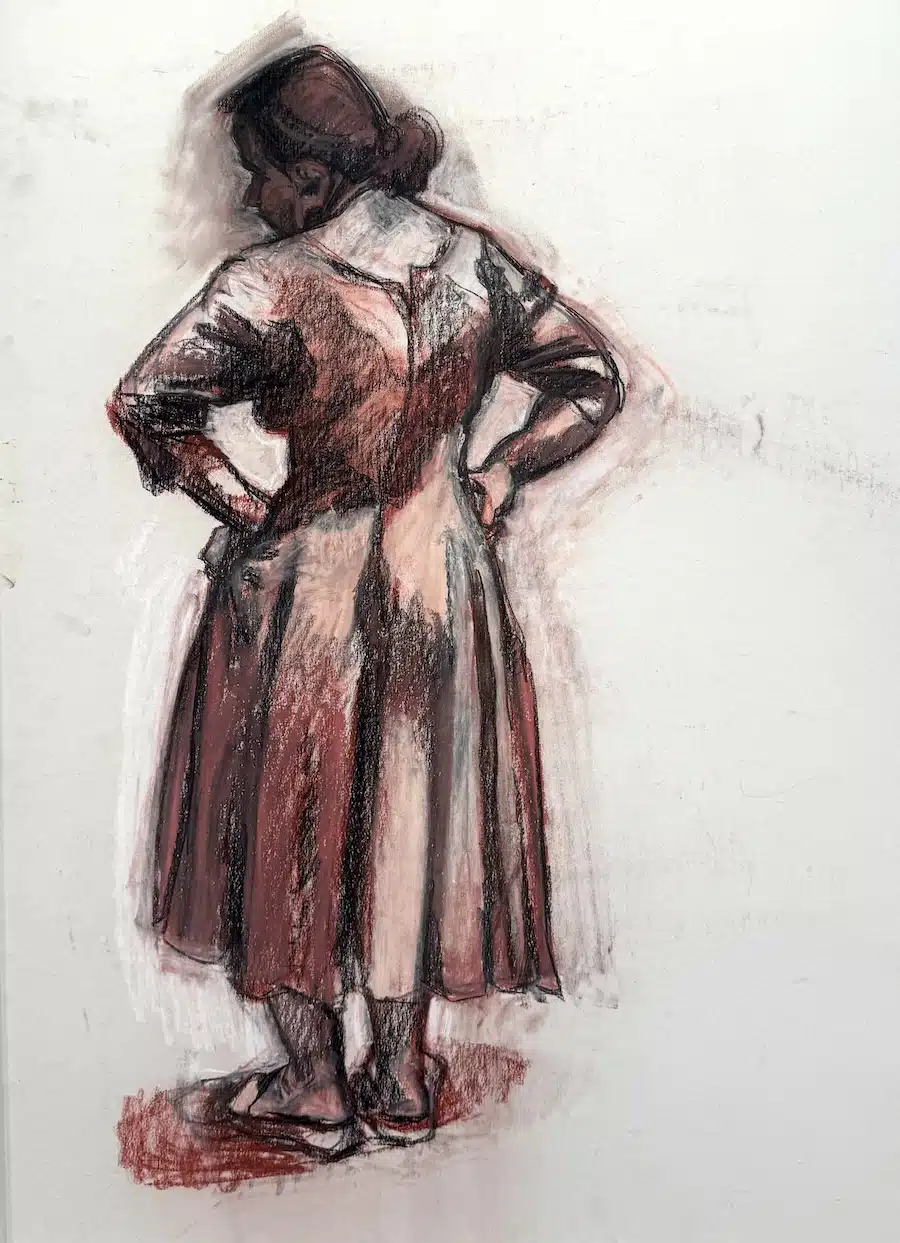
But these are only glimpses, occasional flashes of illumination in a biography that otherwise contains a large amount of speculative padding. Few paragraphs go by that don’t pose unanswerable questions (‘Was Emily a whistler?’, ‘did she make herself sick, perhaps by not eating?’), and the phrase ‘she may have’ is used as reflexively as a full stop. Large swathes of conjecture about what Emily might have seen or done (often based on Charlotte’s experiences) serve as descriptive stepping stones when the facts are too thin on the ground. And a lengthy plot summary of Wuthering Heights reads like a narrative sleight of hand, meant to distract us from the fact that, with no original manuscript, we will never know how it was written. Obscured by a blizzard of unanswered questions and hypothetical experiences, Emily appears just as she did in her self-portraits: with her back to us, a subject who does not want to be known.
Quoting Julian Barnes, Lutz prefaces This Dark Night by asserting that all biography is ‘a collection of holes tied together with a string’, and that ‘with Emily Brontë this is doubly true’. However, whether a biographer succeeds depends entirely on how she chooses to bridge the gaps. Were it only that Lutz relied too heavily on conjecture about what Emily saw or felt, it would merely be a frustrating book; but because her speculation extends to how Emily washed and with what material she managed her menstruation, it is a fundamentally flawed one. Never mind that no biographer of a male author would think to ask how he trimmed his nasal hair or applied his haemorrhoid cream, Lutz seems to have forgotten that her subject is the sublime poet who wrote: ‘I am happiest when most away / I can bear my soul from its home of clay’. She can look for Emily in her slop pails as much as she likes. She will not find her there.
Virginia Woolf wrote that ‘there is no “I” in Wuthering Heights’, but she could equally have written that there was no ‘I’ in Emily Brontë. Like the bluebell, which Emily called a sacred watcher, she observed the world unhindered by the blot of the self – saw it as if from the falcon’s untethered eye, as if from some far-flung perch in the boundless universe.
It is no wonder she remains so elusive. (Charlotte Stroud)
The Yorkshire Post features Paul Crossley, who has created a model of Haworth as the Brontë family would have known it.
With its plethora of independent stores and coffee shops, walking up the village’s Main Street towards the Bronte Parsonage in 2026 is, of course, a very different experience to how it would have been when those three writerly sisters called it home.
But now the village has been faithfully recreated as it would have been in the 1840s - in miniature.
Paul Crossley is a volunteer at the Parsonage, and his impressive diorama, some three years in the making, merges his two passions: model making and the history of the Bronte family.
A fan since being mesmerised by The Brontës of Haworth TV series in 1973, he has a particular interest in Branwell Bronte, who struggled with addiction.
“I was reading one of Ann Dinsdale’s fabulous books about the Brontës. She’s the curator of the Parsonage and in the book was a map of how the street would have looked in the 1840s,” Mr Crossley explained.
“And it got me to thinking, what if I could make a model of that? I’ve been doing model making for 60 years now and it’s almost a kind of illness.”
Using a scale of 2mm to a foot, Paul recreated the maps on his kitchen floor, sellotaping A4 pieces of paper together to work out the exact layout of his planned village.
“Lots of the buildings described have since been demolished,” he explained “So I had to use my imagination - I see myself as a bit of a frustrated architect.”
The Parsonage, the Sunday School and Haworth’s Church tower are all recognisable in Paul’s diorama, although he had to do some digging to ensure accuracy, particularly in the case of the church, which was partially rebuilt in the 1870s.
“I decided I was going to base the diorama in the year 1845, which was a milestone year in the Brontë saga. Patrick [the writers’ vicar father] had got himself a new curate, Arthur Bell Nicholls, who would go on to become Charlotte’s husband,” he said.
“It was also the year Anne resigned her job, Branwell got sacked and Charlotte discovered Emily’s poetry.”
Paul’s commitment to accuracy even stretched as far as ensuring replicas of gravestones were in keeping with the year he chose.
He brought his diorama to the Parsonage for a short display, where he was told by one staff member that she’d “never been able to visualise Victorian Haworth, but now she saw it in an instant.”
A spokesperson for the Brontë Parsonage said: “Paul has been a dedicated and valued volunteer at the Brontë Parsonage Museum for many years. We really admire the time and skill which he has put into this remarkable model, and we're all delighted that he's receiving recognition for his work.” (Victoria Finan)
Lancashire Telegraph tells the story of a Burnley woman who has fulfilled her lifelong dream of visiting Haworth thanks to the generosity of supporters backing a new fundraising initiative from social care charity Making Space.
Jackie was nominated because of her long-standing love of classic literature and old films, as well as a dream she had held for years of visiting Haworth, where Emily, Charlotte and Anne Brontë lived.
In her nomination, Rosemary explained how much the trip would mean.
She wrote: “Jackie has never been to Haworth and would dearly love to see where the Brontë sisters lived and the surrounding countryside which inspired their novels.
“Jackie does not get out and about very much, and this experience would mean so much to her, and would be something she would remember and talk about for the rest of her life.”
When Jackie learned she had been selected, Rosemary said she was “beaming” as she began planning what souvenirs she might bring back from the trip.
The day was made possible by Marcus Edwards, a personal travel consultant and long-time supporter of Making Space, who volunteered to organise the visit and cover all associated costs for Jackie and Rosemary.
Marcus said: “I am so happy to be able to support the work that Making Space does in the community to improve the lives of those who need a friendly face, a helping hand or some much-needed company and kindness.
“I was really touched by this lady’s story and wanted to provide an experience that would make her smile, provide an opportunity for a break and for her to make some happy memories in a place she really wanted to visit.”
During the day, Jackie explored the famous cobbled streets of Haworth, visited the Brontë Parsonage Museum and enjoyed lunch in one of the village’s cafés before travelling to nearby Thornton to learn more about the Brontë family’s early life.
Reflecting on the experience, Jackie said: “I enjoyed every part of the day.
“The Brontë Parsonage was wonderful, and I loved listening to the guide at the museum in Thornton.
“I especially loved the Old Curiosity Shop. It looked like something from an old movie with chandeliers, beautiful mirrors and all the herbal soaps, lotions and potions. I absolutely adored it.
“Thank you for everything. It was a very special day that I will always remember.”
Rosemary added: “Jackie is a very thoughtful and reserved person, but it was clear how much the experience meant to her.
“She kept saying how much she had enjoyed the day and really took everything in.
"It was wonderful to see her experience something she had wanted to do for such a long time.” (Safiyyah Tayyeb)
The Sunday Guardian recommends '10 Heartfelt Romance Novels That Celebrate Love & Emotional Connection | Best Love Stories Every Reader Should Explore' including Jane Eyre. Rutland Herald asks bookish questions to editor and writer Bronwyn Fryer, who says she loves the Brontës among others. The Brontë Sisters UK publishes a video about Aunt Branwell's life and influence on the Brontës. Stay At Home Artist posts an essay on "How Mrs. Gaskell brought about Charlotte's biography".
 

Saturday, May 23, 2026

Saturday, May 23, 2026 8:18 am by Cristina in , , , ,    No comments
Wall Street Journal reviews Deborah Lutz's This Dark Night. Emily Brontë, a Life.
There’s a chilling promise in the preface of “This Dark Night,” Deborah Lutz’s account of the life of a celebrated early-19th-century English poet and novelist. “With this biography,” writes the author, “I work to place Emily Brontë in the history of more modern ways of thinking.”
The phrase “more modern ways of thinking” may curdle the blood of the reader, who may brace for Ms. Lutz to inculpate her subject in matters of race, class and gender. Happily, there’s no cause for alarm. The reader’s blood can resume its easy flow. Such elements do appear in the book, but there’s no sense that Ms. Lutz has strained to find and exploit them. Rather than offering the usual tedious politics, she gives us lavish servings of literary aesthetics. By the end, the reader understands much of what went into Brontë’s making, and leaves feeling grateful, buffeted and a little awestruck by the intense, self-contained, short-lived author of one of the world’s most esteemed novels.
Had Brontë survived past 30, she might have worked yet-greater literary marvels, but as it is she left us with “Wuthering Heights,” a bravura work of melodrama published in 1847 under the pseudonym Ellis Bell. The novel was slow to sell and slow to find its place in the canon. Brontë was dead before it bore her name. Early reviewers, writes Ms. Lutz, found the book “too gloomy, savage, and eccentric.” She speculates that its harsh reception may have to some degree gratified its author who, after all, “did mean to write a savage, cruel, and gloomy novel.”
In “This Dark Night,” Ms. Lutz, a professor literature at Pennsylvania State University, deploys flash and elegance when tracing the wellsprings of her subject’s genius to their sources. Brontë was born in 1818 into a household acquainted with grief; her mother died in 1821 and her two eldest siblings within weeks of each other in 1825. She grew up primarily in the company of her sisters (Charlotte and Anne) and brother (Branwell), with their father (Patrick), in splendid seclusion in a parsonage near England’s West Yorkshire moors.
From her earliest years, Emily thrilled to the austere glories of the landscape, with its great desolate stretches of rocky turf and rushing waterways all shaped and pummeled by winds that whistled and “wuthered.” She was alive to folklore that told of fairies and elves and the lingering dead. She developed, writes Ms. Lutz, a “weird, witchy” sense of humor, doodled violent images in the margins of her books and made a specialty, in her poetry and prose, of the “nocturnal and crepuscular.”Most importantly, Brontë spent her formative years in a kind of grand literary apprenticeship. Most children toggle back and forth between reality and fantasy and leave imaginative play behind (or become incapable of engaging in it) around puberty. The Brontë siblings were able to extend their time of enchantment by staying at home, socializing with one another and committing wholly to living in realms of their own creation: Charlotte and Branwell in the fictive land of Angria, Anne and Emily in Gondal.
The siblings concocted complex lineages and histories for their countries, writing Angrian and Gondalian tales and verse in tiny homemade books. Their reading, writing and collaboration went on for years. It is hard to imagine a better hothouse for growing gaudy literary flowers, and therefore perhaps no surprise that all four Brontës would be published, but still it is a wonder that from this one crowded nursery should spring not one but two of the most distinguished novels ever penned: “Wuthering Heights” and, earlier the same year, Charlotte Brontë’s “Jane Eyre.”
In adulthood, the need for ready money forced each of the Brontës to leave their creative idyll for a time—all of them worked as educators—before returning home. The three girls embarked on novels, writing alone during the days and meeting in the evenings to talk over points of plot and character.
The turbulent Branwell was the first literary Brontë to be published (a poem, not a novel), but also the first to die: drink, despair and tuberculosis put him in a grave at 31. Emily, 13 months his junior, was soon to follow, though even as she sickened (probably also from tuberculosis), she likely continued to disappear into the parallel worlds of her imagination. In her subject’s consciousness, writes Ms. Lutz, “through the scrim of the real appeared, indistinctly, a land where people and objects could shapeshift, where dreams provided texture. Something might lie behind or deep inside the mundane; almost anything could function as an entryway to the miraculous, the sublime.”
As to the elements of modern thinking, Ms. Lutz does explore Brontë’s love life. She alludes to a mysterious adolescent entanglement of which scholars know little (incredibly, for a woman who wrote so much, very little of Brontë’s correspondence is known to exist), and notes here and there the possible influence of lesbians.
In another nod to modern thinking, missing almost entirely from this vivid narrative is the role of Christianity in the life of a young woman who in girlhood said her prayers, who as a teenager carefully reproduced an engraving of an ascetic saint and who would have heard church bells ringing every day of her life. Brontë was fascinated by silent crypts and tormenting passions. These are aspects of the gothic sensibility, of course; they might also, for a clergyman’s daughter, have come from a different guiding philosophy. (Meghan Cox Gurdon)
According to The Guardian, Emerald Fennell 'regrets not showing Margot Robbie’s ‘extremely hairy armpits’' in Wuthering Heights 2026.
Emerald Fennell says period-realistic scene emphasising Cathy’s lack of razors was shot but did not make final cut
The Wuthering Heights director Emerald Fennell said it was “unfortunate” that a scene showing Margot Robbie’s hairy armpits did not make the final cut, because women in period adaptations are often shown with clean-shaven underarms.
Robbie’s character, Cathy, had “extremely hairy armpits” in the 2026 adaptation of the novel, but “unfortunately the scene that we see them didn’t make it in there”, said the director.
Cathy having unshaven pits “was so important to me”, she said, adding that she often wonders “where are the razors that these women are using?” when watching Jane Austen adaptations.
“They’re all kind of hairless like eels. I’m like: ‘What’s going on? It’s completely mad.’”
Fennell spoke to an audience at Hay festival in Wales on Friday evening. Her sexed-up adaptation of Emily Brontë’s gothic novel, starring Robbie alongside Jacob Elordi, was released on Valentine’s Day this year.
Fennell described it as a “sister, not a twin” of the book, saying that she “couldn’t make” the original. “It’s so brilliant,” she added.
Asked about the infamous “skin room” – Cathy’s husband, Edgar Linton, gives her bedroom a bespoke design with walls that resemble her skin – Fennell joked that in marketing meetings the team considered asking Farrow & Ball to make a Cathy’s skin themed colour.
They also asked Robbie to send close-up images of the underside of her wrist in order to reproduce her veins on the walls.
Fennell also spoke about the much-discussed “fish scene”, in which Cathy sticks her finger into a dead fish’s mouth.
“I saw a fish in aspic and I thought: ‘I want to stick my finger in its mouth.’ And then I was like, ‘Well, I think if you were trapped, and you were extremely sexually frustrated, the first thing you’d do is …’
“We had all of the different fish, we had fish with lipstick on, we had real fish, fake fish, in the end that was a real fish. But poor Margot. I mean she had to do that. There were 12 of them.”
On her directorial approach, Fennell said that “being embarrassing, being cringe” is a “really big thing” for her.
“Especially now in our culture, we are so phobic and terrified of being cringe, or being earnest, and so we’ve got this deadening ambivalence about everything, and I feel, for me, I want to get in and go for it, and push it off a cliff.”
Fennell said she is taking time off from film-making to make jigsaw puzzles, see her family, disconnect from the internet and read Sarah J Maas novels.
“And I’m coming up secretly with something so depraved, so profoundly evil, that nobody’s going to make it.” (Ella Creamer)
A contributor to Her Campus shares her review of the film. Elements of Madness reviews it too as a home release.
In the era of BookTok, many fans find themselves drawn to stories fueled by yearning. Some might want to step into a romantasy, where bat-winged boys sweep their powerful protagonists off their feet, while others prefer a more real-world scenario with some sports thrown in to spice things up. So it comes as no surprise that when said readers discover the hyper romantic content of the past, they find themselves either entrenched or disappointed with the lack of fangirl appeal. Either the material doesn’t have the steamy passages found in more modern romances or there’re too many problematic elements getting in the way of diving deep into the fantasy.
One such example comes in the form of Emily Brontë’s tragic soap-operatic tale, Wuthering Heights. From the highly debated depictions of its lead characters to the evolving question of whether the central romantic pair are terrible people or victims of circumstance, there’s no shortage of topics to debate within this masterpiece. But when you add the controversial filmmaking choices of writer/director Emerald Fennell (Saltburn) into a new film adaptation, along with the casting of Margot Robbie (Barbie) and Jacob Elordi (Frankenstein)? The fandom disputes get turned up to 11. Now, thanks to Warner Bros., this highly deliberated version has landed on home video. Are the hot takes surrounding it warranted? Or is it a misunderstood gem? The answer is as full of twists and turns as Cathy and Heathcliff’s relationship. [...]
Thankfully, Warner Bros.’s home release captures the visual splendor of Fennell’s adaptation in sparkling quality. Not only does the 4K release showcase the cinematography in all its beauty, but the sound, in particular, replicates that of its theatrical release (which works to enhance the Charli XCX’s songs as well as the Dolby Atmos version did.) Similarly brilliant are special features. From the delicious commentary by Fennell herself which dives deep into her mindset while making the film to a multitude of behind-the-scenes featurettes, it’s wonderful to see a home release befitting the efforts that went into the film, something that feels rare for most new movies getting the 4K treatment these days.
Ultimately, regardless of whether you like this very different take on Emily Brontë’s classic or not, it goes without saying that Fennell’s adaptation is cinematic. Sure, it might be missing half of the story while also changing quite a number of the factors that make most readers love the original story, but there’s a degree of craft, detail, and genuine artistry found within every frame of this sumptuous romantic venture. It’s just a shame that this level of passion couldn’t have, instead, been poured into something we haven’t already seen many times over. (Dalin Rowell)
The Hollywood Reporter reviews the film Victorian Psycho, claiming that,
There are the faintest echoes of Wuthering Heights and Jane Eyre in the Yorkshire Moors setting. (David Rooney)
The Independent shares a video of Maggie O'Farrell in which she mentions the Brontës as some of her literary influences.

Thursday, May 21, 2026

Thursday, May 21, 2026 8:03 am by Cristina in , , , , , ,    No comments
The Irish Times reports on a recent visit by President Catherine Connolly to her alma mater, the University of Leeds, where
She also viewed the university’s collection of material associated with Yorkshire’s most famous literary family, the Brontës, whose father, Patrick Prunty (who changed his surname to avoid the connotation with Ireland), was originally from Co Down.
“We’re claiming them back,” the President joked in reference to the Brontë sisters, Emily, Charlotte and Anne.
Paper was scarce in 18th-century England and Connolly viewed a mock newspaper written up by Charlotte Brontë in tiny handwriting on an Epsom salts wrapper when she was just 13. Charlotte read the newspaper to the family collection of toy soldiers. (Ronan McGreevy)
She also gave a speech at the Leeds Irish Centre, as reported by the Yorkshire Evening Post:
She also mentioned Patrick Brontë, the County Down father of the Brontë sisters. (Charles Gray)
Irish News recommends '5 new books to read this week,' including
4. This Dark Night: The Life Of Emily Brontë by Deborah Lutz is published in hardback by Bloomsbury Continuum, priced £20 (ebook £14). Available May 28
Drawing on newly unearthed material, Deborah Lutz’s This Dark Night is a lively, comprehensive, and thoroughly researched biography of Gothic fiction titan Emily Brontë. Rooted in the dramatic landscape of the Yorkshire moors, Lutz paints a vivid portrait of the surroundings, people and politics that gave rise to Wuthering Heights. Readers hoping for a biography with an exclusive focus on the middle Brontë sister will not find it here, however. So entwined was her life with those of her sisters, Charlotte and Anne, that any attempt to separate Emily entirely would be misrepresentative. It is Lutz’s dissection of Bronte’s works, from early writings set in the fictional Gondal, to her now renowned 1847 novel, that place her at the biography’s centre. Despite a somewhat slow start, This Dark Night, underpinned by wide-ranging sources and expert analysis, is a discerning insight into the woman behind a tale which has captivated generations. (Prudence Wade)
Gulf Weekly also reviews this biography:
The much-awaited biographical book This Dark Night: Emily Brontë, A Life by Deborah Lutz has hit the shelves.
Drawing on formerly inaccessible notebooks and manuscripts, it constructs a portrait of the gothic 1847 novel Wuthering Heights’ author, who is considered to be an elusive figure with a ghostly legacy provoked by her early death.
It tackles her relationship with her famous writing sisters Charlotte and Anne, and how grieving their mother impacted her writing.
The author also illustrates how Emily, who lived from 1818 to 1848, discussed debates of her time such as class and race, which author Deborah believes still resonate today.
She recounted experiencing grief during the writing process.
“While I was writing the passages about the death of the Brontës’ mother, my mother died,” she said on social media.
“She had been ill and frail for a very long time, so her death was no surprise. But then, exactly a month after her death, my dear, dear dog Penny suddenly died. That loss was devastating, especially on top of my mother’s death,” she added. 
“When I got back to writing, I had the occasion to ponder the ways that death and grieving became an integral part of Emily Brontë’s work and life.”
The 19th-century English-American literature professor is known for her classic works, including The Brontë Cabinet (2015), which brought alive the fascinating lives of the Brontë sisters through the things they wore, stitched, wrote on and inscribed.
It was shortlisted for the PEN/Jacqueline Bograd Weld Award for Biography and has been translated into Spanish and Japanese. (Rima Al Haddad)
According to Comic Book Resources, 'It's Official, Wuthering Heights Failed For One Major Reason'. (The question is: did it actually fail?)
Wuthering Heights was always meant to be controversial. Whether literature fans wanted another adaptation or not, Emerald Fennell’s version was more Gone With the Wind than Edgar Allan Poe. Even so, when the film hit screens for Valentine’s Day 2026, something was missing. The Jacob Elordi and Margot Robbie team-up was marketed as one of the steamiest and most erotic romances of the decade.
Save for some erotic asphyxiation in the first scene, Wuthering Heights felt extremely performative and did not deliver on the promise of a subversive bodice ripper. Whether the movie was a decent adaptation of Emily Brontë’s book was beside the point. Wuthering Heights failed in its edginess because another film had already stolen its thunder. That honor went surprisingly to Saltburn, Fennell’s second feature, also starring Elordi. [...]
Wuthering Heights wasn’t brave enough to make these characters' motivations work and make them truly reprehensible, as opposed to just catty. The film was never going to be a proper adaptation of the Gothic book, but it at least could have been daring. Instead, it was toothless and utterly unsexy, refusing to take any big risks. Love it or hate it, Saltburn at the very least swung for the fences. (Carolyn Jenkins)
Spectator Australia asks the same question that film director Pedro Almodóvar asked a few weeks ago about Jacob Elordi: 'Sex symbol or respected actor?'
Fortunately you don’t have to admire Jacob Elordi’s stab at Heathcliff in Wuthering Heights to be knocked out by On Swift Horses which is a remarkably good film now available on Binge. [...]
It’s fascinating – needless to say – what people are saying about the rise of Jacob Elordi. It was no less a figure than Pedro Almodovar who asked whether Jacob Elordi was ‘just a sex symbol or a respected actor’.This was in the context of the great director saying Wuthering Heights was ‘very bad’ and that it was not the fault of Margot Robbie or Jacob Elordi – ‘They do what they can,’ he said. The great Spanish director of Volver added that Frankenstein’s monster was a very convenient role for an actor. (Peter Craven)
A contributor to The Oxford Blue mentions Charli XCX's Wuthering Heights album.
The Phoenix Picturehouse and the Ultimate Picture Palace have become two of my regular Oxford haunts. I have seen Springsteen: Deliver Me from Nowhere, Frankenstein, Wuthering Heights, Sirāt, The Secret Agent, and Project Hail Mary, among others. 
It’s no surprise that I am constantly distracted by soundtracks: the drolly bittersweet placement of Kris Kristofferson’s “Sunday Mornin’ Comin’ Down”, Charli XCX’s gothic and brooding backdrop to the moors of “Wuthering Heights”, stomach-dropping grief carried by Sirāt’s industrial techno score, and Jeremy Allen White’s sincere recreations of the folk-rock I grew up with. I usually leave the cinema buzzing. Maybe I’m easily impressed, or maybe it has been a great year for music in the media. (Julia Blackmon)
US Magazine interviews Elizabeth Smart:
My very favorite book is Jane Eyre, and there’s a part where Mr. Rochester is talking to Jane, and he’s comparing her to a bird in a cage, and he is like, I could crush this cage, but I’d never get at the bird inside. And I mentioned this quote in my first book, when I talked about what actually happened to me when I was kidnapped. My captors could hurt my body, but my body always protected my spirit. I felt that way through my whole life; my body has carried me through every worst day. It’s given me my children. My body has been through a lot, but it has never let anyone crush my spirit. If it stopped protecting me, then I’d be dead. But here I am alive. So now I feel bodybuilding, for me, is honoring my body. Like, taking the time and the care and the attention that it’s deserved all along, because now it’s stronger. I’m healthier, I’m fitter. (Stephanie Radvan and Andrea Simpson)
Keighley News announces a talk at Keighley Local Studies Library on Labour Party pioneer Philip Snowden, aka Labour's Heathcliff.
Speaker Alexander Clifford, a historian and editor of a new edition of Snowden’s autobiography, says: "With typical Yorkshire grit, Snowden overcame grinding rural poverty and paralysing disability to become the Labour Party’s first Chancellor of the Exchequer.
"But one decision would change his life totally, turning him from socialist hero to traitor and villain and resulting in his expulsion from the party.
"Snowden embraced his new role with gusto, dedicating the rest of his life to attacking the party and people he had once loved.
"His bitter, self-destructive quest for vengeance has strange parallels to a more famous fictional moorland outsider.
"My talk will explore the fascinating story of how and why Philip Snowden betrayed his party to ruthlessly pursue a political vendetta. Was he Labour’s Heathcliff?" (Alistair Shand)

Monday, May 04, 2026

Monday, May 04, 2026 7:29 am by Cristina in , , ,    No comments
According to MovieWeb, 'Margot Robbie's R-Rated Drama [aka Wuthering Heights 2026] Is a Late Night Hit on Streaming'.
Margot Robbie and Jacob Elordi's R-rated Wuthering Heights dominated pop culture during its theatrical build-up and run in early 2026. Some audiences preemptively criticized the film as a wildly unfaithful adaptation of Emily Brontë's novel. Others waited until after the credits rolled to lambaste the film online. Either way, the movie wasn't exactly warmly received. But despite the initial backlash, Margot Robbie's Wuthering Heights adaptation has taken its new streaming home by storm. Wuthering Heights is now streaming on HBO Max. After less than a day, Wuthering Heights is the number one movie on streaming in the US and across the globe. (Archie Fenn)
ScreenRant also describes it as 'An Instant Streaming Sensation'. Metro refers to the film as '2026’s most controversial film', but if that is so, then 2026 seems pretty tame filmwise. Collider ranks Jacob Elordi's roles, and his Heathcliff makes it to #3:
3 'Wuthering Heights' (2026)
Elordi's first-ever period-like drama...truly memorable. One of the most controversial movies of 2026, Wuthering Heights is an adaptation of the famous Emily Brontë book, directed by Emerald Fennell. This was the second project on which Fennell and Elordi worked together, and the messiest one, surely. Not because of the different casting per se, but, according to fans of the original material, because of the too-much erotic portrayal and grand lack of depth to the book's story.
Now, I believe that Elordi and Margot Robbie did an outstanding job in this movie. Despite what critics and the general audience think, Elordi, thanks to his performance in Wuthering Heights, has the potential to be cast as a future Mr. Darcy, if the industry ever considers doing another version of the movie (without counting the Netflix series releasing this fall). Add the romantic value and depth of Elordi's acting...and you've got a great chance of winning an Oscar, just saying! This movie's aesthetic, scenery, and clothing were phenomenal, which added to the beauty of Elordi and Robbie's portrayal. An unforgettable film indeed. (Giulia Campora)
More movies, as Liverpool Echo recommends watching To Walk Invisible and Jane Eyre 2006 (among other, non-Brontë-related adaptations) if you've just finished The Other Bennet Sister.

A contributor to Castlegar News wonders, 
Do you remember the first book you read, or the book that made such an impression on you that you kept returning to it again and again?
For me, it was Jane Eyre, the Charlotte Brontë classic that I discovered on our bookshelves at home when I was about 12. Orphaned Jane and the inscrutable Mr. Rochester certainly struck a chord with me and I still have that old copy and pick it up every couple of years. It’s interesting that although I’m totally familiar with the story, I always find something that surprises me: a scene I didn’t remember or a detail of an encounter or relationship that I had skipped over to get to the juicier bits.The story seems to have resonated with filmmakers as well. I’ve lost count of how many versions have made it to the screen, big or small. Move over, Jane Austen. (Margaret Tessman)

Sunday, May 03, 2026

On Examiner Live, a client of the Haworth Old Post Office restaurant didn't like one of the dishes:
Haworth is a picturesque market town which was once the home of the famous Brontë sisters, a trio of 19th Century authors known for such classics as Jane Eyre and Wuthering Heights, along with a multitude of classic works with gothic themes and emotional resonance.
It’s a lovely town, boasting narrow cobbled streets and a hodgepodge of old-fashioned shops, charming cafes and pubs, and surrounded by rugged moorland. I had a great time simply walking through the centre for the very first time and discovering all it had to offer.
I was sent out to check out a restaurant called Haworth Old Post Office, located in the town’s converted old post office – the place where the famous sisters would have sent off their unpublished manuscripts. The post office dates all the way back to 1829, when the first penny post was used. (Samuel Port)
The Sydney Morning Herald talks about a new AI tool (who-ordered-that? kind of) and fuels our evolution to modern Luddism:
 Imagine wandering through the desolate Yorkshire moors of Jane Eyre, or confronting the deadly Count in Bram Stoker's Dracula. It's one thing to imagine characters in these settings; it's another thing entirely to imagine yourself in them.
Thanks to a new AI tool developed by chatbot program Character.ai, however, you can step into your favourite public domain novels with ease. The platform's latest "Books" feature enables users to literally insert themselves into some of the most beloved works of literature, from Pride and Prejudice to Frankenstein.
Not only can you place yourself within the story, you can also embody existing characters, tinker with storylines, switch up settings and even change endings.
Put simply, you can rewrite the classics.
But should we? Interactive storytelling is nothing new – Netflix has released several "choose your own adventure" films since 2017, and video games have been playing with the concept for decades. These texts exist to be reinterpreted. The same can't necessarily be said for centuries-old novels. (Nell Geraets and Karl Quinn)
More AI garbage. 

Natasha Lester, author of The Chateau on Sunset, explains in The West Australian how she wrote the book. You can agree with her views or not, but at least they're hers. Not some garbAIge.
When I was 10, I walked into Duncraig Library as I'd done every week of my life thus far. I'd already worked my way through all the Enid Blytons, all the horse books, all the Chalet School series and all the Nancy Drews. The librarian wouldn't let me into the adult section of the library until I was 12. So I had to find something else in the children's section to occupy me. I decided to start reading the classics. Yes, I was a nerdy, bookish 10-year-old.
I started with the "A" section, but some other nerdy, bookish 10-year-old must have visited the library that day because there were no Jane Austens left. I continued onto "B", and found a book called Jane Eyre. More than half the front cover featured a large image of Rochester on his rearing horse. In the bottom left-hand corner, taking up only about one-eighth of the cover space, was a woman. Yes, the woman whose name was on the front cover of the book was the smallest thing on that cover. That didn't strike me as particularly odd at the time — feminism hadn't quite found its way to Warwick, where I lived.
I took the book home and started to read. Within a couple of chapters, I was lost forever to the magic of Charlotte Bronte's story. In an interview with Emerald Fennell about her Wuthering Heights adaptation, she said that her movie reflected the impression the book made on her when she first read it as a 14-year-old. That resonated with me. Back when I read Jane Eyre, what stayed with me was the so-called madwoman in the attic and Jane's best friend dying of consumption. Mysterious fires in bedrooms, men stabbed and bitten, an entire house burned down by the madwoman. It was only much later that I realised the main character of Jane had left hardly a mark on my consciousness.
But when I reread the book as an adult, I couldn't believe that I'd been so seduced by the darkness and that I'd entirely overlooked the best part of the book — its heroine. (...)
It was time to find a different era and setting for my next book, meaning I'd have to brainstorm an idea from nothing for the first time in years. (....)
 What if I reimagined Jane Eyre in some way? Immediately I could see Rochester's gothic Thornfield Hall transformed into the gothic Chateau Marmont. I had my book idea. I'd write The Chateau On Sunset, a reimagining of Jane Eyre, set at Hollywood's infamous Chateau Marmont during its 1950s and 1960s heyday. And I would tackle the sense of dissatisfaction I'd had with Jane's story since rereading it as an adult.
What was I dissatisfied about? Well, there are many occasions in the book when Jane looks out at the hills that form a barricade between her and the rest of the world. She longs to cross those hills. She yearns to see the world, to have adventures. On the very first page of Bronte's novel, Jane's reading a book about birds and she imagines what it would be like to travel to the same places those birds do — the Arctic, Siberia. Does she? No. There's just one occasion in the book when she escapes beyond those hills. She runs across the moors and finds herself in a house with a man who's probably even more obsessive than Rochester. She promptly escapes back to Thornfield and her true love, Edward Rochester. It's no spoiler to say that, reader, she marries him. It's a romantically satisfying ending. As a child, I was completely happy with it. But as an adult I wondered — did Jane ever regret not having seen the wider world that she so longed to experience? Was there a way to give Jane Eyre an ending that was both romantically satisfying and personally satisfying?
That's what's so wonderful about literary reimaginings. Jane Eyre is one of the first feminist heroines of literature. Who can forget her declaring to Rochester, in an era when the word feminism was foreign to most, that she was his equal? (Read more
Another writer, Meg Wingerter, gets interviewed in The Colorado Sun:
Favorite fictional literary character: Jane Eyre. There’s something powerful about a young woman of little social standing deciding she cares enough about herself to stick by her principles.
Who What Wear interviews the model and writer Julia Campbell-Gillies:
Poppy Nash: What are your favourite three movies of all time?
JCG: Pride and Prejudice (2005), Jane Eyre (2011) and Marie Antoinette.
The Telegraph & Argus publishes an opinion piece on how TV locations are influencing set-jetting travel trends:
And this year’s Wuthering Heights film saw a tourism spike at Haworth and the Brontë Parsonage Museum. Haworth’s cobbles are well trodden by influencers wandering, wistfully, with a Brontë book. (Emma Clayton)
The streaming premiere of Wuthering Heights 2026 is mentioned in Infobae, Crónica (both in Argentina),  SoapCentral, CBR, The Huffington Post, Times of India, inkl, US Magazine, Ámbito, Quéver, Taxidrivers, Collider, Cinemablend, ...  The Wom Travel (Italy) explores the original settings of Wuthering Heights, both 2026 film and novel.

Monday, April 27, 2026

Monday, April 27, 2026 7:18 am by Cristina in ,    No comments
Writer Amanda Craig writes about her experience of motherhood in The Guardian.
I loved literature, but nothing I read had prepared me for life after birth. What came after marriage was glossed over by the Victorian fiction I adored: Jane Eyre’s Mr Rochester has recovered his sight enough to see the child she puts in his arms and, unlike her author, she does not die a pregnancy-related death. 
Good Housekeeping has '4 Best-Selling Authors Share Their Favorite Historical Fiction Books'.
Adriana Trigiani recommends
Jane Eyre by Charlotte Brontë
“Every summer, I reread Jane Eyre. I love that story. Because it's about a poor girl who's shunned by her family, thrown out, has no reason ever, at any point in her life, to do the right thing. But she's got a moral code. And she cannot be deterred from her path of being a decent human being. So that's the kind of historical fiction I like.” —Adriana Trigiani (Sarah Vincent)
'The Brontës And Burton Agnes' on AnneBrontë.org.

Friday, April 24, 2026

Keighley News has an article on the Brontë Society's plans for the building it acquired last year.
Once home to the famous literary siblings – who drew inspiration for their classic works from the neighbouring moorland – it attracts visitors from across the world, keen to see where the sisters wrote and how they lived.
But whilst the past is central to any museum, parsonage bosses are also keen to look to the future.
And the team's ambitious plans were outlined to Keighley MP Robbie Moore during a visit to the site.
He met up with museum director Rebecca Yorke, who showed him around a historic building – bought by the Brontë Society last year – in the village's West Lane.
The three derelict adjoining properties were acquired shortly before they were due to be sold at auction.
They include the former studio of photographer Fred Smith, who was caretaker of the original Brontë Museum when it was situated above the Yorkshire Penny Bank in the early 1900s.
Many of Smith's photographs, which document the Haworth of that time, are now in the Brontë Society archive and it's hoped some will be displayed in the building once renovations are complete.
The premises will also provide additional space for the society's growing archive and team, and offer opportunities for closer engagement with residents and visitors.
Following the release of the latest movie version of Emily Brontë's Wuthering Heights, visitor numbers to the museum have enjoyed a boost.
Mr Moore says: "It was fantastic to meet with Rebecca and hear about the society's exciting plans for the future.
"The Brontë Parsonage is one of the most important literary sites in the country and it was great to hear about the continued success of the museum – particularly following the recent Wuthering Heights film.
"A huge 'thank you' to Rebecca and the team for the update, and tour of the newly-acquired buildings in West Lane which have massive potential. I’m looking forward to seeing the plans progress."
Rebecca says: "We were very happy to welcome Robbie to the museum and have the opportunity to update him on our recent successes and share our aims and ambitions for the future.
"We take our responsibilities as custodians of the Brontës' legacy and as a world-renowned visitor attraction very seriously, and are pleased to have our contribution to the area's cultural offer and economy recognised by our MP." (Alistair Shand)
Both BBC News and The Yorkshire Post report MP Robbie Moore's speech in Parliament against the wind farm plans at the heart of Brontë country.

After giving Wuthering Heights 2026 a two-star review back in February, now the film it's The Guardian's pick of the week on TV.
Pick of the week
Wuthering Heights
Emerald Fennell has done a grand job dialling up the scandal over her new adaptation of Emily Brontë’s windswept novel. But aside from the casting of a white actor (Jacob Elordi) as the arguably non-white Heathcliff – and an unexpected S&M subplot – this is the bodice-ripping historical romance most fans would wish for. Margot Robbie plays Cathy as a frustrated social climber torn between a life of luxury with Shazad Latif’s Edgar and the earthy lust offered by the uncouth Heathcliff. For its look, Fennell goes full gothic, à la Guillermo del Toro, with stormy skies, unbridled sex on the moors, ludicrous costumes and often bizarre interior design, as the love story comes to a boil.
Friday 1 May, 8.25am, 8pm, Sky Cinema Premiere (Simon Wardell)
A contributor to Her Campus writes about 'Why The Backlash Of ‘Wuthering Heights’ Is So Deserved'.

ABC News has an obituary of writer David Malouf.
For many years, Malouf divided his time between Sydney and Tuscany. Later, he returned to Queensland and lived in an apartment tower overlooking the beach at Surfers Paradise, where he first read Jane Eyre as a 12-year-old on summer holidays. (Nicola Heath)
Purewow recommends the Jane Eyre retelling, The Chateau on Sunset by Natasha Lester.
For those unfamiliar with the premise of Jane Eyre, the 1847 novel was written by Charlotte Brontë. (Yes, she was Emily Brontë's older sister.) The story follows the eponymous orphaned character as she enters into service as a governess at Thornfield Hall. There, she presides over the education of an orphaned French girl, Adèle Varens. Adele is the ward of Thornfield Hall's master, Edward Rochester. Despite Rochester's surly demeanor, he and Jane eventually fall in love. He proposes, she accepts—and then a haunting secret from Rochester's past emerges.
The Chateau on Sunset borrows the major storyline and transplants it into the Golden Age of Hollywood. The backdrop is none other than the famed Chateau Marmont, whose history is just as tumultuous as the lives of the rich and famous who have sequestered behind its walls. In Lester's retelling, Jane becomes Aria Jones, an orphan sent from New York to live with her aunt, the mysterious former Hollywood legend Miss Devine Ray, at the Chateau. There, Aria makes it her business to blend in, hiding herself from her aunt's drug- and alcohol- induced stupors and evading the preying, powerful men who walk the halls. Her two closest friends are up-and-coming actresses Flitter Reeve and Calliope Burns. Aria wants one thing: To escape on her 18th birthday and live by the ocean. But all that is thrown to the wind when the hotel is purchased by brooding rockstar Theo Winchester, who promptly moves into the penthouse with his daughter, Adele.
Lester captures the opulence, corruption, glamour, power, success and fear that coursed through the waning days of Hollywood's golden age, transposing characters from Jane Eyre so that the plot is familiar but the story wholly original.
Aria is a compelling character, but not just because she's a sketch of one of my favorite heroines. In the author's note, Lester made the interesting observation that one of the sticking points of Jane Eyre is Rochester and his wife, Bertha. Bertha famously sets fire to Thornfield Hall, which causes Jane to flee and seemingly break up with Rochester. When someone says Jane Eyre, it's usually associated with "crazy wife in the attic." This is where Lester does Aria a good turn.
Similarly to actual historical events, Chateau Marmont does indeed go up in flames—but what happens next is a story that puts the girl front and center. Instead of simply running back to Theo, Aria must decide who she is going to become. And, more importantly, who she wants to become. A wallflower content with operating behind the scenes and being invisible must realize that she's worthy of the spotlight. Lester's book is powerful to me because of the fact that Theo and his ex are the afterthought. The events that lead to the conclusion of Aria's story are unexpected, taking her far from the confines of LA and exploring how satisfaction isn't so much falling in love with another person as it is falling in love with herself. (Marissa Wu)
The Bark features the 'innovative set design' used for Bearden Theatre's production of Jane Eyre.
The Bearden theatre has taken on the production of Jane Eyre, a literary staple highlighting the internal struggles of a young woman set in early 19th century England.
The play follows Jane as she navigates religious and moral hardships stemming from her relationships and conflicting setting. 
A towering chestnut tree roots the audience into the set. The tree is commonly interpreted as a symbol of Jane’s suffering due to Rochester’s villainous wife Bertha; however, Bearden theatre added a layer of emotion in the designing process. 
“In a lot of ways, the tree is also a point of safety for Jane…it’s more of a comforting place for her,” said senior and production manager Addison Pratt. [...]
Altering their own production of Jane Eyre from 2005, the set crew believed introducing the tree could augment an already impressive production. Visually, the set piece adds a realistic element to the stage, framing Jane’s relationship with her setting. The chestnut tree will act as one of many interactive elements within the play. 
“This was a new edition that we added and I think it adds a lot,” Pratt said. 
The set will go beyond traditional physical props moved on and off the stage. Working closely with the theatre department at UT, the crew was able to utilize projection mapping within the show. This technical feature will allow certain visual effects to be precisely projected onto the set, heightening the emotion of the play.
“We worked closely with the Clarence Brown Theatre downtown and have borrowed some projectors from them,” senior and set crew member Alex Mair said. “We’ve used some programs to projection map creative elements onto the stage for certain scenes. 
Added Pratt: “Our team has spent a lot of time really figuring out the different programs that we can use and finding a way to make the projections work really well on our stage, and it looks really cool.”
The theatre department will step away from traditional auditorium seating for the show, as on stage seating deepens the audience-cast connection simply from their proximity to the stage. Both cast and crew look forward to the creative elements that will be in high definition for spectators.
“While I think that traditional auditorium seating is great for big, flashier shows, you just feel so much more involved with the characters [through on stage seating],” Mair said. “You can see every single movement that’s happening, every single little detail, and it makes the story feel a lot more interactive.”
Added Pratt: “It’s definitely a much more intimate experience, which I think is really cool.”
Senior Caitlin Stout appreciates the creative liberty given to the crew throughout the production. Stout believes that as a member of set crew, it was her role to not only produce impressive design elements, but to aid the cast in their presentation. What turned into yet another showing of Bearden’s standard for creative set design first began with simple features for the cast to make their own. 
“We wanted the set to be a canvas for the actors to take on and not have to work around designs within the set,” she said. (Max Mead)
15WMTV featured another high school production: Edgewood High School and their take on You on the Moors Now.
Students from Edgewood High School are presenting “You on the Moors Now” for an upcoming performance.
“You on the Moors Now” is about four women from the 19th century novels that turn down marriage proposals.
The performance tracks Jo March from “Little Women,” Elizabeth Bennet from “Pride and Prejudice,” Catherine Earnshaw from “Wuthering Heights” and Jane Eyre from “Jane Eyre” and follows them figuring out their romantic ideologies.
“It’s really great to bring classic literature back to the stage in a modern retelling of it,” Bella Baldo, who plays Earnshaw, said. “Being able to bring themes from modern culture into classic literature and really they have been there all along.”
Along with Baldo, Daphne Conner is casted as March, Ellie O’Day plays Jane Eyre and Ruthie Brenner plays the role of Bennet.
“I’m really excited for them to see the battle scene because it’s really chaotic and obscured, but it’s also really funny at the same time,” O’Day said. “We have a lot of cool weapons.” (Calahan Steed)
Church News lists '15 times Church leaders quoted classic literature in general conference' including
Charlotte Brontë
“One of my favorite books is the British classic ‘Jane Eyre,’ written by Charlotte Brontë and published in 1847. The main character, Jane Eyre, is a penniless, teenage orphan who exemplifies what it means to be true. In this fictional account, a man, Mr. Rochester, loves Miss Eyre but is unable to marry her. Instead, he begs Miss Eyre to live with him without the benefit of marriage. Miss Eyre loves Mr. Rochester as well, and for a moment she is tempted, asking herself, ‘Who in the world cares for you? Or who will be injured by what you do?’
“Quickly Jane’s conscience answers: ‘I care for myself. The more solitary, the more friendless, the more unsustained I am, the more I will respect myself. I will keep the law given by God. … Laws and principles are not for the times when there is no temptation: they are for such moments as this. … If at my individual convenience I might break them, what would be their worth? They have a worth — so I have always believed. … Preconceived opinions, foregone determinations, are all I have at this hour to stand by: there I plant my foot.’
“In a desperate moment of temptation, Jane Eyre was true to her beliefs, she trusted in the law given by God, and she planted her foot in resistance to temptation.”
— Sister Ann M. Dibb, then the second counselor in the Young Women general presidency, April 2011 general conference, “I Believe in Being Honest and True” (Kaitlyn Bancroft)
La Tinta de Almansa (Spain) has an article on a local exhibition that shines the spotlight on women writers who used pseudonyms.

Thursday, April 23, 2026

Keighley and Ilkley MP Robbie Moore spoke in Parliament against the plans for a giant wind farm at the heart of Brontë Country. The Telegraph and Argus reports it:
Keighley and Ilkley MP Robbie Moore (Conservative) introduced a Parliamentary debate considering the impact windfarm development might have on 2,300 hectares of protected peatland.
He argued the case against Calderdale Energy Park’s proposals to place up to 34 wind turbines on Walshaw Moor above Hebden Bridge which will impact on Calderdale and Bradford in West Yorkshire and Pendle in Lancashire. 
Calderdale Energy Park, whose statutory public consultation on the proposals runs until June 10, argues the site is in an area identified for generating on-shore wind power, helping deliver “reliable, home-grown renewable energy, helping to reduce energy costs, support local jobs and strengthen energy security”, the turbines capable of generating up to 240 mega watts (MW) on renewable energy.
But Mr Moore said this would come at a price to protected peatland, including damaging a vital carbon store, among other impacts on nature, and have a severe impact on the setting of key cultural heritage.
Taken together, that price would be too high, said Mr Moore in the debate.
“Understandably, our much-loved Brontë Society is firmly against the proposed wind farm development across our heritage landscape, which encompasses Top Withens, believed to be the inspiration for the setting of ‘Wuthering Heights’.
“That landscape, I might add, has a live application worked up right now for UNESCO world heritage status, along with listed status for Top Withens.
“If this wind farm proposal goes ahead, that landscape will be blighted forever.
“We know that because, even after the decommissioning stage of the wind farm, none of the infrastructure is proposed to be removed, apart from the turbines themselves.
“The road infrastructure, all that cabling and those deep foundations that sit beneath the turbines are not proposed to be removed once the wind farm comes to the end of its life, blighting our heritage landscape and the peat forever.”
Mr Moore said he had invited neighbouring MPs – for Shipley, Calder Valley, Halifax, Pendle and Clitheroe, and Burnley – to the debate and urged them to join him opposing the proposals, but was disappointed only Shipley MP Anna Dixon (Labour) and Calder Valley’s Josh Fenton-Glynn (Labour) attended.
Ms Dixon said she agreed with him that peatlands “are crucial in our fight against climate change” and also reduced flood risk, a very evident concern in Calder Valley.
She had been contacted over the proposals by some constituents: “They rightly believe that protected peatland should be protected.
“I agree with them, and I think that the Labour Government, and I hope the Minister, will give the same assurance – I believe that is why there has been a recent announcement that large infrastructure must also be covered by a biodiversity net gain.
“I urge the Government to listen to the arguments made in this debate.
“There could clearly be major negative impacts on our precious peatlands in this area of Yorkshire, and I ask that the Government look carefully and reconsider the proposals.”
Mr Fenton-Glynn, who since the proposals were announced has been under pressure from some constituents to openly oppose the plans, said he knew the moorland well and it was a “uniquely beautiful landscape, resplendent with curlews, lapwings and other moorland birds” though in itself this would not be reason to block the plans as the country needed to ramp up green energy infrastructure.
But following the science should inform the process: “The more we learn about peat and its role in absorbing carbon, the clearer it is that building on peat will do more harm than good,” he said.
Mr Fenton-Glynn said his point was not about a development in Calderdale but about the principle of trying to tackle climate change and looking at that “in the round” with regard to developments on peat and whether any developments on peat make sense.
“I think my position is fairly clear from what I am saying.
“I followed the evidence where it led me, and it led me to the concerns that I have expressed to Ministers fairly constantly, to the point where I have made clear my view that building on protected peat is counter-productive to our climate change aims,” he said.
Parliamentary Under-Secretary of State for Business and Trade, Chris McDonald, responding for the Government, said: “From the contributions we have heard today, I would say there is strong agreement in this room on the need both to tackle climate change and to care for our special environments in the UK, including peatland.
“Because peat soils are rich in carbon, disturbances will have climate impacts.
“We therefore recognise that building infrastructure such as onshore wind on peatland can have detrimental impacts, and we appreciate that communities have valid concerns about that.
“That is why we have protections in the planning system requiring careful consideration from developers and decision makers when onshore wind farm developments are proposed on peatlands.
Mr McDonald said the Government was committed to publishing additional guidance regarding wind farm construction on peatland in England.
The Government was also in ongoing discussions with the Scottish Government about developing a carbon calculator tool for England similar to the one currently used in Scotland, which could inform policy decisions around developments on peatlands, he said.
Mr Moore said the debate had been worthwhile but he still had major concerns – the Government offering guidance rather than protection.
He claimed neighbouring MPs had not put forward a position as to whether they would join him in campaigning “as strongly as we can against this application.”
“Concerns have been raised, but there is no formal position,” said Mr Moore. (John Greenwood)
A contributor to The Harvard Crimson lists 'Seven Depictions of the 19th Century and the Women Who Wrote Them', including
‘The Tenant of Wildfell Hall’ by Anne Brontë (1848)
“Wuthering Heights” may be the Brontë novel of the moment, but Anne Brontë’s 1848 novel, “The Tenant of Wildfell Hall,” stands apart as one of the earliest feminist novels. The book begins with the arrival of the mysterious young widow Helen Graham and her son in a small town in Northern England. Rather than residing near the other villagers, Mrs. Graham chooses to inhabit a run down mansion on a hill named Wildfell Hall. Her behavior attracts disdain from others but intrigues a young farmer named Gilbert Markham. After he discovers her dark secret, Markham finally understands why Mrs. Graham hides away in her forbidding home. In “The Tenant of Wildfell Hall,” Brontë depicts the dark side of domesticity, rendering a staunch critique of the unequal treatment that women received in 19th century marriages. Mrs. Graham’s fearless abandonment of her husband makes her one of the first feminist characters. She does not desire to stick to convention but literally runs away from it. (Nina M. Jasanoff)
Artlyst reviews Paula Rego's exhibition of drawings, Story Line, at Victoria Miro London.
Among her strongest works are those of women. Rooted, sturdy and beefy-thighed, they seem to defy their apparent vulnerability. In the wonderful pastel on paper of Jane Eyre, the lone figure stands hands on her hips in a workaday red dress, nursing an air of rebellion. While her study for Germaine Greer shows the feminist icon sitting knees flopped open in a gesture of sexual defiance. (Sue Hubbard)
A contributor to Express didn't like Wuthering Heights 2026 and recommends the 2009 adaptation instead.
Wuthering Heights is one of those stories that always seems to be getting a new adaptation, with many proving somewhat divisive for fans of the original novel. Earlier this year, Emerald Fennell's take on the classic tale was released in cinemas, and, like many adaptations before it, left fans divided.
As a huge fan of the original novel, I knew I just had to see the film; although, having seen some reviews ahead of time, I was rather sceptical. I was a little shocked, though, as the film actually ended up being worse than I had predicted – and felt more like bad fan-fiction than an adaptation of Emily Brontë's writing. From bizarre casting, to out-of-character storylines and cutting out half of the story, the film was ultimately rather disappointing.
And while there are certainly plenty of other bad adaptations of Wuthering Heights out there (MTV's version, anyone?), there are some that are actually quite good.
One that has remained popular since its release, at least among fans of the Brontës, is the 2009 mini-series starring Tom Hardy and Charlotte Riley as Heathcliff and Cathy – a pairing whose chemistry was so good that they've since married in real life and welcomed two children together.
True to the story, however, the pair's on-screen counterparts didn't quite get a happy ending. Unlike the 2026 adaptation, and many others too, the 2009 version opted against stopping halfway through the story.
While the 2009 mini-series isn't without its issues, Heathcliff being white-washed being one inaccuracy that both adaptations are guilty of, the heart of the story itself is still there. (Isobel Pankhurst)
A contributor to Her Campus says the 2026 adaptation was 'trash'. A contributor to Artículo 14 (Spain) discusses film adaptations, including Wuthering Heights 2026.

Harrogate Informer features the work of local jeweller Joanne Gowan.
Joanne explained how Emily Bronte’s 1847 masterpiece has impacted her as an artist:
The part of Wuthering Heights which always stays in forefront of my mind is actually within the third chapter where the narrator’s ghostly experience with an icy hand outside his window, the tree knocking at the window and Cathy’s ‘Let me in’” says Joanne, “then in the concluding chapters her ghost is always there, ever present.
I hope that I can do it some kind of justice, not an easy thing to do by any means especially as my understanding of the meanings within it have developed and changed in parallel with my own life and emotional experiences.
In a strange twist of fate when I was only 13, Kate Bush released her Wuthering Heights which at that time spoke to me exactly as I felt about the novel…and started me on new creative journeys with a passion for music, which in its turn led me to art college.
That was 40 years ago and little could the young art student Joanne have known how much the dramatic landscapes that the novel conjured would change the direction of her life.
Joanne said:
The seeds of my love of Yorkshire were sown when I was very young, indeed decades before I ever visited the county. From the age of nine or ten I read novels voraciously: Dickens, Hardy, Elliot, Austin [sic] and the Brontës, and a lot of the literature, poems and plays of that era.
But it was always the Brontë novels that fascinated me most, the ones that over the years I have read over and over, my understanding of which has grown and altered as I have. Through their writing I developed a love for the wilds and the moors that I had never seen: until I was in my 40s and came for a week every year with my four children, renting an old North Yorkshire farmhouse with no neighbours and no internet or telephone signal.
And so another 20 years on and I am living here and breathing the wild and the wuthering, and wanting to try to express my own impressions of my favourite Brontë novel: Emily Brontë’s Wuthering Heights, in my own artistic medium of precious jewellery.
During the past year, Joanne has been liaising with a stone carver from the renowned gemstone cutting region of Idar-Oberstein in Germany, to create a carved rock crystal image of Cathy. This carved head is approaching completion and she will have it at her studio for the launch of the Pateley Jewellery Quarter on the weekend of 25/26 April. The design, a vignette or picture piece, can be worn as a brooch or pendant but also is intended to be displayed as a work of art in precious materials.
It will represent that ‘Cathy’ moment at the window which in many ways defines and saturates the whole story.
Joanne said:
Many completed pieces of jewellery in my studio have the influence of the Yorkshire landscape running within them. Indeed it has been an influence on my work for very many years. So now I am delighted that I can call this place my heartfelt home.
I am always very happy to discuss my work and to create jewellery pieces for individual clients which will speak to them in a personal and life-affirming way. Since neolithic times people have felt the joy of creating and wearing jewellery, its possession seems to be an intrinsic part of the human condition. It feels the perfect time for me to create an iconic art piece of Wuthering Heights.
Deccan Chronicle has an article on 'The return of book reading', including the lure of classics such as Wuthering Heights.

Let's finish with an alert in Coslada, Spain:
Biblioteca Municipal Luisa Carnés
Av Príncipes de España, 16, Coslada, Spain
April 23, 19:00

Del páramo a la biblioteca. Cumbres borrascosas (Via Diario de Coslada)