Podcasts

  • S4 E8: With... Rebecca Marks - For the final episode of series 4, Sam and Mia are joined by historian, author and content creator Dr Rebecca Marks! Rebecca holds a Master's in Art Hist...
    2 weeks ago
Showing posts sorted by relevance for query old bell thornton stanworth. Sort by date Show all posts

Sunday, October 07, 2012

Sunday, October 07, 2012 12:49 am by M. in    No comments
From time to time we have been publishing some of the events and activities organised by the Old Bell Chapel Action Group in Thornton, UK. Recently, the local newspapers covered their last event:
Limited edition plates that are the product of a well-known artist’s visit to a Bradford village are on sale.
West Yorkshire artist Ashley Jackson entertained a crowd of more than 50 people at Thornton as he painted a watercolour.
Mr Jackson was in the birthplace of the Brontë children to paint the Brontë Bell Chapel. He was invited by Steve Stanworth in the summer to judge the Brontë Bell Chapel 400th anniversary art festival.
Mr Stanworth said: “I had read that Ashley wanted to do with the brush what the Brontës had done with the pen. I thought he would be perfect to do the judging.
“I took him on a tour of the Brontë Bell Chapel and he offered to paint a picture of the Brontë Bell Chapel and we could sell tickets to watch the event. Dunoon potters in Stoke have produced a fantastic bone china limited edition of 360 plates.”
These are to be sold to raise funds for the St James Roof fund and the old bell chapel action group.
The cost is £24.95.
Contact Mr Stanworth via the group’s Facebook page or website or call him on 07786 028889.
The Old Bell Chapel Groud define themselves like this in their webpage:
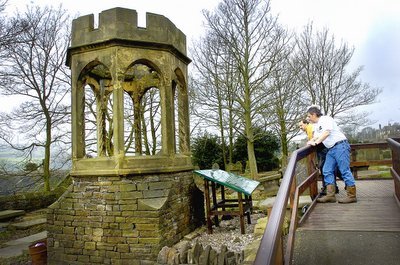
This year we are celebrating 400 years of St. James Church in Thornton. In the grounds (and graveyard) opposite the modern day St. James Church on Thornton Road in Thornton, you will discover the remains of a building with interesting architecture and a very interesting history.
Before 1612 the building was known as ‘Saint Leonards’. For those who enjoy their historical facts, this was at the time when King James was on the throne and a year earlier, in 1611, the King James bible was first published.
After this date the name changed to ‘Saint James’. No one knows the reason for the name change. All we do know, is that a group of local people, including Precilla Bannister and the local freemasons, with the Lord of the Manor, rebuilt the existing chapel and changed the name to St James.
In more recent times we have come to affectionately know the building as ‘Bell Chapel’ or ‘Brontë Bell Chapel’. ‘Brontë Bell Chapel’ is a reference to one of the most recognised times in the Chapel’s history. The Brontë’s were the most famous people baptised in the chapel and Patrick Brontë preached there from 1815 -1820. Thornton village is also the birthplace of the these famous literary figures.
Restoration of the graveyard and the Brontë Bell Chapel began in 2000.
Gradually, like minded people who had an interest in both the history of the Chapel and in the potential of the whole graveyard area for people to enjoy in the future began to find each other. These people had skills in (or were willing to try) gardening, woodwork, landscaping and general labouring.
As numbers grew, the Old Bell Chapel Action group was formed.
We are proud of our achievements in making Brontë Bell Chapel and surrounding graveyard a place where people can now visit to enjoy it’s history, beauty and nature. We have also erected an information board for visitors and created a wilderness corner, recycling bay and bird nesting project. We continue to meet regularly to continue to maintain the grounds.
And they have a new project:
We are in the process of writing a publication to celebrate 400 years. It will combine historical information and prints, with a selection of art work and photography.
Could you help us to fund our publication?
If so, Steve, our Group Coordinator, would love to hear from you.

Friday, December 07, 2007

Friday, December 07, 2007 10:46 am by M. in ,    No comments
As you know, see our sidebar, BrontëBlog has an ongoing campaign to give George Smith a blue plaque in the building where he published Charlotte Brontë's works. So far, the campaign is going well and hopefully the building will display a shining blue plaque eventually (check here for updates).

The Telegraph & Argus asks their readers for possible places to mark with a Blue Plaque in the Bradford area. And The Old Bell Chapel in Thornton is one of the proposed ones:
One of the first responses to the appeal came from Steve Stanworth, who put forward the Old Bell Chapel, at Thornton.
Mr Stanworth, site co-ordinator for the Old Bell Chapel Action Group, said: "This is the place where Patrick Bronte was minister from 1815 to 1820 before moving to Haworth.
"Four of the Bronte children were christened in the chapel after being born in the Bronte house on Market Street, in Thornton.
"Members of the Old Bell Chapel Action group have been clearing the grounds for the last six years ,and we are now reaping the benefits of this with more and more visitors to the site.
"I think this is an important part of Bradford's heritage and as such deserves consideration for a blue plaque." (Will Kilner)
More information about the Old Bell Chapel Action Group activities, here.

Categories: ,

Tuesday, August 22, 2006

Tuesday, August 22, 2006 6:33 pm by Cristina   4 comments
Old Bell Chapel, the place where Patrick Brontë used to preach in Thornton, has been undergoing repairs for four years, as this article reports. Sadly, the Bradford Council is failing to keep its commitment to the place while the volunteers are wondering whether their work has been in vain.

Volunteers working to preserve links between a village and the Bronte family have criticised Bradford Council for failing to carry out vital work - more than a year-and-a-half after it was requested.
An action group spent four years restoring the grounds of the Old Bell Chapel, in Thornton, Bradford, where Patrick Bronte preached before moving to the parsonage in Haworth.

Volunteers have cleared the overgrown site, repaired graves and headstones, installed lights and an information board and built a footpath to the historic chapel. They are now waiting for Bradford Council to complete the job and build a footpath and install drains on adjacent Thornton Road.
Site co-ordinator Steve Stanworth sai
d installing drains was vital in order to protect the future of the site - which is quickly becoming a magnet for Bronte fans from around the world.
"In February last year I contacted the Highways Department to tell them of the need for a drain and a footpath," he said. "I was told the work would be completed by
the end of that financial year. "
More than a year-and-a-half later we are still waiting. If this work is not carried out all the effort we have put in over four years will be in vain.
"
Many headstones have fallen over because of the wet conditions in the cemetery caused, in part, by lack of a drain. This is an important site that needs this work doing.
"We spent around £10,000 putting in a path and sandstone worth around £1,000 has already been washed away."
A Bradford Council spokesman said they hoped to do the work later this year. (...)
Patrick Bronte preached at th
e chapel from 1815 to 1820 and Charlotte, Branwell, Emily and Anne were all born at the parsonage on Market Street.
New volunteers are welcome to join the action group which meets each Saturday at the adjacent St James's church hall from 10am to noon.

We visited the place a few years ago and still found it a bit creepy because of the overgrown weeds and a certain monument on top of a tombstone. Nevertheless, it's an intersting trip as well as a nice little village. We truly hope the Bradford Council will be as good as their word and really start working on it before the end of the year. It should also be fun to join in as a volunteer - it should create a different kind of bond to the Brontë family :) Good luck!


Pictures: On the left, the Old Bell Chapel, today ( source); on the right: the Old Bell Chapel in 2004 (courtesy of BrontëBlog ;))

In similar - only much more agreeable - news: we recently reported the succesful story of Imelda Marsden's efforts to save Thornbush Farm. Today, though more tangently, we have heard of another house being given a grade II from English Heritage. According to the BBC News, Elizabeth Gaskell's house on 84 Plymouth Grove in Manchester, where Charlotte Brontë and other literary figures of the time such as Charles Dickens and William Makepeace Thackeray stayed, is starting its way to finally being the literary shrine it should have always been.

The Grade II-listed building, built in the 1830s, is described by heritage groups as second only in importance to the Bronte Parsonage at Haworth in Yorkshire.

It is also one of the few surviving buildings of its type in Manchester.

The property is owned by the Manchester Historic Buildings Trust, which is trying to save and restore it.

If you remember, last March the Lottery Fund and other sources donated over a million pounds to start the repairs, and English Heritage promised funding to come. Here it is, we suppose! It's always such great news to hear of a historic building being saved, especially if it's Brontë-related.

Categories: , ,,

Wednesday, June 05, 2013

Once again, Thornton is in the news for overlooking/neglecting its Brontë connections. As reported in The Telegraph and Argus (including a video):
Bradford Council has come under fire for leaving the grass to grow out of control to knee-deep level at a historic cemetery with Brontë links.
Church warden Steven Stanworth said the Council had neglected its duties in relation to the Old Bell Chapel, also known as the Brontë Bell Chapel, opposite St James’s Church on Thornton Road, Thornton, by leaving the grass to grow so long.
Mr Stanworth, also the chairman of The Brontë Birthplace Trust, said that cutbacks were being blamed, but said the problem had left him having to help people trace their ancestors headstones by trekking through extra-long grass and showing people around was becoming embarrassing.
It is a further blow to the church after thieves desecrated it by uprooting and stealing three ancient headstones which have been there for the last 200 years last October.
Mr Stanworth said: “They have cut it twice this year and I have been told that it will be cut on a three week cycle at best because resources have been cut.
“It is just not good enough. The Council said if it is raining on that day, it could be six weeks before it is cut.
“Last year they cut it every two weeks and I cut my own grass twice a week.
“It is ridiculous, the cemetery looks unkempt. It affects the work we are doing trying to keep the graves tidy so people can visit.
“People are wading in knee deep grass and it looks unsafe and untidy.
“We are trying to make it a tourist destination as the Brontë birthplace which we want to promote.
“I had someone from London visiting on Sunday and they had to walk through the long grass and it is just not on. [...]
“I am appalled and disgusted because it is supposed to be part of Thornton in Bloom.”
On the Old Bell Chapel issue, Phil Barker, Bradford Council’s assistant director for sport and leisure, said: “We have explained the situation fully to the Bell Chapel volunteers that for the past three years the frequency of cuts is ten times per year across the majority of our cemeteries and parks, which is approximately every three weeks, subject to weather.
“We are due to cut the grass in the cemetery again at the Bell Chapel this week.” (Dolores Cowburn)
Someone should try and explain to the councillors how tourism works, its consequences, etc. It looks like they don't really understand the concept.

The Guardian has a short piece in praise of the new children's laureate Malorie Blackman.
In her youth, Malorie Blackman devoured authors like Agatha Christie, Charlotte Brontë and Daphne du Maurier.
Writer Sofia Samatar also speaks about her reading foundations in Locus Magazine:
 I also read the Brontë sisters, and I read Dracula for the first time when I was in Sudan. 
The Millions has two authors recall their Spelling Bee years:
Jenna Le: [...] At age 9, [...] I preferred to immerse myself in the dark world of Charlotte Brontë novels, reading those heartrendingly romantic dialogues again and again until my lacrimal glands spilled over. [...]
Laura Goode: [...] Unlike you, books were my only siblings, but like you, I loved Gothic novels; Jane Eyre, that lost and lonely only child, has saved my life once or twice. For me, the bees were entirely involved with my obsession with reading — I drilled on the word lists some, but halfheartedly, and I think whatever spelling talent I had was just derived from reading and reading and collecting all the new words I could find. As a combined result of books and bees, there’s a lot of words I knew how to define and spell without having any idea how to pronounce them, and in that way, I think the bees quite literally helped me to find my voice.
Writers Veronica Roth and Leigh Bardugo broach the subject of Jane Eyre and Bertha Mason in an inteview on Entertainment Weekly's Shelf Life.
Both Alina and Tris are strong, brave characters. They’re characters that girls admire. What other heroines found in literature have you admired?L: I’m so tempted to be like, “Bertha Rochester because she burns it all down!” Most of the female characters I admire come from science fiction and fantasy, maybe because there’s more permission to shake up gender roles in genre. Alanna is a favorite, definitely Hermione. And I really adore Brienne of Tarth. She’s sometimes presented as naive or almost dogmatic in her worldview, but I love her conviction.
V: Hermione! Yes! She is a wonderful character, and I love that JK Rowling made a nerdy book-loving girl into a Gryffindor. It’s funny you should mention Bertha Rochester, Leigh, because one of my other favorites is Jane Eyre. She has some pretty strong convictions, too, and is willing to leave the man she loves in order to stand by them, which I think is amazing. More recently I’ve loved some complicated, “unlikable” characters in particular — Sam from Before I Fall, Ruby from Imaginary Girls. (Stephan Lee)
Coincidentally, L'Arena (Italy) recommends Wide Sargasso Sea by Jean Rhys.
Al di là della trama, il romanzo è attraversato da messaggi subliminali che ci parlano di fragilità e di autodistruzione, proprie, purtroppo, all'autrice stessa che sa mantenere, nella scrittura, un ritmo tutto suo che allude senza tutto svelare, creando il fascino di un'allucinata realtà sospesa. (Grazia Giordani) (Translation)
La ventana (Cuba) interviews poet Juan Gelman:
Como uno de los temas centrales es la muerte y las pérdidas, el dolor en sí mismo es una desmesura difícil de abordar y para expresarlo quizá sea necesaria la condensación, ¿no? ―Sí, pero creo que sobre todo es la cuestión del mal sufrido, en el sentido de que es algo que supera la capacidad de reflexión porque entrás en terrenos absolutamente desconocidos y nunca tenés la seguridad de si entraste en ellos o qué. Este es más o menos el asunto. Yo estuve recientemente en Cracovia, ahí participé de una mesa redonda sobre el Mal, experiencia y literatura. Después de analizar cómo lo había encarado Víctor Hugo en ese larguísimo poema de 5400 versos que se llama El fin de Satán ―y que se publicó después de su muerte―, y cómo lo encaró William Blake de un modo completamente distinto, me pregunté cómo era posible que Emily Brontë, a la que no se le conoce ninguna pasión, salvo la preocupación por su hermano borracho y drogadicto, una mujer absolutamente austera que murió a los 30 años en la mesa familiar, conversando, cómo ella podía describir en Cumbres borrascosas, de una manera tan profunda y aguda, el Mal en el amor.
»Luego mencioné los casos clásicos: (Alexander) Solzhenitsyn sobre el gulag y a Primo Levi sobre el campo de concentración nazi. Siempre me da la impresión de que hay algo no dicho ahí. La dimensión del Mal es de tal naturaleza que hay cosas que no se alcanzan a decir. Lo curioso es que personas que no han sufrido el Mal hayan sido capaces de escribir sobre el Mal con tanta profundidad, como Emily Brontë. (Silvina Friera) (Translation)
Nina Camp tells in The Huffington Post how
During that time of the month, a hard boiled egg smells like death to me, and I want to climb into that closed-compartment bed in Wuthering Heights and sleep for 200 hours. 
The Rhein-Zeitung (Germany) finds echoes of Wuthering Heights in the play Am Katzenmoor:
Was sie denn auch tun: Marina Carrs "Am Katzenmoor" präsentiert sich unter der Regie von Ingo Berk als ungeheuer intensives Gothic-Drama mit gefühlvollem Medea-Kern, das in seiner bedrückenden Atmosphäre an Emily Brontës "Wuthering Hights" [sic] erinnert. (Thomas Koelsch) (Translation)
The Princeton University news reveals that one of the 'Four faculty members recognized for outstanding teaching' is Deborah Nord, professor of English:
Students described Nord in many ways, including: "great," "amazing," "great lecturer, masterful seminar leader," "dedicated and impassioned educator," and "one of the most gifted teachers I've encountered at the University." An undergraduate who took her course "Austen, Brontë, Eliot" said it was "one of the most intellectually stimulating and engaging seminars I took during my time at Princeton because of Professor Nord's superb teaching. (Karin Dienst)
Side2 (Norway) features Susanne Abbuehl. The Misfortune of Knowing discusses Lucy Snowe's name.

Finally, the Brontë Society is looking for two interns and an arts officer (maternity cover). Find out more about it here.

Thursday, September 10, 2015

Thursday, September 10, 2015 8:31 am by Cristina in , , , , ,    No comments
First of all - and excuse us for being a little self-centered - have you seen that BrontëBlog is ten years old today? I's quite a milestone if we say so ourselves!

Of course today is also the first day of the first ever Thornton Brontë Festival and The Telegraph and Argus has an article on it.
A festival to mark 200 years since the Brontë family arrived in Bradford opens to the public in Thornton today.
The centrepiece of the event is a new exhibition at St James Church in Thornton Road, with a collection of Brontë artefacts on display for the first time.
The items on show include christening certificates for Charlotte, Branwell, Emily, and Anne Brontë, the font in which they were all baptised, and a wash stand and desk used by their minister father, Patrick.
A permanent display of the family's life, with words by former TV presenter and lifelong Brontë fan Christa Ackroyd, will also be housed in the church.
The exhibition tells the story of how in 1815, the family arrived in Thornton and took up residence in the old parsonage on Market Street.
New minister Patrick Brontë was accompanied by his Cornish-born wife Maria, and their two small daughters, Maria and Elizabeth, both born at the family's previous parish at Hartshead.
It was while they were living there that the family's four famous children were born in quick succession, Charlotte in 1816, Branwell in 1817, Emily in 1818, and Anne in 1820.
All four were baptised at their father’s church, the Old Bell Chapel, which now lies in ruins across from the parish church of St James. [...]
Church warden Steven Stanworth said: "When Patrick left the now ruined Old Bell Chapel in 1820, plans were already afoot for a new more impressive church on the land opposite gifted by John Foster of the famous Black Dyke Mills.
"By the time the new church was completed it was always planned that a permanent exhibition to the famous family would go on display.
"Now for the first time, the trustees have their wish.
"The time in Thornton was described by Patrick Brontë as his happiest years, the time when his family was complete, his ministry well-established, and when he had such hope the the future.
"The sadness that followed in Haworth is well documented, but this is an exhibition of joy and hope.
"Patrick's passion was education for all, and we hope schools from Bradford and beyond will bring children to St James' to learn about the famous family and their links with Thornton, so often forgotten by Brontë biographers, as well as all Brontë and Bradford fans.
"We are hoping this first Thornton Brontë festival will be the catalyst for five years of celebrations."
Miss Ackroyd added: "As a Bradfordian I am proud to reaffirm the Brontë's association with Thornton.
"This exhibition is now a lasting memorial to it's most famous residents, whose words and deeds in praise of equality of class, race, and gender still resonate today.
"The Thornton days were Patrick's happiest time.
"To be able to help in bringing together some never-seen-before documents and artefacts to celebrate his time here is both inspiring and humbling.
"I am proud to share in his legacy and that of his incredible daughters."
As part of the festival, which runs until Sunday, Miss Ackroyd will give a talk on Patrick Brontë entitled 'Father of Genius' at St James' Church on Saturday night.
Other events over the four days include film screenings of 'Jane Eyre' and 'Wuthering Heights', a performance by the Clifton and Lightcliffe Brass Band, arts and craft activities, and family fun days.
For more details and a full festival programme, visit www.james4u.org.
Meanwhile, Dutch author Jolien Janzing will introduce her new novel 'Charlotte Brontë's Secret Love' at the Brontë Society's Literary Luncheon on October 3.
The book, which is published on October 1, is said to be based on true events of a forgotten chapter in Charlotte’s life detailing her secret love affair with the man who would inspire her to write 'The Professor', 'Villette', and 'Jane Eyre'.
The event takes place in The Brontë Room at Hollins Hall Marriott Hotel and Country Club in Baildon. For further information, visit bronte.org.uk. (Rob Lowson)
Still locally, just when we thought we had got rid of the wind farm, this turns up. As reported by Keighley News.
Plans to install a second wind turbine at a quarry overlooking the Worth Valley are being strongly opposed by the Brontë Society.
The organisation has objected to the application for the turbine at Naylor's Hill Quarry, which was submitted by Gillson & Co (Haworth) Limited.
Alexandra Lesley, chairman of The Brontë Society Council, said: "It's extraordinary that the supporting data for this proposed wind turbine – particularly the landscape visual aspect assessment – takes no heed of the special character of Haworth village or its surrounding moorland."
The plans being considered by Bradford Council are for a structure which would be 48-metres high from its base to the tip of the turbine blades.
Gillson & Co argues that the additional turbine will generate renewable energy for the National Grid and help meet the Government's renewable energy targets.
It has also pointed out that the device would not be visible from the area around the Brontë Parsonage, Haworth Parish Church or the top end of Haworth Main Street near the Black Bull pub.
Members of the public have already submitted their responses to the application online, with one commenting: "Ultimately I would much rather a turbine than a power station and so I would welcome a second turbine at the site."
But Ms Lesley said: "If the proposed turbine joins the one already dominating the land high above Haworth, this will damage further the conservation of this unique village." (Miran Rahman)
It's back-to-school time and The Guardian lists the top 10 schoolchildren in fiction.
6. Jane Eyre in Jane Eyre by Charlotte Brontë
“Send me to school soon, Mrs Reed, for I hate to live here.” This is said in defiance, because the plan is already in train. Jane is admirably direct. She is packed off to Lowood Institution for orphans. The long, mysterious journey to reach the place, the setting in a forest dell, a “fog-bed of pestilence”, Mr Brocklehurst, the evil benefactor, Miss Temple the good headmistress – these are fairytale ingredients, but Jane is her own person, alive and spontaneous. Her experience and witness of cruelty is sharp. Who could forget the episode when, having accidentally broken a slate, she is made to stand on a stool, while Brocklehurst publically humiliates her? Jane feels every sting but is not crushed. (Janet Davey)
The Spectator reviews the book Weatherland: Writers & Artists Under English Skies by Alexandra Harris:
Charlotte Brontë, who found, as she put it, ‘no fresh air in Jane Austen’, did not look hard enough. Austen’s plots, Harris reminds us, all hinge on weather. Jane Bennet catches cold on a damp day; Elizabeth wears a mud-splattered dress; Marianne Dashwood slips on the wet grass and twists her ankle; Catherine Morland yearns for a stormy night. It is Brontë, Harris notes, who keeps her heroines indoors. ‘There was no possibility of taking a walk today,’ begins Jane Eyre, and so Jane curls up with a copy of Bewick’s birds. (Frances Wilson)
We rather hope that this is some sort of 'joke' and not an actual argument uttered in the book.

Naples News' Marco Eagle reviews the novel The Hired Girl by Laura Amy Schlitz:
How could you not, when this novel is led by a sassy, independent character reminiscent of every classic literary heroine you’ve ever loved? Yes, that’s what author Laura Amy Schlitz brings to these pages in the form of a young girl’s diary and vivid settings that will remind you of Brontë and Dickinson works. (Terri Schlichenmeyer)
Bustle lists '13 Experiences Only Book-Lovers Have While Dating':
Some Of Your Dates Turn Into Just A Long Listing Of Books
If you’re lucky enough to find another book-lover, you both basically just end up listing your favorite million books and authors back and forth to each other. “What about Vonnegut?” “Oh, me, too!” “Any thoughts on the Brontës?” “You haven’t read any Junot Díaz?!” And then you walk away with 500-plus books added to your already overflowing TBR pile. (Crystal Paul)
Love, dates and relationships are also the subject of this opinion column in the Philippine Daily Enquirer:
I want a “how we met” tale worthy of being storied, a relationship that Joaquin, Austen, or Brontë would have found worthwhile to write about. (Tinderella)
Several sites such as The Hayride or The Christian Science Monitor are commenting on the use of pseudonyms because of the story of - as The Hayride puts it - 'White Guy Writes Lousy Poetry, Is Rejected For Publication; Submits Same Poetry As Chinese Guy, Is Lauded And Awarded'.

Vacancies at the Brontë Parsonage Museum, whose Facebook page also confirms that there will also be a Brontë Festival of Women's Writing next year. Megalopolis is re-reading Jane Eyre.

Tuesday, October 23, 2012

Tuesday, October 23, 2012 8:42 am by Cristina in , , , ,    No comments
The Yorkshire Post reports a 'despicable theft' that has taken place at the Old Bell Chapel in Thornton:
Police are continuing to patrol an historic graveyard closely linked to the Brontë family after thieves desecrated it, stealing three ancient headstones which have been there for the past 200 years.
The damage at the Old Bell Chapel, also known as the Brontë Bell Chapel, opposite St James Church on Thornton Road, Bradford, was discovered over the weekend with police branding the theft “despicable”.
Up to 30 metres of Yorkshire stone was also stolen from a pathway in the graveyard next to the chapel where Patrick Brontë was minister between 1815 and 1820 before moving to nearby Haworth.
Officers patrolled the chapel on Saturday night after fears were raised the thieves would return for more stone slabs they had already removed and stacked up in the cemetery.
And last night, West Yorkshire Police said its officers would continue to pay special 
attention to the site during regular patrols.
Ann Dinsdale, acting director of the Brontë Society, condemned the thefts and said numerous sites connected to the family have been targeted in recent years, including Haworth Church which has had lead stripped from its roof.
“People need to be really vigilant, because when it is gone, it is gone,” she told the Yorkshire Post. “I just don’t know how you go about educating people that this is part of their heritage they are destroying.”
The Telegraph and Argus covers the story as well:
It has led to condemnation by councillors responsible for the district’s heritage, who described it as “sickening” and blasted the vandals who are “throwing away hundreds of years of history”. [...]
The damage was discovered on Saturday morning by church warden Steven Stanworth, who said he was left sickened. He now faces the task of trying to find out who the headstones belonged to and contacting family members with the harrowing news.
The stones were taken between 9pm on Friday and 8am on Saturday.
“It is absolutely disgraceful and disgusting,” he said. “One of the headstones was next to the grave of author Joseph Lister, who was a friend of Lord Fairfax’s and was involved in the Siege of Bradford in 1642.
“It is a graveyard. We have had vandalism before but nothing like this. We have no chance of recovering it and how do you put a price on something like that which is 200 years old?
“A historic part of the ground has been taken and desecrated and they must be sick to do this.
“There is no respect for life or death. This is part of our social history they have no idea what they are doing and must be morons.”
Mr Stanworth believes taking the stones would need four men, adding that a jemmy had been left at the site.
On Thursday night in between the church and the chapel, Mr Stanworth said that 30 metres of Yorkshire stone were taken from the Brontë Way and stone has also gone from the chapel wall.
“I need to raise awareness with the people living around here, because we can’t allow this to happen,” he added. [...]
Councillor Val Slater, Heritage Champion for Bradford Council, said it was terrible news, while Coun Susan Hinchcliffe, the portfolio holder for tourism, said: “Incidents like this are sickening.
“The Old Bell Chapel has a strong significance to the Brontë story, a major tourist draw for the Bradford district. For minimal short term gain, people who commit these crimes throw away hundreds of years of history.” (Dolores Cowburn)
Onto another Church as John Huxley, on Twitter, reports that,
End in sight for Haworth Church roof repair 1st stage. Now for the 2nd stage fund raising!
Click here to see a picture of the work in progress.

Still locally, and on a lighter note, The Telegraph and Argus has received a (humorous) letter from a reader concerning the 'al fresco love' supposedly going on at a car park on the moors in Haworth.
SIR – When I was young, Shipley Glen was a magnet for fans of ‘alfresco love’, now a national newspaper claims that lust-crazed couples are invading the moors around the Parish of Haworth (T&A, October 9).
Police said they had received no reports of the activity in the area, nor had any councillor.
Haworth Parish Council chairman John Huxley said it looks like a figment of somebody’s imagination, but I believe these goings on were known to all and sundry in 1847 when Emily Brontë wrote her single novel Wuthering Heights, an intense and powerful tale of love. And who knows, parts of this acclaimed work could be empirical.
D Rhodes, Croscombe Walk, Bradford
Back to the latest adaptation of Wuthering Heights, Word and Film discusses skin colour and films.
And while color-blind casting in Hollywood, or filling a role irrespective of an actor’s ethnicity as in David Thomson’s example of Morgan Freeman as the white Iago or the dark-skinned Othello might have some catching up to do with Broadway, this year is one of strides from Idris Elba playing a Norse God in Thor to Andrea Arnold casting an unknown, twenty-year-old black actor as the “dark-skinned gypsy” Heathcliff in her adaptation of “Wuthering Heights.” (Tony Phillips)
A columnist from The Gulf Today acknowledges the fact that books make and change you.
I am not into poems, yet the biggest influence on my humdrum life has been some lines from Shelley, Whitman and Iqbal. Again, I would have been a different guy if I had not read Wuthering Heights, Tess of the D’urbervilles, Crime and Punishment and The Cherry Orchard.
Camus and Kafka see us like we should be, the above see us the way we are. And that works for me. (Shaadaab S Bakht)
Writer Susan Isaacs briefly discusses Jane Eyre on Salon:
It’s not all Jane Eyre out there. In her sweet, honorable, slightly passive-aggressive way, Jane was as perfect as a protagonist can get while remaining interesting; in fact, she’s one of my favorites. But most characters are more morally ambiguous. And some are just plain bad – somewhere between nasty and bad to the bone.
The Phoenix Events Examiner wonders what people are reading in October, which is National Book Month.
My favorite books as a child were "Nina Grant Pediatric Nurse" by Patti Stone, "Jane Eyre" by Charlotte Brontë, and "The Blue-nosed Witch" by Margaret Emery, even when it wasn't Halloween season. (S. Renee Greene)
And in El País (Spain) Fernando Savater makes a point of the fact that all literature written by women is not always 'just' women's literature.
La buena literatura no tiene sexo, ni siquiera género, pero cuando la escribe una mujer siempre será bautizada como literatura femenina. Y se le asignarán rasgos idiosincrásicos que la cargan de un punto exótico, como si llegase desde un continente casi inexplorado. Pero ¿son acaso las buenas escritoras indígenas de un continente desconocido por los varones, lleno de zonas en blanco en las que solo pone “aquí hay leones”? Así parece haber sido, desde Madame de Lafayette y Jane Austen, pasando por las Brontë, George Sand o la maravillosa Emily Dickinson, hasta comienzos del siglo XX. Pero entonces llegó Virginia Woolf, seguida luego por Simone de Beauvoir, y el espectro en camisón de lo femenino en literatura se convirtió en una antigualla más bien risible, como el fantasma de Canterville. Creer que esa denominación nos ayudará a entender mejor las obras de Silvina Ocampo y Marguerite Yourcenar, o las de Agatha Christie, J.K. Rowling o Fred Vargas, suena ahora un punto ridículo y hasta absurdo. (Translation)
L'Esprit Vagabond writes in French about Anne Brontë ad her last days at Scarborough. Zielono w głowie... reviews Shirley in Polish. Namefreak! posts about Juliet Gael's Romancing Miss Brontë and Marikas bokdagbok (in Swedish) writes about Rachel Ferguson's The Brontës Went to Woolworths. The Sequined World recommends Jane Eyre 2011.

Saturday, March 15, 2025

Saturday, March 15, 2025 12:30 am by Cristina   No comments
An alert for tomorrow, March 16, in Thornton:
Sun 16 Mar, 4:00pm
St James Church, 300 Thornton Road, BD13 3AB
Price £8

Celebrate the anniversary of Patrick Brontë’s birth (Saint Patrick’s Day, 17 March 1777) with a guided tour of the Bell Chapel in Thornton at which he preached for five years and in which the Brontë children were all baptised. 

Learn more about Patrick Brontë’s work and life in Thornton with local historian and guide Steven Stanworth, churchwarden at St James Church for ten years. Steven formed the Old Bell Chapel Action Group in 1999 – twenty-five years on, Steven is still working with them and is now actively involved with the restoration of the Brontë Birthplace as well. 

Steven also helped to design and build the Brontë exhibition inside St James Church, which you’ll get to see as part of the tour.

(Proceeds from tickets will be divided with The Old Bell Chapel Action Group.)

Friday, November 21, 2025

The Telegraph and Argus features the new book The Birthplace of Dreams by Mark Davis and Steven Stanworth.
Now the Brontës’ Thornton legacy is explored in a new book, launched today, highlighting their lives in the village and the impact it had on the family.
The Birthplace of Dreams is written by Bradford photographer and historian Mark Davis and Steven Stanworth, who has spent more than 25 years looking after Thornton’s old Bell Chapel and is a founder member and former vice chair of the group that purchased and restored the Market Street property.
Illustrated with vibrant photographs, by Mark Davis, of the house and surroundings, and paintings of the Brontës by John Ellis, this fascinating book delves into aspects of the family’s story that we don’t normally hear about.
Says Mark Davis: “There has already been so much written about the family. There are so many interpretations, of their work and personalities. But there seemed to be something missing. It’s surprising how many people hold the common misconception that Haworth, with its quaint cobbles and pretty views, is the one stop Brontë location and that Haworth Parsonage holds their literary lives, from cradle to grave.
“The Birthplace of Dreams was borne out of us wanting to break that myth. Our little book, we believe, is unique in that the focus rests on the very place where the literary giants known today across the globe, Charlotte, Emily and Anne, first breathed in Yorkshire air in the front parlour of the humble little house on Market Street. Although the family only spent five years in Thornton, they were incredibly important years. Patrick in later life would refer to his years there as being his ‘happiest time’.”
From Patrick’s birth in Emdale, County Down, the first of 10 children in a poor rural family, to his death aged 84, surviving all six of his children, the book traces his journey to Cambridge, where he was a prize-winning student, and beyond, to curate positions around the country. From Essex and Shropshire he came to Yorkshire, arriving in Dewsbury aged 32 to be curate of All Saints Church, now the Minster. He moved on to Hartshead in the Spen Valley, where Luddites were attacking wagons delivering machinery to mills, then to Thornton.
Along the way the book takes us to places such as Woodhouse Grove, the Apperley Bridge school where Patrick visited his friend, the headmaster, whose housekeeper was Maria Branwell - the young woman who became Patrick’s wife - St Oswald’s Church in Guiseley, where the couple got married, and their home in Hightown near Hartshead.
The book pays tribute to significant figures in the family’s lives, not least Nancy De Garrs, who was 13 when the Brontës employed her as the children’s nanny in Thornton and had outlived them all by the time of her death, age 82, in Bradford Workhouse. And Tabitha Aykroyd, the family’s housekeeper at Haworth and the inspiration for Nelly Dean in Wuthering Heights and Martha, a servant in Charlotte’s novel Shirley.
The book highlights life in Thornton when Patrick was perpetual curate at the Bell Chapel, and residents who became friends, including Elizabeth Firth of Kipping House who was godmother to Patrick and Maria’s daughters Elizabeth and Anne.
“The social life the family enjoyed at Thornton was in stark contrast to life at Hartshead Moor, dominated by the Luddite movement,” says Mark. “The family met Elizabeth Firth and her father within days of arriving and a warm friendship blossomed. Elizabeth invited the family to dinner regularly at Kipping House. Such was the relationship between the families that Patrick, looking for a new wife and stepmother for his six motherless children, asked Elizabeth for her hand in marriage, of which she refused.”
Elizabeth’s diary provides a glimpse of the relationship between the families. “The entries were no more than bullet points but show a mutual support structure in place throughout the Brontës’ time in Thornton. When Elizabeth died it was the money she left Anne that financed her last tragic trip to Scarborough.”
Adds Mark: “It’s interesting to see how the family’s life in Thornton overlapped to Haworth. Through the book, we take in Haworth, the sisters’ education, achievements and deaths. We return to Thornton to explore the birthplace history and evolution to the present.
“The Birthplace of Dreams is so much more than just another Brontë book. We bring 72-74 Market Street out of the shadows. The house, where three seemingly ordinary girls were born; three girls who dared to dream and would take on a male dominated 19th century literary world and whose names continue to inspire people to dream.” (Emma Clayton)
The authors of the book, Mark Davis and Steven Stanworth, have penned an article for The Yorkshire Post.
Even though the very last member of the Brontë family died in 1861, when Patrick passed away in early June of that year, the good reverend having witnessed his wife and all of his children being laid to rest in the family vault below the flagstones in St Michael and All Angels’ Church before him, the Brontë legacy lives and breathes on.
The story is by no way finished, pray, it’s still in its infancy, given the literary genius of the Brontë sisters and the worldwide interest by young and old alike in both them and their ill-fated yet well-meaning brother Branwell.
There has already been so much written about the family since their deaths and that will continue, long after we are all but dust.
There are so many interpretations, both of their work and personalities. But yet, there always seemed to be something missing.
It is surprising just how many people hold the common misconception that the picturesque, rugged moorland village of Haworth with its quaint cobbles and pretty views, as the one-stop Brontë location and believe that Haworth Parsonage holds their literary lives completely, from the cradle to the grave.
Our new title, the Birthplace of Dreams, was borne out of us wanting to break that myth, our little book, filled to capacity, we believe is unique, in that the focus rests on the very place that saw the literary giants known today across the globe, Charlotte, Emily and Anne Brontë, first breathed in Yorkshire air as their divine literary spark entered the world, in front of the fireplace in the front parlour of the humble little house that is the former parsonage on Market Street, Thornton.
Although the Brontë family only spent five years in Thornton, they were incredibly important years. Patrick in later life would refer to his years there as being “his happiest time”.
Given the tragedy that followed just a year after the family left the village in 1820, it is a statement, no one could ever dispute.
The genteel social life the family enjoyed at Thornton was in stark contrast to the previous harsher life at Hartshead Moor, which was dominated then by the revolutionary Luddite movement.
The family met the young Elizabeth Firth, and her father within days of arriving in Thornton, after which a warm friendship blossomed.
Elizabeth was to become godmother to Elizabeth and Anne and invite the Brontë family to dinner regularly at Kipping House, her comfortable family residence she shared with her father, close by on Lower Kipping Lane.
Such was the relationship between the Brontë and Firth family, that Patrick, looking for a new wife and stepmother for his six motherless children after the tragic premature death of his wife Maria, felt comfortable enough to ask Elizabeth for her hand in marriage, of which she refused.
In 1815, the year in which the families first met, Elizabeth, who 17 years Patrick’s junior, was mourning the death of her mother the previous year and like her father a committed churchgoer.
We know much more about the inter-family relationship between the Brontës and Firths, than we would normally expect because Elizabeth kept a basic diary.
The entries were in essence no more than bullet points; however, they show a consistent mutual support structure in place throughout the time the Brontës were in Thornton.
When Elizabeth, died in 1837, it was the money she had left Anne, that financed her last tragic trip to Scarborough.
It is interesting to see how the family’s lives in Thornton, overlapped to nearby Haworth, certainly for the first few years in any event.
Through the pages of the book, we of course take in Haworth, the sister’s education, achievements and sadly their premature, in today’s terms, deaths.
Towards the end we return to Thornton to explore the birthplace history and evolution up to the present day in 2025.
The Birthplace of Dreams is so much more than just another Brontë book, through its written content, of which is enhanced by the inclusion of striking colour images, we bring the mostly unknown 72-74 Market Street, out of the shadows in literary form.
The very house, where three seemingly ordinary girls were born, three girls who dared to dream, who dared to reach for excellence beyond their wildest dreams and surpassed them all.
Three girls who would take on a male-dominated 19th century literary world and whose names two hundred years after they were born would continue to inspire people to dream beyond all their expectations.
Haworth may justifiably lay claim to the Brontë sister’s literary success, having penned some of the most groundbreaking novels in the history of English literature there, however there is no changing the fact that their first spark of life, quite rightly belongs to Thornton.
In the inspirational composed and written words of Queen Camilla, “Be More Brontë.”
The Washington Post's list of '50 notable works of nonfiction from 2025' includes
‘The Invention of Charlotte Brontë: A New Life’ by Graham Watson
Who was the author of “Jane Eyre”? Charlotte Brontë kept much to herself, and after her death at age 38, her story was muddied by a biography written by her friend Elizabeth Gaskell. Literary historian Watson examines Brontë’s letters to create a clear-eyed portrait of the beloved 19th-century novelist.
The Boar has an article about Wuthering Heights.
It’s safe to say that upon opening my copy of Wuthering Heights, I had high expectations. It is impossible not to have expectations of one of the most famous romance novels of all time.
Even before reading the novel, I knew that the name ‘Heathcliff’ is commonly circulated as a representative of the brooding romantic interest. However, I found him to be a less likeable character than I expected. Throughout the novel, my feelings surrounding Heathcliff oscillated between pity, bafflement, and dislike. His character is as complex and disturbed as Shakespeare’s Hamlet. And there are similarities between the two – they are both haunted by loved ones and both suffer from dysfunctional family situations.
Heathcliff comes to be viewed by the narrator, Ellen Dean, as a black tide that threatens to sweep away the building blocks that Wuthering Heights is built on. He’s always on the fringes of the Earnshaw family, symbolised by his lack of adoption of the name ‘Earnshaw’. He grew up with Catherine, but he is never quite her sibling. Similarly, he loved Catherine but was never quite her husband. Heathcliff’s story is filled with tantalising almosts that serve to torture the readers as well as himself.
The entire novel feels real and yet not; incestuous undertones combined with the isolated characters create a disturbed dreamscape where nothing is ever quite right. Wuthering Heights is an isolated bubble that no other part of the world can touch. Indeed, their world is so separate that Cathy Linton at one stage asks Ellen Dean what lies beyond the hills, having no knowledge of the world beyond, like Rapunzel in her tower. They operate as a society within themselves, but both as a group and individually, they never find a way to operate in a way that makes complete sense. For example, Heathcliff’s normal order of life and death is flipped completely – whilst alive, he continuously suffers as though in hell, and it is only when his mortal life ends that he can reach self-actualisation by haunting the moors immortally with Catherine by his side.
What makes the reader more uneasy is that they are completely reliant on a first-person perspective, which is usually more unreliable than the third person, since they are much closer to the story. I was initially surprised that it was not from the perspective of any of the most central characters, but primarily Ellen Dean, a servant who is a close confidante of many family members. She is always on the fringes of every story she encounters, be it Heathcliff and Catherine or Linton and Cathy; this makes her the most well-equipped character to relate the history of Wuthering Heights to Lockwood, since she has the unique ability to hear and acknowledge multiple perspectives. Reasonable and kind, yet firm when it was necessary, I thought she made a good narrator. Her being indirectly involved in the action likely means that she can be relied upon to be as unbiased as possible. However, this also means that there are likely large pieces of the story that she missed out on. She saw a lot, heard a lot, and was confided in a lot, but it intentionally leaves the reader to wonder what she didn’t see. Because of this, the true intricacies of relationships, especially Catherine and Heathcliff’s, remain a mystery. For example, it leaves the reader wondering when the moment Catherine and Heathcliff fell in love was.
Their love for each other is all-encompassing; it ruins both of their lives in what to an outsider seems to be a melodramatic way. What was particularly baffling to me was that Catherine practically willed her premature death into existence after her husband asked her to choose between him and Heathcliff. Her love for Heathcliff was so strong that it was destructive – she literally died of a broken heart. After her death, Heathcliff’s world turns into a hellscape in which he becomes the devil. If he can’t have love, he wants revenge. Heathcliff seeks to punish everyone around him for the actions of people they are associated with. And during this time, he is haunted – literally by Catherine, and figuratively by her descendants. For the rest of his life, Heathcliff is doomed to suffer from an existence in which Catherine is never quite there. Perhaps this is one reason why he turns into a tyrant. This seems to be the lesson that Wuthering Heights teaches: those who suffer from a privation of love will become a source of evil. (Ella Davey)
The Guardian ranks Charli xcx’s 20 best songs and her new, Wuthering Hieghts-related one makes it to #12.
12. House (2025)
However you might have expected Charli xcx to follow up Brat, it’s unlikely that you expected this, from the forthcoming soundtrack to Wuthering Heights: a warped electronic homage to the Velvet Underground, filled with drones, shards of noise and a guest appearance from John Cale, which bursts into furious distortion-laden industrial noise at its climax. (Alexis Petridis) 
The Week has former deputy PM and president of global affairs at Meta Nick Clegg pick his five favourite books and one of them is
Wide Sargasso Sea
Jean Rhys, 1966
A prequel to “Jane Eyre”, which takes us to Jamaica, through the life and marriage of the soon-to-be Mrs Rochester, the madwoman of the attic. An agonisingly poignant novel, made all the more so by the fact that Jean Rhys wrote it while living in poverty and obscurity; the recognition it earned her came far too late.
FarOut Magazine shares Joan Didion's list of favourite books, which includes Wuthering Heights.

Friday, February 22, 2013

The Yorkshire Post has an article on the Brontë birthplace debacle. However, the article (and also a video) seems to have been written before the fact that it has already been sold was known.
Supporters of the idea have pointed out that the property could be snapped up for £130,000 – substantially less than Bradford Council forked out for the Tour de France.
But Councillor Andrew Thornton, executive member for environment, said yesterday: “We explored a number of ways in which we might offer assistance for the Brontë Birthplace Trust to make an offer for the property.
“However, as the council is not in a position to acquire the building for itself, we were not satisfied that this was a justifiable use of public money or a reasonable intervention for us to make in competition with any private individual seeking to purchase the property.
“Government cuts to the council’s budget together with a national and local contraction in public grant aid continues to put severe pressure on our existing cultural assets.
“Adding to those pressures with an open-ended commitment to an unquantified scheme cannot be justified.
“We will continue to offer support to the Brontë Birthplace Trust as they pursue external funding bids for their project.”
Trust chairman Steve Stanworth said: “We are of course extremely disappointed.
“Our initial thoughts are the council are not supporting a local community in its bid to claim its rightful place on the Brontë way.
“We now have to regroup and press on with our Heritage Lottery Fund bid.
“We still hold out lingering hopes someone will invest in the project.”
A monthly update meeting at the Blue Boar in Thornton this evening will determine the trust’s next move, he added.
But local councillor Valerie Binney, who had asked council bosses to buy the house, is already convinced that a huge opportunity has been missed.
She said: “I was extremely disappointed with the council’s response especially the Tourism and Cultural department who said they did not want the Brontë birthplace.
“We get lots of tourists from Japan and America and local walkers visiting Thornton to see the house on Market Street where the famous sisters were born and to visit the Old Bell Chapel where Patrick Brontë preached.
“Patrick said that the five years he spent in Thornton were some of the happiest of his life.”
Mr Stanworth is also leader of the group that is restoring the Bell Chapel, which contains the font where Patrick baptised his children.
Coun Binney added: “It is very shortsighted of the council when the Government has just announced a fund for keeping our history alive.
“We could have offered a Brontë visitor package tour beginning with the birthplace and the Bell Chapel then up to the Parsonage at Haworth – not just for coach parties but for walkers on the Brontë Way.
“There are a lot of disappointed Thornton residents and associates about this.”
Another sad news: several news outlets report that 'the Brewhouse Theatre and Arts Centre in Taunton has gone into administration'. As The Stage says,
“Even with regular high attendances, such as our final performance of Hull Truck Theatre’s Jane Eyre last night, which sold out weeks ago, the economy of scale no longer works in our favour.” (Nicola Merrifield)
The Flintshire Chronicle reports that Brontë country is a marketing model:
Part of Flintshire could be named ‘Pennant Country’ in a bid to rival popular tourist destinations including Brontë Country.
The idea is the brainchild of the Thomas Pennant Society who want the 18th-century naturalist, historian and travel writer Thomas Pennant to receive greater recognition in his native county.
In the West Yorkshire Pennines there is Brontë Country where the Brontë sisters lived and wrote their famous novels, Hardy Country in Dorset is home to author Thomas Hardy’s birthplace and his later home and if the society gets its wish Holywell and the north Flintshire area could soon be known as ‘Pennant Country’. (Kathryn Quayle)
The Mirror on the latest goings-on on Emmerdale:
 Meanwhile, at Emmerdale’s book club, the topic is Jane Eyre – and Bob and Brenda proceed to get well and truly Brontied. (Jane Simon)
Uh-huh.

Musical theatre actor Michael Ball picks his favourite albums for Express:
Kate Bush: The Whole Story (EMI)
You forget just how brilliant, unique, innovative and current her stuff still is.
If you need an introduction to what she’s about this is a great place to start. I remember watching Top Of The Pops when she did Wuthering Heights and thinking: “What is this extraordinary creature?”
A software engineer who 'grew up on a diet of Dickens, George Orwell and Emily Brontë' in the Deccan Herald. Book Hunter posts about Wuthering Heights in Finnish. Rebecca Heflin includes both Wuthering Heights and Jane Eyre on her 'top five most romantic novels of all time'. BookRiot offers a few suggestions to read after Jane Eyre and The Picky Girl discusses Jane Eyre retellings. Bookends posts about the Brontës. Sharon the Librarian reviews Tina Connolly's Ironskin.

EDIT: An alert from the Brontë Parsonage Museum itself:

The Lion, The Spectacles and the Bracelet
Drop by for this free family talk and walk, at 12pm, 1pm, 2pm and 3pm
Showing:
February 22nd 2013 12:00pm - 03:00pm

What can three simple objects tell us about the Brontës? Education Officer Sue Newby shows three very different objects from the Brontë collection, then leads a short walk to the churchyard, to discover a little about life and death in Haworth in the Brontës' day.

Wednesday, October 24, 2012

Wednesday, October 24, 2012 8:40 am by Cristina in , , , , , ,    No comments
The news about the theft at the Old Bell Chapel in Thornton is being featured by newspapers all over the globe such as the Libero Quotidiano (Italy) or the New York Daily News Page Views. But it is of course the British press that's discussing the matter more. From BBC News:
Church warden Steven Stanworth said he considered the thefts a desecration of the ground.
He said: "We are proud of our achievements in making Brontë Bell Chapel and surrounding graveyard a place where people can now visit to enjoy its history, beauty and nature.
"It is a historic site and it has been desecrated. This was a despicable and awful crime."
Police patrols were stepped up around the cemetery, opposite St James Church in Thornton Road, after the damage was discovered.
Det Insp Mark Long, from West Yorkshire Police, said: "This is quite clearly a despicable act which will cause great offence in the local community."
Bradford councillor Susan Hinchcliffe, who is responsible for tourism in the area, said history "had been thrown away".
The Daily Mail publishes pictures of the site and further details:
Patrick once described his years in Thornton as 'the happiest in his life', before the family was torn apart by the premature deaths of its literary prodigies.
On Saturday, members of the action group set up to restore the site came along to tend the graveyard - and discovered thousands of pounds of damage.
Thieves had removed two horizontal grave slabs measuring six foot long by three foot wide and four inches thick - which would take four men to lift.
They had also taken slabs from the Brontë Way, a footpath linking points of interest across the moorland that inspired Wuthering Heights.
One of the graves marked the final resting place of tragic John and Mary Pickles and the five children who predeceased them in the 1820s.
The other stone covered the plot of Hannah and James Abbott and their 28-year-old daughter Mary who were all dead by 1828.
The thieves did not touch the actual headstones, but the inscriptions on the slabs were more extensive.
Pieces of York stone had also been removed from the top of 15 other graves.
Coping stones had been ripped from the chapel itself and much of the churchyard footpath torn up. [...]
Churchwarden Steven Stanworth, the mastermind of the chapel restoration, was sickened. [...]
'It is a historic site and it has been desecrated. This was a despicable and awful crime. Thousands of pounds of stone have been stolen and the graves are irreplaceable.
'The thieves probably dumped them in a hedge or threw them over a wall once they realised there were inscriptions which made them identifiable.
'The action group of nine volunteers have put a lot of hard work in and are devastated.
'It is absolutely disgraceful and disgusting. The morons who did this must be sick and have no respect for life, death or social history.'
'We were celebrating 400 years of its history this year and it has taken the edge off it.'
The graveyard was the final resting place of many local worthies before the last plot was filled in 1965.
The gates are left unlocked to allow their ancestors [sic] to pay their respects and for families to enjoy the peace and quiet.
The churchwarden added: 'What has happened has been devastating. The two graves taken are over 200 years old and were irreplaceable. It’s totally sad.
'Local stonemasons have been contacted but they do not hold out much hope of getting them back.'
Police patrols were stepped up around St James' Church on Thornton Road after the damage was discovered.
Detective Inspector Mark Long said: 'This is quite clearly a despicable act which will cause great offence in the local community.
'Police are aware of the theft of Yorkshire stone and these gravestones from the church and have been in contact with officials there.
'Unfortunately, there are no positive lines of inquiry at this time despite investigations.
'So we appeal to anyone who has information and furthermore, to any local stonemasons who are offered what are clearly gravestones to contact us.' (William Cook)
The Independent and Express also cover the story. The Telegraph and Argus finds out more about the families whose stones have been stolen.

The Belfast Telegraph reviews the book: To Call Myself Beloved by Eina McHugh.
The love story, and it is as passionate as anything by fictional greats such as the Brontës, isn’t girl-meets-boy and therefore doesn’t have the normal conclusion. It’s girl-meets-wise psychiatrist and therefore the conclusion is mutual understanding and platonic love rather than anything more physical.
Blog Critics discusses Once Upon a Time's Rumplestiltskin:
You may disagree with me that Once Upon a Time's Rumplestiltskin (the brilliant Robert Carlyle) is a Byronic hero, but I'm pretty sure he is. Rumple is certainly not heroic in the the way most of us use the word, but then again, neither is Wuthering Heights' Heathcliff, and few would dispute his status as a true Byronic!
The Byronic hero is specific archetype in literature of all types. Intelligent and magnetic, melancholy and brooding, isolated and always burdened with significant flaws. He is part of a grand tradition of romantic heroes.
Brooding? Melancholy? With his demented laugh and gleeful menace, that doesn't necessarily sound like our Rumple, at least on the surface. But it seems like a pretty good description of his Storybrooke alter ego Mr. Gold. [...]
The creators of the show Adam Horowitz and Eddy Kitsis the writers, and Carlyle have collaborated to create in Rumplestiltskin a Heathcliff Byronic hero. He is more in the Byronic mold of Heathcliff, the anti-hero of Emily Brontë's Wuthering Heights than, than he is the softer Edward Rochester of Charlotte Brontë's Jane Eyre, but Rumple is in many ways a very classic Byronic hero.
In Wuthering Heights, Heathcliff is as cruel vengeful as he is wounded and tormented. There is little softness to him as he seeks revenge upon those whom he believes have wronged him, and those whom would keep from him his beloved Cathy. Now that sounds like our Rumple. But like Rumple, Heathcliff doesn't he doesn't start out that way.
An orphan, he is taken in by a kindly man (perhaps his natural father), but soon thereafter, the young boy is treated cruelly. Humiliated, beaten, and kept filthy, his is as trampled upon as anyone might be. The only light in his life is Cathy, the daughter of the Earnshaw household, with whom he makes a pact to love they will love each other into eternity. But she grows up, goes off to become a lady, and he is left alone and in despair. She marries for wealth, and he disappears, off to war, only to return years later a wealthy man, now more educated and powerful than those who so abused him a child. He has returned to claim his lady, but at the same time make those who humiliated him suffer his own hands.
We don't know what has made Rumple into the terrified, defeated man we meet in this week's episode "The Crocodile" whether he's always been that way, or beaten down by circumstance. There is history and backstory here yet to be learned by us, and I wonder about his origins. But it is in this way that his story parallels Heathcliff's.
In the years between Heathcliff fleeing the Earnshaw household and when we meet him again years later, he has acquired not only wealth, but elegant manners and an education. He has become a gentleman. [...]
In Wuthering Heights, Heathcliff is not redeemed. His bitterness and cruelty to all of those around him, extend into a new generation and haunt him until the day he dies. Rumple's story is not yet completed, of course, and as monstrous as he can be, his love for Baelfire and for Belle humanize him still after so many centuries. It is that humanity, the light that still remains within him that keeps him from complete darkness. (Barbara Barnett)
The Encore Sun Journal reviews The Book Club Play at the Public Theatre, Lewiston.
“The Book Club Play” is good fun for the audience on multiple levels. There is plenty of comedy and it is not necessary to have previous knowledge of the books mentioned. After all, it’s a long list of titles that starts with “Moby Dick” and goes through classics like “Wuthering Heights” and “The Age of Innocence” all to way to the other extreme of the Tarzan books, which were Rob’s favorites in his teen years. (David A. Sargent)
This is how the Mirror describes the (former) couple Katie Price and Leandro Penna:
Like a modern-day Heathcliff and Cathy (he grunts a lot, she’s feisty), Leo and Jordan’s two-year relationship has ebbed and flowed with passion and heartache. (Clemmie Moodie)
The Maz Blog and Lecture de livres (in French) both post about Jane Eyre. The Brontë Weather Project is not enjoying Shirley. Felice's Blog reviews Wuthering Heights 1939 at length. Licking the plate again posts about a weekend spent in Brontë Country.

Friday, December 17, 2010

Friday, December 17, 2010 2:37 pm by Cristina in , , ,    1 comment
A couple of thought-provoking discussions in the news today:

Miller-McCune discusses a recent report published by the Journal of Research in Personality (doi:10.1016/j.jrp.2010.11.011) called Portrayal of personality in Victorian novels reflects modern research findings but amplifies the significance of agreeableness by John A. Johnson, Joseph Carroll, Jonathan Gottschall and Daniel Kruger. This is how it came about:
Over the past century, countless theories purporting to explain human behavior have been proposed, only to ultimately be modified or discarded. But as it turns out, there was one set of 19th-century writers whose insights into human nature were so nuanced and profound, they still ring true today.
Paging Dr. Austen. And Dr. Brontë. And, of course, Dr. Dickens.
“Victorian authors do seem to be good intuitive psychologists,” concludes a research team led by psychologist John Johnson of Pennsylvania State University, DuBois.[...]
After sending invitations to hundreds of English departments and individuals interested in Victorian-era literature, Johnson and his colleagues recruited 519 “raters,” each of whom agreed to assess at least one character. (About half the characters were assessed by more than one rater.) The researchers ultimately collected data on 432 characters from 143 canonical novels published between the early 19th and early 20th centuries — essentially, from Jane Austen to E.M. Forster.
The raters ranked the degree to which the character accomplished his or her primary goals. They then assessed the character’s underlying motivations, working from a list that included “finding or keeping a spouse,” “gaining or keeping wealth,” “making friends and forming alliances” and “building, creating or discovering something.”
If a character is engaged in one or more romantic relationships during the course of the novel, the raters assessed the qualities he or she finds attractive in a potential mate, differentiating between long-term and short-term attachments. These variables include physical attractiveness, power, prestige, intelligence and kindness.
Finally, the raters assessed the degree to which the character reflects five essential personality traits, including “extraverted, enthusiastic,” “critical, quarrelsome,” “dependable, self-disciplined” and “calm, emotionally stable.”
By crunching this data, the researchers created psychological profiles of these fictional characters. For example, the title character in Charlotte Brontë’s Jane Eyre scored “very low on extraversion, well above average on agreeableness and emotional stability, and high on conscientiousness and openness to experience.” (Tom Jacobs)
NewsTime (South Africa) discusses schooling in fiction and in life.
The most memorable depictions of the school experience manage to unite the child’s vision with the reminiscing adult’s increased wisdom. This complex assessment is present, of course, in Charlotte Brontë’s descriptions of Lowood in “Jane Eyre”, and in Dickens’s presentation of Salem House in “David Copperfield”. [...]
The profundity of [Muriel Spark's] “[The prime of] Jean Brodie” – in no matter what version – lies in its recognition of the fact that the truly great teacher has to be both powerful and, in the end, disempowered. We hope to communicate our knowledge, yet should delight in our pupils’ challenging responses to it. We should be overjoyed to introduce pupils to “Wuthering Heights”, for instance, but should never be affronted if their views of Heathcliff differ from ours. (Digby Ricci)
And on Young Adult Fiction Examiner Melissa Jensen lists her 'Top Ten fave books for teens' stockings this holiday', one of which is
7. Jane Eyre by Charlotte Brontë. Ambition, loneliness, insanity, and a guy who's somewhere between Mr. Devine-Darcy and that kind of biting werewolf I don't like (and, of course, you should all care very very much about what I like...). Jane's not Lizzie Bennet, but there's something in her restlessness and yearning and refusal to agree with everyone else that she doesn't deserve something fab that just resonates. If we're not Jane, we know Janes. If we're lucky, she's one of our inner circle.
On the blogosphere, Murphy's Library posts about Wuthering Heights and La favola della botte writes about Villette in Italian. Finally, Poetictouchannel on YouTube has uploaded a recording of Mauren Lipman reading Emily Brontë's Love and Friendship.

EDIT: Steve Stanworth informed us of the recent annual carols in the Old Bell Chapel in Thornton. Regrettably the information came a bit late:
The Brontë Bell Chapel in Thornton holds its annual carols by candlelight 6.30. All welcome, bring your torch and sing your favourite carols in this atmospheric setting where the Brontë girls were christened  and Patrick preached from 1815-1820. Free mulled wine and mince pies after in the church hall.
Steve Stanworth.  Old Bell Chapel Action Group
Categories: , , ,

Wednesday, July 01, 2026

A rare first edition of Emily Brontë’s Wuthering Heights, together with Anne Brontë’s Agnes Grey, sold earlier this evening in The Exceptional Sale: Masterworks Across Cultures for £1,206,500, setting a new world auction record for Emily Brontë.
The result marks the highest price ever achieved at auction for any printed book by a woman, as well as the highest price for any work of 19th-century literature.
Regarded as one of the finest surviving examples in private hands, the set remains in its original 1847 publisher’s cloth binding. No other textually complete copy of Wuthering Heights in publisher’s cloth has appeared at auction since 1908.
Mark Wiltshire, Specialist, Books & Manuscripts, Christie’s commented, “This is exactly the kind of book collectors dream about but almost never see. A first edition of Wuthering Heights in original cloth is extraordinarily rare. It’s a true survival – and a landmark result for Brontë collecting. It is an honour to have been entrusted with such an exceptional work.”
More news outlets mention the fact that Queen Camilla has accepted being the royal patron of the Brontë Birthplace:
Sarah West, a volunteer at the site who met the Queen at the time, said: “One of the joys of volunteering at the Brontë Birthplace is meeting fascinating people from all over the world who come to discover where the Brontë story began.
“Having the opportunity to meet Her Majesty during her visit was a wonderful experience, and it is fantastic news that she has chosen to become our royal patron.”
A group of people stand and watch as the Queen lifts a cloth covering a memorial plaque mounted on an easel in front of the building
Cathy Boyden, the chairman of Brontë Birthplace, said it was an “incredible honour” that the Queen had become its royal patron.
She said: “Our first year has been a remarkable journey, made possible by the dedication of volunteers, supporters, members, funders and visitors who believed in the vision of bringing this historic building back to life.
“Her Majesty’s patronage is a wonderful endorsement of what has been achieved so far, and gives us great encouragement as we look towards the future.” (Tom McArdle in The Telegraph)

Also on Museums+Heritage.

One of the "heritage champions" behind the Brontë Birthplace project, Steve Stanworth, is interviewed in The Yorkshire Post:
For 26 years now, local heritage champion Steven Stanworth has been celebrating the area’s Brontë legacy. Since the turn of the millennium, the now 70-year-old has dedicated countless hours of his time to restoring and promoting the Bell Chapel and, with fellow Bradfordian the broadcaster Christa Ackroyd, also created a Brontë exhibition at St James’ Church in the village, which includes the font at which five of the Brontë children were baptised.
Formerly involved in both the Brontë Birthplace Trust and Brontë Birthplace Ltd, Stanworth has also helped to shape a lasting celebration of Thornton’s place in the Brontë story at what was once the family home on Market Street.
Next month, he’ll give a talk there about his Brontë journey, one of a number of Bradford-born or based speakers taking centre stage at this year’s Bradford Literature Festival to reflect the city’s rich literary and cultural landscape. (...)
Stanworth’s involvement with the Brontë story began in 2000, whilst a church warden for Thornton’s St James’ Church, opposite the ruin of the Bell Chapel. After spotting two people tending to graves in what was its rather overgrown graveyard at the time, he got together a working group to tidy the place up and clear it from weeds and brambles.
“I didn't realise how big the site was, or what its historical significance was at the time,” he reflects. “But people kept turning up and saying ‘you do realise this is where Patrick Brontë was the minister and five of the six children were christened in this place?’ I didn't at that time but I started to research it...And lo and behold there we are with this unique selling point for Thornton that had been left to go to rack and ruin.
“So I really wanted to set about making this place known to people. Brontë fans come from all over the world to Haworth but they very rarely came to Thornton. This seemed wrong, you know, this is the birthplace of the children. These are three of the world's greatest, well-known authors and they should be celebrated in the place where they were born. I thought it's time to put Thornton on the map.”
Fast-forward to 2012 and Stanworth took a leading role in The Brontë Birthplace Trust, which was established to raise funds to purchase the house where the family previously lived. “But unfortunately we didn't have enough time to get the money together and buy it,” he recalls.
It was a lot of work and Stanworth, who retired as an engineer for Northern Powergrid six years ago, was reluctant at first to get involved in a second opportunity a decade later.
But he did in fact become a key part of a group of heritage campaigners who stepped in to buy the Grade II-Listed house and convert it into a visitor attraction. After being lovingly restored to reflect both its historic character and contemporary charm, the building opened to the public as Brontë Birthplace last year and was paid a royal visit by Queen Camilla.
More than £650,000 was raised to bring the site back to life, with money from more than 700 individual investors, together with grants from Bradford City of Culture 2025, the Community Ownership Fund, National Lottery Heritage Fund and the Rural England Prosperity Fund, contributing to the purchase. The house now runs as a museum, cafe and education centre with facilities for overnight stays.
"I think you have to celebrate people where they were born,” reflects Stanworth, who last year released the book Birthplace of Dreams, with photographer Mark Davis, to champion the Brontë heritage in Thornton. “Famous people from your town inspire other people. I want children in particular to be inspired because these girls lived in a humble terrace house and they became world famous and are still famous 200 years later. That’s aspirational.” (Laura Reid)
The Lancaster Guardian reviews The Haunting of a Brontë by Amelia Blackwell: 
What would happen if Georgiana, younger sister of Pride and Prejudice’s swoonworthy hero Fitzwilliam Darcy, met Branwell, the troubled only brother of the famous Brontë sisters, shining stars of the 19th century literary firmament? (...)
Georgiana finds herself in 1845, only forty-six years in the future, and at gloomy Thorp Green Hall in Yorkshire. It’s the home of the ageing Reverend Robinson and his decades younger wife… and also the place where Branwell and Anne Brontë are employed as the children’s tutor and governess.
Mistaken for the eldest and troublesome daughter Lydia’s ‘special companion,’ Georgiana settles in but anticipates she has been drawn to Thorp Green Hall for a reason… to investigate another murder. However, even before she discovers the cook’s father dead on a chopping block, Georgiana finds herself entangled in a web of passion, deception, and danger centred on the eccentric, haunted Branwell.
It seems Branwell is engaged in a perilous affair with Mrs Robinson and experiencing a series of sinister omens and terrifying encounters. As Georgiana uncovers the secrets of the house, and learns more about the origins of her time-travelling, she must find the killer and save the Brontë siblings from an evil plot… thus preventing, of course, a most terrible loss to future readers everywhere.
Blackwell’s ingenious blend of crime, time travel, all things Austen-esque, and now the Brontë siblings, delivers an atmospheric murder mystery while allowing readers a fresh and fun perspective on much-loved fictional Austen characters, and a glimpse into the real lives of characters like Anne, youngest of the famous sisters, and the tragic Branwell whose turbulent, alcohol-addicted life ended at the early age of 31. (Pam Norfolk)
The author of 4 Janes, Marian Yee, lists a series of Jane Eyre reimaginings on BookTrib:
What makes Jane Eyre still relevant today? That was a question very much on my mind when I was writing my own Jane Eyre reimagining, 4 Janes, which traces the parallel lives of one soul searching for meaning, connection and a place to belong.
For a character self-described as small, plain and poor, Jane remains larger than life. Is it because of her independence, her intelligence, her endurance, her moral courage? These are admirable traits, but perhaps what makes Jane most relatable is her desire for more, for a bigger life. Jane wants love — who doesn’t — but she will not compromise herself for it. No wonder readers can’t get enough of Jane Eyre.
The roundup below brings together new and earlier reimaginings of Jane’s story. Each uniquely picks up and elaborates upon an important theme in Jane Eyre. Altogether, these retellings are a testament to Jane Eyre as an enduring source of inspiration for both readers and writers.
The full cast of Jane Eyre. The Musical at Southwark Playhouse Elephant in London has been revealed. In Musical Theatre Review: 
As previously announced, Charlie Burn (Mean Girls, Savoy Theatre, Les Misérables, UK and Ireland tour) will take on the title role opposite Ashley Gilmour (Miss Saigon, West End/UK and international tour, Evita, Curve) as Rochester.
They will be joined by Claire Greenway (Abbot/Grace Poole), Melad Hamidi (St John/Lord Ingram), Connor Wood (John Reed/Vicar), Jonathan Andrew Hume (Brocklehurst/Mason), Izzi Levine (Agnes/Leah/Jane’s Mother/Mary Ingram), Hannah Lindsey (Scatcherd/Bertha Mason), Isabelle Methven (Helen Burns/Bessie), Gemma Page (Reed/Fairfax), Eve Shanu-Wilson (Blanche/Sophie), Poppy Jason (Young Jane/Adele) and Emily-Rose Samuel (Young Jane/Adele).
Co-directed by RSC and National Theatre director John Caird (Les Misérables, Spirited Away) and Broadway star Megan McGinnis (Beauty and the Beast, Little Women, Beetlejuice), Caird and Paul Gordon’s musical reimagining of the classic novel will play a strictly limited season at the south London venue from 28 August to 24 October.
Commenting on the London premiere of the musical which was first seen in Canada in 1996, Caird said: “I’m so pleased to have the opportunity to explore a new version of Jane Eyre in the beautifully intimate Southwark Playhouse Elephant. It’s always a pleasure to work on this timeless romance but all the more exciting to be collaborating with the brilliant and innovative Megan McGinnis as co-director.”
Co-creator Gordon added: “I’m beyond thrilled to finally bring the musical of Jane Eyre to the UK. Charlotte Brontë’s masterpiece is not only a landmark portrayal of a strong female protagonist, but a story that sends audiences out of the theatre feeling better about their own lives than when they walked in.” (Angela Thomas)
York Vision reviews (and hates) Wuthering Heights 2026: 
It seems Emerald Fennell is at it again, riding on the high from her very successful Saltburn, she has reprised her trusty Jacob Elordi to take a stab at adapting Wuthering Heights into a glossy, shock-value-heavy, erotic reimagining.
When the trailer for her adaptation dropped, it seemed she had a very different vision to the gothic classic than people were expecting. A vision of a whitewashed Heathcliff with a horrendous Yorkshire accent, a bleach blonde Catherine Earnshaw sticking her fingers into Elordi’s mouth and a Charlie XCX soundtrack thundering across the windy moors.
To put it simply, she has taken a classic story rooted in racism, classism and generational trauma and reduced it to a ‘dark erotic romance’ created simply for aesthetics.
The most glaring controversy of Fennel’s adaptation is her casting choice, once again she has casted Jacob Elordi as her main lead. Talk about beating a dead horse. This casting choice has not only made the film terribly unexciting and overdone but has also stripped away the core plot of the entire novel. (Kate Koles)
And goes on and on. The Yorkshire Post is much more positive:
Fennell’s storytelling style and directorial instinct tend towards overstatement and hyperbole which in some sense is appropriate for a story that has such huge emotional highs and lows. Robbie and Elordi are equal to those and portray them well enough, but it is a shame that as empathetic and nuanced actors they are not given much of an opportunity to develop or explore their characters and the dynamic between them beyond the two-dimensional. Where the film scores highly is in the beautiful cinematography from Linus Sandgren and the luminous depiction of the Yorkshire landscape, the soundtrack featuring specially written songs from Charli XCX and the stunning production design and costumes. It is undoubtedly a visual feast. (Yvette Huddlestone)
The Times of India lists English towns with unforgettable main streets:
Haworth - Nestled within West Yorkshire's Worth Valley, Haworth is closely associated with the literary legacy of the Brontë sisters. Their novels remain deeply linked to the surrounding moorland landscapes and the village where much of their lives unfolded.
The steep main street climbs through the centre of Haworth, passing stone-built shops, tearooms and historic buildings. The atmosphere feels distinctly different from larger market towns, with much of the village retaining its nineteenth-century appearance.
Literary visitors often head to the Brontë Parsonage Museum, housed within the family's former home. Nearby, St Michael and All Angels Church remains an important part of the village's history and contains the Brontë family vault.
City AM reviews the Regent's Park Open Air Theatre production of A Midsummer Night's Dream:
The more you beat me, I will fawn on you: Use me but as your spaniel, spurn me, strike me, Neglect me, lose me), delivered on all fours with a ribbon-tied ponytail, is an intentional homage to Emerald Fennell’s Wuthering Heights Isabella, but there are certainly likenesses. (Anna Moloney)
Il Giornale di Italia reviews Emily Brontë's novel:
Cime Tempestose, analisi critica e socio-psicologica del potente e immortale capolavoro della scrittrice Emily Brontë
L’apparente monoliticità dell'opera nasconde in realtà una struttura mineraliforme di vettori culturali e concettuali, che Brontë edifica per manomettere, dall'interno, i canoni estetici e morali della sua epoca. (Massimo Triolo)