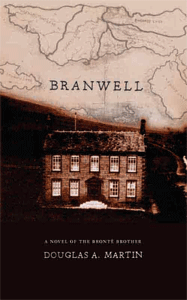
Saturday, January 14, 2006
Small Spiral Notebook. Review by Patricia R. Payette. We quote some fragments:
Martin portrays the deaths of both Marias as creating a deep sense of irreparable abandonment and loss in young Branwell. Throughout the novel, as Martin leads the reader through Branwell's slow spiral into alcoholism, opium addiction and self-destruction, he uses sparse, haunting prose that relies on well known biographical events while imbuing those events with measured feeling and nuance. The novel evokes sympathy for this only Bronte boy and complicates the sometimes simplistic portrayal of Branwell seen in earlier books about the Brontes. Martin refuses to dismiss Branwell as the alcoholic, arrogant ne?er do well who failed in every way his sisters succeeded. One of the major accomplishments of this novel is Martin's ability to guide us through the events in Branwell's life without making up lengthy episodes of dialogue or inserting abundant, artificial details that might undermine his credibility as a biographer. Instead, Martin carefully and skillfully uses content from some of the same letters, poems, scraps of prose, historical newspapers and other documents that shaped earlier Bronte biographies, but he weaves them together in new ways in order to show us the deeper, richer colors of Branwell's life. He also contributes new ideas to what we know about Branwell challenging some traditional Bronte mythology.
Branwell the novel is consistently heartbreaking and provocative as Martin asks us to peer into Branwell's head and heart, demonstrating how the young poet's life revolved around a series of tormenting desires between his need to find a suitable profession and inability to hold a job, between his social ambitions and his emerging sexual preference, between his gifts for storytelling and poetry and his failed attempt to be a portrait painter, between his desire for familial acceptance and his blossoming masculine ego, and, coloring all of this is the alcoholism and opium addiction that helped hasten his death of chronic bronchitis and consumption at age 31.
Martin's poignant, third person narrative of Branwell's lives also gives us finely detailed glimpses of the more familiar Brontes. Charlotte's stern, disapproving older sister persona, Emily's brooding but loving presence, and Ann's quiet, pensive, spiritual strength are juxtaposed to Branwell's tragic romanticism. As the remote, authoritative father who outlived all his children by decades, and was passive and silent in the face of Branwell's professional failures and public addictions as he struggled with his own failing eyesight, Patrick Bronte's life appears almost as heartbreaking as those of his famous literary offspring who all died of illness before age 40.
In Newsweekly. Review by Richard Lebonte
Branwell was haunted by the early deaths of his mother and a sister, dabbled in painting and poetry but never found his muse, disappointed his clergyman father, and lost a succession of jobs - including that of tutor to the young son of a prominent family. Martin suggests that Branwell's romantic longing for the lad led to his dismissal, but the power of this story derives from how its wonderfully evocative prose style - as hallucinatory and hypnotic as opium dreams are said to be - fiddles with the reality of the Bronte boy's physical desires. Though Martin's deft mix of the biographical and the fanciful centers on the celebrated writing family's troubled only son, this concise novel also delivers a knowing portrait of the domestic dramas that fueled literary accomplishments.
Categories: Books, Fiction, Branwell_Brontë
Friday, March 10, 2006
Douglas Martin's novelization of the little-known life of Branwell Brontë, brother to authors Charlotte and Emily...
And Anne! Coming from a review on a site that specialises on overlooked books they have missed such an opportunity to bring Anne to her more than deserved spotlight.
The follow-up to Martin's debut novel Outline of My Lover, Branwell is more experimental fiction than generic biography. Martin's simple, abstract compositional style frequently betrays the biographical element; his subject often becomes a malleable figment of a fictive imagination. Branwell's sisters provide the historical and literary context (not to mention the star power, so to speak), which allows Martin to thread a dreamlike narrative through well-known pillars of fact.
Branwell's story is set up as a musky, candlelit tragedy from the start. He's preoccupied with the early deaths of his mother and sister, so much that his later years never seem to progress beyond a shadowy state of grief. Martin's language is palpably incandescent, the sensuality of its poetics curtailed by a terse fatalism. The book's episodic snapshots -- each so brief and tactful that it's vaguely profound -- illuminate the beauty in a life's inevitable ruin. It's a consuming and haunting read, one that hides its dark allure in ghosts, insinuations, and recessed crevices of human nature. Branwell, Martin writes, is "a shining example of romantic self-destruction, and of all his sisters' hopes, an embodiment of the fears they each chose to see there, those sides of their characters." Besides the conceptual fodder he comes to represent, Branwell is imbued with flesh and blood, a character whose own misfortunes are as much the product of human anguish as they are high art.
Categories: Branwell_Brontë, In_the_News, Books, Fiction
Friday, December 09, 2005
Pride Source publishes a brief review of the book :
Branwell: A Novel of the Brontë Brother
By Douglas A. Martin. Soft Skull Press, 256 pages, $13.95 paper
Branwell, the overshadowed Brontë brother of Charlotte, Anne, and Emily, was an immensely troubled lad, dead at age 31of an addiction to alcohol and opium - and failure. This mesmerizing fictional realization of the young man's tragic life hews closely enough to the factual: Branwell was haunted by the early deaths of his mother and a sister, dabbled in painting and poetry but never found his muse, disappointed his clergyman father, and lost a succession of jobs - including that of tutor to the young son of a prominent family. Martin suggests that Branwell's romantic longing for the lad led to his dismissal, but the power of this story derives from how its wonderfully evocative prose style - as hallucinatory and hypnotic as opium dreams are said to be - fiddles with the reality of the Brontë boy's physical desires. Though Martin's deft mix of the biographical and the fanciful centers on the celebrated writing family's troubled only son, this concise novel also delivers a knowing portrait of the domestic dramas that fueled literary accomplishments.
(Richard Lebonte)
Originally printed 12/8/2005 (Issue 1349 - Between The Lines News)
Featured Excerpt
There's a letter quoted that will never be seen. A few facts were always open to another interpretation. Branwell will tell them what it says, all of its black contents, how and why the Robinsons want to get rid of him, want to get him away from Edmund. They must trust him. From the swells and hollows of the mossy turf, he is returning. Branwell is returning for good this time. Emily will be happy to have their brother home again.
-from "Branwell," by Douglas A. Martin
Categories: Books, Fiction, Branwell_BrontëSaturday, October 08, 2005
publisher's web, you can find a rather disturbing excerpt from middle of book, regarding Branwell's implied feelings for the young boy he is tutoring, that is, Lydia Robinson's youngest son.The book synopsis is the following (from the publisher):
The Bronte Boy traces the life of Branwell Bronte, the sole brother of Charlotte, Emily, and Anne Bronte, from childhood to his alcohol and opium induced death at the age of 31. As the only son, Branwell is expected to make the fortune for the family, and immortalize the Bronte name. He is given no formal education, but is painstakingly tutored by his father, and writes endless stories and poems with his sisters in their small parsonage home. Haunted by the early deaths of his mother and sister, both named Maria, and the imaginary worlds Angria and Gondal he and his sisters create as children, Branwell is unable to touch his heart's desire: to be a great artist. Forever discontent, he roams from job to job, as painter, railway man, and tutor, constantly writing and sketching. He sinks further into his own disappointment at great expectations, as his sisters spin and fume on the dark moor with the stories that will immortalize them.Douglas A. Martin probes the locus where history and myth collide, and with language as rich and dark as the windswept, rainy moors of Wuthering Heights and Jane Eyre, gracefully uncovers Branwell Bronte's almost forgotten lost loves and thwarted talent, while circling around his nameless sexuality. Maintaining the haunting quality of childhood memory throughout, The Bronte Boy is a genre bending exploration of the tragic figure of Branwell Bronte and the dismal, dazzling landscape that inspired his sisters to greatness.
On Amazon we can find a more detailed insight on the approach of the book to Branwell's life:
From Publishers Weekly
In this mannered, tortuous life of Charlotte Brontë's younger brother, Branwell, novelist Martin (Outline of My Lover) offers a tender, tragic portrayal of a doomed artist and homosexual avant la lettre. In Martin's marvelous free and direct telling, Branwell, as the sole son among many daughters (only Charlotte, Emily and Anne survived childhood) is accorded privileges they are not, such as special home schooling by their strict father, curate of provincial Haworth. Branwell also lords over the set of toy soldiers the siblings use in elaborate play wars, creating vast civilizations in poems and plays. The early deaths of their mother and sisters Maria and Elizabeth prove shattering for Branwell, on whose fragile shoulders the great hopes of the house rest. Sent off alone to London to gain admittance to the Royal Academy, he falls continually in his family's esteem, becoming a local drunkard and apprentice to the secretly homosexual freemason society; a last chance at gainful employment, as tutor to a boy in Thorp Green, ends in a scandalous dismissal, and Branwell descends irretrievably into a drug-induced, punishing state of monomania. Though slender, this volume's beautiful declarative sentences are perfectly fitted to this famously imaginative, headstrong family; they bring Branwell Brontë's world to light. (Oct.)
Copyright © Reed Business Information, a division of Reed Elsevier Inc. All rights reserved.
We at BrontëBlog know for sure that it will be a controversial book. So we'd like to encourage potential readers of the novel to send us their opinions whatever they might be.
Categories: Books, Fiction, Branwell_Brontë
Friday, September 11, 2020
A house thought to be the inspiration for Emily Brontë when writing 19th century classic Wuthering Heights is on sale for more than £1m.Also on BBC Culture we find this interesting article on Daphne du Maurier:
Ponden Hall, in Stanbury, West Yorkshire, dates back to 1541 and played host to Brontë and her family during their childhood.
Several features of the property are said to have inspired her work.
In 2014, it was converted into a bed and breakfast which is currently run by owners Steve Brown and Julie Akhurst.
Sisters Emily and Anne, who began writing as children along with their sibling Charlotte, first came across Ponden Hall during the Crow Hill Bog Burst, a mudslide that occurred following heavy rainfall in September 1824.
While this was the girls' first encounter with Ponden, they continued to visit, with the house providing inspiration for both Wuthering Heights and The Tenant of Wildfell Hall.
The library at Ponden, considered one of the finest in West Yorkshire and which boasted a Shakespeare first portfolio, was particularly appealing to the Brontës, who would often stop by to use it.
Mr Brown said it was a request from a Brontë enthusiast to stay over in the old library that prompted the couple to turn Ponden into a bed and breakfast.
The couple moved into the property in 1998 and undertook extensive restoration work.
The main guest bedroom features a small, single-paned window within a wooden, panelled box bed which bears similarities to the window that appears in Wuthering Heights.
Ms Akhurst said: "This is the room in the old end of the house which has a tiny window in it which inspired Emily to write the story of Cathy's ghost.
"There is the scene in which Mr Lockwood is asleep in the bed and he has a nightmare where he believes the ghost of Cathy is coming through the window to get him."
An article in the Spectator in the same year of the TLS reappraisal, 1962, made what I think is the first connection between Charlotte Brontë’s masterpiece and du Maurier’s own, describing Rebecca as “a Cornish Gothic resetting of Jane Eyre.” It’s a comparison that, in more recent years, has seen Rebecca finally claimed by the literary establishment, thus metamorphosing a novel once blurbed as the “world-famous bestseller of love and suspense” into a key 20th-Century feminist gothic text: Brontë’s madwoman in the attic transformed into Rebecca’s ghostly presence, each woman a dirty little secret their husbands have to take care of, one way or another. (Lucy Scholes)Commonweal Magazine reviews both Isabelle Greenberg's Glass Town and Douglas A. Martin's Branwell: A Novel of the Brontë Brother:
Isabel Greenberg’s graphic novel Glass Town: The Imaginary World of the Brontës (Abrams ComicArts, $24.99) and Douglas A. Martin’s newly reissued Branwell: A Novel of the Brontë Brother (Soft Skull Press, $16.95). Both works take something solid from Brontë history (childhood imaginings in the case of Greenberg; addiction to drink and drugs in the case of Martin) and turn it strange and otherworldly.Church Times reviews the book Converting Britannia: Evangelicals and British public life, 1770-1840, by Gareth Atkins
While living at Haworth Parsonage in the 1820s, the Brontë siblings—Charlotte, Emily, and Anne, all celebrated novelists, as well as brother Branwell, the family’s great disappointment—created an imaginary world called Glass Town. Through text and image, Greenberg recreates both the lives of the young Brontës and the realm they imagined. Glass Town was a world of soldiers and romance, hard facts and wild fancy; it offered the isolated siblings an opportunity to think about other worlds, and it gives Greenberg the chance to blend literary biography with fantastical speculation. (...)
It is a truth universally acknowledged that all good prose must be described as poetic. But Martin’s writing really does display the compressed lyricism and rhythms of poetry.
By one light, Douglas A. Martin’s Branwell takes the airy Brontë myth and brings it back down to earth. Reissued with an excellent introduction by the novelist Darcey Steinke, Branwell serves as an imaginative biography of the ne’er-do-well Brontë brother: a talented, desirous would-be artist/poet (he sent letters to William Wordsworth, Thomas De Quincey, and Hartley Coleridge) who became a has-been drunk before dying at the age of thirty-one. (...)
Though Branwell is an excellent novel of deromanticizing, it can be as otherworldly as Glass Town. Martin’s hero “doesn’t know how to contain all he doesn’t know what to do with,” and his mind, when under the influence of opium or erotic desire, becomes hallucinatory, beautiful and terrifying in the way of dreams. (Anthony Domestico)
A modest example was a poverty-stricken young Irishman, Patrick Brunty, who, arriving at St John’s College, Cambridge, in 1802, was taken up by Charles Simeon’s curate, Henry Martyn, who introduced him to the Evangelical great and good. Through their influence, he progressed via several Evangelical curacies to be perpetual curate of Howarth (sic) in Yorkshire, and father of the Brontë sisters. Evangelicals could also be ruthless in removing or silencing anyone who dissented from or challenged their vision. (William Jacob)Yorkshire Life has a list of Yorkshire falls which includes our very own
Brontë WaterfallThe Hamilton County Times presents a curious series of talks organised by the CEArts’ annual Noblesville Interdisciplinary Creativity Expo (NICE) project:
Follow in the footsteps of the famous sisters, take the Brontë Trail starting from Haworth and running over the moors to the waterfall and Top Withens.
Does Jane Eyre’s role in society always adhere to social convention?State of Mind (Italy) reviews the essay Questo matrimonio non s’ha da fare di M. Morretta:
Are Edward Rochester and Rhett Butler just a “bad boys,” or is there more to them than that?
Does Scarlett O’Hara’s sexuality help her or hurt her as a survival mechanism?
How would you describe Jo March in terms of gender roles and norms?
Is Dracula the ultimate abuser?
We’ll discuss these questions and more in the three sessions on September 12!
To register, simply email us at info@cearts.org, and we'll send you invitation information for September 12’s three Zoom sessions.All Workshops Are Free; donations welcome!
Un paio di anni fa visitai Haworth, villaggio inglese dove vissero le sorelle Brontë. Un tuffo emotivo nel mio passato adolescenziale in cui cercavo di capire cosa significasse amare. Per anni ho creduto che quello fosse il vero amore: gli sguardi rubati tra Mr. Rochester e Jane Eyre, i tormenti interiori, l’unica forza in grado di cambiare le persone, l’unico motore per raggiungere la felicità. Se avessi continuato a ricercare tra quelle righe il senso della vita forse avrei vissuto a metà, in angosce profonde e frustrazione, alla ricerca di un ideale impossibile. (Eleonora Natalini) (Translation)
Tonight, at the Teatro Comunale di Cagli (Italy) a concert in remembrance of the anniversary of the 9/11 terrorist attacks will contain an unexpected Brontë-related piece:Venerdì 11 settembre alle 21.00 al Teatro Comunale di Cagli va in scena il recital I want magic , in prima esecuzione assoluta, con la soprano Laura Muncaciu e la pianista Yasue Hokimoto. Un progetto musicale che vuole ricordare attraverso la musica uno degli eventi più sconvolgenti della nostra epoca: la tragedia della Torri Gemelle di New York, avvenuta l’11 settembre di 19 anni fa. (...)The piece is I have dreamt from Bernard Herrmann's Wuthering Heights opera.
Il programma si muove dalle sonorità inglesi (R.V. Williams) dell’ultimo recital (sempre con Yasue pianista) alle atmosfere americane del ’900, i “Suoni americani” (che sono differenti da altri suoni), le parole di Emily Brontë e Tennesse Williams nel Teatro di Cagli. (Source) (Translation)
Information (Denmark) reviews the novel Sortsyge by Cecilie Bødkers:
August er en god gammeldags narcissist, der det ene øjeblik overstrømmer Freja med kærlighed og straks truer med at tage den fra hende. Freja kaster sig forudsigeligt i hans arme, og den slags usunde dynamikker har da også givet stof til god litteratur fra Romeo og Julie til Heathcliff og Catherine i Wuthering Heights. (Bodil Skovgaard Nielsen) (Translation)El Quindiano (Colombia) talks about pseudonyms in literature and mentions the Brontës. Books & Livres reviews the graphic novel Jane by Aline Brosh McKenna and Ramón K. Pérez.
Wednesday, November 21, 2007
"Gaskell was a woman ahead of her time in many respects. A social reformer who believed in equality for women.Indeed BrontëBlog finds it puzzling as well. As if books were not enough, Mrs Gaskell has three recent adaptations of her works, with North and South being extremely popular even years after being first broadcast. Will Cranford - with its discreet humour and its great cast - finally manage to bring Mrs Gaskell to the forefront of classic authors? We hope so.
"She was also extraordinarily underrated as a novelist compared to the likes of Jane Austen and Charlotte Bronte, so I hope Cranford will help to redress the balance.
"She writes incredibly well, with great wit and pathos about an amazing period in our history, when radical changes were taking place. In that sense, there's a lot of relevance to what's happening in today's society." (Ian Wylie)
Talking about people who tend to pass unnoticed. The Little Professor talks about Branwell Brontë while reviewing Douglas A. Martin's Branwell: A Novel of the Brontë Brother.
I must admit upfront to struggling with the book, in large part because Branwell, like John Polidori (who has unaccountably managed to spawn two novels), is not particularly charming company. He drinks; he takes drugs; he accomplishes virtually nothing; he seduces the Robinson family's young son (in Martin's version, that is). In other words, Branwell manages to simultaneously disappoint his family and the reader. At one level, of course, Martin's Branwell simply reiterates the now-mythologized Branwell's abject position within the Bronte household: the coddled son who disintegrated amongst a family of female geniuses. He is one of the legendary disappointments of British literary history. But in taking Branwell as his subject, Martin develops an anti-Künstlerroman, charting the disintegration of the would-be artist under the weight of his own fantasies of brilliance. (Even the poems Branwell manages to publish are pointedly dispersed among multiple newspapers; he cannot pull himself together, even in volume form.)The review is very interesting. We suggest you read it in its entirety.
One of the most striking things about the novel is its style. Or, to be more precise, its refusal to engage in the kind of pastiche that frequently characterizes the neo-Victorian novel. Martin instead writes stark, minimalist prose, often relying on simple sentences. (A random example: "The color leaves our cheeks towards morning. But why. Why must it" [85].) He eschews the leisurely periods of Victorian prose style, along with the apparently endless paragraphs. Martin goes to the opposite extreme by keeping his paragraphs short, sometimes as short as a single sentence or sentence fragment. Offhand, I cannot remember a single colon or semi-colon, although Martin does use the occasional dash. There is virtually no dialogue; what little dialogue appears is abrupt, sometimes fragmentary, and often rendered in FID. The occasional bursts of speech frequently sit by themselves on the page, as though the characters talk into silence instead of to each other.
Anne Brontë sadly - and unjustly - qualifies for the 'overlooked person' category as well. But today her Tenant of Wildfell Hall is the subject of a lengthy review in German on Lesertreff.
The Coveted posts samples of Marci Washington's art. She quotes her describing her work as follows:
Marci Washington describes her haunting work as 'It's like I'm illustrating a novel that doesn't exist. If it did, it would probably be a lot like Wuthering Heights, Jane Eyre, or Bleak House- novels which function as social commentary as well as beautiful romantic epics.'And finally for the weird, impossible quote of the day. Ben Katner from the Seattle Post-Intelligencer asks one Ambreal Williams (apparently she's 'definitely going down in America's Next Top Model history — but only as the first contestant to be eliminated twice.') the following question:
TVGuide.com: I was really annoyed on your behalf when Tyra said you looked hoochie during the Enrique Iglesias video shoot. They dressed you in a leather shoestring, said you were playing a vampire and put you in a sex dungeon! How were you supposed to slide down that pole, like Jane Eyre? [Answer not relevant.]Because, you know, Jane Eyre is world-famous for sliding down poles constantly in all manners of puritanical, un-sexy ways.
Categories: Art-Exhibitions, Books, Branwell Brontë, Movies-DVD-TV, The Tenant of Wildfell Hall, Weirdo
Monday, April 10, 2006
Branwell is not a history, relating an objective chain of events, nor in any sense a biography, attempting to shed light on its subject. Instead, it invites the reader to join Douglas Martin in his dream of Branwell Brontë—a dream so enchantingly and hypnotically rendered that the invitation is a pleasure to accept.
For more info on the novel, we recommend you browse through our Branwell Brontë category, which has other reviews of the book.
Categories: Branwell_Brontë, Books
Wednesday, December 21, 2005
Soft Skull Publishers inform us that after a series of delays, Douglas A. Martin's book "Branwell" (and links therein) is finally available. It is now available for sale pretty much everywhere, although, in order to give reviewers the time to write and file reviews and such, the official publication date is January 21st. Douglas will be doing readings in New York and Minneapolis, and we’ll keep you updated with any more.
Another possible Christmas present!
EDIT: The publishers have contacted us with further info on the readings:
Here's a link with info on the New York reading at Coliseum Books on January 16 at 6:30 pm.
And here are the details for at least two other readings:
EVENT: Book discussion, reading & signing on Thursday, Jan 19th at 7:30 PM
Query Booksellers
520 East Hennepin
Minneapolis, MN 55414
EVENT: Book discussion, reading & signing on Saturday, Jan 21st at 7:30 PM
Magers & Quinn Booksellers
3038 Hennepin Ave S
Minneapolis, MN 55408
The publishers also forwarded us a review from Publisher's Weekly:
In this mannered, tortuous life of Charlotte Bronte's younger brother, Branwell, novelist Martin (Outline of My Lover) offers a tender, tragic portrayal of a doomed artist and homosexual avant la lettre . In Martin's marvelous free and direct telling, Branwell, as the sole son among many
daughters (only Charlotte, Emily and Anne survived childhood) is accorded privileges they are not, such as special home schooling by their strict father, curate of provincial Haworth. Branwell also lords over the set of toy soldiers the siblings use in elaborate play wars, creating vast
civilizations in poems and plays. The early deaths of their mother and sisters Maria and Elizabeth prove shattering for Branwell, on whose fragile shoulders the great hopes of the house rest. Sent off alone to London to gain admittance to the Royal Academy, he falls continually in his family's esteem, becoming a local drunkard and apprentice to the secretly homosexual
freemason society; a last chance at gainful employment, as tutor to a boy in Thorp Green, ends in a scandalous dismissal, and Branwell descends irretrievably into a drug-induced, punishing state of monomania. Though slender, this volume's beautiful declarative sentences are perfectly fitted to this famously imaginative, headstrong family; they bring Branwell Bronte's world to light.
Even if we are told that the explicitness of the homosexual theme has been overstated, we still feel the need to highlight that this book is fiction and by no means is intended as a scholarly biography. Just saying :)
Categories: Books, Fiction, Branwell_Brontë
Monday, July 20, 2020
A virtual alert for today July 20:Live via Zoom:
Monday, July 20, 7:30 PM
Douglas A. Martin presents
Branwell: A Novel of the Brontë Brother
In conversation with Darcey Steinke
Douglas A. Martin, award-winning author of Outline of My Lover and the anti true crime novel Wolf, takes to the virtual Greenlight stage to share the reissue of his novel, Branwell: A Novel of the Brontë Brother. Branwell Brontë—brother of Charlotte, Emily, and Anne—has a childhood marked by tragedy and the weight of expectations. After the early deaths of his mother and a beloved older sister, he is kept away from school and tutored at home by his father, a curate, who rests all his ambitions for his children on his only son. Yet while his sisters go on to write Wuthering Heights, Jane Eyre, and Agnes Grey, Branwell wanders from job to job, growing increasingly dependent on alcohol and opium and failing to become a great poet or artist. Martin’s Branwell is a portrait of childhood dreams, thwarted desire, the confinements of gender—and an homage to the landscape and milieu that inspired some of the most revolutionary works of English literature. This new edition includes an introduction by Greenlight neighbor and acclaimed author Darcey Steinke, who also joins Martin in conversation for this virtual book talk.
Thursday, January 19, 2006
Query Booksellers
520 East Hennepin
Minneapolis MN 55414
At 7PM Douglas Martin will visit Query Booksellers to discuss his book Branwell: A Novel of the Bronte Brother, where Charlotte Bronte's younger brother Branwell Bronte, an only son, is expected to make the family fortune and distinguish the Bronte name. Martin probes the locus where history and myth collide, and uncovers Branwell's lost loves, thwarted talent, and possible homosexuality.
Click here to read a few recent reviews.
As usual, we would love to hear about this event if anyone reading us happens to be there :)
EDIT: City Pages has a tiny article devoted to this event.
Categories: Branwell_Brontë, Alert, Books, Fiction
Tuesday, May 13, 2008
Pacific Standard Fiction Series: Victorian NightCategories: Alert, Branwell Brontë, Fiction, Talks
featuring Arthur Phillips and Douglas A. Martin
Tuesday, May 13th, 7:00 p.m.
82 Fourth Avenue, Brooklyn, New York (betw. St. Marks and Bergen)
hosted by Garth Risk Hallberg
Books available on-site!
Drink specials to be chosen by dartboard!
The Spring Season Finale for New York Magazine's "Best New Literary Event!"
Douglas A. Martin's second novel, BRANWELL, was hailed as "a cohesive and convincing portrait of the lost, forgotten Brontë" by The Austin Chronicle. "Stylistically complex and emotionally evocative," Darcy Steinke wrote. "Branwell Brontë emerges as ...both muse and devil to his sisters' passions, giving us a new dimension to this ever fascinating family."
Friday, February 03, 2006
Martin avoids the temptation of plunging headfirst into the gothic, instead conveying Branwell's psychic turmoil in simple, stripped-down sentences. A hopeless romantic, Martin's hero lives inside a dream, dazed by his failure and an unacceptable interest in other young men. Most Brontë biographies suggest that he was fired from a tutoring position because he fathered an illegitimate child, but this novel hints at another kind of scandal involving Branwell's male charge: "He can show him some things if he doesn't tell his parents, in the stable. He could have a little drink there sometime. Just one." Martin sparsely fills in the outlines of Branwell's dissolution, a suitably phantom account of the man who painted himself out of his own family portrait.
Erm... most Brontë biographies say what? Poor Lydia Robinson not being credited with Branwell's destruction. Of course, the theory that Branwell had an affair in the Lake District is plausible but his fathering a child is not (see for instance Barker's The Brontës where the latter is torn to pieces). So that's not what most Brontë biographies say.
Categories: Books, Branwell_Brontë, Fiction
Tuesday, September 18, 2007
The Oregonian reviews Maureen Adams's Shaggy Muses:
"Shaggy Muses" is readable and interesting but has a somewhat scholarly tone. It's not brimming with sentiment, but it is full of facts and insights. Adams goes beyond the superficial and provides real information. (Deborah Wood)Wet Asphalt recommends Douglas A. Martin's Branwell: A Novel of the Brontë Brother:
Soft Skull Press is currently experiencing a financial crisis. As a result, they're offering their entire catalog at 40% off.
If you'd like to take advantage of this, may I recommend Branwell: A Novel of the Brontë Brother by Douglas A. Martin? Full disclosure: Martin was my writing teacher at the New School; in fact he's the best writing teacher I've ever had. Branwell is a lyrical and beautiful novel, biographical fiction done in a sparse, almost poetic style. It's a novel in the tradition of Marguerite Duras, gradually building character and mood out of striking images, unattributed interlocutors (which often seem to be within Branwell's head) and startling juxtapositions of sentences and words that speak volumes. (Eric Rosenfeld)
Christina from book-o-rama has alerted us to this entry on Tripping Toward Lucidity where the author has finally read Wuthering Heights (at the fourth attempt!) and liked it!:
Yes, the "Everyone is miserable and crazy," bit is a fair assessment of this novel, but it really is worth the read in spite of the miserable horribleness. In all honestly, what would a Victorian, gothic, creepy novel be without crazy people? (...) Emily Brontë had quite the deft hand for storytelling even if her subjects were a bunch of nutters. (Andi)Wuthering Heights is also the subject of this post in Meine Bücher, albeit in German.
Categories: Books, Branwell Brontë, Wuthering Heights
Thursday, September 11, 2008
But now I'm thinking, why should Hollywood glamour disqualify an actor from playing a nicotine-and-ink-stained literary icon? (Imagine how much better at the box office Capote and Infamous would have done if Truman Capote had been played by George Clooney or Brad Pitt instead of Philip Seymour Hoffman or Toby Jones.) So why shouldn't Tori [Spelling] star in a biopic of, say, Charlotte Brontë or Joyce Carol Oates or Eudora Welty? After all, she's got literary cred now. (Gary Susman)Brisbane Times devotes an article to the ongoing performances of Polly Teale's Brontë in Brisbane, Australia:
Women have long faced a dilemma of numbers in the creative industries.The Village Voice interviews songstress Basia Bulat, a new Brontëite:
They usually outnumber men in the worlds of film and theatre despite meaty roles for female thespians being few and far between.
However, three Brisbane women are ready to challenge that stereotype.
Actors and friends Hannah Levien, Kathryn Marquet and Rebecca Roberts met while completing their degrees at the University of Southern Queensland and, frustrated with the status quo, decided to band together and create their own theatre company.
The product, Three Sisters Productions, aims to empower young female performers by demonstrating the stage can be theirs for the taking. (...)
Three Sisters describe as "instrumental" the influence of Sue Rider, the award-winning director, writer and actor behind the company's production of Polly Teale's Bronte.
Set in 1845, Bronte delves into the lives of Anne, Charlotte and Emily by exploring the chaotic world of madness, illness and death in which these remarkable literary sisters penned their extraordinary tales.
"It was a huge coup for us to get our hands on Bronte and use it to launch Three Sisters Productions into the Australian independent theatre scene," says Levien.
"Sue has been so supportive and guided us to rise to the challenge of the female characters.
"The Brontes are such iconic and heroic female role models."
Levien says the company are pegging their debut as a literary detective story, where the power of the imagination haunts and inspires its creators and triumphs against all odds.
"Emotions and circumstances I think we can all relate to at times," she adds.
Bronte will play at Sue Benner Theatre, Metro Arts from September 10 to 27. (Katherine Feeney)
The name of a book she's read at least twice:Fangoria reviews the recent release of Joseph L. Mankiewicz film debut Dragonwyck (1946) included on the Fox Horror Classics Vol. 2 DVD and insists on the Jane Eyre references, much to our dismay:
Oh, gosh. There's a lot of them. One book that I've read at least twice . . . Oh God, I've read so many books a million times. I've read a lot of biographies lately, but the book I've read the most has probably been Jane Eyre.” (Rob Trucks)
DRAGONWYCK is weak tea horror-wise, as it’s actually “only” an atmospheric, JANE EYRE-like 19th-century tale of a simple farm girl (Gene Tierney) attracted to her cousin (Price), the handsome but mysterious and tyrannical master of a Hudson River estate. (Tom Weaver)Con Houlihan remembers his post-war university years in an article on The Herald (Ireland). We found this very funny anecdote:
I remember especially a spelling mistake in an essay on Wuthering Heights. "Heathcliff and his friends used to spend the nights gambolling in the big hall."The recent Movie Map issued by the Peak District and Derbyshire is mentioned in The Birmingham Mail.
En Tarde-Garde reviews Douglas A. Martin's Branwell:
Douglas A. Martin’s Branwell is a novel that bleeds the line between novel and historical fact. It’s written in a style that traces the tragic story of Branwell Brontë and composites it through the lives of those involved, from golden child and hope of the family to drunken dissolute, all while the politics of family allegiance drift and Branwell falls further into oblivion. This hallucinatory narrative shifts back and forth, switches tense, shows us one reading only to challenge it later, and ultimately unfolds a tale embroidered of speculation, suspicion, and earnest confession, where one is never certain of the absolute truths. (Read more)Simply Bookish briefly talks about Jane Eyre.
Categories: Branwell Brontë, Brontëites, Fiction, Jane Eyre, Movies-DVD-TV, References, Theatre
Sunday, September 20, 2009
Well known names and historical figures also feature in the current series. There’s author Charlotte Brontë’s Sunday school bible, Michael Jackson’s fedora hat, a bracelet owned by Queen Victoria found in a London side street and valued at several thousand pounds, Barbara Cartland’s entire collection of pink hats, Sir Walter Scott’s cabinet, Marilyn Monroe’s lemon squeezer and the paint box reputedly used by artist John Constable. (David Stephenson)The Boston Globe presents Douglas A. Martin's new novel Once You Go Back and mentions his previous one, Branwell: A Novel of the Brontë Brother:
Douglas Martin’s previous novel, “Branwell,” invoking the Brontë sisters’ dissolute brother, was an imaginative stretch. (Amanda Heller)Some days ago we reported Izzy Lane's designs inspired by Wuthering Heights presented at the New York Fashion Week. The Sun gives more details:
Isobel Davies, who runs the Izzy Lane label from a farm in Richmond, North Yorkshire, debuted her spring/summer 2010 collection at The Green Shows, a two-day event dedicated to eco-friendly and fairtrade fashion.The Wall Street Journal lists the five best books about obsessions. Wuthering Heights is there:
It is the first time the designer has shown her knitwear designs in New York.
The spring/summer collection 2010 features fine Shetland wool spun from rescued sheep and woven into a light summer cloth in Victorian mills.
The patchworks are inspired by the Wuthering Heights landscapes of the Yorkshire Dales. (Liz Lamb)
Obsession is a mischief maker, and its most common disguise is what romantics call true love. Emily Brontë's "Wuthering Heights" is probably the bleakest, most intense novel about obsessive love ever written—Catherine Earnshaw and Heathcliff, thrown into relief by the tale's setting on the desolate Yorkshire moors, have practically become synonymous with tempestuous passion. The two had seemed destined to be together since childhood, but then Catherine, despite her obsession, marries someone else, and Heathcliff's fury is unleashed. The mutual fixation ruins their own lives and the lives of those around them. "If all else perished and he remained, I should still continue to be," Catherine says, "and if all else remained and he were annihilated the universe would turn to a mighty stranger." (Susan Cheever)More reviews linking together Lorrie Moore's A Gate at the Stairs and Jane Eyre. In The Columbus Dispatch:
Her new novel, A Gate at the Stairs, manages the same unlikely combination, though here, the lighter elements give way more gradually to the darker. A Gate, which plays subtly off Jane Eyre, is narrated by naive college student Tassie Keltjin, who lives in a town not unlike Madison, Wis. (Margaret Quamme)Finally, A Season with Austen visits Haddon Hall, Jacques Serir (Facebook) talks about L’humeur névrotique chez Charlotte Brontë (in French) and Keri Patterson Kegley (Facebook) reviews The Tenant of Wildfell Hall.
Categories: Books, Brontëana, References, The Tenant of Wildfell Hall, Wuthering Heights
Monday, January 16, 2006
Today, January 16 at New York's Coliseum Books (11 W 42nd Street New York) as we informed previously, Douglas A. Martin, the author of Branwell: A novel of the Brontë brother will present his book:Coliseum Books, an independent bookseller, is proud to feature three authors from Soft Skull Press, one of the world's most daring, and most thoroughly independent publishers of books : Wayne Koestenbaum with Moira Orfei in Aigues-Mortes; Maggie Nelson with Jane: A Murder and Douglas A Martin with Branwell: A Novel of the Bronte Brother.
Coliseum Books, 11 W 42nd Street New York, NY (06:30 PM)
Categories: Alert, Books, Fiction, Branwell_Brontë
Monday, June 26, 2006
Branwell Brontë was born on a day like today in 1817. All men in the Brontës' lives - excepting perhaps William Weightman and very few others - have been misunderstood and vilified over time, and Branwell undoubtably so.Patrick Brontë educated his children in a very modern way, but that is not to say he didn't feel especially proud of his only son, or that he hadn't special hopes for him. The sisters themselves seem to have been in awe of him until he was obviously in no fit state to be admired. And yet he did have a privileged mind, which was sadly wasted through bad connections and wrong choices.
Patrick Branwell Brontë had winning ways about him, was talkative, friendly, could trick well-travelled people into believing he had been to London when all he had was a book on London and could write with both his hands in Latin and Greek at the same time.
A few good mysteries remain about his life which will probably never be solved now. But we hope he will be looked in a more sympathetic light and valued for what he did. He might be known nowadays thanks to his connection to his sisters, but good things did come out of his pen. Hartley Coleridge himself congratulated him on his translations of Horace's Odes and encouraged him to work further on them. He got a few poems published in local newspapers as well.
So we encourage you to look for the real Branwell, through his writings and through his biographies. You will learn that he wasn't just the mischievous, drunkard, adulterous brother of the Brontë sisters'. This is a good year to start doing so, as you can see by the recent new edition of Daphne Du Maurier's The Infernal World of Branwell Brontë (introduced by Justine Picardie), the fictional account of his life by Douglas A. Martin, and the forthcoming edition of his selected poems in September 2006.
Categories: Reminder, Branwell_Brontë
Thursday, April 12, 2007
The Globe Gazette talks about this and asks its readers to recommend their favourite books.
"Jane Eyre," by Charlotte BronteIf you're looking for inspiration on what to drop everything for and read today, you might find this news item interesting. It looks like the New York Public Library has recently picked its top 10 favourite love stories according to Reuters. Which is number one? Well, no other than Wuthering Heights! Tango Together lists the complete selection. No Jane Eyre though :(
I read “Jane Eyre” when I was 13 or 14 and I guess it came at just the right time. I loved the book so much, I couldn’t put it down. I read it at the school bus stop, on the bus and as soon as I got out of school, then again during all my waking hours at home when I wasn’t doing homework. (Kristin Buehner, reporter, Globe Gazette, Mason City)
Angel Eve doesn't need telling. She posts several quotes from Wuthering Heights 1939 on her blog.
And as you know, we recently posted about a German novel - Sturmherz - inspired by Wuthering Heights. Today Pressemitteilung has a review of it in German.
Someone who will certainly drop everything and read is Amrita Rajan from Blog Critics. While talking about reading Far from the Madding Crowd by Thomas Hardy (BrontëBlog humbly recommends this novel too), she writes:
Put Jane Eyre in front of me and I become a zombie that must feed on all things Bronte.And finally The Irish World reviews Douglas A. Martin's book Branwell.
Martin skilfully takes the reader on a journey of Branwell’s life and self-discovery through his very own eyes. (Hazel Gray-Read)Just remember: today drop everything and READ.
Categories: Books, Branwell Brontë, In the News, Wuthering Heights
Thursday, January 26, 2006
Moody, broody songs with lots of plaints and hurt running through them, to differing degrees and steps. An odd list, perhaps, oddly dated. (...) So they are deep inside me, and they occur to me to call out and up when I try to think about Branwell walking around and longing, long before such rock, such rolls, such, what, expressive loves and tones. I think something might happen, something like an emotional arc, if you put these songs in this order and listened to them.
-"Bedtime Story," Tammy Wynette
Categories: Fiction, Branwell_Brontë, Websites
Wednesday, October 21, 2020
Brendan Mathews: When did you first learn that there was a brother in the Brontë family—a sibling who didn’t write one of the classics of 19th century British literature?Douglas A. Martin: I didn’t know about him at all, which is what intrigued me completely because I’d been taught the Brontës like everybody else in school, and Wuthering Heights was one of the first important reading experiences for me. I had been out of my MFA program for a year or so, and as I walked around the city I would stop to see Darcey Steinke at the New School. One day, she was writing a lecture on the Brontës and she casually mentioned that there was a brother, which completely took me aback. The way she described him fascinated me and made me feel like this was a person that I would have been in love with immediately if I’d been taught about him in school.BM: What was it about him?DAM: It was the way that Darcey talked about his awareness of self-fashioning. When I did my MFA, my critical thesis was on self-presentation in the work of Patti Smith and Anaïs Nin, and how they styled themselves determined the reception of their work—one being hyper feminine and the other being hyper masculine. When Darcey talked about Branwell’s sense of self-drama, and the way that he would faely comport himself around in his poet blouses, because he wanted to be Byron, that was really electric to me. But she also had ideas about how he was like David Bowie, and so, two things came together really nicely for me—this idea of self-determination, but that one can make one’s own codes, one could begin to forefront how one wanted to be read. You know, create a metaphor of the self, and that was as much through how he moved through the world as what he put on the page. (Read more)
Jane Eyre is so absorbed into my psyche that I named my female protagonist Jane.
“Yo quería ser escritora, yo creía que era Charlotte Brontë porque en la escuela, como castigo, mi profesora de francés me puso en un rincón, me tiró un libro y me dijo: leé esto. Leí Jane Eyre, y no fui la misma persona desde entonces. Yo solía pensar que era Jane Eyre o Charlotte Brontë o un poco de las dos. Quería ser escritora, pero creía que nadie escribía más libros después de Rudyard Kipling” (Silvina Friera) (Translation)
2. Simplifying MessageSometimes teachers choose a work and reduce it to a simple message. Such teachers can make highly complex works, like “Huckleberry Finn,” into banal message carriers:First impressions are misleading (“Pride and Prejudice”).Child abuse is wrong (“Jane Eyre”).Stop moping and do something (“Hamlet”)!There’s no fool like an old fool (“King Lear”).But if that’s all these works have to say, why not just read SparkNotes or, still better, memorize the message? (Gary Saul Morson)
Jane Eyre by Charlotte BrontëCharlotte Brontë's Jane Eyre has a surprising amount in common with Rebecca. Both are told from the perspective of young women who fall in love with a wealthy older man, and they both feature a huge old manor that hides secrets, as well as a mysterious former relationship that threatens the couple's future. For more angsty, romantic thrills, you can't go wrong with this classic. [...]Wuthering Heights by Emily BrontëEmily Bronte's Wuthering Heights is pretty much the poster child for Gothic romance. Rich, spoiled Cathy and her family's wild ward Heathcliff grow up together, fall passionately in love, and embark on a toxic relationship that has more than a hint of the supernatural surrounding it. [...]The Tenant of Wildfell HallAnne Brontë's The Tenant of Wildfell Hall is perhaps slightly less famous than her sisters' novels, but no less intriguing. A reclusive widow slowly reveals her mysterious past to a suitor, including the horrifying story of her husband's actions and whether or not the wicked rumours about her are true. (Amanda Prahl)
Is it based on Jane Eyre?Many critics have noted the similarities between Rebecca and Charlotte Brontë's Jane Eyre, which was published 100 years prior to Du Maurier's novel.Rebecca is not explicitly based on Jane Eyre, but Du Maurier may have been influenced by Brontë's novel.There are certainly similarities between the two novels - both are written in Gothic Romance styles.Both the unnamed narrator of Rebecca and Jane in Jane Eyre have similar voices - they're both anxious and self-deprecating.Even the two male love interests, Rochester and Maxim de Winter are both brooding and dark characters.So, although not explicitly related, Rebecca has picked up on many of Jane Eyre's tropes. (Clara Gaspar)
Rebecca can be recognised as part of the genre of the “female gothic”, critic Ellen Moers’ term for works that derive their terror from women’s domestic entrapment and manipulation, as in the Bluebeard folktale.Female gothic narratives seek to expose the psychological manipulations and abuse of power disguised as romance. This alone explains the narrator’s continued sympathy for her “wronged” husband, even at the novel’s end.This use of the female gothic also constitutes a critique of the novel’s source text: Du Maurier’s Rebecca is a reimagining of Charlotte Brontë’s Jane Eyre (1847), in which Jane is disturbed by the looming presence of Mr Rochester’s first wife, the infamous “madwoman in the attic”.Whereas Jane’s ultimate devotion to her husband is celebrated in that novel, Du Maurier encourages her reader to recognise her narrator’s powerlessness. (Jessica Gildersleeve)
Commentators on this Netflix production have described it as a “remake” of the famous Alfred Hitchcock version from 1940. I suppose you could call it that. But the du Maurier novel, healthily in print for 80 years, has generated any number of successful adaptations (Diana Rigg won an Emmy for her Mrs Danvers in a 1996 TV version). So it is no more unreasonable to have another crack at the thing than it is to wrestle once again with Wuthering Heights. (Donald Clarke)
Search

Labels
- Advert (13)
- Agnes Grey (358)
- AI (4)
- Alert (1857)
- Anne Brontë (630)
- Art-Exhibitions (1067)
- Arthur Bell Nicholls (45)
- At The... (11)
- Audio-Radio (646)
- Biography (402)
- Books (4223)
- Branwell Brontë (389)
- Brontë 200 (395)
- Brontë Birthplace (89)
- Brontë Parsonage Museum (1773)
- Brontë Society (584)
- Brontëana (812)
- Brontëites (2016)
- Brussels (317)
- Charlotte Brontë (1058)
- Comics (423)
- Contest (34)
- Cottage Poems (9)
- Dance (393)
- Elizabeth Gaskell (265)
- Ellen Nussey (20)
- Emily Brontë (1173)
- Fake News & Blunders (162)
- Fiction (461)
- Games (3)
- Haworth (1991)
- Humour (386)
- Illustrations (177)
- In Memoriam (13)
- In the News (1304)
- Ireland (118)
- Jane Eyre (8242)
- Journals (656)
- Juvenilia (305)
- Maria Branwell Brontë (34)
- Mary Taylor (80)
- Messages from BB (116)
- Movies-DVD-TV (5140)
- Music (2536)
- New Releases (7)
- Opera (238)
- Patrick Brontë (233)
- Penzance (15)
- Poetry (927)
- Red House (64)
- References (2833)
- Reminder (142)
- Review (139)
- Scarborough (87)
- Scholar (1423)
- Sequels and Retellings (1248)
- Shirley (287)
- Software (17)
- Talks (1636)
- The Professor (138)
- The Tenant of Wildfell Hall (569)
- Theatre (3503)
- Thornton (190)
- Top Withens (114)
- Translations (550)
- Unfinished Novels (10)
- Victorian Era (432)
- Villette (588)
- Websites & Apps (197)
- Weirdo (684)
- Wide Sargasso Sea (1116)
- Wuthering Heights (7748)
Recent Posts
Old Labels
Blog Archive
Other BrontëBlogs
-
-
Les hauts de Hurlevent | Documentaire | ARTE - Paru en 1847 sous le pseudonyme masculin d’Ellis Bell, "Les hauts de Hurlevent" sidéra la critique. Dans ce conte d'amour, de vengeance et de mort, Em...4 days ago
-
Charlotte Bronte Helping A Fellow Author - Everything goes more smoothly when you have a little help from your friends. Charlotte Brontë is known world-wide as a writer of genius, of course, as have...5 days ago
-
Unexpected – and memorable – day out in Brontë Country - My husband Paul and I headed again to Haworth last month for our annual visit and participation in the June weekend of events organised by the London Bro...1 week ago
-
2026年ブロンテ・デイ公開講座が開催されました - 6月6日(土)14:00〜16:10 2026年ブロンテ・デイ公開講座が早稲田大学戸山キャンパにて開催されました。 馬渕恵里大阪大学准教授によるご講演「シャーロット・ブロンテの自伝体小説」と、金谷益道同志社大学文学部教授・同志社大学国際教養教育院所長によるご講演「シャーロット・ブロンテと身体化された ...1 month ago
-
“Wuthering Heights” Review - Emerald Fennell’s adaptation of Wuthering Heights has been much anticipated pretty much since it was first announced a few years back. The idea alone was e...4 months ago
-
A New Adaptation of Jane Eyre In the Works - Image Source: Deadline 1934, 1943, 1970, 1973, 1983, 1996, 1997, 2006, and 2011. These are the years when major film and television productions of Jane E...5 months ago
-
-
ERROR: Database error: Table './rss/feeds' is marked as crashed and should be repaired at /var/www/html/feed.pl line 1657. -1 year ago
-
More taphophilia! This time in search of Constantin Heger's grave in Brussels. - Constantin Heger's Grave Charlotte Bronte Constantin Heger Whilst on a wonderful four day visit to Brussels in October 2024, where I had t...1 year ago
-
Empezando a leer con Jane Eyre (parte 2) - ¡Hola a todos! Hace unos pocos días enseñaba aquí algunas fotografías de versiones de Jane Eyre de Charlotte Brontë adaptadas para un público infantil en f...1 year ago
-
Goodbye, Jane - As two wonderful years come to an end, Piper and Lillian reflect on what we've learned from Jane Eyre. Thank you for joining us on this journey. Happy...2 years ago
-
Hello! - This is our new post website for The Anne Brontë Society. We are based in Scarborough UK, and are dedicated to preserving Anne’s work, memory, and legacy. ...2 years ago
-
Final thoughts. - Back from honeymoon and time for Charlotte to admire her beautiful wedding day bonnet before storing it carefully away in the parsonage. After 34 days...3 years ago
-
Ambrotipia – Tesori dal Brontë Parsonage Museum - Continua la collaborazione tra The Sisters’ Room e il Brontë Parsonage Museum. Vi mostriamo perciò una serie di contenuti speciali, scelti e curati dire...4 years ago
-
-
-
Buon bicentenario, Anne !!!!! - Finalmente annunciamo la novita' editoriale dedicata ad Anne nel giorno bicentenario della nascita: la sua prima biografia tradotta in lingua italiana, sc...6 years ago
-
Two New Anne Brontë 200 Books – Out Now! - Anne was a brilliant writer (as well as a talented artist) so it’s great to see some superb new books…6 years ago
-
Review of Mother of the Brontës by Sharon Wright - Sharon Wright’s Mother of the Brontës is a book as sensitive as it is thorough. It is, in truth, a love story, and, as with so many true love stories, the ...6 years ago
-
Brontë in media - Wist u dat? In de film ‘The Guernsey Literary & Potato Peel Pie Society’ gebaseerd op de gelijknamige briefroman, schrijft hoofdrolspeelster Juliet Ashto...6 years ago
-
Ken Hutchison's devilish Heathcliff - *Richard Wilcocks writes:* Ken Hutchison and Kay Adshead Browsing through the pages of *The Crystal Bucket* by Clive James, last read a long time ago (p...7 years ago
-
Nouvelle biographie des Brontë en français - Même si, selon moi, aucune biographie ne peut surpasser l’excellent ouvrage de Juliet Barker (en anglais seulement), la parution d’une biographie en frança...7 years ago
-
Researching Emily Brontë at Southowram - A couple of weeks ago I took a wander to the district of Southowram, just a few miles across the hills from Halifax town centre, yet feeling like a vil...7 years ago
-
Reading Pleasures - Surrounded by the heady delights of the Brontë Parsonage Museum library archive, I opened this substantial 1896 Bliss Sands & Co volume with its red cover ...8 years ago
-
Link: After that dust-up, first editions are dusted off for Brontë birthday - The leaden skies over Haworth could not have been more atmospheric as they set to work yesterday dusting off the first editions of Emily Brontë at the begi...8 years ago
-
Page wall post by Clayton Walker - Clayton Walker added a new photo to The Brontë Society's timeline.8 years ago
-
Page wall post by La Sezione Italiana della Brontë Society - La Sezione Italiana della Brontë Society: La Casa editrice L'Argolibro e la Sezione Italiana della Brontë Society in occasione dell'anno bicentenario dedi...8 years ago
-
Html to ReStructuredText-converter - Wallflux.com provides a rich text to reStructredText-converter. Partly because we use it ourselves, partly because rst is very transparent in displaying wh...8 years ago
-
Display Facebook posts in a WordPress widget - You can display posts from any Facebook page or group on a WordPress blog using the RSS-widget in combination with RSS feeds from Wallflux.com: https://www...8 years ago
-
charlottebrontesayings: To Walk Invisible - The Brontë Sisters,... - charlottebrontesayings: *To Walk Invisible - The Brontë Sisters, this Christmas on BBC* Quotes from the cast on the drama: *“I wanted it to feel...9 years ago
-
thegrangersapprentice: Reading Jane Eyre for English class.... - thegrangersapprentice: Reading Jane Eyre for English class. Also, there was a little competition in class today in which my teacher asked some really spe...10 years ago
-
5. The Poets’ Jumble Trail Finds - Yesterday I had the pleasure of attending with some friends a jumble trail in which locals sold old – and in some instances new – bits and bobs from their ...10 years ago
-
How I Met the Brontës - My first encounter with the Brontës occurred in the late 1990’s when visiting a bookshop offering a going-out-of -business sale. Several books previously d...12 years ago
-
-
Radio York - I was interviewed for the Paul Hudson Weather Show for Radio York the other day - i had to go to the BBC radio studios in Blackburn and did the interview...13 years ago
-
Short excerpt from an interview with Mia Wasikowska on the 2011 Jane Eyre - I really like what she says about the film getting Jane's age right. Jane's youth really does come through in the film.15 years ago
-
CELEBRATION DAY - MEDIA RELEASE February 2010 For immediate release FREE LOCAL RESIDENTS’ DAY AT NEWLY REFURBISHED BRONTË MUSEUM This image shows the admission queue on the...16 years ago
-
Poetry Day poems - This poem uses phrases and lines written by visitors at the Bronte Parsonage Museum to celebrate National Poetry Day 2009, based on words chosen from Emily...16 years ago
-
The Secret Diaries of Charlotte Bronte - Firstly, I would like to thank the good people at Avon- Harper Collins for sending me a review copy of Syrie James' new book, The Secret Diaries of Charlot...17 years ago
Podcasts, Etc..
-
S4 E4: with... Eliza Goodpasture - On this episode, Mia and Sam sit down with art historian and writer Eliza Goodpasture! Eliza has written the introduction to a new edition of Emily Bront...22 hours ago
-
-
Subscriptions
Brontë Parsonage X
Brontë Studies X
Other Stuff

Click to join BRONTE

This work is licensed under a Creative Commons Attribution-Noncommercial-No Derivative Works 3.0 Unported License.
Site archived by the British Library - UK Web Archiving Consortium