Podcasts

  • S4 E8: With... Rebecca Marks - For the final episode of series 4, Sam and Mia are joined by historian, author and content creator Dr Rebecca Marks! Rebecca holds a Master's in Art Hist...
    4 days ago
Showing posts sorted by relevance for query the blue hour lilian. Sort by date Show all posts

Saturday, May 30, 2009

Saturday, May 30, 2009 12:27 am by M. in , , , , ,    No comments
The Prague Post reviews the Prague Fringe performances of The New Victorian Manifesto. It seems that the actual Brontës are less in it than we expected:
Yes. Well. Hmm. A curio, Victorian or otherwise. The blurbs seem to promise something that was seldom seen in this evening, which was in equal parts frustrating, unique and, at times, unintentionally entertaining. What is this new Victorian manifesto? Not a clue, unless it was vocalist-keyboardist Nick Pagan's dictum that true poets and artists must continue to aspire in the face of adversity - something he banged on a bit more than his Casio. I went expecting this singular soul, who speaks in an accent somewhere between Mid-Atlantic and Liberace, and who has worked with Siouxsie and the Banshees, to meld contemporary music with the verse of Thomas Hardy, Emily Bronte, Matthew Arnold, et al. And, while there were two examples of this at the top of the program, the rest of the hour was spent being forced to acknowledge Pagan's own versifying (a song about Prozac was particularly forgettable) or find him creatively trying to shoe-horn the Beatles and John Cale into this vague Victorian manifesto. The oddity of the evening was enhanced by a startling time-warp in the room. There was Pagan, mop-topped and passionately attacking his keyboard, as if still auditioning three decades ago for a chance to open for Spandau Ballet. But to his left were two sleek, elegant French musicians (Catherine Lubatti on electric violin and Damien Soupizet on eclectic [sic] guitar), both brilliant, and both seemingly visitors from a more promising future. Under what circumstances did these people meet? It's one of the hour's greatest questions. Still, STILL, Pagan is unlike anyone else. He is his own man, complete with his own loves and manias, and more power to him. He's a true original, and, in this dull age of stifling conformity, I salute him. (Steffen Silvis)
The Provincetown Banner reviews a local production of The Mystery of Irma Vep (at the Wellfleet Harbor Actors Theater):
The Wellfleet Harbor Actors Theater jumps into its 25th season with this Charles Ludlam play, subtitled “A Penny Dreadful.” It is, and is intended to be, an over-the-top send-up of everything from “Jane Eyre” and especially “Rebecca” to Edgar Allen Poe and every other book, poem and movie of the genre. (Sue Harrison)
Broadway World presents yet another production of the Charles Ludlam's play by The Atlanta Shakespeare Company at The New American Shakespeare Tavern in Atlanta, Georgia. And The Arizona Daily Star talks about another one by the Live Theatre Workshop in Tucson:
"It's a wonderful spoof of movies like 'Rebecca' and 'Wuthering Heights,' " said [Leslie J. ] Miller, adding that puns are plentiful, too. (Kathleen Allen)
Amanda Ash in The Times-Colonist gets a nomination for this most unBrontëite of references. Reviewing Jumpin' Jack by Lyle Victor:
The play is filled with witty one-liners and laugh-worthy expressions, but as a whole, it feels like reading Jane Eyre. An 80 minute one-man play is simply too long.
The Chicago Tribune reviews Lilian Pizzichini's biography of Jean Rhys: The Blue Hour:
Yet she was holed up in a bungalow in Cornwall working for decades on what would be considered her masterpiece, "Wide Sargasso Sea," which evokes Rhys' childhood and rewrites one of the most famous screeching mutes in literary history, Charlotte Bronte's lunatic Bertha Mason in "Jane Eyre."
"I wanted to write her a life," Rhys said of Antoinette Cosway, her tragic Creole heiress. Lilian Pizzichini's goal in her new biography, "The Blue Hour," is also to rescue Rhys from the caricature of a life of ill repute and drunken dissolution. (Kate Zambreno)
A local musician competing in the Edmonton Provincial Music Festival (Canada):
Jordyn Appleby is competing in the musical theatre category, which includes singing and dancing in costume from a stage production. Her piece is a song called Forgiveness from the musical Jane Eyre. (Crowsnest Pass Promoter)
And in Xalapa, México at the Festival de la Lectura:
Hoy, los estudiantes volverán a estar en el Festival de la Lectura, de 12:00 a 14:00 horas en la Casa del Lago, mostrando está técnica de grabado y regalando a los asistentes grabados de las portadas de la Biblioteca del Universitario.
Algunos de los autores de los grabados de la colección son los siguientes: (...)Cumbres borrascosas de Emily Brontë. (Juan Carlos Plata in Diario de Xalapa) (Google translation)
And even more students with Brontë leanings. In Volgograd, Russia, the winner of the regional competition Герой нашего времени (The hero of our time) is Надежда Дружинина which devoted her work to Jane Eyre according to Volgograd.ru.

RealTV News announces the broadcast of Jane Eyre 2006 in Europa, Europa TV for Latin America.

Ratschlag24 reviews James Birdsall's Die Welt der Brontës:
Die Schwestern Anne, Charlotte und Emily Bronte faszinieren ihre Leser seit anderthalb Jahrhunderten und bereits seit 1850 interessieren sich Literaturtouristen für die Orte, an denen die Familie lebte und die in ihren Romanwelten beschrieben wird. Der Bildband „Die Welt der Brontes“ zeigt auf wunderschönen Fotos Häuser und Orte, die mit der Familie verknüpft sind. Das Pfarrhaus in Haworth, in dem die Brontes den größten Teil ihres Lebens verbrachten, ist selbstverständlich zu sehen, aber auch die Apotheke, in der sich ihr Bruder Branwell mit Opium versorgte, ist noch erhalten und die von ihrem Vater, dem Reverend, erbaute Sonntagsschule. Hinzu kommen Orte, die in den Texten beschrieben werden, und für die es – mal gesichert, mal wahrscheinlich - ein Pendant in der Realität gibt. Charlotte beschreibt in Jane Eyre das Dorf Morton, und man darf annehmen, dass sie dabei den Ort Hathersage vor Orten hatte. Wo Wuthering Heights liegt, das bleibt allerdings weiter ungeklärt.
Nun kann man sich fragen, warum man einen Bildband braucht, wenn in den Romanen doch alles dargestellt wird - reicht das nicht? Schon. Aber irgendwann möchte man eben genauer wissen, wie ein Herrenhaus beschaffen ist, das „nicht gerade riesig, aber doch von stattlichem Ausmaß“ ist, wie die karge Heidelandschaft aussieht und die Bilder von den engen Dorfgässchen geben sowieso vor, die Zeit sei stehen geblieben. (Pia Helfferich) (Google translation)
And hearing aids and Jane Eyre in the Bemidji Pioneer, Cornucopia of Books reviews Wuthering Heights, Concursori (Romania) invites you to win a copy of Charlotte Brontë's The Professor in Romanian just by answering a very easy question.

Categories: , , , , ,

Monday, May 25, 2009

The Times suggests a few 'walks for the family', one of them in Brontë Country:
Brontë country
A great way to bring literature to life for your children. Start at Penistone Country Park and wander across the dramatic Yorkshire moors where the young Brontë sisters played. Many devotees head to the peaceful Brontë Waterfalls, where children can play safely, and carry on to Top Withens, a ruined farmhouse said to have been the inspiration for Wuthering Heights.Finish at the Brontë Parsonage Museum in the picturesque village of Haworth.www.visitbradford.com/bronte-country (Alice Miles)
Incidentally, though certainly not a walk, children (and adults too) might enjoy a ride on the famous Keighley & Worth Valley Railway, whose tours resume today according to The Telegraph and Argus.
Families climbed aboard a classic carriage and were served cream teas by a butler on the Keighley & Worth Valley Railway yesterday.
Passengers sat in the UK’s oldest working railway carriage, the Victorian Old Gentleman’s Saloon. Famously used in the 1970 film The Railway Children, it was in action to give tours of Bronte Country. The 1871 wooden carriage, hauled by a Victorian steam locomotive, visited six stations, Haworth, Damems, Oakworth, Ingrow and Keighley, leaving Oxenhope station to the sound of a brass band playing on the platform.
The tours resume today, from Oxenhope at 11.45am, 1.15pm, 2.45pm and 4.15pm. Prices start at £12. (Ben Barnett)
A video can be seen here as well.

Speaking of the railway, The Old Foodie reminds us that,
On this day in 1849, the literary Brontë sisters Anne (1820-1849), Charlotte (1816-1855) and their friend Ellen Nussey travelled by train from their home in Yorkshire to the seaside town of Scarborough. Anne was ill with consumption, and as their brother Bramwell and sister Emily had both died of consumption within the previous year, she was under no illusions as to the seriousness of her condition. She decided to use her small inheritance to fund the trip, in the hope that the sea air would be beneficial. As soon as they arrived, the young women treated themselves to dandelion coffee, and bought season tickets for the spa and the famous Cliff Bridge. Sadly, it was too late for Anne, who was already very ill and frail, and she died in their lodging house only a few days later. [...]
Dandelion coffee was not a cheap alternative in the Bronte sisters’ time. It was a relatively expensive medicinal treat - which seems surprising given that the dandelion grows like a weed in Britain but the coffee bean is of course imported.
Quite interesting to read about the intriguing dandelion coffee. However, while we're at it, the beginning of the story is actually a little less straighforward. Ellen Nussey had agreed to meet Charlotte and Anne at Leeds station on May 23rd. She waited and they never turned up (though a coffin apparently did, and she got quite a fright). She went back home and on May 24th returned to the station and did find them - Anne looking shockingly ill. They decide to stop at York for the night (and some shopping) and them resumed the journey on May 25th, when they finally arrived in Scarborough and drank the dandelion tea in question.

An interesting piece of Brontë-related trivia is to be found on Commander Bond, which has an article on a documentary on Kevin McClory which is to be broadcast tonight in Ireland.
McClory was born in Dun Laoghaire in 1926. He was related to the English novelists, the Brontë sisters and his own life reads like an adventure story. (Devin Zydel)
The wikipedia entry on Mr McClory has a little more info on this:
McClory was born in Dublin. His grandmother, Alice McClory, was related to the Brontë family (Patrick Brontë's mother was a McClory).
We don't really know how many generations there are between Patrick Brontë and Kevin McClory, though. However, the name Alice seems to have run in the family as Patrick's mother is sometimes called Alice too (as well as Ayles, Eleanor and Elinor).

The New York Times reviews The Blue Hour: A Life of Jean Rhys by Lilian Pizzichini.
Rhys is the Caribbean-born writer who spent much of her life in Europe, personified the louche life in ways that have guaranteed her an everlasting cult following and stunningly amplified Charlotte Brontë’s “Jane Eyre” by writing one of the few great books hitched to an existing classic. That is “Wide Sargasso Sea,” a novel that envisions the story of the first Mrs. Rochester, the one locked in Mr. Rochester’s attic.
To see that among Ms. Rhys’s many alternate title choices for this classic were “Story of the First Mrs. Rochester,” “Le Rouge et le Noir” and “Wild Sea of Wrecks” is to understand how much of her renown may have been built on backhanded good fortune. “The Blue Hour” only furthers that impression. (Janet Maslin)
Western Mail carries an article on artist Gerald Scarfe who gave a talk yesterday at Hay Festival. A screen showed some of his cartoons, among which was...
Gordon Brown was depicted as Heathcliff on the hilltop, cape flying in the wind with the caption Dithering Heights. (Chris Haines)
This great cartoon can be seen here on the artist's website.

Organiser (India) reviews the book 100 Great Books, Masterpieces of All time, edited by John Canning, Rupa & Co, where Jane Eyre and Wuthering Heights are considered to be two of those 100 great books.

And the Examiner looks for the 'classical inspirations' behind the Twilight saga, Wuthering Heights among them.

On the blogosphere today, you can read about the novel Jillian Dare by Melanie M. Jeschke on Fiction Showcase and read the first chapter here. Jane Eyre, the novel which inspired it, is reviewed by Exclusively Books and Une curiosité de qualité (in French) and makes Szösszenetek (in Hungarian) wonder what would have happened had Rochester been younger than Jane. 5-Squared discusses Villette. And both Tales from a Café Chick and Le Troubadour Urbain (in French) post about Wuthering Heights.

Categories: , , , , , , ,

Saturday, May 09, 2009

Lilian Pizzichini's biography of Jean Rhys: The Blue Hour. A Portrait of Jean Rhys is reviewed by the Daily Mail:
Had she been alive today Jean Rhys (1890-1976) would certainly have been diagnosed with a personality disorder. Or as hovering on the very edge of the Asperger's spectrum. Poor woman.
As Lilian Pizzichini's excellent biography makes clear, Rhys, author of such troubling novels as Quartet, Good Morning, Midnight and the radiantly brilliant Wide Sargasso Sea, was an absolute nightmare. And, of course, such a volatile personality is God's gift to a biographer. (...)
How she managed to write Wide Sargasso Sea (the Jane Eyre prequel about the first MrsRochester) is one of the great literary mysteries of our time. Pizzichini describes the original draft as being 'stained with grief, sweat and face powder' - as well as splashes of whisky, we must assume, as by now Rhys was getting through at least a bottle a day. (Val Hennessy)
The same Daily Mail publishes a profile of Samantha Morton which highlights her performances of Jane Eyre in 1997:
It was her performance as Jane Eyre in 1997, in ITV's adaptation of the Charlotte Bronte classic, which established her as leading lady material. (Tim Oglethorpe)
The Star (Malaysia) recommends a visit to Haworth and the Brontë country:
If you’ve read The Canterbury Tales or Wuthering Heights and wondered what it must be like to be in the landscapes that inspired the story, why not take a look yourself? (...)
At the opposite end of the country, and of no less literary significance, is the town of Haworth in the bleak but beautiful Yorkshire Dales. It was here that some of the great romantic novels of the 19th century were written.
Inspired by their surroundings, three of the five daughters of Patrick Bronte became some of the most famous literary figures of all time. Known as the Bronte sisters, Charlotte is famous for writing Jane Eyre, Ann, The Tenant of Wildfell Hall, and Emily, one of the classic romantic tales Wuthering Heights.
Haworth is a former industrial mill town, but is now given over almost entirely to tourism, with its main street consisting of numerous gift shops, pubs, restaurants and bed-and-breakfast accommodation. However, it is not a tacky place and retains its charm, mainly due to the lack of modern buildings and its dramatic location on the Yorkshire Moors.
It is these windswept, rugged grasslands which fired the imagination of the sisters while they gazed out of the windows of their house. The Parsonage (priest’s home), where they spent most of their adult lives, is now maintained as a museum to the family.
It has kept many of its original features, including, rather macabrely, the sofa on which Emily died. In fact, ill health dogged most of their lives, as it did many people in this area in the 19th century. It was their frail compositions which led them to spend much of their time indoors or around the Parsonage — with their energies being put to literary pursuits.
Of less morbid interest, there is an interactive exhibition based on the family’s life and works, and each room is decorated authentically and full of information about the sisters.
Many people opt to take the Bronte walk, which leads from the Parsonage and past the graveyard (don’t take this walk at night if you are easily spooked) and down a well-used footpath to the picturesque but not very big, Bronte Falls. On a hot day (unfortunately not very common on the moors), it is great to just sit here with a picnic and admire the beauty of the scenery.
In fact, this is what the Brontes were said to have done in the so-called Bronte Chair, a large stone on which the sisters allegedly sat in and took turns writing their novels. For those who are feeling a little fitter, the walk continues uphill to a ruined cottage called Top Withens, which is apparently the setting for Heathcliffe’s (sic) home in Wuthering Heights.
Gazing down from here at the undulating expanse of moorland, you could easily lose yourself in the story and imagine Heathcliffe frantically searching the moors and calling out for his beloved Kathy (sic).
Back in the town, Haworth has many attractions in its own right, but it is also the centre of what is known as the Brontë Country, which includes sites of scenic beauty, 19th century railroads, castles and thriving market towns.
Indeed, after spending some time in this harsh but inspiring area, one can see how the sisters were inspired to write what they did. (Wayne Johnson)
Two early Brontëites. Author Hilary Mantel is interviewed in The Financial Times:
Which literary character most resembles you?
When I was a child I empathised with Jane Eyre, as women writers often do. Since then I haven’t thought of books in that way: I know me and I know the character and the two don’t merge. (Anna Metcalfe)
And Guillaume Musso in Nice Matin:
Les livres, une affaire de famille ? L'écrivain confirme : « Mes parents m'ont appris à être éclectique. Vers 10-11 ans, je passais mes étés dans la réserve de la bibliothèque et je dévorais tout ce qui me tombait sous la main. C'est comme ça que j'ai découvert Les Hauts de Hurlevent d'Emily Brontë. Un choc. » (Google translation)
He insists on his passion for Wuthering Heights in Metro:
Quels classiques vous inspirent ?
Mes deux romans cultes sont "Belle du Seigneur" d'Albert Cohen ainsi que "Les hauts de hurlevent" d'Emily Brontë. (Google translation)
Les Echos reviews Sam Savage's Firmin:
La première fois qu'il sortira avec sa mère et ses frères et soeurs (douze crétins incultes) et qu'il goûtera une feuille de laitue, il aura cette réflexion profonde : « Elle a le goût de Jane Eyre. » « Firmin », sous-titré « Autobiographie d'un grignoteur de livres », est le roman singulier d'un écrivain philosophe excentrique, Sam Savage - devenu, grâce au bouche-à-oreille, un best-seller outre-Atlantique. (Philippe Chevilley) (Google translation)
The Globe and Mail talks with Margaret Trudeau who seems a little bit confused about who lived at Thornfield Hall's attic:
And after the Trudeaus' 1977 separation, she “lived in the attic at 24 Sussex and at Stornoway, like Jane Eyre,” for two to three years before buying her own house. (Sarah Hampson)
Briefer news: an impersonation of Emily Brontë in a flowing, blue dress in The Burlington Hawk Eye. Sufi mystics and Wuthering Heights in the Denver Examiner. The Australian celebrates that Penguin mugs (including Jane Eyre and Wuthering Heights) are finally available in Australia. The Bethel College (Indiana) announces a production of Gordon & Caird's Jane Eyre: The Musical scheduled for February 2010. Bella Online remembers how Vivien Leigh was offered the role of Isabella in Wuthering Heights 1939 and how she turned it down for Gone With the Wind. Finally, Le Journal de Dimanche (in French) links together once again Wuthering Heights and the Twilight saga.

On the blogosphere: WORD for Teens posts about Jane Eyre, The Trials and Tribulations of a Misplaced Misfit is impressed with Toby Stephens's Rochester in Jane Eyre 2006 and extra posts about the differences between Jane Eyre and Bella Swan. On YouTube we find an animated version of the poem Spellbound by Emily Bronte created by students at New Rickstones Academy.

Categories: , , , , , , ,

Saturday, June 06, 2009

Let's start today's newsround with Paul Auster's reading recommendation to a child. Today in The Financial Times:
What novel would you give a child to introduce them to literature?
I gave my daughter Wuthering Heights when she was 11 or 12. (Anna Metcalfe)
This Saturday's Walking Holidays section of The Guardian is devoted to the Brontë moors:
Walk in a nutshell
This walk takes you out of Haworth, the village where the Brontë sisters lived and wrote, along pathways they walked and through the moorland that inspired them. Beginning near the church that holds the family vault, you walk up to the Brontë waterfalls, described by Charlotte Brontë as "fine indeed; a perfect torrent racing over the rocks, white and beautiful," then up again to Top Withens, the supposed setting of Wuthering Heights. The Pennine Way is followed for part of the return and the walk ends at the parsonage where the Brontës lived and wrote, now an excellent museum.
Why it's special
The Brontë sisters lived most of their short but fruitful lives in Haworth. In 1847, Charlotte published Jane Eyre, Anne published Agnes Grey and Emily published Wuthering Heights, but within eight years all three had died, outlived by their father. This walk, especially combined with a visit to the Brontë Parsonage Museum, really brings their milieu to life. Although there is no evidence that the now ruined farmhouse on Top Withens was the inspiration for Heathcliff's dwelling, locals and the Brontë Society say Emily was most likely thinking of its moorland setting when she wrote about Wuthering Heights. Describing it, she wrote: "One may guess the power of the north wind blowing over the edge, by the excessive slant of a few stunted firs at the end of the house; and by a range of gaunt thorns all stretching their limbs one way, as if craving alms of the sun."
Keep your eyes peeled for
A stone at the waterfalls known locally as the Brontë chair. Also, part of the open moorland on the way to the falls is renowned for the birds that breed here, including curlews, golden plover peregrines and merlins. Between mid-March and mid-July the birds court, make nests in the heather and grass, lay eggs and raise chicks.
More information a map and step-by-step instructions here.

The Chicago Tribune picks Denise Giardina's upcoming Emily's Ghost as one of the 33 hot reads for the summer:
The talented writerly sisters make their way through 19th Century England. (Kristin Kloberdanz)
The Huntington Newsday talks with the fantasy and S/F author Christie Golden, also known as Jadrien Bell:
You’ve also written under the pen name Jadrien Bell. Does it have a special meaning?
“Bell” is a nod to the Bronte sisters, who each chose that for their pen name. “Jadrien” because, well, I once saw a British production of “The Secret Garden” and one of the actors was named Jadrien and I thought it was cool. (Mary Beth Foley)
Another Brontëite is the writer Adriana Trigiani as we previously posted. The Scotsman confirms it once more:
"One day a teacher hands me, Harriet the Spy, by Louise Fitzhugh. I probably read it 150 times. I'm obsessive like that. I re-read Jane Eyre every year." (Lee Randall)
Also in The Scotsman there is a review (by Claire Harman, author of Jane's Fame) of Lilian Pizzichini's biography of Jean Rhys: The Blue Hour:
Was Wide Sargasso Sea, published in 1966, a "modernist masterpiece", as Ms Pizzichini keeps saying? Not at all, though Rhys's much better books, Good Morning, Midnight, After Leaving Mr Mackenzie and the passive-aggressive Smile, Please are tremendous. Rhys was ill-read, preferring to pass out over a thriller rather than Proust or Trollope. She wasn't interested in other people's books, just as she wasn't interested in other people (part of the reason she was so impressed by Jane Eyre – to the extent of writing its prequel – was that she had read so little like it). This leaves her a singularly uncommunicative, even chilly writer.
The Quincy Patriot-Ledger recommends The Mystery of Irma Vep's performances in Cape Cod:
Those headed to the Cape can catch the Wellfleet Harbor Actors Theater production of “The Mystery of Irma Veep.” This fast-paced show throws together elements of Hitchcock's "Rebecca," the novels of the Bronte sisters and a slew of monster movies to create one very clever comedy
And The Reading Chronicle talks about the recent launch of the British Literary Manuscripts Online c1660-1900:
There are also documents from Charlotte and Emily Brontë, Robbie Burns and early drafts of some of Charles Dickens’ work.
The collection is called the British Literary Manuscripts Online c1660-1900, launched on Tuesday by Gale Cengage Learning, an e-research and educational publishing firm.
It is available from subscribing schools, colleges and libraries, and eventually through a pay-per-view service. (Annabel Williams)
Carlos Ruiz Zafón's The Angel's Game is now published in Australia. The Courier Mail talks about its Brontë references:
Zafon litters The Angel's Game with references from literary classics such as Charlotte Bronte, Charles Dickens and Jane Austen. He covers a range of eras and subjects such as mythology, nature, film noir and even comic books. (Fiona Purdon)
The Fort-Wayne News Sentinel interviews Roxanne Gregg, director of the Upward Bound programme at Indiana University-Purdue University Fort Wayne:
“If I had to pick a favorite, I think it would be one of Jane Austen's books - probably ‘Pride and Prejudice.' I've seen every version on ‘Masterpiece Theatre' and think it is fabulous! I first read Jane Austen in school but annually watch the productions on PBS. ‘Jane Eyre' is also a favorite, and I've watched it on television, too. Timothy Dalton was my favorite Rochester. (Betty E. Stein)
La Gaceta and other Argentinian outlets report the death of the actress Fanny Dupré who performed Wuthering Heights in an Argentinian radio adaptation. AgoraVox compares the Brontës and the Anguissola family, BD sélection reviews Yann & Édith's Les Hauts de Hurlevent comic:
Le crayon acéré d’Edith y fait merveille : croquant des personnages aux trognes savoureuses qui évoluent sur les landes balayées par les vents du nord, tout en proposant des ambiances colorées dans des tons bleu-nuit. Quant à la narration, très fluide, elle est significative du style romantique du prolifique Yann, incorrigible scénariste qui n’a pas pu s’empêcher de rajouter un petit fond caustique et cruel : et c’est ce qui fait l’originalité de ce bel ouvrage nous racontant le destin tragique de cette famille prise dans les tourments violents de la passion et de la vengeance ! (Gilles) (Google translation)
The Little Professor reviews Sarah Waters's The Little Stranger, arteyliteratura reviews Jane Eyre 1944 (in Spanish), Red Curtain publishes (a lot of) Wuthering Heights 2009 screencaps and Insert exciting blog title here talks about Wuthering Heights (the novel). Jane Learmonth posts a video reading of Charlotte Brontë's Evening Solace.

Richard Wilcocks posts on the Brontë Parsonage Blog about the new exhibition about Branwell Brontë and the ongoing AGM events (check previous post):
On Thursday evening the new exhibition Sex, Drugs and Literature: The Infernal World of Branwell Brontë was viewed by an appreciative crowd. Branwell's life is presented in a balanced way, with recent research appropriately incorporated. (Read more)
Categories: , , , , , , , , , , ,

Sunday, May 24, 2009

The Telegraph has an article about the possible downgrading by Standard & Poor's of the British government debt. Talking about the history of the British Funds a Brontë references slips on:
The bonds issued by British governments are called gilts by investors not because they were once printed on gilt-edged paper – that is a myth – but because they have a reputation for being secure and trustworthy. Gilts were originally called Consolidated Funds, or consols. They paid a coupon of 3 or 5 per cent and you will find references to them throughout Victorian literature. In Vanity Fair, for instance, Becky Sharpe is envious of the £50,000 the “great, rich Miss Crawley” has in the funds. In Jane Eyre, when the heroine finally inherits her fortune from her uncle, her cousin reassures her that “your money is invested in the English funds”. (George Trefgarne)
The Times publishes a brief review of the latest CD by Kate Royal: Midsummer Night which includes a track from Bernard Herrmann's Wuthering Heights opera:
The fast-rising British soprano makes adventurous choices for her second EMI album. (...) Solos from Britten’s Paul Bunyan, Peter Grimes and The Turn of the Screw are dotted among extracts from Alwyn’s Miss Julie, Carlisle Floyd’s Susannah, Walton’s Troilus and Bernard Herrmann’s Wuthering Heights. If Royal’s voice sounds squeezed at the top of her range, she revels in this lush music. (Hugh Canning)
A Jury of Her Peers: American Women Writers from Anne Bradstreet to Annie Proulx by Elaine Showalter is also reviewed in The Times.
Authorial insecurity was ­reinforced by comparisons with British cousins such as Charlotte Brontë and George Eliot, who benefited from working in a nation that did not so greatly favour “outdoor” male virtues. In fact, so great was Eliot’s sway over American female writers that several saw her death “as the exorcism of an oppressive ghost”. (Stephen Amidon)
The Boston Globe reviews The Family Man by Elinor Lipman. The presence of an orphan girl in the story is a perfect excuse to mention Jane Eyre:
And like Jane Eyre or any other favorite orphan, our girl seems both intact and self created, so this story is actually that of Henry charting his transformation from solitaire to bustling family man. (Jane Vandenburgh)
A couple of reviews mention Jean Rhys's Wide Sargasso Sea. Obviously, The Washington Post's on The Blue Hour: A Life of Jean Rhys by Lilian Pizzichini but also The Chronicle Herald on Diana Athill's Somewhere Towards the End:
Athill quickly disabuses any reader of the notion that the memoir might be a sympathy saga. Authors Jean Rhys (Wide Sargasso Sea), and Nobel laureate, Elias Canetti (Auto-da-Fé ), both of whom Athill knew for a number of years, were models "demonstrating how not to think about getting old." (Mary Jo Anderson)
The high-school graduation season is just started and The Goldsboro News-Argus quotes a part of the commencement speech at the Wayne Country Day School:
"Reading makes you smarter -- you have more brain cells right now than before taking that journey with Jane Eyre or running along the fence with Benji," she said. "Reading increases the capacity of the brain. Think of all the characters you have met in books." (Diane Price, quoted by Phyllis Moore)
AnoisNI has uploaded a couple of videos to YouTube with two of their song adaptations of Emily Brontë's poems included in their new CD 'Emily Brontë': The Wanderer, How Clear She Shines, Song and Stars.

And old 'book friends' rediscovered in The Star (Malaysia), Bonaca reviews Wuthering Heights 1992 (in Slovenian), The Fiction Circus reviews Wuthering Heights, the Role Playing Game by Philippe Tromeur, Welcome to Sara's Organized Chaos has some problems with Joseph's Yorkshire dialect in Wuthering Heights and Tonårsboken posts about Jane Eyre in Swedish.

Finally, Ludic Despair posts about Lord Satan (cover on the right) by Louisa Bronte (one of the pseudonyms of Janet Louise Roberts), a satanic gothic retelling of Jane Eyre published in 1972:
Published by Avon press in 1972, Lord Satan does little to disguise its relationship to Jane Eyre, even attributing the manuscript to a "Louisa Bronte," who one assumes the reader is supposed to take as a distant relative of some kind, perhaps even a long-lost fourth sister. All the elements are here for the titillation that comes with fantasizing about courting a mysteriously threatening (and possibily half-goat) man: the 17-year-old Adrienne, "Lord Satan" himself, and the apparent ghost of Lord Satan's mother wandering the halls of "Castle Caudill." As in the original, much of the book would appear to involve Adrienne attempting to understand the mysterious personal and domestic relationships around her. Despite her marriage to a man known as LORD SATAN, Adrienne is unsure if her vivid memories of satanic rituals and black masses are real or only dreams. Eventually she begins to suspect her husband (again, LORD SATAN) might be a witch. Plucky Jane she is not, it would seem. (Jeffrey Sconce)
Categories: , , , , , , , , ,

Monday, June 08, 2009

News-Antique posts a few more details on Patrick Brontë's re-found photograph.
A photograph of the father of the Brontë sisters, lost to the literary and art world since it was auctioned in 1898, has been discovered at a provincial antiques fair and will be sold by Surrey fine art auctioneer Ewbank Clarke Gammon Wellers. The sale is on June 24-25.
The faded sepia photograph of the Rev Patrick Brontë. still in its original oval gilt frame, was uncovered among papers in an old Ilford film box. With it was a dog-eared copy of the 1898 auction catalogue for the dispersal of “The Museum of Brontë Relics” conducted in The Strand by Sotheby Wilkinson and Hodge. The portrait photograph had previously been on display along with other Brontë mementoes at the Temperance tearooms in Haworth, in Yorkshire where the family lived.
A foreword to the 1898 sale catalogue reads: “A large proportion of these relics was given by members of the Brontë family at various times to William Brown (father of Mr Robinson Brown), Sexton at Haworth Church during 20 years of the Rev P Brontë’s incumbency, and to his niece Martha Brown, who for many years lived in the Brontë family. Those relics which were not inherited from these relatives by Mr Robinson Brown, he acquired from Mr A Gledhill, Keithley; Miss Nussey; Mr W Scruton, Bradford and others; a few were purchased by him in the locality.”
A further note reads that the collection of 107 lots was to be offered for sale in one lot with a reserve price. It adds: “If this sum be not realised, it will then be sold in detail as catalogued”. The latter course was taken.
It is not known how much was raised by the sale of the photograph, which was Lot 105 in the catalogue, but the sale was not well received. In her book “Strange World of the Brontës” (Sigma Leisure 2001) author Marie Campbell states that when Robinson Brown’s Museum of Brontë Relics closed, it had been hoped to sell the treasures at the Chicago Exhibition “… but it was not to be. A further attempt to auction 107 lots was made on Saturday 2 July 1898 at Sotheby’s. Even this failed to attract many serious bidders. Amongst the effects that didn’t receive a bid at all were J.H. Thompson’s oil portrait of Charlotte [Brontë] and her doll’s cradle. The Brontë Society spent just under £20 on the day, purchasing several Brontë mementoes. An unfinished counterpane worked by all three sisters was knocked down for £1.2s (£1.10), a signed watercolour of Anne’s pet dog Flossy for £12, a lock Charlotte’s of hair belonging to Martha Brown and taken after her [Charlotte’s] death cost £1.14s (£1.70), while yet another fetched double that amount”.
An inscription on the reverse of the portrait, which was presumably the original museum description, reads: “Rev P Brontë; Various relics including an oval photograph framed and glazed, a small china blue and white plate often used by him and a sword stick. The photograph was owned by Martha Brown and was bought from the Ratcliffes from whom came also the plate. The swordstick is accompanied by a framed certificate from C Stansfield who sold it to Mr Dixon. It was given by Mr Brontë to John Hudson the elder of Haworth who repaired Mr Brontë's boots for many years and was bought by Stansfield from John Hudson the Younger his son”.
The copy of the1898 auction catalogue is being offered with the photograph, as is a copy of “Emily Jane Brontë and the authorship of Wuthering Heights” by Alice Law a book published by the Old Parsonage Press. The lot is estimated at £400-600.
Patrick Brontë (1777-1861) was born in Emdale, Drumballyroney, County Down, the eldest of 10 children. His father was an agricultural labourer and the boy was originally apprenticed to a blacksmith and also later to a draper and a weaver. However, largely self-taught, he became a teacher and subsequently gained a place to study theology at St John’s College, Cambridge, where he was awarded a Bachelor of Arts degree in 1806.
It is interesting to note that it was around this time that Patrick changed his surname from the Irish Brunty and various theories have been given for the reason. It has been suggested he simply wanted to hide his humble origins, while others think his classical training persuaded him to adopt the name with a dieresis – the two dots over the “e” – to highlight the second syllable as in the Greek. In Greek mythology, brontes means thunder and was the name of one of the three Cyclops.
He was ordained into the Church of England in 1807 and married Maria Branwell at Guiseley Church in 1812. His famous daughters Maria was born in 1814, Elizabeth in 1815 and Charlotte in 1816, Emily in 1818 and Anne in 1820, He also had a son Patrick Branwell, born in 1817. In 1820, Patrick was appointed perpetual curate of Haworth. He died there in 1861 at the age of 84, having outlived his wife and all six children.
Viewing for the Summer sale of fine art and antiques at Ewbank Clarke Gammon Wellers is on Saturday June 20 from 10am to 2pm; Monday June 22 from 10am to 5pm and Tuesday June 23 from 10am to 8pm. There will also be viewing on each sale day from 9.30-10am.
The sale catalogue with all lots illustrated will also be available for viewing on the Internet at www.ewbankauctions.co.uk a week prior to the sale. For further information, please contact the auctioneers on 01483 223101.
That book by Alice Law which will be thrown in with the photograph should be quite a fun thing to read, as Alice Law firmly believed that Branwell Brontë had at best worked alongside Emily in the creation of Wuthering Heights, at worst written it all himself only to have it stolen by Emily. Another book by Alice Law, a biography of Branwell published in 1923, can be found on the Internet Archive.

Not all of us can afford bidding in auctions, but walks are most certainly free and the newspapers don't tire of recommending scenic walks for the summer season. The Guardian suggest a walk around Holmfirth and, since this is England, they do well to suggest alternatives in case it begins raining:
If it's tipping down
Oakwell Hall country park, with its Elizabethan manor house, is 30 minutes' drive away. It was often visited by Charlotte Brontë, and was the inspiration for Fieldhead, the heroine's home in her novel Shirley. oakwellhallcountrypark.co.uk
Charlotte Brontë visited the area - which is, after all, also known as Shirley Country - often, but we are not so sure about her visiting Oakwell Hall itself so often, though, as it was a girls' school in her time and she didn't teach or study there.

Not far from there, Hebden Bridge - near Haworth - and its shops are praised by The Independent.
Of the 33 per cent of towns to escape censure [villages branded as clones], Hebden Bridge, in the Yorkshire Pennines, scored the highest for best retaining its individual character. The four other towns with the most distinctive high streets in Britain are Peebles and Bo'ness in Scotland, Normanton in West Yorkshire, and Frodsham in Cheshire.
Duncan McKie, who owns Pot Stop, a cook shop on Hebden Bridge's high street, said: "Shop-keeping here is how it was years ago. We give old-fashioned service - something that's lacking in the big chains."
The tourist office recommends shopping and walking as the top two pursuits in the old mill town, which is in the heart of Bronte country. Any visitor glancing out of the tourist office's front door won't see a single chain store. Instead, quirky boutiques await, from a fair trade shop (known locally as "that hippie shop") selling ethnic goods and a kitchenware shop, to a country tailor for all your hunting, shooting and walking needs. (Susie Mesure)
We are not leaving Yorkshire yet, as the Ripon Gazette is warming up for when Tamasha's Wuthering Heights arrives in Harrogate next June 16.
EMILY Brontë meets Bollywood in the world premiere of a show which is taking place at Harrogate Theatre.
The acclaimed Tamasha group will be bringing their new musical adaptation of the classic novel Wuthering Heights to the town, combining all the thrilling drama, dance and enchanting music of classic Indian cinema.
Brontë's timeless tale of passion, jealousy and revenge will be relocated from the wilds of the Yorkshire Moors to the sun-scorched desert of Rajasthan as Shakuntala (Cathy), the fiery and headstrong daughter of spice merchant Singh, falls for Krishan (Heathcliff), the wily street urchin from Bombay that Singh brings home after a trip to market.
With this version of Wuthering Heights, Tamasha retain the dark and brooding atmosphere of the original novel, while seeking to create a fresh musical style with a fusion between a Bollywood cinematic treatment and other more classical elements of a western musical. Wuthering Heights follows Tamasha's previous large-scale populist productions, East is East, Fourteen Songs, Two Weddings and a Funeral, and Strictly Dandia.
To celebrate the world premiere production, Harrogate Theatre, in association with Punch Records, will transform their foyer and bars to house two visually stunning exhibitions, Soho Road to the Punjab and Bollywood Stills – Style, Sweat, Glamour.
Soho Road to the Punjab maps 50 years of bhangra music, culture and style in UK, while Bollywood Stills – Style, Sweat, Glamour explores the use of photo stills in Bollywood film publicity, drawing on the large 'Action Stills' archives from Kamat Foto Flash in Mumbai, India.
Wuthering Heights will be at Harrogate Theatre from Tuesday to Saturday, June 16 to 20. Tickets cost £11 to £15 with concessions available from the Box Office on 01423 502 116.
The exhibitions run from Monday, June 1 to Friday, July 31. Admission is free.
The New Zealand Listener takes a quick look at Wuthering Heights adaptations when announcing that the 2009 miniseries will be broadcast there next Sunday, June 14.
A brand new production of the classic story of doomed love.
The earliest film adaptation of Emily Brontë’s only novel, Wuthering Heights, was made by prolific British director AV Bramble in 1920. Then came the famous 1939 version with an all-star cast of Laurence Olivier, David Niven and Merle Oberon. Since then, there have been French, Japanese and Filipino versions, operas, stage plays and musicals, including one narrated by, of all people, Ray Winstone. Let’s not forget, although some might wish to, Kate Bush’s wailing debut single in 1978. Cliff Richard played Heathcliff in a musical in 1996. There is a Monty Python sketch entitled The Semaphore Version of Wuthering Heights.
And still the adaptations arrive – a film next year will star Gemma Arterton and Ed Westwick – which implies one of two things: either the story still fascinates 162 years after it was published (in a 2007 poll, British readers voted it the greatest love story of all time), or the adaptations aren’t getting it right.
So how does the latest television version of Wuthering Heights (TV1, Sunday, 8.30pm) measure up? The Brits are yet to pass judgment, as this two-parter hasn’t screened there yet due to the financial chaos at ITV. It has screened in the US, however, where one reviewer said that the performances of Tom Hardy, Charlotte Riley, Burn Gorman and Andrew Lincoln were “compelling”. The reviewer did think that director Corky Giedroyc (Elizabeth I) “goes over-the-top gothic at every opportunity”, but a story of love, jealousy, madness, alcoholism, ghosts on the moor and cruelty to children is no time to hold back on the gothic, surely. And the brooding. Especially the brooding. (Fiona Rae)
Heathcliff has won a new 'title', according to the Brisbane Times:
Sandra Yates, chairwoman of the Sydney Writers' Festival, nominates Heathcliff from Wuthering Heights as literature's greatest bounder. . . (Conrad Walters)
StaticGirl is slowly uploading her very own comic adaptation of Wuthering Heights to ComicSpace. So far there are five pages in total: here's the latest one.

Schenkenblogger posts about Jane Eyre and dovegreyreader reviews Lilian Pizzichini's The Blue Hour.

Categories: , , , , , , , ,

Wednesday, April 01, 2009

Wednesday, April 01, 2009 12:03 am by Cristina in , , , ,    No comments
Several present (and past) alerts:
1. In Edinburgh, UK:
Wednesday 1 April, 7pm
BOOK LOVERS GROUP
Venue: Sheraton Hotel, Exchange Bar

Join us at the popular SBC Book Club. Enjoy lively discussions over a drink or two. Whether you are an avid reader or would love to read more, you'll love our relaxed group.
Our book next month is Wide Sargasso Sea by Jean Rhys. "Wide Sargasso Sea is a great novel, it is many brilliant books in one. Multi-layered and complex, Jean Rhys's prelude to Jane Eyre vividly illustrates how accounts and understanding differ, and creates a sense of the characters' past being inescapable." The Independent.
Optional light dinner available for just £10 (decide on the day).
Curiously the Elle Magazine's April book recommendations include Lilian Pizzichini’s The Blue Hour:
Biographer Lilian Pizzichini’s The Blue Hour (Norton) delves into the turbulent life of Dominicaborn, Europegrafted Jean Rhys, whose groundbreaking 1966 novel Wide Sargasso Sea—a prequel to Charlotte Brontë’s Jane Eyre that was published when Rhys was 76 years old—made her a poster-fem for women writing in obscurity, dislocation, and fragile circumstances. (Lisa Shea)
2. At the Cinémathèque Française in Paris:
Retrospective André Téchiné:
Wednesday, April 1 - 21h30 - SALLE GEORGES FRANJU - 35mm

LES SOEURS BRONTË
France - 1979 - 115’
Avec Isabelle Huppert, Isabelle Adjani, Marie-France Pisier, Pascal Grégory, Patrick Magee, Hélène Surgère, Roland Bertin, Alice Sapritch, Roland Barthes.

With the presence of the screenwriter Pascal Bonitzer.
3. And belatedly we report some performances of Charles Vance's adaptation of Wuthering Heights in Bangalore, India:
Orange Sky Productions presents
Wuthering Heights

Directed by Kanak Narayan Sen
Playwright: Charles Vance
(based on the novel by Emily Bronte)

With: Sonu Sonkar, Dhanya Menon, Kartik Iyer, Pulkit Bhuwalka, Parthasarathy Devarajan, Aparna Warrier, Madhubanti Banerjee, Ratish Mani, Salil Lal Ahamed and Vidya Belman.

Lights: Mohammed Mustafa A.
Music: Siddhartha Chattopadhyay
Speech Consultant: Nazu Tonse
Productions Managers: Irene Daniel, Ameya Sarda

27th March 2009 at 7.30 p.m.
28th March at 3.30 p.m & 7.30 p.m.

At the Alliance Française de Bangalore, India.
A flyer can be seen here.

Categories: , , , ,

Tuesday, June 24, 2014

Tuesday, June 24, 2014 12:30 am by M. in ,    No comments
Tomorrow, June 25, a literary event not to be missed in London:
The Ultimate Romantic Hero:Darcy or Rochester?
with Fay Weldon, Grainne Maguire, Lilian Pizzichini & Professor John Mullan. Chaired by Melvyn Bragg
London Jewish Cultural Center
Wednesday 25 June 2014, 8pm
£12 in advance (£15 on the door)

Darcy and Rochester represent the epitome of the romantic hero. But what would they really have been like to live with? Are they better on the page? We debate the desirability - and the horror - of two of the greatest figures in English literature.

Melvyn Bragg has edited, produced and presented a wealth of award-winning documentaries and programmes across the cultural spectrum.

Grainne Maguire is a stand up comedian, comedy writer and columnist. She writes for the Evening Standard and the Independent.

Fay Weldon CBE, is a novelist, screenwriter and essayist, whose work over the decades has been translated into most world languages. Her novels include, most notably, The Life and Loves of a She-Devil, Puffball, She May Not Leave, Chalcot Crescent and Kehua! She has recently enjoyed success with the publication of her Edwardian trilogy: Habits of the House, Long Live the King and The New Countess. Her novels and stories serve as despatches from the ever changing battleground between the sexes. The least didactic of contemporary chroniclers, she is one of the few authors whose every new novel or story provokes discussion, surprise and argument.

Lilian Pizzichini is a writer and journalist. Her first book, Dead Men's Wages, about her conman grandfather, won the 2002 Crime Writers' Association Gold Dagger for Non-fiction. Her second, The Blue Hour: A Portrait of Jean Rhys, was published in 2009 to critical acclaim. Her latest book is Music Night at the Apollo: A Memoir of Drifting published by Bloomsbury in April 2014. Lilian has also been writer-in-residence in prisons. She has taught at universities and is a Creative Writing Mentor and Coach.

Professor John Mullan is a Professor of English at University College London. He specialises in 18th century fiction. He is currently working on the 18th-century section of the new Oxford English Literary History.

Sunday, May 03, 2009

We have a good and a bad review for Tamasha's Wuthering Heights. The good one (more or less) comes from The Guardian:
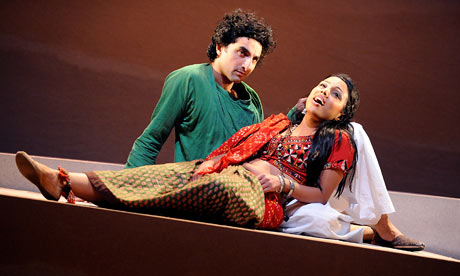
Picture: Davina Perera in Wuthering Heights at the Lyric Theatre, Hammersmith. Photograph: Tristram Kenton. Source.
This Wuthering Heights has something which never overburdened Emily Brontë: a sense of humour. At the same time, the melodrama of the moors - its wails, its glowers, its gnashings and thunderings - translates perfectly into Bollywood's eye-rolling, breast-heaving extravagance; Kristine Landon-Smith's production takes its cue from the 1939 movie with Laurence Olivier and Merle Oberon, and wind-whipped, nostril-quivering profiles.
The choreography is limited: the lovers spend an awful lot of time running from side to side of the stage to show their entrapped passion; the dialogue is occasionally slurred; the stage is sometimes - and this is India? - underpopulated; the prevailing mood is alluring rather than alarming. But Felix Cross and Sheema Mukherjee's music expands the emotional vocabulary, with its big strings, its drummings and its sidling rhythms. A patina of irony is added by everyone lipsynching, Bollywood-style. Pushpinder Chani and Youkti Patel shimmer as the lovers. It's 13 years since Tamasha produced East is East; 11 years since they helped to propel Parminder Nagra towards stardom with Fourteen Songs, Two Weddings And A Funeral. Wuthering Heights is less surprising, but equally buoyant. (Susannah Clapp)
The bad one comes from The Independent:
From this silly romp we bound away to the tempestuous romance of Wuthering Heights, turned into a Bolly- wood-tinged musical by the British-Asian troupe, Tamasha.
It must be said, Kristine Landon-Smith's touring production has its risibly cheesy moments as Heathcliff and Cathy – renamed Krishan and Shakuntala – lipsynch to pre-recorded songs. Burning ardour loses all conviction when your hero and heroine are visibly just mouthing along. And there is more unwitting bathos in Felix Cross's lyrics. "She walks across the sand, like she's floating on air," croons the smitten Vijay – Krishan's wealthy rival – even as Youkti Patel's Shakuntala hobbles out of a wheelchair, recovering from a gunshot wound to the calf. I know love is blind, but this is ridiculous.
That said, adaptor Deepak Verma's concept, translating Emily Brontë's 1840s tale from the Yorkshire moors to the desert landscape of Rajasthan, is seductive. The ensemble spin in beautiful scarlet turbans and green saris on the zigzagging slopes of a golden dune (design by Sue Mayes). The Indian setting, moreover, enriches the tragedy, as the caste system proves a devastating barrier between the ragged Krishan and his socially superior childhood sweetheart.
A couple of the songs, jointly composed by Cross, Sheema Mukherjee and Chandru of Bollywood Strings, prove haunting, too, with echoing ululations, a husky bamboo flute and pulsing tablas. (Kate Bassett)
The Independent talks about Jean Rhys now that Lilian Pizzichini's biography of her, The Blue Hour, is going to be published:
She carried on, in a third unhappy marriage and drinking ever more heavily, until 1949, when a writer and actress called Selma Vaz Dias placed an ad in a newspaper looking for her. She wanted to adapt some of Rhys's work for the BBC; an editor, Francis Wyndham, wanted more work from Rhys. She had, she told him, a novel under way. It was Wide Sargasso Sea, the story of Bertha Mason, the first wife of Mr Rochester in Charlotte Brontë's Jane Eyre.
It's perhaps not surprising that Rhys's greatest work was about a woman who is rejected by the man she loves and goes on to destroy herself. Rhys constantly felt abandoned, yet was constantly searching for the man who could take care of her and, finally, make it all right. Yet, as Pizzichini rightly says, her writing was her true partner. It is possible that Rhys never fully realised this, or didn't want to realise it, perhaps: the path of the artist is often by necessity a lonely one, and Rhys drank not to feel lonely.
And so, her response to the sudden fame and fortune that Wide Sargasso Sea brought was classically self-pitying and the lament of the ingénue: "It has come too late." Rhys, ever the contradiction, wouldn't let it happen for her, however much she wanted it to. The truth of Jean Rhys's genius is contained within that contradiction, however: the little girl who wouldn't grow up, yet whose work depended, ultimately, upon the maturity of experience. I believe that she understood that contradiction. She knew what lay "deep and primitive" in her own soul. In her writing she was able to use it, and it was a relationship with a male writer that taught her how. (Lesley McDowell)
And yet another article from The Independent. Talking about the Poet Laureates, a mention is made to Robert Southey and his infamous 'advice' to Charlotte Brontë:
The first Poet Laureate to receive a salary was Henry James Pye (1790), who was given £27 a year and was not widely held to deserve it. The post in relation to women was defined by Robert Southey (1813), who in 1837 received a letter from Charlotte Brontë, asking for his advice about her poetry. He replied, discouraging her from writing anything further and advising her that "literature cannot be the business of a woman's life". (Katy Guest)
Finally, students who love Jane Eyre in Neighborhood Star, plays on words with Wuthering Heights in The Independent (Ireland) and Wuthering Heights evocations in Alaska in the Sunday Herald.

Categories: , , , , , ,

Wednesday, May 06, 2009

Wednesday, May 06, 2009 1:21 pm by Cristina in , , , , , ,    No comments
Our usual beginning of late: more reviews of Tamasha's Wuthering Heights. The Guardian reviews both the play and other reviews with which you will be familar as we have been posting them:
Picture: Youkit Patel as Shakuntala and Pushpinder Chani as Krishnan. Photograph: Tristram Kenton (Source)
When you first heard that Emily Brontë's brooding Victorian love story was going to be staged as a Bollywood musical by Sanjay off of EastEnders, naturally your hopes were high. No matter that the novel, according to the Guardian's Michael Billington, has already been the source for "23 plays, 14 musicals, 16 TV and radio adaptations and eight films". And never mind that Deepak Verma has decided to cut the vengeful second half of the book, thereby bringing his version "closer to Mills and Boon than King Lear" (Billington).
What clearly transcended these quibbles was that, as the Times's Clive Davis puts it, "Brontë's taste for the Gothic and Mumbai's love of melodrama ought to have made a promising match". And after all, everybody loves a bit of Bolly, don't they? What's not to like about an incredibly long and incomprehensible Indian musical? And yet ... you can probably already guess which way this is going to go.
When voicing your opinion you must, like most of the critics, demonstrate that you have really done your best to like this Wuthering Heights musical. A quick string of somewhat feeble compliments should do it. "Kristine Landon-Smith's production makes an agreeable spectacle," says Billington, for instance, adding that, "Sue Mayes's design beautifully evokes russet Rajasthan skies, and the acting is perfectly good."
Or you might observe that Verma's adaptation is "close enough to be familiar and is generally successful," as Ian Shuttleworth of the Financial Times does. "A couple of the songs ... prove haunting, too," says Kate Bassett, piping up to fill an awkward silence in the Independent on Sunday. "I only wish I could recommend [it] with ardency," shrugs the Telegraph's Dominic Cavendish, without any. "You can see how it might look good on the big screen; on stage, it feels dramatically malnourished."
Having tried to like the show, however, it is time to join the chorus of disapproval. Davis, in particular, pulls on his kicking boots. "This half-hearted pairing [of styles] yields neither spectacle nor psychological insight," he thunders. "Felix Cross and Sheema Mukherjee's lip-synched music – specially recorded in India, although you would hardly guess it – is never more than tepid. And Kristine Landon-Smith's direction delivers little of the visual energy that is the hallmark of the Bollywood industry." He pauses to get his breath back. And then he resumes. "The decision to pepper the dialogue with Hindi phrases is irritating too." Boot. Stamp. Bludgeon. "My Indian wife has taught me quite a few over the years, but I was still left in the dark as my neighbours chuckled away."
To avoid being mistaken for one of Davis's neighours, you might finally want to point out that if you did chuckle, it was only because you found a moment that was laugh-out-loud bad. Helpfully, Bassett has provided this example: "'She walks across the sand, like she's floating on air,' croons the smitten Vijay," Bassett observes, "even as Youkti Patel's Shakuntala hobbles out of a wheelchair, recovering from a gunshot wound to the calf. I know love is blind, but this is ridiculous."
Do say: Bollywood is so marvellously vibrant and life-affirming.
Don't say: Shouldn't this be about three hours longer?
The reviews reviewed: Not nearly wuthering enough. (Leo Benedictus)
Variety's review is more conventional and not very enthusiastic:
A Bollywood musical version of Emily Bronte's beloved tale is an engaging idea in principle. The melodramatic story of "Wuthering Heights" ostensibly fits into the Bollywood style, and the comparison made between 18th century Rajasthan and 19th century England inevitably prompts reflection on the ways in which ethnicity and class now mingle together in contempo Britain's complicated multiculture. The production also stands to capitalize on the popularity of Indian-themed pop culture post-"Slumdog Millionaire." But this new touring version falls at many key hurdles; weak music, lyrics and performances and muddy direction make for a lumbering 160 minutes.
The story is told in flashback, narrated by mysterious tramp Baba (Shammi Auukh) to Changoo (Divian Ladwa), a young boy he meets in a camel market. Bronte's Cathy becomes headstrong spice merchant's daughter Shakuntala (Youkti Patel), while Heathcliff is Krishan (Pushpinder Chani), a low-caste boy adopted into the family who develops a lifelong bond with Shakuntala.
The latter is enticed into the wealthy world of the high-caste Vijay (Gary Pillai) and eventually marries him, but her head is turned several years later when Krishan returns to the community a wealthy man, just in time for her tragic death. A clever 11th-hour plot twist ties together Baba with the story he's telling and enables a somewhat happy ending.
Spectacle and broad-strokes storytelling are favored over character development, but this seems a faulty choice because lack of access to the characters' psyches makes them come across (particularly in these underpowered performances) as one-sided and somewhat facile.
The Bollywood elements, which were presumably intended to add interest and steer the audience's relationship to the material, are underplayed. That the musical numbers are all prerecorded -- including vocals -- could have been played as an ironic wink, but it remains unclear if auds are meant to actually believe the performers are singing live. Similarly, it's unclear whether Felix Cross and Sheema's repetitious music and Cross' simplistic lyrics ("Me with you and you with me/Be whoever we want to be/Only you can turn the key ...") are intentionally laughable.
Set design and staging choices further hinder engagement, though this is mitigated mildly by the loveliness of Sue Mayes' silken costumes. The stage is made up of a series of slanted diagonal pathways leading up to a raised playing area. The stage floor becomes, unnecessarily, almost exclusively Baba and Changoo's domain, squashing most of the action onto the narrow pathways. Director Kristine Landon-Smith frequently hides key moments in remote corners of the stage and unforgivably places supernumeraries in front of the action during Shakuntala's death scene.
This is not the first foray into Bollywood-style stagings for lead producer Tamasha, a leading British Asian theater org best known for premiering Ayub Khan-Din's play "East Is East," which went on to become an acclaimed film. The company's well-received 1998 tuner "Fourteen Songs, Two Weddings and a Funeral," an adaptation of a Bollywood film, used many of the same conventions (lip synching to a recorded track, for example). Here, however, the creative team has not found a way to satisfyingly transpose the historic story into its new format; the production seems lost between worlds. (Karen Fricker)
But back to the Guardian where our friend (not!) Tanya Gold writes an article entitled 'To understand Amy Winehouse, perhaps we should consider Jean Rhys, author of Wide Sargasso Sea' "inspired" by Lilian Pizzichini's biography of Jean Rhys, The Blue Hour.
She reappeared in 1949 when a radio producer, who wanted to dramatise one of her novels, placed an advertisement in the New Statesman. Jean Rhys, where are you? She was found, and she finally rewrote Wide Sargasso Sea.
The novel is a prequel to Jane Eyre. Jane Eyre is about a principled, virginal governess who falls in love with her employer Mr Rochester, but cannot marry him, because he has a wife, an insane and dangerous woman who lives in the attic, and appears only to start fires. It is a rescue fantasy - a book about how a plain woman can be saved by a powerful man. Jean Rhys took a copy of Jane Eyre, a bottle of whisky, and retreated to her bed.
And she wrote it brilliantly, punching Charlotte Brontë in the face with a bottle of Scotch. Wide Sargasso Sea is a cynical version of Jane Eyre - written not by a virginal parson's daughter, but by a woman who has been a drunken destitute. One book is a fantasy of rescue, the other a book about how an addict can never be rescued.
If there was any possibility that Charlotte Brontë and Miss Gold had shared time and space at some point we'd be positive that Charlotte Brontë had done something very bad to offend Ms Gold on purpose. As such a possibility doesn't exist we must simply conclude - yet again - that Ms Gold is highly prejudiced against Charlotte Brontë.

On to something else. According to The Frisky Mother's Day Gift Guide, you fall into the 'classy and refined' category if you...
... knew who Charlotte Bronte was before starting high school (Catherine)
FilmCrunch writes about how the Academy of Motion Picture Arts and Sciences has decided to 'pay homage to one of the greatest years for movies by honoring ten legendary films from 1939'. William Wyler's Wuthering Heights is obviously one of them:
Wuthering Heights, based on that tragic book of lost love by the same name, stars Laurence Olivier and Merle Oberon. This film was nominated for eight statues in ‘39, but Gone With the Wind took almost every single award. Olivier very much wanted his future wife, Vivien Leigh, to play opposite him in the role of Emily. Lucky for film fans, Leigh became the leading lady of GWTW instead. (K.C. Morgan)
In the Academy's website we find more information:
The 10-film 70th anniversary celebration, which will run through August 3, showcases all of the Best Picture nominees from a landmark year that saw the release of an exceptional number of outstanding films. All screenings will be held on Monday evenings at 7:30 p.m. at the Academy’s Samuel Goldwyn Theater.
June 8 “Wuthering Heights”
Just one blog today: Echostains posts about S.R. Whitehead's book The Brontës' Haworth.

Categories: , , , , , ,

Monday, September 14, 2009

Monday, September 14, 2009 1:52 pm by Cristina in , , , , ,    No comments
Quite a few local press articles to report today. The Telegraph and Argus encourages readers to follow the 'Brontë trail', as do we:
Think Brontemania and you’re likely to think of a windswept parsonage standing against bleak moorland, overlooking the cobbled streets of Haworth. The Brontes’ former home has been a museum for more than 80 years, and attracts thousands of visitors from around the world.
Numbers have been boosted by the ITV adaptation of Emily Bronte’s classic Wuthering Heights, shown last week. Costumes from the drama, including dresses worn by actress Charlotte Riley as Cathy and a long black coat worn by Tom Hardy as Heathcliff, are on display at the museum until the end of the year.
But the Bronte trail doesn’t just lead to Haworth. The literary family left a mark across the district, from Thornton, where the sisters’ birthplace stands in Market Street, to Apperley Bridge, where Charlotte taught, to the Spen Valley, which provided much of the inspiration for her novel, Shirley.
In the TV adaptation of Wuthering Heights, also starring Andrew Lincoln and Sarah Lancashire, both East Riddlesden Hall and Oakwell Hall had a starring role as the Earnshaw family’s moorland home.
Exterior shots of East Riddlesden’s imposing facade were featured, and filming at Oakwell Hall took place in the kitchen, with its huge stone fireplace, parlour, wood-panelled dining-room, used as Mr Earnshaw’s study, the painted chamber and a servant’s room upstairs. Artefacts from the TV drama currently on display at Oakwell Hall include a signed script, a portrait of Cathy, a headboard carved with the names Cathy and Heathcliff, and the deeds to Wuthering Heights which Heathcliff made a drunken Hindley sign.
There was already a Bronte connection to Oakwell Hall long before the Wuthering Heights film crew rolled up. Charlotte Bronte visited the house in the 19th century and it was the inspiration for Fieldhead in Shirley.
Built in 1583, the manor house is set out as it would have been in the 1690s, when it was home to the Batt family. A mix of original and reproduction furnishings provide an insight into late 17th century life. Outside, dotted around a pretty courtyard, is a visitor centre, shop, cafe and ‘Discover Oakwell’ gallery.
The house is set in 110 acres of country park, with delightful walks, nature trails, a period garden and a wildlife area.
Over at Gomersal, an 1830s former cloth merchant’s home, Red House, also has a Bronte link. The home of Charlotte’s friend Mary Taylor, it is featured as Briarmains in Shirley.
“There was no splendour, but taste was everywhere,” wrote Charlotte about the pretty red-brick house, which looks much as it did in her day. Each room brings you closer to the 1830s, from the elegant parlour to the stone-flagged kitchen with its old range and jelly moulds, to the stained glass windows, described in the novel. Charlotte’s Spen connections and friendship with Mary are explored in an exhibition in the barn.
Wandering around the Parsonage Museum, with the sound of crows outside, there’s a fascinating flavour of the Brontes’ domestic and creative lives.
Items on display include Charlotte’s writing materials and their father Patrick’s magnifying glass.
Pre-booked guided tours allow visitors to see treasures from the Bronte Society’s world-famous collections not always on display, including miniature books, made from sugar paper stitched together, which the siblings created as children.
Outdoor activities include guided walks around Haworth, starting in the Parsonage garden, which remains pretty much as it was during the Brontes’ time. A Cyprus Pine tree has grown from saplings planted by Charlotte acquired on honeymoon in Ireland.
Peter Bowker, screenwriter of ITV’s Wuthering Heights, will be at West Lane Baptist Church, Haworth, on September 24 to talk about the process of adapting a classic novel for television.
Next Saturday, novellist Barbara Taylor Bradford will be at Haworth’s Old Schoolroom talking about her love of the Brontes.
Factfile The Bronte Parsonage Museum, Haworth, is open from April to September, 10am-5.30pm and October to March, 11am-5pm. For more, ring (01535) 642323 or bronte.org Oakwell Hall, Nutter Lane, Birstall, is open weekdays, 11am-5pm, and Saturdays and Sundays, noon-5pm. Ring (01924) 326240 or visit kirklees.gov.uk East Riddlesden Hall, Bradford Road, Riddlesden, is open Saturday to Wednesday, 11am-5pm. Ring (01535) 607075 or visit eastriddlesdenhall.co.uk Red House Museum, Oxford Road, Gomersal, is open Monday to Friday, 11am-5pm and Saturdays and Sundays, noon-5pm. Ring (01274) 335100. (Emma Clayton)
Also The Telegraph and Argus reports that East Riddleden Hall will be open to the public as part of this year's Heritage Open Days:
East Riddlesden Hall, near Keighley, owned by the National Trust, was one of eight of the charity’s Yorkshire properties taking part in Heritage Open Days programme.
The 17th century manor house, which has a country garden, grass maze and duck pond, also has links to the Civil War and was the location for the 1992 film adaptation of Wuthering Heights. (Hannah Baker)
Don't forget that Holy Trinity Church at Little Ouseburn - the church Anne attended while working for the Robinson family - will also be open as part of the same initiative.

And also from The Telegraph and Argus comes an interesting letter from a reader:
SIR – Haworth is a lovely place, I go there often. There’s nothing better than strolling up Main Street to the Bronte Parsonage, and then back down to The Fleece, where on a nice afternoon one can sit outside with a pint of Timmy Taylors, chill out, and watch the world go by.
Just one thing spoils it. Why can’t Bradford Council replace the modern imitation gas lamp, opposite the pub, with a genuine ‘proper’ Victorian gas lamp (adapted to electric of course).
For a few hundred quid it would look much better and more in keeping with the street.
Just one more thing while talking of improvements; get rid of the wheel-clamping ‘Dick Turpin’ – he gives Haworth a bad name.
I Dickinson, Cooper Lane, Horton Bank Top
After all this (excepting the hateful clamper, of course), the following article from the Keighley News is hardly surprising, is it?
Keighley and Haworth are helping Yorkshire in its role as one of the most popular tourist destinations in the UK.
Bradford district comes out as a top spot in a visitor survey which reveals how the county is bucking tourism trends.
And the Brontë Parsonage Museum and Keighley and Worth Valley Railway are among the tourist hotspots.
The city and surrounding area was praised for its “good atmosphere”.
The majority of visitors — 84 per cent — planned to attend museums or other cultural attractions, according to the survey.
Almost 11,000 people visiting the county were quizzed about their opinions, between May 2008 and April this year.
The survey was funded by Yorkshire Forward and managed by Welcome to Yorkshire.
Its aim was to give a breakdown of visitor habits and the results revealed high scores for feeling welcome, customer service and atmosphere and value for money.
Bradford was said to be full of character and had lovely countryside and the Haworth area was good for walking and visiting.
Jim Shipley, of the Keighley and Worth Valley Railway, said the survey was in line with what the heritage line was experiencing.
“We have noticed that the number of visitors midweek is higher — last year we suffered a drop,” he said. “And there is a distinct increase in the number of foreign visitors. All this is very gratifying. Keeping visitors and ensuring they return involves giving them extra value when they get here — not just a trip on a steam locomotive.”
Gary Verity, chief executive of Welcome to Yorkshire, said: “This is the first time that such in-depth visitor information has been collated.
“Headline results show that 96 per cent of visitors would recommend to a friend and 88 per cent are likely to return, which is excellent.”
A town on the other side of the pond - in Texas - also has a Brontë connection, according to the San Angelo Standard Times:
Folklore has it that the town of Bronte was named after the author of “Wuthering Heights” when it was founded in the 1880s. . . (Laurel L. Scott)
Western Mail reviews The Blue Hour: A Life of Jean Rhys by Lilian Pizzichini.
She left the Caribbean in 1907 for a convent school in England, already by this time a lover of the works of Dickens and the Brontes. [...]
But it was Wide Sargasso Sea, published in 1966 after she spent many years as a recluse in Devon, which is best remembered.
The book was written as a prequel to Charlotte Bronte’s 1847 classic Jane Eyre.
In the novel, set in the Caribbean, Rhys invents a dark and disturbing history for the unfortunate first bride of Edward Rochester, known as Bertha Mason.
Pizzichini said: “Written more than 40 years ago, Wide Sargasso Sea clearly mined Rhys’s memories of life in the lush backwaters and steamy heat of Dominica in her attempt to explain how Bronte’s dishevelled figure locked in the attic came to lose her mind.”
Bethan Jenkins, Plaid Cymru AM for South Wales West, has listed Wide Sargasso Sea as one of her favourite books. She described it as a “strong critique of colonialism with a vibrant feminist edge”. (Robin Turner)
The Monthly Review discusses 'a new edition of Jonah Raskin’s The Mythology of Imperialism: A Revolutionary Critique of British Literature and Society in the Modern Age', making a brief reference to Emily Brontë.
As a big fan of Victorian novels, even the stay-at-home kind, I’m tempted to object that some of what Raskin says about the Victorians (not all of which is negative—he does see important virtues in Dickens, Emily Bronte, and even George Eliot) is tendentiously arranged to make the contrasting case for the modernists who came afterward. Is there too much resolution in the endings of Victorian novels? Well, maybe, but it depends on how good you are at recognizing loose ends, so to speak, that carry the logic of the novel beyond its final distribution of reward and punishment. These novels invest a lot of energy in issues that they cannot finally resolve, and that they all but admit they cannot resolve. In this sense, they do what Raskin’s book also does: teach readers to recognize the contradictions in their lives by following out the contradictions lived by literary characters, even if no one can imagine any immediate or likely resolution to those contradictions. (Bruce Robbins)
And it looks like we're in for another ride in the 'Austen-meets-Brontë' review type, as shown by this article from The Telegraph on the BBC's forthcoming Emma adaptation.
Producers seem to believe that passion is good and appeals to modern audiences, while emotional restraint is a distortion of natural impulses therefore bad. Perhaps this is what is behind the new BBC adaptation. It sounds as if what they're going to create is a strange kind of hybrid: Austen crossed with the Brontes or Bridget Jones in a bonnet.
In some ways the aim to make Emma alive and readable is laudable but you have to work out how much you can change Austen for it to still be Austen. (Judith Hawley)
Crafty people on the blogs today: Love and Friendship has created several Jane Eyre 2006 icons and Carol's Crafty Creations has pictures of her Wuthering Heights quilt.

Categories: , , , , ,