Podcasts

  • S4 E4: with... Eliza Goodpasture - On this episode, Mia and Sam sit down with art historian and writer Eliza Goodpasture! Eliza has written the introduction to a new edition of Emily Bront...
    1 day ago
Showing posts sorted by relevance for query tanya gold. Sort by date Show all posts

Saturday, December 29, 2007

The Guardian highlights some of the forthcoming novels for 2008. Among them, one that has been already mentioned on BrontëBlog:
Justine Picardie's Daphne (Bloomsbury, March) investigates Daphne du Maurier's fascination with the Brontë sisters' reprobate brother Branwell, in a literary mystery of stolen manuscripts. (Justine Jordan)
The Oklahoman best TV bet for this weekend is the PBS re-airing of Jane Eyre 2006:
SUNDAY
BEST BET
•"Masterpiece Theatre,” 8 p.m., OETA-13.
Did you swoon over Colin Firth as Mr. Darcy in "Pride and Prejudice”? Meet Toby Stephens, whose portrayal of Mr. Rochester in this four-part "Jane Eyre” drew raves. Ruth Wilson gives an equally inspired performance as Jane, the plucky orphan he hires as a governess, in what many are calling the best screen take on Charlotte Bronte's classic. Even if Toby's not your type, you'll enjoy it.
The Minneapolis Star-Tribune reviews the best theatre seen in the Twin Cities area and Alan Stanford's Jane Eyre at the Guthrie Theatre is mentioned:
Outstanding play, larger theaters: Director Peter Rothstein and his cast sharpened Noel Coward's wit in "Private Lives," which bested a provocative "Merchant of Venice" -- both Guthrie productions -- and an incisive "Speed the Plow" at the Jungle. Honorable mentions to "Jane Eyre" and "The Glass Menagerie" at the Guthrie. (Tom Wallace)
And well, we have another Brontë mention in an article by Tanya Gold in The Guardian. Yes, the same person who wrote this and this. It's a pity that Charlotte Brontë gets mixed into this article where Ms Gold plays the missing link between Valerie Solanas and Bridget Jones.
Why does the loneliness never end (© Charlotte Bronte 1855)?
We don't know if Tanya Gold is quoting from Charlotte Brontë or - as is her wont - just making fun of her. In any case it's quite improbable that Charlotte Brontë would have written such a thing in 1855, months into her happy marriage and shortly before her death.

On the blogosphere, Bokmania talks about the upcoming airing of Jane Eyre 2006 in Sweden among other Brontë-related Swedish stuff, CataRomance interviews author Michelle Douglas who chooses Emily Brontë as one of her favourite writers (for her passion). O Muro das Lamentações briefly discusses Wuthering Heights in Portuguese. Girlebooks reviews Anne Brontë's The Tenant of Wildfell Hall:
The Tenant of Wildfell Hall is a story that will stay with you, perhaps requiring subsequent readings. Another common theme among reviewers was astonishment that such an accurate portrayal of marital strife should come from a young woman who never married. (Laura McDonald)
My temporary tree posts a beautiful picture inspired by Wichrowe wzgórza, i.e. Wuthering Heights in Polish.

And finally, a post from The Victorian Peeper about Joshua Cawthra, the Man with Handel on His Monument. Its author, Richard Wilcocks, former chairman of the Brontë Society and current editor of the Brontë Parsonage Blog.

Categories: , , , , , , , , , ,

Thursday, April 08, 2010

Thursday, April 08, 2010 1:56 pm by Cristina in , , , , ,    4 comments
Further news on Cara Fukunaga's Jane Eyre filming locations. According to the Derby Telegraph, apart from Froggatt and Fox House, locations include:
TWO Derbyshire stately homes will be used to film scenes for a new Hollywood movie.
Chatsworth and Haddon Hall will both be featured as locations in Jane Eyre, a new production of the classic novel by Charlotte Bronte.
Stars appearing in the film include Dame Judi Dench and Jamie Bell and shooting will take place over the next few weeks.
Yesterday the Derby Telegraph revealed that the movie's stars would be staying near Matlock during some of the filming.
Now Ian Thompson, publicist for Ruby Films, which is producing the film, has confirmed the filming locations.
He said: "Along with Chatsworth and Haddon Hall we are also shooting some scenes in the Derbyshire Dales.
"It's not hard to point the camera somewhere in Derbyshire and for it to look stunning.
"It's the untouched rural beauty of the region and the stately homes that makes it perfect for shooting period films."
In the past, films such as The Wolfman and The Duchess have been shot at Chatsworth, attracting stars such as Benicio Del Toro and Keira Knightley.
James Trevethick, head of house operations at Chatsworth, said: "It's not only a tourism boost to the estate but it celebrates the beauty of the place.
"We are only involved in a few minor scenes but we are always glad to welcome a film crew."
Red House Stables, in Darley Dale, will be providing accommodation for both horses and humans while filming is under way.
Caroline Dale-Leech, owner of Red House Stables, said: "We are catering for up to 16 people and 16 horses and they will be staying over the next few weeks but numbers will vary as filming changes."
Yesterday's edition of the Derby Telegraph did indeed comment on the goings-on behind the scenes:
HOLLYWOOD stars will be in Derbyshire again as parts of a new adaptation of classic novel Jane Eyre are filmed in the county.
Dame Judi Dench and Billy Elliot star Jamie Bell are among the cast for the new movie.
The locations for filming have yet to be confirmed, but the cast and crew will be staying at a working museum near Matlock while shooting takes place.
Red House Stables, in Darley Dale, will provide accommodation for both horses and humans while filming is under way for the period drama, based on the 19th-century novel by Charlotte Bronte.
The building houses a large collection of original horse-drawn vehicles and equipment and, as a working museum, regularly takes them out on the road.
The size of the collection and working order of the equipment has led to the place developing a growing sideline in providing props and horses for film-makers.
Caroline Dale-Leech, owner of Red House Stables, said it was not the first time the company had worked with a film crew.
She said: "We have been operating as a museum since 1946 and have helped with plenty of films before.
"But we are always happy to accommodate them. Normally they use our horses and carriages in the films but this time they have their own so we will just provide the horses and crew with somewhere to stay. (...)
She said the stables had been involved with film companies since the 1960s.
Over the years, Caroline said they had helped in the making of Chitty Chitty Bang Bang, the BBC TV version of Pride and Prejudice, films based on DH Lawrence's novels Sons and Lovers and Women in Love and TV show Peak Practice.
She said: "We also do all sorts of promotions and advertising. We have built up a good reputation and it is a unique selling point.
"On the back of our work with films, especially after the BBC's Pride and Prejudice series, we had people from as far as Japan come and visit on tours especially to see us." (...)
Christine Langan, creative director of BBC Films, said: "We're delighted to bring together two such fresh and impressive talents as director Cary Fukunaga and screenwriter Moira Buffini.
"Added to the gorgeous cast Cary has assembled, this is exactly the treatment Charlotte Bronte's evergreen classic Jane Eyre deserves."
And the search is still on for the young and older Heathcliff as well as young Cathy for Andrea Arnold's Wuthering Heights, as the Gazette & Herald says.
FILM-MAKERS are appealing for unknown actors in the region to star in the latest big-screen film to shoot in Yorkshire.
A new adaptation of Emily Bronte’s 1847 novel Wuthering Heights is set to film on location in Yorkshire at the end of May, directed by Oscar and BAFTA-winning director Andrea Arnold.
Skins star Kaya Scodelario will play Catherine Earnshaw, but the role of Heathcliff had yet to be filled.
Now an open casting call has been issued by investors Screen Yorkshire looking for Heathcliffe and younger versions of both central characters.
A spokesman for the film- makers said the Heathcliff they are looking for is, “Male, working class, brooding, 16-21 years old.” Actors auditioning for the role of young Heathcliff must fit the same description, but be aged between 10 and 14.
The young Catherine is described as “10 to 13 years old (strictly no older than 13), pale-skinned, dark-haired, feisty”.
Actors auditioning for the roles do not need any acting experience, but will ideally have a Yorkshire accent and must be available for eight weeks from the end of May.
Auditions take place at Jurys Inn Hotel in Leeds today, at 2pm, and tomorrow, at 9am.
For more details, email Rob Earnshaw at rob@thecastingwebsite.com or phone 01952 458450.
An Earnshaw casting Heathcliff... Life's ironies.

A.V Club reviews Marina Endicott's Good to a Fault:
Good To A Fault’s perspective jumps fitfully between the members of the ad hoc family, and some of its best moments are spent following Lorraine’s precocious daughter, Dolly, as she snoops into strangers’ homes and escapes into Jane Eyre and Mistress Masham’s Repose. They’re stories about orphans, but fiction lets her keep her mother’s illness at arms’ length. An Anglican priest who takes an interest in the family has a similar coping mechanism: When his own words fail him, he always has a snatch of poetry ready to substitute. Together, they present a moving portrait of the ways art can function as salve and shield. (Christian William)
And The Smith College Sophian discusses R.D. McHattie's Returning to Denver:
I found Returning to Denver difficult to read, its main character undeveloped and therefore unsympathetic - for how can one sympathize with what one does not know? - and its tale only half-coherent, and the coherent half seemed cribbed from other, better novels. The mystery of the Glampers family and their old house was reminiscent of every other "madwoman in the attic" novel ever written, and frankly, I'd rather have Jane Eyre or the mysterious, gruff Heathcliff of Wuthering Heights than the inscrutable Doris. I'd even rather have Jane the obnoxious Mr. Lockwood than the annoyingly repetitious protagonist Diane. (Emily Atkinson)
The Galway Advertiser alludes to Joyce Carol Oates's Brontëiteness and CCTV.com mentions Charlotte Brontë as one of the visitors to London's 1851 Great Exhibition.

But the actual big news of the day is that Gordon Brown has mutated into yet another Brontë character! From The Telegraph by the always controversial Tanya Gold:
“We cannot cut our way to recovery!” Gordon responded, with a wince. As he shuddered, knowing that the electorate IS too busy WATCHING EMMERDALE to decipher the minutiae of Keynesian economics, I realised that people are wrong when they say Brown is Rochester from Jane Eyre. Actually he is Rivers, the wracked, obsessive missionary who wants to save the world but dies himself.
Nevertheless, Tanya Gold is not so original as the comparison has been done before.

On the blogosphere, Le Blog de Verte Adélie (in French and English) has joined in the Brontë-along.

Categories: , , , , ,

Wednesday, May 06, 2009

Wednesday, May 06, 2009 1:21 pm by Cristina in , , , , , ,    No comments
Our usual beginning of late: more reviews of Tamasha's Wuthering Heights. The Guardian reviews both the play and other reviews with which you will be familar as we have been posting them:
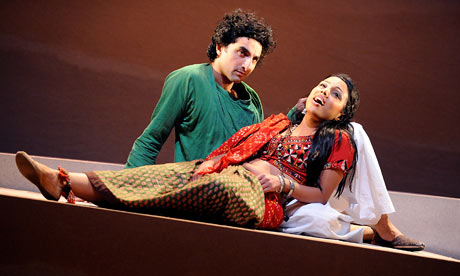
Picture: Youkit Patel as Shakuntala and Pushpinder Chani as Krishnan. Photograph: Tristram Kenton (Source)
When you first heard that Emily Brontë's brooding Victorian love story was going to be staged as a Bollywood musical by Sanjay off of EastEnders, naturally your hopes were high. No matter that the novel, according to the Guardian's Michael Billington, has already been the source for "23 plays, 14 musicals, 16 TV and radio adaptations and eight films". And never mind that Deepak Verma has decided to cut the vengeful second half of the book, thereby bringing his version "closer to Mills and Boon than King Lear" (Billington).
What clearly transcended these quibbles was that, as the Times's Clive Davis puts it, "Brontë's taste for the Gothic and Mumbai's love of melodrama ought to have made a promising match". And after all, everybody loves a bit of Bolly, don't they? What's not to like about an incredibly long and incomprehensible Indian musical? And yet ... you can probably already guess which way this is going to go.
When voicing your opinion you must, like most of the critics, demonstrate that you have really done your best to like this Wuthering Heights musical. A quick string of somewhat feeble compliments should do it. "Kristine Landon-Smith's production makes an agreeable spectacle," says Billington, for instance, adding that, "Sue Mayes's design beautifully evokes russet Rajasthan skies, and the acting is perfectly good."
Or you might observe that Verma's adaptation is "close enough to be familiar and is generally successful," as Ian Shuttleworth of the Financial Times does. "A couple of the songs ... prove haunting, too," says Kate Bassett, piping up to fill an awkward silence in the Independent on Sunday. "I only wish I could recommend [it] with ardency," shrugs the Telegraph's Dominic Cavendish, without any. "You can see how it might look good on the big screen; on stage, it feels dramatically malnourished."
Having tried to like the show, however, it is time to join the chorus of disapproval. Davis, in particular, pulls on his kicking boots. "This half-hearted pairing [of styles] yields neither spectacle nor psychological insight," he thunders. "Felix Cross and Sheema Mukherjee's lip-synched music – specially recorded in India, although you would hardly guess it – is never more than tepid. And Kristine Landon-Smith's direction delivers little of the visual energy that is the hallmark of the Bollywood industry." He pauses to get his breath back. And then he resumes. "The decision to pepper the dialogue with Hindi phrases is irritating too." Boot. Stamp. Bludgeon. "My Indian wife has taught me quite a few over the years, but I was still left in the dark as my neighbours chuckled away."
To avoid being mistaken for one of Davis's neighours, you might finally want to point out that if you did chuckle, it was only because you found a moment that was laugh-out-loud bad. Helpfully, Bassett has provided this example: "'She walks across the sand, like she's floating on air,' croons the smitten Vijay," Bassett observes, "even as Youkti Patel's Shakuntala hobbles out of a wheelchair, recovering from a gunshot wound to the calf. I know love is blind, but this is ridiculous."
Do say: Bollywood is so marvellously vibrant and life-affirming.
Don't say: Shouldn't this be about three hours longer?
The reviews reviewed: Not nearly wuthering enough. (Leo Benedictus)
Variety's review is more conventional and not very enthusiastic:
A Bollywood musical version of Emily Bronte's beloved tale is an engaging idea in principle. The melodramatic story of "Wuthering Heights" ostensibly fits into the Bollywood style, and the comparison made between 18th century Rajasthan and 19th century England inevitably prompts reflection on the ways in which ethnicity and class now mingle together in contempo Britain's complicated multiculture. The production also stands to capitalize on the popularity of Indian-themed pop culture post-"Slumdog Millionaire." But this new touring version falls at many key hurdles; weak music, lyrics and performances and muddy direction make for a lumbering 160 minutes.
The story is told in flashback, narrated by mysterious tramp Baba (Shammi Auukh) to Changoo (Divian Ladwa), a young boy he meets in a camel market. Bronte's Cathy becomes headstrong spice merchant's daughter Shakuntala (Youkti Patel), while Heathcliff is Krishan (Pushpinder Chani), a low-caste boy adopted into the family who develops a lifelong bond with Shakuntala.
The latter is enticed into the wealthy world of the high-caste Vijay (Gary Pillai) and eventually marries him, but her head is turned several years later when Krishan returns to the community a wealthy man, just in time for her tragic death. A clever 11th-hour plot twist ties together Baba with the story he's telling and enables a somewhat happy ending.
Spectacle and broad-strokes storytelling are favored over character development, but this seems a faulty choice because lack of access to the characters' psyches makes them come across (particularly in these underpowered performances) as one-sided and somewhat facile.
The Bollywood elements, which were presumably intended to add interest and steer the audience's relationship to the material, are underplayed. That the musical numbers are all prerecorded -- including vocals -- could have been played as an ironic wink, but it remains unclear if auds are meant to actually believe the performers are singing live. Similarly, it's unclear whether Felix Cross and Sheema's repetitious music and Cross' simplistic lyrics ("Me with you and you with me/Be whoever we want to be/Only you can turn the key ...") are intentionally laughable.
Set design and staging choices further hinder engagement, though this is mitigated mildly by the loveliness of Sue Mayes' silken costumes. The stage is made up of a series of slanted diagonal pathways leading up to a raised playing area. The stage floor becomes, unnecessarily, almost exclusively Baba and Changoo's domain, squashing most of the action onto the narrow pathways. Director Kristine Landon-Smith frequently hides key moments in remote corners of the stage and unforgivably places supernumeraries in front of the action during Shakuntala's death scene.
This is not the first foray into Bollywood-style stagings for lead producer Tamasha, a leading British Asian theater org best known for premiering Ayub Khan-Din's play "East Is East," which went on to become an acclaimed film. The company's well-received 1998 tuner "Fourteen Songs, Two Weddings and a Funeral," an adaptation of a Bollywood film, used many of the same conventions (lip synching to a recorded track, for example). Here, however, the creative team has not found a way to satisfyingly transpose the historic story into its new format; the production seems lost between worlds. (Karen Fricker)
But back to the Guardian where our friend (not!) Tanya Gold writes an article entitled 'To understand Amy Winehouse, perhaps we should consider Jean Rhys, author of Wide Sargasso Sea' "inspired" by Lilian Pizzichini's biography of Jean Rhys, The Blue Hour.
She reappeared in 1949 when a radio producer, who wanted to dramatise one of her novels, placed an advertisement in the New Statesman. Jean Rhys, where are you? She was found, and she finally rewrote Wide Sargasso Sea.
The novel is a prequel to Jane Eyre. Jane Eyre is about a principled, virginal governess who falls in love with her employer Mr Rochester, but cannot marry him, because he has a wife, an insane and dangerous woman who lives in the attic, and appears only to start fires. It is a rescue fantasy - a book about how a plain woman can be saved by a powerful man. Jean Rhys took a copy of Jane Eyre, a bottle of whisky, and retreated to her bed.
And she wrote it brilliantly, punching Charlotte Brontë in the face with a bottle of Scotch. Wide Sargasso Sea is a cynical version of Jane Eyre - written not by a virginal parson's daughter, but by a woman who has been a drunken destitute. One book is a fantasy of rescue, the other a book about how an addict can never be rescued.
If there was any possibility that Charlotte Brontë and Miss Gold had shared time and space at some point we'd be positive that Charlotte Brontë had done something very bad to offend Ms Gold on purpose. As such a possibility doesn't exist we must simply conclude - yet again - that Ms Gold is highly prejudiced against Charlotte Brontë.

On to something else. According to The Frisky Mother's Day Gift Guide, you fall into the 'classy and refined' category if you...
... knew who Charlotte Bronte was before starting high school (Catherine)
FilmCrunch writes about how the Academy of Motion Picture Arts and Sciences has decided to 'pay homage to one of the greatest years for movies by honoring ten legendary films from 1939'. William Wyler's Wuthering Heights is obviously one of them:
Wuthering Heights, based on that tragic book of lost love by the same name, stars Laurence Olivier and Merle Oberon. This film was nominated for eight statues in ‘39, but Gone With the Wind took almost every single award. Olivier very much wanted his future wife, Vivien Leigh, to play opposite him in the role of Emily. Lucky for film fans, Leigh became the leading lady of GWTW instead. (K.C. Morgan)
In the Academy's website we find more information:
The 10-film 70th anniversary celebration, which will run through August 3, showcases all of the Best Picture nominees from a landmark year that saw the release of an exceptional number of outstanding films. All screenings will be held on Monday evenings at 7:30 p.m. at the Academy’s Samuel Goldwyn Theater.
June 8 “Wuthering Heights”
Just one blog today: Echostains posts about S.R. Whitehead's book The Brontës' Haworth.

Categories: , , , , , ,

Tuesday, November 10, 2009

Tuesday, November 10, 2009 11:59 am by Cristina in , , , , ,    1 comment
Not much to report today, except for the joys of prejudices, as perfected by Tanya Gold in the Guardian.
And do you know what is coming soon? The Life of Charlotte Brontë. I can already see Keira Knightley or Other Small Skeleton stalking the moors and pretending to cough, while moaning: "Why did Branwell have to die?" It is called Brontë. Oh, I just vomited some blood on my page. Fade. Credits. End.
Yeah, well, as far as we know the film is not so forthcoming, so Ms Gold can go on without that anguish in her life for the moment.

Daily Illini talks to young actress Lisa Musser, who played young Jane in the Broadway production of Jane Eyre the Musical.
Needing a break, Musser left Les Miserables and, for a brief time, went back to Oak Lawn. However, only six months later she auditioned and went on tour for the cast of “Sound of Music.” After that, she again was home for a couple months, only to audition and receive the role as Young Jane in the original cast of “Jane Eyre.”
“When you see your kids doing what they have worked so hard to do it’s incredibly rewarding, and breathtaking,” Robert said.
While Musser was living out what she called the best experience of her life, she does acknowledge the strain it put on her family. To cover the expenses of living in New York, Musser’s mom had to work three jobs, including being a blackjack dealer, for the extra income.
“I am in my parents’ debt forever,” Musser said. “They have sacrificed so much. They would do that for any of their kids. They would go to the ends of the earth for us.”
Jane Eyre wasn’t generating enough money, however, and shut down after less than a year on Broadway. By this time Musser was 13, and decided it was time to go home and have a normal life. (April Dahlquist)
Wuthering Heights is a highly international book today: Read It writes about it in Portuguese, Romanzi 2.0 reviews it in Italian, Consus-France posts about a French edition with a very original cover and Even Small Whispers Can Make Big Changes writes about the novel and its Ruben Toledo artwork in Norwegian. Finally, Real Photographs has an atmospheric picture of the Brontë Bridge.

Categories: , , , , ,

Friday, November 01, 2013

Friday, November 01, 2013 4:33 pm by M. in , , , , , , ,    No comments
Tanya Gold discusses in The Guardian the 'airbrushing' of Jane Austen on the forthcoming £10 bank notes (the Cassandra Austen portrait has been replaced by the William Home Lizars 'prettier' engravement):
I thought both of Ann Widdecombe's 108th TV makeover (she went blonde) and the latest incarnation of My Little Pony, which is pornographic with its Disney princess eyes, even if it is a toy. This is misery on a level with the 2012 erotic novel Jane Eyre Laid Bare (in the most uninteresting way) and also with the 2007 film Becoming Jane, in which Jane Austen is played by Anne Hathaway, of the Princess Diaries, more competent actors being unavailable, or perhaps too ugly to hold a pen when a camera is present. The byline of Jane Eyre Laid Bare is particularly gruesome. It credits Eve Sinclair and Charlotte Brontë, who I suspect would have preferred to be left in the famous attic of her psyche, gnawing at her own face, and not on the cover at all.
CNN's Amanpour talks about Yorkshire:
Not to mention Heathcliff and Jane Eyre, who wandered through the imagination of the Brontë sisters.
But Yorkshire is more than gloom; more even than a puffy pudding that goes with roast beef at Sunday lunch; more than the name of a cute little terrier that you can fit in a purse. (Lucky Gold)
The New York Times carries an interesting article where various writers are asked how modern and daily used technologies have changed the way we write a story:
Marisha Pessl: The trouble with technology is that it eradicates a character’s ability to be lost, and it’s the state of being in the dark and the journey toward understanding that has given rise to the greatest stories ever written. Marlow’s voyage up the uncharted Congo in “Heart of Darkness,” the shocking truth of Rochester’s past in “Jane Eyre,” the mysterious gentleman caller in “The Glass Menagerie” — none of these tales could take place today because access to a smartphone would reveal mysterious whereabouts, mad first wives and marital status in seconds without the hero ever needing to leave his living room couch. And without a character forced to seek answers in the real world there can be no journey, no transformation.
Daily Mail reviews Orwell's Cough by John Ross, now in paperback:

Were all the Brontë sisters victims of TB, which kills off various characters in their books? (Sally Morris)
The Lion's Roar talks about some lectures at Southeastern Louisiana University:
Last Wednesday, English instructor Natasha Whitton gave a lecture as part of the Fanfare series comparing the “Twilight” series to works of great authors such as Jane Austen, theBrontë sisters and even Shakespeare. I confess that this piece was originally conceived with the intention of arguing why “Twilight” should not be mentioned in the same breath as such classic literature. I have disliked “Twilight” for years, long before it became cool to do so. A friend pressed the first two books upon me, certain I would love them as much as she did, but I found myself unimpressed with the characters, story and even the quality of the prose.
When I hear “Twilight” compared to “Pride and Prejudice,” “A Midsummer Night’s Dream” or my all-time favorite novel “Wuthering Heights,” I cringe. When someone says the bland Bella Swan is anything like the fiercely independent Jane Eyre, I’m the first to draw upcounterarguments. However, after listening to the lecture, I came to realize two things: firstly, it’s not controversial to hate “Twilight.” (Emily Stephan)
The American Conservative talks about the faults of the Lexile Program:
The Lexile system is, similarly, a tool: like any tool, it is insufficient. Perhaps its creators will find ways to incorporate qualitative measurements into their scoring system—but do we want them to? I don’t mind utilizing a little common sense alongside the Lexile “thermometer.” Any good teacher should know better than to believe Sports Illustrated for Kids’ Awesome Athletes is more complex than Jane Eyre. (Gracy Olmstead)
Third Week Jitters at Oxford University in The Huffington Post:
Understandably, some students struggle to make a connection between an analysis of Jane Eyre through Foucault's theory in Discipline and Punish and the 'carceral network' (don't ask) and how they can obtain a job at Citibank or even in the government sector. (Stefan Lancy)
Erie Times-News presents the DVD release of Byzantium:
Screenwriter Moira Buffini brings a worldly authenticity to the characters in a way that those most famous of movie vampires, "Twilight's" charmed Bella and Edward, never did. In tone, "Byzantium" is closer to "Jane Eyre."
CMJ talks about the new video of Dum Dum Girls:
Dum Dum Girls have just announced their follow-up to 2011′s subtle dark-pop effort Only In Dreams. It’s called Too True, and is scheduled for release January 28 via Sub Pop. And not only that, but the band also released their new single, Lost Boys And Girls Club, as well as a video for the track.
Directed by Cody Critcheloe of SSION, the clip is a surreal kind of leather-bound Heaven/Hell dream montage. It’s George Michael’s Faith meets Beauty School Drop Out meets moody Degrassi meets Kate Bush’s Wuthering Heights on LSD. (Lizzie Plaugic)
Yale Daily News reviews the Yale Repertory Theatre production of  Owners by Caryl Churchill:
Marion never fell out of love with the now broken down, uncaring Alec. The choices she now makes in her own are all in the shadow of the life she could have had with him. Marion manipulates Lisa into letting her adopt Lisa’s baby. And, when Alec still refuses to commit to her, she and Worsley plot revenge. He suggests burning the house down, and Marion likes the idea. Toward the climax of the play, her sanity seems to deteriorate as Alec’s revives. She clings to Alec’s baby, her piece of him, and declares a fit of passion: “I can be as terrible as anyone!” This assertion of emotional equality almost recalls Jane Eyre — perhaps Marion’s unique tragedy lies in her combination of both Brontë’s learned heroine and the madwoman in the attic (flat?) all at once. Overload! (Madeline Duff)
The Star (Kenya) interviews the musical producer Tedd Josiah:
The last book l enjoyed was... ... ... .. Jane Eyre by Charlotte Brontë (Isaiah Langat)
KDrama Stars gives some details of the KBS 2TV soap opera Secret (Korea):
Min Hyuk (played by Ji Sung) who gives Se Yeon (played by Lee Da Hee) Wuthering Heights in episode 7.
The Hindu is concerned about heroes in literature:
I talked to some friends about what kind of fictional man they had serious feelings about. Apart from one who had impure thoughts about Othello, and younger women who sighed over Heathcliff, most of them seemed to look for intelligence, an infinite capacity for love, and the ability to put up shelves in a pinch. (Latha Anantharaman)
Manga Maniac Cafe interviews the author Debbie Herbert:
[Manga Maniac Cafe] If you had to pick one book that turned you on to reading, which would it be?
[Debbie Herbert] Jane Eyre, with Little Women as a close second. Does anyone read Little Women anymore? And can I give Harriet the Spy an Honorable Mention?

The recent award obtained by Jane, le Renard et Moi is also mentioned in L'Express d'Outremont & Mont-Royal:
«Jane, le renard et moi», de Fanny Britt (texte) et Isabelle Arsenault (illustrations), publié aux éditions de la Pastèque, remporte le Prix du livre jeunesse 2013 !
Jane, le renard et moi raconte l'histoire de la jeune Hélène, victime de harcèlement et d'intimidation à son école. Elle trouve alors refuge dans le monde de Jane Eyre, le premier roman de Charlotte Brontë. Journal intime "rétrospectif" de l'auteure Fanny Britt, mis en image par Isabelle Arsenault, Jane, le renard et moi explore la méchanceté de certains enfants et le regard cruel que l'on porte parfois sur soi.
Il traite aussi du refuge et des possibilités infinies qu'offre la lecture d'un roman dans lequel on peut oublier le monde qui nous entoure. Une vie en noir et blanc, une vie parsemée de touches de couleurs. Ce roman graphique saura faire chavirer ses lecteurs par ses mots, ses images et, surtout, son regard universel. (M.J.-F.) (Translation) 

Estrella Digital (Spain) talks about TV literary adaptations:
Incluso el cine y la TV han ido de la mano a la hora de adaptar textos para sus respectivos fines. Sobre todo a través de escritores de otros siglos. Así, lo mismo echaban mano de obras de Shakespeare (en la pequeña pantalla servían principalmente para obras teatrales), que de Emily Brontë, que vio cómo se hacían distintas versiones para ambos de libros como "Jane Eyre" o "Cumbres borrascosas". (M. Arroyo) (Translation)
El Cultural (Spain) asks several writers for horror literary recommendations. Benjamín Prado says:
En nuestra casa de Las Rozas había una habitación cerrada, porque tenía balcón y tenía miedo mi madre de que me cayera. Me daba pánico. También leí Jane Eyre y recuerdo que pensaba que en esa habitación estaba encerrada la loca. (Translation)
Sveriges Radio presents a new opera rock written for the radio, Ola Salo's Kult:
Och det passar den här Jane Eyre-inspirerade historien väldigt bra. "Kult" handlar om två gymnasietjejer, Elin och Märta, som låtsas att de upptäckt en lokal, romantisk poet som ingen känt till. Och när lögnerna snärjer in sig i varandra friläggs också småstadens dolda patriarkala strukturer som ingen ville låtsas om. (Hanna Höglund) (Translation)
A Glen Rose High School freshman writes about Jane Eyre on YourGlenRoseTX; Petals and Pages reviews the collective book Red Room; Belper Book Chat briefly posts about Villette and The Never Dusty Bookshelf reviews The Brontë Sisters: The Brief Lives of Charlotte, Emily, and Anne by Catherine Reef; Booklover's Bench shares a fragment from Death of a Dowager, the second installment of the Jane Eyre Chronicles by Joanna Campbell Slan; the Brontë Parsonage Facebook shares some pictures of the Half Term activities.

Sunday, June 30, 2013

Sunday, June 30, 2013 2:31 pm by M. in , , , ,    No comments
The Sydney Morning Herald publishes an extract from For God's Sake: An Atheist, a Jew, a Christian and a Muslim Debate Religion, by Jane Caro, Antony Loewenstein, Simon Smart and Rachel Woodlock
I have had flirtations with religious belief. I was a precocious reader and many of my favourite authors were profoundly religious Victorians (George Eliot, the Brontës, Mrs Gaskell). Heavily influenced by their spiritual world view, I used to try saying prayers secretly at night, waiting for some kind of momentous spiritual experience (I was also a horribly melodramatic and exceedingly morbid child). (Jane Caro)
Tanya Gold in The Sunday Times gives her two cents about the Austen bank notes affaire. Take care Austenites, because she is no Austen fan:
There is an emotional austerity and joylessness to Austen, which Charlotte Brontë described: "The passions are perfectly unknown to her; she rejects even a speaking acquaintance with that stormy sisterhood... Jane Austen was a complete and most sensible lady, but a very incomplete, and rather insensible (not senseless) woman; if this is heresy - I cannot help it." I like to paraphrase this as: what a great writer Jane Austen is; what a shame she had nothing better to write about. Austen is a banker's woman, tidy as coin, dull as rain, no banging. Some fondly call her "subversive" and she was, but only in the sense that women actually speak in her novels.
The Independent (Ireland) reviews Beatsploitation by Kevin Curran:
A book's main character doesn't have to be admirable, but if not, he must be compelling. Rob is no Raskolnikov or Heathcliff; he's basically a selfish, delusional clown, leaving a vacuum of sorts at the novel's heart. (Darragh McManus)
Dawn (Pakistan) makes a nostalgic reminder of the Lahore of the 60s:
We considered ourselves liberated (not in the sexual sense though) but America appeared downright promiscuous. Alongside the adult stuff, one still stuck to reading Barbara Cartland, Georgette Heyer, Daphne du Maurier’s haunting love story ‘Rebecca’, the Brontë sisters and of course Jane Austen. (Anjum Niaz)
A Wuthering mention on Libreriamo (Italy):
Diciamo che è uno di quei romanzi che non sfugge all' attenzione delle nuove generazioni di buoni lettori. Un vero e proprio cult. Questo è l' unico romanzo scritto dalla Mitchell e mi viene in mente la Brontë e il suo memorabile romanzo "Cime tempestose" (il mio primo romanzo del cuore, il secondo è proprio "Via col vento").
El Tiempo (Spain) is fascinated with the idea of Vending Books (Wuthering Heights in an underground machine!); Neverland Hikayeleri posts about Agnes Grey in Turkish; Bancrofts from Yorkshire devotes a post to the Bancroft records of Haworth Church, some of them related to Patrick Brontë; Theatre Gold has created an entry to Gordon & Caird's Jane Eyre. The Musical; Steve Swis has uploaded sobre Brontë moors pictures to Flickr; out-worn heart in a time out-worn posts a Wuthering Heights-inspired meme; another tumblr bear up, brave heart! we will be calm and strong has created some covers for Jane Eyre and Wuthering Heights using 19th century paintings.

Monday, April 13, 2009

Monday, April 13, 2009 12:12 pm by M. in , , , , ,    No comments
David Sillito reports for BBC News about the ongoing performances of Tamasha's Wuthering Heights. You can watch the report here:
A theatre adaptation of English literature classic Wuthering Heights has given the Emily Bronte tale a Bollywood spin.
And remember you have still a few days (until Friday, April 17) to enter your name in our contest to win two free tickets for the London performances.

Amanda Craig writes in The Independent an article about how difficult it is to write a (good) novel set in the present versus the somehow (easier) approach that presents a period or pseudohistorical novel. Although the article at times is a bit self-indulgent it poses interesting questions:
Indeed, writing about the present is the hardest thing of all to do. You might think it easy because there are so many good writers on newspapers and magazines around, and at its best – in the work, say, of the late Studs Terkel – journalism approaches what fiction can do to illuminate the human condition. Yet to seize the present moment is like trying to capture the moment when a fried egg turns from liquid into solid, as in Velazquez's painting, Kitchen Scene with Christ in the House of Mary and Martha. What is it now that will have resonance in 50 or 100 years time? What will there be to bring our times to life for the future reader? What are we most concerned about, in the way that Dickens was concerned with education, Charlotte Bronte with the position of governesses or Tolstoy with the structure of Russian society? A good contemporary novel is a perfect time-capsule that will transport its reader a hundred years hence into the preoccupations, tastes, opinions and spirit of the moment that it was written. Yet such novels – unless they are delivered to us from the developing world – are rare. What has remained consistently respectable and desirable are novels set in the past.

It is interesting to bear in mind that many of Charlotte Brontë's novels were 'period novels' even when they were first published. It is obvious in the case of Shirley and less obvious, but also true of, Jane Eyre or Villette, which take place years if not decades before they were written. Emily Brontë's Wuthering Heights was also a 'period drama'. Only Anne Brontë's novels can be considered more or less proper contemporary dramas.

The Daily Mail has just one another of those Tanya Gold articles full of clichés and feminist misogyny (an apparent oxymoron, not so apparent when you read Gold's articles). This time we are luckier as there are fewer Brontë references. The article? Well, it seems that the crisis is killing the metrosexual type and recovering the good-old-beer-belly type... or something like that.
I have always fancied men like him. Even when I was a tweenager, I yearned not for Rick Astley, but for Orson Welles as Mr Rochester in the Forties version of Jane Eyre.
Yes, he was fat - he apparently had to take a steam bath every night and wear a corset to squeeze him- self into his costume - but he stomped around Thornfield like a dog with toothache, his cloak flapping in the wind.
Another article about Stephenie Meyer's Twilight which quotes several of its references:
In addition to all of this, the Cullens are much richer than Bella’s dad. Edward’s dad is a doctor who seems entirely in charge of the local hospital. When Edward brings Bella home to meet the folks it turns out that the Cullens live in a postmodern palace in the woods. Their house is hung with posh paintings. Its uncarpeted stairs fairly clatter with the footsteps of Mr Darcy, Mr Rochester and Heathcliff. Outside James Dean is revving up the car. (Ann Marie Hourihane in The Irish Times)
We read on E!online how the Gossip Girl characters Chuck and Blair can be considered:
There is a touch of classic literature to their coupling—Cathy and Heathcliff, Beatrice and Benedict, Scarlett and Rhett. (Jennifer Goodwin quoting Team Bluck)
Verlorene Werke reviews Jane Eyre (in German), Shannon's Blog posts about Wuthering Heights, Läser&funderar briefly posts about Agnes Grey (in Swedish). Finally Random Jottings of a Book and Opera Lover posts a very interesting review of the recently published Jean Rhys's biography: The Blue Hour by Lilian Pizzichini. Concerning Wide Sargasso Sea:
The small excerpts of letters used here show a different side to Jean and she wrote to Maryvonne regarding the Wide Sargasso Sea "If I could finish it before I peg out or really turn into some fungus or other! I think of calling it the First Mrs Rochester with profound apologies to Charlotte Bronte and a deep curtsey too. I suppose that won't do (I'm supposing that you have studied Jane Eyre like a good girl)". I see these letters have been published and I must see if I can get hold of them next time I visit the library as this glimpse of Jean has made me want to find out if I can like her a little better.
Categories: , , , , ,

Tuesday, June 24, 2014

The Toast devotes an article to Emily Brontë and her relation with animals, particularly Keeper (an article that links nicely with the current exhibition at the Brontë Parsonage Museum). The article makes interesting insights as well into Gaskell's Life of Charlotte Brontë:
(...) If Charlotte is all culture, all humanity, then Emily is all passion, all animality. Charlotte is compelled by animals’ helplessness; Emily is lured by their “fierce, wild, intractability.” Gaskell’s Emily is otherworldly, more animal than human, a woman who embraces the unfettered passions of nature’s inhabitants. If Emily, like Keeper, is an animal, then their relationship is one of animalistic kinship, formed in canine hierarchy, not human empathy. Emily’s animal justice might seem unfathomable to cultured urbanites, but Keeper understood. She alone spoke his language.
What if we took Charlotte’s hints and Gaskell’s animal metaphor and ran with it? What if we thought of Emily as animalistic? What if we situated her intellectual life outside the drab walls of Haworth and let her loose inside the animal kingdom? In that space, a very different Emily Brontë emerges, a writer who is deeply uncomfortable with the cultural order, reveling instead in her deep affinity for the animals of the wilds. (Read more) (Stassa Edwards)
You can also read the Gawker discussion about the article.

The Bristol Post recommends a visit to Brontë country:
Your holiday will begin with a private coach trip that takes you to the quaint Yorkshire village of Haworth where the cobbled streets and alleyways helped inspire the Brontë sisters to write Jane Eyre and Wuthering Heights.
 The Yorkshire Post highlights the release of a 'quirky' tourist guide to Yorkshire with the Tour in mind:
First-time visitors to Yorkshire are being pointed in the direction of Keighley and to Chapeltown in Leeds in a slightly quirky guide to the county’s heritage tourism sites.
Managers at the Heritage Lottery Fund have drawn up a ‘top 20’ guide to Yorkshire for those visiting for the Tour de France on July 5 and 6. (...)
Meanwhile, a Banksy-style street artist has been creating a stir with life-size stencils depicting famous folk on buildings across West and South Yorkshire. Bristol-based ‘Stewy’ depict David Hockney, Jarvis Cocker, Sylvia Plath and the Brontë sisters.
The work appeared on the Tour de France route with the blessing of building owners. (Andrew Robinson)
Wharfedale & Aireborough Observer insists on the Tour's visit:
"While the Grand Départ has attracted attention, it is the world-class attractions and hospitality that make visitors stay longer and keep coming back - places like the National Media Museum, City Park, the Alhambra, Brontë Country, Keighley and Worth Valley Railway and many more really play a part in this.
“The Tour is estimated to inject £100 million into Yorkshire’s economy. Its value for business is immense."
Ham & High recommends tomorrow's literary talk in London:
Mr Darcy and Mr Rochester – two heart-throb characters penned by Jane Austen and Charlotte Brontë – have long represented the epitome of the romantic hero. But what would they really have been like to live with?
A panel of writers, novelists and broadcasters debates the desirability – and horrors – of these two characters and whether they will always be better left on the page.
The panel includes author Lilian Pizzichini, Guardian journalist Tanya Gold, professor of English at University College London John Mullan, and novelist Fay Weldon. Chaired by broadcaster Melvyn Bragg. (Paul Wright)
Country Life summarises recent sales and auctions:
On May 19, a book and manuscript auction at Bloomsbury featured a complete set of first editions of the Brontë sisters' novels, sent for sale from America. Estimated to £80,000, the set reached £111,600. (Huon Mallalieu)
The New Yorker's Page-Turner interviews the author Rebecca Curtis:
Are there ghost stories that you’re particularly fond of, either by other writers or ones you’ve heard by the campfire?
I love ghost stories. As a kid, I read collections of ghost stories. I loved “Wait Till Martin Comes,” for example, which is about a man taking refuge in an old hut and getting his head bitten off by the largest of a series of three black cats that appear. I loved the Headless Horseman—stuff like that—and Grimm’s Fairy Tales, which are ghosty, in that many feature “spirits” who appear and harm or help out. I love classic ghost novels like “Wuthering Heights,” “Dracula,” “The Turn of the Screw,” and of course Shakespeare’s ghosty plays. (Willing Davidson)
The Independent talks about the exhibition The Wonder of Birds at the Norwich Castle Museum:
More taxidermied birds peer down from high ledges throughout the exhibition, seemingly accusing us humans from beyond the grave. There is a plump-breasted white cockatoo, a blue and gold macaw, a domestic turkey, a chicken, and a magnificent Berwick’s Swan, named after the Enlightenment natural history author Thomas Bewick, whose History of British Birds (1804) became a classic. It is read by a young Jane Eyre in the first chapter of Charlotte Bronte’s 1847 novel. A 19th-century edition of Bewick’s book is displayed here. (Zoe Pilger)
The Boston Herald celebrates the release of the Acorn Classic Drama Collection on DVD which includes Jane Eyre 1997:
Samantha Morton tops almost any list of the world’s greatest English-speaking actors and she is wonderful as Jane Eyre, as is the better known Kate Beckinsale as Austen’s meddlesome Emma. (Stephen Schaefer)
She has been called a mystic, Asperger-like, lesbian, incestous, anorexic (and in this same post animal-lover and animal-abuser)... asexual is not the most far-edged we have read:
What do T.E. Lawrence, Isaac Newton, Janeane Garofalo, and Emily Brontë have in common? They identify and identified as asexuals. Like these people, I am also asexual. (Katrina Trask on The Peak)
Kaite Welsh in The Huffington Post doesn't like the 'reading-is-sexy' type of literary advertisement:
Men aren't the target of this misplaced, cross-brand advertising campaign because it's assumed that they read, they don't need to wear it on their sleeve or across their tits. For every Scrabble tile cufflink, there are hundreds of bracelets quoting Jane Eyre and earrings with quotes from Pride and Prejudice and the real kicker  --  the A Room of Her Own tea-towel. Somehow, I don't think the kitchen was the room Virginia was talking about.
The Telegraph interviews Cheryl Hickman, artistic director of the Opera on the Avalon:
Newfoundland has unique characteristics that attract established composers and directors, she believes, including weather that we might consider lousy, but to some, offers a mysterious, “Wuthering Heights” feel. (Tara Bradbury)
Le Vif (Belgium) begins an article about summer festivals like this
Manon, 23 ans, évoque davantage une héroïne d'Emily Brontë (Les Hauts de Hurlevent) que la festivalière tout-terrain standard. (Philippe Cornet) (Translation)
Ziarul de iaşi (Romania) announces that next July 26, they will give a Romanian translation of Jane Eyre with the newspaper; The News & Observer traces an exclusive book club between a father and a daughter which began with a reading of Wide Sargasso Sea; Homo Literatus (in Portuguese) posts about Anne Brontë; Thany's Thoughts reviews Jane by April Lindner and Jane Eyre 2011; Pa(i)ge Turners has not enjoyed fully a re-reading of Jane Eyre; Prickiga Paula Och Böckerna (in Swedish) posts about Fanny Britt and Isabelle Arsenault's Jane, the Fox and Me; the Brontë Parsonage tweets this 1836 drawing by Charlotte Brontë, The Cross of Rivaulx.

Saturday, October 27, 2012

Saturday, October 27, 2012 4:51 pm by M. in , , , , ,    No comments
It seems that the Yorkshire stone thefts in Thornton are still happening, as The Telegraph & Argus reports:
Thieves have struck again in Thornton pinching yet more Yorkshire Stone just metres away from the house where the Brontë sisters were born.
The theft of seven flagstones from the pathway outside 78 Market Street was discovered by Steven Stanworth, the chairman of the Brontë Birthplace Trust 2012, as he gave an interview in Market Street on Wednesday.
Mr Stanworth blasted the vandals, claiming they must be part of an organised gang after three gravestones were taken from the Old Bell Chapel, which also has Brontë links, last week. Mr Stanworth, also the church warden at the Chapel, said yet another part of the district’s history had been taken away.
“The community need to take notice and be vigilant and not just in quiet areas. Market Street is the main thoroughfare through Thornton and anything suspicious needs reporting,” he said. (Dolores Cowburne)
The Yorkshire Post talks about the general heritage problem:
However, at some point in the last week, most likely in the middle of the night, the 400-year-old Yorkshire chapel where the Brontë sisters were baptised became a scene of crime.
The evidence suggest this was no mindless act of vandalism. With centuries-old gravestones ripped up from the cemetery, along with stones from the chapel walls and a nearby footpath, it appeared a carefully planned operation. (...)
The Alliance to Reduce Crime Against Heritage (Arch) was set up to assess the impact of crime on some of the country’s valuable assets and its early findings suggest the problem is worse than anyone first thought.
According to ARCH’s most recent figures, more than 70,000 listed buildings were targeted by criminals last year, with the number of incidents estimated at around 200 a day.
And Yorkshire, where more than a fifth of properties have been damaged, is worryingly near the top of the league. Following the theft of stone from St James’ Church in Thornton, Ann Dinsdale, acting director of the Brontë Society, said: “I just don’t know how you go about educating people that this is a part of their heritage they are destroying.” It’s a problem Chief Inspector Mark Harrison hopes ARCH will help to address. (Sarah Freeman)
A few months ago we echoed the words of Patrick Brontë fighting against the 1834 Poor Law Amendment Act commenting on some events in the most recent Irish elections. Tanya Gold writes in The Guardian about the new coalition plans to reform the welfare system and we feel as if have heard this story before. Will we ever learn?
This week Iain Duncan Smith, who deports himself with the grave charity of Jane Eyre's Mr Brocklehurst doing harm to do good, suggested limiting child benefit to the first two children if the parents are unemployed. If you work, his idea goes, you are helped; if you don't, you are punished, even as hundreds chase every job. To support this dull demonisation of poverty, he conjured the usual monsters, so voters might forget he is actually attacking them. Out came the nightmare visions of millions of feckless parents having children out of spite, which entirely ignores the truth that the poor, when in work, work harder than anyone, for fewer rewards.
Publishers Weekly presents the new edition of Rotten Reviews Redux, edited by Bill Henderson which includes the infamous North British Review of Wuthering Heights in 1847:
"Here all the faults of Jane Eyre (by Charlotte Brontë) are magnified a thousand fold, and the only consolation which we have in reflecting upon it is that it will never be generally read." -James Lorimer, North British Review, 1847, on Wuthering Heights by Emily Brontë.
Triangle publishes a negative review of Wuthering Heights 2001:
But in this case, curiously enough, the effect is the opposite. The grunts and howls seem every bit as mannered as the florid diction of Olivier and Oberon, perhaps even more so. Their artifice, like Bronte’s own, was overt, whereas Arnold strives to disguise hers in the trappings of authenticity. And as a result, the impact – the grandeur, the art – of “Wuthering Heights” is diminished. (A.O.Scott)
The Brisbane Times mentions the Victorian concerns about childless women:
About the same time, Edward Gibbon talked about single English women as "growing thin, pale, listless and cross", and William Thackeray, in a private letter, described the author Charlotte Brontë as wanting a ''Tomkins'' to rescue her from terminal spinsterhood. ''But you see she is a little bit of a creature without a penny worth of good looks, thirty years old I should think, buried in the country and eating up her own heart there, and no Tomkins will come,'' he wrote. (Jacqueline Maley)
The Independent interviews the novelist Kate Mosse:
Choose a favourite author and say why you admire her/him
They change from week to week... But stalwarts include Emily Brontë, Willa Cather, MR James and TS Eliot.
Dave Astor discusses rich men in literature in The Huffington Post:
Then there are the upper-class characters a reader has mixed or negative feelings about. For instance, Rochester in Charlotte Brontë's masterpiece Jane Eyre is basically a good man who had become embittered, but he does possess some arrogant "I want what I want" tendencies.
The New York Times reviews San Miguel by T. Coraghessan Boyle:
Fanciful, novel-reading, artistic Edith, who misses her piano and dance lessons and pines for her friends back in San Francisco, compares the island to “Wuthering Heights.” “Only where’s my Heathcliff?” (Tatjana Soli)
The Scotsman reviews Inconvenient People by Sarah Wise
Charlotte Brontë’s first Mrs Rochester; Wilkie Collins’ Woman in White … Victorian society was stalked by the spectre of the “madwoman in the attic”. And, still more alarmingly, by that of the sane woman branded mad for no other reason than her nervous anxiety, her feisty independence, or her wealth. In fact, this fascinating book makes clear, it was at least as likely to be a man who was “put away”, given that inherited property invariably followed the male line.  (Michael Kerrigan)
Financial Times reports that goth is back in fashion:
Black lace looked more demure on covered-up gowns at Valentino (think Jane Eyre) while a cobweb-lace knit at Helmut Lang suggested spiders had taken over the atelier. (Carola Long)
The Times talks about the visit of the Queen Elizabeth II to the BFI:
Yesterday, the Queen was still marching on, in a purple velvet hat and coat, with gold buttons, taking a tour of the BFI Reuben Library and the Mediatheque before settling into the cinema with the crowd.
She watched a clip reel from great British films, featuring the occasional bare bottom. The cuts included Psycho, The Life of Brian, Andrea Arnold's Wuthering Heights and Riachard Ayoade's Submanrine. The final clip was, appropriately, from The King's Speech. (Kate Muir)
The National Post reviews Camille Paglia’s Glittering Images: A Journey Through Art from Egypt to Star Wars:
In Glittering Images, she ends her survey with George Lucas. It is true, as Paglia maintains, that the bridging of art and technology is an important aspect of much late-20-century art and Lucas is a master of this. Despite all the gadgetry in Star Wars, however, there’s a hollowness to the series — despite, or perhaps because of — Lucas’s immersing himself in studies of mythology by writers such as Joseph Campbell and James Frazer. These authorities were meant to help him design his own myth. “He constructed a vast, original, self-referential mythology like that of James Macpherson’s pseudo-Celtic Ossian poems, which swept Europe in the late eighteenth century, or the Angria and Gondal story cycle spun by the Bronte children,” Paglia writes. (Philip Marchand)
Rzeczpospolita (Poland) presents a new Wuthering Heigths theatre adaptation (by Julia Holewińska) that will open in Warsow next November 17:
Na pewno wcześniej swoją wersję „Wichrowych Wzgórz" pokażą tam Julia Holewińska i Kuba Kowalski. Hollywood zobaczył w powieści Emily Brontë materiał na wielki melodramat, opowieść o tragicznej miłości w efektownej scenerii ponurych wrzosowisk. – My próbujemy spojrzeć na „Wichrowe Wzgórza" jak na swoistą encyklopedię miłości. Brontë zawarła w swojej powieści niezliczoną ilość wzorców miłosnych relacji, od tych bratersko-siostrzanych, poprzez miłość rodzicielską i synowską, koncentrując się wreszcie na związkach kochanków – mówi Kowalski. Czytanie na nowo klasyki to specjalność nowej dyrektor teatru Agnieszki Glińskiej. Jak wyjdzie to teatralnej młodzieży? (Jacek Tomczuk) (Translation)
Indian Ruminations interviews the poet Aiswarya T. Anish:
Who is your favorite author/poet and work? Can you tell us whyyou consider it so?
I love classics, and the work of Thomas Hardy, Charlotte Brontë and Charles Dickens. They have beautiful imagery and they feel so real. Looking at modern writing and the old ones, we can learn a lot. (Christina Anna Alex)
The Spenborough Guardian celebrates the 40th anniversary of the foundation of the Spen Valley Historical Society which, as readers of this blog know, is very much involved with the Red House Museum and the restoration of the preservation of Rydings at Birstall which was the old home of Ellen Nussey.

SiOL TV announces that Wuthering Heights 2011 is available on the Slovenian PPV; the film is reviewed on and Still there are SongsThe Big Book Cull, A Rapariga dos Livros (in Portuguese), Женский Путь или Как Полюбить Себя? (in Russian) and  Books and Tea post abouteviews Jane Eyre; Tartaruga Máxica (in Spanish) talks about the 2011 version; the Best of British blog posts about Charlotte Brontë; nickb676 posts a nice picture of the Brontë moors in autumn.

Saturday, August 27, 2011

Two articles in The Times salute the forthcoming Brontë season in British cinemas. Hannah Betts repeats some of the usual late feminist criticism of Jane Eyre (the castration of Rochester, etc...) and adds some boutades à la Tanya Gold, trying to convert Charlotte Brontë into a single militant:
A new celluloid Jane Eyre will shortly be upon us, and in it a Hollywood hottie will be given the requisite make-under/Jane-over. It is a guise that Victoria Wood described in her skit on the Haworth industry, Brontëburgers. Charlotte Brontë, she noted, was no looker, but these days she’d have sported some blusher and a perm. Unlikely, one feels. William Thackeray’s daughter, Anne, recalled a dinner at which Currer Bell frustrated the family’s “wild excitement” by Janian mumbling to the governess, provoking a guest to observe that it was the dullest evening she had ever spent and causing her father to do a runner to his club.
Brontë reserved her passion for her writing. Despite Jane’s “Reader, I married him”, the novel constitutes a spinster manifesto. Ms Eyre is a plain, poor, independent, bolshily articulate career girl – reserved yet hotly neurotic – with a pronounced streak of S&M. Proposed to by the man of her dreams, she fears the loss of name and identity and detests feeling kept and dressed up like a doll. She rejects his rival because the sex wouldghastly, and marries Rochester only once he has been emasculated and she holds the financial clout. Reader, I crippled him. It remains the most radical text a child will read. Unless, of course, they get hold of Villette, in which the hero is obliged to go missing at sea so that the heroine is not compromised by wedlock. Our poster spinster did finally get hitched, dying of shame less than a year later.
And Valerie Grove interviews Blake Morrison and gives a solid article about the Brontës now and then:
The square grey stone parsonage alongside the grim slabs of gravestones, the wild and windswept moorland beyond: here the Rev Patrick Brontë brought his doomed family to live in 1820. Today visitors flock in their thousands to see the Brontë sisters’ tiny shoes and the thumb-sized books that they wrote as children, in microscopic script. Despite its remoteness, Haworth Parsonage is second only to Stratford-upon-Avon among literary shrines. For a century and a half the Brontë story has held the world in thrall. It fits into an ancient English narrative tradition: three sisters living with their lone father (woodcutter or monarch) is a is a staple theme of folklore, from Beauty and the Beast to King Lear. The three surviving Brontë sisters would ceaselessly walk around the dining-room table, or sit talking, drawing, secretly writing novels and poetry. The errant brother, Branwell, their “chief genius”, adds a dash of dangerous testosterone to their legend. Collectively they possessed what we most admire in Victorian literary giants: thwarted romance, tragic loss and early deaths. Beneath the apparently repressed and isolated spinsterhood, sidelined into working as governesses, they seethed with fury — and in their writing they voiced it. And what was shocking in 1847 is still exciting in 2011. This autumn there are two major big-screen adaptations — Cary Joji Fukunaga’s Jane Eyre and Andrea Arnold's Wuthering Heights — and a new biographical Brontë play by Blake Morrison. It’s time to brace yourselves for a new wave of Brontë mania. [...].
Now the novelist Blake Morrison has loosely adapted Chekhov’s Three Sisters into a Brontë play, We Are Three Sisters. The evening before we met, Morrison had taken a walk from Haworth Parsonage up to Top Withens (a seven-mile round trip), the ruined farmhouse still regarded as the prototype of Wuthering Heights. He grew up not far away, in Skipton, “so any literary influence that was in the air came from Haworth”. He once wrote a Wuthering Heights musical with Howard Goodall, scuppered only by Tim Rice’s Heathcliff, starring Cliff Richard. But Morrison’s favourite Brontë novel is Jane Eyre: “Emily fans say she’s more passionate and innovative than Charlotte, but I find Wuthering Heights structurally a bit of a mess.” He started noting parallels between Chekhov’s Three Sisters and the Brontës ten years ago. Chekhov had certainly read about the Brontës (in the Gaskell biography) soon before he wrote Three Sisters; they even have a troubled and self-destructive brother in common. Morrison found links in the sisters’ frustration and longing to be elsewhere and humour in their bantering dialogue, and “liked the idea of letting a bit of light in”. Playwright’s licence allows him liberties, but anyone toying with the Brontë story has to face the fiercely protective Brontë Society. At a read-through of Morrison's play at Howarth (sic) Parsonage one member queried the line “Branwell’s been screwing money out of Father for years” (a quotation from Charlotte) and another queried the word “automaton” as anachronistic — but it is there, in Jane Eyre. Morrison wanted to show that they were not really three intellectually isolated spinsters from the sticks: they had a cultural life in Haworth, a busy town with a good lending library, “and they went to hear Paganini in Halifax”. Their father — “the hypochondriac whose health they were always fretting over, who outlived them all” — was not the stern, eccentric patriarch usually portrayed. “He had his foibles, but he was an active citizen, supporting education and health in Howarth (sic). He was interested in his daughters’ lives and eventually proud of Charlotte.” Morrison includes the scene in which Charlotte reveals to her astonished father that she has published a book. All Patrick’s aspirations had centred on Branwell, though he educated the three daughters himself after the eldest two died. “It mattered to him that they read poetry and could play the piano. But he was a man of his time: he expected women to be useful around the house and didn’t necessarily want them to marry. He was outraged when his curate, Arthur Bell Nicholls, presumed to propose to Charlotte.” Another well-documented episode is Charlotte and Anne’s visit to their publisher in London, determined to scotch a rumour that Currer, Ellis and Acton Bell (the sisters’ pen names) were all one male author. This was the moment that Charlotte explained: “We are three sisters.” And the play’s dialogue reflects many thoughts revealed in the sisters’ novels — about women’s lives and expectations, marriage and men — all highly relevant today. “Our mode of writing and thinking was not what is called ‘feminine’,” as Charlotte put it. Had she dropped her masculine pen name, Currer Bell, she feared that she would lose with it her strength and courage and would ever after “shrink from writing the plain truth”. [...]
The Fish Tank director Andrea Arnold has cast James Howson, an unknown young black actor from Leeds, as Heathcliff, inspiring not so much a buzz as a roar of expectation. Fukunaga’s Jane Eyre opens next week. It is a stunningly good film, faithfully scripted by Moira Buffini, inevitably melodramatic but firmly rooted in northern earth, aided by the plainspoken Yorkshirewoman Judi Dench’s strong performance as the homespun Mrs Fairfax. Rochester (Michael Fassbender) has the ideal combination of good looks and brooding menace, and the Polish-Australian Mia Wasikowska, 21, is a Jane behind whose enigmatic stillness beats a vivid inner life. I think we may have found at last the perfect Jane Eyre. “The Brontës’ works possess an enduring appeal,” says Morrison. “But the lives of the Brontës are at least as fascinating as the books, and both are as the books, and both are endlessly open to new interpretation.” Brontë mania is here to stay.
The Times also asks some other opinions:
Jeanette Winterson on Wuthering Heights
I read Wuthering Heights when I was 16. I did not read it as a love story; I thought it was a loss story. Heathcliff loses Cathy. Cathy loses Heathcliff. Edgar Linton loses Cathy, their daughter, his life and home. Hindley loses Wuthering Heights. His son Hareton is dispossessed. Heathcliff’s revenge on everyone, including himself, is matched only by Cathy’s death wish. Heathcliff is a foundling. As an adopted child myself, I understood his humiliations, his ardour and his capacity to injure. I also learnt that property is power. Whatever Emily Brontë was doing, it was not the sentimental interpretation of this novel: “All for love and the world well lost.” Cathy is a woman and can’t own property in her own right, therefore she can’t rescue Heathcliff unless she marries Edgar (but Heathcliff has already misunderstood and disappeared). Heathcliff himself starts with nothing, so can’t marry Cathy. His gradual gain of every house, horse and heirloom of the Earnshaws and the Lintons is his revenge and his ruin. What’s love got to do with it? (All right, quite a lot, but this is not a love story.)

John Sutherland on The Tenant of Wildfell Hall
Anne Brontë was the youngest of a clutch of siblings for whom writing fiction came as naturally as breathing. She followed her two sisters into the genteel spinster’s hell of governessing. Unwisely, she secured her brother Branwell a tutor’s position with her own employers, the Robinsons. He was dismissed from that post for “proceedings ... bad beyond expression”, namely misconduct with Mrs Robinson. Branwell fell into a “spiral of despair”. He died in 1848 of drink and other complications, aged only 31. Anne memorialises him as Arthur Huntingdon in the The Tenant of Wildfell Hall. Descriptions of drunkenness are common enough in literature. What is particularly powerful in The Tenant is the close description of the alcoholic death. [...] The novel was published three months before Branwell’s death. Anne may have hoped that plain-speaking, even through one of her characters, would effect a cure. [...] Not the horror, but the accuracy, is what strikes the reader. Anne survived her brother by only a few months, dying decently, aged 29, of the other family complaint, consumption. Antibiotics would have saved her; AA might have saved him. Thank god for the 20th century.

Joyce Carol Oates on Jane Eyre
“I resisted all the way” — these defiant words of the child Jane, at the start of chapter 2 of Jane Eyre, were quite a surprise for me when I first read this novel as a girl of 13 or 14. [...] My first love had been the more tumultuous Wuthering Heights, and so it had been a challenge for me to see in Jane Eyre the less spectacular, but perhaps more enduring, qualities of female resis the less spectacular, but perhaps more enduring, qualities of female resistance and self-reliance — in the articulate “plain” Jane, qualities of of forthrightness and stubborn irony largely missing in more feminine heroines. The great enduring appeal of Jane Eyre for contemporary readers is Jane’s voice. University students with whom I’ve read the novel are struck by what seems to them the modernity of Jane’s speech — her tone of rebellion, her distrust of her elders and of conventional morality, her expressions of fear, dismay, helplessness, rage. [...]
What are we to make, as contemporary readers and film viewers, of Brontë’s pitilessly harsh portrait of Rochester’s rejected lawfully wed wife, Bertha, a syphilitic madwoman kept captive in an attic room in Rochester’s house? If only, we think, Jane would feel pity for Bertha, and a tug of sisterly solicitude. But to expect this is, perhaps, to expect too much of a novel already quite subversive in its time, and wonderfully alive in our own.

Simon Armitage
Emily B: a new poem
Too much rain in the blood.
Too much cloud in the lungs
One summer in ten a dry wind rushes the moor.
[...]

John Burnside on Apostasy by Charlotte Brontë
In his study of how we play, Finite and Infinite Games, James Carse distinguishes between ‘the theatrical’ and ‘the dramatic’, suggesting that theatrical play conforms to a known script, enacted for a given audience, while the dramatic discards predetermined roles and launches into a game that makes “all scripts useless”. “Dramatically,” he says, “one chooses to be a mother; theatrically, one takes on the role of mother.”
It’s a distinction that might apply to Charlotte and Emily Brontë: for me, it seems that Emily takes on the lover’s role, while Charlotte chooses, and so, affirms it, something we see in her deeply moving poem ‘Apostasy’, which tells the tale of a dying woman who rejects the ministrations of a “solemn Priest” in order to concentrate on memories of her lost husband, Walter, for whose love she “sold her earthly truth”. [...]
Also in The Times there is an interview with Mia Wasikowska:
Jane Eyre, already released in the USA, to an outpouring of superlatives from the critics. “Radiant spirit blossoms in barren land,” gushes The New York Times. “Wasikowska beautifully captures Jane’s watchful, mature intelligence and wounded spirit,” concurs USA Today. “She embodies Jane's most endearing qualities but not for a moment the moist poignance that many of the umpteen previous versions have inflicted on her,” sighs The Wall Street Journal. (Helena De Bertodano)
The Italian press is having a good time describing (without any real knowledge) Andrea Arnold's Wuthering Heights which will be presented at the upcoming Biennale:
Sex and violence: Non mancherà poi anche un nuovo originalissimo adattamento di Cime tempestose di Andrea Arnold, con un Heatcliff (sic) versione nera e con un particolare concentrato di sesso e violenza. (Alice Zampa in Best Movie)
More sex and violence and... pop: Il 6 settembre sarà poi la volta della versione pop di «Cime tempestose» di Andrea Arnold, dove violenza e sesso abbondano in ogni scena e per la prima volta il protagonista Heatcliff (sic again) sarà nero. (Il Tempo)
Wuthering Pulp: Sono tratti invece da celebri romanzi Cime tempestose di Andrea Arnold, versione pulp del capolavoro di Emily Brontë[.] (Erica Premoli in Milanodabere)
With all that sex Heathcliff had to be renamed, of course.

And as Jane Eyre 2011 opens in Russia next September 1st, several Russian magazines/websites present the film: Glamour, Коммерсантъ, Lostfilm, Woman proposes a poll with fifteen previous Jane Eyre couples, Film.ru, Газета.Ru, Grazia Magazine (with an interview with Mia Wasikowska)...

The Stage interviews Blake Morrison about his upcoming theatre play, We Are Three Sisters:
“I’m trying to get away from the image of the Brontes as rather gloomy and depressed,” says Morrison. “Basing my play on Chekhov gave me plenty of opportunities for humour.” His We Are Three Sisters is based on Juliet Barker’s The Brontes, her huge biography, but he readily admits to using dramatic licence, inventing peripheral characters and telescoping events.
Yet this has had a positive response from what could have been his most critical audience - members of the Bronte Society. “We had a read-through at Haworth in the chapel,” says Morrison. “Juliet Barker and members of the Bronte Society were there and the feedback was okay. I was expecting trouble but people were quite receptive to it, and one man actually said that it was very powerful, better than most other versions of their lives, such as the Shared Experience Bronte.” (...) (Alekz Sierz)
Novel Ideas: Modern Musings on the Long Nineteenth Century in its Virtually Victorian section reviews Jane Eyre 2011:
Arguably the most intriguing characteristic of the new Jane Eyre is that the film’s contemporary stylings still yield a commendably accurate period drama. A large part of the production’s success stems from its acknowledgement of the inevitability of “historical reciprocity”: the notion that modern perspectives will manifest in some form in any assessment, interpretation, or reinvention of the past (or its literature, for that matter). (...)
True to Charlotte Brontë’s original tone, mood, and vision but with a unique contemporary verve, Fukunaga’s Jane Eyre deserves a place of honor in the growing pantheon of nineteenth-century-literature film adaptations. (Emily K. Cody)
We really like Daphne du Maurier's Rebecca (and Alfred Hitchock's Rebecca, by the way) but we are not sure about what The Daily Advance says:
Rebecca, 1940 - This gothic tale won a Best Picture Oscar, the only Hitchcock film ever to do so. And its story of an unnamed young woman’s return to the haunting Manderley estate outdoes Jane Eyre. (Shirrel Roades)
The Selby Times presents the upcoming edition of the Brontë Mountain Bike Challenge:
Selby area mountain bike enthusiasts are encouraged to take on one of three routes on the Bronte Mountain Bike Challenge in aid of Sue Ryder – Holme Hall on September 18.
The event takes place within the stunning and challenging landscape of ‘Brontë Country’ in the south Pennines, named after the famous literary family who lived in 19th century Haworth and who between them penned classics such as Wuthering Heights and Jayne (sic) Eyre. The three routes are named after the three most famous Brontë sisters. Charlotte is the 31 mile challenge route, Emily is the 21 mile intermediate route and Anne the 11 mile family/beginner route.
Clash Music interviews Jacks Goldstein, singer of Fixers:
What are you reading at the moment?
I'm reading some George Oppen and Bertolt Brecht.
I am also in the middle of Norwegian Wood by Haruki Murakami.
I want to read Wuthering Heights after too. (Robin Murray)
The Dallas Morning News reviews A Small Hotel by Robert Olen Butler:
Some of literature’s greatest plots would have been ruined by modern technology. Take Romeo and Juliet — if those lovesick teenagers had been able to text each other, there would have been no mix-ups over who was dead and who wasn’t. And what if Jane Eyre could have gone online... (Jenny Shank)
MyNorthwest defends the role of libraries today and slips this reference to Rory Gilmore(?).
You might even discover your child is a savant when they want to bring home Charlotte Brontë at the ripe age of 8. (Alissa Kleven)
Reading in Public posts about Jane Eyre and The Most Illustrious Order of the Bookworms suggests a few books you may want to read if you like Jane Eyre. Feeding the paper ghosts has made a collage inspired by The Tenant of Wildfell Hall. Paperblog (Italy) and Filmweb (Poland, with some curious blunders) review Jane Eyre 2011. Meloleggo (also in Italian) reviews the original novel.

Diario de Sevilla (Spain) devotes an article to Bernard Herrmann's one hundredth anniversary:
En Jane Eyre dará rienda suelta a su sensibilidad romántica y a su confesada pasión anglófila (musical y literaria) para crear una atmósfera de misterio gótico que será otra de sus señas de identidad, tanto en el cine (óigase la hermosa y triste música para El fantasma y la señora Muir) como en la radio, la televisión (The twilight zone) o la sala de concierto, para la que compondría la ópera Wuthering Highs, la cantata Moby Dick, una sinfonía y varios conciertos, suites, ballets y piezas de cámara. (Manuel J. Lombardo) (Translation)
El Litoral (Argentina) reviews The Pregnant Widow by Martin Amis:
De esta manera comenzará a desplegarse un clima de tensión e intriga sexual en los pasillos y las periferias del castillo, mientras el joven veinteañero irá despachando, una a una, las principales novelas de la literatura inglesa de los siglos XVIII y XIX (Clarissa, Tom Jones, Orgullo y prejuicio, Emma, Cumbres borrascosas, Jane Eyre, Casa Desolada, Middemarch y muchos otros clásicos) y se mantiene al tanto, gracias a la noticia que le hace llegar por correspondencia su hermano Nicholas, de los desmanes sexuales cometidos por su promiscua hermana menor Violet. (Fabricio Welschen) (Translation)
Rue89 (France) loves Little House on the Prairie (both series and novels):
Alors que sa mère s'évertuait à lui répéter qu'une « femme bien élevée n'attire jamais l'attention sur elle », Laura Ingalls Wilder a finalement captivé l'attention de milliers de lecteurs, et de nombreux critiques la placent en tête des héroïnes littéraires aux côtés de Jane Austen, Charlotte Brontë et Colette. (Fanny André) (Translation)
Categories: , , , , , ,