Podcasts

  • S4 E8: With... Rebecca Marks - For the final episode of series 4, Sam and Mia are joined by historian, author and content creator Dr Rebecca Marks! Rebecca holds a Master's in Art Hist...
    2 days ago
Showing posts with label Elizabeth Gaskell. Show all posts

Friday, September 18, 2026

Love Horror reviews Wuthering Heights: The House of the Damned.
Heathcliff and Catherine’s doomed romance has always carried more than a hint of the macabre, but Wuthering Heights: The House of the Damned is taking that darkness much further. The new British horror reworking of Emily Brontë’s classic novel transforms Catherine into a vengeful ghost and Heathcliff into a man prepared to kill in order to bring her back.
Directed by Rebecca J Matthews, the film will be released to own next month through Signature Entertainment, offering a supernatural reinterpretation of one of literature’s most famously destructive relationships.
The story begins after Catherine’s death, with her spirit haunting the halls of Wuthering Heights and terrorising those who remain there. Heathcliff, consumed by grief and obsession, becomes convinced that her continued presence depends on bloodshed and begins carrying out sacrifices in the hope that Catherine might eventually possess a living body.
That arrangement is disrupted by the arrival of Mr Lockwood, a new tenant at a neighbouring property whose curiosity draws him into the increasingly dangerous affairs of the house. As his health deteriorates and his grip on reality begins to falter, Lockwood encounters Catherine’s tortured apparition while gradually discovering just how far Heathcliff is willing to go.
Liana Failla wrote the screenplay, drawing on Brontë’s 1847 novel while pushing the material firmly into supernatural horror. Rather than treating Catherine’s presence as an ambiguous gothic element, the film makes her ghost central to the action, with Heathcliff’s grief transformed into a murderous devotion.
Filming took place in Brechin, Scotland, giving the production a suitably remote backdrop for its reimagining of the isolated Yorkshire estate.
The project joins a long line of screen adaptations inspired by Wuthering Heights, although its emphasis on possession, sacrifice and explicitly supernatural violence takes the material in a markedly different direction from the more traditional romantic and period-drama interpretations.  The House of the Damned recasts Catherine and Heathcliff’s relationship as something much more dangerous, turning romantic obsession into the engine for a full gothic horror story. (Emily Bennett)
A columnist from The Guardian wonders, 'Why stop at Wuthering Heights: House of the Damned? Bring on Mrs Dalloway’s Rampage!'
In which case, you really have to applaud whoever came up with the idea of Wuthering Heights: The House of the Damned. Available on digital platforms in three short weeks (on 19 October in fact), it is a remake of Emily Brontë’s classic novel, only scarier. In the film, as far as I am able to tell, Cathy has died and her ghost starts haunting Heathcliff to the point that he starts murdering everyone. Is it any good? All signs point to not really, especially since the trailer contains a shot where Cathy seems to become a zombie so that she can punch through a window and strangle someone to death. But will I watch it? Oh God, try to stop me.
You can see what’s happening here, can’t you? Emerald Fennell made a Wuthering Heights film this year and it was wildly successful, currently the 19th biggest film of 2026. But Wuthering Heights was published 179 years ago, so anyone can do whatever they want with it. Fennell’s film proved this all too well, with its rubbing and squishing and skin-coloured rooms. But it also means that someone else can hop on the back of it and turn it into a hammy horror about a zombie in a bridal gown. It’s not like the Brontës are around to sue, is it? (Stuart Heritage)
A sad case of 'Wisdom has been chasing you, but you've always been faster' in another article of The Guardian, though. 
Rain came in with the wind and I got absolutely drenched on the final approach to Haworth. But soon after, I was entering Bradford’s prettiest township and thinking about coffee and cake. The walk officially ends at Penistone Hill country park, but after taking walking therapy a few years ago, I am no longer a completist – and was satisfied with my walk and mini achievement. I bowed out on Haworth high street, without so much as a glance at the Brontë Parsonage Museum. (Chris Moss)
Are we really supposed to cheer that on now?

For The Sun, Haworth is 'the most autumnal English destination EVER'
Cobbled streets, vintage shops, pubs with roaring fires all surrounded by rolling countryside hills – you’ll find it all in this Yorkshire village.
There’s no better time to visit than autumn, as the whole village gets a seasonal overhaul with huge shop displays and twinkling lights for the dark evenings.
The West Yorkshire village called Haworth has absolutely everything associated with autumn from cobbled streets to charming cottages and cosy cafes. [...]
The town has literature connections too as it was home of the Brontë sisters, who between them wrote books like Wuthering Heights and Jane Eyre.
Yorkshire.com explained: “Home of the famous Brontë sisters, Haworth is an undisputed literary mecca, attracting visitors from all around the world." (Alice Penwill)
A contributor to The Conversation discusses why 'the places we love in books can never quite be found in real life'.
From the Brontës' Haworth to Jane Austen's Bath, Wordsworth's Lake District and Thomas Hardy's Dorset, literary places continue to exert a powerful hold over readers.
Literary tourism appears to be enjoying renewed popularity, from visits inspired by classic novels to the TikTok trend of turning books into travel itineraries. But what exactly are literary tourists hoping to find when they get there? The answer is more complicated than it might seem.
Haworth, Bath and Dorset all exist, obviously. They can be found on a map and visited. But the Brontë moors, Austen's Bath, Wordsworth's Lakes and Hardy's Wessex are also literary reimaginings of those places. They may never have existed in quite the form readers imagine.
Our fascination with literary places has a long history. Literary geography, which combines physical geography with literary studies, emerged in the late 19th century as the novel grew in popularity and, in many ways, developed alongside literary tourism.
In 1899, William Lyon Phelps created his Literary Map of England, marking locations associated with authors and literary works. A few years later, William Sharp's Literary Geography (1904) mapped regions such as "Dickens land," "the Brontë country" and the literary geography of the English lakes.
These early literary maps invited readers to see where fictional and geographical worlds appeared to overlap. More than a century later, readers are still seeking those points of intersection. [...]
When visitors reach Haworth, Grasmere or Dorset, they are not encountering those places for the first time. They have already visited them in their imagination. Their version of the landscape has been assembled from books, films, photographs, places they have visited and other cultural references. When they arrive, they compare the physical location with that imagined one. [...]
At Haworth, visitors move through domestic spaces associated with the Brontë family while simultaneously encountering the imaginative worlds of Jane Eyre and Wuthering Heights.
The Brontë Parsonage Museum in Haworth derives much of its power from bringing biography, landscape, family tragedy and fiction together in one place. [...]
From the earliest maps of Dickens land and Brontë country to today’s literary pilgrimages, the goal has remained remarkably consistent: to find the point at which real and fictional worlds collide. Literary geography suggests that this point may never quite be reachable. Perhaps that is precisely why readers keep looking for it. (Rebecca Hutcheon)
A couple of sites are wondering why CNN shone the spotlight on the fact that Jane Eyre is now mandatory reading for Chinese teenagers. According to China Daily, CNN is 'Reading too much into a reading list'.
There was a time when putting Jane Eyre on a school reading list would have been regarded as a fairly ordinary educational decision. A teacher might have thought that young readers could benefit from encountering a spirited orphan, a brooding gentleman, a Gothic mansion and a complex moral journey. CNN, however, has discovered that the matter may be considerably more sinister. The appearance of Charlotte Brontë's novel on a Chinese reading list, it suggests, is evidence of something called ideology.
This is an impressive burden to place on a book. A novel that has survived Victorian moralists, modern feminists, postcolonial critics, film directors, television producers and generations of adolescent readers must now also survive the investigative imagination of cable news.
According to CNN, the Chinese authorities see Jane Eyre as a corrective to the superficial romantic fantasies of the social-media age. That interpretation is not especially difficult to understand. The novel does, after all, present a young woman who values dignity, independence and moral self-respect more than money or social position. Jane refuses to become Rochester's mistress even though she loves him. She rejects St John's proposal because it offers duty without affection. Her famous declaration — "I care for myself" — is hardly a ringing endorsement of passive obedience.
Yet CNN appears determined to treat the inclusion of an extracurricular classic as a coded ideological communique. One begins to wonder whether every alteration to a school reading list must now be examined for signs of a change in the authority's philosophical weather. If a book is added, it is a signal. If a book is removed, it is another signal. If a book remains where it was, perhaps that is the most ominous signal of all.
There is, of course, a legitimate discussion to be had about Jane Eyre. The novel was published in London in 1847, and its treatment of Bertha Mason, the "mad woman in the attic", has rightly attracted criticism. Its depiction of colonialism, race and imperial wealth deserves scrutiny. Rochester's conduct, too, may strike contemporary readers as less than an ideal model of romantic behaviour. But literary criticism requires a modest acquaintance with history. Brontë was writing in the nineteenth century, not drafting a relationship guide for the year 2026. To read an old novel critically is sensible; to demand that it conform entirely to present-day moral vocabulary is to confuse literature with an updated terms-of-service agreement.
A classic's value does not depend on its being ideologically spotless. Jane Eyre has generated a vast critical literature, inspired countless adaptations for stage and screen, and remained influential across cultures for nearly two centuries. Its endurance is not proof that every idea in it is beyond question. It is proof that the novel contains enough artistic power, psychological complexity and unresolved contradiction to keep readers arguing. [...]
A reading list is usually a reading list. Sometimes a book is chosen because it is good, sometimes because it is available, and occasionally because someone has actually read it. That last possibility may be less dramatic than ideological intrigue, but it is probably worth considering. (Li Yang)
And from Global Times (also a Chinese newspaper):
In the fall semester of 2026, the British literary classic Jane Eyre was included in the ninth-grade Chinese language curriculum as part of the "whole-book reading" list. CNN reported on the news, but described China's textbooks as being "tightly curated by the state," claiming that the inclusion of such a British romantic classic was "surprising."
But what is so "surprising" about Jane Eyre being included in Chinese middle school curriculum?
Thornfield Hall, Rochester, the secret in the attic, and Jane Eyre herself - a petite woman of plain appearance who refuses to yield to fate - have long been part of the shared literary memory of generations of Chinese readers. As early as 1917, "A Sketch of Western Women Novelists" published in Women's Magazine, a magazine founded in Shanghai in 1915, introduced Charlotte Brontë and Jane Eyre. In July 1925, Zhou Shoujuan's translation Chong Guang Ji is believed to be the earliest Chinese translation of the novel. In 1979, the film Jane Eyre was released in China. In 1980, the Shanghai Translation Publishing House published Zhu Qingying's translation, with an initial print run of about 270,000 copies.
How could it be "surprising" that a work read in China for over a century - given its immense popularity - has become part of the required reading list for Chinese students? Is it that CNN's understanding of China is too outdated, or that it simply refuses to take off its colored glasses?
The Chinese Ministry of Education has clearly stated that Chinese language textbooks include "a wide range of classical and contemporary works from both China and abroad." Many foreign literary classics such as Resurrection, One Hundred Years of Solitude, Hamlet, and To the Skylark have already been included in Chinese language textbooks. CNN's reporters may not even be aware that former US president Abraham Lincoln's Gettysburg Address has also been included in the People's Education Press high school elective curriculum.
What is even more puzzling is that in its report, CNN specifically interviewed several Chinese parents and scholars who opposed the inclusion of Jane Eyre, citing concerns that the book might "teach girls in class that their brain should being wrongly ruled by love." While questioning whether it helps adolescents develop "healthy values," it made no mention of the broad public appreciation for the novel in China. When quoting coverage from the Beijing Daily, CNN also selectively omitted student reflections from a Jane Eyre reading session - insights that touched on core themes of love, respect, growth, and emotional resonance with remarkable precision.
Great literature transcends language, nationality, and time. The enduring resonance of Jane Eyre among Chinese readers is a testament to the success of cultural exchange between China and the world. The CNN report, which repeatedly emphasized "surprise," does not appear to be an attempt to challenge stereotypes about China, but rather to reinforce them under a different guise.
To be quite honest, we weren't expecting to see Jane Eyre embroiled in international politics, but that's the Brontës' incessantly busy afterlife for you.

Church Times reviews Susan Dunne's book Charlotte Brontë and Elizabeth Gaskell: Their lives, friendship and writings.
Part III is the most original in the book. Entitled “The Unlucky Book” (1855-60), its chapters chart the story of Elizabeth’s research for The Life of Charlotte Brontë and the several libel cases that followed its too hasty publication. Vivid vignettes abound, as when Elizabeth and Catherine Winkworth travel to Haworth by train to find the parsonage still deep in mourning and both clergymen breaking down in tears, and when the biographer enlists the help of her daughters and some of her many visitors in copying Brontë letters. Her rash comments on Lydia Robinson, Branwell Brontë’s femme fatale (literally), and Cowan Bridge School got her into even more trouble than had Mary Barton and Ruth. Changes were made in a later edition, and Elizabeth swore never to write another biography.
Religion shaped these writers’ lives but is ignored here. The book contains many typos and is printed on inferior paper. Nevertheless, it remains a page-turner. (Dr Michael Wheeler)
The Telegraph and Argus celebrates the fact that the Brontë Birthplace welcomed 'over 100 open day visitors'.
Located in Thornton, Bradford, the birthplace of the famous literary family welcomed more than 100 visitors during a special open day held on Sunday, September 13, as part of a scheme of free heritage open days.
The exhibition, titled From Butcher's Shop to Birthplace: The Story of the Brontë Birthplace, focused on the building’s transformation after the Brontë family left Thornton.
Thomas Haigh, vice chair of the Brontë Birthplace, said: "Visitors loved the exhibition, and it was really nice to see the Brontë Birthplace attracting new audiences who aren't necessarily Brontë fans.
"One visitor said the exhibition was so informative, and it was a wonderful experience to learn about the butcher’s shop as well as the Brontës history.
"The building is so iconic because it is the birthplace of the famous Brontë authors."
The Brontës lived in Thornton for five years before moving to Haworth.
The exhibition traced the building’s later life, including its time as a butcher’s shop run by Reg Lovette for more than 40 years.
Mr Haigh said the highlight of the day was their VIP guests Barbara, the daughter of Mr Lovette and her husband Alan.
"Barbara was there throughout the day sharing more memories and greeting visitors as they came to learn more about one of Thornton's Master Butchers." (Amelia Short)

Saturday, August 08, 2026

Saturday, August 08, 2026 10:33 am by Cristina in , , , , , ,    No comments
The Yorkshire Post features what 'world-famous yogi' Sadhguru has to say about the wind farm project at the heart of Brontë Country.
One of the world’s most high-profile environmental campaigners has warned against Saudi-backed plans to build one of the country’s biggest windfarms on the wild moorland that was the inspiration for Wuthering Heights.
Walshaw Moor, near Halifax in West Yorkshire, is designated as a Special Area of Conservation and a Special Protection Area due to its rare peatland habitat and red-listed bird species, including curlews, lapwings, skylarks, merlins, and golden plovers.
The ruined farmhouse on top of the moor is said to have inspired the novel by Emily Brontë, which shot to prominence again earlier this year with Emerald Fennell’s movie adaptation starring Jacob Elordi and Margot Robbie.
Despite its legal protections, the developers are pushing ahead with plans to build 34 wind turbines – at 200m more than 40m higher than the Blackpool Tower – and a battery energy storage system, known as Calderdale Energy Park.
MPs from Labour and the Conservatives have objected to the project, highlighting the fact that the scheme would cover more than 2,300 hectares of protected peatland, one of the UK’s most important natural carbon stores.
Now Sadhguru, a spiritual yogi who is the leader of the Save Soil movement and one of the most famous campaigners in India, told The Yorkshire Post that certain soil types like peatland “must be prioritised” over developments.
He said: “Preserving agricultural land and soil health is a generational responsibility.
“We are just pop ups on this planet, and our actions have an impact on generations to come.
“Whether it is peatlands or any kind of soil, construction can definitely cause its damage.
“It’s not that all development is negative, and renewable energy sources are needed - but certain soil types are unique in their ability to regulate our climate, are essential for the surrounding biodiversity, and their future prosperity must be prioritised.” (Ralph Blackburn)
A contributor to El País comments on the grey-scale trend in Hollywood.
But these are not isolated cases: recently, the same technique has been used in other movies with historical backdrops such as Macbeth (Justin Kurzel, 2015), Lady Macbeth (William Oldroyd, 2016), The King (David Michôd, 2019), The Wonder (Sebastián Lelio, 2022), The Northman (Robert Eggers, 2022), Firebrand (Karim Aïnouz, 2023) and Wuthering Heights (Emerald Fennel, 2026). And last year Chloé Zhao’s Hamnet entered the Oscars race with that same visual register used also in French blockbusters such as The Count of Monte Cristo and The Three Musketeers: D’Artagnan, and Spanish movies from Alatriste to El Cautivo.
In all these cases, the absence of color tells us we are watching an important film, suitable both for an award and box office success, as discussed by the artist and scholar David Batchelor in his book Chromophobia (Ed. Síntesis), originally published in 2000. According to Batchelor, this expulsion of color usually takes place in one of two ways. In the first, the color is attributed to some “foreign” body: the oriental, the feminine, the infantile, the vulgar, or the pathological — or by relegating it to the realm of the superficial, the supplementary, the inessential, or the cosmetic. In the first case, the color is considered something strange and, therefore, dangerous; in the second, it is perceived simply as a secondary quality of experience and, therefore, unworthy of serious consideration. (Ianko López)
But does that description really fit Wuthering Heights 2026?

A couple of other news sites also mention things connected to Wuthering Heights 2026. RNZ reports that copies of The Odyssey are 'flying off the shelves around New Zealand':
The booksellers say the surge in interest followed a similar pattern after other film adaptations earlier this year for The Wuthering Heights and Project Hail Mary. (Isra'a Emhail)
While a contributor to KXLY mentions 'the very horny spirit of 2026'.
Entertainment can often be a way for us to switch off. This year what’s on our screens has frequently been aimed at turning us on. From the sensual pleasures of “Wuthering Heights” to the steamy shower scenes in “Heated Rivalry”, sex has been front and center in a slew of recent hits in ways that might previously have made them ineligible to be mainstream cultural powerhouses. It’s safe to say horniness is having a moment. (David Mack)
The New Yorker discusses extreme morning sickness.
Charlotte Brontë, the author of “Jane Eyre,” who died, at thirty-eight, a few months into pregnancy, in 1855, experienced “sensations of perpetual nausea and ever-recurring faintness,” according to her biographer and friend Elizabeth Gaskell. Though her death certificate lists the cause of death as phthisis, or tuberculosis, contemporary scholars believe she died of complications from H.G. (Anna Russell)
Times Now lists '8 Book Quotes That Perfectly Capture What Finally Finding 'The One' Feels Like' including one from Jane Eyre.
An online alert for tomorrow, August 9, at the Brontë Parsonage Museum:
Wed 9 Sept, 7:00pm
Online via Zoom

Ruth from Fact to Fiction tells the story of Elizabeth Gaskell’s involvement with a young prostitute in Manchester’s New Bailey prison and the novel she wrote based on this encounter. Discover why Ruth was considered so controversial that it was burned on the steps of the Cross St Chapel in Manchester...

Livi Michael has written award-winning novels for adults, young adults and children. Her short stories have been published in various places including Granta and Fictive Dream, and in The Best British Short Stories (Salt, 2026). Her play, Singers Not Sinners, is about the first three women who were allowed to sing in a choir, and was performed in Oldham in 2022. Livi has taught creative writing in various universities and was Programme Leader of the MA in Publishing at Manchester Metropolitan University. She runs a podcast about short stories with the writer and translator Sonya Moor. Elizabeth and Ruth is her 21st book.

Sunday, August 02, 2026

Yorkshire Live celebrates all things Yorkshire:
The Brontë Sisters. All born in Thornton, Bradford, but more closely associated with Haworth where they were raised and penned their celebrated novels, the Brontë sisters created some of the most iconic and beloved works in English literature. From The Tenant of Wildfell Hall to Jane Eyre and Wuthering Heights, these novels have captivated and enchanted millions of readers. (Sebastian McCormick)
National Geographic (Spain) explores the Most Wuthering Heights Day Ever events: 
Cada julio, cientos de personas rinden homenaje al fantasma de Cathy, protagonista de la novela de Emily Brontë; a la vez que celebran el cumpleaños de dos mujeres que marcaron el arte británico. (...)
El videoclip, en el que Kate Bush aparece bailando descalza con un largo vestido rojo y que encarna el fantasma de Catherine Earnshaw, terminó convirtiéndose en una de las imágenes más icónicas del pop británico y es justamente esa escena la que recrean las participantes, llamadas a sí mismas Cathys, durante la particular celebración anual.
Pocas novelas han dejado una huella tan inmensa como Cumbres borrascosas. La única obra de Emily Brontë ha sido —y sigue siendo— una fuente de inspiración para incontables adaptaciones cinematográficas y televisivas. La más reciente llegó a la gran pantalla este mismo año, constatando que el relato de Catherine y Heathcliff sigue fascinando a nuevas generaciones. (Elsa Saom) (Translation)

The Newcastle event is also on the Newcastle Herald, and the Haworth one is mentioned in the BBC.

The Fine Books & Collections July Books Roundup includes:
This Dark Night: The Life of Emily Brontë by Deborah Lutz
A new biography drawing on previously unexplored archival materials to examine her life and creative process. Also published by Bloomsbury.
The Washington Examiner reviews the TV series Gone:
[David] Morrissey plays Michael Polly, an English headmaster who falls under suspicion after the disappearance of his wife, Sarah. As taciturn as Jane Eyre’s Mr. Rochester, Michael is seemingly incapable of rising to the emotional moment, insisting, for example, that he is still the man to coach the school’s rugby squad even as Sarah’s body turns up in a nearby woods. (Graham Hillard)
IANS quotes Celine Dion's Instagram where it is celebrated the 30th anniversary of It's All Coming Back to Me Now: 
According to Steinman, the song was inspired by Wuthering Heights and was intended as "the most passionate, romantic song" he could create. Meat Loaf, who had collaborated with Steinman on many of his hit songs, had wanted to record the track for years, but Steinman refused, saying he viewed it as a "woman's song".
Vulture thinks it's great we are arguing about filming the classics, now with The Odyssey, but a few months ago were Wuthering Heights or Hamnet:
But it’s great that people are engaging with these ideas. We are in a resurgence of humanities in cinema. Wuthering Heights came out and everybody was suddenly talking about how faithful it was to Heathcliff. A similar thing happened with Hamnet. That’s the kind of back-and-forth we’ve been sorely lacking for a while. (Bilge Ebiri)

Finally, the Brontë Birthplace publishes how the Elizabeth Gaskell's Society recently visited them in Thornton.

Monday, July 13, 2026

Monday, July 13, 2026 5:10 am by M. in , , , ,    No comments
A recent Polish thesis with a Brontë-related topic:
Funkcje wątków gotyckich w Wichrowych Wzgórzach Emily Brontë oraz Pogance Narcyzy Żmichowskiej (The Functions of Gothic Themes in Wuthering Heights by Emily Brontë and The Heathen by Narcyza Żmichowska)
by Szklarz, Weronika
July 1, 2026

Zarówno w Wichrowych Wzgórzach Emily Brontë, jak i w Pogance Narcyzy Żmichowskiej występują elementy charakterystyczne dla „formuły gotyckiej”. Niniejsza praca stanowi analizę porównawczą sposobu wykorzystania przez pisarki wątków gotyckich, a jej celem jest wskazanie ich funkcji w wymowie obu dzieł. Autorka wyznacza najważniejsze cechy powieści gotyckiej, przeprowadza analizę konstrukcji przestrzeni i ich wpływu na bohaterów, a także omawia kreację postaci przypominających gotyckich łotrów. Ponadto podkreślono znaczenie sił nadprzyrodzonych w obu utworach oraz wyjaśniono, w jaki sposób gotycka maska służy wprowadzeniu kwestii takich jak związki nieheteronormatywne, dyskryminacja rasowa oraz opresyjność norm płciowych. Praca dowodzi, że wątki gotyckie w utworach Brontë i Żmichowskiej nie tylko tworzą atmosferę grozy, lecz za sprawą kategorii „niewypowiadalności” umożliwiają równoczesne ukrycie i wyeksponowanie tematów niemożliwych do wyrażenia wprost. Tym samym zestawienie Wichrowych Wzgórz i Poganki ujawnia transgresyjny potencjał gotycyzmu, pozwalający na wpisanie obu powieści w szeroki kontekst społeczno-kulturowy.

Both Wuthering Heights by Emily Brontë and The Heathen by Narcyza Żmichowska feature elements from “the Gothic formula”. The thesis is a comparative analysis of the usage of Gothic themes, and its aim is to state their functions in the novels’ message. The author of the thesis outlines the most important features of the Gothic novel, analyses the construction of the spaces and their influence on the characters and considers the characterisation of these who resemble Gothic villains. Furthermore, meaning of the supernatural forces is highlighted, and also it is explained how the gothic disguise serves to introduce issues such as queer relationships, racial discrimination and oppressiveness of gender norms. The thesis proves that the gothic themes in Brontë’s and Żmichowska’s novels not only create horror atmosphere but also, through the category of “unspeakable”, enable the simultaneous concealment and unveiling of topics that cannot be expressed directly. Therefore, a comparison of Wuthering Heights and The Heathen reveals the transgressive potential of Gothicism, which allows both novels to be situated within a socio-cultural context.
A talk given at a recent Russian conference: 
Dmitrienko K. V. 
Current issues of translation, linguistics, history of literature and folklore: collection of articles from the XIV International scientific conference of young scientists dedicated to the 95th anniversary of the Department of Foreign Languages ​​(Ekaterinburg, February 19-20, 2026). - Ekaterinburg: Publishing house "Azhur", 2026. - P. 1224-1236.

This article analyzes how the Chartist movement is reflected in Charlotte Brontë's social novels Shirley (1849) and Elizabeth Gaskell's North and South (1855). It examines ideas about Chartism that existed in British society and how they were depicted in women's fiction of the second half of the 19th century. Particular attention is paid to the images of the characters through which the writers convey their attitudes to the social problems of their era.

Monday, June 15, 2026

Books and Publishing reports that UWA Publishing has acquired Thuy On’s fourth poetry collection Insolence.
UWA Publishing (UWAP) has acquired world rights to Insolence, the fourth poetry collection by Melbourne-based poet, critic and arts journalist Thuy On.
According to the publisher, Insolence “reinvents, reimagines and rearranges iconic figures in our literature, visual art, history, books, and screens”, bringing a contemporary feminist perspective to both real and fictional characters.
In the collection, Eve explains why she ate the forbidden fruit, Medusa recounts her own origin story, and Jane Eyre, Emma Bovary and Ophelia update their Tinder profiles. From Ada Lovelace to the Mona Lisa and Hello Kitty, the poems offer “a witty and perceptive celebration of women’s voices across time and space”.
On said, “Insolence offers poems from the point of view of female characters both real and fictional who have been historically sidelined or silenced and grants them centre stage.”
Toronto Star asks writer Liz Johnston all sorts of bookish questions.
Three authors living or dead would you like to have a coffee with?
The real answer is that I can be a bit socially awkward, so I’d like to grab a coffee with authors who are already friends, or at least acquaintances. But OK, let me try: Katie Kitamura, Kagiso Lesego Molope (I’m currently enthralled by her new novel, “We Inherit the Fire”), and, just to throw a bit of time travel in the mix, Emily Brontë. (Jean Marc Ah-Sen)
A contributor to Geeks reviews Wuthering Heights 2026. AnneBrontë.org looks into what Elizabeth Gaskell's daughters said about the Brontës.

Monday, June 01, 2026

Washington Examiner describes Deborah Lutz's biography of Emily Brontë as 'A fulsome portrait of an untameable spirit'.
Deborah Lutz’s new biography of Emily Brontë — the first such work in over two decades — offers a considerably more nuanced portrait of this individual woman and idiosyncratic writer. Bronte is in good hands: Lutz, an English professor at Penn State University, excelled with her innovative 2015 book, The Brontë Cabinet: Three Lives in Nine Objects. Now, with This Dark Night: Emily Brontë, A Life, Lutz has sharpened her gaze and drawn on previously unavailable manuscripts and notebooks to produce what is arguably the most comprehensive study to date of the enigmatic author of Wuthering Heights. [...]
Some of Lutz’s standout chapters are on Wuthering Heights. [...]
This Dark Night will appeal to all sorts, from the Brontë lay reader to the Brontë aficionado. It should be required reading for those who cast doubt on Brontë’s genius after having only experienced (or endured) Emerald Fennell’s recent overwrought and underwhelming film adaptation of Wuthering Heights, a textbook example of style over substance. Along with her analysis of Bronté’s “weird, witchy” masterpiece, Lutz provides insight into her mesmerizing poetry. At regular junctures, she reveals how Brontë’s life informed her art. The loss of her mother at a young age engendered a question that Brontë would grapple with throughout her career: “Where did life end and death begin?” 
Lutz makes clear at the outset that certain chapters of Brontë’s story remain a mystery. At the age of 16, she got into trouble. About this incident, Lutz speculates that she may have become romantically entangled with a young man, “or a young woman.” Most of Brontë’s papers were lost, possibly destroyed, after her death, which prompts Lutz to wonder if she had started a second novel and stashed this unfinished work behind a wall panel in the parsonage or even secreted it out on the moors.  
Despite the gaps, Lutz utilizes a range of sources to convincingly flesh her subject out. We come away from this riveting biography with the awareness that a prodigious talent was snuffed out prematurely. We might wince as certain traits and themes are described as “Emilian,” but otherwise it is hard not to be captivated by the Brontë that emerges. She may have been that “untameable spirit”: We see instances where she doesn’t suffer fools — or, in one jaw-dropping case, disobedient animals. But she was also fiercely intelligent, independent, principled, and driven. Martha, the Brontës’ servant, conceded she was “self-willed … but devoted and kind.” As a woman, she was out of step with her own time, but as a novelist, she was way ahead of it. (Malcolm Forbes)
Express features Haworth as the background to the film adaptation of The Railway Children. Annie Stay at Home Artist published a post on 'How Mrs. Gaskell brought about Charlotte's biography'. AnneBrontë.org posted 'An Account Of The Death Of Anne Brontë'.
A recent scholarly book with Brontë-related content:
by Sarah Danielle Allison
Columbia University Press
ISBN: 9780231209717 (Paperback)
ISBN: 9780231209700 (Hardcover)
ISBN: 9780231558075 (E-book)
August 2025

Literary celebrity in the nineteenth century emerged from a miscellaneous array of trending print forms, including antislavery writing, which was a popular, consumable form of literature in the period. Antislavery print culture could function as a pop culture, leveraging cultural myths about gender and authorship through print forms that connected readers with writers: printed collections of author signatures, descriptions of writers’ homes, autobiography, biography, and travel writing. The Rise of Celebrity Authorship traces surprising relations among figures and across shared forms in the period: What do antislavery forms and figures tell us about literary celebrity and the networks of transatlantic print culture?
Sarah Danielle Allison illuminates the collective creation of celebrity by tracing unexpected connections within this anarchic nineteenth-century literary marketplace. Bringing together book history with more recent computational approaches, The Rise of Celebrity Authorship shifts focus from the conventional literary work of major writers to the breadth of print forms circulating around them. Allison considers a variety of texts adjacent to the novel, including Edgar Allan Poe’s satire of autograph collecting, antislavery gift books, and a Southern travelogue by the Swedish writer Frederika Bremer. She draws striking parallels between two starkly different 1858 texts: Elizabeth Gaskell’s biography of Charlotte Brontë, which sought to unearth the reality behind Jane Eyre, and Josiah Henson’s autobiography, which circulated as the life of the “original Uncle Tom.” A rich account of the competing and complementary forces that shape images of authors, this book reveals the collaborative work of literary production and celebrity.
The book includes the chapter: 
5. A True History of Jane Eyre: The Collaborative Posthumous Creation of Charlotte Brontë 

Saturday, May 30, 2026

Engelsberg Ideas reviews Deborah Lutz's This Dark Night: The Life of Emily Brontë (UK edition).
The mounting number of biographies of Emily is a testament to her elusiveness. Like a moth, she has been caught, chloroformed and staked onto the page many times over, but always with a new label. First, she was a genius recluse, then a wild spirit, and more recently an agoraphobic anorexic. But as Emily herself put it, ‘Vain are the thousand creeds’, ‘worthless as withered weeds’: she is not a woman who stays pinned for long. It is refreshing, therefore, that in Deborah Lutz’s This Dark Night: The Life of Emily Brontë, she has dispensed with these deadening labels, with what she calls the ‘twentieth and twenty-first-century ideas and identities [that] don’t import easily into the past’. Instead, she sets out simply to render the ‘texture’ of Emily’s days, ‘to ponder what she wore, saw, heard, smelled, and felt along her skin’.
This tactile approach, a method Lutz developed in her earlier book, The Brontë Cabinet: Three Lives in Nine Objects, is employed to great effect. The Haworth Parsonage, with its graveside aspect, rears up darkly before our eyes, and the smell of its peat fires, of the various dogs and cats, of tallow candles and pungent bedpans wafts out from the page. With only four rooms, it was a crowded home for its many inhabitants, but when we learn that every member of the family aspired to be a writer, the space feels smaller still. What could be seen represented only a sliver of the bustling reality of this house, in which whole universes were dreamt up by children who found as much freedom in them as they did on the wild Yorkshire moors. Goethe wrote that ‘talents are best nurtured in solitude’, but it was among the chiming clocks and creaking floorboards of this cramped and dimly lit parsonage that three great writers were born.
Given that creativity in the Brontë family was always a collaborative affair, no biography of Emily could consider her in isolation from her sisters, Charlotte and Anne, or from her wayward brother, Branwell. Even the ghosts of her mother and her two older sisters, Elizabeth and Maria, were ever present – their successive burials in the family vault having had a profound effect on the minds of the surviving children. Emily was not, then, as Lutz explains, the isolated genius of the Brontë myth but connected, as though by a series of ‘underground rivers’, to a shared familial source. Lutz is particularly good at setting out the various components of this spring of intellectual and creative life: Blackwood’s Magazine with its dungeon tales, Irish folk stories, the well-stocked library at Ponden House with its pornographic volumes, copies of Byron, of de Sade, of Virgil, of Horace, books on geometry, and a well-thumbed History of British Birds representing only a fraction of their shared reading. Like Mary Wollstonecraft and Jane Austen before them, George Eliot and, later, Virginia Woolf, the Brontë sisters had the run of their father’s library but with very little guidance. It was in this permissive atmosphere, and out of the tomes of a patriarchal culture, that they would make something entirely their own.
While Lutz is attentive to this shared life, she tries not to lose sight of Emily for too long. We glimpse her ‘peripatetic creativity’ in the image of her reading while kneading dough, or writing on palm-sized pieces of paper that could be secreted away in an apron; we get a sense of her fierce stoicism from the story of the dog bite wound that she seared with a red-hot iron; from the various descriptions of her animals – including her intimidating mastiff, Keeper, and her wild falcon, Nero – we see a woman who gloried ‘in the ferociousness of nature’; and in her stream-of-consciousness-like journals and academic essays we recognise the cast of that original mind that would go on to write poetry like ‘No Coward Soul Is Mine’, and create the dark, primordial world of Wuthering Heights.
But these are only glimpses, occasional flashes of illumination in a biography that otherwise contains a large amount of speculative padding. Few paragraphs go by that don’t pose unanswerable questions (‘Was Emily a whistler?’, ‘did she make herself sick, perhaps by not eating?’), and the phrase ‘she may have’ is used as reflexively as a full stop. Large swathes of conjecture about what Emily might have seen or done (often based on Charlotte’s experiences) serve as descriptive stepping stones when the facts are too thin on the ground. And a lengthy plot summary of Wuthering Heights reads like a narrative sleight of hand, meant to distract us from the fact that, with no original manuscript, we will never know how it was written. Obscured by a blizzard of unanswered questions and hypothetical experiences, Emily appears just as she did in her self-portraits: with her back to us, a subject who does not want to be known.
Quoting Julian Barnes, Lutz prefaces This Dark Night by asserting that all biography is ‘a collection of holes tied together with a string’, and that ‘with Emily Brontë this is doubly true’. However, whether a biographer succeeds depends entirely on how she chooses to bridge the gaps. Were it only that Lutz relied too heavily on conjecture about what Emily saw or felt, it would merely be a frustrating book; but because her speculation extends to how Emily washed and with what material she managed her menstruation, it is a fundamentally flawed one. Never mind that no biographer of a male author would think to ask how he trimmed his nasal hair or applied his haemorrhoid cream, Lutz seems to have forgotten that her subject is the sublime poet who wrote: ‘I am happiest when most away / I can bear my soul from its home of clay’. She can look for Emily in her slop pails as much as she likes. She will not find her there.
Virginia Woolf wrote that ‘there is no “I” in Wuthering Heights’, but she could equally have written that there was no ‘I’ in Emily Brontë. Like the bluebell, which Emily called a sacred watcher, she observed the world unhindered by the blot of the self – saw it as if from the falcon’s untethered eye, as if from some far-flung perch in the boundless universe.
It is no wonder she remains so elusive. (Charlotte Stroud)
The Yorkshire Post features Paul Crossley, who has created a model of Haworth as the Brontë family would have known it.
With its plethora of independent stores and coffee shops, walking up the village’s Main Street towards the Bronte Parsonage in 2026 is, of course, a very different experience to how it would have been when those three writerly sisters called it home.
But now the village has been faithfully recreated as it would have been in the 1840s - in miniature.
Paul Crossley is a volunteer at the Parsonage, and his impressive diorama, some three years in the making, merges his two passions: model making and the history of the Bronte family.
A fan since being mesmerised by The Brontës of Haworth TV series in 1973, he has a particular interest in Branwell Bronte, who struggled with addiction.
“I was reading one of Ann Dinsdale’s fabulous books about the Brontës. She’s the curator of the Parsonage and in the book was a map of how the street would have looked in the 1840s,” Mr Crossley explained.
“And it got me to thinking, what if I could make a model of that? I’ve been doing model making for 60 years now and it’s almost a kind of illness.”
Using a scale of 2mm to a foot, Paul recreated the maps on his kitchen floor, sellotaping A4 pieces of paper together to work out the exact layout of his planned village.
“Lots of the buildings described have since been demolished,” he explained “So I had to use my imagination - I see myself as a bit of a frustrated architect.”
The Parsonage, the Sunday School and Haworth’s Church tower are all recognisable in Paul’s diorama, although he had to do some digging to ensure accuracy, particularly in the case of the church, which was partially rebuilt in the 1870s.
“I decided I was going to base the diorama in the year 1845, which was a milestone year in the Brontë saga. Patrick [the writers’ vicar father] had got himself a new curate, Arthur Bell Nicholls, who would go on to become Charlotte’s husband,” he said.
“It was also the year Anne resigned her job, Branwell got sacked and Charlotte discovered Emily’s poetry.”
Paul’s commitment to accuracy even stretched as far as ensuring replicas of gravestones were in keeping with the year he chose.
He brought his diorama to the Parsonage for a short display, where he was told by one staff member that she’d “never been able to visualise Victorian Haworth, but now she saw it in an instant.”
A spokesperson for the Brontë Parsonage said: “Paul has been a dedicated and valued volunteer at the Brontë Parsonage Museum for many years. We really admire the time and skill which he has put into this remarkable model, and we're all delighted that he's receiving recognition for his work.” (Victoria Finan)
Lancashire Telegraph tells the story of a Burnley woman who has fulfilled her lifelong dream of visiting Haworth thanks to the generosity of supporters backing a new fundraising initiative from social care charity Making Space.
Jackie was nominated because of her long-standing love of classic literature and old films, as well as a dream she had held for years of visiting Haworth, where Emily, Charlotte and Anne Brontë lived.
In her nomination, Rosemary explained how much the trip would mean.
She wrote: “Jackie has never been to Haworth and would dearly love to see where the Brontë sisters lived and the surrounding countryside which inspired their novels.
“Jackie does not get out and about very much, and this experience would mean so much to her, and would be something she would remember and talk about for the rest of her life.”
When Jackie learned she had been selected, Rosemary said she was “beaming” as she began planning what souvenirs she might bring back from the trip.
The day was made possible by Marcus Edwards, a personal travel consultant and long-time supporter of Making Space, who volunteered to organise the visit and cover all associated costs for Jackie and Rosemary.
Marcus said: “I am so happy to be able to support the work that Making Space does in the community to improve the lives of those who need a friendly face, a helping hand or some much-needed company and kindness.
“I was really touched by this lady’s story and wanted to provide an experience that would make her smile, provide an opportunity for a break and for her to make some happy memories in a place she really wanted to visit.”
During the day, Jackie explored the famous cobbled streets of Haworth, visited the Brontë Parsonage Museum and enjoyed lunch in one of the village’s cafés before travelling to nearby Thornton to learn more about the Brontë family’s early life.
Reflecting on the experience, Jackie said: “I enjoyed every part of the day.
“The Brontë Parsonage was wonderful, and I loved listening to the guide at the museum in Thornton.
“I especially loved the Old Curiosity Shop. It looked like something from an old movie with chandeliers, beautiful mirrors and all the herbal soaps, lotions and potions. I absolutely adored it.
“Thank you for everything. It was a very special day that I will always remember.”
Rosemary added: “Jackie is a very thoughtful and reserved person, but it was clear how much the experience meant to her.
“She kept saying how much she had enjoyed the day and really took everything in.
"It was wonderful to see her experience something she had wanted to do for such a long time.” (Safiyyah Tayyeb)
The Sunday Guardian recommends '10 Heartfelt Romance Novels That Celebrate Love & Emotional Connection | Best Love Stories Every Reader Should Explore' including Jane Eyre. Rutland Herald asks bookish questions to editor and writer Bronwyn Fryer, who says she loves the Brontës among others. The Brontë Sisters UK publishes a video about Aunt Branwell's life and influence on the Brontës. Stay At Home Artist posts an essay on "How Mrs. Gaskell brought about Charlotte's biography".
 

Thursday, May 07, 2026

Susan Dunne sheds fresh light on the relationship between Charlotte Brontë and Elizabeth Gaskell.
Ten years of research have uncovered a wealth of details about the pair's friendship, which lasted from their first meeting in Windermere in 1850 to Charlotte’s death in 1855.
The book traces their parallel development from unknown writers to literary giants, and reveals more about the controversy surrounding Gaskell’s The Life of Charlotte Brontë.
Susan says: "Charlotte Brontë’s friendship with the novelist Elizabeth Gaskell is one of the most important literary friendships ever and it led to one of the most controversial and enduring biographies ever written.
"As a student and fan of both writers, I wanted to know more about the friendship – how did they first hear about each other, what brought them together and what did they think of each other?
"It was fascinating to find out about their shared views on areas as varied as national and international events, the position of women in mid-Victorian Britain and more domestic concerns such as child rearing. And then they share a lot of gossip about contemporary famous figures as well as discussing the art of writing and their experiences at the hands of critics."
As well as considering them as writers, the book looks at how their domestic lives overlapped and examines the different challenges married and unmarried women faced at the time.
Susan adds: "Charlotte took an active interest in the lives of the Gaskell children. She wasn’t by most accounts very maternal but the youngest daughter, Julia, was her favourite.
"I was also intrigued to find out about Elizabeth’s efforts to bring about Charlotte’s marriage to Arthur Bell Nicholls, and her professed willingness to abort Charlotte’s unborn child if it would have helped save her life.
"And then of course there’s all the controversy over The Life of Charlotte Brontë.
“Elizabeth Gaskell tends to get a bit of a bad rap amongst Brontë fans, with some biographers accusing her of duplicity by writing about Charlotte to the press in the hope of getting a commission to write the biography, but I’ve come up with some clear evidence that this did not happen." (Alistair Shand)
Inside Pulse reviews the Bluray/DVD release of Wuthering Heights 2026 giving it a 4/5.
4K Blu-ray Video and Audio Review:
“Wuthering Heights” is a visually stunning film, with its set design and cinematography being as integral to telling the story the way Fennell wanted as the story itself, and this 4K 2160p/HDR10/Dolby Vision transfer delivers her vision in spectacular fashion for home audiences to enjoy. The details, lighting, camera angles, fog and various other changes to the weather throughout the film all come through gloriously in one of the best looking 4K transfers of the year.
On the audio side of things we’ve also got a remarkable Dolby Atmos mix that surrounds the viewer both in fantastic sound effects that just bring you into the world, as well as the beautiful original score by Willis, and the perfectly placed original songs by Charli XCX. The dialogue is crisp and clear, front and center, never battling for center stage. An audio mix like this next to a top tier 4K transfer like we’ve received and whether you love “Wuthering Heights” or not, there’s no denying that Warner Bros. has delivered a masterful home release that fans can devour.
Special Features:
Audio Commentary – If you’re going to want to hear a commentary from anyone involved in this film it’s going to be Fennell, and that’s what we get here. The writer/director dives deep into the creation of the film, her mindset with the story she’s trying to tell, as well as the casting, the crew, the sets, the music…you name it, she likely touches upon it. As a whole this is a track well worth listening to after watching the film first.
Threads of Desire – This featurette is just under 7-minutes in length and aptly focuses on the costume design in the film and the importance they play to the story and characters.
The Legacy of Love and Madness – This feaurette is five-and-a-half-minutes in length and sees various cast and crew talk about Brontë’s novel, and how for some this was their first time diving into the world. They talk about how this film isn’t an exact adaptation of Wuthering Heights and shouldn’t be viewed as such, which is something I feel many have missed.
Building a Fever Dream – This featurette is just over 12-minutes and sees Fennell and Margot Robbie talk about the production, the set, and the unique brand of storytelling in place here that they hope audiences will latch onto. (Brendan Campbell)
The Teen Magazine reviews it.
Like so many, I spent part of my Valentine’s Day at the theatre, watching Emerald Fennell’s highly anticipated (and equally controversial) new film with a friend. Having consumed enough online discourse, I went in with low expectations and the assumption that I wouldn't enjoy it. In the end, my low expectations were somewhat exceeded, and I ultimately gave it a solid 3-star Letterboxd review.
So, does Wuthering Heights do justice to the novel it's based on? The short answer: Not exactly. But that shouldn't stop you from seeing it for yourself, nor should it stop you from enjoying it. [...]
If we're answering the question of whether Fennell's movie "did justice" to Brontë's Wuthering Heights, then the answer would objectively be no. But if one is asking whether or not the movie is good, then the answer is more murky. It's a visually beautiful film with an easy-to-follow plot and emotional moments (Even a skeptical viewer like me cried at one point).
Ultimately, no amount of social media discourse or negative reviews should interfere with whether or not you decide to see a movie, or even whether or not you enjoy it. So whether you're a die-hard Brontë fan or someone unfamiliar with the novel, Wuthering Heights might just be for you. (Amy Guerin)
Herald Sun features it on a list of new-to-streaming films:
The two leads have an electric chemistry as the doomed Cathy and her toxic lover Heathcliffe but while it’s stunning to look at, their volatile, cruel and tumultuous relationship ultimately becomes a bit of a slog. (James Wigney)
Kget gives the Bluray/DVD release a D.

Indulge Express has an article on references to food in classic novels and apparently:
Tea time has always been a very prominent cultural part of the British era. It finds ample mentions in poems and novels of that time. From Jane Eyre’s lavish parties to Jane Austen’s portrayal of the elite class, it finds a mention there. Items like freshly baked breads, scones, seasonal jams and a variety of tea often formed a part of this set-up. (Subhadrika Sen)
A contributor to The Conversation has an article wondering 'why do we always forget about Anne?'
This enduring oversight could be for all of these reasons or a combination of some. Still, I resent the descriptions of Anne by journalists such as Charlotte Cory as the “runt of the literary litter”, and urge readers and Brontë fans to give her work a chance in its own right. (Amy Wilcockson)
Margaret Lane describing her as 'a Brontë without genius' always stings too.

Tuesday, May 05, 2026

Tuesday, May 05, 2026 12:30 am by M. in , , , , ,    No comments
A couple of online alerts:
Tue 5 May, 7:00pm
Online via Zoom

This 5 week course, delivered by Dr Sam Hirst, takes a deep dive into the world of the Brontë Juvenilia, exploring the fantastical worlds they created. Weekly topics are: Creating Worlds: An Introduction to the Juvenilia in context; Branwell's Angrian Imagination; Charlotte's Gothic Africa; Charlotte's 'Farewell to Angria' and Untangling Gondal: Emily and Anne's shared world in poetry. The course will explore what the Brontës' juvenilia reveals about their attitudes towards empire and desire and map how the sisters' writing develops across their juvenile work and lays the groundwork for their later fiction. After reading short stories and poems from the juvenilia, you may see the Brontës in a new light!
Online via Zoom

Elizabeth Gaskell’s famous biography, The Life of Charlotte Brontë, went a considerable way to creating the myth of the famous writer living up on the moors. But what of the image of Charlotte’s two groundbreaking literary sisters, Emily and Anne Brontë? How has our view of these trailblazing writers changed over the years?
Emily Brontë’s enduring classic Wuthering Heights makes her the author of one of the finest novels in the English language and shows her to be a woman of great passion. What was she like as a person, and how was she depicted outside the family? Her sister Anne has been overshadowed by both siblings but her debut novel, Agnes Grey, and feminist masterpiece The Tenant of Wildfell Hall are now critically acclaimed. Compared with Charlotte, both sisters left little behind beyond their work, creating a vacuum others have been happy to fill with their own theories, and this has sometimes obscured our understanding further.
So, what did Elizabeth Gaskell discover about Emily and Anne in her research? How have opinions on their trailblazing works changed over the years, and how has our image of them changed? Sue Newby, Education Officer at the Brontë Parsonage Museum, reveals all the answers.
The last in the Charlotte Brontë and Elizabeth Gaskell mini-season, in partnership with Elizabeth Gaskell’s House.

Tuesday, April 28, 2026

Tuesday, April 28, 2026 7:22 am by Cristina in , , , , ,    No comments
HuffPost describes Elizabeth Gaskell as 'The Unsung Author That Jane Austen and Brontë Fans Will Love'.
And though the response to Emerald Fennell’s 2026 film version of Wuthering Heights has been pretty mixed, there’s no denying it’s brought about a bit of a Brontë boom; sales of the book have skyrocketed.
(If you ask us, that’s a good reason to adapt the two Brontë novels that have never had a TV or movie version made).
To me, that also means we’re long overdue for an Elizabeth Gaskell revival. After all, the author is said to have been influenced by Austen’s Pride & Prejudice when writing North & South (to great success, IMO).
She also wrote the world’s first controversial Brontë biography, The Life of Charlotte Brontë; she had been friends with the subject. (Amy Glover)
Far Out Magazine features Bernard Herrmann's soundtrack for Taxi Driver.
Unlike Welles, however, Herrmann was able to stay relatively prolific in the industry, as his distinctive style and endless well of ideas made him equally suited to epic dramas like Jane Eyre and The Snows of Kilimanjaro and genre classics of the sci-fi and fantasy realms, including The Day the Earth Stood Still and The 7th Voyage of Sinbad. What really separated him from his contemporaries, though, was an understanding of how to build suspense in the still relatively young medium of sound film, shedding the melodramatic swells of old Hollywood for something much fresher, more contemporary, and often experimental, including an embrace of electronic instruments. (Andrew Clayman)
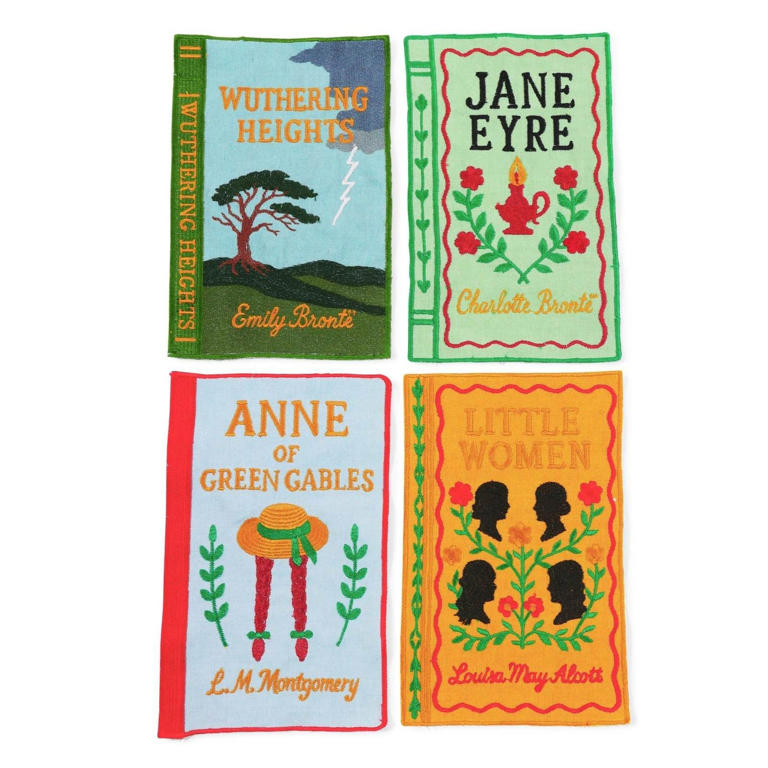
Oprah Daily shares its 'O list: Mother’s Day edition' which includes literary napkins.
Honor the heroine in your life with napkins that celebrate four female-centric literary classics: Jane Eyre, Wuthering Heights, Anne of Green Gables, and Little Women. Handmade and full of character, they’re sure to be the life of any party, whether a book club gathering or happy hour at home. (Holly Carter and Rae Ann Herman)
A digital alert for tomorrow, April 29, from the Brontë Parsonage Museum and the Elizabeth Gaskell's House:
by Libby Tempest, Vice-Chair of the Gaskell Society
Wed 29 Apr, 7:00pm
Online via Zoom

This introductory talk explores the relationship between two giants of nineteenth century literature. Charlotte Brontë and Elizabeth Gaskell were opposites in many ways. Yet they were profoundly interested in each other’s work and lives. Their first meeting in the Lake District in 1850 led to a real friendship. Charlotte had written the instant classic Jane Eyre and then Shirley, while Elizabeth’s astounding debut novel, Mary Barton had been well-received.
This talk uses letters, writing and contemporary accounts to try and discover what held the friendship between these two extraordinary women together. With speaker Libby Tempest, Vice-Chair of the Gaskell Society. 
The second in the Charlotte Brontë and Elizabeth Gaskell mini-season, in partnership with Elizabeth Gaskell’s House.

Tuesday, April 21, 2026

Tuesday, April 21, 2026 1:00 am by M. in , , ,    No comments
An online alert from the Brontë Parsonage Museum and the Elizabeth Gaskell's House:
Wed 22 Apr, 7:00pm

Since its publication in 1857, Elizabeth Gaskell’s The Life of Charlotte Brontë has divided opinion. Some critics suggest it is historically unreliable – perhaps Gaskell’s sources were flawed and maybe she exaggerated or even invented details for profit? Now new research into her writing and methods tells a different story: that of a diligent whistleblower silenced by the very forces she sought to expose.
Now Graham Watson’s The Invention of Charlotte Brontë traces the events behind Gaskell’s sensational biography and the cultural legend it inspired – from her six-year friendship with Charlotte Brontë to the media scandal that followed the book’s release, when Gaskell was pressured into a false confession of error to protect her publisher from a lawsuit.
Graham Watson argues that long-standing criticisms of The Life of Charlotte Brontë, still repeated today, must be challenged, as they first appeared within weeks of its publication – and all came from the very people Gaskell had criticised.
Doomed survivor of a family of geniuses, Charlotte Brontë had a life as dramatic as her famous novel, Jane Eyre. Now you can join us as Graham Watson challenges the established narrative to reveal the Brontë family as you’ve never seen them before.
The first in the Charlotte Brontë and Elizabeth Gaskell mini-season, in partnership with Elizabeth Gaskell’s House.

Monday, March 30, 2026

Monday, March 30, 2026 12:30 am by M. in , ,    No comments
A new book about the friendship of Charlotte Brontë and Elizabeth Gaskell:
by Susan Dunne´
Pen & Sword History
ISBN: 9781036135096
30th March 2026

Charlotte Brontë and Elizabeth Gaskell shared one of the most remarkable literary friendships of the 19th century, one that ultimately led to the creation of one of the most controversial literary biographies ever written. The Life of Charlotte Brontë continues to spark debate over 150 years after its publication, but the deeper story of the friendship that inspired it has never been fully explored until now.
In this fascinating and well-researched narrative, the intertwined lives of these two literary greats come to life. What drew them together despite their contrasting personalities? How did they influence each other’s work, navigate the challenges of publishing, and contend with the harsh judgment of critics? Did Elizabeth Gaskell’s well-meaning interventions, both personal and professional, shape the course of Charlotte’s life in ways never before considered?
Through letters, historical records, and fresh insights, this book reveals the warmth, respect, and complexities of their brief but profound connection. A tale of admiration, resilience, and literary legacy, it sheds new light on the enduring impact of a friendship that helped shape our understanding of one of literature’s most beloved figures.

Sunday, March 08, 2026

The Brussels Times explores how Brussels shaped Charlotte Bronteë's "expat novel" with Helen MacEwan, whose The Brontës in Brussels is now available in paperback:
When most of us think of the Brontë sisters, we are transported to the wild, windswept moors of Yorkshire in northern England, where the celebrated sisters were born and raised – and where many of their books were set.
But for a crucial two-year period in the early 1840s, two of the Brontë sisters – Charlotte and Emily ­– briefly became Brusseleirs. From 1842 to 1843, before their literary careers took off, the women taught at a girls’ boarding school called Pensionnat Heger in the city centre.
“Very few people would associate the Brontës with Brussels, and they wouldn't think of Charlotte and Emily Brontë eating waffles in Grand Place – but they probably did,” says Helen MacEwan, a leading expert on the Brontë sisters and co-founder of the Brussels Brontë Group. (...)
Helen, who moved to Brussels in 2004, has made it her mission in life to educate people about the Brontë sisters and their time in Brussels. Villette provided her gateway into what she describes as her “obsession” with the Brontës.
“Shortly after moving here to work, I re-read Villette and became fascinated by the Brontë sisters’ time in Brussels,” says Helen. “You could say I became obsessed.”
The novel resonated with her because, she explains, it is an “expat novel”.
“It’s about an expat in Brussels observing, trying to adjust to a foreign city and foreign life. And it feels very modern, not only is it about a working woman, but there's a lot about mental illness in it – depression and isolation – and finding your place in a foreign city.”
According to Helen, Charlotte Brontë’s feelings towards Belgium were “intense, but they were also painful”.
“It was the place where she fell in love,” she says. “But she had mixed feelings because it was an unrequited love.”
Charlotte was, Helen explains, “fairly satirical about the country and the people in general”. She criticised Belgians, primarily for their Catholicism, but also for being “too phlegmatic, too laid back – and for not really caring very deeply about anything”. (...)
Over the years, Helen and the Brussels Brontë Group have made valiant efforts to inform people about the Brontë sisters’ link to Brussels – but she feels more can be done by local authorities to promote the connection.
“I've always thought that the fact that the Bronte sisters lived here for two years is a really good literary link for Brussels and Brussels has never made as much of it as it could,” says Helen.
In addition to the guided walks (organised via Waterstones) the group, which was founded in 2006, has organised numerous literary events over the years to celebrate the Brontë link.
Emerald Fennel’s recent film interpretation of Emily Brontë’s only novel, Wuthering Heights, has been a boon for the group, reigniting interest in the sisters’ work among a new generation of readers.
While the reviews for film have been mixed to say the least, Helen is not among the naysayers. “Let's just say that I went expecting to hate it, and I found that I was quite well entertained,” she says. “It's just visually so wonderful.” (Katie Westwood)
Maggie O'Farrell shares her Brontë influences in a brief video in The Independent:
Hamnet author Maggie O’Farrell has spoken about the figures who have shaped and inspired her career, as she appears on The Independent’s Influence List marking International Women’s Day.
From winning the Women’s Prize for Fiction in 2020 to seeing Hamnet adapted for the stage by the Royal Shakespeare Company — and most recently transformed into a star-studded film featuring leading British talent — O’Farrell has reflected further on the literary influences that have shaped her work.
“There are so many women I look up to,” she says.
“Creatively, I think about the Brontë sisters in their passage, writing, all three of them sat around the table and discussing their work and walking around and round the room reading it aloud to each other.” (Lucy Leeson)
BBC reports that the plans for building an escape room in Haworth's Main Street have been rejected:
Plans for an escape room attraction on a picturesque street near the world-famous Brontë Parsonage in Haworth have been rejected.
The application included converting the upper floors of two Grade II listed cottages into an eight-room venue above a cheese shop but planners said the works would result in "substantial unjustified harm" to the building. (Chris Young)
Examiner has a promotional article on several rental cottages in Haworth, and Far Out Magazine is fascinated by Haworth as the place where they live and write the Brontës:
It’s incredible to think that several of the greatest English novels were written by different authors in the same house, let alone that they were all related, and talent as rare as the Brontë sisters seems unbelievable, but in their Yorkshire home, titles like Jane Eyre, Wuthering Heights, and The Tenant of Wildfell Hall were penned by Charlotte, Emily, and Anne. 
The siblings were born in the village of Thornton, before moving to nearby Haworth, where their father became the perpetual curate at the parsonage – it was this small village, surrounded by sweeping countryside moors and perpetually gloomy weather, that inspired the sisters’ work, although one street in particular unlocked the key to their eventual success.
Take a trip to Haworth, and you can visit the Brontë Parsonage, where relics of the family’s creative endeavours and personal lives are on display… You can even see the very spot where Emily succumbed to her weakening health, passing away at the age of just 30, but once you walk a short distance up the street, past the churchyard where you can see a plaque dedicated to Emily and Charlotte, you’re on the main street that runs through the village, and it was here that the sisters were granted access to a world beyond their own.
The Huffington Post praises Elizabeth Gaskell, "The Unsung Author Jane Austen And Brontë Fans Will Love":
Last year, fellow Jane Austen fans had a bumper harvest of new shows and audiobooks as part of the 250th anniversary of her birth.
And though the response to Emerald Fennell’s 2026 film version of Wuthering Heights has been pretty mixed, there’s no denying it’s brought about a bit of a Brontë boom; sales of the book have skyrocketed.
(If you ask us, that’s a good reason to adapt the two Brontë novels that have never had a TV or movie version made).
To me, that also means we’re long overdue for an Elizabeth Gaskell revival. After all, the author is said to have been influenced by Austen’s Pride & Prejudice when writing North & South (to great success, IMO).
She also wrote the world’s first controversial Brontë biography, The Life of Charlotte Brontë; she had been friends with the subject. (...)
I think The New York Times were right to call her a “very Victorian feminist”. And I reckon fans of Brontë and Austen will enjoy her novels immensely; I certainly did. (Amy Glover)
The New York Times has a very funny article describing the falling of MAGA grace of the Kristi Noem and Corey Lewandowski DHS "first couple":
 Eat your heart out, Emerald Fennell.
You may have the alluring stars Margot Robbie and Jacob Elordi cavorting on the moors in your crimson adaptation of “Wuthering Heights.” But for radioactive romance, you can’t beat Washington.
Emily Brontë’s Cathy and Heathcliff are selfish, manipulative creatures, destroying each other and all around them as they indulge their passions and egos. But their damage was kept to one windswept village.
With MAGA’s version of “Wuthering Heights,” the far less alluring but equally intertwined Kristi Noem and Corey Lewandowski have been cavorting over the swamp, scandalizing the capital as they’ve spread their cruelty far and wide. (To Lewandowski’s credit, he didn’t try to kill a dog like Heathcliff did. That’s Noem’s department.) (...)
Like Heathcliff, Lewandowski is known as a menacing presence who has been accused of having some dark physical exchanges with women. (Now there’s a dog Noem won’t put down.) (...)
Like Cathy in “Wuthering Heights,” Noem was aspirational, always trying to move up. Cathy traded up to the big house nearby; Kristi commandeered the Coast Guard commandant’s waterfront residence. (Maureen Dowd)
The New Indian Express reviews the latest book by Ruskin Bond, Life's Magical Moments:
 Books, unsurprisingly, are his lifelong companions. As a child, he was shaped by classics such as Wuthering Heights and Jane Eyre. (Rashmi Gopal Rao) 
News9 celebrates Women's Day by listing iconic books by female writers: 
Jane Eyre´by Charlotte Brontë
A landmark Victorian novel tracing Jane’s journey from hardship to self-respect. Her insistence on dignity and independence gives the romance enduring depth and power. (Sangeeta Das)

And now, the Wuthering Heights 2026 section: 

Laura Ramos in Clarín (Argentina), author of Infernales. La Hermandad Brontë, goes against the current and thinks that Wuthering Heights 2026 is the most faifhful adaptation of the novel (with the sole exception of the Luis Buñuel one):
El enorme mérito de la versión cinematográfica 2026 de Cumbres borrascosas es haber destruido, con una ráfaga de ametralladora de utilería FN SCAR–H color rosada, el malentendido –la maldición bienintencionada– trenzado durante casi dos siglos sobre Emily Brontë y su obra.
El grito de horror propinado por las lectoras de literatura romántica ante la brutalidad –el grado cero de sevicia– del héroe brontëano del film, Heathcliff, es el grito de todas las generaciones que se rehusaron a aceptar la verdad intolerable de la demoníaca novela original.
Ya fuera por razones de marketing, por su asociación con el género de terror, porque las prácticas BDSM exploten las taquillas; ya sea por los motivos más espurios, viles, bajos, antiartísticos y mercantiles, ninguno va a lograr opacar el hecho contundente de que esta versión capturó el espíritu bestial de la novela.
Un espíritu que ninguna de las hermosas –románticas– versiones anteriores pudieron tomar. Aunque Lawrence Olivier haya sido el más grande actor trágico inglés y Juliet Binoche atesore toda la espiritualidad de la que carece Margot Robbi; pese a que Ralph Fiennes –¡un Heathclif rubio!– actuara y transpirara el personaje, cosa que no pudo hacer Jacob Elordi; aun así, las adaptaciones anteriores de Cumbres borrascosas son más infieles a Brontë que la directora Emerald Fennelll.
A excepción, claro, del genial Luis Buñuel, que con el 1% del presupuesto de Fennelll, bajo los chaparrales tórridos de México y en las peores condiciones posibles, con actores de telenovelas con acento polaco –pese a que la productora se llamaba Tepeyac– logró realizar la más embrujada y fantasmagórica versión de Cumbres borrascosas del cine.
El artefacto se llamó Abismos de pasión y, a diferencia del film de Fennelll, el suyo comulga hasta el tuétano con la pasión metafísica, el material del que está hecha la novela. Con sus actores de cuarta categoría, un vestuario lastimoso y los acentos espurios, Buñuel trazó con maestría las tensiones entre una superficie dramática y las profundidades del bien y del mal.
Porque Cumbres borrascosas, y eso Buñuel lo entendió muy bien, es un romance metafísico: trata más de fuerzas que de personas. (Translation)
Quillette, on the other hand, has a completely opposite opinion: 
Emerald Fennell’s misbegotten adaptation of ‘Wuthering Heights’ destroys the very structure of Emily Brontë’s classic story. (...)
But for most of the film’s running time, I was bored. After about an hour, I began to wonder when, how, and if all of this was going to end. Part of the problem is that for all their strenuous exertions, there’s no chemistry between Elordi and Robbie at all. Elordi is good-looking and swarthy enough, but he doesn’t have the hammy charisma of, say, Laurence Olivier in William Wyler’s 1939 adaptation. It doesn’t help that, for the first third of Fennell’s movie before he makes his fortune and cleans himself up into Hot Mr. Darcy, Heathcliff resembles a stringy-haired, bushy-bearded hobo (like Charles Manson, but a lot taller). Whenever he kissed Margot Robbie, much less licked her fingers, I recoiled on her behalf. (...)
Nor is Robbie well-served by the movie’s much-praised but actually ugly and unflattering costumes—the handiwork of Jacqueline Durran (who also designed the costumes for Barbie). Nearly every one of Robbie’s frocks features a tight-waisted bodice that makes her look like an opera coloratura instead of a Yorkshire ingenue, and a neckline (if it can be called that) cut to emphasise her heaving cleavage (I don’t know whether it was push-up bras or nursing, but Robbie isn’t that busty). (Charlotte Allen)
Mint doesn't like the 'oversimplifications' of this adaptation:
 I am a sucker for movie adaptations of literary texts. So, despite the deluge of bad press, I simply had to watch Emerald Fennell’s recent remake of Wuthering Heights. Let’s say, the only good thing to have come out of that experience was my keen desire to revisit Emily Brontë’s first and only novel, published in 1847 under the pseudonym “Ellis Bell”, a year before her untimely death at the age of 30.
My singular takeaway this time around is a deep appreciation of the story’s resistance to following a single arc or steady moral compass. The plot is unsuited to quick judgements because it is hard to affix feminist or misogynist labels on the text and be done with it. The psychological complexity of Brontë’s characters creates a slippery cognitive terrain for the reader. The frequent twists and turns in the plot, triggered by the gap between action and intention, leave us confused, unsure of whether to align our feelings with Catherine or Heathcliff, the two central figures. This difficulty also explains Fennell’s Mills & Boons-style interpretation in her movie version. The only way she could attempt to tame, and make presentable, a sublime but rugged masterpiece was by turning it into a Hollywood-style sob story. (Somak Ghoshal)
Dirty Movies explores the costume design of the film:
 What remains largely unacknowledged is the middle ground between these poles – between the “savage” and the over-civilised, between material necessity and aesthetic excess. It is precisely this missing middle that makes the film so revealing. In glossing over labour while amplifying wardrobe spectacle, Wuthering Heights inadvertently mirrors the logic of contemporary fashion culture.
Clothes come and go. Identities shift. Surfaces remain immaculate. What quietly disappears is the work – and the responsibility – that makes such transformations possible.
Wuthering Heights ultimately gestures toward a reality the film itself only partially acknowledges. Beneath the heightened emotions and romantic excess lies a far more persistent force: the clothes that quietly regiment bodies, environments, and outcomes. (Piret Ilves)
Valencia Plaza is all for creative freedom (as are we):
 Con todo esto, Fenell ha hecho su película importándole un bledo el realismo, la coherencia histórica y, sobre todo, la fidelidad a la obra original, porque a lo que es fiel a su propia visión y a lo que para ella significa la novela. Y, francamente, nada que objetar a esto. La creadora, cualquier creador, puede hacer lo que le dé la gana con los materiales previos. Libertad creativa, se llama eso.  (...)
¿Que le ha salido desequilibrada y desigual? No hay duda. ¿Que a ratos funciona y a ratos no? Así es. ¿Que es muy bella, pero en algunos momentos parece carecer de alma? También, también. Pero, ¿que esto es cine autoral, por más comercial que parezca la operación y todo el marketing previo? Indudablemente. (Áurea Ortiz Villeta) (Translation)
La Tribuna (Chile) is taxative:
 Esta Cumbres Borrascosas, es pésima, porque no cuenta la historia real, sino que un relato frívolo de quienes son la pareja de actores "bella" de la época. Obvio, no busca ser la versión definitiva y eso está bien, pero no es una película para quien espere un romance gótico clásico. Es una disección del amor cuando se convierte en obsesión. Y en ese sentido, es coherente, aunque no siempre equilibrada, lo cual la hace olvidable. (Leonardo A. Ramiro Reyes) (Translation)
Scott Meldeson discusses the weekend's box office and makes an interesting remark about the film (and the film industry in general):
Before we get into the meat of the thing, WB’s Wuthering Heights passed $75 million domestic on Friday and had previously passed $200 million globally on Thursday, with an as-of-Friday $205 million worldwide total. That probably deserved its own post, but... at least for the moment, discussing yet another “not what conventional wisdom says is successful” win for Warner Bros. is yet again a bitter pill. Once again, the likely reward for such efforts will not be fortune, glory, and/or promotions, but another round of consolidation-motivated lay-offs. That’s not even getting into broader concerns about consolidation and the political machinations behind what gets made and why.
Daily Mail explains a nice anecdote concerning Jacob Elordi:
 A lucky Jacob Elordi fan got the surprise of her life last month when the Aussie actor gifted her with a piece of priceless memorabilia. 
Patricia Albassit had a chance encounter with the 28-year-old Brisbane-born actor during a commercial flight while he was in Australia to promote his new movie, Wuthering Heights.
After landing, Elordi excused himself and ducked into a nearby bookshop and returned with a copy of Emily Brontë's famous novel. 
Elordi gifted her the book after he signed his autograph and included a message: 'Dear Patricia! I hope the sun comes out for you today. Love, Heathcliff.' (Anthony James)
On BBC Radio 3's Sound of Cinema, Edith Bowman interviews the Wuthering Heights 2026 composer,  Anthony Willis. His soundtrack is reviewed on Cinemagavia. According to the Official Classical Chart, the album is number 6 in its first week on the chart.

El Periódico (Spain) reviews the Charli XCX album. MovieWeb remembers Wuthering Heights 1978 TV series and Wuthering Heights 1992 are the only adaptations implementing the second half of the novel correctly. Her Campus analyzes the controvers(ies) around the film. Koimoi thinks that there are similarities between the film and Bridgerton. Milenio (México) also reviews the film. Riffrreporter (Germany) argues that Emerald Fennell's films — beyond being a love story — highlight the ecological importance of the moors. Frankfurter Allgemeine (Germany) thinks the film is a glossy, oversexualized Instagram-era adaptation that sacrifices Brontë's dark, complex novel for aesthetic spectacle and mainstream appeal. Time Out Barcelona (Spain) highlights the increase in sales of the original novel:
Hace unos días, el portal Milanuncios anunciaba que el estreno de Cumbres borrascosas el pasado 13 de febrero había disparado las búsquedas del libro en plataformas de segunda mano, que habían aumentado un 455%. Club Victòria y Proa –que disponen de versiones en catalán del libro de Emily Brontë– han explicado a la ACN que el film ha impactado positivamente en las ventas, ampliando y renovando lectores. "Hay una nueva generación que lo ha descubierto, y eso es significativo" sostiene Josep Lluch de Proa. Blanca Pujals, de Club Victòria, cuenta que tuvieron que sacar adelante una nueva edición para servir bien a todas las librerías y subraya que es su título más vendido desde febrero. (...)
El éxito de Cumbres borrascosas también ha puesto el foco en otras obras y ha hecho que lectores se interesen por ejemplo por Jane Eyre, de la hermana de Emily Brontë, Charlotte, un hecho que Lluch encuentra comprensible teniendo en cuenta que se trata de otra de las "grandes novelas inglesas del XIX".
También lo confirma Pujals, que reconoce que ya se está notando "tímidamente" y que puede ser una tendencia que vaya a más. "Cuando uno empieza con una Brontë, tiene ganas de más", bromea. (Borja Duñó) (Translation)

Incidentally, The Sunday Times Bestsellers list puts Wuthering Heights as number 5 in the Fiction paperback section. 

InStyle (Spain) lists the Brontës in an article about female writers who used male pseudonyms when published her novels. El Progreso de Vigo (Spain) has an article about Heathcliff in the novel of Emily Bronttë:
 No sabemos quién es Heathcliff. En la novela, es un crío sucio, hambriento y oscuro que el señor Earnshaw recoge en las calles de Liverpool, lo que ahora llamaríamos un MENA, acrónimo que se ha convertido en un insulto que dice más y peor de quién lo enarbola en una manifestación contra un centro de acogida, que de los propios niños solos en un mundo tan violento como el de Cumbres borrascosas.  (...)
A Heathcliff, de existencia y corazón miserable, nada le importa más que su recuerdo y a los cineastas no les importa que la novela vaya mucho más allá de la muerte de Cathy. Emily no redime a nadie. Todos pierden en Cumbres borrascosas y, sin embargo, cuánta belleza en esta novela despiadada. (Mercedes Corbillón) (Translation)

El Español (Spain) visits Haworth, including the KVWR heritage train, the Parsonage and the moors. El Comercio (Perú) mentions a live Peruvian TV Cumbres Borrascosas from 1964, of which no recording survives. The Telegraph & Argus asks locals about Haworth pronunciation and well... it's complicated.