Saturday, October 31, 2009

Setts, clampers, vampires and a new Ruben Toledo cover

Let's begin with some Haworth-related news. Keighley News discusses the cost of restoring all the setts in Main Street:

Repairing or restoring all the damaged setts in and around Haworth’s historic Main Street would cost about £1 million.
The figure was announced by Haworth, Cross Roads and Stanbury Parish Council chairman John Huxley, who is part of a working group set up to investigate how to carry out the work.
Cllr Huxley said a report on the issue has suggested different methods of preserving the setts, including imposing a 7.5 tonne vehicle weight restriction.
Cllr Peter Hill said there has already been one concrete, positive outcome of the increased attention on the state of Main Street.
He said in future, any contractors digging up the road would be obliged to employ a sett specialist to ensure the stones were properly replaced.
Cllr Huxley said Bradford Council was now considering what effect a figure of £1 million would have on its budget.
He said a complete restoration would take years to finish.
The parish council declined an invitation from British Telecom to “adopt” the traditional red phone booth in Sun Street, Haworth, for £1.
Councillors were informed that BT was planning to remove the phone but leave the booth in place.
Parish clerk Glyn Broomhead said he understood that in the last 12 months only 105 calls had been made from the phone box.
Cllr Barry Thorne warned the cost of maintaining the structure would be “enormous”, adding that even replacing broken window panels would be extremely expensive.
Cllr Huxley said the council should respond “thanks but no thanks” to the invitation.
Haworth is to be twinned with its namesake, in New Jersey, USA.
Cllr Peter Hill, who has recently visited Brontë Country’s American counterpart, said he would be putting together a “twinning statement of goodwill” to formalise the partnership.
He said there was scope for Haworth New Jersey’s school, along with its volunteer fire brigade and ambulance services, to link up with similar organisations here.
He emphasised the initiative would not cost the parish council any money. (Miran Rahman)
The Guardian brings up again those (in)famous Haworth clampers in its letters section:
On a recent visit to the beautiful Bronte town of Haworth, I had the misfortune to park in the Changegate Road car park operated by Car Stoppers Limited. I paid £1.60 and returned to my car in plenty of time to find it had been clamped. The clamper was still there and I proved that I had paid the fee. He insisted the ticket had been turned round and the expiry time "was not clearly visible". I paid £75 to have the clamp removed but he told me to take the matter up with his boss. I appealed but heard nothing. I am a pensioner on a fixed income. JG, Oldham

Another case of a seemingly out-of-control clamper operating on private land. The operation is run by local resident Gareth Evans whose activities in Haworth have been highly controversial. His company once clamped the ex-speaker of the Commons, Baroness Boothroyd, who told me that Car Stoppers was out of order in the way she and her friend were treated. It was winner of the RAC Dick Turpin Award for the nation's worst clamper in 2003, but that dubious accolade seems to have had little impact. Motorists can be tied up in small print in the firm's terms and conditions – the fact you can prove you paid seems to be of little concern. Capital Letters has tried to contact Mr Evans with no success. I would have pointed out what strikes me as apparent breaches of the Companies Act in the paperwork. Take action in the county court to challenge the practices of this business. The penalty notice states the ticket number you purchased, which proves it must have been visible. It will cost you £30 but, believe me, it will be worth it to make Mr Evans jump through a few hoops. (Steve Playle)
On October 29th The Museum at FIT in New York invited Ruben and wife Isabel Toledo to share their stories of fashion and art (including Ruben Toledo's recent covers for Penguin classics like Wuthering Heights). The Columbia Spectator talks about it and gives some interesting news:
Wuthering Heights, Pride & Prejudice, and The Scarlet Letter were the three books chosen to feature Toledo’s interpretations. The artist said that the books were just fascinating, citing Wuthering Heights as his favorite. (...)
[Elda] Lotor [editorial director for Penguin Classics] and Toledo surprised the crowd by revealing that three more classics will undergo a Toledo makeover: The Picture of Dorian Gray, Dracula, and Jane Eyre.
And now for some other class of vampires, the undead ones. The Independent makes and A to Z of vampires and uncovers a Jane Eyre quote:
J is for Jane Eyre
Jane Eyre suffers a terrible fright when a nocturnal visitor comes to her bedroom; the next day, she tries to explain to Mr Rochester that what she saw was no common English ghost: "This, sir, was purple: the lips were swelled and dark; the brow furrowed; the black eyebrows wide raised over the blood-shot eyes. Shall I tell you of what it reminded me?... Of that foul German spectre – the Vampyre." In fact, the suspected vamp is the first Mrs Rochester. Note that at this time – Jane Eyre was published in 1847, exactly 50 years before Dracula – it is Germany, not Transylvania, that is held to be the homeland of vampirism. Miss Brontë was probably thinking of the many German Romantic poets who wrote on the theme, including Goethe. (Kevin Jackson)
The Telegraph-Journal interviews Susan Vida Judah, textile artist and Brontëite:
q Your favourite hero of fiction?
a Charlotte Brontë's Jane Eyre. Jane, a talented, empathetic, hardworking, honest and passionate girl, with a strong sense of conscience, is skilled at studying, drawing and teaching - characteristics anyone would like to emulate.
Another Brontëite is Anna Keesey according to The Linfield Review:
Keesey also said she appreciates the works of 19th-century women writers such as Charlotte Brontë, author of “Jane Eyre.”
The Mirror's Weakest Link Test includes a very, very easy Brontë-related question:
11. In literature, who does the character of Jane Eyre marry in Charlotte Bronte's novel of the same name: Mr Rochester or Mr Winchester?
Hollywood Today interviews Syrie James, author of The Secret Diaries of Charlotte Brontë:
I was astonished to discover that much of Jane Eyre was inspired by Charlotte’s own experiences,” says The Secret Diaries of Charlotte Brontë author Syrie James. “Despite her difficult circumstances at home, including the fact that her brother became an alcoholic and a drug addict and her father nearly went blind, she and her sisters Anne and Emily [who wrote Wuthering Heights] all became published authors at the same time. I can’t think of any other family in history who’ve achieved a similar literary feat. I knew it would make a fabulous story, and it had never been told.”
The Secret Diaries of Charlotte Brontë tells the story of Charlotte Brontë from her point of view. In her diaries, she’s very honest about who she is. Brontë has traveled a bit and fallen in love, but that love was not to be. Brontë is secretive, as all the Brontë sisters are about their writing. When they admit what they’re doing, they’re there for each other. The Secret Diaries of Charlotte Brontë was selected by the National Women’s Book Association as a Great Group Read of 2009.
“While in Yorkshire, touring the former Roe Head School which Charlotte attended in her youth, the Director of the school took my husband and me up into the spooky, rambling attic and told us old legends of the Ghost of Roe Head,” says James. “He and others have seen strange apparitions, including an inexplicable, icy presence which haunted the main hall. I feel certain that legends of the same mysterious, attic-dwelling ghost influenced Charlotte’s Jane Eyre.”
“Her father’s curate, the tall, dark, and handsome Arthur Bell Nicholls, carried a silent torch for Charlotte for more than seven years before he had the nerve to propose,” says James. “Charlotte greatly disliked him for many years, but her feelings eventually changed. She came to love him with all her heart.”
For her research, James poured over countless Brontë biographies. She read all the poetry of the Brontës, their published novels, Charlotte’s juvenilia, and her voluminous personal correspondence. More than 500 letters exist, preserved by Charlotte’s publisher’s literary adviser William Smith Williams and her friend Ellen Nussey. James studied the art of the Brontës which she found “quite remarkable”. She also read everything she could find about the life of Arthur Bell Nicholls.”
“I went to Haworth, England,” says James. “I walked the village’s steep, narrow main street, and made an extended visit to the Brontë Parsonage Museum, which has been preserved to reflect the way it looked when the Brontës lived there. I haunted the church and the rooms and lanes where Charlotte and Emily and Anne lived and walked, and strolled through that gloomy graveyard in the pouring rain. I visited the Brontë library, where I was allowed to hold and read a selection of original letters and manuscripts penned by Charlotte and other members of the Brontë family.
 What an unforgettable thrill!” (...)
“It seemed to make sense to write my next novel from the perspective of another 19th century British writer,” says James. “This time focusing on the life and romance of Charlotte Brontë, the famed authoress of one of my all-time favorite books, Jane Eyre. I wanted to know and understand the woman who wrote this remarkable novel, which is still so popular today. As I did my research, I was quickly captivated by the true story of Charlotte’s real-life romance.”
Even thought James’ book is called a dairy, it’s not written in diary format. There are occasional references where Charlotte addresses her diary. The book is more conversational, as though Charlotte is telling you a story. James researched her subject thoroughly. Charlotte, her friends, and family come off as plausible. James adds details that are available. The drama isn’t over done. James’ characters are real people. As you read you can understand their feelings and why they do the things they do.
James makes Charlotte’s relationship and subsequent marriage to Arthur Bell Nicholls romantic, as Charlotte might have written herself. After reading this book you’ll want to go back and read the Brontë’s books. At the back of The Secret Diaries of Charlotte Brontë there are is an afterward, question-and-answer section for the author, and excerpts from some of Charlotte’s letters, as well as some poems by the Bronte siblings. (
Gabrielle Pantera)
The Jane Eyre references of the film An Education are mentioned in the Washington Post's review:
After a few more impromptu encounters, Jenny and David begin to date, and suddenly Jenny's world of Latin declensions and "Jane Eyre" is carbonated with a heady cocktail of concerts, nightclubs and the slow, deliciously slippery slope of sexual seduction. (Ann Hornaday)
Some performances of a theatrical adaptation of Henry James's The Turn of the Screw at the Campbell House Museum seem to invite The National Post to make a Jane Eyre reference:
The governess, herself the child of a stark and oppressive home with romantic notions derived from reading Jane Eyre, does passionate, even hysterical, battle for the children's bodies and their souls. (Robert Cushman)
Los Angeles Times finds unlikely Jane Eyre echoes in Barbados:
Then there are the Barbadians themselves, people who are the very definition of friendly locals. And the fact that 300 years of British rule have left the island with some interesting Anglo-Caribbean quirks, including stone churches straight out of "Jane Eyre" and cricket players with dreadlocks. (Janis Cooke Newman)
El Tiempo (Spain) recalls the Brontëite in Siri Hustvedt:
Desde niña quiso escribir. "Fue un deseo que comenzó cuando tenía 13 años y vino directamente de la lectura -dice Siri-. Siempre fui una lectora apasionada y alrededor de los 11 ó 12 años me sentí capaz de digerir libros 'adultos', sobre todo novelas. Leí vorazmente -a Dickens, las Brontë, Austen, Twain- y de la experiencia con esas grandes novelas incubé la fantasía de convertirme en escritora". (María Paulina Ortiz) (Google translation)
ABC (Spain) is really quite confused about the origins of the gothic trends:
Yo no sé ustedes, pero reconozco que fue ayer cuando me enteré que la mítica película «Cumbres borrascosas» (1939), basada en la obra de Emily Bronte, es el germen de la novela gótica. Tal cual. Quién nos iba a decir que ese estupendo dramón, llevado al cine por Willian Wyler y protagonizado por Laurence Olivier y Merle Oberon, iba a derivar en el desarrollo de un movimiento que se sigue por igual en todos los continentes y países. Desde Japón a España. Vivir para ver. (María Isabel Serrano) (Bing translation)
Indeed.

L'Occidentale (Italy) has an article about Britain through its literature:
I romanzi delle Brontë o di Jane Austin danno una visione positiva della campagna e negativa della città industrializzata, di cui Dickens offre squarci spaventosi. (Daniela Coli) (Google translation)
Коммерсантъ (Russia) talks about sequels and mentions Wide Sargasso Sea:
Это своеобразный приквел к знаменитому роману Шарлотты Бронте "Джейн Эйр", рассказанный от лица одного из самых неприятных персонажей — первой жены графа Рочестера. Роман Джин Рис стал, таким образом, феминистским и антирасистским ответом Шарлотте Бронте, которая осмелилась изобразить гордую креолку в виде жалкой и отталкивающей полубезумной злодейки.
Злободневность романа принесла ему популярность, вполне сопоставимую с популярностью "Джейн Эйр". Журнал Time включил его в свой список ста лучших англоязычных романов XX века, его экранизировали в Голливуде в 1993 году, по нему сняли сериал, и он стал основой либретто оперы. (Google translation) (Константин Пряничкин)
Mademoiselle V stays in London reviews Wuthering Heights 2009 in French, Liratouva2 (also in French) posts about Jane Eyre, Ladyloo Land retells a scene from Wuthering Heights with a particular Halloween feeling, Oyunun başı sonu… posts about Jane Eyre 2006 in Turkish, the RPP Blog has a reminder of this weekend's broadcast (see our sidebar) of Mi Novela Favorita: Jane Eyre (in Spanish) in Perú.

Categories: , , , , , , , ,

Brontë Studies, Volume 34, Issue 3

The new issue of Brontë Studies (Volume 34, Issue 3, November 2009) is already available online. We provide you with the table of contents and abstracts:

Articles

Mr Wise and Mr Wood: Two Brontë Bibliographers in Harmony. Part 1
pp. 185-208(24) Author: Duckett, Bob
Abstract:
An account of an exchange of letters in 1917 between the bibliographer, Thomas J. Wise, and Bradford's City Librarian, Butler Wood, concerning the compilation of A Bibliography of the Writings in Prose and Verse of the Members of the Brontë Family (1917) edited by Wise. Wood, the Bibliographical Secretary of the Brontë Society, compiled an earlier bibliography in 1895 and carried out research for Wise. Despite Wise's later fall from grace, the two men had a high regard for each other at this time. This exchange of correspondence gives an interesting insight into the process of bibliographical research at that time, the result of which has been of lasting value. A few other letters are also featured.

Melting Miss Snowe: Charlotte's Message to the English Church
pp. 209-219(11) Author:
Armitage, Nicholas
Abstract
Lucy Snowe, Charlotte Brontë's heroine in Villette, paints an unflattering image of Roman Catholicism. But Charlotte distanced herself from Lucy, something that should perhaps encourage us to see the anti-Catholic rhetoric of the novel as at least partly a literary device. Lucy's identification of Catholicism with Sentimentalism appears to be mirrored by her own identification of Protestantism with Reason, such that Charlotte may be saying that in their different ways, both understandings of Christianity romanticize self-sacrifice. Her message seems to be that the true gospel is neither of these, but a liberty which is paradoxically better demonstrated by the Catholic Paul Emanuel than by the Protestant Lucy herself.

How Lucy Snowe Became an Amnesiac
pp.
220-233(14) Author: May, Leila S.
Abstract

This essay is an attempt to refute the thesis of Nicholas Dames's book of 2001, Amnesiac Selves: Nostalgia, Forgetting, and British Fiction, 1810-1870, as it applies to Charlotte Brontë's Villette. Dames sees Lucy Snowe, the long-suffering narrator of the novel, as the victim — or the perpetrator — of an extreme case of amnesia that constitutes 'the death of memory'. I argue that Dames's thesis involves a misreading of the role of memory in Charlotte Brontë's novel, a novel that, perhaps more than any other Victorian novel, is about long-term memory in all its detail and painfulness. I further argue that Dames's error is partially motivated by an over-emphasis on his part of the role of phrenology in Villette.

Arctic Spectacles in Jane Eyre and Villette
pp. 220-233(14) Author: Cadwallader, Jen
Abstract
Although a number of Brontë scholars have studied the many similarities between Jane Eyre and fairy tales such as Cinderella and Beauty and the Beast, one significant difference between the novel and its fairy-tale influences is Jane's physical plainness. This essay examines Jane's appearance specifically as a contrast to fairy-tale heroines such as Jeanne-Marie Leprince de Beaumont's Beauty in her version of 'Beauty and the Beast'. As a contrast to the fairy-tale beauties invoked throughout the novel, Jane's plainness takes on the dimension of social critique. This essay demonstrates, through an examination of the significance of female beauty in Charlotte Brontë's juvenilia and in nineteenth-century renditions of Beauty and the Beast, that Charlotte uses plainness and beauty to condemn an upper-class system of values which, by emphasizing the importance of a woman's appearance, limited her ability to develop selfhood and achieve autonomous action.

Three Quartets: the Rossettis, the Mendelssohns and the Brontës
pp. 247-254(8) Author: Emberson, Ian M.
Abstract
The article presents a comparison of the childhoods of three early nineteenth-century families: the Rossettis, the Mendelssohns and the Brontës. In each case there were four exceptionally gifted children, fairly close in age, talented in more than one branch of the arts, and interacting with one another. They were all somewhat apart from their immediate surroundings, and yet ultimately managed to blend different cultural influences into outstanding achievements. There is also a consideration of the link between their childhood activities and the work they produced as adults.

A Brontë Reading List: Part 3
pp. 255-262(8) Author: Ogden, James
Abstract
This is the third part of an annotated bibliography mainly of essays, either in scholarly and critical journals, or as chapters in books, 2003-2008. The first and second parts are published in Brontë Studies, 32:2 (July 2007) and 33:3 (November 2008).

Recent Acquisitions at the Brontë Parsonage Museum
pp. 263-268(6) Author: Dinsdale, Ann

Reviews pp. 269-278(10)
Categories: , ,

Friday, October 30, 2009

The mother of all soap operas and the father of all the Brontës

If you are in Australia, don't forget to watch the second - and final - episode of Wuthering Heights 2009 this Sunday. The Brisbane Times has a reminder.

Wuthering Heights ABC1, 8.30pm
Surely the mother of all soap operas, Wuthering Heights was Emily Bronte's only novel and viewers who don't much care for overblown costume dramas will be forever glad of the fact. But for those who enjoy a romp on the moors, cruelty, deception, eternal love cursed by venality and amorality unfettered by decency and shame, well, it's a pity she wasn't as prolific as her sisters.
In this second and final instalment, Heathcliff's fiendish machinations reach the plane of high art, Cathy finds herself in the worst of all possible worlds and without giving the game away ... What am I saying? This is Wuthering Heights , for heaven's sake – everyone knows what happens. It all ends in tears. (Pat Sheil)
And the Sheffield Telegraph includes a Brontë alert for today which might be interesting for Brontëites around Ecclesfield (UK).
Patrick Father of the Brontës, one man show with Colin Pinney, as the Rev Patrick Brontë recounting the story of his son Branwell and his famous novelist daughters – Emily, Charlotte and Anne, EPPIC Theatre, Wells Lane, Ecclesfield, Friday, 7.30pm (£5, 2402624)
The theatre's website provides us with more info about this piece included in the Off the Shelf Festival of Writing and Reading:
Colin Pinney, as the Reverend Patrick Bronte, reveals the story of Patrick's son Branwell Bronte and his famous sisters: Charlotte Bronte who wrote Jane Eyre, and three other novels: Emily, author of Wuthuring [sic?] Heights: and Anne, who wrote Agnes Gray and The Tenant of Windfell [sic?] Hall.
Such were the times that all three were forced to pretend they were male authors. The fame of the Bronte's rests on their novels, but they were equally proud of their verse, from the "simple-minded rhymes" of the Reverend Patrick Bronte to the compelling poetry of Emily and her brother Branwell - "My Unhappy Brother" as Charlotte called him.
The performance includes comments made by the Bronte's on one another's works and springs a few surprises in verse and pose from the Bronte's, their friends and their critics.
Also mentioned are such diverse characters as Miss Finch the Scourgemistress, Tom Spring the champion prize fighter of England, and the stationmaster at Ludden [sic?] Foot.
For One Night Only
Friday 30th October 2009
Start 7.30 prompt
Colin Pinney's one man show was previously presented at the Swaffham Assembly Rooms (Norfolk), last Sunday October 18th, 3.00pm.

The Independent has an article on Paul Auster, who is, as you know, an admirer of Emily Brontë.
They say he's a postmodern master of meta-narratives, with his spools of stories within stories, but he cites the likes of Emily Brontë over Baudrillard as a source of inspiration. (Arifa Akbar)
The Times has a lengthy piece on '70 facts you didn't know about Marvel' and this is what they say about Wolverine's past.
Wolverine's origin story was kept a mystery for 26 years. Most superhero comics deal with origin stories in the first few issues but Wolverine was different. His writers fed readers only snippets of his past - he fought in the Second World War, sinister government scientists erased his memories and covered his bones with an indestructible metal alloy, he may have been the first mutant, his real name is not Logan but James - but these served only to make him mysterious. Marvel eventually relented to fan pressure in 2001 and published Wolverine Origin. The series is set in late 19th century and tells the story of a servant girl who befriends a frail, pampered boy from a rich family. After a series of Bronte-like tragedies, the boy eventually turns into the rough, beer-swilling clawed killer fans know and love. (Owen Vaughan)
And now for the dear otherworldly creatures who visit us so often lately: vampires and zombies.

Zombies (or something like them) in The Herald (Scotland), in the appropriately-entitled article, 'The whole country’s trapped in a kind of zombie trance':
There was much circling over A Discovery of Witches by the US academic Deborah Harkness. This novel tells the story of scientific researcher Diana Bishop, who dis­covers an ancient alchemical manuscript in the Bodleian and unleashes all manner of supernatural folk, among them the dashing, Heathcliff-like, Jaguar-driving vampire, Matthew Clairmont, who may be 1500 years old but is still able to pull women. (Roger Tagholm)
And vampires in The Tyee:
There is no point in bemoaning the issue. Times change and so we get a thin gruel of left-over ideas and rehashed hash. The success of Twilight, which is simply another bastardization of Jane Eyre (poor yet plucky girl, wins the heart of smoldering aristocrat, vaults over all class and economic distinctions) still works, even if is only a faint echo of the original. If Edward Cullen is no Rochester, on television, the vamp man is even further reduced into a smudgy charmless lunkhead named Stefan Salvatore in The Vampire Diaries. (Dorothy Woodend)
On the blogosphere: The Squeee has watched Wuthering Heights 1978 and Life and Times of a "New" New Yorker posts about Wide Sargasso Sea.
EDIT:
An alert from Tampa, Florida:
TEMPLE TERRACE LIBRARY GREAT BOOKS ROUNDTABLE:
This group meets every month (except December and August) on the LAST SATURDAY of each month, from 1:00 P.M. to 2:30 P.M., at the Temple Terrace Library, 212 Bullard Parkway, Tampa, Florida The group is free and open to the public, although copies of the reading selections are lent out free only to those who hold a Hillsborough County library card. For more information on joining this group, contact the moderator, Patrick DeMarco at TampaBayArea1@greatbooksdiscussionprograms.org or at 813-672-9052.

10/31/09: JANE EYRE (Charlotte Bronte)
Categories: , , , , , , , ,

Victorian Sensation Fiction and Servants

Two new scholar publications with Brontë content:

From Wollstonecraft to Stoker
Essays on Gothic and Victorian Sensation Fiction
Edited by Marilyn Brock

ISBN 978-0-7864-4021-4
notes, bibliographies, index
220pp. softcover 2009


This collection of 13 essays examines the work of Victorian authors Wilkie Collins, M.E. Braddon, Letitia Elizabeth Landon, Mary Wollstonecraft, J. Sheridan Le Fanu, Bram Stoker, Charles Dickens, Robert Louis Stevenson, Elizabeth Gaskell, Henry James and Charlotte Brontë. Each essay explores their use of archetypal Gothic elements, such as dark secrets and forbidden sensations, to depict nineteenth-century attitudes to class, gender, race, colonialism and imperialism.
The Brontë essay is “Portrait of a governess, disconnected, poor, and plain”: Staging the Spectral Self in Charlotte Brontë’s Jane Eyre by Laurence Talairach-Vielmas.

Victorian Servants, Class, and the Politics of Literacy
Jean Fernandez

Routledge Studies in Nineteenth Century Literature
ISBN: 9780415804387
ISBN-10: 0415804388
Publisher: Routledge
Publication Date: 09/03/2009
Pages: 218


In this volume, Fernandez brings the under-examined figure of the Victorian servant out of obscurity in order to tell the story of his or her encounter with literacy, as imagined and represented in nineteenth-century fiction, autobiography, pamphlets and diaries. A vast body of writing is uncovered on the management of servant literacy in Victorian periodicals, advice manuals, cartoons, sermons, books on household management, and pornography, thereby revealing that the domestic sphere was a crucial war zone in the battle over mass literacy. By attending to how fictional and nonfictional texts of the age feature literate servant narrators, she demonstrates how the issue of servant literacy as a cultural phenomenon has profound implications for our understanding of the nexus between class, mass literacy, voice and narrative power in the nineteenth century. The study reads canonical fiction by Mary Wollstonecraft, Emily Bronte, Elizabeth Gaskell, Wilkie Collins, and R.L. Stevenson alongside popular detective fiction by Catherine Crowe, the Diaries of Hannah Cullwick, and best-selling pamphlets of the age, while introducing to Victorian scholarship hitherto little known or unknown servant autobiographies that address life history as an engagement with literacy.
The Brontë chapter has the title Oral Pleasures: Repression and Desire in Emily Bronte's Wuthering Heights (1847) and Elizabeth Gaskell's The Old Nurse's Story (1862).

Categories: , ,

Thursday, October 29, 2009

Back to Charlotte Brontë Villa and other news

A bit of virtual travelling to begin with, as the Belfast Telegraph takes us on a trip to Haworth.

Nestled amid the bleak Pennine moors, overlooking the Worth Valley, lies the quaint hilltop village of Haworth.
It’s a picturesque little place, with its cobbled main street, flower-fronted brick houses, cosy restaurants and pretty tearooms, not to mention the rolling hills and vast, lonely countryside that surround it.
And it’s to this place that tens of thousands of tourists make a pilgrimage each year, to follow in the well-trodden footsteps of the world’s most famous literary family, the Brontes.
Charlotte, Emily and Anne Bronte wrote most of their classic novels while living in Haworth, when their Northern Irish-born father Patrick was parson at the adjacent Church of St Michael and All Angels.
The trio drew inspiration from their environs, particularly Emily, who looked to the wild and windy moors as the backdrop for her one and only novel, Wuthering Heights.
Today, the old parsonage is a museum, maintained by The Bronte Society. Exhibiting original manuscripts and letters belonging to the sisters and their brother Branwell, as well as furniture, clothes and personal possessions, the museum is a mecca for Bronte devotees from around the globe.
Yet despite its position as the second most popular destination for literary tourists — next only to Stratford-Upon-Avon — Haworth somehow manages to retain its olde-worlde charm.
There’s still a sense of the Brontes’ presence here. Everywhere one looks there is a connection to the family — Villette’s coffee shop, Rochester art gallery, a gift shop called Eyres and Graces, Ye Olde Bronte Tea Rooms, Heathcliffe Mews. Even the local taxi firm, Bronte Cabs, borrows the name.
The October weekend I chose to visit with my friend, Michelle, was off-peak and was fairly quiet. The base for our break was the five-star Ashmount Country, a homely guest house set in beautiful gardens, just a minute’s walk from Main Street and the moors.
Like almost every aspect of Haworth life, there’s a link back to the Brontes. Ashmount once belonged to Dr Amos Ingram, physician to Patrick Bronte and daughter Charlotte, author of Jane Eyre, Villette, Shirley and The Professor.
Charlotte was the last surviving sibling of six and watched, one by one, as her four sisters, Maria, Elizabeth (who both died as children), Emily, Anne and brother Branwell passed away.
Patrick Bronte, who lost his beloved wife from cancer less than a year after moving to Haworth, outlived all his children. Not one of the six lived beyond the age of 40.
Ashmount today cleverly combines the character of a bygone age with modern facilities — much like the village itself.
Our first port of call was the Bronte Parsonage Museum. The old Georgian house, which has been extended since the Brontes lived there, looks onto the graveyard, adding to the ghostly atmosphere. Inside, each room has been laid out as close as possible to what they would have looked like in the Brontes’ day and most of the objects on display actually belonged to the family — the miniscule manuscript books that they made as children, letters, drawings, even Charlotte’s wedding bonnet.
There’s something quite poignant about standing in the same room that Emily penned my favourite novel, Wuthering Heights, and where it is rumoured she breathed her last breath, lying on the sofa in the dining room.
The following day we woke early to begin our trek across the moors, but the heavy downpours put paid to that. Instead, we opted for a ride on the Keighley and Worth Valley steam train, which has been used in numerous films including The Railway Children.
When the rain finally stopped, we took a taxi to the nearby village of Stanbury. Our destination was Top Withins, the remains of an old farmstead high on the moors, which many believe to be the inspiration for Wuthering Heights itself.
Quite a few public footpaths lead out of Haworth and form part of the 43-mile Bronte Way, but the route from Stanbury is shorter, and given the weather conditions that day, a more sensible option.
We had our lunch at the Wuthering Heights pub, situated on the edge of the moors. How could we resist? And then, clad in our walking boots, heavy coats and jumpers, we set off on our journey.
Our path took us high up onto the moors, passing one or two isolated farmhouses that remain there. We by-passed the walk to the Bronte Waterfall and Bridge, and headed on towards Top Withens instead, praying the rain would stay away. It would be no fun to be caught out in a downpour up there, with nowhere to shelter and miles to walk before finding any kind of civilisation.
I expected the moors to be teeming with tourists, but we only met a handful of ramblers on our trek.
I was struck by the beautiful colours of the moorland — golden, green, purple and red — and the rapid changes in the weather.
One moment, the sun flitted across the moors, bathing the countryside in a warm glow, next, the skies turned dark and threatened to spoil our walk.
But it was the strong winds up at Top Withins that really brought home to me just how inspirational these moors were for Emily Bronte. It nearly knocked us off our feet as we battled against it.
In Emily’s classic novel we are told “Wuthering Heights is the name of Mr Heathcliff’s dwelling. ‘Wuthering’ being a significant provincial adjective, descriptive of the atmospheric tumult to which its station is exposed in stormy weather. Pure, bracing ventilation they must have up there at all times, indeed, one may guess the power of the north wind blowing over the edge, by the excessive slant of a few stunted firs at the end of the house.”
These days, only one tree remains by the ruins of the old house, bravely defying the blustery gales. Standing there in eerie silence, looking over the moors, we could almost hear the sound of horses’ hooves galloping up the path or the chatter of farmhands as they set to work at the Heights.
Unfortunately we didn’t see the ghosts of Cathy and Heathcliff wandering the windswept moors and we never made it as far as Ponden Hall, believed to be the inspiration for the Linton’s home, Thrushcross Grange.
With dark clouds gathering ominously overhead, we decided to walk back through the moors to Wuthering Heights, where the host was much more hospitable than his fictional counterpart. But we both agreed we’d come back to Haworth and soon, to continue our Bronte journey.
For anyone who’s ever enjoyed a Bronte novel, or who likes to ramble in the great outdoors, Haworth is definitely worth a visit.
But you don’t have to be a literary know-all or a hill-walker to find this West Yorkshire village a magical place. Like the three Bronte sisters who lived and wrote there, all you need is some romance in your soul and a vivid imagination. (Maureen Coleman)
Those on the other side of the pod might enjoy going on a little pilgrimage (just joking!) to the Charlotte Brontë Villa in Riverdale (NY), which according to The Riverdale Press, is
probably the most interesting apartment building in Riverdale. . .
Now seriously, a more interesting visit might be to see the exhibition on Edgar Allan Poe 'From Out That Shadow' is at UT's Ransom Center through January 3rd. And while you are in the Ransom Center you might like to know that...
In fact, the Ransom Center has a fairly extensive hair collection, including the locks of George Washington, Napoleon, Byron, Charlotte Brontë, Elizabeth Barrett Browning and Marie Antoinette. (Jeff Salamon in The American-Statesman)
And one more thing to do, this one today and only if you are a teenager. As seen in The Contra Costa Times.
Wuthering Heights Book & Movie Event: 6-8:45 p.m. Oct. 29. Teens are invited to discuss the classic book, "Wuthering Heights," by Emily Bronte. Participants will watch the 1992 movie starring Juliette Binoche and Ralph Fiennes. (At the Concord Library at 2900 Salvio St., Concord. Phone: 925-646-5455)
This film is not included, however, in The Brontë Collection, which is reviewed by Edge San Francisco.
Back in 2005, the BBC may have set too high a standard for its period pieces with its five-star production of Charles Dickens’ Bleak House, starring the magnificent Gillian Anderson. Even masterpieces like I, Claudius (1976) look a little shabby in comparison. Today’s audiences expect dramas to be gripping from start to finish and, before Bleak House, the BBC didn’t always deliver. So why is it putting The Brontë Collection in its follow-up queue?
Now out on DVD are three BBC adaptations of three novels from Victorian England’s preeminent literary family-Emily Brontë’s Wuthering Heights, Charlotte Brontë’s Jane Eyre, and Anne Brontë’s The Tenant of Wildfell Hall.
Even as a period drama, The Tenant of Wildfell Hall (2008) is remarkably current in flavor à la Bleak House. Yet the film anthologists curiously culled the 1967 television serial of Wuthering Heights and the 1983 serial of Jane Eyre to stand beside it. Ultimately, "anachronistic" is the only word to describe this newly released collection.
The BBC’s 1967 production of Wuthering Heights is an intriguing film study in that it aligns with the stark, dark realism of the then-current New Wave movement in British cinema, but it also demands more patience than today’s ADD audience may be able to muster. Moreover, it seems to have been filmed live from a rogue hot-air balloon with camera angles sweeping from ground to aerial without warning. On the upside, a young Ian McShane with his perennially brooding charm puts Laurence Olivier’s overly mannered Heathcliff to shame. Likewise, Drew Henley plays the drunkard Hinley to the hilt, mirroring the last days of the Angry Young Men era in British theater.
This BBC collection then makes a quantum leap-sixteen years and several pop-cultural eras forward-to its 1983 production of Jane Eyre. Alexander Morton seems to have devised his pedestrian script with an audience of homebound, crocheting spinsters and widows in mind. All the characters and the heroine herself constantly accuse Jane Eyre of being "passionate," but Zelah Clarke is nothing but dowdy in the role. Also, if they wanted to portray Rochester as a sexy-ugly villain, they shouldn’t have cast an all-out hottie like Timothy Dalton who barely approaches "hideous" even after he winds up a blind burn victim. Meanwhile, the story of the decorous but cruel society drags like an overstuffed laundry bag in the rain.
When we fast-forward to 2008, however, we find The Tenant of Wildfell Hall storming in as the collection’s dark-horse winner. Tara Fitzgerald is grand and alluring as Helen Graham, a reclusive painter who has moved into the derelict Wildfell Hall mansion with her young son. Fiercely possessive of her son and decked out in widow’s weeds, Helen arouses the suspicions of the townspeople who hear on good account that she’s a fallen woman. As they attempt to ostracize her from her new village, Gilbert Markham (Toby Stephens) pursues Helen as his destined mate and comes to discover that she has fled an abusive husband who can’t seem to lay off the sauce or the sluts. While it seems a bit contrived that Gilbert would pine for Helen, who is downright rude to him, the drama’s intrigue and pathos make it a strong successor to 2005’s Bleak House.
If you must watch adaptations of Jane Eyre and Wuthering Heights, there are many worthier candidates for viewing than those represented in The Bronte Collection. Better to save a few bucks and, if at all possible, buy The Tenant of Wildfell Hall separately. (Kyle Thomas Smith)
The band Wolfmother played a version of Kate Bush's Wuthering Heights.
But the most surprising and unexpected delight of the evening is the encore's Kate Bush cover. Stockdale and his fellow crazy-haired lead guitarist Aiden Nemeth take to the stage with just a mic and guitar to belt out 'Wuthering Heights' to an unsuspecting audience. (Matt Hamm on ClickMusic)
The Film Fanatic reviews Jane Eyre 1934 and gives it 3/10 (agreed! But watch it if you can - you'll laugh out loud at just how bad it is). And The Little Professor brings pop culture to Victorian novels and mixes couples' names à la Brangenlina.

EDIT: An alert from Jerago, Italy:
Nell'ambito degli ultimi incontri della rassegna Duemilalibri, una serata d'eccezione a Jerago con Orago: giovedì 29 ottobre, alle 21, il Castello Visconteo di Jerago aprirà i suoi battenti per ospitare Silvio Raffo, protagonista di un appuntamento dedicato alla letteratura gotica e di fantasmi, “Il piacere del terrore”, itinerari di letteratura “gotica” italiana e inglese.
L'atmosfera suggestiva della sala dove avverranno le letture sarà preparata da un percorso di fiaccole sul viale d'ingresso al castello, alla maniera delle scenografie di film horror d'antica data. Saranno interpretate le pagine più famose dei classici del genere fantastico (da "Il castello di Otranto"di Horace Walpole a "Jane Eyre" di Charlotte Bronte, a "Giro di vite" di Henry James) fino a giungere alla presentazione degli ultimi tre libri di Raffo, tutti aventi a che fare con il mystery o l'elemento soprannaturale. (Google translation)
And another one from Concord, California:
Concord Library
Oct 29 (Thu) 6:00PM MOVIE: discuss classic mentoned in Twilight and Evermore: Wuthering Heights, then watch the Wuthering Heights movie.
Categories: , , , , , , , ,

Henry Hastings in Milan

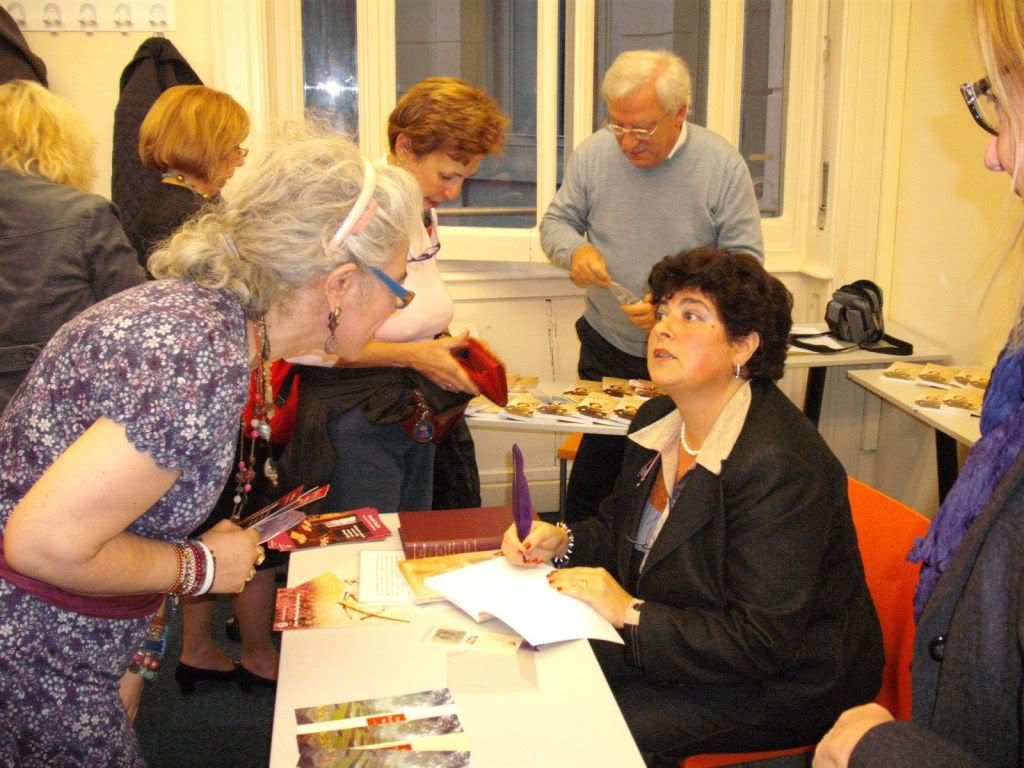
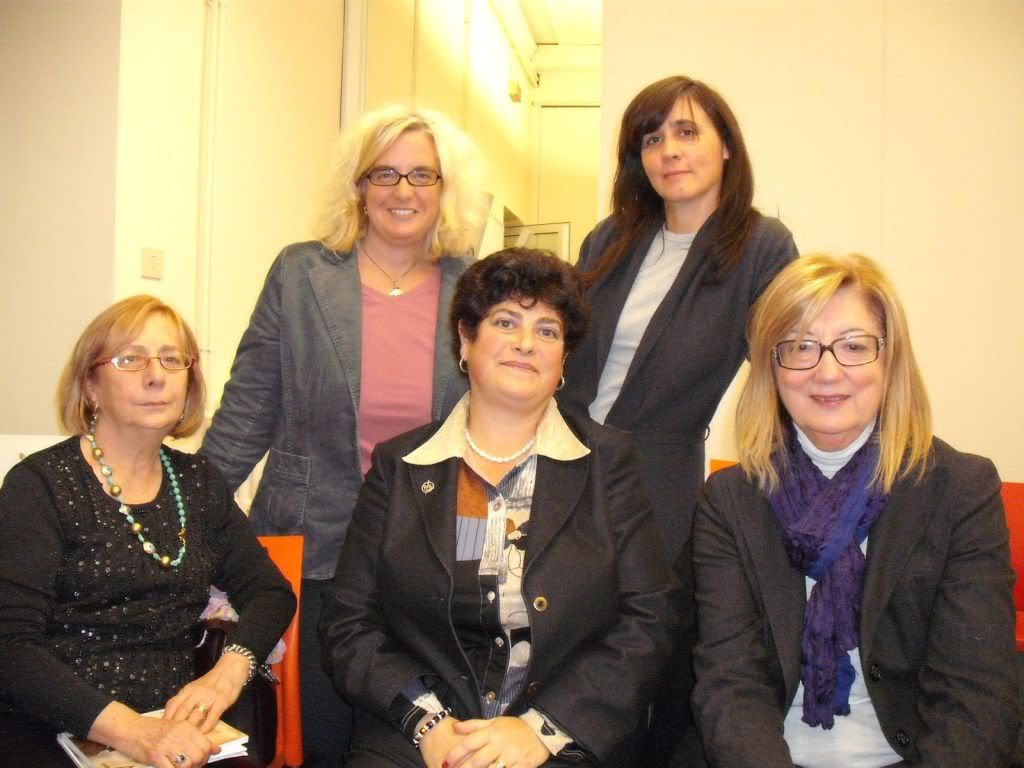
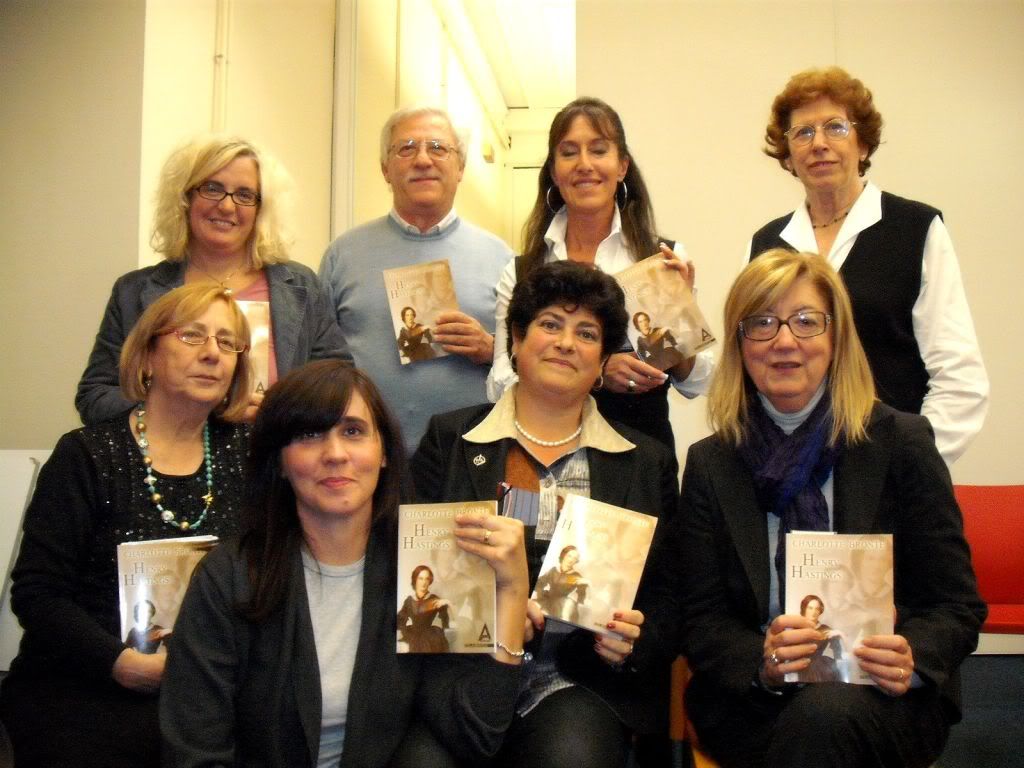
Last Saturday 24th October 2009 at 5 p.m. Professor Maddalena De Leo gave a talk at the British Council in Milan (Italy) concerning her last publication, a first edition and translation in Italian of Charlotte Brontë’ novelette Henry Hastings. The event was organized by the Italian section of the Brontë Society and by Albusedizioni, the publisher of the nice little book.
Professor De Leo then explained why she long ago had chosen to translate this particular tale by Charlotte by saying that it is extremely fascinating. The talk ended with a video reproducing some moments of the York Conference 2009 and the flowered moor at Haworth and, last but not least, a little party for all the people present.

Categories: , , ,

Wednesday, October 28, 2009

Lowbrow culture and online manuscripts

The Columbia Spectator poses an interesting question today:

With the simultaneous popularization of and obsession with lowbrow culture (see: ONTD, “Gossip Girl,” Miley Cyrus), has it become a social taboo to read literature? (Lucy Tang)
Part of the accompanying article includes the following:
Although I have not read any of Stephenie Meyer’s Twilight books, if it takes Bella Swan to encourage 13-year-old girls to pick up “Wuthering Heights,” so be it. (Lucy Tang)
And we agree.

Sparkle finds out the Twilight-Wuthering Heights connection and comments on it.

24dash has published a press release which might be of interest to Brontëites in the London area in December. A chance to see firsthand the online resource British Literary Manuscripts Online, c. 1660-1900 by Gale Cengage Learning:
British Literary Manuscripts Online (1660-1900): Also available to view at the show [Gale, part of Cengage Learning, will be previewing The Financial Times Historical Archive 1888-2006 on stand 524 at Online Information 09, Olympia, London (December 1st-3rd)] is an online library of manuscripts from many of Britain’s literary giants - the first of a series offering a unique, in-depth window into the world of creative writing, including autograph works by Pope, Johnson, Scott, Dickens, the Brontës and Wilde.
The British Library famously has the manuscript of Jane Eyre and other Charlotte Brontë novels as well as juvenilia, etc. What they don't have - because they no longer exist - are the manuscripts of Wuthering Heights, Agnes Grey or The Tenant of Wildfell Hall. Just saying in order to avoid disappointments.

The Brussels Brontë Blog publishes a report about the recent Brontë-related guided walk around Brussels:
On Sunday 18 October a group of about 20 Brontë fans braved the freezing weather to meet up in front of the Chapelle Royale (the Protestant Church in Brussels) for a fascinating tour of some spots relating to Charlotte and Emily's stay in Brussels. (Read more) (Patricia De Gray)
Categories: , , , ,

Jane back to Prague

New chances to see the Věra Mašková adaptation of Jane Eyre in Prague:

Jana Eyrová
at the Divadlo ABC, Prague

Director ... Peter Gábor
Translation ... J. Fastrová

Adapted by ... Věra Mašková
Settings ... Jozef Ciller
Costumes ... Tomáš Kypta
Music ... Petr Filák

Cast
Jana Eyrová ... Evellyn Pacoláková
Rochester ... Hynek Čermák
Paní Fairfaxová ... Carmen Mayerová
Adélka (alt.) ... Sany Stirská / Sabina Rojková
Richard Mason ... Lukáš Jurek
Grace ... Stanislava Jachnická
Berta (alt.) ... Máša Málková / Kateřina Vainarová
Saint John Rivers Radim Schwab


Wednesday, 28th October 19:00 DIVADLO ABC
Monday, 30th November 19.00 DIVADLO ABC
Monday, 30th November 11.00 DIVADLO ABC
Thursday, 17th December 19.00 DIVADLO ABC
Other pictures of the April premiere can be found here.


Categories: ,

Tuesday, October 27, 2009

Ghosts of Haworth

The Telegraph and Argus goes on a ghost tour of Bradford and district and Haworth is one of the stops.

Across the moors in Haworth, the rich history of the literary Bronte sisters is also entwined with that of the supernatural. The Brontes themselves were not averse to bringing the paranormal into their writing – witness Cathy’s unquiet spirit at the start of Wuthering Heights, and the mention of the large, goat-dog hybrid of Yorkshire myth, the ghostly guytrash, in Jane Eyre.
But do the ghosts of the Brontes themselves walk the cool, shadowed corridors of the Bronte Parsonage in Haworth?
There have been claims that shadowy outlines have been seen in the Parsonage windows, and that the sisters still haunt their old home. What we’re to make of the claim that Charlotte Bronte’s spirit materialised in a London cab is anyone’s guess, though.
More definite sightings – if such a thing can exist – have been made at the Black Bull pub in Haworth, where the spirits do not appear to confine themselves to the optics behind the bar. Dark figures have been sighted from the corner of the eye, and a mysterious man in a beige suit has apparently been spotted drinking at the bar… the ghost of our man in Havana, perhaps. Glasses and ashtrays have been flung to the floor in empty rooms, and one recurring vision is of a man in a top hat and smoking a cigar – some guests have even reported smelling the cigar smoke. Could this be Branwell Bronte, wayward male scion of the Bronte clan? (David Barnett)
If you are interested in the topic, you might like to take a look at books such as Philip Lister's Ghosts and Gravestones of Haworth or Marie Campbells' Strange World of the Brontës.

The South Wales Echo has an article about cinema in the year of Phoney War (that included part of the so-called best year in the history of cinema, 1939) which has the following reference to that year's Wuthering Heights.
This was that fabled Phoney War period when no-one really believed that a packed cinema could become a death trap if the bombers came.
So they took a chance and, let’s face it, who’d want to miss Laurence Olivier smouldering as Heathcliff in Wuthering Heights – “My hate is burning. I will have vengeance.” – making the girls from Woolies and Marks shudder with delight, doubtless casting disappointed sidelong glances at their Brylcreemed boy friends who so lacked Larry’s fire. (Dan O'Neill)
And The Sydney Morning Herald finds a retreat in the Blue Mountains called The Greens of Leura which has...
five rooms, each named after a famous writer or poet – including Shakespeare, Bronte and Austen – and a communal dining and lounge room, which features a full-size billiard table and free internet access for those unable to extricate themselves from the office for even one night. (Picture source)
An alert from Bowling Green, Ohio. Today, at the Gish Theater:
Tuesday, Oct. 27, 7:30 pm
I Walked with a Zombie
(1943) U.S., 69 minutes
Director: Jacques Tourneur


This eerie film tells the story of Betsy (Frances Dee), a young nurse sent to a Caribbean island to care for the comatose wife of plantation owner Paul Holland (Tom Conway). As Betsy settles into her assignment, she begins to uncover the bizarre world of secrecy and voodoo that permeates the island’s lush tropical environment. Is her charge really suffering from a naturally occurring illness, or is she the victim of something significantly more malevolent? Produced by legendary horror guru Val Lewton, this adaptation of Charlotte Brontë’s Jane Eyre is a classic tale of mystery and suspense.
A few blogs for today: Linda Loves Books has compiled a few illustrations of Jane Eyre by different artists, the novel itself is reviewed in German by Rezensorium. Tani's Rambling Words has watched Jane Eyre 2006 again. Audrey Allure posts about MTV's Wuthering Heights. And Life Unfurnished discusses Agnes Grey as 'the other one'.

Categories: , , , , ,

Haworth Through Time - A review

Our thanks to Amberley Publishing for providing us with a copy of this book.

Haworth Through Time
by Steven Wood and Ian Palmer (Photographer)

* Publisher: Amberley Publishing (30 Jun 2009)
* Paperback: 96 pages
* ISBN-10: 1848685092
* ISBN-13: 978-1848685093
A few days ago we quoted Elizabeth Gaskell's description of Haworth at the time when she visited the village. She described a grim, remote place, something which Charlotte Brontë had also done before, perhaps trying to make physical the psychological alienation she and her siblings had mostly felt with the local folk. And yet, through other less subjective accounts we know Haworth to have been a busy, bustling place, hardly a remote spot at all. All this to say, that it's easy to travel with the imagination, but what about the real thing?

Haworth Through Time helps in that quest to see Haworth as the Brontës would have recognised it. It remains an intriguing question whether the Brontë family would recognise today's cheerful, colourful Haworth as the place they inhabited for so many years, a place to which Emily Brontë, whenever she went away, was longing to return to and a place where Charlotte, whenever she spent long, fruitless stretches of time in, was longing to leave.

Photography wasn't a widespread format until the latter half of the 19th-century, which actually makes it hard for us to see Haworth through the Brontës' eyes. But it has the advantage of having remained mostly untouched for at least a couple of decades after the Brontës' deaths. Thus, the oldest pictures seen in Haworth Through Time date from the 1860s spanning until the 1960s-1970s, during which years there was, in the words of Steven Wood, a 'clearance mania' which affected many well-known spots around Haworth.

Steven Wood and Ian Palmer (photographer) document all these changes remarkably well, drawing attention to the tiniest details which are both curious - in that they are sometimes quirky and funny - and interesting - in that they serve to tell of Haworth's social history throughout the years. Who can resist finding out about people named Manasseh Hollindrake, Zachariah Booth or Zerubabbel Barraclough?

A sample page of the book would have the oldest picture on the top of the page, the brief explanation in the middle, and then the modern pictures at the bottom, taken from as similar an angle as the old one as possible. One of our favourite pages, for nothing in particular, is page 11, which is about Dean Street, with the oldest picture dating back to around 1970.
Here we see local builder Tom Laycock pushing his bicycle (his only form of transport) up Dean Street on the way to a job. The streets of the Brown climb steeply up the valley side. Many of them were never surfaced for cars and are now attractively grassed over. Other changes of the past forty years are visible [in the modern picture below]: cars for bicycles, wheelie bins for dustbins and satellite dishes instead of TV aerials. Washing lines survive unaffected.
The pictures - both old and new - are of good quality, making the endless process of gazing at them and inevitably looking for differences and similarities very easy on the eyes. Certainly, residents as well as visitors - both past and future - will find it a delightful, entertaining book. Residents will no doubt discover new things about the place and perhaps will even be tempted to take the book on a ramble or two in order to see Haworth with new eyes. Past and future visitors will discover the village of the Brontë sisters as they have never seen it before and will be very tempted to jump on the first train/bus/airplane in order to be able to explore for themselves.

On this last note - visitors - we would have welcomed a map of Haworth. Returning visitors who have spent days roaming about the place will know the places mentioned for sure, but other visitors who have focused on the Brontë Parsonage, the moors, the Black Bull, the church, Main Street and such will find it hard to place Sun Street or Acton Street. A map would have been very helpful, both for navigating the book and - why not - for navigating Haworth itself with the book in hand, which is no doubt what many will do.

When we first heard of Haworth Through Time - which is part of a series of similar books about differente villages - we wondered whether it wouldn't cover the same ground as Ann Dinsdale's lovely Old Haworth. Our surprise, then, is that they are both capable of going over the same place and yet approach it from totally different points of view. While Dinsdale is concerned about the Brontë connection of the places, using mostly images - not always photographs - of places where we know for a fact that the Brontës went to, Wood and Palmer are more focused on depicting the life of the village as a whole, regardless of whether the place has any Brontë connection, which of course is not to say that the Brontës are ignored in this book. Only about four pictures are the same in both books, the rest, even if a given place is mentioned in both - are different, which is very enriching.

Haworth Through Time is a wonderful opportunity to get to know better the place that surrounded the Brontës during most of their lives and which certainly helped shaped their narratives in one way or another.

Categories: , ,

Monday, October 26, 2009

Our innermost gothic self

The broadcast of the first part of Wuthering Heights 2009 took place yesterday in Australia and according to the audience figures, Crikey considers it one of the losers of last night's TV programmes with an audience of 769,000. Is it really that bad?

Incidentally, the Brontë Parsonage Blog has written about Saturday's event with screenwriter Peter Bowker and director Coky Giedroyc.

“I first read Wuthering Heights when I was sixteen,” director Coky Giedroyc tells the audience in Haworth. “I think it spoke to my innermost gothic self.”
Screenwriter Peter Bowker says that he stumbled through the novel in his teenage years: “My first strong memory is of the black and white Hollywood film, but I read it at university and I adored it……..
I had to return to my brutal younger self when I was choosing what to cut and what not to cut. The book is the work, of course, and I am doing a take on it, what a musician calls a cover version………ultimately, it is a redemptive version…….. (Read more) (Richard Wilcocks)
Click here to see a couple of pictures from the event.

Another TV production of a Brontë novel - Jane Eyre 1983 - is mentioned in The Times obituary for Barry Letts, who produced that adaptation.

A stage adaptation of Jane Eyre was seen at Farmers Alley Theatre, which looks back on its first year in the Kalamazoo Gazette.
“Jane Eyre” in April was also something special, with a cast of 14 in the small space. (Mark Wedel)
And according to China Daily reading Jane Eyre in China is easier thanks to the China Mobile Foundation.
Lin Xiuhong is a primary school teacher in a small county in Anhui province that received library support from China Mobile. Her son attends the same school where she teaches Chinese.
"On the first day, my son borrowed Robinson Crusoe, Little Golden Horse and How the Steel was Tempered; I borrowed Jane Eyre, Education of Love and a set of Encyclopedia for Kids," Lin said.
"Thanks to the library, my life and the life of my son have become more colorful," she said. (Hou Qingyang)
The Brussels Brontë Blog has a post on last week's talk and readings of Villette.
The theme of our talk on Saturday 17 October in our usual venue (Facultés Universitaires Saint-Louis) was Charlotte Brontë's novel Villette. People who read or re-read the novel after moving to Brussels agree that reading it here is illuminating both about Villette and Brussels. There are always some readers who find it difficult and unappealing, yet for many it is uniquely atmospheric and fascinating.
Maureen Peeck O'Toole's talk, Are you anybody, Miss Snowe?, by focusing on the narrator Lucy Snowe and her relationship with us, the reader, addressed some of the questions that arise about this novel. Many of these relate to the character of Lucy. Can we like her, or at least understand her and feel sympathetic towards her? What is her attitude to us, the reader? Why does she sometimes seem to deliberately mislead us or at least withhold things from us? The talk was intended to be useful for first-time readers of the novel while suggesting new ways of approaching it to those already acquainted with it. The discussion that followed and comments by people who attended suggest that the audience did indeed find it thought-provoking.
Maureen Peeck has lived in the Netherlands for much of her life and taught for many years at Utrecht University, but she was born Maureen O'Toole and brought up in Bradford close to the Bronte village, Haworth, which she visited as a child. Maureen is a founder member of the Brussels Bronte group and has always been one of its most active members.
Her talk was followed by readings of passages from Villette selected by her to illustrate it. We had five very competent readers, many with acting experience. Four were members of our group while the fifth had volunteered to join them in response to our appeal for a male reader to read M. Paul's part. The formula of talk plus readings worked well and several people said afterwards that the readings highlighted the points touched on by Maureen as well as being enjoyable in their own right.
We prepared for the talk by reading Villette in our reading group. There was so much interest that in addition to our meeting of regular members of the reading group, we organised an extra discussion just before Maureen's talk for all the other people eager to talk about the novel. (Helen MacEwan)
And if you are one of of those amazing people who start their Christmas shopping early, you might want to consider this Brontë cover designed by Leslie Hsu for the forthcoming nook eReader, seen via GeekSugar. We don't really see what's particularly Brontë about it, but it is nice all the same. There are two models (black and turquoise):
Display your favorite photo in the cutout window while you read with this durable cover named for the famous Brontë sisters of classical literature. Designed to open like a book, it features a PVC-coated cotton canvas outer shell and soft synthetic suede lining that helps protect your nook from scratches and handling.
There are a few reviews of Wuthering Heights 2009 on the blogosphere (a few of the above-mentioned 769,000): Cara Gabriel, Out of the Inkbottle (who makes the dislike for this production very clear) and Vanishing Point. She Reads Books reviews Jane Eyre, Golden Girls looks at some of the young actresses who have played the young Jane in Jane Eyre through the years, and Derek & Emily also discusses some of these productions. A Word to the Wise posts about the Brontës.

Let us finish by rememebering that Shirley was published 160 years ago exactly today.

Categories: , , , , , ,

Mystery writers on the mooooors

Smithsonian Journeys is organising a Mystery Lover’s England and Scotland trip which today, October 26, goes very Brontë:

October 26 — Charlotte Brontë and Robert Barnard—West Yorkshire

West Yorkshire is the renowned home of the Brontë sisters and Robert Barnard. Charlotte Brontë was the eldest of three novelist sisters, and her stories from the 19th century have become standards of British literature. More recently, in 2003, Robert Barnard received the Cartier Diamond Dagger award by the Crime Writers Association for lifetime achievement. Highlights: In West Yorkshire, visit Haworth and the surrounding countryside, which captivated the imagination of Charlotte Brontë. Follow the steps of contemporary mystery writer Robert Barnard’s Charlie Pearce as he searches for clues in modern Haworth, and Superintendent Perry Trethowan who looks into a Brontë manuscript that is a motive for murder. Meet with a mystery writer at a traditional pub lunch to discuss current works and meander through the haunting ruins of Wycoller Hall, the inspiration for Ferndean Manor in Jane Eyre.
And next October 28, a not-to-be missed alert for Brontëites with a sense of humour. Check the youtube video:
The History Girls
28th October 2009 £8/7 8pm
11th November 2009 / 8pm
Lowdown At The Albany
240 Great Portland Street
"Enter the skewed world of Heffernan, Fletcher and Stanley as they take their version of history and put a wig on it"


Categories: , ,

Sunday, October 25, 2009

The Psychopath and the Bigamist

Sequels, prequels... are discussed in The Independent. And Jean Rhys's Wide Sargasso Sea both as milestone and pioneer is mentioned:

The benefits of playing off classic novels became clear as long ago as 1966, when Jean Rhys emerged from decades of obscurity and into public prominence when Wide Sargasso Sea, her prequel to Charlotte Brontë's Jane Eyre, became an award-winning triumph. And, as Rhys showed, by basing her novel around the "mad woman in the attic" from Jane Eyre, the central character of a new piece doesn't necessarily have to have been the lead in the original. (Paul Bignell and Andrew Johnson)
The novel is also quoted in an article by the author Githa Hariharan in The Telegraph (Calcutta):
Jean Rhys in Wide Sargasso Sea created a prequel and corrective to Jane Eyre from the point of view of the ‘underdog’, Mrs Rochester. Wide Sargasso Sea completes our picture of the Rochesters by taking us to another world altogether, to another, equally valid and important, point of view. In a sense, this is what I try to do with the Scheherazade myth. I take something apparently ‘dated’ and remote from our present-day lives and connect it to the contemporary world through fictional narrative. There is a resemblance between Mrs Rochester, Antoinette, in Rhys’s novel and Dunyazad in When Dreams Travel in the sense that both women are more or less silent in the original work in which they make their appearance. Their bodies are there, but not their voices or their stories. But I do not really see Dunyazad as an underdog figure in the Arabian Nights story, nor do I see When Dreams Travel as an updating of or ‘corrective’ to the Arabian Nights.
The Independent (Ireland) finds paralells between the case of Edward Erin and some Brontë/Austen characters:
We cite literary characters like Heathcliff, Mr Rochester and Darcy as archetypes of male heroism, when in reality they are nothing of the sort. Heathcliff was a violent psychopath who treated every woman he came in contact with despicably. Mr Rochester dragged his young wife miles from her home and imprisoned her in an attic; he then pretended she didn't exist until he was unmasked at the altar trying to marry again. Darcy was an insufferable, narcissistic snob who believed he could get away with anti-social behaviour because of his wealth and status.
The women are no better. Catherine Earnshaw seems only faintly concerned at Heathcliff's horrific treatment of her sister-in-law, Isabella. Jane Eyre never stops to wonder if a man who locks his wife in an attic is really such a good catch. Elizabeth Bennett quite blatantly marries her Mr Darcy for his money. (Carol Hunt)
The Mirror describes True Blood like this:
Set in a world where vampires have ‘come out of the coffin’ and live freely with humans, True Blood is a mix of some of the hottest sex scenes on TV as well as a passionate love story to rival Kathy (sic!) and Heathcliff. Or even Bella and Edward, if we’re talking vamp/human affairs…
Marcia Zaaijer reviews for the Brussels Brontë Blog the Toneelgroep Dorst's production of De Brontë Sisters:
(...) Personally I think it is a pity, that their father Patrick is portrayed as an eccentric and not very child-loving father, almost like Mrs. Gaskell did one-and-a-half century ago. But somebody who has just come to see this play because Jane Eyre and Wuthering Heights made good television not so long ago, has no problems at all with this and can look freely to an fascinating story told by good actors, performing beautifully dressed in sober surroundings. (...)
The readers of The Guardian suggest the Keighley and Worth Railway as a worthwhile trip; buying Wuthering Heights in a Public Library sale in the Galesburg Register-Mail; a Charlotte Brontë quote opening an article in The Phoenix; we have an Australian blogger (another something) posting about Wuthering Heights 2009 (which is being broadcast this Sunday and the following one); Sallan lukupäiväkirja posts in Finnish about the Classical Comics's adaptation of Jane Eyre; Inhaler of Books reviews Wuthering Heights; Fiction Fanatic uploads a poem inspired by Wuthering Heights; The Republic of Rumi posts his very personal interpretation of Jane Eyre (in the antipodes of the postcolonialists) and Capitol Cougar complements the discussion with a (quite) different view; Love and friendship posts several Jane Eyre 2006 icons and Wizardscar (members of Siriusly Hazza P) have visited Haworth and the Parsonage. Starlets Past & Present posts about some of the young Jane Eyres on film and TV.

Finally, Notes from a Subway Journal posts a quite interesting review of Charlotte Brontë's Unfinished Novels 1993 edition which included among others Emma, Ashworth or The Story of Willie Ellin.

Categories: , , , , , , , ,