Podcasts

  • S3 E8: With... Corinne Fowler - On this episode, Mia and Sam are joined by Professor Corinne Fowler. Corinne is an Honorary Professor of Colonialism and Heritage at the University of Le...
    3 months ago

Wednesday, November 30, 2011

Wednesday, November 30, 2011 10:28 pm by M. in , , , ,    No comments
Little White Lies reports the latest meeting of the Curzon Book Club devoted to Wuthering Heights 2011:
In her version Arnold has tried to juxtapose the old with the new, adding a subtext of racial tensions in a film set in the 19th century. She has also opted for a 4:3 aspect ratio, often rejected for the widescreen in this modern age.
The camera style is raw, particularly whilst depicting the rugged Yorkshire landscapes, Heathcliff and Cathy’s relationship blossoming. The close-ups of her wild hair, being pinned down and muddied by a ravenous Heathcliff, are certain to evoke sexual connotations.
Symbolism is rife, the most striking and vivid that of a black beetle struggling about its way about this cruel landscape, metaphorically depicting Heathcliff’s quandary. The sound design is mainly diegetic, adding to the realist, raw style; it’s only at the end of the film that we hear music needle-dropped in a stylised fashion, which advocates the point that it appears that Arnold loses focus with the latter part of the film, moving from the realist approach to one of a more stylised fashion.
The style that prevails at the beginning disperses and the acting changes, clearly consequential with the change in Heathcliff and Cathy’s ages, but also loses the quality that Solomon Glave and Shannon Beer ooze onscreen. The work of Kaya Scodelario and James Howson as the older Cathy and Heathcliff is not overtly in tune with the characters that Brontë describes in her novel, lacking the rugged traits these characters are distinctly known for.
Most in the book club have declined to finish Wuthering Heights in the same way that it seems feasible that some cinema-goers may opting out half-way through. As viewers perhaps we should not be as harsh on Arnold’s rendition of Brontë’s prose. Yet an injection of passion was missing from this book club meeting; a little ironic when you consider that passion is so central to this classic text. (Keira Brown)
By the way, Mac Birmingham gives away a Wuthering Heights 2011 bundle.

Stuart Kelly makes the following question in The Guardian:
I'm sure that you'll all correct me, but I'm rather surprised that there are no meta-literary uchronias: Jean Rhys brilliantly interpolated a story into Jane Eyre, but what about a story where Jane Eyre marries St John Rivers?
Well, Oranges are Not the Only Fruit explains something similar, albeit in a different context.

Carey Mulligan says in The Daily Beast how at the school she read the Brontës:
“I didn’t study it in school [The Great Gasby]. We read Austen and Dickens and Brontë,” she said. “I felt more recently the weight of the responsibility. Everyone who has read The Great Gatsby or seen the film has their own version of Daisy, and I have mine ... I have never seen The Great Gatsby. When I was doing The Seagull in London, I made the great mistake of watching Vanessa Redgrave, and so I played Vanessa Redgrave playing Nina for the next three nights.” (Lorenza Muñoz)
Enid News & Eagle announces an upcoming Christmas festival with a bit of Brontë:
The ninth annual program performed by Thom Whittaker, music director at First United Methodist Church, and Christianne Chase begins at 4 p.m. in the sanctuary of the church, 401 W. Randolph. Whittaker, an accomplished organist, will play some new carols mixed with old standbys like “What Child is This,” “God Rest Ye Merry Gentlemen,” “Joy to the World,” and “Hark, the Herald Angels Sing.” (...)
Poetry includes works by Longfellow, Ann (sic) Brontë, Ann Weems and a special selection of Dylan Thomas, “A Child’s Christmas in Wales.” (Robert Barron)
The Jewish Daily Forward talks about Adina Bar Shalom, founder of the Haredi College:
The JTA story also reported that Bar Shalom was always worldly, and it said that she “read everything: “Jane Eyre,” “Gone With the Wind” and the works of Ayn Rand, but was forbidden from learning formal academic studies and instead studied sewing and got married at 18. (Elana Sztokman)
Cosmic Log explores how comics can help in teaching science:
Educational comics are nothing new, of course: Classics Illustrated, for example, was delivering comic-book versions of English lit and science class back in the '50s. (I still get the heebie-jeebies when I recall the Classics Illustrated version of "Jane Eyre" that sat in the comic-book box at Grandma's house.) (Alan Boyle)
The Pittsburgh Historical Fiction Examiner interviews the author Ella March Chase:
What three novels could you read over and over? 
"Jane Eyre" by Charlotte Brontë, "Little Women" by Lousia May Alcott and "A Little Princess" by Frances Hodgson Burnett.  I know two of them are children's books, but they take me back to my roots as a writer.  I read all three at least once a year 'medicinally' when I need a literary 'hug'.  They comfort me, center me and remind me how powerful a good book can be.
BlogHer is not very optimistic about the reading habits of young women:
I find this more and more in women's fiction, this wishful longing for the reader to know that they really love the classics. No, really love them. They want us to think that their families sit around debating Chaucer or the Brontë sisters. That their parents connected with their children through the reading of Yeats poems. That they were young women who lay in fields clutching their copy of worn copy of Sense and Sensibility.
I know lots of young women, many of whom are very smart. They may lay in fields, but you know what they're reading?
Twilight. (Colleen Blooms)
The Ledger-Enquirer loves Out of Print Clothing:
But I came across this site, Out of Print Clothing, which has t-shirts, tote bags, note cards and more, all inspired by great literary works.
For the bookworm in your life, this could be a God-send.
I'm particularly fond of the t-shirts for Wuthering Heights, Atlas Shrugged, The Bell Jar and Pop Poe, which gives E.A. Poe the Andy Warhol treatment. (Katie McCarthy)

The Squeee reviews Claire's Not-So-Gothic by Bonnie Blythe:
Chick lit, it may be, but it's not a re-telling of Jane Eyre, because for that, you need to at least parallel the plots, and this doesn't.  (Traxy)
Several Spanish blogs are eager to see Jane Eyre 2011: Bandejadeplata, ...el abismo te devuelve la mirada, Cinempatía. Leeds Book Club reviews the film. Newly Domesticated posts about Jane Eyre's costumes; thelibrarianreads re-reads Wuthering Heights (and includes an original poem); Foglie d'Autunno reviews Jane Eyre in Italian.
12:00 am by Cristina in ,    No comments
Our thanks to Hesperus Press for sending us a review copy of this book:
On Fiction
Virginia Woolf
Hesperus Press (On series)
Publication Date: October 2011
ISBN 13: 9781843916185
ISBN 10: 1843916185

Here, then, very briefly and with inevitable simplification, an attempt is made to show the mind at work upon a shelf full of novels and to watch it as it chooses and rejects, making itself a dwelling-place in accordance with its own appetites. Of these appetites, perhaps, the simplest is the desire to believe wholly and entirely in something which is fictitious.’
Her readings sensitive, her prose style elegant, authoritative and at times thoroughly opinionated, who better equipped than Virginia Woolf to ruminate on the art of fiction? In this selection of lesser-known essays on reading and storytelling, Woolf turns her critical gaze on treasured favourites including ‘the four great women novelists – Jane Austen, Emily Brontë, Charlotte Brontë and George Eliot’, and unearths some less familiar talents. Her discussion of differing approaches to reading is characteristically forward-thinking, and pinpoints the joys of this favourite pastime, in all its guises.
Whether one agrees with her or not, it is always an interesting pleasure to read Virginia Woolf's thoughts on anything but particularly her eloquent arguments on fiction and literature.

This short anthology recently published by Hesperus Press combines four of her essays(1)on the subject where she discusses many aspects of literature, creative writing, etc. and in which she mentions the Brontës from time to time. In The Narrow Bridge of Art she praises Charlotte Brontë's description at the end of Villette while in Phases of Fiction she includes Emily Brontë and her Wuthering Heights in the group of 'the poets' claiming that
Wuthering Heights again is steeped in poetry. But here there is a difference, for one can hardly say that the profound poetry of the scene where Catherine pulls the feathers from the pillow has anything to do with our knowledge of hers or adds to our understanding or our feeling about her future. Rather it deepens and controls the wild, stormy atmosphere of the whole book. By a master stroke of vision, rarer in prose than in poetry, people and scenery and atmosphere are all in keeping. And, what is still rarer amd more impressive, through that atmosphere we seem to catch sight of larger men and women, of other symbols and significances.
But undoubtedly, the more relevant of the essays at least as far as the Brontës are concerned is the last, Women and Fiction, published in 1929 only a few months before the seminal A Room of One's Own, when her mind was already advancing the themes that would make up the lager essay. It makes for a great introductory text and is a great read which, just like A Room of One's Own, is still relevant today.

A great way of approaching Virginia Woolf the essayist by (a remote) way of the Brontës.

Notes:
(1) Hours in a library  (1916); The Narrow Bridge of Art (1927); Phases of Fiction (1929) and Women and Fiction (1929)

Tuesday, November 29, 2011

Tuesday, November 29, 2011 8:14 pm by M. in , , , , ,    No comments
The Sydney Morning Herald talks about the Judge a book, buy its cover initiative:
[Jason] Benjamin is one of 25 artists to have contributed to an exhibition and silent auction, opening tomorrow, to benefit the Sydney Story Factory, a non-profit creative writing centre for children and teenagers.
The idea was hatched by its volunteers and pursued by Catherine Keenan, a Fairfax journalist and the Story Factory's co-founder, who asked Sydney Morning Herald readers in August to nominate their favourite book. Inspired by the list, artists were asked to create new book covers or artwork. (Linda Morris)
The list included Jane Eyre (number 11) and Wuthering Heights (number 10).  The first one has been chosen by the artist Wendy Sharpe:
Wendy Sharpe Jane Eyre, Charlotte Brontë. Oil on canvas, 25 x 20 cm (Picture source).
32auctions interviews her:
When and where did you first read Jane Eyre?
I first read 'Jane Eyre' when I was twelve, immediately loved it and did drawings of what I thought all the main characters looked like. There have been seventeen adaptations of Jane Eyre for television and film; what is it about the novel or Jane herself that continues to invite reinterpretation?
It is such a dramatic, exciting story and has so many great scenes. Though "poor and friendless”, Jane Eyre is a very strong, independent woman. I hate it when you see versions where she looks like a fashion model or Hollywood starlet. In this work I’ve attempted to depict the supernatural aspect of the novel.
The Guardian's Film Blog talks about Wuthering Heights 2011's box office:
Among holdover titles, Wuthering Heights saw another big drop, falling 62%. Director Andrea Arnold's previous picture Fish Tank reached £597,000, which looks an elusive target for the Brontë adaptation, currently at £447,000. (Charles Gant)
Glamour Magazine publishes a twitterview with the actress Chloë Grace Moretz:
RT@Kimmiejamms Are you a bookworm like Isabelle & what's your fave book? #GlamChloe
My fave is Wuthering Heights. I love books! (...)

RT @jimdougan: If you could spend a day in the life of any film character, who would you choose? #GlamChloe
Scarlett O'Hara or Cathy from Wuthering Heights.
Another Brontëite is the author Cathy Woodman, according to Novelicious:
What is your favourite Women’s Fiction book of all time and why?
I adore Wuthering Heights by Emily Brontë, its story of passion, unrequited love and revenge acted out on the wild Yorkshire Moors.  Although the ‘hero’, Heathcliff, is tragically flawed, I have fallen in love with him many times.
My parents chose my name from having read Wuthering Heights just before I was born. 
California Literary Review posts a recap of the latest episode of House M.D., Perils of Paranoia (Season 8, Episode 8):
I know I’m on controversial ground here, but if people read more Victorian literature, they’d be aware that mostly, before vaccines (and decent plumbing), people just died a lot, especially the children. Doesn’t anyone read Jane Eyre anymore? Or the novels of Mrs. Gaskell? (Holly Hunt)
The costume drama cough, indeed.

We don't have a clue of what this descripcion of Rihanna's We Found Love video is saying:
The narrative's romanticization of a passionate, abusive (presumably pseudo-fictional) relationship takes off just like the sparklers in the clip, despite the corny narration and occasional overstyling. It bangs on the proper brain receptors like a council house Wuthering Heights. One last hit of Euro-techno euphoria just as the sun starts setting early for the winter over leafless trees. (Molly Lambert in Grantland)
Melissa Kite in the Daily Mail doesn't like George Osborne's speeches but we think that she likes even less Wuthering Heights 2011:
It was more depressing than the new film version of Wuthering Heights which is two hours of wind howling and rain pelting on window panes as Cathy wails 'Eeeeeacliffe!'  
Niagara This Week announces that the Shaw Festival’s annual film series returning to Niagara-on-the-Lake will screen Jane Eyre 2011 next January 7; Simon Riley describes Jane Eyre 2011 as 'sublime' in The Playlist and Hollywood Chicago thinks that the film is underrated. Other reviews can be found on The Bagpiper Online, Filmtabs (in German) and chris watches movies. LadyLavinia 1932's Blog reviews Jane Eyre 1997 and The Gown posts about Wuthering Heights 2011. Becky's Book Reviews and livrespourvivre revisite/read Jane Eyre, the novel and Yours Beloved Wuthering Heights, the novel. One more entry at the Brontë Weather Project documents its progress.
12:09 am by M. in    1 comment
The news are all over the web (The Telegraph, The Guardian, BBC News ...), the film director Ken Russell (1927-2011) has died. Eternally controversial, enfant terrible, fiercely independent he will be remembered for films like Women in Love, The Billion Dollar Brain, The Devils, Lisztomania, Altered States or the opera rock Tommy.

Picture Source:
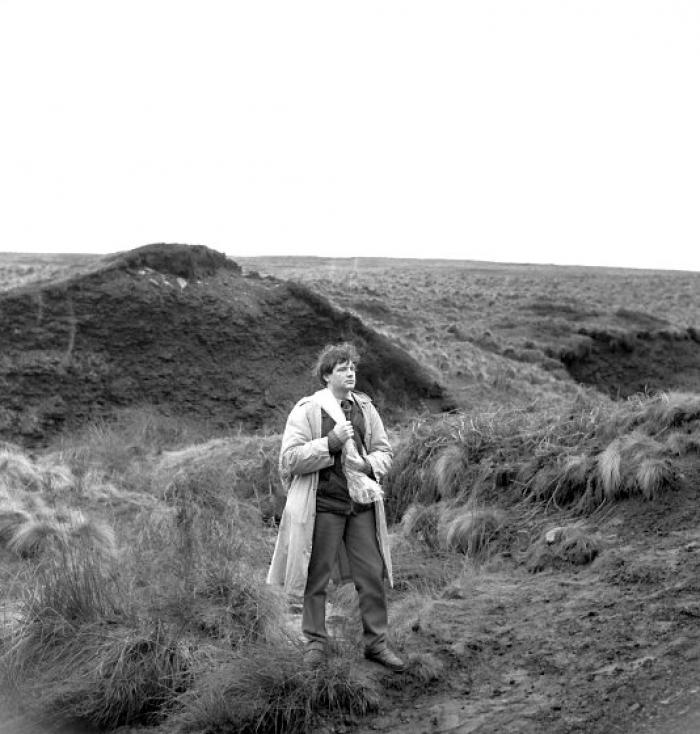
Ken Russell as Heathcliff in 'Brontë Story' shot near Haworth in Yorkshire, 1957
Photograph by Shirley Kingdon © TopFoto

But the Brontës also play a part in his story. At the very beginning and at the end of his career. Before becoming a director, in the late 50s, he was a photographer:
Russell was a struggling photographer and started to make picture stories- series of photo's that told a story. Often his wife Shirley starred and did the costumes. It wasn't long before he tried films with second hand equipment and produced amateur shorts. (...)
The photographer Russell made picture stories, photo sequences that together told a story. It was his substitute for film making until he could afford a movie camera. They appeared in Picture Post and other magazines.  The most famous image is of his wife Shirley [Ann Kingdon] playing the role of Charlotte Brontë. This was made during their honeymoon. (Iain Fisher in The Savage Messiah)
Ken Russell remembered these photographs in a 2007 interview in The Arts Desk :
During that, on my honeymoon, my wife and I went to Haworth, the Brontë village and stayed at the Red Bull (sic) where the brother used to get drunk and stoned. There are a couple of my wife in one of her Victorian costumes as Emily Brontë. While I was up there me and my wife did a whole series.
In 2006, when his film career was reduced to amateur and home recordings, he was invited to film the Radical Brontës Festival final party: A Brontë Burlesque. Quoting from the aforementioned interview:
I was asked to go to the Brontë festival in Haworth. I thought, that sounds fun, I’d rather like to be involved in that. so I suggested to the authorities that I make a short ten-minute film of an aspect of the event. I suddenly came up with the idea that Charlotte Brontë was a bit of a schizo in so far as she called Jane Eyre an autobiography, and in some respects it was, and so I devised a little entertainment to be shot on the lawn of the vicarage with some locals playing the roles. There was a couple of characters from Jane Eyre, and also her brothers and sisters. So I wrote a scenario, a ballet, which I mostly choreographed myself, called Charlotte Brontë enters the Big Brother House. I had her continually called to the Diary Room. It was a challenge because my children said, "You’re mad, you can’t do it." My daughter who is 40 hid behind the sofa and just used to peep over the top, until she saw it was all right.
Charlotte Brontë enters the Big Brother house was to be premiered on YouTube, but as far as we know it never was available there. Or anywhere. The best account of its shooting can be read in Ken Russell: re-viewing England's last mannerist, edited by Kevin M. Flanagan. It seems that the film was completed and edited. Ken Russell conceived the choreography; his wife, Lisi Trible, played both Charlotte and Jane Eyre and the whole thing was co-directed by Ken Russell and Michael Bradsell.

Monday, November 28, 2011

Monday, November 28, 2011 8:55 pm by M. in , , , , , ,    1 comment
L.M.C. is the owner and webmaster of Abigail's Ateliers. A website of reference for people interested in historical costumes and, particularly the costumes used by the Brontës. And now Ms Cutliffe is also big national news in The Telegraph:
EDIT: Read L.M.C.'s take on this story. 
L.M.C., 49, loves 19th century author Charlotte Brontë so much she dresses as the famous author all the time - even while doing her supermarket shopping. (...)
L.M. started dressing as the famous author - who penned classic novel Jane Eyre, which was recently turned into a Hollywood blockbuster - three years ago.
She said: "I love the works of all the Brontë sisters, and really wanted to encourage other people to find out more about them.
"I started dressing as Charlotte around Haworth, to point tourists in the right direction to the Bronte house.
"Now I love my costumes so much it's hard to take them off!"
L.M. has forked out a whopping £4,000 fashioning more than 50 incredible period costumes.
She added: "I dress as Charlotte because the other Brontës were quite young when they died and I'm 49.
"But I feel I'm more like Emily because she loved the Yorkshire moors and animals.
"I love taking our dogs for long walks on the moors and it always reminds me of Wuthering Heights and Heathcliff.
"I tend to do my shopping in costume, and people love seeing me around.
"I went into Sainsbury's in jeans once, and the checkout girl told me to go home and come back as Charlotte.  (...)
"I still pick Becky up but she doesn't seem to notice, never mind care, that I'm dressed as Charlotte Brontë. I think she thinks it's funny!"
"My husband has also been very supportive of me - I couldn't do any of it without him; he is my Mr Rochester." 
The Daily Mail (and The Daily Express) is also carrying the story with some more pictures (the McDonald's one included) and a few more comments:
She said: 'My family have been really supportive and John even takes pictures for my Bronte website of me in costume in the hills of Brontë Country. (Lauren Paxman)
L.M.C. herself posts about the articles and the (most of them) stupid comments that have been published all around.

The Yorkshire Post interviews Mark Atkinson, owner of Atkinson Action Horses. His work in Wuthering Heights 2011 is mentioned (picture source):
It is a good job that Dylan, a stunt horse, is an unflappable character.
Carrying a cameraman across the moors, who sat facing the horse’s tail so that he could film as they went along, was all in a day’s work for this horse.
On this occasion the work in question was for the film Wuthering Heights. (...)
The Atkinsons were asked to supply a total of nine horses for the film Wuthering Heights, much of which was filmed near Hawes.
“The horses were based at Ferdy Murphy’s racing yard at West Witton and the facilities were brilliant,” said Mark. “Andrea Arnold, the director, was so supportive and it was a really good experience.”
They spent three months working on the film. At one point, the conditions underfoot were so muddy and uneven that they decided the only way to film Cathy and Heathcliff riding across the moors would be to put the cameraman, who had never ridden, on horseback.
The Race (a The Hollywood Reporter's blog) updates its predictions about the upcoming Oscars.  Mia Wasikowska and Dario Marianelli (Best Original Score) are not in the top five possible nominees, but there are listed as major threats. Michael O'Connor seems a sure bet in the Best Costume Design category.

Time Out London interviews Martin Scorsese about his new film Hugo and the reporter asks him about British cinema:
I like Lynne Ramsay [the director of ‘We Need to Talk about Kevin’] too, and Andrea Arnold.’ When I mention that Arnold has just released a low-budget, defiantly auteurist version of ‘Wuthering Heights’, his ears prick up. ‘Oh, really?’
This might be a phone conversation, but I’m sure he was reaching for pen and paper. It’s an arresting image: Martin Scorsese, packing to travel to London, readying himself to premiere ‘Hugo’ in London and Paris, but scribbling down on a scrap of paper that he must remember to catch up with a radical new British version of ‘Wuthering Heights’ when – if – he ever manages to find a spare hour or two. (Dave Calhoun)
A Yorkshire Post reader defends Andrea Arnold's film after reading the (very) bad review of the newspaper:
Don't  be put off. Tony Earnshaw’s total drubbing of Andrea Arnold’s rendition of Wuthering Heights is too tough (Yorkshire Post, November 7).
See it for yourself. Visually it is incredibly beautiful, you are part of it, in the atmospheric shifting moorland mist, the strange light of which makes the colour sing. You can smell the sodden moss and peat. The brilliance of the close-ups of flora and fauna and the vast panorama of Swaledale. (...)
Did it capture the essence of that towering novel, which soars because of its narrative rather than its dialogue? You decide – take an open mind and go and see it.( From: Hilary Bunt, Monklow Moor, Harrogate.)
The Mirfield Reporter reports that the fight to save Shirley Country is still going on:
Kirklees Council would be wrong to put forward a site of enormous historical significance for an industrial development that would dwarf the White Rose Centre.
That was the message from people protesting against plans for a 42-hectare business development at Cooper Bridge.
They had their say at the start of a meeting on Wednesday – but councillors agreed to set aside the land on the Mirfield border for development.
The site is currently popular with walkers and is cherished by many for its historical ties to the Luddites and the Brontë family.
Campaigners held placards outside Huddersfield Town Hall before the meeting, calling on councillors to ‘Keep Roberttown and Hartshead rural’.
Unreality TV talks about the latest installment of UK's X-Factor:
Dressed in a white flowing dressed and backed by a stage backed by giant bay window she [Amelia Lily]  looked like she was about to launch into a Kate Bush number luckily Wuthering Heights wasn’t on the agenda  (Lisa McGarry)
Simon Heffer begins an article in Standpoint like this:
When I was a child in the 1960s the favoured period for nostalgia was the Victorian age, in all its manifestations. A Dickens or a Brontë serialisation seemed to be on television every Sunday.
The Free-Lance Star publishes a curious (and regrettably more usual than it seems) story:
George Newman recently came across this sentence as he copy edited a book review:
"Madeleine ultimately decides that she's going to go to graduate school and study the great Victorian novels of Austen and Eyre, because, unlike real life, they almost always have a marriage plot and a happy ending."
Before I tell you what changes George made to that sentence, let me say that I put the unedited sentence up on my blog on fredericksburg.com and asked readers to take a crack at it.
Several suggested rewording "going to go to graduate school and study" or removing commas.
Maybe the sentence could have been worded better, but the real problems were the two easily checkable errors of fact.
George checked them--because it occurred to George that he should check them.
First, who is this supposed author named "Eyre"? There is a famous character named Jane Eyre, in a book by Charlotte Brontë.
Second, Jane Austen was a Victorian? No, she was not. She wrote in the Regency era, predating Queen Victoria's rule.
George changed the sentence to save us from a spate of angry letters from the literarily inclined.
As published, it read: "Madeleine ultimately decides that she's going to go to graduate school and study the great novels of Austen and Brontë, because, unlike real life, they almost always have a marriage plot and a happy ending." (Laura Moyer)
Clash Music chooses a Sonic Youth playlist:
I Love You Golden Blue - Sonic Nurse
In my opinion Sonic Nurse is the ultimate hit record of Sonic Youth. Every track is so nicely composed, and the production is more crisp and in-your-face than a lot of the other records. This song is just darn graceful, and Kim Gordon sings like some sort of fallen angel from the hinterlands. The lyrics seem to capture a universal feeling of loss, and for me Kim Gordon enacts the gothic world of Emily Brontë with this song.
The Arts Desk reviews the performances of Matilda, The Musical at the Cambridge Theatre:
Precocious beyond her years, she’s read Brontë, Jane Austen, Lord of the Rings and many more classics by the time she arrives in the class of the sympathetic Miss Honey at Crunchem. (Carole Woddis)
The amateur DJ Anna Conray talks about her failsafe floor-fillers in NME:
'Wuthering Heights’ by Kate Bush (I realised that this was failsafe when a man decided to physically take hold of my hand and propose afterwards).
The Yorker, Casteluzzo, SİNEMASKOP (in Turkish) and La Sala de Cine and Monky (both in Spanish) talk about Jane Eyre 2011;  Languid Prattle reviews We Are Three Sisters; Tanta Coisa! (in Portuguese) is beginning a Brontë challenge; Owl Tell You About It loved re-reading Jane Eyre; The Art of Leo and Diane Dillon posts a 1969 cover of Jane Eyre; David Nguyen and captainBLIGH review Wuthering Heights 2011 and A Girl Walks into a Bookstore... posts about the original novel.
A new radio adaptation of The Tenant of Wildfell Hall begins today, November 28. The whole adaptation runs for 150 minutes and will be broadcast in ten episodes (15 minutes each) included in BBC Radio Four's Woman's Hour:
BBC Radio Four
Monday to Friday: 10:45 AM / Repeat: 19:45 AM
BBC Radio Four Extra
Saturday: 12:00 PM (Omnibus: All the episodes of the week) / Repeat: 02:00 AM

The Tenant of Wildfell Hall
by Anne Brontë

In Anne Brontë’s The Tenant Of Wildfell Hall, Helen Graham is the mysterious new tenant with a dark and painful past.
As gentleman farmer Gilbert Markham becomes powerfully drawn to this enigmatic widow he discovers her turbulent past.
Dramatised by Rachel Joyce, The Tenant Of Wildfell Hall is seen as a powerful sister-novel to Emily Brontë's Wuthering Heights and partly set in a similarly remote moorland place. The story incorporates two narrative viewpoints in two literary forms - Gilbert's letters frame Helen's diary which she eventually gives him to read and from which listeners learn of the awful events of her tempestuous marriage to Arthur Huntingdon that have precipitated her need to seek anonymity and seclusion at Wildfell Hall.
Dramatised by Rachel Joyce
Directed by  David Hunter

Gilbert ... Robert Lonsdale
Helen  ...  Hattie Morahan
Huntingdon ... Leo Bill
Arthur ... Samuel Bridger
Mrs Markham ... Carolyn Pickles
Rose ... Leah Brotherhead
Annabella ... Emerald O'Hanrahan
Hargrave ... Stephen Critchlow
Lowborough ... Chris Webster
Miss Myers ... Alex Rivers
Lawrence ... Carl Prekopp
Eliza Victoria ... Inez Hardy
Rev Millward ... Gerard McDermott
Mrs Maxwell ... Tracy Wiles
Boarham ...  James Lailey

Episode 1: The Tenant
Episode 2:  A Snake in the Grass
Episode 3: Assault
Epiosde 4: The Warnings of Experience
Episode 5: Matrimony

Sunday, November 27, 2011

Sunday, November 27, 2011 2:28 pm by M. in , , , ,    No comments
The Minneapolis Star-Tribune asks readers about favourite holiday reads:
As a child, I received a really nice hardcover copy of "Jane Eyre" from an aunt. I wasn't ready for it yet, but I kept it. Years later, I got a job at a factory. I brought "Jane Eyre" with me to read on lunch breaks. It was the most wonderful escape -- one of the best gifts ever!
(Jennifer Wills Geraedts, Park Rapids, Minn.)
The New Statesman talks about how different performers can share the same role in a film:
Filmmakers drawn to the generation-spanning yarn often fail to foresee or sidestep a structural booby-trap that comes with the territory. A few weeks ago, in my review of Andrea Arnold's Wuthering Heights, I referred to the problem as "transplant casting", so let's stick with that phrase: the passing of one character between two or more different performers, with all the hazards this entails.
In Arnold's case, the shift from the earlier incarnations of Heathcliff and Cathy (played by Solomon Glave and Shannon Beer) to their slightly older selves (James Howson and Kaya Scodelario) caused a rupture from which the last third of the movie struggled to recover. (Ryan Gilbey)

We don't know if quoting Wuthering Heights (and particularly Andrea Arnold's Wuthering Heights) is a good idea in an article about the c-sections on demand UK issue in the Daily Mail:
In the stunning new film of Wuthering Heights, Cathy’s sister goes into labour on the beautiful crystalline moor. Then we see her grave being dug. Yes, it’s primal stuff.  (Suzanne Moore)
The article talks about a different thing, but this reference on edhat Santa Barbara makes us wish such a gift was real:
We've outgrown needing a spot for Santa to leave the 12,347-piece Wuthering Heights-themed Lego set our boy once coveted. Even better, there'll be no rearranging of furniture[.] (Billy Goodnick)
The Sunday Times talks about the street artist Swoon. You know pseudonyms...
Swoon, real name Caledonia Curry, works on a piece in her Brooklyn studio...lone female wolf in such a male world? At the beginning of her career, rather like female novelists such as George Eliot or Charlotte Brontë who wrote under male pseudonyms, Swoon did not let on she was a woman, despite her bodice-ripping name.  (Eleanor Mills)
An alert for tomorrow, November 28 in Jacksonville, Florida:
Jacksonville Main Public Library, 12:00 PM
Masterpiece Theatre Book Club focuses on Masterpiece Theatre classics. Participants are invited to watch the film, read the accompanying book and meet with the club to discuss both. Today we will discuss "Jane Eyre".
Charlotte Reads Classics posts about Agnes Grey; My Journal of Becoming a Writer reviews Wuthering Heights and Kitcher's Café does the same with Jane Eyrelivin cool and Elaine Macintyre reviews Wuthering Heights 2011; books & other stuff too liked Jane Eyre 2011.
12:28 am by M. in ,    No comments
The November 5 issue of The Spectator published a poem by Christopher James devoted to Branwell Brontë freely mixing facts and legend. The poem can be read here:
The Brother 
'All my life I have done nothing either great or good'

Branwell Brontë, you died standing up,
your talent eclipsed by whisky and genius.
A station master's assistant,
you were let go for translating Horace in the ticket office;
you made announcements only in Latin.
As a tutor, you were driven to distraction:
Mrs Robinson, seductres of Thorp Green,
she became your one blaze of excitement.
On Sundays you had the hall to yourselves;
you drank tea in the nude and read Keats in the bath.
She always said the maid was not to be trusted.
You took to the hills with your brushes
to escape the chattering of your sisters
and the prison of your father's love.
You chased phantoms across the moors.
Merely gifted, you painted yourself out of life;
and could not remember setting fire
to the bed or Emily sousing you with a bedpan.
Branwell Brontë, King of Angria, forever cast
to the shadows of history, you found laudanum
no cure for heartache or mediocrity. Your sisters'
greatest love: the brilliant boy, who never shone.
Christopher James
Igor Pomerantsev (Игорь Померанце) likes the poem so much to devoted an article to it and the Brontës on Svoboda News (Радио Свобода).

Saturday, November 26, 2011

Dave Astor in The Huffington Post shows his Brontë colours:
I give thanks to the books that turn adolescent readers into adult readers. For me, it was one 19th-century novel by a woman, and one 20th-century novel by a man. (...)
But by the time we reach our mid-teens, English teachers up the ante. Two books on their agenda when I was that age included Charlotte Brontë's Jane Eyre and John Steinbeck's The Grapes of Wrath -- both of which made me groan before I cracked their covers. A novel about some oddball governess? A farm family leaving Oklahoma? Bor-r-ring.
Then I read those two books, and my literary landscape was transformed. There was no going back to kid fiction with few nuances and little complexity. Danny Dunn was done.
Though I was a 20th-century American male, I strongly related to the British female protagonist in Brontë's 1847 novel. Jane Eyre somehow transcended time, place, and gender -- like all great literary characters can do. I admired her ethics, intelligence, independence, and self-sufficiency. Plus I was sort of a loner like her, and was from modest economic circumstances like her. (...)
For all the lessons and such in those two books, the Brontë and Steinbeck classics were also darn good reads filled with suspense, pathos, believable dialogue, and flat-out excellent writing. Plus Jane Eyre was and is incredibly romantic.
Pilar Vera in Diario de Cádiz (Spain) also uses Jane Eyre as synonym for the love of books:
Decidida a escapar de su inmundo mundo, la pequeña Jane Eyre -huérfana, inoportuna, marisabidilla-, cogía un libro y se acurrucaba tras gruesas cortinas. La única fuerza, la única salvación, estaba en la lectura. Es cierto que las historias pueden salvar vidas. Por eso amamos tanto a los libros, quienes los amamos: somos conscientes de su valor exacto. (Translation)
The Atlantic talks about being a writer today:
Though it's rare to make a living on writing, it's becoming increasingly easy to call yourself one. Without any money at all, anyone can publish digitally with the click of a button or, for a price, self-publish a print manuscript. The ecology of authorship has changed dramatically since, say March 1845, when Charlotte Brontë was working as a governess, miserable, and wrote in a letter, "I shall soon be 30 and I have done nothing yet." That was two years before Jane Eyre was published. 
 This is Money discusses how houses which have been featured in films are more interesting for buyers:
The latest version of Wuthering Heights, out now, was shot extensively in three locations in the Yorkshire Dales — Thwaite, Muker and Coverham.   (...)
Typically beautiful National Park villages, the first two are dotted with stone cottages, while Coverham is even smaller. All are full of Dales character.
House buyers there are often in search of the Wuthering Heights farmhouse on top of a hill, with ‘views forever’, according to Brian Carlise, of J.R. Hopper.  (Mark Hughes-Morgan)
The Weekly Standard reviews Freud's Couch, Scott's Buttocks, Brontë's Grave by Simon Goldhill. A controversial view of the Brontë Parsonage:
But year after year, tens of thousands of tourists visit the five shrines on his tour—the homes-turned-museums of Sir Walter Scott, William Wordsworth, the Brontës, William Shakespeare, and Sigmund Freud—in search of some insight or connection. So if Goldhill starts off skeptical of these pilgrimages, he also has reason to take them seriously. (...)
The Brontë estate in Yorkshire reveals the dark side of writers’ homes, and not just because of all the moors. The Brontë sisters tend to attract hysterical fans—“going to Haworth feels like joining a cult”—and the museum at Haworth Parsonage certainly reflects a certain obsessiveness, which forces Goldhill to confront the voyeurism of his mission. In Charlotte Brontë’s room, her very shoes and stockings are part of the exhibit: “What Victorian woman, let alone the cripplingly shy Charlotte, would want her used underwear on display? It is also Goldhill’s misfortune to have brought as his traveling companion a friend who once saw the original manuscript of Jane Eyre in the British Library. This friend finds nothing at Haworth Parsonage half as moving as beholding the page where Charlotte first set down “Reader, I married him" which leaves Goldhill wondering if the sisters’ intimate belongings have been exposed not only tastelessly but pointlessly. (Helen Rittelmeyer)
In all likelihood Charlotte Brontë wouldn't appreciate her clothes being on display (and Arthur Bell Nicholls certainly wouldn't) but truth be said the Parsonage is highly considerate with what it shows. No real underwear ever (are stockings underwear?) goes on display, even if it exists (see our review of Katrina Naomi's Charlotte Brontë's Corset).

The Sydney Morning Herald mourns the death of the writer Hazel Rowley. She was quite a Brontëite:
Her real drive to biography, it seems, came out of her first reading of Jane Eyre. It fired her imagination, she said: ''I could not read enough about the Brontë sisters and their harsh life in that parsonage.'' (Jane Sullivan)
The Dayton Daily News mentions the pen name of Charlotte Brontë:
Shakespeare’s champions act as if it’s inconceivable that anyone would write under a pseudonym. Tell that to Mary Anne Evans, still known to the world as George Eliot; or to Charlotte Brontë, who originally published as Currer Bell. (Mary McCarty)
Contatto News (Italy) reviews Elizabeth Newark's Jane Eyre's Daughter:
In conclusione, credo che questo libro non sia affatto consigliabile, credo che lasci un’onta nel cuore del lettore che non potrà mai evitare di paragonarlo alla bellezza non solo della storia, ma anche stilistica, del capolavoro di Charlotte. Risultati di vendita di questo romanzo possono risultare per l’affetto che ci lega a quella giovane indifesa e forte al contempo, che era la nostra adorata Jane Eyre, quella reale, quella pura della Brontee, e non madre snaturata descritta dalla Newark. (Translation)
Keighley News reports a recent meeting of the Brontë Country Partnership looking for new initiatives to promote tourism in the Brontë country. Sink into a Good Book... reviews Wide Sargasso SeaLove, Romance, Passion reviews Sharon Kendrick's The Forbidden Wife; the Brontë Sisters lists some links about Branwell Brontë and Luddenden Foot; lift up the shades, turn off the lights posts about Branwell Brontë;  Nadando en tinta (in Spanish) reviews Wuthering Heights; Melodee Writes, Leopard-Skin-Pill-Box-Hat, The Spider's House, New Empress, Assistant Blog, CineHouse, Alternate Takes and Bad Grammar post about the Wuthering Heights 2011 adaptation; Mia's Musings and Wirtualna Polska and Gazeta Płock (in Polish) posts about Jane Eyre 2011. By the way, several Spanish websites publish the trailer of the film (which reveals far too much of the story, so much that it is not a trailer but a summary). And the German news outlets also publish several articles and reviews: Monsters & Critics, Oberhessische Presse, Net Tribune and Aviva-Berlin. Such a Litwit compares Brontë and Austen.
12:12 am by M. in ,    No comments
A couple of recently published Jane Eyre audiobooks:

Carole Boyd's reading of Jane Eyre is republished:
Jane Eyre (abridged)

Read by Carole Boyd

Original Release Date: December 1, 2010
Number of Discs: 2
Label: Talking Classics
Copyright: 2010 © De Agostini UK
and a curious edition with an artificial voice:
Jane Eyre (unabridged)

Label: Eternal Classic Audio Books
Total Length: 18:59:59
Release Date: 2011

Friday, November 25, 2011

Friday, November 25, 2011 2:15 pm by Cristina in , , , , , ,    No comments
The Epoch Times travels around Brontë country:
Haworth, a former wool manufacturing village, and the Parsonage are the starting points to explore the world of the Brontë sisters. A fascinating journey and experience awaits in the neighbouring county of Lancashire that includes the chance to stay in part of the former school house that the four sisters attended.
Nestled within the verdant setting of the Lune Valley at Cowan Bridge in Lancashire is the “Brontë Cottage”. Dating back to the 1750s, the grade II listed former school house is both unassuming and cosy in appearance, belying its place and significance in the history of the Brontë family.
An inscribed plaque at the gable end of the building details the provenance of the place and reads “Maria, Elizabeth, Charlotte & Emily Brontë lived here as pupils of the clergy daughter’s school 1824-25”. It was the inspiration for “Lowood School” in the literary classic Jane Eyre.
The cottage has been sympathetically restored, using traditional techniques and materials, by a local couple, who now gives visitors a chance to stay and self-cater in this unique landmark.
The smell of the log burner and creaking floorboards set the rustic scene for new arrivals, while items found during the restoration are on display along with bookshelves of novels waiting for visitors to absorb the character of the period.
The eco-garden facing the cottage backs onto the fast flowing River Leck beside which a towpath provides an exhilarating walk. In fact, walk in any direction and you are surrounded by rolling countryside. One of the nicest, we were to discover, was to retrace the walk the Brontë sisters made to Tunstall Church for Sunday services. The sisters had to make the weekly two-mile pilgrimage across open fields come rain or shine. There remains a small raised annex sitting above the stone entrance to the church that is reached by a ladder, in which the sisters used to eat their lunch while they stayed for the services of the day.
The Brontë family could never have foreseen the immense impact their lives would have on millions of people or indeed the countless adaptations of their writings. It is heartening to think that Patrick Brontë would have at least had an inkling of how his children’s talents were fostering great interest in the world outside. (Ramy Salameh)
Still locally, Inside Halton reports that Haworth will be lighting its Christmas tree tomorrow.

The Guardian Books Blog wonders, 'What makes good winter reading?'
Jacqueline Wilson chooses the classic Jane Eyre ("Jane Eyre starts on a cold, bleak winter day, but Jane hides indoors on the window seat and reads a book – and so do I") (Alison Flood)
However, the Digital Journal argues that the Classics are not always viewed so cosily:
Books like Wuthering Heights and How to Kill a Mocking Bird being pushed aside for less difficult reads such as The Harry Potter series and The Twilight series. (Jesse Rutigliano)
Coincidentally, The Jewish Chronicle discusses Twilight:
I recently made the bold move of going public about my love for Twilight. I argued that it was a classic tale of love and loss, much like my favourite book Wuthering Heights, but I'm starting to think that my attraction to the franchise is rooted in something deeper. (Lauren Davidson)
The Times discusses book adaptations:
For every original screenplay idea that makes it to the screen, such as Tree of Life or even Inception, there is a plethora of adapted titles, from contemporary to classic fiction — see Twilight, One Day, Jane Eyre and Wuthering Heights. “These days it’s financially riskier to invest in original material,” [...]
And yet, says Robert Bernstein, the producer of the recent Wuthering Heights adaptation, being truthful to the book differentiated his film from the previous slew of Wuthering adaptations. “It had been done many times before, but never correctly,” he says. “With the correct age of the protagonists and the dark-skinned element referred to in the book. We were interpreting it as Emily Brontë imagined it: an intense and cruel story set on these wild and desolate moors.” (Kevin Maher)
This is how the Daily Herald describes Kate Bush:
On the phone from home, she’s funny and solicitous and sweet, more like the British equivalent of a soccer mom than a Brontë character come to life. (Allison Stewart)
The Brontë Weather Project has a post on getting to see and handle Charlotte's original letters.

Flickr user Lullaby Blue has uploaded an image inspired by Wuthering Heights. The G Says writes briefly about Wuthering Heights 2011 and The Bookworm Chronicles reviews the 1992 adaptation of the novel. La Casa sull'albero di Casmi & Rosbì writes in Italian about Emily Brontë. It's All About Happiness posts about Jane Eyre 2011. Marginalia discusses water imagery in Jane Eyre. The Wisdom of Gavroche posts about reading the Brontë poetry for the first time.
12:35 am by M. in ,    No comments
Another example of recent Japanese Brontë scholarship:
First Wave Feminism: Changing Women in the Novels of Brontë, Hardy and Drabble
フェミニズムとヒロインの変遷 ― ブロンテ、ハーディ、ドラブルを中心に
by Kazama Makiko (風間末起子)
Publisher: 世界思想社 (2011/7/23)
ISBN-13: 978-4790715320
Chapter 2 (リベラル・フェミニズムを受け継ぐヒロイン,それを越えるヒロイン) discusses Jane Eyre and Chapter 3 (セクシュアリティとヴィクトリアン・ヒロイン) talks about Villette.

Thursday, November 24, 2011

Thursday, November 24, 2011 2:43 pm by Cristina in , , , ,    No comments
X Media Online gives 3.5 stars out of 5 to Andrea Arnold's Wuthering Heights:
Character and language problems aside, aesthetically the film is exquisite. Because of this, it is much more suited to lovers of the countryside and the gothic romantic than specifically of Wuthering Heights as a novel. Watching this in the cinema really transports you to the middle of nature – it rolls you in mud, drenches you with rain, shakes you with storms, sings you traditional songs by the fire and presents picturesque, misty vistas. While not a great telling of Wuthering Heights “the story”, this film definitely shows you Wuthering Heights, “the experience”. (Katie Wilkinson)
The film is also reviewed by: John Bates Writes, Wading Through Treacle, Cecil & Bea's Film Reviews and Miss Cellany.

Film Threat has a demolishing review of Cary Fukunaga's Jane Eyre:
Mia Wasikowska’s stiff Jane and Michael Fassbender’s cranky Rochester add to the confusion – anyone who is familiar with the Brontë text or the numerous other film versions will be baffled by the utter lack of emotion (let alone oxygen) in the stars’ performances. The rest of the cast carefully recite their lines in robotic monotones, as if they learned their lines phonetically. Judi Dench, serving a light hammy turn as the chatty housekeeper Mrs. Fairfax, is the only one who tries to pump life into this mess. But even an old trooper like Dame Judi cannot prevent this film from collapsing into hopeless inertia. (Phil Hall)
However, The Seattle Times lists the film as one of those 'Movies based on good books that get it right'.

The Derby Telegraph features Haddon Hall, which is already decorated for Christmas:
Haddon Hall's fame is growing all the time with its use as a film location. Which stars did you meet during the filming of the recent Jane Eyre movie?
I met Mia Wasikowska, who played Jane, Michael Fassbender (Rochester) and Dame Judi Dench (Mrs Fairfax).
Which other celebrities have paid the hall a visit?
We've had lots of celebrities at Haddon Hall, both during filming and as visitors. Keira Knightley (Pride and Prejudice), Natalie Portman and Scarlett Johansson (The Other Boleyn Girl), Cate Blanchett (Elizabeth), Toby Stephens (BBC's Mr Rochester), Colin Firth and, most recently, John Sargeant.
The York Press reviews the play We Are Three Sisters:
Amid the coughing and suffering that presages life’s short passage for the sisters, and the sound of the buffeting wind and the mason’s chisel chipping away at another grave, it is not all doom and gloom in Morrison’s play, despite the constant shadow of death. Far from it. Kinsell’s Charlotte may be the most stoic sister, but di Martino’s whistling, moorland-walking Emily and Hutchinson’s yearning Anne are both quick of wit.
Morrison enjoys playing the sisters off each other, especially in Charlotte’s less-than-flattering assessment of her sisters’ writing talents, and there is a particularly sharp moment when all three dismiss Jane Austen. “Where’s the fresh air [in her novels]?” they lament.
The humour is not of the satirical nature of Victoria Wood’s Brontëburgers monologue or Lip Service’s Withering Looks (which coincidentally plays Hull Truck next Wednesday to Saturday), but slightly ameliorates the dramatic punch of this nevertheless rounded, intelligent, beautifully written portrait of restless sisters caught between domestic routine and an escape through writing. (Charles Hutchinson)
The Gazette Times has an article on the Willamette Stage Company's production of The Turn of the Screw:
“It has a kind of Jane Eyre-ish feel to it,” said [Robert] Hirsh, who also serves as the company’s artistic director. (Sarah Payne)
The Adelaide Advertiser features a group of young illustrators, one of which is quite the Brontëite:
TALIA WIGNALL, 27
Talia was a finalist in the National Youth Self Portrait Prize in 2009 and has exhibited in group and solo shows. Her last solo exhibition at FELTspace (an artist-run initiative) was inspired by the “beautiful poetic prose” found in Jane Eyre.
“The way Charlotte Brontë described physical and emotional spaces gave me a lot of inspiration for my work,” she says.
Talia takes the femininity found in words she reads and places it on her canvas. “Maybe it’s the romanticism of Jane Eyre; high skies, golden visions of fire and seas,” she says. (Hélène Sobolewski)
The Huffington Post makes a statement that opens a can of worms:
This weekend, English-speaking Catholics around the world will walk into their churches to find an act of Vatican vandalism, as a new English translation of the Mass is foisted upon them. This new translation is a throwback to 19th century English that would make the Brontë sisters feel right at home. (I should, in fairness to the Brontës, point out their prose is eminently more readable than the Mass translation in question). (John Pinette)
We get the point but actually, in fairness to the Brontës, any Catholic Mass text would make them feel anything but 'at home'.

The Reading Corner posts in Italian about Jane Eyre while Sharan Srinivas (Outlaw Film Critic) reviews the 2011 adaptation of the novel and rominaopina writes in Spanish about the different adaptations of the novel. Iris on Books recommends a few books for the 'Jane Eyre obsessed'. And finally Wicked Wonderful Words reviews Rachel Ferguson's The Brontës Went to Woolworths.
12:07 am by M. in ,    No comments
An alert for today, November 24 in Holmfield, Halifax:
Brontë Literary Supper with Notable Brontë author Juliet Barker
At: Holdsworth House Hotel & Restaurant, Holmfield, Halifax, HX2 9TG.
Time: 7.00pm, Thursday 24th November

Holdsworth House is not only one of the finest hotels in West Yorkshire it also is a wonderful example of a ‘Halifax House’, an important style of 17th Century architecture unique to this area. One of the earliest properties built in this style was nearby High Sunderland, now sadly demolished, it is thought by many Bronte historians to be the inspiration for Wuthering Heights. Emily Brontë would certainly have been aware of its presence, as it stood on the hill top across from Law Hill, where she worked in 1838.

At this special Holdsworth House event, local author Juliet Barker, one of the leading authorities on the Brontë family, will provide an insight into their lives and writings, drawing from their experiences in this area.

There will be books available for purchase by the author herself, plus a raffle to win a selection of Brontë themed items. All proceeds from the raffle will go to The Brontë Parsonage charity.

This will be a lovely way to experience Halifax’s top hotel and taste the fabulous food on offer.

Tickets £12.50 per person payable online at http://holdsworthhouse.eventbrite.co.uk/ or call 01422 240024. Buy 3 tickets and get 4th FREE. For further information please contact the hotel directly on 01422 2410024 or email info@holdsworthhouse.co.uk.

Wednesday, November 23, 2011

Wednesday, November 23, 2011 1:24 pm by Cristina in , ,    1 comment
The Edinburgh Journal reviews Andrea Arnold's Wuthering Heights giving it 4 stars out of 5:
Arnold’s film succeeds in conveying the darkness of the book. The English moors have never looked more beautiful and isolated; battered by ceaseless wind and torrents of rain.
The characters seem as eroded by the harshness of the weather as the land they inhabit. The majority of the actors involved do a great job of playing Brontë’s characters, but if James Howson is a frightening, grief-stricken, devilish Heathcliff, Kaya Scodelario’s Catherine is a flatter character; more whimsical woman than Brontë’s tortured protagonist.
Nonetheless, this is a remarkable film, driven by some bold directorial choices which have made what could have been just another cinematographic version of a well-known story into a visual feast. The attention to detail through close ups, the slow pulling of the focus in several blurred shoots, an extreme use of light, and the total lack of a soundtrack, land the film an eerie vibe.
This is a bewildering piece of cinema: shocking and unflinching but subtle. It is a film that hints but does not show, and leaves the audience puzzled on more than one occasion. The viewer is simultaneously enraptured by its raw style but induced to reflect on the conspicuous use of music and fancy visual effects in mainstream cinema. By contrast, Wuthering Heights, mostly filmed with a hand-held camera, is as bare and haunting as the landscape in which it is set, and all the more memorable for it. (Claudia Marinaro)
The Socialist Worker reviews it too:
Arnold clearly understands the essence of the novel, and the way the brutality of the landscape shapes the characters’ lives.
There are some incredible performances. Both the younger and older Cathys, played by Shannon Beer and Kaya Scodelario, are brilliant. The actors portraying Heathcliff—Solomon Glave and James Howson—present a figure whose inability to speak his mind makes for uncomfortable viewing. [...]
Wuthering Heights brings new ideas and encourages a re-engagement with Brontë’s text. It is also a beautiful piece of filmmaking.
The energy of the first hour perhaps isn’t sustained in the second half. But you could say that this reflects the change in Cathy’s life with Edgar.
Brontë wrote her novel at a time of great change in British society—after the Chartists’ general strike of 1842 and around the time that Frederick Engels wrote The Condition of the Working Class in England.
There is a flavour of this in the film. The characters are people we can identify with rather than the period mannequins of many costume dramas. As such, Wuthering Heights has more in common with the social realism of Ken Loach. (Alan Kenny)
The film is also reviewed by The Reflected Life, jkinsleyfilm and Rev Stan's Film Blog.

A columnist at the National Catholic Register looks back on her teen reads:
Wuthering Heights. When Emily Brontë‘s novel came out, there an outcry over its fevered and degenerate excesses. And at age 16, I fully internalized the idea that the highest form of love is self-immolating, world-excluding, virtue-obsolescing devotion to an eternally predestined companion soul. Now, in the novel, this relationship is clearly not healthy; but oh how exquisitely it is portrayed, and I couldn’t get enough of it. But it’s a great story and a great illustration of the collective unconscious of the 19th century. (Simcha Fisher)
In the meantime the Salem Classic Literature Examiner columnist lists several winter reads:
Jane Eyre by Charlotte Brontë – This is a great read for when the weather turns nasty, as it will keep readers engaged with its perfect blend of romance, suspense, and chills. The heroine of the story is determined and courageous, and the story itself is a great read, sure to make readers cry, cheer, and shiver (not because of the cold). (Erin Kahn)
Madam Novice looks at the Jane Eyre 2011 costumes. Peewiglet's Plog hasn't liked the film at all.
12:02 am by M. in , ,    No comments
Our thanks to Classical Comics for sending us a review copy of this book.
Wuthering Heights. The Graphic Novel
Emily Brontë
Script Adaptation: Seán M. Wilson
Artwork: John M. Burns
Lettering: Jim Campbell
Format: 160 pages full colour, sewn paperback
Original Text Version
ISBN: 978-1-906332-87-7
Quick Text Version
ISBN: 978-1-906332-88-4
In the last years on BrontëBlog we have reviewed many Wuthering Heights adaptations, revisitations, remakes, prequels or sequels. And some children adaptations with or without illustrations too. But when we address the Classical Comics' adaptation we feel as if we were travelling in quite a different country. Not because we have here a new, challenging, exciting new approach to Emily Brontë's territory full of unexplored ideas or controversial ones. No, this is not the equivalent of the Andrea Arnold's treatment of the story of Heathcliff and Catherine(1) but a very canonical, very faithful but, nonetheless, very interesting adaptation.

The effort is quite similar to the Jane Eyre adaptation that Classical Comics published some years ago. When we reviewed that book we said about the main aim of these books:
What Classical Comics is trying to do is not only entice young readers to read, giving them a glimpse of the classics, but trying to do all that with quality and high standards in the art department as well as in the scripts. All their releases appear at least in two versions: Original Text, where the original novel or play is abridged but most of the times quoted almost verbatim and a Quick Text version which might be more controversial in its editorial decisions
These high standards are maintained in this edition and Wuthering Heights. The Graphic Novel is by far the more ambitious comic approach to the novel and arguably the most engaging in the last few years. Not because of its classical (no pun intended) approach but because it's a consistent, occasionally impersonal but mostly successful proposal.

As in others Classical Comics publications, a case in point is Jane Eyre, the adaptation respects the original chaptering of the text and illustrates sometimes verbatim the story and dialogues of the book. The original text version respects much of Emily Brontë's prose and both the hardcore fans and the occasional reader will be able to enjoy it through the careful and respectful work of Seán M. Wilson. The adaptation manages to combine the double narration of the original effectively without incurring in a confusion of voices as many other adaptations regrettably do(2)

Apart from recognising the merit of Seán M. Wilson's work, it's nevertheless a matter of justice to notice that what makes this adaptation memorable is the extraordinary work of John M. Burns. Talking about John M. Burns is talking about living history of the British comic industry. He has been working since the sixties and most notably he was the illustrator of the previous Jane Eyre adaptation which we praised as:
His artwork is beautiful, clear and always illustrative. His choice of colours and general style evoke even a period-look not at all unrelated to the traditional kind of drawing and colouring used by Mr Burns as opposed to other more modern techniques
Many of the adjectives can be used again. John M. Burns's vivid, highly-detailed illustrations (illustrate is a verb that doesn't make justice to his work, he doesn't illustrate, he recreates) helped by the concise, true-to-the-novel adaptation by Seán M. Wilson, make the story leap from the page. His works excels in many points but his vision of the death of Linton with an almost cinematographical dolly-up shot towards Edgar, ending in a extreme close up of his eyes is at the same time terrifying, moving and disturbing. The meticulous choosing of the palette of colours, the careful creation of the psychological profiles of characters (Catherine vs Cathy are a perfect example) shows the impressive work of John M. Burns(3).

As usual with the Classical Comics publications the book is completed with a short biography of Emily Brontë, a Brontë family tree and a mini making-off of the creation of a comic page from the original pencil drawing up until the final result, showing the completely analogic techniques of Mr Burns.

We are quite confident that the readers of Classical Comics' graphical novel will be haunted anew by Wuthering Heights.

Notes:
(1) Which in a way (at least in its racial subtext) was already present in a 2006 comic adaptation of Wuthering Heights (this one, original and edgy) by Siku.
(2) The mechanism chosen is to give Lockwood the primacy of first narrator and introducing Nelly's voice through talking heads at the beginning of many of her narrations. The recurse is effective but a bit tiresome and repetitive when the internal logic of the narrative makes it prescindible.
(3) It's very curious and highly instructive to compare the 2011 approach to Emily Brontë's novel to the 1963-64 serialised one published in the Diana magazine. Not only showing the evolution in style and technique but also comparing the fast-paced, compressive narrative of a serial publication with the present one. Some of the pages can be seen here.

Tuesday, November 22, 2011

Tuesday, November 22, 2011 4:13 pm by Cristina in , ,    No comments
Nouse reviews Andrea Arnold's Wuthering Heights, giving it just one star:
Period dramas are supposed to be our forte. The genre is supposed to be what we excel at. So when one hears that the UK film council is making an adaptation of the classic English novel ‘Wuthering Heights,’ a high quality is expected. However, this latest attempt is a disastrous failure and all aspects of the film are to blame.
Andrea Arnold, the woman behind such overrated British dramas as ‘Red Road’ and “Fish Tank” is totally out of her depth with the rolling countryside of Yorkshire as her setting. She seems to have ignored the existence of a tripod in all her films, thinking the handheld look is part of her “original style” which only adds to the queasiness and depressingly slow pace as the camera wonders from meaningless shots of Heathcliff’s foot to a meandering wood louse.
The beginning is drawn out like a broken tap, dripping onto the screen for the thirsty viewer to lap up. Occasionally, a bit of plot is showered onto the audience only to be towled down with pretentious imagery. Two hours in, I was wondering how they would fit in the last dozen or so chapters into the final eight minutes. It turns out that one of the finest stories of English literature was neglected in favour of Arnold’s pondering over the meaning of Heathcliff’s neck, which the camera seemed to be fixated upon. [...]
The film was a limp attempt considering the novel has so much substance and a terrific story. Her attempts to bring a traditional British grittiness clash horribly with the setting and the actors are mostly incapable of understanding their characters fully. This is one of the worst critically acclaimed films of the year. (Tom Bonnington)
Other sites reviewing the film: Wanderlust, The Blog of Stuart, Tomboy Films, Zeemoon, Confessions of a Film Critic, Beyond the Multiplex and The Clapper Bored.

And Live4ever mentions Kate Bush's Wuthering Heights in a review of her album 50 Words For Snow:
There was always a reason to suspect Kate Bush was something more than a singer/songwriter. Her new album settles it. She’s a storyteller. She was always a storyteller; it’s just that she started out using Emily Brontë’s characters.
Now these songs offer something bigger, something freer in form and scope than the operatic ‘Wuthering Heights’ or the breathless ‘Running Up That Hill’ – they are incredible, genre-defying songs, but Bush has never been one for resting on her laurels, so a new sound is necessary. (Simon Moore)
The Daily Pilot features an Etsy shop to watch:
Her son's blue, faded pants from when he was 2? They're ideal for Heathcliff's coat from her Heartthrobs of Literature series. (Lauren Williams)
We haven't found that yet in the shop but hope it will make it there eventually.

Wuthering Heights, the novel, is discussed by Tortoisebook and the city life.. and travels beyond. Mediandidentity posts about Jane Eyre.