Podcasts

  • S4 E8: With... Rebecca Marks - For the final episode of series 4, Sam and Mia are joined by historian, author and content creator Dr Rebecca Marks! Rebecca holds a Master's in Art Hist...
    1 month ago
Showing posts sorted by date for query ian emberson. Sort by relevance Show all posts

Sunday, May 20, 2018

South China Morning Post discusses why China loves Jane Eyre:
Why China loves Jane Eyre, whether as a feminist manifesto, a history of colonialism or just a simple children’s bedtime story
Charlotte Brontë’s classic 1847 novel Jane Eyre was first published in Chinese as an abridged version in 1925. But it was the secret dubbing of the 1970 film during the Cultural Revolution where its story in China really started.
ane Eyre is huge in China – some say the novel is even more popular there than in its home country of England.
The novel, written by Charlotte Brontë in 1847, has been translated into Chinese multiple times and released in bilingual, illustrated, abridged and simplified editions, as pocket books and e-books, and as children’s bedtime stories.
The book is taught in Chinese schools and has been adapted into a long-running stage play and a Chinese opera. There is even manga inspired by governesses from the book, such as the novel’s eponymous main character, that are popular on the mainland and especially in Hong Kong.
Last month, Brontë’s original hand-written manuscript went on show in Shanghai. The exhibition – which also included other treasures of English literature such as personal letters by T.S. Eliot and D.H. Lawrence, a draft of Charles Dickens’ Pickwick Papers and another of Percy Bysshe Shelley’s sonnet to Lord Byron – drew 20,000 visitors in a month. The show was part of a three-year programme by the British Library to foster dialogue and connections between China and the UK.
“We would like to enrich and expand our collaboration with China,” says Jamie Andrews, head of culture and learning at the British Library. “Our British collection is known and enjoyed there, and museums and libraries are opening up. There’s a huge demand for exhibitions and partnerships.”
Andrews says their team thought very carefully about which artefacts to put on show at the Shanghai Library.
“The Jane Eyre manuscript is often among the five most popular artefacts for British visitors, but we were also aware that Jane Eyre has a strong pull for Chinese audiences,” he says.
So what makes Jane Eyre so appealing in China?
Shouhua Qi, English professor at Western Connecticut State University and co-editor of the book The Brontë Sisters in Other Wor(l)ds, says the story really begins with the television film of the novel directed by Delbert Mann. Starring Susannah York and George C. Scott, it was released in the UK in 1970.
“The film was dubbed secretly into Chinese in 1975 during the Cultural Revolution by the storied Shanghai Film Dubbing Studio and was finally screened publicly in 1979,” Qi says. “At this time, China was opening to the outside world, and all things Western were gushing in. A renaissance of learning was sweeping the country, with a frenzied reading of books, both Chinese and Western classics, that had been banned during the Cultural Revolution.” (Read more) (Victoria Burrows)
The Sunday Express reviews the Northern Ballet's performances of Jane Eyre in London:
Maybe the subject fits very well into Northern Ballet’s homelands but Marston’s telling is enveloped in the heavy-handed insistence on the unfairness of life for the female of the species. Danced to a commissioned Philip Feeney score, the work is in two doom-laden acts set amid Patrick Kinmouth’s scenery of middle class respectability.
For a change the male corps de ballet changes the set as the action moves between the drawing room, church and moors. And this is where the evening is partly rescued. (...)
Marston has enthusiastically entered Bronte’s world but unfortunately has taken it all too seriously. (Jeffery Taylor)
Darragh McManus in The Irish Independent is enjoying Rachel Joyce's dramatization of Wuthering Heights in BBC Radio 4:
Finally, on a much lighter note, this incorrigible old romantic has been mightily enjoying the adaptation of Wuthering Heights on 15 Minute Drama (BBC Radio 4, Mon-Fri 7.45pm). It continues next week, and Rachel Joyce's adaptation captures the essence of the novel: in all its overwrought, operatic, sepulchral (and faintly ridiculous) glory.
Great stuff, both as a reminder of Emily Brontë's Gothic classic, and as a listening pleasure in its own right.
Brighouse Echo reports the publication of a posthumous novel by Ian M. Emberson:
Moving to Todmorden after meeting his wife-to-be Catherine in 1988, Brontë Society life member Ian’s published works include several volumes of poetry, novel-in-verse Pirouette of Earth, Pilgrims From Loneliness, which is a literary criticism of Charlotte Brontë still sold in the Haworth Parsonage bookshop, the e-book The Zig-Zag Path and evocative autobiographical Yorkshire Lives And Landscapes.
The Arts Desk reviews a Tesla coils show by Robbie Thomson at the Brighton Festival which happens to be at The Spire (based in St. Mark's Chapel):
 From 1849, for a century-and-a-half, this venue was a church and attached school, its claim to fame a dismissive mention in Jane Eyre. But this evening the stained glass windows are blacked out, blocking the evening sun. In the centre of the old building is a Faraday cage beside which, on a raised podium, Thomson is ready at his various laptops. (Thomas H. Green)
Erm... according to The Spire website, the 'dismissive mention' is no mention at all:
The construction of the church was completed in 1849 by Henry Venn Elliott, the first incumbent of St Mary’s, Rock Gardens , and Founder of St Mary’s Hall, a school for the daughters of poor clergy. His school in Brighton was inspired by the Clergy Daughters’ School in Casterton, run by his friend, Rev. W Carus Wilson, which had impressed Henry Venn when he visited. Charlotte Brontë described the school – not very flatteringly – in ‘Jane Eyre’. However, Henry Venn must have seen a very different school for he ‘offered up a little prayer that the Brighton School might receive a similar blessing’.
Albany Herald interviews the artist Heather Ashberry:
“In the era that the Brontë sisters wrote, women always used pen names for their work,” Ashberry said. “‘Beatrice Wormwood’ is my ‘pen name,’ so to speak. Beatrice was a popular name during that era, and ‘wormwood’ is part of that bohemian deal.” (Carlton Fletcher)
Yesterday's royal wedding has also a Brontë echo in Time Magazine:
And it wasn’t just the working classes where the father wasn’t involved in the walk. [George Monger in Marriage Customs of the World] also provides many examples (including Charlotte Brontë) of women being given away by some other relative, sometimes a woman, when her father objected or was not available. (Lily Rothman)
The Nassau Guardian talks about the film Sorry, Not Sorry by Alberta Whittle:
Sorry, Not Sorry is coupled with seminal film Handsworth Songs, which is a painful yet revelatory documentary of British civility and colonial “savagery” or incivility. This is a theme that resounds throughout E.M Forster’s “A Passage To India” (1924) and Charlotte Brontë’s “Jane Eyre” (1847), later re-penned (but really reconstructed from before the story unfolded) by Jean Rhys in “Wide Sargasso Sea” (1966). So much can be said about the un-civilizing of the savage as seen, but when the other story is told, as Rhys does, we see context. (Ian Bethell-Bennett)
Melissa Broder chooses Wide Sargasso Sea as one of her favourite stories of sand and sea in The Week:
This is the luscious prelude to Jane Eyre, in which "Bertha," Mr. Rochester's madwoman in the attic, tells the story of her Jamaican history and relocation to England. It's all gaslight, love potion, and candles before the fire.
Página 12 (Argentina) interviews Laura Ramos, author of Infernales. La hermandad Brontë, a new biography of the Brontës just published in Argentina:
Le llevó casi diez años escribirlo y tres viajes a Haworth, inglaterra, el lugar de los hechos. Allí transcurrió en gran parte la historia que cuenta Laura Ramos en Infernales: la hermandad Brontë. Es la historia de las hermanas Charlotte, Emily, Anne y el rescate de la figura de Branwell, el hermano mayor. Pero Infernales es también una investigación que busca cuestionar el mito romántico para dejar al descubierto a las mujeres reales y la construcción de una identidad: la de las tres hermanas que provenientes de una familia pobre y alejada de los grandes centro culturales se convirtieron en escritoras profesionales avanzadas a su época. (...)
El mito Brontë, entonces. Una familia maldita en el páramo de Yorkshire: el padre excéntrico y violento, el hermano borracho y poeta frustrado, la pobre Charlotte, la salvaje y desdichada Emily, Anne que nunca pudo ser feliz. Las jóvenes que inventaron mundos góticos y convulsos y apasionados sin casi haber salido de su casa. Este mito, famoso y poco disputado por la imaginación popular, fue creado a cuatro manos por Charlotte Brontë y su biógrafa y amiga, Elizabeth Gaskell,también novelista. Gaskell, en su Vida de Charlotte Brontë de 1857 –publicada apenas dos años después de la muerte de la autora de Jane Eyre– sigue los deseos de su biografiada ocultando los aspectos más controversiales de la familia, las mezquindades y las contradicciones, y enalteciendo el mito romántico. Laura Ramos viajó a Haworth, el pueblo de los Brontë, bajo el influjo de la biografía de Gaskell. “Yo me devoré todo el mito, con lágrimas, totalmente poseída. Lloraba frente al sofá donde murió Emily: ahora sé que murió en su cama. Casi todas las biografías tempranas de los Brontë están escritas desde la primera persona, desde la pasión, y muchas son ilegibles por eso: querés saber y no se puede, solo está la emoción. Es que la lectura biográfica suele empezar por Gaskell y su biografía, que es política y sigue los deseos de Charlotte.” (...)
Infernales es, entonces, el viaje que va desde el mito romántico hasta las mujeres reales y el destino inesperado del hermano, a partir de investigaciones recientes, en su mayor parte no traducidas. “Mi libro está escrito para gente hispanoparlante, para nosotros”, dice Ramos. “No es de crítica, no es académico, no analiza en profundidad la obra. Es como una novela, solo que todo lo que se dice está documentado. Es para que lo leamos los que leímos Jane Eyre en la colección amarilla de Robin Hood y decíamos Carlota Brontë. Y para que otros lectores descubran a estas mujeres cuyas vidas rivalizan con sus novelas”. (Read more) (Mariana Enriquez) (Translation)
A library's 35th anniversary library is celebrated in La Depeche:
Du coup, avec son employée Valérie, Nicole a commencé de recevoir les «incontournables» de ses clients qui ont pris place dans la vitrine. On y trouve des grands classiques bien entendu «Cent ans de solitude» ou «La nuit et le silence» ou «Jane Eyre» mais aussi des choses étonnantes comme un «Psion» ou la BD «Le diable des rochers». (Place Pélisson) (Translation)
Alessandria News (in Italian) interviews the author Rafella Romagnolo:
Fra i tanti testi che la Romagnolo ama ha scelto per noi cinque libri che hanno contribuito alla sua formazione: “Jane Eyre” di Charlotte Brontë, “Il Conte di Montecristo” di Alexandre Dumas, “L'amore ai tempi del colera” di Gabriel Garcia Marquez, “Una questione privata” di Beppe Fenoglio. E, a sorpresa, la saga di Harry Potter. Con “Jane Eyre” della Brontë siamo nell'Ottocento inglese, a colpire la Romagnolo oltre la forza del personaggio è la tecnica descrittiva: “in quel tempo non c'era il cinema e le minuziose descrizioni, ormai in disuso, servivano a creare una tela su cui proiettare le immagini facendoti vedere ciò che leggevi. Oltre alla Brontë, anche le opere di Dickens hanno la stessa forza narrativa”. (Translation)
El Diario Vasco (Spain) talks about El bosque sabe tu nombre by Alaitz Leceaga:
'El bosque sabe tu nombre' es lo que la editora Carmen Romero, enamorada de esta historia de amor y pasión, venganza y miedo, mujeres fuertes y grandes momentos históricos -desde la década de los 20 del siglo pasado hasta la Segunda Guerra Mundial- llama «un clásico que se podría haber escrito hace veinte años o que podría escribirse dentro de diez». Hace referencia a una voz narrativa que conecta con 'Cumbres borrascosas', 'La casa de los espíritus', 'Rebeca', por no citar las de García Márquez. Leceaga (1982) lo reconoce: «Yo era la típica niña que estaba siempre leyendo y he escrito la novela que me hubiera gustado leer». (Elena Sierra) (Translation)
An alert in Ravenna, Italy:
Alle 17 “Vite che sono la tua” in cui Paolo Di Paolo, scrittore e firma di Repubblica parlerà racconterà il fascino dei personaggi letterari da Tom Sawyer al giovane Holden, da Jane Eyre a Raskòl'nikov partendo dal suo ultimo libro edito da Laterza. Di Paolo dialogherà con Nicoletta Bacco. (Ravenna Notizie) (Translation)
Click Americana apparently thinks that 'Emily Brontë ringlets' is a 60s thing.  Minha Velha Estante (in Portuguese) reviews the Jane Eyre Manga adaptation. My Jane Eyre continues exploring copies of Jane Eyre in libraries.

Tuesday, December 26, 2017

Tuesday, December 26, 2017 12:28 pm by M. in , , , ,    No comments
The Stage lists the best shows from around the UK in 2017. Including
The Tenant of Wildfell Hall – Octagon, Bolton
“Elizabeth Newman’s evocative production brought Anne Brontë’s proto-feminist story of flawed menfolk and the women left bobbing in their wake vividly to life. Thanks to some stellar design work from the creative team, the play’s haunting Yorkshire moorland setting almost became a character in its own right.” (Chris Bartlett)
Vogue talks about doll's houses and mentions that
In 2009, for example, a house decorated by Charlotte Brontë – and to which Walt Disney, the Mitfords and Bruce Chatwin had all undertaken pilgrimages to see – fetched £15,000 at Christie’s. (Jessie Burton)
Allegedly decorated by Charlotte Brontë would be more accurate. If you are interested in the story, check these old posts: this and this one.

The Guardian explores the radical freedom of writing and walking in the wilderness:
It was either Charlotte or Emily Brontë – no one knows which – who said, “I’ll walk where my own nature will be leading”. When we walk, we are fashioning a self. At once similar to and very different from our other, workaday selves. The rest of your life has no tension on the track, it can’t get you. You are encapsulated, apart, orbiting yourself. You fall back on whatever resources you have. (Kristina Olsson)
The verses belong to the poem Often Rebuked, Yet Always Back Returning which has been attributed to Emily or Charlotte depending on the authors. More information again in this old post or in this article by Ian M. Emberson in Brontë Studies.

El Diario de Coahuila (México) lists Wuthering Heights among books for Christmas reading:
Cumbres Borrascosas – Emily Brontë Esta novela es considerada un clásico de la literatura inglesa y su autora una de las mejores poetisas de Inglaterra. Es un drama trágico con los picos de amor, odio, venganza y locura que caracterizan a las relaciones de dependencia como la que protagonizan sus personajes Heathcliff y Catherine, quienes llevan al lector a vivir una apasionante y desgarradora experiencia. (Translation)
Göteborgs-Posten (Sweden) talks about the use and mostly abuse of political correctness in language. Sexism or blatant stupidity?
Branschorganisationen Svenska Tecknare tyckte det var dags att uppdatera till något lite mindre stötande. Som redigerare var jag då mot, av den huvudsakliga anledningen att det passar min kärlek till allt som doftar bahytt, Dickens och Jane Eyre att dagligen få användning för ett så daterat begrepp. Som skörlevande kvinna tycker jag också jag hade visst tolkningsföreträde. (Kajsa Bergström Feiff) (Translation)

Tuesday, August 19, 2014

Tuesday, August 19, 2014 2:42 am by M. in , ,    No comments
The new issue of Brontë Studies (Volume 39, Issue 3, September 2014) is already available online. We provide you with the table of contents and abstracts:
‘Felicitations to the Brontëites’: the 1895 Inaugural Volume of the Brontë Society’s Transactions and Other Publications
pp. 165–177 Author: Pike, Judith E.
Abstract:
The inaugural volume of the Brontë Society’s journal sheds light on the complex relationship the founders had with Elizabeth Gaskell’s The Life of Charlotte Brontë. While Gaskell played an integral role in the Brontës’ legacy, the founders took issue with her disparaging portrayal of Yorkshire, its inhabitants and her austere rendering of Charlotte. The article, ‘Haworth: Home of the Brontës’, acts as a centrepiece for the volume, creating a new composite image of the Brontë Country that invites the Victorian public to see England as not only the birthplace of Shakespeare and Wordsworth but also of the Brontës and to represent Yorkshire as alluring as the Lake District.

Jane Eyre: Jane’s Spiritual Coming of Age
pp. 178–186    Author:  Sexton, Kristi
Abstract:
No doubt Jane Eyre may be characterized as a romance with gothic elements within its pages, but it is also a coming of age story that begins with a young orphan girl and ends with a happily married woman. Other critics see Jane’s journey as a woman’s conflict against an unjust male-dominated world. Although these interpretations are credible, they do not take into consideration Jane’s spiritual condition; but from Gateshead to Thornfield, Jane’s spiritual awakening is foremost in the novel. Through her journey, Jane realizes that she alone must account for her spiritual condition. She no longer needs to rely on man’s authority for her relationship with God. Jane Eyre is novel of one woman’s spiritual pilgrimage.

Supplementary Annotations to Jane Eyre
pp. 187–190       Author: Stenning Edgecombe, Rodney
Abstract:
This article offers annotations to Jane Eyre designed to supplement those provided by Sally Shuttleworth, Stevie Davies and Richard Dunn, the respective Oxford, Penguin and Norton editors of the novel. It advances, inter alia, two Byron quotations relevant to the characterization of Rochester, and also suggests a possible source for Blanche Ingram’s ‘Corsair-song’.

The Presentation of Isabella in Wuthering Heights
pp. 191–201   Author:  Tytler, Graeme
Abstract:
Amid the attention they have bestowed on Isabella in Wuthering Heights over the years, a good many Brontë scholars have tended to regard her simply as a foolish young thing. Such a view of Isabella has doubtless been sustained by knowledge of the humiliations she is subjected to not only by Heathcliff and Catherine but also by some of the other characters portrayed in the novel. That all this, however, argues a somewhat narrow interpretation of Isabella’s presentation derives from our awareness of the development of her character and personality through, among other things, her ability to overcome her anguish as a neglected bride, to associate with her fellow residents at the Heights, and to live her life as a single mother. By way of Isabella, then, we are told a remarkable tale of a naive but fundamentally decent girl of privileged upbringing who eventually turns into a seemingly strong and independent woman.

Family Complexes and Dwelling Plight in Wuthering Heights
pp. 202–212  Author:  Wing-chi Ki, Magdalen
Abstract:
This essay argues that central to Wuthering Heights is the connection between troubled homes and unresolved family complexes — namely, the weaning, intrusion, and Oedipus complexes, leading to the rise of neuroses, psychosis and perversion. Men and women build different spaces in order to dwell, but they often create dwelling plights to perpetuate their ongoing problems. Old Earnshaw negates the paternal custom to construct a house of equity, and this directly prompts an insecure Hindley to establish a house of tyranny. To sideline paternal dominance, Catherine creates for herself different anti-oedipal spaces, only to be bound by a co-dependent love and a love of individuation, and to end up drifting madly in a liminal non-place. To deal with peer rivalry, abandonment rage, and castration threat, Heathcliff becomes a vengeful sadist bent on destroying happy places. Within this overall context, Emily Brontë intends that the new family should seek new ‘contrarian’ ways of thinking and dwelling.

Bringing Portraits Alive: Catherine Paula Han Interviews Andrea Galer, the Costume Designer for Jane Eyre (BBC, 2006)
pp. 213-224  Author:  Han, Catherine Paula
Abstract:
A prominent costume designer, Andrea Galer has contributed to several Brontë adaptations and Brontë-inspired works, most notably Jane Eyre (BBC, 2006). In this interview, she discusses the adaptation and her other work, relating her screen projects to her activism supporting contemporary craft and ethically traded fashion. She recounts her research and design process, offering insights that shed light on costume drama more generally. Her perspective elucidates the theoretical debates surrounding the genre’s authenticity and its representation of the past.

The Brontës in Turkey
pp. 225-231  Author:  Berg, Temma
Abstract:
The Brontës never went to Turkey — but an important conference entitled ‘The Brontë Sisters and their Work’ was held in Ankara in December 2013. Spurred on by the hospitality and intellectual excitement of the event and by the way other sites in Turkey reflected back on the three sisters and their work, I was motivated to write a short essay about the experience.

Mr Lockwood and Mr Latimer: Wuthering Heights and the Ghost of Redgauntlet
pp. 232-238  Author:  Emberson, Ian M.
Abstract:
This article stresses the paramount importance of Sir Walter Scott’s novels to the Brontë family. It goes on to consider the resemblances between the opening scenes of Scott’s Redgauntlet and of Emily Brontë’s Wuthering Heights, noting in particular the way in which the characters can be matched up with each other. Finally, it is argued that these opening scenes show a similar combination of humour and mystery.

Ian M. Emberson: a Personal Appreciation
pp. 239-241   Author:  Smith, K. E.

Reviews
pp. 242-248

Tuesday, May 20, 2014

Tuesday, May 20, 2014 12:03 am by M. in ,    No comments
The latest issue of The Brontë Society Gazette is now out (Issue 63. April 2014. ISSN 1344-5940).
ARTICLES

Letter from the Editor by Helen Krispien
Letter from the Chairman by Sally McDonald, Chairman The Brontë Society Council
Report from the Executive Director by Ann Sumner, Executive Director of the Brontë Society
Brussels, Brontë, Jenkins: a descendant of Evan Jenkins visits Brussels by Helen MacEwan, Brussels Brontë Group
The Parsonage Garden
The Riots at S- by Ian M. Emberson.
Ian Emberson 1936-2013 by Bob Duckett, former editor of Gazette and Brontë Studies
Parsonage People: Charlotte Derry, Membership and Development Officer
Poetry Corner:  The Moor by David Havens
Why I Dislike Heathcliff by Andy Mydellton, CEO Foundation for Endangered Species & Wildlife Zone
Membership News: Dame Margaret Drabble will pick best short story; Launching the year-long 120th anniversary programme of the oldest literary society in the English speaking world, at Christie's in London; Study Day: Words of War; In Memoriam: Frank Kilner; Last Reminder: Brontë Society Conference 2014; New book on the Brontës in Brussels: The Brontës in Brussels by Helen MacEwan; The Brussels Brontë Group takes a virtual walk through the Isabelle Quarter with Eric Ruijssenaars.

Saturday, November 16, 2013

Todmorden News publishes an obituary of writer, artist and Brontëite Ian M. Emberson:
He took to painting and writing in early childhood, and pursued those activities all his life, drawing creatively on his life’s experiences in whichever form his work took. The results were always of high quality.
Following National Service (Royal Signals, Cyprus, 1955-57), he went on to earn a living in both horticulture and librarianship in different parts of the country, settling in Huddersfield in 1971 on becoming Music Librarian. He retired in 1986 to concentrate on painting and writing.
His work as an artist is best known through postcards and book illustrations. His publications include eight books of poetry and prose-poems, as well as many journal and magazine articles. In 1996 Bradford Playhouse produced his one-actor play Cockerel Crowing Dawn, based on the life of the Russian composer Mussorgsky. Ian also wrote the libretto for Daniel Bath’s opera The Forest, performed at the Hebden Bridge Arts Festival in 2003. Four other composers have set his poetry to music.
Ian met Catherine through the Brontë Society in 1988, and despite his love for his home village of Thurstonland, and the many musical interests of Huddersfield, he moved to Todmorden to be with her. Ian initially found it difficult to adjust, but soon came to love the town, its wonderful walking country and its swimming pool. He became well known at literary, artistic and musical events. He was a patron of Todmorden Orchestra and an enthusiastic member of Todmorden Antiquarian Society. His talk ‘A Comer-In’s View of Yorkshire’ - based on his semi-autobiographical book Yorkshire Lives and Landscapes - was due to be given to that organisation shortly.
Ian and Catherine worked together on various pieces of Brontë research. One of these led to the discovery of George Sowden’s Recollections of the Brontës – which had lain virtually forgotten for over one hundred years. The Brontë Society have published Ian’s book Pilgrims from Loneliness: an interpretation of Charlotte Brontë’s “Jane Eyre” and “Villette” .
Ian had two children by his first marriage – Beth, who lives in France, and the late Robert, who died in 2012.
His funeral will be at 1.30pm on Monday, November 18, at St Mary’s Church, Todmorden, and from 3pm to 5pm friends are invited to gather at the Bear Cafe to chat about Ian and hear some of his works. (John Greenwood)
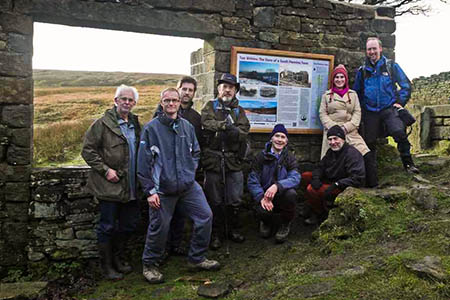
Steve Wood and other members of the Top Withins board
(Source)
Grough informs that a new information panel has been placed at Top Withens:
A ruined farmhouse with literary connections high on the Pennine Way has a new information panel offering walkers a glimpse into its history. (...)
The building, which is owned by Yorkshire Water, also has a small, rudimentary bothy attached.
Local historian Steve Wood researched the background to the building which has no direct links with the Victorian author or her works, but has been held by many to match the location of the Earnshaw dwelling in the Bronte novel.
The panel tells the story of farming high above Haworth, going back at least 400 years with the first written record of a William Bentley dividing his estate amongst his three sons.
Their tough livelihood had to be supplemented by income from other activities including quarrying and weaving.
The panel has been placed in the ruins at Top Withins, also sometimes known as Top Withens, as part of the Watershed Landscape Project, managed by Pennine Prospects and funded by the Heritage Lottery Fund and South Pennine Leader.
Alastair Harvey, countryside and recreation manager at Yorkshire Water, said: “As the owner we have carried out restoration works to the building to ensure it is able to withstand the erosive nature of the sometimes vicious upland weather.
“We are grateful for funding from Pennine Prospects and Heritage Lottery Fund that enabled us to protect the ruin for years to come.”
Robin Gray, Watershed Landscape project manager, said: “So many visitors come up to this romantic ruin but until now there has been little information.
“We hope that visitors will now feel better informed not just about the ruin but about the significance of this unique landscape.
“We have even provided a translation into Japanese for those visitors who come from across the globe to visit this iconic site.” (Liz Roberts)
The Philippines Daily Enquirer interviews the composer John Williams. He choose Jane Eyre 1970 as one the compositions he would like to be remembered for:
When we asked him for at least three film scores that he’d like to be remembered for, one of John’s picks was a surprise.
“I always remember certain passages in ‘Close Encounters…’ that I particularly enjoy playing with orchestras, away from film, so that may be indicative of something.”
He added, “And several movements of ‘Star Wars’ I also continue to have interest in as a performer. I did a television version of ‘Jane Eyre’ years ago (1970), directed by Delbert Mann. I wrote that new score in London many years ago. I have continued to enjoy revisiting that. So, in my case, that’s been a good measure of what I like that I have done in the past. If I don’t pick it out of the library and don’t want to perform it, it means that I don’t particularly want to return to it.” (Ruben V. Nepales)
USA Today imagines what the Brontës (and other writers) could tweet today:
10. The Brontë sisters: Charlotte, Anne and Emily Brontë were as close as sisters can be. They would've been each other's biggest Twitter fans, favoriting/retweeting each other every five minutes, spamming the hell out of their followers. Sweet? We guess. Annoying? Yeah, kinda.
Anne Brontë would tweet: "RT @JaneEyre 'You know full well as I do the value of sisters' affections: There is nothing like it in this world.' CC @wutheringgirl" (Daniel Lefferts and Kristen Mascia)
The Telegraph reviews All Change, by Elizabeth Jane Howard.
Clary, the Duchy’s granddaughter, born in 1925, the same generation as Howard herself, is a talented novelist, struggling to bring up children and help support her husband, an impecunious artist. Before the children, she wrote two novels that were well received, but since then she has sobbed into the kitchen sink and taken on proofreading to pay the rent. There are fleeting references to Charlotte Brontë and Jane Austen: both childless. (Ruth Scurr)
The Wall Street Journal reviews several retellings of classical novels, including Minae Mizumura's A True Novel:
Minae Mizumura's "A True Novel" (Other Press, 854 pages, $29.95) is a fascinating example of a cross-cultural adaptation. In one of the sizable passages of meta-commentary that frame the narrative, the author explains that the rewriting of Western novels has been "a central project in the modern literary history of Japan." Here she tells a story that is a mix of "Wuthering Heights" and "The Great Gatsby."
It centers on the magnetic Taro Azuma, recounting his bumpy rise in postwar Japan. In the highlands of Karuizawa (since converted to a popular resort town), the orphan Taro is taken in by a family of servants and supported by the aristocratic Saegusa clan. A perpetual outsider because of his low rank and half-Manchurian bloodline, he has no friends except Yoko, the sickly daughter of his employers. But though the two are in love, Yoko rejects Taro for a husband with better prospects. The spurned youth moves to Long Island and works his way up from chauffeur to "the most successful Japanese businessman in America." Despite his wealth, he moves back to the decaying cottage of his childhood, intent on reclaiming Yoko.
Ms. Mizumura's writing, smoothly translated by Juliet Winters Carpenter, doesn't have anything close to the pitched intensity of Emily Brontë's, though her depiction of Taro contains elements of Heathcliff's consuming resentment: "His youth was no longer fresh and vigorous," she writes of Taro when Yoko throws him over, "but had settled like a thick sediment, with a stale smell to it." When, years later, Taro tries to lure a married Yoko to live with him in a mansion on Long Island's north shore built early in the 20th century by an "American nouveau riche," he summons the restless apparition of Jay Gatsby. (Sam Sacks)
Zoë Triska chooses 'the biggest heartbreakers' in literature for The Huffington Post:
Edward Fairfax Rochester Rochester from "Jane Eyre"
Where to even begin with Rochester? We know some people like to think of "Jane Eyre" as a romantic story, but it certainly doesn't begin that way. I have always thought that Rochester KNOWS from the beginning that Jane has feelings for him, but that he toys with her intentionally. It honestly does appear that Rochester was courting Blanche Ingram, and not Jane. Who could blame Jane for thinking so? Also, when he proposes to Jane, he forgets to mention that he has his wife locked up in the attic. Yikes. (...)
Catherine Earnshaw from Emily Brontë's "Wuthering Heights"
Despite Catherine's love and adoration for her childhood best friend, Heathcliff, she decides that he's too low class for her and goes off and marries another. Heathcliff pines away for her, going so far as to leave in order to become a "gentleman." Catherine dies prematurely. Even after she DIES, she haunts him! How cruel is that?!
Of course Rochester toys with Jane intentionally and... well, Heathcliff asks Catherine to be haunted by her.

Also in The Huffington Post, Sarah Barness has been seduced by Mark Grist's 'I want a girl who reads' poem:
Mark, you can totally call us. We'll just be over here tearing through our copy of Jane Eyre.
Financial Times talks about the evolution of the Oxford English Dictionary:
He talks also of the potential to embed OED content in ereaders so the meaning of a word such as “plisky” (a trick or an awkward situation) in Wuthering Heights (1847), not found in most dictionaries of current usage, could be revealed to the reader as he or she went along. (Lorien Kite)
Kpopstarz mentions the including of a Wuthering Heights-inspired song in the soundtrack of the Korean TV series, Secret:
The highly successful melodrama Secret came to an end, this week, with actor Ji Sung providing vocals for the final soundtrack. Heights of Windstorms or Wuthering Heights draws inspiration on the prevailing theme of betrayal, secrets, and love lost that dominate both Secret and the novel,Wuthering Heights. Secret concluded with a strong ratings lead and with Ji Sung proving that his acting talent transcends into singing.
Haaretz quotes from Eva Illouz's Why Love Hurts: A Sociological Explanation:
From the Introduction:  The Misery of Love
"Wuthering Heights” (1847)‏ belongs to a long literary tradition portraying love as an agonizingly painful emotion. The novel’s notorious protagonists, Heathcliff and Catherine, develop a strong love for each other while growing up together, yet Catherine decides to marry Edgar Linton, a socially more appropriate match. Humiliated when he accidentally overhears Catherine claim that she would degrade herself in marrying him, Heathcliff runs away. Catherine looks for him in the fields, and when she does not find him, she falls ill to the point of near-death.
France Info (France) reviews  Lady Hunt by Hélène Frappat:
Un roman qui marche sur les pas de chefs-d'oeuvre anglais comme Les Hauts de Hurlevent ou Rebecca, avec beaucoup de talent mais aussi de distance et d'humour. (Philippe Vallet) (Translation)
YA? Yeah, Yeah! interviews the author Laura Summers:
Who was your first fictional crush?
When I was a teenager I don’t really remember there being many books written particularly for my age group so when I ran out of books at the library (the Narnia series, Swallows and Amazons, Just William and masses of legends and fables were some of my childhood favourites), I jumped straight into books by Agatha Christie and classics like Jane Eyre. I definitely didn’t fancy Hercule Poirot so I think my first fictional crush has got to be Mr Rochester.
El Correo (Spain) lists films about love and passion including Wuthering Heights; St Margaret's Community Website has an interesting post on James Chesterton Bradley, the curate that inspired Charlotte Brontë's Mr Sweeting in Shirley quoting from original sources; Gedankengerüste, Gedankengelüste (in German) has not loved Wuthering Heights; Salmagundi recommends re-reading Jane Eyre; Practically Marzipan reviews one of its retellings, Tina Connolly's Ironskin; ARD (Germany) announces the airing the documentary Yorkshire - Land der Geister und Legenden (directed by Peter M. Kruchten) (3sat, November 16, 16.15 h) which includes mentions to the Brontës.

Friday, November 08, 2013

Friday, November 08, 2013 12:30 am by M. in    2 comments
Richard Wilcocks shares extremely sad news on the Brontë Parsonage Blog. Artist, composer, writer and Brontë scholar Ian M. Emberson (1936-2013) died last Monday. From his website:
Ian Emberson was born at Hove in Sussex in 1936, and is proud to have been christened by the poet Andrew Young. After moving around quite a bit, he now lives with his wife Catherine in the small town of Todmorden - just within the Yorkshire boundary, despite the postal address.
For many years he was Music Librarian at Huddersfield, but has now retired in order to concentrate on writing and art. He also enjoys walking and swimming and is a life-member of the Gaskell and Brontë Societies. His daughter Beth lives in France.
He was indeed very much involved with the Brontë Society and he was a frequent contributor to Brontë Studies(1) (and its predecessor, Brontë Society Transactions). His last contribution can be found in the latest issue: Passages in the Life of Which Individual?, Brontë Studies, Volume 38, Number 3, September 2013 , pp. 240-244(5).

He published essays about the Brontës: Pilgrims from Loneliness. An interpretation of Charlotte Brontë's Jane Eyre and Villette (2005); he rescued forgotten literary accounts about the Brontës:  Recollections of the Brontës by George Sowden. He even published and illustrated a poetry book inspired by the Brontës: Mourning Ring. Brontë Related Poems in 2008.

(1) A list with his contributions:
'Often rebuked, yet always back returning' — The Poem Itself
Brontë Society Transactions: The Journal of Bronte Studies, Volume 26, Number 1, April 2001 , pp. 68-70(3)
'And I am so Plain …'
Brontë Studies, Volume 27, Number 1, March 2002 , pp. 67-67(1)
Turns in the Circle of Friendship: 'Uncle Fennell', 1762–1841
‘My Spirit's Sky’: Astronomy and the Brontës
Brontë Studies, Volume 29, Part 3, November 2004 , pp. 253-256(4)
Brontë Studies, Volume 30, Number 2, June 2005 , pp. 141-150(10)
A Necktie and a Lock of Hair: The Memories of George Feather the Younger
Brontë Studies, Volume 31, Number 2, July 2006 , pp. 159-162(4)
A Missing Link: The Brontës, the Sowdens and the Listers
Brontë Studies, Volume 32, Number 2, July 2007 , pp. 116-124(9)
'The Likeness of a Kingly Crown': John Milton's Influence on Charlotte Brontë
Brontë Studies, Volume 32, Number 3, November 2007 , pp. 207-216(10)
Three Quartets: the Rossettis, the Mendelssohns and the Brontës
Brontë Studies, Volume 34, Number 3, November 2009 , pp. 247-254(8)
The Broken Tree: Symbol and Actuality
Brontë Studies, Volume 36, Number 4, November 2011 , pp. 336-343(8)
‘A Wreck Just Sinking’: The Beginning of Jane Eyre and the Ending of Villette
Brontë Studies, Volume 28, Part 1, March 2003 , pp. 89-90(2)

Tuesday, August 13, 2013

Tuesday, August 13, 2013 12:41 am by M. in , ,    No comments
The new issue of Brontë Studies (Volume 38, Issue 3, September 2013) is already available online. We provide you with the table of contents and abstracts:
Editorial
pp. iii Author: Adams, Amber M.

‘For her very life’: Duty, Health and the Poisonous Atmosphere of Haworth in Elizabeth Gaskell’s The Life of Charlotte Brontë
pp. 185-194(10)   Author: Morris, Emily
Abstract:
This paper examines Gaskell’s The Life of Charlotte Brontë in terms of women’s presentation of the common nineteenth-century belief that a change of scene could be an important curative measure for both physical and emotional illnesses. It argues that Gaskell believed Charlotte Brontë died because she would not leave Haworth, and that this belief informs The Life, which suggests there is a lesson in Charlotte’s sacrifices. Gaskell’s insistence on indulging illnesses with travel or rest indicates that she felt that an alternative to expectations of constant industry and sacrifice was necessary, and that it could be found in reimaging duty in terms of health.

From ‘Emma’ to Emma Brown: Charlotte Brontë’s Legacies
pp.  195-205(11)      Author:  Tomaiuolo, Saverio
Abstract:
Soon after her death, the artistic legacy of Charlotte Brontë became a matter of debate among her contemporaries — in particular after Elizabeth Gaskell’s biography — and has been contended, interpreted, read and misread by subsequent generations of readers and critics. The so-called ‘Brontë myth’ has been alimented and nurtured by this peculiar fashioning of Charlotte’s life and works. Apart from the numberless rewritings and ‘translations’ of her novels, her unfinished fragment entitled ‘Emma’ has aroused the interest of many writers who have tried to imagine the conclusion of the story. In this respect, Clare Boylan’s Emma Brown (2003) not only represents an ultimate exercise in literary imagination, but also a neo-Victorian novel balanced between a nostalgic glance at the past and a questioning of cogent Victorian issues that are still relevant today.

Heathcliff’s Abject State in Emily Brontë’s Wuthering Heights
pp. 206-218(13)   Author:  Lodine-Chaffey, Jennifer
Abstract:
Applying Julia Kristeva’s theories of abjection reveals both the development of the character of Heathcliff and his actions within Wuthering Heights. Heathcliff exhibits common attributes of abused children, which is exacerbated when the Earnshaw family treats him as a liminal ‘Other’. As a result of his abjection, Heathcliff exhibits borderline personality traits. He abuses human beings and animals, and constantly rejects social laws. Longing for fulfilment and connection, Heathcliff becomes enmeshed with Catherine Earnshaw. Unable to separate himself from Catherine, despite her death, Heathcliff increasingly spends his time searching for signs of her absent presence in the natural world. Although he seems to realize his abject state and reject his carefully planned revenge at the end of his life, Heathcliff cannot move away from abjection. Instead, Emily Brontë creates a character who fails to construct a boundary between himself and the Other and exemplifies Kristeva’s definition of abjection.

Robinson Reflections Part 3: Paper Chase — The Story of Mary Robinson’s Arranged Marriage
pp. 219-239(21)   Author: Gamble, Bob
Abstract:
‘Paper Chase’ is the third of three complementary articles collected as ‘Robinson Reflections’.* It further examines the reactions of the Robinson and Brontë families in the period following Branwell’s dismissal from Thorp Green Hall in July 1845. By linking the papermaking industry in Airedale to that in Derbyshire’s Derwent valley, the work provides evidence that the arrival in Keighley in late 1848 of the newly-married Mary Robinson/Clapham (daughter of Lydia Robinson) was not an accident of fate, but a deliberately planned arrangement driven by the business and political interests of her uncle, William Evans MP of Allestree Hall.

Passages in the Life of Which Individual?
pp.  240-244(5)      Author: Emberson, Ian M
Abstract:
This essay looks at Anne Brontë’s working methods — firstly in connection with her poetry, then as regards her two novels. It considers the possibility that Passages in the Life of an Individual may be a first draft of what was ultimately to become the middle section of The Tenant of Wildfell Hall. It also discusses possible links with Bishop Burnet’s Some Passages of the Life of John, Earl of Rochester.

Religiosity in the Poetry of the Brontë Sisters
pp. 245-250(6)  Author:  Waddington-Feather, John
Abstract:
This paper explores the piety, or religious feeling, expressed in the poems of Anne, Charlotte and Emily Brontë. Anne’s theology, Charlotte’s conventionality and cheerfulness and Emily’s near-pantheism are discussed with excerpts from the poems.

Reviews
pp. 251-254(4)

‘Kitty Bell’ Again
pp. 255-255(1)  Author:  Heywood, Christopher

Saturday, April 28, 2012

Saturday, April 28, 2012 12:02 am by M. in ,    No comments

The latest issue of The Brontë Society Gazette is now out (Issue 57. April 2012. ISSN 1344-5940).
ARTICLES
Letter from the Editor by Helen Krispien
Brontë Treasures. A visit to Sotheby's on 14 December 211 prior to a public auction the next day by Val Wiseman, Brontë Society Representative for London & the South East.
Call for suggestions
Letter from the Chairman by Sally McDonald, Chairman of Council
What really happened on Oak Aplle Day? by Ian M. Emberson
Charlotte Brontë and Lorine Niedecker: Unlikely Sisters by Margot Peters
Taylor graves at St. Mary's, Gomersal by Ann Clayton
Film Review: Wuthering Heights 2011 by Irene Truman
Poetry Corner: Her Voice and Mine by Jane Besser; Charlotte's Widower by Edwin Stockdale; Set in Stone by David Havens; Heathcliff by Sharon Marshall. Membership News: June Weekend events by Ruth Battye, Chair of Membership Committee; New UK Editor of Brontë Studies: Dr Kenneth E. Smith; In Memoriam: Marjorie Rose Darby, John Haggart.
Review: The Grubby Experiment - novel by Helen D. Newman by Alexandra Lesley, Member of Council.
The Life and Influences of Charlotte Brontë by Bethany Johnson

Reminder: Proposals for the Daphne Carrick Memorial Scholarship.
Jane Eyre on the air by Erik Eriksson
A new venture in the Brussels Brontë Group by Helen MacEwan.

Tuesday, April 03, 2012

The Independent (Ireland) has visited Yorkshire, including Haworth:
THERE was the usual Sunday carvery fare on offer in the pub, but I knew what I wanted -- the roast beef with Yorkshire pudding -- because this wasn't just any old pub. We were in the village of Haworth in West Yorkshire, and the pub was the Black Bull, favourite haunt of wayward Brontë brother Branwell.  (...)
The first thing that you notice about Haworth is the quietness. Even in the depths of winter, the quaint narrow streets of the village are thronged with tourists, come to pay homage to the world's most famous literary family, but there is still an air of calm and peace about the place.
The parsonage at the top of this solid Yorkshire town is where the sisters Charlotte, Emily and Anne, wrote some of the best-loved novels in the English language, while brother Branwell, when he wasn't supping in the Black Bull, tried to make a name for himself as a portrait painter, all watched over by their Irish father Patrick. The parsonage is now a museum where you can discover first hand what the lives of these extraordinary writers must have been like, and see the rooms where they lived and wrote their novels. The picturesque village, with its fine stone houses and sloping cobbled streets, is rather beautiful today -- parts of the film The Railway Children were filmed there -- but in the Brontës' day it was not the most healthy of places, with open sewers and an average life expectancy of only 25 years. (Willy Brennan)
The Derby Telegraph reports a case of counterfeit DVDs:
P.L., 38, of Blackstone Close, Alfreton, was caught with more than 700 fake DVDs at a car boot sale in Hucknall in September last year.
He was spotted during a routine inspection by trading standards officers from Nottinghamshire County Council.
One of them paid L. £2 for a counterfeit copy of Jane Eyre – a DVD that would normally retail for around £13.
Deadline mentions the Edinburgh Science Festival talk about Madwomen in Literature:
Dr Dillon, a lecturer in contemporary fiction at St Andrews, said, “The figure of the mad woman is a familiar one in some of our favourite literary classics, from the famously locked away Bertha Rochester in Charlotte Brontë’s Jane Eyre to Flaubert’s frustrated Madame Bovary. (...)
“Many professional women, including myself, might have been locked up if we’d lived in the Victorian age.”
Drs Dillon and Persaud will examine literary characters including Mrs Rochester, Emma Bovary and Anne Catherick, Wilkie Collins’s Woman in White, taking into account current medical knowledge.
According to Dr Dillon, the famously tormented heroines were more likely to be suffering from sexual repression and stress rather than mental illness. (...)
“In Jane Eyre, Mr Rochester alludes to sexual promiscuity in his first wife, identifying that, rather than her madness, as what brought shame upon him and their marriage.
“But these are all women who want to break free from the soft image of women, and they are punished for their desires. Madness was a very useful label in those days to cover up something even more undesirable.
“There is a famous quote in Jane Eyre, in which she says that ‘women feel just as men feel; they need exercise for their faculties, and a field for their efforts, as much as their brothers do; they suffer from too rigid a restraint, too absolute a stagnation, precisely as men would suffer; and it is narrow-minded in their more privileged fellow-creatures to say that they ought to confine themselves to making puddings and knitting stockings….It is thoughtless to condemn them, or laugh at them, if they seek to do more or learn more than custom has pronounced necessary for their sex.’” (Kirsty Topping)
The Huffington Post thinks that Joyce Carol Oates's Mudwoman is similar to
James Joyce's "Ulysses" for its raw narration blended with bouts of surrealism; Charlotte Brontë's "Jane Eyre" for its gothic nature and strong female protagonist with a troubled childhood.
The Hindu interviews the writer Dacia Maraini:
What are the authors you read?
Jane Austen, the Brontë sisters, I love their. Also, the American poet, Emily Dickinson. I also admire Sylvia Plath. I don't know about influence, but I love these writers. (Swati Daftuar)
The New York Times reviews Fifty Shades of Grey by E.L. James:
This S-and-M story about a virginal college student and the handsome young billionaire who binds her sounds racier than it is. Mostly it’s an updated throwback to scandalous novels of the past, including “Jane Eyre” and the 1920s desert rape fantasy “The Sheik.”  (Alessandra Stanley)
Rummage sales on Florida Today:
Most importantly, we developed a bond, unity born of shared time spent plowing through someone else’s jewelry and junk and finding a nice copy of “Wuthering Heights.”  (Britt Kennerly)
The Binghamton Books Examiner talks about The Hunger Games and mentions the recent Wuthering Heights adaptation:
This situation is similar to the recent adaptation of Wuthering Heights by director Andrea Arnold, who cast an African American actor to play Heathcliff.  This is a first in the history of film adaptations of Emily Brontë’s novel, although the character is described in what can be interpreted as non-white terms.  As a fan of Brontë’s novel, I think it adds an interesting dimension to the story, a fresh perspective.  What’s new or interesting about a strictly homogenous, white interpretation of literature? (Sasha Hoffman)
TrekEarth uploads a picture of Wycoller Hall and Ponden Kirk has been added to the UKClimbing logbook; OperaNews publishes an obituary of the soprano Patricia Neway who was Catherine Earnshaw in the 1959 revision of Carlisle Floyd's Wuthering Heights; Will Knit for Cake thinks Jane Eyre rocks; Kate O'Keefe uploads a Jane Eyre drawing; A Breathless Trail posts about Wuthering Heights 2011; Ian M. Emberson describes the Brontë Parsonage Franklin exhibition (The Garden of Oblivion) at the Brontë Parsonage Blog; Shabbyblogs (in German) posts about Jane Eyre; The Compulsive Reader interviews Eve Marie Mont, athor of A Breath of Eyre; A Lonely Quiet Concert reviews The Flight of Gemma Hardy; the Brontë Sisters posts about the fascinating life of  Benjamin Herschel Babbage.

Tuesday, December 20, 2011

Tuesday, December 20, 2011 12:05 am by M. in , ,    No comments
The new issue of Brontë Studies (Volume 36, Issue 4, November 2011) is already available online. We provide you with the table of contents and abstracts:
Editorial
pp. iii-iv(2) Author: Adams, Amber M.

Balthus: Self-Portrait as Heathcliff
pp. 307-321(15) Author: Vitte, Paulette
Abstract:
On the European continent Emily Brontë's novel fascinated artists and writers. The violent dark novel cast a spell on Balthus at a very special moment in his life and influenced all his work.


Branwell at the Heights: an Investigation into the Possible Influence of Branwell Brontë upon Wuthering Heights
pp. 322-335(14) Author: Flintoff, Everard.
Abstract:
A reprint of the article first published in the Durham University Journal (July 1994), 241–51, with kind permission of the University of Durham and Mrs Katherine Flintoff. The Editor thanks Dr Bob Duckett for the paper and Dr David Gordon of Queen's University Belfast for his obliging bibliographic assistance.


The Broken Tree: Symbol and Actuality
pp. 336-343(8) Author: Emberson, Ian
Abstract:
This article considers the concept of the broken tree in literature and the visual arts by quoting examples from the paintings of Jacob van Ruisdael and Sir Walter Scott's novel Peveril of the Peak and by illustrating its use in the drawings, poems and novels of the Brontë sisters.

Lessons from The Tenant of Wildfell Hall: Recasting the Mother
pp. 344-357(14) Author: Le Veness, Kristin
Abstract:
The mother functioned as a central, stabilizing figure of the Victorian household, sparking widespread debates over what qualities best served this role. This article reassesses Anne Brontë's contributions to this important social debate. Her feminism is best evidenced through her characters, particularly the mother, and her rational feminist approach to mothering. This philosophy links her to an earlier radical feminist tradition, yet it also advances her modern notions of motherhood. Her radical rendering of the mother — best articulated in The Tenant of Wildfell Hall — challenges existing standards and proposes new possibilities for active mothering and rational motherhood.

Branwell Brontë, Agnes and Mary Riley
pp. 358-362(5) Author: Griffiths, Sarah Elizabeth
Abstract:
Following years of speculation regarding the reason for Branwell Brontë's dismissal from his post as tutor for the Postlethwaites in Broughton-inFurness, recent research has shed more light on the suggestion that he fathered an illegitimate child. A young, unmarried woman, Agnes Riley, living near Broughton, has been cited as a strong contender to be the mothe r of the child, and this article discusses the latest research, which shows what happened to Agnes and her child Mary Riley after Branwell returned to Haworth in disgrace. It proves a link with Agnes and the Postlethwaites and shows that records suggest Agnes's child did not die in infancy but outlived Branwell by twenty years following his death.

Dr John Outhwaite and Miss Frances Outhwaite: Friends of the Brontë Family
pp. 363-373(11)  Author: Walker, Michael
Abstract:
During the five years of the Brontës' residence in Thornton, Patrick and Maria made many friends and led a very active social life. They were introduced into this society by John Scholefield Firth of Kipping Hall, Thornton, and his daughter, Elizabeth. In this circle were Dr Thomas Outhwaite and his two children, John and Frances, who were all destined to play an active role in the Brontë story. This article takes a brief look at the life and times of the Outhwaite family.

A Brontë Reading List: Part 4
pp. 374-380(7) Author: Ogden, James
Abstract:
This is part of an annotated bibliography of scholarly and critical essays. The earlier parts were published in Brontë Studies, 32.2 (July 2007), 33.3 (November 2008) and 34.3 (November 2009). The four parts cover just over 200 essays published from 1999 to 2009, of which about half were on Jane Eyre or Wuthering Heights.

Brontë Society Literary Competition 2010-11: First Prize Winners
pp. 381-382(2) Author: Fermi, Sarah

Mourning Bracelet 
pp. 383-383(1) Author: Bromley, Carole
Truelove': Names and Jane Eyre 
pp. 383-387(4) Author: Earnshaw, Steven
Still Cats and Birds 
pp. 388-389(2) Author: Spinks, Catherine

Reviews

pp 390-398(9)

Saturday, October 01, 2011

Saturday, October 01, 2011 1:13 am by M.   No comments
The latest issue of The Brontë Society Gazette is now out (Issue 55. September 2011. ISSN 1344-5940).
ARTICLES
In the Autumn edition... by Helen Krispien
My Favourite Brontë...  by Paloma Ríos Prieto, Constance Renfrow and Pat Marshall.
Letter from the Chairman by Sally McDonald, Chairman of Council and Doreen Harris, Council Secretary.
Brontë Society AGM Weekend:
Interview with Salley Vickers by Rosemary Waxman
Michael Lofthouse and Friends by Ken and Beryl Snape
Annual Lecture by Ian Dewhirst by Doreen Harris
Withering Looks at the Brontë Society by Judith Bland
Walk to Ponden Hall by Brian Speak
Miss Branwell's Companion Saves the Day by Alexandra Lesley
Concert in Haworth Church by Isobel Stirk
Excursion to Kildwick and Gawthorpe Hall by Chris Went
Stop Press- Ireland Excursion by Ruth Battye
Poetry Corner: The Tenants by Melissa Parker; The Peewits by P H Holtam; Top Withins by Sue Benwell; The Fire of Emily Brontë by Sharon Marshall
Membership News:Spring Walk by Judith Yeadon and Judith Bland
A Visit to Northern Ireland by Sally McDonald
The Making of The Brontë Boy by Michael Yates.
Truth is stranger than Brontë fiction by Mary A. Haigh.
Parsonage People: Judith Bland
Anglo-Japanese Brontës by Judith Bland
Save the Lost Dance... by Amanda J. Hadleigh
Fathers and Faces: Brussels Brontë Group Weekend  by Emily Waterfield.
A Price above Rubíes by Pat MarshallIn Memoriam: Mabel Ferrett by Ian Emberson
Mrs Olive Richardson
Brontë Studies: online Following up members requests at the AGM by Sally McDonald
Jane Eyre : contrasting the book and film by Helen Krispien
Brontë Studies online (3/24)
Categories: ,

Friday, June 03, 2011

Friday, June 03, 2011 12:01 am by M. in    No comments
Brontë Society AGM Weekend Haworth
Friday 3rd June - Monday 6th June 2011


Friday 3 June


1pm Donors Event.
Finger buffet with wine. Baptist Centre, West Lane. By invitation only.


3.30pm  Novelist Salley Vickers reads and discusses her work, including her most recent novel, Dancing Backwards. Salley Vickers is the author of six novels including the bestseller, Miss Garnet's Angel. An admirer of the Brontës, she has written the introduction to the Hesperus Press edition of Charlotte Brontë's The Secret. The Baptist Centre, West Lane.


6.30pm  A supper of cheese and wine. Followed by a great evening of light entertainment provided by Haworth's Gilbert & Sullivan group. The Baptist Centre, West Lane.

Saturday 4 June

11.00am Annual Brontë Society Lecture by Mr. Ian Dewhirst, speaking on Haworth and the Brontës.  
To be followed by the announcement of the Literary competition winners.

2.00pm: Annual church service at the Parish Church, to commemorate the 150th anniversary of the death of Patrick Brontë. Address given by Rev. Paul Slater. Collection in aid of church funds.


3.00pm Afternoon Tea, Ashmount Mews.


4.30pm Annual General Meeting of the Brontë Society.
The Baptsit Centre, West Lane


8.00 pm  Lip Service: Withering Looks. West Lane Baptist Centre.


Sunday 5 June


10.30am  Angela Crow will talk about her latest book Mrs. Brontë and answer questions about the Branwell family. Parsonage Cellar


12 noon Ann Dinsdale will be leading a walk to and around Stanbury and Ponden. The afternoon will include a tour of Ponden Hall, and tea at Ponden House, for half the party at a time.


5.00pm Ian Emberson & Musicians performing his Brontë Song Cycle. Parish Church of St.Michael's and All Angels.


From 6.30pm: Informal Evening and Quiz.  The Old White Lion.


Monday 6 June

Excursion to Stonegappe, Lothersdale, Kildwick and Gawthorpe Hall.
Morning coffee at Kildwick, a short entertainment from Angela Crow and Richard Wilcocks, and a talk from Isobel Stirk about Lothersdale Church. Guided tour of Gawthorpe, home of Sir James Kay-Shuttleworth.


Tuesday 7 June

11.00am onwards. Angela Crow will be in the Art Gallery, South Square, Thornton. You might like to bring a sketch or picture on a Brontë theme. 
Categories:

Sunday, May 08, 2011

Sunday, May 08, 2011 12:04 am by M. in ,    No comments
The latest issue of The Brontë Society Gazette is now out (Issue 54. April 2011. ISSN 1344-5940).
ARTICLES

Letter from the Editor. Happy Spring by Helen Krispien

My Favourite Brontë Event by Kathlee Shortt

Letter from the Chairman by Sally McDonald, Chairman of Council

Bonnie Greer to be President of the Brontë Society by Andrew McCarthy

Report on Watermen's Hall event in celebration of the Contemporary Arts Programme by Virginia Rushton

Brussels Brontë Group rounds off the year with a Christmas lunch and entertainment by Helen MacEwan

Brontës in Brussels  by Helen MacEwan (about the Jolien Janzing project novel)

In Memoriam: 
Phyllis and Arthur Cheney by Robert Duckett
Pearl Cragg by Dyddgu Pritchard Owens
Arthur Hartley by Judith Bland, Fleur Coppock and Ann Dinsdale
Barbara Whitehead by Angela Crow-Woods

Encore Theatre presents: The Brontë Boy by Michael Yates

Poetry Corner: So Old... by Judith Bland; Haworth Parsonage at Night by Jean Walker; The Elfin Child by Melissa Parker; To the Imagination of Emily Brontë by Sharon Marshall

Parsonage People: Amanda Schultz, Susan Newby.

Z's Dream by Ian Emberson

Post-It: Talk by Juliet Barker on her new edition of The Brontës. November 2010, Haworth by Sarah Barrett
Categories: ,

Monday, February 07, 2011

Monday, February 07, 2011 12:02 am by M. in ,    1 comment
Our thanks to Peter Lang Publishing for sending a review copy of this book.
Jenkins, Keith A.
Charlotte Brontë's Atypical Typology
Peter Lang Publishers
Series: Studies in Nineteenth-Century British Literature - Volume 9
New York, Bern, Berlin, Bruxelles, Frankfurt am Main, Oxford, Wien, 2010.
ISBN 978-1-4331-0855-6
We own we should be sorry to subject any child of ours to the teaching and insinuations of the mind here pictured; whose religion is without awe, -who despises and sets down every form and distinction she cannot understand,- who rejects all guides but her Bible, and at the same time constantly quotes and plays with its sacred pages, as though they had been given to the world for no better purpose than to point a witticism or furnish an ingenious illustration. (Anne Mozley, from an unsigned review of Villette, Christian Remembrancer, April 1853, n.s. XXV, 401-43, as reproduced in The Brontës. The Critical Heritage. Edited by Miriam Allott, Routledge, 1974)
Keith A. Jenkins's Charlotte Brontë's Atypical Typology main purpose is, precisely, to demonstrate that Charlotte Brontë's use of the Bible was not a mark of witticism or an ingenious way to illustrate an idea or event but a conscious personal appropriation of the Scriptures which was based on a rather nonconformist approach to Classical Typology.

This year, 2011, marks the 400th anniversary of the King James Bible which was completed in 1611. Accordingly, the Brontë Society Conference (to be held in Homerton College, Cambridge University, 26-28 August 2011) will center on The Brontës and the Bible: Influences both Literary and Religious. We don't know if Keith A. Jenkins (currently President of Houston Graduate School of Theology and Elder of the United Methodist Church) will be among the scholars invited to the upcoming Brontë Society Conference (which includes Marianne Thormählen, Brian Wilks or Tom Winnifrith) but after reading his unscheduled(1) contribution to the celebrations it would certainly be fitting, as his book deserves a place among the very few anthologies devoted exclusively to Charlotte Brontës' fiction from a Bible-studies point of view.

Mr. Jenkins's approach is almost exclusively devoted to the mature fiction of Charlotte Brontë(2) analysed through the direct quotes, allusions or allegories from the Bible(3). His personal agenda is to articulate how Charlotte Brontë's use of Biblical material was a sort of atypical typology but not in a theological (or faith-driven) sense but in a Bloom-like anxiety-of-influence way:
While I have identified what Charlotte Brontë does with biblical material in her novel as typology, it is atypical and differs greatly from the classical form of that hermeneutic system. I no true theological sense does she views Rochester as the antitype of Adam or Samson, nor Paul Emanuel as the antitype of Christ. As much as some readers and critics may wish to, we cannot view the biblical parallels in her fiction as testimony to her faith in the divinely ordained interconnectedness of all creation. Only by creating new ficitional antitypes for biblical characters and scenes in a way that replaces the old with the new, can Brontë adequately differentiate herself from the strong precursor text that looms over her and her culture. As she frees herself from the anxiety of the Bible's influence on her views and her voice, she can, at the same time, minimize the influence of the anxiety that the Bible and its male-dominated tradition of interpretation produce in her.
The questioning of the traditional male-dominated scriptural interpretation is one of the pivots around which Keith A. Jenkins's strategy revolves, through the gender-reversed nature and further gender destabilization of many of the Bible quotes used by Charlotte Brontë. The other two strategies used for the analysis of the whole of the Brontë opus are the undemining of a providential (God-driven) view of history and finally, the translation of the otherwordly into his world (particularly the Garden of Eden imaginery which features prominently in Jane Eyre, for example). Of course, the author knows that an approach which follows such parameterised rules unavoidably incurs in overlappings and ignores other possible alternative partial strategies(4).

Beyond the exegesis of the Brontë opus focused in the emergence of the atypical, unstable, mutant and fluidic typology which Jenkins materialises in this book, what is certainly fascinating is the complex interweaved fabric which Charlotte Brontë is able to create, where her vast knowledge of the Bible and the strength of her narrative feature in a rather unique way(5).

The majority of the current readers of Charlotte Brontë's novels lack the familiarity with the Bible which the contemporary readers of the author had. Books like Charlotte Brontë's Atypical Typology (6) are crucial in order to understand up to which point not only the Bible as a holy book, but as the source of our (and Charlotte's) Western mythology, was influential in her writings. Only with this background one is able to understand reactions like Anne Mozley's review of Villette. And though the background is not essential to celebrate and enjoy the novels of Charlotte Brontë, it is a bonus which opens the door to a much deeper understanding.

Notes

(1) Not only because the book was published at the end of 2010 but because some parts of it (particularly the Jane Eyre chapter) have appeared previously: "Charlotte Brontë’s New Bible” in Approaches to Teaching Brontë’s Jane Eyre, eds. Diane Long Hoeveler and Beth Lau (New York: Modern Language Association of America, 1993).“From Eden to the New Jerusalem and Back Again: Biblical Resonances in Jane Eyre” in Approaches to Teaching Jane Eyre, ed. John O. Jordan (Santa Cruz, CA: The Dickens Project, 1989).
(2) Dismissing the whole juvenilia quoting Tom Winnifrith's statement on The Brontës and their Background: Romance and Reality, 1988: 
As has been shown there is not a great deal of evidence in the juvenilia about Charlotte's religious views, but what there is suggests orthodox.
is, in our opinion, quite hasty although understandable taking into account the scope of the book. On the other hand, the study concentrates exclusively on fiction with no biographical information to trace meaningful resonances. We wonder what would happen, for instance, with the fiction/reality duet formed by Paul Emanuel / Constantin Heger when confronted to the Christ / Paul type-antitype. We know that this is going far beyond the secularised typological approach of the book but we are intrigued.

(3) In this scheme, all the other secularised or filtered Bible mythology articulated through Milton's Paradise Lost or Bunyan's The Pilgrim's Progress, for instance, is generally not explored. Jenkins's agenda is different from Ian Emberson's in whose Pilgrims of Loneliness tried to approach Jane Eyre and Villette through a basic mythologhy drawn from all those precedents
(4) Although the author explictly advocates against the perils of over-reading some of the examined allusions, at times the problem seems to overtake whole sections of the book. We are thinking particularly of the Passion/Resurrection motif as read in Jane Eyre.
(5) It is fascinating to read in this light Shirley's words (and to imagine Emily Brontë, of course) talking about Eve (later identified as Nature) as the mother of the Titans and daughter of Jehovah, equal to Adam, his son.
(6) Just mentioning some of the more recent the ones:  Thormählen, Marianne. The Brontës and Religion. Cambridge: Cambridge UP, 1999;  Gallagher, Susan VanZanten. "Jane Eyre and Christianity." Approaches to Teaching Jane Eyre. Eds. Diane Long Hoeveler and Beth Lau. NY: Modern Language Association, 1993, 62-68; "Charlotte Brontë's religion: faith, feminism, and Jane Eyre", Christianity and Literature, Autumn, 2008 by Emily Griesinger; Maynard, John. "The Brontës and Religion." The Cambridge Companion to the Brontës. Ed. Heather Glen. Cambridge: Cambridge UP, 2002. 192-213 (curiously enough, this one is not included in the bibliography).

Categories: ,