that will be broadcast at 7pm UK time later today.
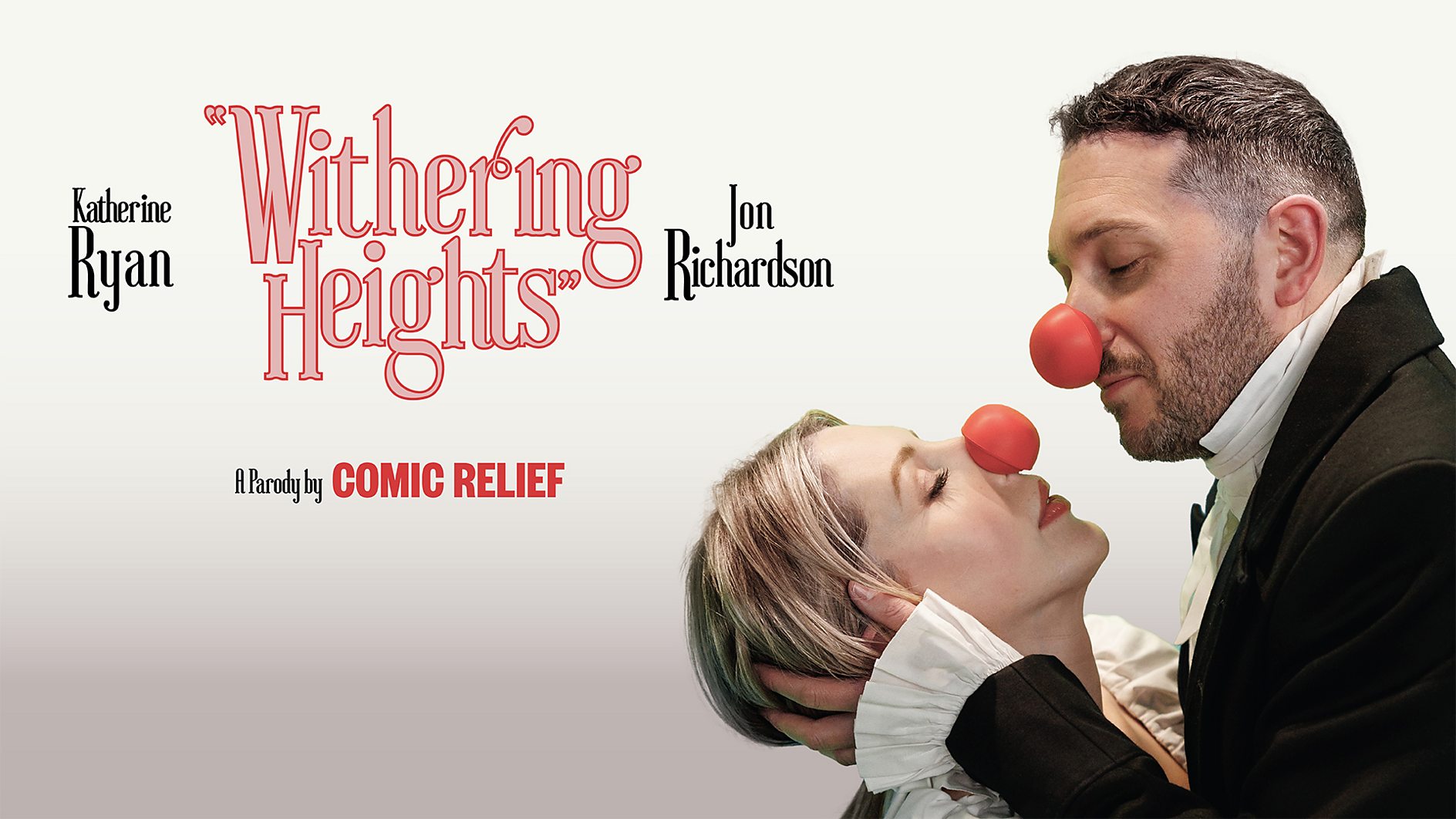
In an exclusive sketch for Comic Relief: Funny for Money, Katherine Ryan and Jon Richardson are set to embody Cathy and Heathcliff in an unmissable Wuthering Heights sketch this Red Nose Day.
Have you ever wondered who else may have auditioned for the leading roles in smash-hit film Wuthering Heights? Or rather, why Margot Robbie and Jacob Elordi ended up in the role? Fret no more, as this Red Nose Day we are set to get a sneak peek at the exclusive audition tapes as Katherine Ryan takes on the role of Cathy, and Jon Richardson gives it his best Heathcliff, in ‘Withering Heights’.
Comic Relief: Funny for Money is live from MediaCityUK in Salford on BBC iPlayer and BBC One on Friday 20 March from 7pm, and for the very first time, live streamed simultaneously on the official BBC YouTube channel.
The money raised this Red Nose Day could help people access food, shelter and safety – the vital essentials everyone needs to survive.
MR: Can we talk about Isabella? Obviously, your character in Wuthering Heights, and she is my favourite thing ever. You’re so funny in the movie. Your physicality for Isabella is so distinctive and perfect and hilarious. People are going to lose their minds when they see you. I’m so excited for this moment. I remember seeing you find that character and I saw how rigorous you are in your preparation. Your notebook that you would check in between takes with tons and tons of writing in it. I’m curious – what was your process for Isabella, and then what’s your process in general?
AO: Isabella felt very clear to me. Emerald’s writing is so amazing, that character just jumps out at you when you read her. In our version, she’s a ward, and she’s actually lived in India until she was around eight, and then was sort of orphaned, taken in by the Lintons, and moved to England. Mary from The Secret Garden was actually a really big reference for the character, because she had that same beginning. But for Isabella, she’s obviously been so sort of, infantilised by Edgar and kept in this child state. I was just really curious about characters that have a kind of peculiarity to them. I remember Polly [Bennett, movement director] said something to me which was really interesting. We talked a lot about that era and how much is repressed, how much is not allowed, and how you’re almost trained and bred into being a good little girl. Then when anything repressed is let out, it’s really messy and unorganised. With Isabella, there’s so much in her, but she has to lock so much of it away – she’s like, reverberating. Desperately wanting to kiss someone – or strangle someone.
MR: She’s practically vibrating. I’m so bummed the scene didn’t make the cut where Isabella’s saying her prayers before bed, but then pulls out this 18th-century porn. [both laugh] And that book, which, by the way, is a real book, is crazy.
AO: It’s actually horrific.
MR: The images in it. When people are like, “I’m so worried about the youth of today, because what they’re seeing online is giving them an extreme idea of sex,” honestly, looking at this book, I was like, what on earth did people back then think sex was? The illustrations in this 18th-century porn book – essentially a porno – honestly, it was like Cirque du Soleil. [laughs]
AO: It was completely awful. But that’s the repressed thing: if it’s all so shameful, then when you let it out, it’s this fucking weird thing. That’s sort of Isabella. I loved playing her so much.
MR: Do you think she’s the funniest character you’ve played?
AO: Yes. Emerald is also so great; she really lets you push things or let go. It’s such a freeing thing when the person you’re working with is really encouraging you to find that. I think there are loads of different ways of interpreting that character, and the way Emerald interpreted her was so exciting to me. What’s interesting about Isabella and Cathy is that Isabella is the reverse of Cathy. It’s like there’s an uncorseting of Isabella that happens. But in that uncorseting, she’s actually free. Whereas in reverse, you are coming from something wild and passionate and crazy, and then it all sort of gets cleaned up. But that’s actually not the answer. It’s an interesting study of that time for women: the options available, or the life available to you, was so limited. I don’t know if you found this, but when I was in the Wuthering Heights house, I was like, “I feel so free.” As beautiful as Thrushcross Grange is, it’s quite contained.
MR: I had the opposite. It’s actually when we were outside on location that I felt the most free. Wuthering Heights for Cathy, I think, is oppressing and dirty. Then she gets to Thrushcross Grange, and it’s so beautiful and clean. But then, like you said, there’s something stagnant about it. It’s kind of frozen, and that’s unnerving as well – but in a new version of oppression that takes her a while to realise is being inflicted. I just loved when we were on location – the landscape is so incredible, wild, harsh, and magical. And then on top of that, our personal experiences: we all got to hang out at the pub every day. [laughs] The best thing was that you guys were only actually needed for a couple of days out there…
AO: Two scenes, but we were there for the week.
MR: More than a week. You came and stayed out there just to hang. [both laugh] It was so fun. Every day I’d be messaging you guys, because everyone would be at the pub, and I’d be like, “Oh, I’ve still got another scene to go.” Then on our group thread, you guys are like, “Look at this waterfall we found,” or, “Look at this walk we went on, and we found a new pub we should try.” Jacob and I would just be like, “Shit. We gotta wrap this scene up so we can get to everything!” [both laugh]
AO: That was so much fun. I was thinking the other day about when we shot all of those montage pieces, and how much fun that was, and so crazy. At the end of big days where we’d done big dinner scenes or where loads of people were in, they’d be like, “OK, we’re going to do the picnic!” or “OK, we’re going to do Christmas!” It was just like, it’s Christmas now.
MR: And we’d always have fifteen minutes or something – it was mayhem. But the thing about Emerald is she uses every single bit of footage that she films; it all ends up being in the movie. There are even shots from the camera test that ended up in the movie. Cathy wandering in the courtyard – that was just a camera test shot. She uses every single scrap of film. Having said that, some scenes can’t make it, like Isabella praying and then pulling out the porno. Also that amazing scene where we do the walk around the library. Isabella’s so funny in that scene too, asking Heathcliff if he’s a man of science and pretending that she doesn’t care about that stuff as well. I loved that so much.
AO: Emerald’s ability to create on the spot is amazing.
MR: She’s both an insane preparer and an amazing improviser, actually – a lot like you, because you seem to be an insane preparer, and then also you can completely improvise. It’s so fun to be able to play at both ends of the spectrum.
AO: I sometimes feel like I can only do improvisational stuff if I’ve prepared in an insane way. Maybe it’s a confidence thing, and I feel like I have to have done my homework before I can let go like that.
MR: I feel like we are similar in that way – we approach things similarly. I have to do so much prep and so much work so that I can walk on set and throw it all away.
AO: Because you work so fucking hard. I’ll never forget seeing I, Tonya and finding out that was you. I was like, “What the actual hell?!” And when we were making Wuthering Heights, seeing you stepping in, giving the most incredible performance, then stepping out and being like a producer, getting on a Zoom call, then coming back in, doing another take – I was like, “How in the living hell are you doing this?” It’s mind-blowing to me. How have you found having those different hats on set?
MR: Honestly, I feel like I thrive on the multitasking nature of it. I don’t have a problem compartmentalising. I can sit in the edit on a film that I’m in and have no issue separating myself from the character on screen. And then [it’s also] loving the thrill of doing so many exciting things all at the same time. I feel like you have that too, because when you’re acting, you’re very aware of everything happening around you. You can feel if you’re moving out of your light or if someone’s blocking your light. I see you adjust, I see that you are conscious of where the crew members are, and you’re adapting your performance so that it works within the context of what everyone else is doing. So much of brilliant acting is lost because if you can’t be conscious of all the things happening around you, it’s not going to work in the edit, it’s not going to work on screen. Whereas you’re one of those actors who makes it work so that it’s going to end up being in the movie. And in order to do that, you have to be conscious. And in order to be conscious of everything else, you do have to be able to compartmentalise so many things. You have to be like, “I’m taking note of that – the camera, the lens, the light, what this actor is doing, how much time we have.”
AO: I’m actually not just saying this, I swear to god, I learned so much from you. I’ll never forget the day where, you know, that long scene you had…
MR: The hair-pull scene?
AO: Yes. You have a million things going on in that scene. There were so many different elements. And I remember you were sat on the couch, and people were coming over going, “OK, can you make sure you sit like this? Can you not put your hair that way? Also the camera’s going to be coming in here, so you need to do that.” And you were like, “Yeah, no problem.” Then I was watching the scene, and I was like, “You did all of it.” I’m really not just saying this, but I actually feel like that was something I was so conscious of when I was making the movie – watching how you did that. I was really trying to learn from it. (Ella Joyce)







0 comments:
Post a Comment