Podcasts

  • S4 E3: With... Murray Tremellen - Sam and Mia are joined by their colleague Murray, who is one of the Museum's curators! Before taking on the role, Murray worked at other Museums and hist...
    1 week ago
Showing posts with label Top Withens. Show all posts

Friday, May 15, 2026

Penn State University features Deborah Lutz's new biography of Emily Brontë and has a Q&A with the author.
English author Emily Brontë is best known for her novel “Wuthering Heights,” a multigenerational story of obsession, revenge and love set in the Yorkshire moors. “This Dark Night,” the first full-length biography of Brontë in over 20 years and written by Penn State Professor of English Deborah Lutz, draws on Brontë’s formerly inaccessible notebooks and manuscripts to bring new light to the author’s tragic and fiercely independent life.
Lutz, the George and Barbara Kelly Professor in Nineteenth-Century English and American Literature, discussed in the following Q&A her new biography of Brontë and why readers still obsess over her novel nearly 200 years later.
Q: Who was Emily Brontë?
Lutz: Brontë grew up in a family of writers, and she collaborated with her siblings on all of her work. Both “Wuthering Heights” and her sister Charlotte’s “Jane Eyre” grew out of this shared writing space. While she composed her great, gothic novel, with its gloomy passions, she did chores around the house — sewing her own clothing, making bread and cleaning the parlor. In “This Dark Night,” I evoke her as an embodied self; I ask, what was it like to be in a woman’s body in 1830s and 1840s West Yorkshire? What were the sounds, smells, the feelings along the skin?
Q: Why continue to study her almost 200 years after her death?
Lutz: New lovers of her novel “Wuthering Heights” appear every day, it seems! And so much new research over the past 30 years changes the way we see her. She knew queer people, like Anne Lister — called Gentleman Jack and recently was the subject of her own HBO series — a local lesbian. And the character Heathcliff was likely based on a person of color, possibly the child of an enslaved person passing through Liverpool — a major stop for ships involved in the slave trade. When he first arrives in the novel, after being found on the streets of Liverpool, he is speaking a foreign language and is described as “black,” a “gypsy” and with the appearance of an Indian sailor. Brontë also witnessed the beginnings of the climate crisis. Textile mills and mining in her area polluted the air and streams, and some of the birds she so loved were going extinct.
Q: What new insights did you discover in your research? Any surprises?
Lutz: I was surprised at how much she revised “Wuthering Heights,” since it’s easy to imagine it coming from her fully formed. But it went through distinct versions, and she really labored over it.
But also how quickly she wrote it! She finished it in about two years. And then, after her death, Charlotte revised it again, when it was reprinted. Charlotte had always been ashamed of the novel, finding it coarse, violent and immature. She made it more conventional by stringing together short paragraphs and smoothing out the local speech. This seemed like a real betrayal of her sister, given that Emily had her own eccentric voice and Charlotte tried to tame it.
Q: The new “Wuthering Heights” movie starring Margot Robbie and Jacob Elordi recently hit streaming. Any thoughts about the film or why we keep returning to it two centuries later?
Lutz: The new film is a visual feast and the costumes and interiors are amazing. It seemed a shame, though, that only about 5% of the dialogue comes from the novel. The novel is mainly oral — it's a tale full of people talking to one another — so it’s a missed opportunity to ignore most of Brontë’s text. It was also a shame to have Heathcliff played by a white actor. It’s fairly unusual for a great Victorian novel to have a major character who is a person of color, and I think today filmmakers should run with that. (Francisco Tutella)
Speaking of the film, We Live Entertainment interviews cinematographer Linus Sandgren, production designer Charlotte Dirickx, and set decorator Susie Davies.
Speaking to Sandgren first, he detailed the creative process behind the film’s visual language, the use of weather as an emotional tool, and the technical decision to shoot on VistaVision and Sandgren details the creative process behind the film’s visual language, the use of weather as an emotional tool, and the technical decision to shoot on VistaVision and 35mm film.
When asked about Fennell’s approach to the film, Sandgren stated, “We were about to design a film from scratch from her sort of mind… everything—and you will talk maybe with Suzie about it—but how she built sets just from a fantasy version of how she basically saw it.”
With the movie notably shot on film, that choice also had a key reason. Sandgren explained it, “Emerald really felt that the grain was needed for the emotional story… in my opinion, 16 millimeter is the most poetic emotional of all of those usually because… there’s some nostalgia or something that is helping you feel the texture of the skin.”
Of course, with this film, Sandgren had to work with VistaVision cameras. For that format, as he stated,  “What’s good with VistaVision for us was that we could have the same film stock and the same format and then just have a VistaVision camera. To me, like everything you—every decision you make should have a reason… usually in emotional stories I think it always helps with film so far… to create that sort of—that you’re actually watching an impression of reality and not reality.”
Sandgren had plenty more to say about the production, including how the film’s visual style was built around “heightened realism,” using a stage-bound environment to create a “magical” and “surreal” atmosphere. Key emotional beats were emphasized through weather motifs. Production designer Susie Davies further expanded this. For Davies, the key was the process of building the film’s “heightened, surreal” world on a soundstage, her meticulous approach to designing the contrasting environments of the Heights and Thrushcross Grange, and the close-knit collaboration between herself, the cinematographer,  and the set decorator.
Again, commenting on that “heightened realism,” Davies noted, “We were aiming for that sliver between reality and unreality. And when you’re on a soundstage, we aimed to make it feel real. We didn’t want anyone really to know, but ultimately… You end up with this weird sliver between reality and unreality.”
Davies also recognized that this was something Fennell had wanted to do since her younger days. With that in mind, “This whole world building, you know, this teenage lens that we were going to show this story through, bringing to life her imagination was extraordinary.”
As a great way to set things up for production designer Charlotte Dirickx, Davies talks about this continued collaboration. As she states, “She’s a real perfectionist, whereas I might cut corners for speed. She knows when to hold fast or, you know, her wealth of knowledge is like nothing else… yeah, she’s extraordinary and so talented with her eye.”
For Dirckix, the experience did have its challenges. As she states, “The production involved highly unusual props and set details, spanning from real fish accented with lipstick set in resin jellies to massive fake strawberries crafted from cake. For the outdoor sets, the team referenced the stagey atmosphere of Florence Yoch’s gardens from Gone with the Wind and Fragonard’s painting The Swing, adding 12-foot weaves of dried gypsophila to construct a dreamlike background.
This also spoke to the anachronistic take that was key to Fennell’s vision. “…We would take like a period shape, say for the furniture, but then upholster it in a kind of different or more modern fabric. So you’ve always got that slight jarring going on.”
It’s this wide variety of choices that allows for the movie to stand out as much as it did in theaters. I was quite the fan and would have been happy spending so much more time with each of these three to dive even further into what the process of making so many exciting choices to realize this fully realized version of the world, originating with Emily Brontë and reimagined here by Fennell, was like. Given that all of these craftspeople worked on Saltburn as well, I’ll certainly be curious to see what they all tackle next. (Aaron Neuwirth)
A contributor to Literary Hub thinks that 'Hollywood Needs to Stop Hot-Washing Literary Adaptations'.
I finally caught the latest film adaptation of Wuthering Heights last week and even though I knew it had been divisive I was still disappointed in a way I hadn’t imagined. I was prepared for the film to be tacky and over the top and too much, and that didn’t faze me at all. I welcomed it. The source material demands it, in fact. But I cannot forgive the fact that in the 2026 version of Wuthering Heights there is absolutely no haunting.
What is Wuthering Heights without ghosts? It becomes a mildly sordid tale of the romance between two very beautiful people that ends when one of them dies, and it also makes Kate Bush’s song of the same name make no sense at all. A non-Gothic Wuthering Heights is a particularly odd choice because I’d assumed the auteur Emerald Fennell would have jumped at the chance to explore Heathcliff’s despair for dead Cathy throughout his troubled life and use his pain as an opportunity to get really weird. I still can’t believe Saltburn is still the only Emerald Fennell film with a very dirty graveside wanking scene.
Ending Wuthering Heights at Cathy’s death is like ending The Great Gatsby after the big party, or ending The Secret History at the bacchanal. There is so much more that happens afterward—and it’s the uglier, messier parts that make great fiction great. As it stands the latest movie version is simply too pretty, with all of its rougher edges flattened out. I suppose I should have expected this, given that the role of Catherine is played by Barbie herself (Margot Robbie), after all.
Fennell’s film is just one example of a phenomenon adjacent to whitewashing in film that I’ll call hot-washing. There’s nothing new about Hollywood adaptations featuring profoundly good-looking people, but film stars used to be made to look a bit more… regular, particularly before plastic surgery made the faces of so many A-list actresses look eerily similar.
Hot-washing is when source material that’s complicated has its edges smoothed out by the casting of conventionally hot people who are made to look conventionally hot in a way that clashes with the source material, and it’s ruining a bunch of recent literary adaptations whose characters are meant to seem a little more real. Imagine if Bridget Jones’s Diary were remade in 2026 with Sydney Sweeney as the title character. (Maris Kreizman)
A columnist from The Daily Star thinks that the film is a 'reimagining that strays too far from its roots'.
This film is everything the book is not. It doesn’t adapt the novel so much as it uses it almost loosely as a starting point, and then turns the entire material upside down. Emily Brontë never imagined that her Cathy would be played by a Barbie-era actress, with a Charli XCX score blaring in the background, accompanied by an Australian Heathcliff and a boudoir-esque Isabella. In fact, there is reason to speculate that she would not be fond of any of these twists of events. Naturally, fans of her work aren’t either.
The biggest disconnect comes from how the film markets itself: “the greatest love story ever told”. Yet, that’s never what the original story was. “Wuthering Heights” is not a romance in the traditional sense. It’s a cautionary tale about obsessive love, cycles of abuse, domination, vengeance, and the way toxicity echoes across generations. It’s about how that kind of love doesn’t just destroy the people involved, but everyone around them as well. The only sense of peace comes when those patterns are finally partially broken.
Catherine and Heathcliff are often mistaken for the ultimate romantic ideal, but their connection is rooted in possession, mutual destruction, and something almost brutally confusing. It’s about the faint possibility of redemption through the next generation. The novel focuses on class difference, racism and discrimination, and deteriorating mental health. It never romanticises the eventual psychosis.
However, the movie barely explores these dynamics. Instead, it leans heavily into the intensity that comes with yearning. And yes, there is a lot of it, particularly crafted for the female gaze.
I would actually argue that there is too much of it. The cast is perfectly capable of adapting their lines, but on screen, their chemistry is reduced to just playing dialogue. It pushes a narrative of forbidden love that is absent because of the plot lines that the movie doesn’t adapt.
There is an interesting, unexpected positive note, though, which is the visuals. The direction is unapologetically bold. Emerald Fennell rejects the muted minimalism that a lot of modern films lean into and instead embraces a loud, saturated, and almost overwhelming aesthetic. The use of colour is striking: Cathy’s skin against her crimson outfits that represent her inner turmoil, the deliberate clashing tones, and the heightened tone of the palette that turns every frame into something picturesque.
There isn’t a single scene or outfit that wasn’t carefully placed or thought out. The film uses vast, evocative backdrops to conjure a kind of sentimentality that feels aptly grand. A few instances that come to mind are the colder scenery changes during the lowest pivots, as well as Cathy’s room, which resembles the veins beneath our skin. The latter, in particular, perfectly articulates her eventual descent. Even the stylistic choices, like the almost anachronistic elements and the unexpected costume influences, add to the film’s identity, allowing it to go beyond the boundaries of traditional period drama.
At times, it feels like the film is more interested in being seen than being understood and strangely, that’s where it succeeds the most. Even when the narrative falters, the imagery carries it. You could honestly watch this film purely for its cinematography and walk away satisfied.
“Wuthering Heights”— intentionally titled with quotation marks—exists here as more of an idea than an adaptation. A reinterpretation, a reimagining that prioritises emotion, aesthetics, and atmosphere over fidelity. Emerald Fennel said her goal was to capture the experience of a teenage girl reading a romance book for the first time. She clarified several times that she has no intention of adapting the book but rather depicting her own interpretation of it. Watching the movie with that in mind might leave less shock and bitterness, and could even satisfy a cinephile who prefers the visuals. (Tinath Zaeba)
A contributor to Los Angeles Times writes about her 'bucket-list trip to Yorkshire'.
Brontë Country
It is difficult to imagine a fictional tale more gothic, inspirational and remarkable than that of three brilliant sisters who lived in relative isolation on the edge of the Yorkshire Moors, secretly battling their socially conscripted futures by writing poems and novels that they dared not publish under their own names.
Two of those novels — ”Jane Eyre” by Charlotte Brontë and “Wuthering Heights” by Emily Brontë, are still considered masterworks, influencing subsequent generations and endlessly adapted for film and television. (In the ultimate Yorkshire crossover, Wainwright wrote the breathtaking two-part Brontë biopic “To Walk Invisible,” which everyone should see.)
The Brontë Parsonage Museum, and the town of Haworth which it overlooks, is very much a tourist attraction. An information annex, gift shop and public restroom have been added behind it, but once you enter the small garden that stands between the parsonage’s front door and St. Michael and All Angels’ Church, you are in another world.
In 1820, Patrick Brontë, recently appointed incumbent of St. Michael, moved his wife, Maria, and their six children into the parsonage where they all lived for the rest of their natural (albeit in most cases, short) lives. Maria died in 1821; the two older children, Maria and Elizabeth, died four years later after being sent to a typhoid-plagued school Charlotte would pillory as Lowood in “Jane Eyre.
The museum is meticulously restored to reflect the years that the surviving children — Charlotte, Emily, Anne and Branwell, the only son — were young adults. The dining room table, where the sisters wrote, is strewn with manuscripts, quill pens and tea cups; a bonnet and shawl bedeck a chair in the small kitchen. Patrick had his own study but it is difficult to imagine three women being able to write separate works, never mind classics, in such close quarters. Ironically, only Branwell’s room, papered with sketches and poems, looks like an artist’s refuge.
Unlike his three sisters, Branwell, his artistic career stunted by alcoholism and an opium addiction, never published. He died of tuberculosis in 1848 at 31.
If any place should be haunted, it is the Brontë parsonage. Shortly after Branwell’s funeral (and just a year after “Wuthering Heights” was published), 30-year-old Emily also died of tuberculosis, expiring on the sofa that stands beside the dining room table. A few months later, after the publication of her second novel, “The Tenant of Wildfell Hall,” Anne, 29, succumbed to the disease in nearby Scarborough, just south of Whitby.
Charlotte, who wrote two more novels after “Jane Eyre,” was the only sister to be celebrated during her lifetime. She married and then died at the parsonage in 1855 at 38 of complications from her first pregnancy. Only Patrick lived to old age — 84 — dying in 1861 in the home where he had served for 41 years.
But it is not a sad house; instead visitors are left to wonder at the genius, resolution and audacity that roiled the quiet rooms and halls where the sisters secretly wrote and sent out their manuscripts, all initially under the the names of Currer (Charlotte), Ellis (Emily) and Acton (Anne) Bell.
The steeply descending main street of Haworth is filled with tea shops, pubs and stores clearly dedicated to pleasing Brontë pilgrims, but its basic form, including the original stationery store where the sisters once bought their paper, remains the same.
As do the moors that stretch behind the parsonage. On a walk to the Brontë Waterfall (more like a small but still lovely rill) and Top Withens, the ruin of a 16th century farmhouse believed to have inspired “Wuthering Heights,” the wild silence and sweeping vistas are even more transporting than the parsonage. One imagines not the ghost of Cathy or Heathcliff, but a trio of women, very much alive and striding through the heather, their minds alight with the stories they would tell, set among similar terrain. (Mary McNamara)

Saturday, May 02, 2026

Saturday, May 02, 2026 8:37 am by Cristina in , , , , ,    No comments
Among many, many other sites announcing that Wuthering Heights 2026 is now available for streaming, Decider wonders whether to stream it or skip it:
So are we drinking the Wuthering Heights (now streaming on HBO Max, in addition to VOD platforms like Amazon Prime Video) bathwater, or are we scowling at it in disgust? That’s the question of the day, my friends. Hot-button filmmaker Emerald Fennell’s third provocative outing after Saltburn and Promising Young Woman is a version of Emily Bronte’s 1847 all-timer of an English novel, albeit stripped down to bare bones covered in sweaty goosepimples. Fennell famously turned down $150 million from Netflix and took $80 million from Warner Bros. so the film could enjoy theatrical release, and the gamble worked – it was a $250-plus million worldwide hit, and its damp, soupy atmospherics (I’m guessing about $60 million of that budget went towards fog machines) and lush photography look even more stunning on a big screen. Oh, and so do its stars, Margot Robbie and Jacob Elordi, who lick each other up and down more than I remember from the novel. Not that I remember much. It’s been a while. And that’s probably for the better in this case. [...]
What Movies Will It Remind You Of? Different Brontë sister, but Cary Fukunaga’s spooky, horror-coded 2011 take on Jane Eyre is highly memroable. And Sophia Coppola is a clear influence – see the many brilliantly styled anachronisms in Marie Antionette. 
Performance Worth Watching: Of course Elordi and Robbie are magnetic, even in underwritten roles. But what a movie like this needs, and gets, is a weird little wacko supporting character who steals scenes like Michael Shannon in Revolutionary Road, and we get one in Oliver’s hilarious, screw-loose characterization of Isabella, whose every display of lovely decoupage inevitably looks like engorged human genitalia. Crafty girl, this one.
Sex And Skin: Buckets of it, although we see no bits, butts or boobs. 
Our Take: So: Are we slurping up Wuthering Heights or not? A little. Not heartily mind you, but Fennell heats up a frothy concoction that’s worth some sips, especially if you’re not a traditionalist potentially upset by significant alterations of the source material. Personally, I care not for authenticity of adaptation, and admire the audacity of Fennell’s interpretation, which indulges sloppy pig slaughter, big oozy snails leaving trails on windows, the slapping-flesh sounds of bread dough being kneaded, a pile of pink hairless pig’s feet that look like dicks, a couple instances of BDSM, a soundtrack heavy with Charli XCX, and the walls of Cathy’s bedroom at the Linton mansion, which are pink with freckles and delicately veiny, modeled after her luminescent skin. Fennell has never been afraid of getting fetishy with her films, but Wuthering Heights takes the cake and smashes it on everybody’s tits. So to speak.
This is Fennell feeding Masterpiece Theatre or Merchant-Ivory into the meat grinder. This is no stodgy period piece bursting with repressed yearning. Its throb ‘n’ heave is considerable, even if its horniness is somewhat restrained at times, a few hairs shy of going over the top. Of course, it’s still ridiculous, a story set in a universe where logic is less than nil and passion is all, and narrative and thematic sloppiness is a byproduct most of us can deal with, in the context of the director’s robust and sensual visual aesthetic. (What’s the movie “about”? Death, sex and weather, in the broadest terms.) This is absolutely gorgeous trash, Fennell roping us in with meticulous and rigorously conceptualized eye candy and rubbing our face in egg yolks, pig’s blood and assorted varieties of mucus or mucus-adjacent substances. 
You likely know the basic what-happens of the Wuthering plot, but not the how, and within that margin Fennell gets playful, gross, lusty and funny. There’s absolutely no way you’ll take a single second of this seriously; it’s sexual obsession transformed into a sort of deranged comedy, intentional or otherwise, and Elordi and Robbie, faced with sketchy and uninspired renderings of their characters, lean heavily into their ability to explode screens with concupiscence. Try as I might, I can’t argue against that. 
The punkish lack of respect for classical English lit means you won’t likely feel emotionally involved enough to sense the depths of Cathy and Heathcliff’s pain, considering how much thematic barley this movie harvests from skin. Just skin. Skin everywhere – beading up, blushing pink, scarred and bleeding, on faces and bosoms and backs, even the damn walls around this joint. (You might actually wish it went a little farther here in the era of best picture Oscar nominee The Substance.) Wuthering Heights is all blood, sweat and tears, but unlike Saltburn, no semen, surprisingly. Progress? Or regression? Yeah, no. Sure? Maybe. You tell me. Inevitably, the liquids run low, and the film doesn’t end, it just slowly bleeds out, like a hog with its throat slashed. Come to think of it, maybe that’s what Fennell does to the source material. But so fucking what?
Our Call: Wuthering Heights, wuthering blights on traditional literature. Approach it like it’s a very expensive soap opera and you’ll have a pretty damn good time. STREAM IT. (John Serba)
Escribiendocine  and Micropsia (in Spanish)  review Wuthering Heights 2026:
Con Cumbres Borrascosas, Emerald Fennell deja de lado la reverencia al texto original para ofrecer una adaptación que responde más a su propia sensibilidad autoral que a la tradición literaria. Es una propuesta arriesgada y, por momentos, irregular, pero también apasionada y visualmente potente. Si en Saltburn la obsesión se expresaba a través del exceso, aquí se canaliza mediante la estilización y la emotividad. El resultado es una versión distinta, provocadora y decididamente contemporánea de un clásico eterno. (Laia Cabuli) (Translation)
Digital Spy explains the ways how you can stream the film in the UK: 
Emerald Fennell's Wuthering Heights has landed a new UK streaming home in time for the Bank Holiday weekend. Whether you're going in for a rewatch or a first watch, it's available to watch right now.
Warner Bros has now added Wuthering Heights to HBO Max, but there is an important caveat if you're a subscriber in the UK. The Basic with Ads plan – which is included in the Sky Ultimate subscription or automatically given to existing NOW Entertainment subscribers – doesn't include brand-new Warner Bros movies.
You'll need either the Standard with Ads plan (£5.99/month), Standard without ads (£9.99/month) or the 4K-enabled Premium tier (£14.99/month) to be able to watch the movie today,  (...) However, HBO Max is not the only way to stream the movie tonight as Wuthering Heights has also now been added to Sky Cinema and NOW (with a Cinema membership). (Joe Anderton) 
The Straits Times has an article on 'Why Emily Brontë’s Wuthering Heights withstands multiple readings and adaptations'.

A contributor to Mirror 'tried the 'moorcore' travel trend'.
“Wuthering” is a Northern English term for a strong, roaring wind or a storm-lashed place, which is highly appropriate for Emily Brönte’s only novel – Cathy and Healthcliff’s tempestuous story of passion and revenge. It’s a harder sell for a holiday.
That hasn’t stopped ‘Moorcore’ from becoming the latest trend in UK breaks. And what is Moorcore? It's a move-on from the cutesy cottagecore vibe (all roses round the windows, thatched roofs and cats curled by the fire). It’s wild and free. The feeling of standing atop a gritstone edge, a heathery moorland vista stretching to the horizon, tumbling waterfalls, fairy glens, fresh air in your lungs.
There’s no better place to channel moorcore than on Haworth Moor – whose wild, heather-strews footpaths were well-traipsed by the Brontës. Two miles from their parsonage, Royds Hall Cottage is marked on maps from 1847, the very year Wuthering Heights published, and it’s likely it was a familiar sight for the sisters on their rambles. As we arrive, the breeze tusseling daffodils along the embankment and a buzzard hovering above, it feels magical. [...]
On an energetic five-and-a-half mile loop from the cottage front door, we took in the waterfall at Lumb Beck (detailed in Charlotte’s letters to her friend, Ellen) and the desolate farmhouse at Top Withens – said to be the setting for Cathy and Healthcliff’s home. From there, across the moorland paths we discovered the Fairy Kirk at Ponden Clough (‘Penistone Crags’ in the novel), and beautiful Ponden Hall, which Emily Brontë used as Edgar Linton’s Thrushcross Grange and where her sister Anne set The Tenant of Wildfell Hall.
Around Top Withens and the waterfall, there were scores of walkers admiring the famous views but, only a crow-call beyond, we saw barely a soul – just swooping curlews with their strange warbling cries and a roe deer bouncing off into the distance. It’s easy to find both wild inspiration and, afterwards, scones and clotted cream at Ponden Mill.
In the other direction, Haworth village was less than an hour’s stroll. It's the focal point of Brontë pilgrimage, so it was busy – yet still so beguiling, with a sense of the sisters at every turn. Visiting on foot meant we could skip the car park and enter the village – just as they would have – from the footpath at the end of Church Street.
Their house (now an unmissable museum) is the first you come to on the cobbled street. From the parlour table, the one Emily and her sisters worked at, you can still look out at the graveyard with its overcrowded, flat-lying gravestones. (Octavia Lillywhite)
A contributor to The Guardian 'tried to live for 24 hours without using oil-based products' and so
Before dinner, I would usually mindlessly watch television but instead I lay a cotton cloth on the floor and enjoy an 1897 edition of Jane Eyre lent by a colleague.
I have hundreds of books but didn’t realise most paperbacks made after 1900 use adhesives and plastic laminate, unlike the good old days of animal-based glue and wheat starch paste. (Caitlin Cassidy)
She could get this question from the Financial Times weekend quiz right then:
In Charlotte Brontë’s novel, who does Jane Eyre marry? (James Walton)

The Everygirl recommends Gothic books to binge, including Jane Eyre and Wuthering Heights. The Brontë Sisters UK explores in her latest video What Charlotte Brontë Though Was Worth Reading. 

Saturday, April 25, 2026

Variety, The Hollywood ReporterDeadline, Elle, and many others report that Wuthering Heights 2026 will stream on HBO Max beginning May 1.
Wuthering Heights, Emerald Fennell‘s take on the classic Emily Brontë novel starring Margot Robbie an d Jacob Elordi, is set to premere on HBO Max on Friday, May 1, debuting on HBO linear the following day at 8:00 p.m. ET.
A version with American Sign Language will also stream exclusively on HBO Max, performed by ASL Dubbers Leila Hanaumi and Giovanni Maucere, and directed by Justin Jackerson. (Kennedy French)
A contributor to Afar celebrates 'Wuthering Heights Fever With a Literary-Inspired Tour of Brontë Country'
As I climbed into the four-poster bed of my regency-styled bedroom, I had to remind myself this was real. Tonight, I was sleeping in a room where members of the Brontë family had slept some 200 years ago, in the building where Charlotte, Emily, and Anne—the literary sisters who gave the world Jane Eyre, Wuthering Heights, and The Tenant of Wildfell Hall respectively—were born. As a travel writer, I’ve slept in many wonderful places, but this felt particularly surreal.
Having joined a new wave of Brontë-curious readers in the wake of Emerald Fennell’s recent Wuthering Heights film adaptation, my stay at the Brontë Birthplace—a museum that offers overnight board—in the small English village of Thornton was one part of a literary tour readers can string together to explore the homes, landscapes, and inspirations behind the sisters’ novels. The county of Yorkshire in northern England is both their, and my, childhood home. I wanted to delve deeper into the lives they led and explore their connection to this familiar moorland scenery.
My drive to the Brontë Birthplace, which sits on the outskirts of the city of Bradford (the United Kingdom’s city of culture in 2025), seemed unremarkable until I reached Thornton’s historic center. Here, lanes became narrower and buildings noticeably older, dating from the late Georgian to the early Victorian eras. Tiny “snickets” (lanes) ran between them. Faded shop facades echoed the former community where the Brontë siblings’ father, Patrick, worked as a perpetual curate (a type of parish priest in the 19th-century Anglican church).
A short walk from their Market Street home led me to the ruined Chapel of St. James—or the Bell Chapel—where the famous siblings were baptized. Beside an ivy-strewn bell tower, a section of the original church wall was etched with the words: “Thornton: my happiest years 1815–1820” followed by Patrick’s name.
One of the most distinctive Brontë-themed walks in the area is a nine-mile route marked by four “Brontë Stones.” Created by novelist and poet Michael Stewart, the trail links Thornton with Haworth, where the family spent most of their lives.
Three of the commemorative stones are dedicated to each sister and one is dedicated to the three siblings collectively. Each is inscribed with a bespoke verse from famous writers such as poet laureate Carol Ann Duffy and singer Kate Bush.
Traveling to Haworth by car from Thornton will take you less than 20 minutes and, once you’re there, the village’s streets are well worth exploring if you’re not put off by their steep inclines. The soot-blackened gritstone buildings and mélange of converted mills speak to the region’s textile manufacturing past. When the Brontë sisters were alive, Haworth’s cobbled Main Street would have had everything from blacksmiths and joiners to stone masons and grocers.
I passed a former tea merchant that once sold writing paper to Charlotte, plus the Barraclough clockmakers (now the Hawthorn restaurant) who crafted the family’s grandfather clock. The Haworth Old Post Office, now a curio-filled café with an original Victorian counter, was where the sisters sent off their manuscripts to London under the pen names Currer (Charlotte), Ellis (Emily), and Acton (Anne) Bell.
The parsonage where the Brontës lived from 1825, was among the most enthralling stops I made. Jane Eyre, Wuthering Heights, and Agnes Grey were all written in the home, which is now a museum. Seeing the sofa on which Emily Brontë died was a somber moment.
The parsonage’s rooms showcase writing desks, clothing, and jewelry owned by the sisters, plus sketches by brother Branwell. Beside their creativity—encouraged by their enthusiastic, story-telling father—there was much darkness in the Brontës’ lives. Branwell fell into alcohol and opium addiction, and this once poorly sanitized village brimmed with reminders of death. One museum member told me that Haworth’s water supply “passed through the graves of 42,000 bodies.”
Rambling across Haworth’s surrounding heather moorland brought me close to the sentiment of Wuthering Heights. The popular 4.5-mile Brontë Connection route starts in the village of Stanbury, reachable via the “Brontë Bus.” It follows the outskirts of the disused quarry site of Penistone Country Park and follows the rocky path that leads to the frothing Brontë waterfall, named after the family, which descends into Sladen Beck.
Keen walkers might want to go as far as Ponden Kirk, the gritstone outcrop that inspired Emily’s depiction of Penistone Crags in the novel, before rejoining the road that leads back to Stanbury to pass Ponden Hall (the farmhouse that may have inspired her Thrushcross Grange).
The description in the original Wuthering Heights novel by housekeeper Nelly Dean of “temporary brooks [crossing] our path, gurgling from the uplands” couldn’t be more fitting of the sodden, peaty bogs I’d experienced. Yet now, as I paused to take in the panoramic views, the clouds parted to reveal a bright blue sky. (Lucy McGuire)
A contributor to The Age has also been touring Haworth and Top Withens.
Ordinarily, I’d object to the howling, bone-chilling wind on Haworth Moor. It turns a refreshing country walk into a test of tenacity. On the hike to the ruined Top Withens farmhouse, however, that icy wind feels fittingly atmospheric. A sunny idyll wouldn’t be very Wuthering Heights – the moody, weather-beaten setting is a key part of what makes Emily Bronte’s only published novel.
This unforgiving but handsome slice of West Yorkshire moorland is likely to get many more boots trudging across it in 2026. The Emerald Fennell-directed movie, Wuthering Heights, starring Aussies Margot Robbie and Jacob Elordi, is likely to have a whole new generation setting off in search of Heathcliff’s windswept, isolated home.
Bronte fans have long since adopted Top Withens as the real-life location, even though a plaque on the wall of the ruined farmhouse wall admits it may not be. “The buildings, even when complete, bore no resemblance to the house she described,” it reads. “But the situation may have been in her mind when she wrote of the moorland setting of the Heights.”
Architectural layouts be damned. Top Withens embodies the spirit of Wuthering Heights. It is bleakly beautiful, built on one floor into the hillside and guarded by a pair of spindly sycamore trees. The moorland landscape hasn’t changed much since Bronté’s only novel was published in 1847, with the reservoir and wind turbines being very much on the horizon, rather than disturbing the lonely, heather-swathed foreground. Crucially, Top Withens stands apart and alone. There is no building in sight that could pass muster as a neighbour.
There is little doubt that the author would have walked here. She was born in the outer Bradford suburb of Thornton – where the Brontë Birthplace reopened as a small museum in 2025 – but lived for the vast majority of her life at the parsonage in Haworth.
Her father, Patrick, was the perpetual curate at St Michael’s Church, on the other side of the graveyard from the Bronte family’s honey-stoned home. The sheep paddocks and moors start at the back of the parsonage, and Top Withens is nearly six kilometres away on foot. The most popular route also passes Brontë Falls, a small waterfall that was given its name post-literary fame.
While the moorland is the best place to get a sense of Wuthering Heights’ setting, the Brontë Parsonage Museum gives much more insight into the author’s life.
Emily Bronte’s personal tale is lapped by great waves of tragedy. Her mother, Maria, died within 18 months of moving to Haworth. Two of her elder sisters died of tuberculosis while away at school, and her brother, Branwell – a mildly talented painter – was a troubled alcoholic and opium addict. Branwell died in September 1848, three months before Emily died of tuberculosis, aged 30.
Patrick Bronëe outlived all six of his children, and his character is most pervasive throughout the museum. An Irish immigrant, he was unusually well-educated, having studied at Cambridge. His poems were published, and the children grew up surrounded by books bearing their family name.
The most memorable room of the parsonage is the dining room, and not just because Emily is widely believed to have died on its couch. This is the room where the three Bronte sisters would write, regularly flitting around the table to check on their siblings’ progress. Emily’s Wuthering Heights, Charlotte’s Jane Eyre and Anne’s Agnes Grey were put together at the same time, around the same wooden table.
Haworth village is no longer quite as the Brontes would have remembered it, although Branwell’s old haunts, the Old White Lion and the Black Bull, still stand. The hilly, pedestrianised main street is now lined with restaurants and literary-leaning gift shops, the result of an overnight success that was sustained long after the sisters died. The moorland, however, is still the same wild, brooding place that inspired Emily’s masterpiece. (David Whitley)
More on adaptations as Mirror recommends Jane Eyre 2006 after watching The Other Bennet Sister.
For many, classic English novels are regarded as untouchable works of literature, and adaptations can often face considerable scrutiny - yet this particular TV series appears to capture the 19th century with remarkable authenticity.
Originally broadcast in 2006, this rendition of Jane Eyre brings Charlotte Brontë's beloved novel to life, chronicling the journey of its titular character as she navigates orphanhood while striving to carve out a better existence for herself.
Spanning four episodes, the series delivers a breathtaking retelling of this timeless tale, with Ruth Wilson taking on the lead role alongside Toby Stephens as Edward Rochester. (Emily Malia)
The Free Press Journal has an article on Jane Eyre and 'Why The Classic Still Resonates In A Modern Feminist Lens'.

Thursday, April 23, 2026

Keighley and Ilkley MP Robbie Moore spoke in Parliament against the plans for a giant wind farm at the heart of Brontë Country. The Telegraph and Argus reports it:
Keighley and Ilkley MP Robbie Moore (Conservative) introduced a Parliamentary debate considering the impact windfarm development might have on 2,300 hectares of protected peatland.
He argued the case against Calderdale Energy Park’s proposals to place up to 34 wind turbines on Walshaw Moor above Hebden Bridge which will impact on Calderdale and Bradford in West Yorkshire and Pendle in Lancashire. 
Calderdale Energy Park, whose statutory public consultation on the proposals runs until June 10, argues the site is in an area identified for generating on-shore wind power, helping deliver “reliable, home-grown renewable energy, helping to reduce energy costs, support local jobs and strengthen energy security”, the turbines capable of generating up to 240 mega watts (MW) on renewable energy.
But Mr Moore said this would come at a price to protected peatland, including damaging a vital carbon store, among other impacts on nature, and have a severe impact on the setting of key cultural heritage.
Taken together, that price would be too high, said Mr Moore in the debate.
“Understandably, our much-loved Brontë Society is firmly against the proposed wind farm development across our heritage landscape, which encompasses Top Withens, believed to be the inspiration for the setting of ‘Wuthering Heights’.
“That landscape, I might add, has a live application worked up right now for UNESCO world heritage status, along with listed status for Top Withens.
“If this wind farm proposal goes ahead, that landscape will be blighted forever.
“We know that because, even after the decommissioning stage of the wind farm, none of the infrastructure is proposed to be removed, apart from the turbines themselves.
“The road infrastructure, all that cabling and those deep foundations that sit beneath the turbines are not proposed to be removed once the wind farm comes to the end of its life, blighting our heritage landscape and the peat forever.”
Mr Moore said he had invited neighbouring MPs – for Shipley, Calder Valley, Halifax, Pendle and Clitheroe, and Burnley – to the debate and urged them to join him opposing the proposals, but was disappointed only Shipley MP Anna Dixon (Labour) and Calder Valley’s Josh Fenton-Glynn (Labour) attended.
Ms Dixon said she agreed with him that peatlands “are crucial in our fight against climate change” and also reduced flood risk, a very evident concern in Calder Valley.
She had been contacted over the proposals by some constituents: “They rightly believe that protected peatland should be protected.
“I agree with them, and I think that the Labour Government, and I hope the Minister, will give the same assurance – I believe that is why there has been a recent announcement that large infrastructure must also be covered by a biodiversity net gain.
“I urge the Government to listen to the arguments made in this debate.
“There could clearly be major negative impacts on our precious peatlands in this area of Yorkshire, and I ask that the Government look carefully and reconsider the proposals.”
Mr Fenton-Glynn, who since the proposals were announced has been under pressure from some constituents to openly oppose the plans, said he knew the moorland well and it was a “uniquely beautiful landscape, resplendent with curlews, lapwings and other moorland birds” though in itself this would not be reason to block the plans as the country needed to ramp up green energy infrastructure.
But following the science should inform the process: “The more we learn about peat and its role in absorbing carbon, the clearer it is that building on peat will do more harm than good,” he said.
Mr Fenton-Glynn said his point was not about a development in Calderdale but about the principle of trying to tackle climate change and looking at that “in the round” with regard to developments on peat and whether any developments on peat make sense.
“I think my position is fairly clear from what I am saying.
“I followed the evidence where it led me, and it led me to the concerns that I have expressed to Ministers fairly constantly, to the point where I have made clear my view that building on protected peat is counter-productive to our climate change aims,” he said.
Parliamentary Under-Secretary of State for Business and Trade, Chris McDonald, responding for the Government, said: “From the contributions we have heard today, I would say there is strong agreement in this room on the need both to tackle climate change and to care for our special environments in the UK, including peatland.
“Because peat soils are rich in carbon, disturbances will have climate impacts.
“We therefore recognise that building infrastructure such as onshore wind on peatland can have detrimental impacts, and we appreciate that communities have valid concerns about that.
“That is why we have protections in the planning system requiring careful consideration from developers and decision makers when onshore wind farm developments are proposed on peatlands.
Mr McDonald said the Government was committed to publishing additional guidance regarding wind farm construction on peatland in England.
The Government was also in ongoing discussions with the Scottish Government about developing a carbon calculator tool for England similar to the one currently used in Scotland, which could inform policy decisions around developments on peatlands, he said.
Mr Moore said the debate had been worthwhile but he still had major concerns – the Government offering guidance rather than protection.
He claimed neighbouring MPs had not put forward a position as to whether they would join him in campaigning “as strongly as we can against this application.”
“Concerns have been raised, but there is no formal position,” said Mr Moore. (John Greenwood)
A contributor to The Harvard Crimson lists 'Seven Depictions of the 19th Century and the Women Who Wrote Them', including
‘The Tenant of Wildfell Hall’ by Anne Brontë (1848)
“Wuthering Heights” may be the Brontë novel of the moment, but Anne Brontë’s 1848 novel, “The Tenant of Wildfell Hall,” stands apart as one of the earliest feminist novels. The book begins with the arrival of the mysterious young widow Helen Graham and her son in a small town in Northern England. Rather than residing near the other villagers, Mrs. Graham chooses to inhabit a run down mansion on a hill named Wildfell Hall. Her behavior attracts disdain from others but intrigues a young farmer named Gilbert Markham. After he discovers her dark secret, Markham finally understands why Mrs. Graham hides away in her forbidding home. In “The Tenant of Wildfell Hall,” Brontë depicts the dark side of domesticity, rendering a staunch critique of the unequal treatment that women received in 19th century marriages. Mrs. Graham’s fearless abandonment of her husband makes her one of the first feminist characters. She does not desire to stick to convention but literally runs away from it. (Nina M. Jasanoff)
Artlyst reviews Paula Rego's exhibition of drawings, Story Line, at Victoria Miro London.
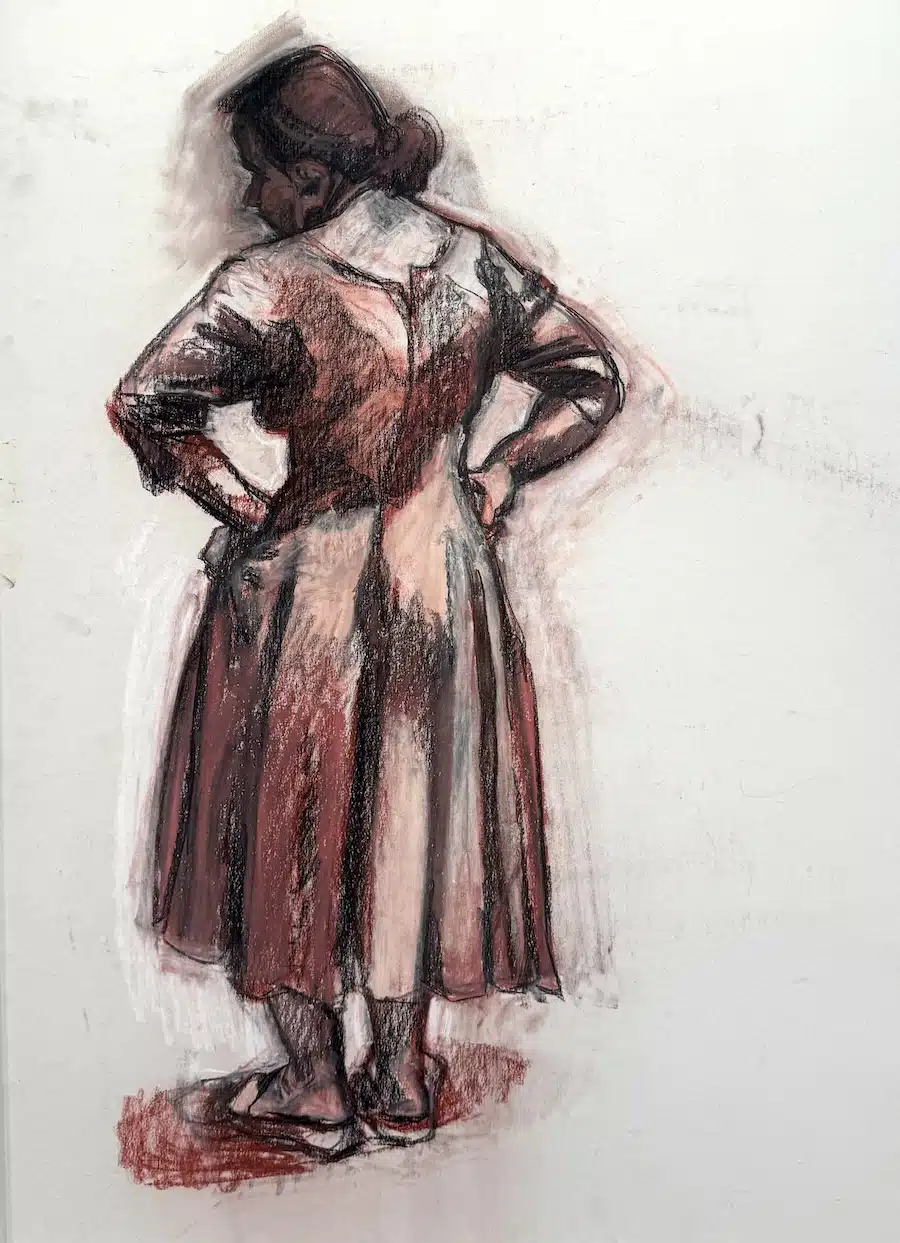
Among her strongest works are those of women. Rooted, sturdy and beefy-thighed, they seem to defy their apparent vulnerability. In the wonderful pastel on paper of Jane Eyre, the lone figure stands hands on her hips in a workaday red dress, nursing an air of rebellion. While her study for Germaine Greer shows the feminist icon sitting knees flopped open in a gesture of sexual defiance. (Sue Hubbard)
A contributor to Express didn't like Wuthering Heights 2026 and recommends the 2009 adaptation instead.
Wuthering Heights is one of those stories that always seems to be getting a new adaptation, with many proving somewhat divisive for fans of the original novel. Earlier this year, Emerald Fennell's take on the classic tale was released in cinemas, and, like many adaptations before it, left fans divided.
As a huge fan of the original novel, I knew I just had to see the film; although, having seen some reviews ahead of time, I was rather sceptical. I was a little shocked, though, as the film actually ended up being worse than I had predicted – and felt more like bad fan-fiction than an adaptation of Emily Brontë's writing. From bizarre casting, to out-of-character storylines and cutting out half of the story, the film was ultimately rather disappointing.
And while there are certainly plenty of other bad adaptations of Wuthering Heights out there (MTV's version, anyone?), there are some that are actually quite good.
One that has remained popular since its release, at least among fans of the Brontës, is the 2009 mini-series starring Tom Hardy and Charlotte Riley as Heathcliff and Cathy – a pairing whose chemistry was so good that they've since married in real life and welcomed two children together.
True to the story, however, the pair's on-screen counterparts didn't quite get a happy ending. Unlike the 2026 adaptation, and many others too, the 2009 version opted against stopping halfway through the story.
While the 2009 mini-series isn't without its issues, Heathcliff being white-washed being one inaccuracy that both adaptations are guilty of, the heart of the story itself is still there. (Isobel Pankhurst)
A contributor to Her Campus says the 2026 adaptation was 'trash'. A contributor to Artículo 14 (Spain) discusses film adaptations, including Wuthering Heights 2026.

Harrogate Informer features the work of local jeweller Joanne Gowan.
Joanne explained how Emily Bronte’s 1847 masterpiece has impacted her as an artist:
The part of Wuthering Heights which always stays in forefront of my mind is actually within the third chapter where the narrator’s ghostly experience with an icy hand outside his window, the tree knocking at the window and Cathy’s ‘Let me in’” says Joanne, “then in the concluding chapters her ghost is always there, ever present.
I hope that I can do it some kind of justice, not an easy thing to do by any means especially as my understanding of the meanings within it have developed and changed in parallel with my own life and emotional experiences.
In a strange twist of fate when I was only 13, Kate Bush released her Wuthering Heights which at that time spoke to me exactly as I felt about the novel…and started me on new creative journeys with a passion for music, which in its turn led me to art college.
That was 40 years ago and little could the young art student Joanne have known how much the dramatic landscapes that the novel conjured would change the direction of her life.
Joanne said:
The seeds of my love of Yorkshire were sown when I was very young, indeed decades before I ever visited the county. From the age of nine or ten I read novels voraciously: Dickens, Hardy, Elliot, Austin [sic] and the Brontës, and a lot of the literature, poems and plays of that era.
But it was always the Brontë novels that fascinated me most, the ones that over the years I have read over and over, my understanding of which has grown and altered as I have. Through their writing I developed a love for the wilds and the moors that I had never seen: until I was in my 40s and came for a week every year with my four children, renting an old North Yorkshire farmhouse with no neighbours and no internet or telephone signal.
And so another 20 years on and I am living here and breathing the wild and the wuthering, and wanting to try to express my own impressions of my favourite Brontë novel: Emily Brontë’s Wuthering Heights, in my own artistic medium of precious jewellery.
During the past year, Joanne has been liaising with a stone carver from the renowned gemstone cutting region of Idar-Oberstein in Germany, to create a carved rock crystal image of Cathy. This carved head is approaching completion and she will have it at her studio for the launch of the Pateley Jewellery Quarter on the weekend of 25/26 April. The design, a vignette or picture piece, can be worn as a brooch or pendant but also is intended to be displayed as a work of art in precious materials.
It will represent that ‘Cathy’ moment at the window which in many ways defines and saturates the whole story.
Joanne said:
Many completed pieces of jewellery in my studio have the influence of the Yorkshire landscape running within them. Indeed it has been an influence on my work for very many years. So now I am delighted that I can call this place my heartfelt home.
I am always very happy to discuss my work and to create jewellery pieces for individual clients which will speak to them in a personal and life-affirming way. Since neolithic times people have felt the joy of creating and wearing jewellery, its possession seems to be an intrinsic part of the human condition. It feels the perfect time for me to create an iconic art piece of Wuthering Heights.
Deccan Chronicle has an article on 'The return of book reading', including the lure of classics such as Wuthering Heights.

Let's finish with an alert in Coslada, Spain:
Biblioteca Municipal Luisa Carnés
Av Príncipes de España, 16, Coslada, Spain
April 23, 19:00

Del páramo a la biblioteca. Cumbres borrascosas (Via Diario de Coslada)

Wednesday, April 08, 2026

Wednesday, April 08, 2026 7:45 am by Cristina in , , , ,    No comments
BBC News says that the would-be developers of Brontë country's wind farm have claimed that the turbines 'will not discourage visitors to moors once loved by the Bronte sisters'. As if that was what was at the heart of the matter.
Calderdale Energy Park is applying to construct 34 turbines on Walshaw Moor, between Hebden Bridge and Haworth - the village associated with Brontë tourism.
As a nine-week public consultation begins, chief executive Christian Egal told objectors that the development would provide "cheap, reliable and stable" energy.
Campaigners who oppose the plans for the West Yorkshire moorland said that the wind farm would turn the scenic area into an "industrial complex".
The South Pennine moors and Pennine Way have long been associated with writers Charlotte, Emily and Anne Brontë, who were raised at the parsonage in Haworth, now a museum, in the 1840s.
Speaking about the literary tourists, Egal said: "They will still come. Of course the turbines will be visible, but it will not affect the number of people visiting Top Withens. We expect the impact on the landscape to be moderate and acceptable for this area."
Top Withens is a ruined farmhouse that is thought to be the inspiration for Emily Bronte's 1847 novel Wuthering Heights.
Egal added: "Wuthering is an old Norse word that means "high winds", so it's not surprising that the site is very suitable for a wind farm." (Spencer Stokes)
That only goes to show that they have no clue about anything at all beyond numbers and economy. Of course tourists will come, but the point is that a literary landscape (not to mention the consequences for local fauna) will be wrecked. Hopefully, those in charge of granting the permission or not will be less short-sighted and will turn it down once and for all.

A contributor to Redbrick gives Wuthering Heights 2026 a 3/5. Spoiler's Bolavip compares Wuthering Heights 2026 to Wuthering Heights 1939.

Monday, March 02, 2026

Monday, March 02, 2026 7:31 am by Cristina in , , , , ,    No comments
The Sun reports 'Fury as novel Wuthering Heights hit with trigger warning despite being turned into MUCH steamier movie' (loving the non-sequitur in caps).
Emily Bronte’s 1847 tale is said to contain “misogynistic, homophobic and racist attitudes”, according to dons.
It comes after the story was reimagined into a raunchy film released last month starring Margot Robbie and Jacob Elordi.
The woke warning has been slapped on an English literature Victorian fiction module at Cardiff University, with other greats including Bram Stoker’s Dracula on the reading list.
A handbook has staff warning scholars they may encounter Victorian-era attitudes.
Yorkshire Moors-set romance Wuthering Heights is among the books which may upset snowflakes.
The advisory warns of scenes of “physical and sexual violence, which some students may find distressing” and tells them to seek advice if concerned. (Thomas Godfrey)
If you need trigger warnings, perhaps don't do a course on Victorian literature, as the trigger warnings are going to be even longer than the books themselves.

ScreenRant looks into 'Wuthering Heights & 7 Other Seminal Books That Hollywood Won't Stop Adapting'.
Wuthering Heights
Margot Robbie wearing a wedding dress with a huge veil in Withering Heights 2026
The actual text of Emily Brontë’s Wuthering Heights doesn’t really open itself up to a movie adaptation. It’s the antithesis of a typical Hollywood love story; the central couple don’t really get along, they’re both deeply flawed human beings, and the supposed hunk exhibits cruel, brutish behavior. A lot of its character development happens internally, so it’s hard to visualize.
But the book is such a huge part of so many people’s childhoods that filmmakers like Emerald Fennell will keep taking a crack at it. The 1992 version starring Ralph Fiennes and Juliette Binoche included the second volume that often gets omitted from adaptations. World cinema legends like Luis Buñuel and Jacques Rivette did their own interpretations of Wuthering Heights. It’s a global enterprise. (Ben Sherlock)
According to The Yorkshire Post, 'Top Withens and Brontë landmarks in Haworth say more than Emerald Fennell's film could'.
On a cold winter’s morning, sufficiently hat-and-scarfed up, I took a train to Keighley before jumping on a BrontëBus for the short trip through the snow-covered fields of Worth Valley to Haworth - the home of the Brontë family, and the jewel in Yorkshire’s literary crown.
By mid-morning the town’s famed steep, cobbled street was beginning to stir. Margot Robbie and Jacob Elordi featured in some form in the various boutique, antique, and book shop windows that adorn both sides.
At the top of the hill stands the church, rebuilt since the days when Patrick, the Brontës’ father, presided over the parish. A few steps further, past the most gothic-looking graveyard you’ve ever seen, and you arrive at the Brontë Parsonage Museum - the first stop of my visit.
Visitors to the Parsonage can explore the rooms in which the sisters lived, wrote, and died. These rooms have been transformed into a rich repository, offering the opportunity to learn the family’s history, and peruse various manuscripts and personal effects once owned by the sisters.
Upon arrival there was only one topic on the lips of my fellow visitors, which made me consider the film’s potential impact on local tourism.
Sue Newby, Learning Officer at the Parsonage, explained: “We always notice an upturn in visitors when there is a new adaptation on film or TV. The Brontë sisters’ own story is fascinating and there is a real appeal for people in seeing where the sisters grew up and produced their work.
“We are expecting a sizeable and sustained increase in visitors to the Parsonage and the surrounding area.”
Sue also identified a particularly popular Brontë-inspired location nearby: “There is a ruin of a farm known as Top Withens, approximately three and a half miles from Haworth, which anecdotally, is said to have been the inspiration of the house of Wuthering Heights.
“The site itself is a beautiful spot, and is very evocative of the story.”
Exploring Brontë country was certainly on the day's agenda, but not before a brew. Walking back into town I stumbled upon the Haworth Old Post Office. You won’t be able to post your Brontë-themed postcards here, but they do offer a full menu including award-winning brunch, a licensed bar, and great coffee.
The site was a post office when the Brontë sisters were working on their novels, and offers a small glimpse into their world. It is said to have been the location from which the sisters posted their manuscripts to prospective publishers, and Brontë brother, Branwell, even used to crash there after a heavy night of drinking at the nearby Black Bull. [...]
I dipped below and resurfaced above a snowy undulation, and all at once the summit closed in on me.
From a frozen bench I gazed out over the snow-topped trees and white-capped fields - that desolate white expanse in all its haunting grandeur. It is this duality that shapes Wuthering Heights, as Sue Newby said: “The surrounding moorland landscape plays a part in all the Brontë novels, but in Wuthering Heights the whole of the story takes place there.
“Though there aren’t lengthy descriptions of the landscape in the novel, the mixture of its beauty and bleakness is at the very heart of the story.
“It’s very clear that the three sisters had a close sense of connection with the surrounding countryside but Emily especially loved it and knew it intimately.”
Re-reading passages of the novel in the days following my trek - having traced the steps of the Brontës, felt the ooze of the moorland mud beneath my boots and experienced the icy blast of the Yorkshire wind whipping up from the gorse - I understood this entirely. The moors cast new light on the stark, elemental forces that shape Brontë’s characters. It is a must-do pilgrimage for any Brontë enthusiast.
Hike completed and safely back in Haworth, there was only one place I was going for a pre-cinema tipple. The Black Bull makes the corner where the cobbled Main Street branches up towards the church and the Parsonage. Often frequented by Branwell, if his night didn’t end hiding in the post office he was known to escape out of the kitchen window when someone came to fetch him for overindulging. [...]
Some of the landscape shots were incredible, filmed 25 miles from Haworth in Swaledale, but with the exhilaration of the hike and its connection to the story still firmly in my mind, I couldn’t help but ask: what has this film added that the moors have not already said?
Between the Parsonage, the cobbles of Haworth, and the icy summit at Top Withins, I had experienced Wuthering Heights in its true setting. The film had offered colour and spectacle, but the windswept moors gave something deeper: the story’s wild heartbeat - alive in snow and solitude.
In the end, the landscape writes Wuthering Heights more faithfully than any adaptation ever could. (Sam Shakerley Reed)
The Maneater has some recommendations for March, including
Read: “Jane Eyre” by Charlotte Bronte
Classic literature is a popular genre for book-to-film adaptations, with Emily Bronte’s “Wuthering Heights” having come out in February 2026. While “Jane Eyre” does have a movie, the book is charming and witty, with a feminist protagonist and many unexpected plot twists. Spring break can be an ideal time to sit down and binge read a good book, and this one is a quirky novel to break open. (Callie Kemp)
A contributor to The Sun went exploring 'the gothic English region where Wuthering Heights was filmed with cosy pubs and scenic train rides'. For a contributor to Her Campus, Wuthering Heights is 'The Cruelest Love Story of All Time'. 'The Death And Obituaries Of Mary Taylor' on AnneBrontë.org.

Sunday, February 08, 2026

Let's begin this long, long... long Wuthering Sunday news with a great article in The Sunday Times exploring previous Wuthering Heights adaptations and what their creators have to say about the book and the adaptation process:
First things first: Wuthering Heights is a demented novel. If people lose their minds over Emerald Fennell’s sexed-up film adaptation, remember that Emily Brontë got there first. When she published it in 1847, under the pseudonym Ellis Bell, readers were appalled by its violence and immorality, and by the incestuous, narcissistic Cathy and Heathcliff.
Fennell has taken the film in an S&M direction — a test screening featured “a bondage-tinged sexual encounter involving horse reins” — but it’s all there in the book: the floggings, the slappings, the cruelty and the shared death wish. Add a banging Charli XCX soundtrack, the Adolescence star Owen Cooper as young Heathcliff and a controversy over the leads, Margot Robbie and Jacob Elordi (too old, too white: Brontë’s Heathcliff is a “Gypsy beggar” and “a lascar”), and you have a hit tailor-made for the I-love-it-I-hate-it era of film consumption.
The story, which is on the A-level English syllabus, is also fantastically complicated, but in a nutshell: Cathy Earnshaw’s father rescues the young Heathcliff from the streets of Liverpool and brings him to live in the family home on the Yorkshire moors. He and Cathy become close — but when they grow up Cathy is torn between Heathcliff and a more conventional life with their wealthy neighbour, Edgar Linton. After Heathcliff runs away she marries Linton; he returns three years later to seduce Linton’s sister Isabella, and all hell breaks loose: there are ghosts, howling storms, dug-up graves and murdered puppies.
It’s a lot, which is what attracted the director of the equally unhinged Saltburn (remember what Barry Keoghan did with a dug-up grave). Last September Fennell told the Brontë Women’s Writing Festival that Wuthering Heights “cracked me open”: “I’ve been driven mad by this book. I know that if somebody else made it I’d be furious.” When she first saw Elordi in his Heathcliff sideburns she “wanted to scream” with excitement. (...)
Despite its strangeness and deep Yorkshire roots, Brontë’s story has resonated at the level of myth — a story about crazy, stupid love that every generation wants another go at. (...)
Anna Calder-Marshall was 23 when she played Cathy opposite the future 007 Timothy Dalton in the 1970 version. The film’s US producer, Louis Heyward, wanted to shake things up, telling reporters: “Olivier and Oberon portrayed him as a regular nice guy and her as sweetness and light. That was not the truth and Hollywood now goes in for the truth. Heathcliff was a bastard and Cathy a real bitch and that’s how they’ll be.” (...)
What does [Peter] Bowker think Wuthering Heights is about? “If I wanted to piss everyone off, I’d say toxic masculinity. Really, it’s about a series of unfortunate men making very bad decisions, starting with Heathcliff being taken from Liverpool. It’s about class and generational pain — Heathcliff makes a decision to cause damage and sticks with it.” (...)
The other star of Brontë’s book is the Yorkshire moors, lovingly shot for Arnold by her longtime cinematographer Robbie Ryan despite six weeks of unwanted sunshine. “We expected it to be miserably wet,” he says, laughing. “We needed rain for a scene where Heathcliff walks away, but the pipes froze and I had to do it with a watering can from behind the camera.” Even so, the location turned into a mudbath. “I was running around with a 35mm camera in rugby boots and a T-shirt that said There Will Be Mud.” There were animals everywhere. “Tons of dogs, tons of horses. Wuthering Heights is a love story, for sure, but it’s the environment that makes it for me — it should be a shot in the arm of nature.” (Melissa Demes)
The Guardian explores how Haworth residents feel about the expected Wuthering Heights hype.
The four-mile trail from the village of Haworth to Top Withens in West Yorkshire is well trodden; numerous footprints squelched into the boggy ground by those seeking the view said to have inspired the setting for Emily Brontë’s 1847 novel Wuthering Heights. The landscape rolls in desolate waves of brown bracken. A lone tree punctuates the scene. It’s bleakly, hauntingly beautiful.
With the release of Emerald Fennell’s new film of the Gothic masterpiece starring Margot Robbie and Jacob Elordi next week, Haworth and many of the filming locations in the Yorkshire Dales national park, where the book is set, are braced for a slew of visitors.
The local residents, though, seem distinctly unfazed by the attention.
“We’re used to crowds,” shrugs Craig Verity, the landlord at the Kings Arms, a pub at the top of Haworth’s steep cobbled Main Street, just steps from the parsonage where the Brontës were raised.
Brontë country has been milking the connection for decades. On a wall in the Kings Arms, a board promotes a selection of Bridgehouse cask ales named Charlotte, Anne, Emily and Branwell, the latter being the lesser-known Brontë brother.
In the surrounding streets, there’s the Brontë Hotel and the Brontë Bar and Restaurant, as well as – somewhat tenuously – Brontë Balti. (...)
For this new film, the cast stayed at Simonstone Hall, a sumptuous country house hotel in Yorkshire Dales. It’s a 20-minute drive from here to Swaledale, where many of the scenes were shot.
“They were lovely people, and brilliantly undemanding,” said the owner, Jake Dinsdale, noting that Robbie had since been back for a stay with her husband. “Although they’d booked out all 20 rooms, our restaurant was still open to the public, and the cast enjoyed being around the firepit to toast s’mores, or sitting down to a roast dinner or afternoon tea.”
Haworth, pictured here, and many of the filming locations in the Yorkshire Dales national park are braced for a slew of visitors. Photograph: grough.co.uk/Alamy
His own attitude is equally relaxed. “I don’t know what the film will do,” he said. “It could all be a flash in the pan, and that’s fine. If it sticks, that’s also great. What I do know is that I won’t be renaming any rooms as ‘The Jacob Elordi Room’ or ‘The Heathcliff Room’. (...)
Tony Watson, head of economy and tourism for North Yorkshire council, said: “The area has featured in so many films and series; we’re experienced in managing that. Post-Covid, we were already seeing more younger people getting outdoors and exploring the county, and this demographic will doubtless grow as the film showcases the area’s beauty and authenticity.
“We’ll have to wait until the release to see whether there’s some iconic shot that people want to replicate. If there is, hopefully it will be somewhere like Aysgarth Falls, which has all of the necessary infrastructure in place – otherwise, we’ll need to suggest alternatives that don’t make mountain rescue unhappy.”
Back at The Kings Arms, Jack Greatrex, who lives in the area, is sanguine. “The Brontë sisters shaped this village for future generations, and for lovers of landscape and literature,” he said. “This film could mean that they continue to do so.”
Whatever effect the new film has, said Watson, they’re ready for it. “I’m the luckiest head of tourism imaginable – the film is going to do my job for me.” (Sarah Rodrigues)
For the upcoming visitors, we have some guides: 

The West Australian visits 'moody Yorkshire':
The moody moorland and pretty villages of Yorkshire are the romantic backdrop of the film Wuthering Heights, which is set to be released in Australia on Thursday, February 12, 2026.
Based on Emily Brontë’s novel, it stars Margot Robbie and Jacob Elordi, and is directed by Emerald Fennell.
Wuthering Heights film locations are in both the Yorkshire Dales and the West Yorkshire countryside.
It was filmed in Arkengarthdale, Swaledale and the village of Low Row.
Yorkshire Dales National Park has a starring role.
The Visit England team have come up with a two-day touring itinerary to immerse yourself in the movie, its mood and locations.
There are plenty of good places to stop — Haworth, Hawes, Arkengarthdale, Low Row and Top Withens.
Alongside confirmed filming locations, it includes places closely linked to Brontë’s life and the landscapes that inspired the novel. (Stephen Scourfield)
Yorkshire Live goes to Haworth and the Brontë Falls:
Tucked away into a corner of West Yorkshire, Top Withins stands proud against the elements it has been battered by for hundreds of years.
As a self-proclaimed big fan of Wuthering Heights, I was eager to complete the pilgrimage popular with Brontë fans. Top Withins has long been rumoured to be the inspiration behind the classic novel, and it's easy to see why. Standing high on the moors, the ruined farmhouse is exposed to wind and rain, a landscape of moorland and hills surrounding it.
Top Withins is a stone's throw away from Haworth, where Charlotte, Emily and Anne lived with their brother Branwell and father Patrick. The bustling village is now home to pubs, boutique shops and the Bronte Parsonage, which stands proud in front of the graveyard. (Sophie Corcoran)
A new literary bar and kitchen in Haworth: Writer's Bloc is in The Yorkshire Post:
The team behind the venue – Writers’ Bloc – said they are inviting visitors not just to experience Haworth, but to actively contribute to its story.
A spokesman said: “Founded by real-life couple and creative entrepreneurs Jamila Juma-Ware and Matthew Wignall, the space blends literature, cocktails and community under the ethos ‘come as strangers, leave as friends’.” (...)
To coincide with the film’s release, Writers’ Bloc is launching a Creative Love Letter Competition, encouraging guests to write love letters to Haworth itself, which celebrate the village’s power to inspire creativity. Selected letters will be displayed in the venue, with winners receiving dinner and drinks. (Greg Wright)
Vogue publishes a Wuthering Heights-Coded Guide To Brontë Country:
Haworth is a 20-minute drive through the Pennines. At the top of its cobbled high street sits the Brontë Parsonage, the house where Charlotte, Anne and Emily lived with their brother Branwell. Nestled next door is St. Michael and All Angels Church (where their father Patrick was curate) and its deeply atmospheric graveyard. Charlotte and Emily are buried in the family vault in the church; on show inside is Charlotte’s marriage certificate; she is listed with no profession despite being renowned then as the author of Jane Eyre.
The house itself is hauntingly close to when the family were in residence. The front parlour room is laid out as if they’d just broken for tea, the small dining room table they worked at scattered with a writing block and ink, newspapers, cups and saucers. But tragedy, too, isn’t far from sight; against the wall is the sofa where Emily died from Tuberculosis, aged 30. (Victoria Moss)
The Yorkshire Post visits Cahty's room, an Airbnb ‘setcation’, located in West Yorkshire:
I’ve been lucky enough to be given the opportunity to immerse myself deeper into the story, with a visit to a replica film set of Cathy’s Thrushcross Grange bedroom, which was used for shooting the new Wuthering Heights adaptation.
It was here, in the book, where some of the biggest moments happened – particularly in the relationship between Cathy and Heathcliff. (...)ç
It’s a lavish, sumptuous space, with a silk canopied bed and an ornate dressing table, which encapsulates the grandeur and refinement of the Linton family’s estate, perhaps illuminating what captured Cathy’s attention as a young woman and subsequently were her reasons for marrying Linton – sealing hers and Heathcliff’s fate.
In the film, the bedroom was decorated by her husband Linton, whose design choices were an ode to his wife and her untamed spirit.
The room is apparently painted the exact Pantone shade of actress Robbie’s skin, with vein detailing across the wall panels which deepen as the film continues, representing Cathy’s intensity and wild nature. (Sophie Goodall)

Deutsche Welle has a ten-minute video piece about Wuthering Heights 2026 with particular emphasis in the alleged non-whiteness of Heathcliff. Among others, the video features Mithu Sanyal, author of

Mithu Sanyal über Emily Brontë,

Air Mail publishes an interesting article about what is and isn't Wuthering Heights 2026. The article is almost a review of the film, but not quite:
The wonder of it is that Wuthering Heights, which was declared to be “unquestionably and irredeemably monstrous” upon publication, exists at all, its creative origins forever obscured by the brief and enigmatic life of its author. The novel, published in 1847 under a male pen name (Ellis Bell), was written by Emily Brontë, a 27-year-old virgin so reclusive she makes Emily Dickinson seem positively sociable, who lived in a parsonage together with her gifted sisters and alcoholic brother in the tiny village of Haworth in Yorkshire, England. (...)
For all its heaving drama, the plot of Wuthering Heights is remarkably simple, even primitive. It is the age-old one of a soured romance, of childhood sweethearts who are foiled by the adult reality they grow into. Boy meets girl; boy falls in love with girl; boy loses girl. And then, if the boy in question happens to be Heathcliff, with his “satanic nimbus,” as one writer put it—the romantic antihero par excellence—all hell breaks loose. (...)
While watching the latest film adaptation, I kept wondering what Brontë would have made of this version of her stark, doomed story, with its graphic scenes of masturbation, B.D.S.M., and doggy-style penetration. Would she have recognized her novel at all? And what about Cathy’s outlandish, anachronistic wardrobe, replete with a red latex gown, German milkmaid corsets, and Elton John sunglasses? (...)
Influenced by the aesthetics of soft porn and high fashion, this is a movie with its sights firmly fixed on Gen Z. It works, in its edgy stylistic way, and it should sell heaps of tickets. But by simplifying the arc of the original story, ending the narrative with Cathy’s death and leaving out her ghostly haunting of Heathcliff, and by making explicit what was implicit, this Wuthering Heights is, curiously, a less subversive and radical rendering of the otherworldly, inexorable desire that Emily Brontë captured almost two centuries ago. (Daphne Merkin)
The London premiere, the bracelet, the Boucheron brouches, Brontë bun, Margot Robbie's nails... all that old news from 24 hours ago still linger on in Indulge Express, Something about Rocks (and another one), The Fashion Spot, Hello!, AzatTV, TV Azteca Chihuahua, BBC, American Salon, Daily Mail, Great British Life, Metro, The Mirror, Times of India, Grazia, Instore, The Tab, Times Now News, News18, Harper's Bazaar, Forbes...

The boost in sales of the novel is also discussed in The Express Tribune. The raunchy, kissing nature of the film is once again highlighted in the Daily Mail, The Sun, and Telegrafi. First reactions in The Cinema Group. Emerald Fennell explains the R rating of the film in Cinemablend. The Times explores "Margot Robbie, Jacob Elordi and the Hollywood ‘showmance’ industry". Margot Robbie defends her casting as an older Cathy in USA Today:
Over the course of the movie, "Cathy's in her mid-20s to early 30s, which puts so much more pressure on the marriage situation," Robbie tells USA TODAY. "A bunch of people telling an 18-year-old, 'Oh, f---, you better hurry up and get married!' That doesn't really hold the same weight to a modern-day audience member."
Whereas now, "particularly for women, there's suddenly this checklist that society has given you and you better have it all ticked off by the time you're 30: get married, get a house, have your career figured out, and start thinking about kids," Robbie continues. For Gen Z and millennial moviegoers, "watching an older Cathy have that pressure might carry more weight." (Patrick Ryan)
Anna Silverman summarizes Wuthering Heights 2026's style in The Sunday Times:
 Barbie + Kim K’s gothic dress + Mills & Boon paperback = Emerald Fennell’s Wuthering Heights
El Día (Argentina) explores the original novel by Emily Brontë:
En los páramos desolados del norte de Inglaterra, donde el viento no solo azota la tierra sino también los ánimos, Emily Brontë  levantó una de las novelas más inquietantes y perdurables de la literatura universal. Cumbres Borrascosas, publicada en 1847 bajo el seudónimo de Ellis Bell, sigue siendo una obra incómoda, feroz y profundamente actual, capaz de sacudir al lector incluso más de un siglo y medio después de su aparición. No es una historia pensada para tranquilizar ni para ofrecer consuelos fáciles: es, ante todo, una exploración descarnada de las pasiones humanas llevadas al extremo.
La novela se desarrolla en un escenario áspero y hostil que no funciona como simple decorado, sino como una prolongación emocional de los personajes. Los páramos, el clima violento y la casa que da nombre a la obra conforman un universo cerrado, casi opresivo, donde el amor, el rencor y la obsesión crecen sin freno. Allí se forja el vínculo entre Heathcliff y Catalina Earnshaw, una relación que desafía las categorías tradicionales del romanticismo. No hay idealización ni ternura permanente: lo que los une es una fuerza primitiva, absoluta, que ignora las normas sociales, la razón y hasta los límites de la vida y la muerte. (Translation)
TVO (Ontario) broadcasts the dramatized documentary In Search of the Brontës 2003. StageTalk interviews Sally Cookson, and her Jane Eyre adaptation is mentioned several times. BookClub includes Jane Eyre in a list of "books about happy women with happy endings". Only an AI could have written that. Giornale della Danza (Italy) interviews prima ballerina Silvia Selvini:
Michael Olivieri: Un romanzo da trasformare in balletto?
Cime Tempestose di Emily Brontë. (Translation)
The Yorkshire Post publishes several Haworth postcards from the Peter Tuffrey collection:
 Postcard collector, the late Norman Ellis of Ossett enthusiastically gathered as many images of West Yorkshire as he could find.
Also in The Yorkshire Post, some news about the Stop Calderdale Windfarm campaign:
Campaigners against proposals to build a giant windfarm on West Yorkshire moorland believe they are winning the battle – but the fight isn’t over yet.
The Stop Calderdale Windfarm campaigners oppose Calderdale Energy Park proposals to put giant turbines on Walshaw Moor, above Hebden Bridge.
The say in a presentation to local parish councils this month the developers revealed the have scaled back their plans for the second time.
Their original proposal in September 2023 was for 65 turbines, reduced to 41 in April 2025.
They have now reduced that number further to 34 after widespread criticism and public opposition, claims the campaign group.
The group adds the timescale for the project has also slipped, with Statutory Public Consultation previously scheduled for January now being put back to April 2026.
Despite believing it shows the developers might be on the back foot, the group warns the fight is far from over.
“The developers are clearly on the defensive, but the latest proposals would still be incredibly damaging to the carbon-rich blanket peat bogs on Walshaw Moor and the endangered ground-nesting birds which breed on this internationally important Special Area of Conservation (SAC) and Special Protection Area (SPA). (John Greenwood)
Books for the hopeless romantics in Times Now News:
Jane Eyre
A sweeping, atmospheric love story that feels timelessly tender, Jane Eyre is for romantics who adore emotional intensity wrapped in quiet strength. Jane and Mr. Rochester’s bond is slow, smoldering, and full of moral complexity, the kind of love you root for even when they stumble. It’s haunting, passionate, and beautifully earnest. Every chapter feels like a heartbeat you can hear, not just read. (Simran Sukhnani)
Broadway World Chicago reviews Dracula: A Comedy of Terrors:
[Valerie] Martire’s Lucy shares more in common with Charlotte Brontë’s Jane Eyre than her original fictional counterpart. She desires for adventure and a place in society in which her knowledge and accomplishments can be celebrated, not buried under the weight of matrimony. ( Misha Davenport)
Places to visit in the Peak District in The Sunday Times:
 5. Hathersage, Derbyshire
“High banks of moor were about me; the crag protected my head: the sky was over that.” So narrates the eponymous Jane Eyre in Charlotte Brontë’s beloved novel. Having stayed in Hathersage in 1845, Brontë set her story in the charming Hope Valley village. Also inspiring her, as per that quote, was the surrounding, brooding Dark Peak scenery, and not least Stanage Edge — a four-mile gritstone ridge that offers memorable vistas for miles. Modern-day Hathersage has a heated outdoor pool, but you may just prefer its churchyard. Little John, Robin Hood’s loyal outlaw companion, is supposedly buried here, as a gravestone attests. (Oliver Perry)
Nice Bastard Blog (in German) posts about how Emily Brontë's poems and a French anorexic novelist inspired a small publishing house. The Behind the Glass podcast's latest guest is Elizabeth The Thisty:
Mia and Sam are joined by THE drag queen historian Elizabeth the Thirsty.
We share our love for making history fun, imagine a Brontë-themed drag show and learn about a secret language used by the Georgians...