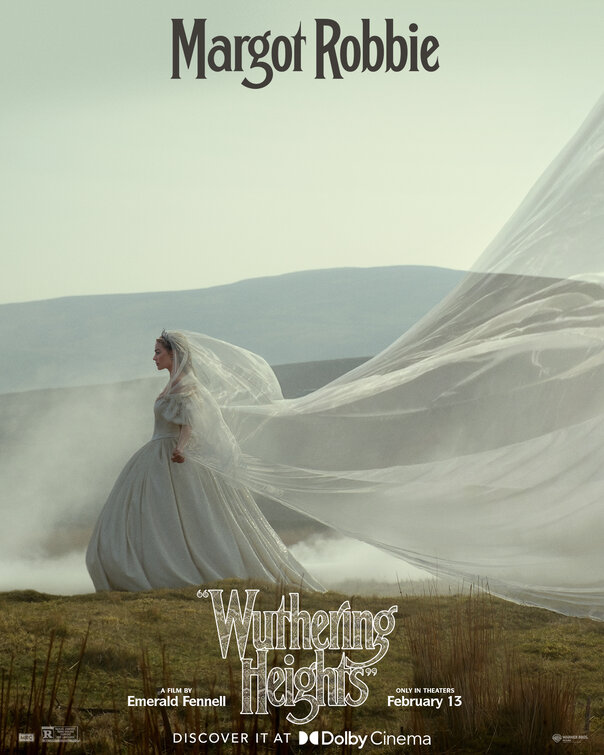
Wuthering Heights tells us that love should hurt. Actually, it should burn. Lacerating your heart and excavating your soul, it will, in the words of Emily Brontë herself, drive you mad. Fans of the 19th-century classic were reminded of this when the first full-length trailer for Emerald Fennell’s highly contentious but much-anticipated adaptation, which stars Margot Robbie and Jacob Elordi, came out in the fall.
The trailer depicts Cathy (Robbie) and Heathcliff (Elordi) meeting as children before becoming embroiled in what it describes as “the greatest love story of all time.” While it’s not clear how far Fennell has strayed from the 1847 novel—the film has raised eyebrows among literary types who’ve pointed out that Heathcliff is described as “dark-skinned” in the book, while Cathy wears a shiny red dress, among other things in the film—it’s set to be a major cinematic event, with original songs by Charli XCX and a Valentine’s Day release date.
Make no mistake: Wuthering Heights—which focuses on the intense bond that develops between Cathy and Heathcliff and the subsequent devastation that occurs when social mobility prevents them from being together—is a heart-wrenching tale, one that offers up meaningful commentary on everything from class and revenge to generational trauma. For me, though, it has always been about one thing and one thing only, and that’s Heathcliff, a.k.a. literature’s original fuckboy. Brooding, handsome, and troubled beyond repair, he epitomizes everything straight women are supposed to run from, and yet tend to run towards. I do, at least.
Unfortunately, I’ve got a long history of fancying terrible men. The highly functioning alcoholics who pledge sobriety after an argument, only to get hammered a week later? Tick. The self-destructive avoidants who are addicted to you one minute and repulsed the next? Tick. The tormented artists who haven’t discovered bed frames and trade on empty promises and incessant love-bombing? Tick, tick, and then a few more ticks.
I blame all of this on Brontë—partly because it’s more convenient than analyzing my own self-destructive patterns, but mostly because I remain convinced that the precedent for chasing toxic love stories was one set out for me as a teenager, by Heathcliff. To be clear, in the book he is a truly abominable character. This is a man who not only speaks in growls and terrorizes children, but who also hangs dogs and beats women (character traits that we should all skip when it comes to dating prospects, obviously).
And yet he is often upheld as a romantic antihero, which I suspect has something to do with the fact that two of the most popular Wuthering Heights adaptations (William Wyler’s 1939 classic starring Laurence Olivier and Andrea Arnold’s stark but stunning 2011 version) conclude with Cathy’s death, neatly glossing over the second half of the book, which sees Heathcliff going full sociopathic mode.
For me, though, the allure of Heathcliff was always less about the man himself than what he, and his relationship with Cathy, represented: a love so deep and destabilizing that it could hardly exist. Given they are—spoiler!—never actually together, their dynamic is defined by absence, possibility, and longing, which are arguably the most romantic things of all. Their love never becomes a reality, confining it to the realm of fantasy, where everyone and everything feels so much better because you made it all up inside your head.
This is the trap I’ve fallen into many times, creating my own epic Cathy-and-Heathcliff love stories with men who couldn’t be less interested in me. There was the boy at school who, in my mind, was stringing me along for years, but in reality just never wanted to be with me. The filmmaker who told me quite clearly that he “didn’t want anything serious,” which I took as a challenge to change his mind. And several others I won’t mention to save a little face.
There’s also something about Cathy and Heathcliff’s relationship being rooted in childhood that holds a certain amount of appeal. They know each other so well. They grew up together. They have history. After yet another disappointing experience with a man, I often find myself craving the comforts of familiarity, returning to exes I’ve romanticized and convincing myself that someone I dated two years ago was actually the one for me.
It makes sense why I—and others like me, I’m sure—might be craving Brontë’s maddening breed of passion. I can’t tell you how many mediocre dates I’ve been on recently, swapping the same insipid stories about siblings and pets, hoping for a sudden spark of excitement and settling for it not being a complete disaster. The bar is absurdly low; these men will get a round of applause for texting us back or booking a restaurant. Where are the ones who’ll cry for us on the moors and dig up our graves? They might not be healthy, but at least they’re interesting.
I know in reality that nobody should conflate drama with romance. We all know that real love is supposed to be quiet, stable, and safe, and that it also probably shouldn’t extend into the afterlife—least of all with a raging psychopath. But when dating feels so relentlessly and desperately dire, can you blame the toxic girlies for occasionally wanting something a little spicier? If not to inject a little energy into our dating pursuits, then to give us something a little more compelling to talk about in the group chat?
With this in mind, I personally cannot wait to watch Fennell’s Wuthering Heights. I’ll admit, as a dedicated fan of the book, I was skeptical at first. But now I no longer care about accuracy. Give me madness on the moors. Snogs in a storm. And the kind of love story that will ruin my life. It’s probably a little wiser to experience it on screen than off, anyway. (Olivia Petter)







0 comments:
Post a Comment