Podcasts

  • S4 E8: With... Rebecca Marks - For the final episode of series 4, Sam and Mia are joined by historian, author and content creator Dr Rebecca Marks! Rebecca holds a Master's in Art Hist...
    1 month ago
Showing posts sorted by date for query simon armitage. Sort by relevance Show all posts

Thursday, July 03, 2025

The Telegraph and Argus features Wondering Heights.
A celebration of 'collective joy and creativity' inspired by Emily Brontë and Kate Bush will feature as part of Bradford 2025's UK City of Culture programme.
Wondering Heights invites everyone to join a free, playful celebration
Inspired by Emily Brontë's imagination and Kate Bush's pop anthem 'Wuthering Heights', the event seeks to engage people from all walks of life in a simultaneous celebration of place, dance, and song.
People can participate from anywhere they choose - whether at home, in the workplace, or amidst the rugged beauty of the Bradford moors.
Wondering Heights is described as a 'tiny project with a big hopeful heart' focuses on togetherness through activities like walking, dancing, drawing, or simply imagining.
There will be two free workshops for people to learn the Kate Bush-inspired dance routines on July 5 and July 23.
The event encourages everyone to participate in their own creative way, be it dancing, drawing, waving a dramatic tea towel, or walking one of the mapped routes.
Artist Lucy Barker is the brain behind Wondering Heights.
The project aims to welcome everyone to create and share their own moments of 'collective effervescence', a term defined by modern sociologists to signify the joy of moving or feeling together.
Routes on the event map include Lucy's Dream, starting near Denholme Gate, Thornton Village, Ogden Water, and Denholme.
Full access guides are available for select routes on Lucy Barker's website.
The Wondering Heights map, designed by Chris Goddard, is available online or in limited-edition risograph print form at venues, including the Bradford 2025 Ticket Office, The Brontë Parsonage Museum Reception, and South Square Centre Café.
The map can be used as a guide for a walk on the moors, a prompt for a dance, or a 'spark for something entirely your own'.
When finished with it people can recycle it, pass it on, or repurpose it creatively.
The event is free to participate in and encourages everyone to share their creative responses on social media using a QR link or by tagging Lucy Barker on Instagram.
The initiative is said to be inspired by the words of Priya Parker, from 'The Art of Gathering', who said: "Gatherings have the power to temporarily transport us to a world created for a specific purpose—where we feel we belong to something larger than ourselves."
For more information, visit Lucy Barker's website or follow her on Instagram. (Gavin Engelbrecht)
Domain (Australia) sees some cottages for sale in Haowrth and thinks of turning them into tourist accommodation.
From the outside, this modest stone cottage in England looks like the perfect escape for those seeking peace and quiet. 
But the house is next door to a world-famous tourist site that attracts 70,000 people each year.
The Brontë Parsonage, located just 50 metres down the road, is a magnet for literary tourists. 
It is here that Charlotte, Emily and Anne Brontë penned some of English literature’s most famous works, including Jane Eyre and Wuthering Heights. 
In their day, the Yorkshire village of Haworth was a grim place where sewage flowed down the streets and sanitation was poor. 
It was also a time when the average life expectancy in the village was just 25. 
Today, Haworth is a peaceful country town with a bustling tourist trade.
There are two one-bedroom cottages, one two-bedroom cottage and a small studio on offer. 
The cluster of buildings will go to auction at the end of July with a guide price of £350,000 ($732,000). 
The listing by SDL Property Auctions suggests the cottages could be used as holiday accommodation. 
“The building would lend itself to Airbnb or could potentially be redesigned, internally, to accommodate any number of functions, i.e. guest house,” the listing reads. 
“This is all subject to the necessary consent.” 
The cottages are ideally positioned between two of the town’s biggest tourist sites: the house where the Brontë sisters lived and the church where their father preached. 
The idyllic ivy-covered buildings have traditional stone walls, chimneys and mullioned windows. 
Three of the four cottages are currently rented out to private tenants, while the other is vacant. (Orana Durney-Benson)
Wakefield Express reports that,
Pupils from across the Castleford Academy Trust held their annual arts showcase in June, taking inspiration from local figures such as Barbara Hepworth, Charlotte Brontë, and Simon Armitage to create Yorkshire-themed poetry, catwalks, singing, visual art and physical theatre. (Catherine Gannon)
Fine Books & Collections recommends Charlotte Brontë's Book of Ryhmes.
A Book of Ryhmes by Charlotte Brontë
Nearly 200 years since the then 13-year-old Charlotte Brontë handwrote her miniature book in Decembe 1829, A Book of Ryhmes [sic] has been published for the first time by The Brontë Society and Tartarus Press, an anthology of 10 transcibed poems (including The Beauty of Nature and On Seeing the Ruins of the Tower of Babel) with a foreword by singer Patti Smith. The original manuscript was bought by the Friends of the National Libraries  in 2022 at the New York International Antiquarian Book Fair and donated to the Brontë Parsonage Museum in Haworth where it was originally written.
BBC News reports that auctioning off Mary Taylor's Red House wasn't nearly enough to get Kirklees Council out of debt.
A cash-strapped local authority is planning to offload more of its assets in order to bring in £6m.
Kirklees Council was faced with a £47m black hole in its budget in 2023-24.
The authority has already raised nearly £1m after four assets were sold off in May and June.
Seventeen new assets have been earmarked for disposal including a plot of land at Grasscroft in Almondbury, despite several objections. [...]
It has already auctioned off of the former Red House Museum at Gomersal, which sold for £650,000.
The Grade II listed property, which was once the home of Charlotte Brontë's friend Mary Taylor, was previously a museum which closed in 2016 and a plan to turn it into holiday accommodation and wedding venue fell through. (Abigail Marlow)
According to TimesNowNews, Jane Eyre is one of 5 books recommended by Benedict Cumberbatch.
4. Jane Eyre by Charlotte Brontë
‘Jane Eyre’ remains a timeless exploration of emotional strength, morality, and self-worth. Through Jane’s voice, Charlotte Brontë crafts a narrative that merges gothic drama with a profound inner journey. Jane’s resilience in the face of abuse, neglect, and heartbreak reflects a fiercely independent spirit determined to define her own value. Benedict Cumberbatch has expressed admiration for the character’s emotional depth and the novel’s enduring relevance. As someone who often portrays psychologically rich roles, it’s clear why he would be drawn to such a work.
Warwickshire World reviews Tread the Boards' play The Complete Jane Austen Collection .
There were several dance routines, which were very varied, almost none of which were appropriate for the Austen era and which made the scenes even more humorous. The cast were clearly well rehearsed in what superficially were chaotic scenes. In Sense and Sensibility, Emily and JR danced to Kate Bush’s Wuthering Heights before Rosie pointed out that was by Emily Brontë, not Jane Austen. (Charles Essex)

Saturday, November 04, 2023

Saturday, November 04, 2023 8:59 am by Cristina in , , , ,    No comments
A couple of the Brontës' works as psychological thrillers in The Guardian:
Although sometimes perceived as a new publishing trend, psychological thrillers have always been popular, said Harriet Tyce, a former criminal barrister and author whose most recent novel is It Ends At Midnight. Daphne du Maurier’s Rebecca, Emily Brontë’s Wuthering Heights and Charlotte Brontë’s Jane Eyre are all early examples of the subgenre, she explained.
“As a genre it’s been traditionally more popular with female authors and readers – who make up the majority of book buyers, let us not forget – perhaps because its exploration of the terrors that can be hidden in domestic settings are so strong and resonant to women who are trapped by patriarchal structures within the home.” (David Barnett)
The Yorkshire Post features Catherine Warr and her book A Yorkshire Year. 
“The pleasure for me”, says Catherine, is to get readers to explore further. So, I take them, I hope, into unknown territory, and beyond things that they already know. Like the Brontë sister. Everyone knows quite a lot about them, and there’s really little for me to add.
"Their dissolute brother Bramwell [sic], however, is quite another matter – to me, he’s the strangest of those Howarth [sic] children, and by far the most interesting in his relative obscurity, and his being a true misfit. The ‘Brontë tea towel economy’ just bores me to tears!” (Phil Penfold)
We prefer the attitude of poet Robert Powell, also interviewed by The Yorkshire Post:
Name your favourite Yorkshire book/author/artist/CD/performer.
It's a three-cornered fight between Tristram Shandy by Laurence Sterne, Wuthering Heights by Emily Brontë, and Kes, by Barry Hines. Other living authors I relish are Simon Armitage and Sally Wainwright, and the two we have lost, and whose work still gives me great pleasure, are Ted Hughes and Winifred Holtby. (Phil Penfold)
Madame Figaro (France) interviews Siri Hustvedt.
Vous écrivez également sur des femmes écrivains, comme Jane Austen et Emily Brontë. Les considérez-vous comme vos « mères littéraires » ?
Oui. Je les ai lues pour la première fois quand j'avais 13 ans, et elles continuent de m'influencer. Bien que les romans d'Austen aient été déformés par Hollywood et des hordes de fans sentimentaux, son travail est en fait tout entier tissé d'ironie et de critique sociale, particulièrement envers un monde qui asservit les femmes. Et Les Hauts de Hurlevent est un roman si radical, si déroutant et rempli d'ambiguïtés, que je ne m'en suis jamais remise. C'est pourquoi j'ai écrit dessus : pour me plonger, quitte à m'y embrouiller, dans ce que je ne peux pas résoudre. De nombreux lecteurs en ont proposé des interprétations jusqu'à le transformer en ce qu'il n'était pas. Je considère ce livre comme une bombe philosophique, une œuvre qui bouleverse bon nombre des frontières que nous tenons pour acquises, celles entre l'homme et la femme, entre soi et l'autre, entre la personne et l'environnement. (Minh Tran Huy) (Translation)
Notas de prensa (Spain) interviews writer Ángeles Caso.
q. ¿Qué debemos heredar de estos desheredados?
R. El coraje y la fortaleza que tuvieron para escuchar su propia voz. Cuando todo el mundo te dice que las niñas no saben escribir, pintar o investigar bien, ¿dónde encuentras el coraje y la fuerza para defenderte y conservar tu talento? Llevo una camiseta de las hermanas Brontë: Charlotte, Emily y Anne. A ellos les dediqué mi novela. Todo este fuego. La forma en que estas mujeres se respetaban a sí mismas más allá de todas las convenciones sociales y pagaban precios muy altos, este respeto por lo que realmente tenían dentro de ellas… (Heberto Corrales Domínquez) (Translation)
Sixth Tone features Shanghai's female-friendly bookshop, which is been more and more successful since it opened in 2020.
It’s easy to see why Wang’s business has prospered. A three-story space just across the road from the trendy Tianzifang neighborhood, Xinchao Bookstore styles itself as the city’s first and only independent women’s bookstore.
The interior resembles a set from the “Barbie” movie. Between bright pink walls, rows of bookshelves are stuffed with titles by female authors ranging from Jane Austen and the Brontë sisters to the Japanese feminist Chizuko Ueno. (Fan Yiying and Liu Shuhuan)
El Independiente (Spain) on saying goodbye.
De estos otros adioses que son el envés del acto soberano y libertino de marcharse voluntariamente de los sitios está llena la literatura del XIX, aunque tal vez el cesante Villaamil de la novela Miau de Pérez Galdós sea la manifestación más estomagante y estructurante de estos adioses forzados de cuantas hemos conocido, con permiso de la honesta fuga de Jane Eyre o de los más contemporáneos y más prosaicos ceses de los entrenadores de fútbol, valga el de Vicente del Bosque por todos ellos, que fue despedido del Real Madrid por no tener, ni de lejos, el charme para el tiro de cámara ni los ojitos azules del efímero Carlos Queiroz, mucho más guapo, desde luego, que el genio salmantino. (Pablo Sánchez Chillón) (Translation)
Far Out Magazine has actress Jemima Kirke list her favourite books and one of them is Wuthering Heights. iNews features Hebden Bridge and mentions its proximity to Brontë country as one of its good things. BBC Countryfile has a guide on Hathersage that mentions the Charlotte Brontë connection.

Wednesday, November 01, 2023

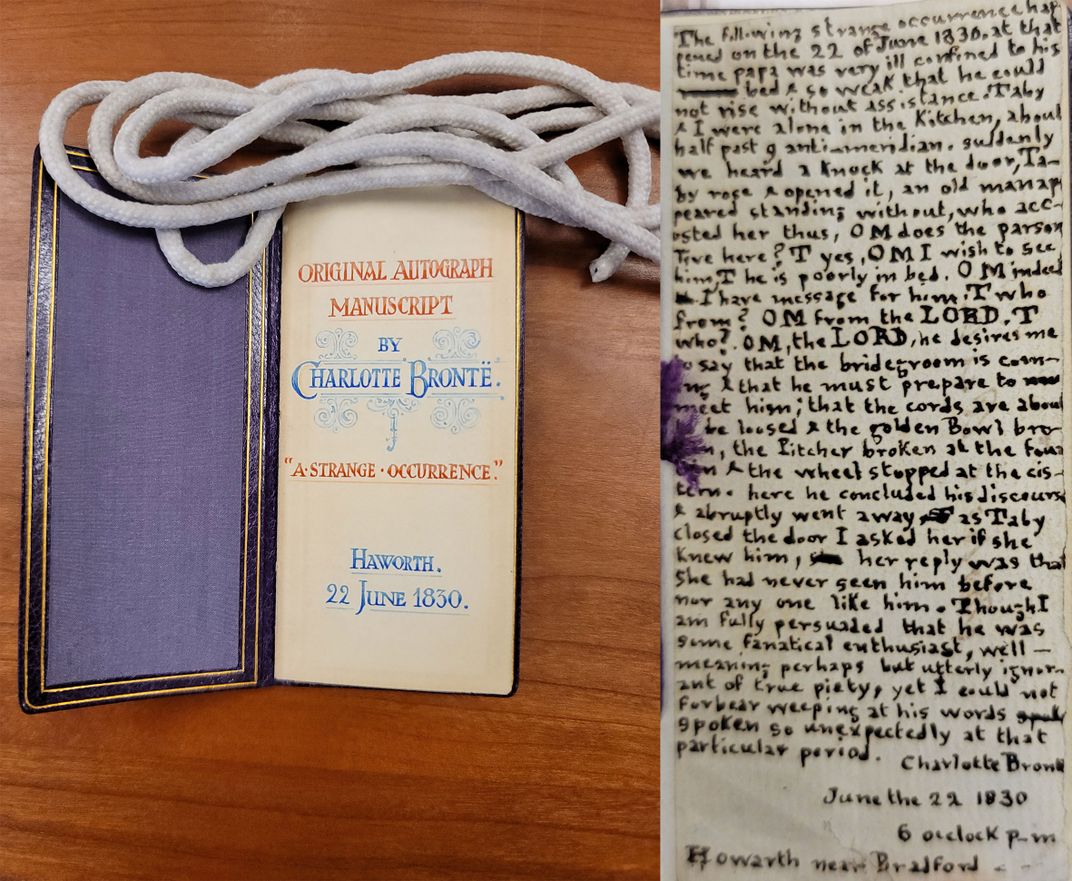
Smithsonian Magazine features an early story by Charlotte Brontë: 'A Strange Occurrence at the Parsonage', the manuscript of which is kept at at Harvard University’s Houghton Library.
Source 
(Note that Charlotte herself misspelt Haworth as Howarth)
Bound in faded purple leather, the minuscule object made the book cart look absurdly unnecessary. At just 9.5 centimeters long and 4 centimeters wide, the manuscript fit in the palm of my hand. But nestled inside was a treasure rare enough to take any literature lover’s breath away: a single page covered in the microscopic handwriting of a 14-year-old Charlotte Brontë. [...]
Titled “A Strange Occurrence at the Parsonage,” it tells an eerie story, detailing the teenage Brontë’s recollections of the night of June 22, 1830, when she crossed paths with something unsettlingly close to the supernatural. Aside from a few brief mentions in Brontë biographies, the manuscript hasn’t garnered too much attention. I came across it quite by chance in the online catalog of rare manuscripts at Harvard, where I study English literature. When I saw the title, I was so intrigued that I decided I had to see it in person.
The incident in question was strange but true. On that early summer night, Brontë was sitting in the kitchen of Haworth Parsonage, her family’s home in West Yorkshire, England. Her father, Patrick Brontë, was the parson of the local parish. But he “was very ill, confined to his bed and so weak that he could not rise without assistance,” as the author writes. (An inflammation of the lungs would keep Patrick in bed for a total of three weeks in June and July of that year.)
“Suddenly,” Brontë continues, “we heard a knock at the door.” Tabitha “Tabby” Aykroyd, the family servant, “rose and opened it. An old man appeared, standing without.”
Brontë records the exchange between the servant and the old man in dialogue form. The stranger asked to see Patrick, but after he was informed that the parson was ill in bed, the encounter took an unsettling turn. The visitor came, he claimed, with a message for the parson from God himself:
The Lord, he desires me to say that the bridegroom is coming and that he must prepare to meet him; that the cords are about to be loosed and the golden bowl broken; the pitcher broken at the fountain and the wheel stopped at the cistern.
Appropriately enough, these cryptic words quoted a Bible verse. Taken from Ecclesiastes, the passage comes at a moment when King Solomon of Israel is giving advice to a young man about how to live and die. The images of shattered objects convey the irrevocability of death, as Solomon implores his companion to remember God “before the silver cord is broken.” Apparently, the stranger at Haworth Parsonage had come to tell Patrick that he was going to die.
The man’s words—also drawn from the Book of Matthew, which states that “The bridegroom was a long time in coming”—evidently unnerved young Brontë, much as she tried to resist believing his prophecy.
“Though I am fully persuaded that he was some fanatical enthusiast, well-meaning perhaps but utterly ignorant of true piety, yet I could not forbear weeping at his words, spoken so unexpectedly at that particular period,” she concludes at the bottom of the tiny page. [...]
The stranger, moreover, turned out to be a local farmer who would later be consigned to an asylum. “A Strange Occurrence” may not have turned out to be a real encounter with the paranormal, but it provides evidence of a side of Brontë that even her most avid readers rarely see or notice—one fit for a season of spooky tales. From a young age, Brontë had an affinity for the supernatural. What’s more, her attraction to the strange and horrific was an early vehicle for her love of storytelling. (V.M. Braganza)
The article goes to to contextualise Charlotte's interest in the supernatural and it makes for quite an interesting read.

The Harvard Crimson lists 'Five Centuries of Haunting Reads by, for, and about Stubborn Women'.
“Frankenstein” is pre-Victorian. Must-read Victorian Era works of women’s Gothic fiction: “Jane Eyre” by Charlotte Brontë, and “Wuthering Heights” by Emily Brontë. (Vivienne N. Germain)
Times Now News lists the 'Top 10 Must-Read Classics and Why They Still Matter'.
9. Wuthering Heights by Emily BrontëThe passionate and tragic love story between Catherine and Heathcliff unfolds amidst the moors of England. Brontë's dark tale of love and revenge explores the depths of human emotions, from unbridled passion to deep-seated resentment. The narrative raises questions about the nature of love and its power to uplift and destroy. (Girish Shukla)
Locus reviews Starling House by Alix E. Harrow.
Alix E. Harrow is also acutely aware of the traditions behind Starling House, as evidenced by her epigraph from Wuthering Heights and a few passages – including the opening line – that sound like they might have come from du Maurier’s Rebecca. (Gary K. Wolf)
Wealth of Geeks ranks Orson Welles's best films and Jane Eyre makes it to #14.
14. Jane Eyre (1943)
When his RKO contract expired and he was free to work for other studios, Welles took the opportunity to play Edward Rochester in an adaptation of Charlotte Brönte’s (sic) Jane Eyre, as it would earn money for his own projects. Director Robert Stevenson mounts a handsome version of the novel from a script he wrote with Brave New World author Aldous Huxley and Welles’s one-time collaborator John Houseman. Stevenson emphasizes the gothic elements of the tale, which matches Welles’s smoldering take on Rochester’s romance with Joan Fontaine’s Jane. (Joe George)
Film School Rejects discusses 'The Evolution of ‘Dracula’ Performances'.
As [actor Frank] Langella mentioned in an interview with the New York Times in 1977: “I see the play as a love story with Dracula very much in love with Lucy. So I insisted on no fangs, no red eyes, no hollow cheeks. He is not a ghoul, not a ghost. I saw him more as a Byronic hero.” This choice to play Dracula as a brooding Gothic character like Heathcliffe [sic] in Emily Brontë’s Wuthering Heights gives us a far more seductive impression than what Lugosi created. (Jacob Trussell)
Autostraddle has an article on 'Work and Class in “The Haunting of Bly Manor”'.
The governess often spent the evenings alone and she was sometimes expected to use the schoolroom as her sitting room. Life could feel very lonely: 19 year old Edith Gates, a governess in Reading in the 1870s, confides to her diary how homesick she feels. 30 years earlier Charlotte Brontë tried to avoid going into her employers’ sitting room in the evenings because she found it awkward to make conversation with people she didn’t know very well.” – Kathryn Hughes, author of The Victorian Governess (Nico Hall)
Muse interviews spoken word artist Toria Garbutt and asks her about her work in the Brontë Parsonage Museum.
Could you talk a bit about your work at the Brontë Parsonage Museum over the years?
I love the Brontë Parsonage. I was the poet in residence there after Simon Armitage. They commissioned me to create a new piece of work about addiction, drawing comparisons between my sister and Bramwell [sic] Bronte. It was made into a film. When she died, I made the decision not to release it, and they respected that. (Alexandra Pullen)

Friday, August 18, 2023

Keighley News presents the poet Simon Armitage as a Brontë enthusiast:
Poet Laureate and Brontë enthusiast Simon Armitage will be among the headline acts at a leading literature festival.
He will give a lyrical reading as part of an evening celebrating "the music of language".
The event is one of around 100 taking place during Ilkley Literature Festival, between October 6-22.
Mr Armitage has been a frequent visitor to the Brontë Parsonage Museum at Haworth over the years.
In 2017 he was the museum's creative partner and curated the main exhibition for the year, Mansions In The Sky, as activities were held marking the 200th anniversary of Branwell Brontë's birth. (Alistair Shand)
InSession Film lists Michael Fassbender's "essentials":
 Jane Eyre
This 2011 adaptation of Charlotte Bronttë’s 1847 tale featuring the titular Mia Wasikowska (Crimson Peak) to Michael Fassbender’s Rochester has divine costumes, emotional scoring, excellent locales, foggy scenery, and flickering period lighting. Candles and firelight invoke an old-fashioned ambiance as well as shadows and gothic mood. Natural camerawork and flashback storytelling build realistic suspense and mystery as our governess trades literary barbs with the brooding master of the manor. Wasikowska’s poise reiterates Jane’s intelligence and self-respect as she grows from pale to radiant and confident in her unusual relationship with Rochester. The Brontë banter opens these kindred souls up beyond their societal barriers, but Jane sticks to her convictions despite Rochester’s intimidating attraction. Fassbender’s Master of Thornfield Hall appears almost as an apparition – striking an alluring balance between lonely menace and unobtainable flirtation. He’s demanding, pesky, and trusts no one but Jane, whose spitfire matches his own tongue in cheek intellect. Unfortunately, the Victorian conventions and secrets in the attic threaten to undo their would be bliss. Despite the reduced time and structural changes, Brontë fans and period piece aficionados will be swept up upon the moors thanks to these atmospheric performances. (Kristin Battestella)
The Guardian interviews Nigerian author  Ayòbámi Adébáyò:
The book or author I came back to
I couldn’t finish Charlotte Brontë’s Jane Eyre initially, but I went back to it after I’d read Jean Rhys’s Wide Sargasso Sea.
Literary Hub discusses Jane Austen's country dances and quotes Charlotte Brontë... bitching her:
In the 206 years since her death, Austen has been lambasted for this so-called “want of body.” “What sees deeply, speaks aptly, moves flexibly, it suits her to study,” Charlotte Brontë wrote in 1850. “But what throbs fast and full, though hidden, what the blood rushes through, what is the unseen seat of Life and the sentient target of death—this Miss Austen ignores.” (Cornelia Powers)
Fashion United traces the 'historical romance' trend in fashion:
In recent years, young British designers including Emma Chopova, Laura Lowena and Simone Rocha appear to have been inspired by gothic Victorian novels like Jane Eyre and Wuthering Heights as well as venerated British houses Vivienne Westwood and Alexander McQueen. (Jayne Mountford)
This article on Espinof (Spain) illustrates the worst of these days of clickbait-y journalism. The title describes Wuthering Heights 1992 as an Iconic adaptation that you should not miss, but the text goes another way and criticises and contextualises the film:
La cinta de Kosminsky apenas roza los aspectos más espinosos del libro y ofrece una versión más accesible para el gran público, con ese inicio más cálido (que apenas vislumbramos en el libro, ya que vemos a los personajes siempre a través de los ojos de la criada) y obviando parte de los episodios más crueles de Heathcliff.
'Cumbres borrascosas' es una buena forma de acercarse por primera vez a la historia creada por Brontë, ya que ofrece una versión más accesible y disfrutable para los amantes de las historias de amor de época. No obstante, como adaptación se queda algo corta si se conoce de antemano el texto original, .(Carla Monfort) (Translation)
Bon Dia (Andorra) talks about some new novel translations to Spanish:
La segona novetat amb què Trotalibros arrencarà el curs torna a tenir una dona sofrent com a protagonista: Precioso veneno és l’obra mestra de Mary Webb (1881-1927), autora maleïda de les lletres britàniques i fins ara inexistent en castellà, víctima –com Von Armin– d’un matrimoni infeliç i que durant tota la seva vida va enyorar i idealitzar la infància als paratges idíl·lics de Shropshire. Així que no és casualitat que hi ubiqui la trama de Precioso veneno: som en el període de les guerres napoleòniques i Prudence Sarn, Prue, té un defecte congènit (llavi leporí) que li impedeix ser estimada però viu en comunió amb una naturalesa exuberant, carregada de simbolisme i de supersticions, diu Arimany, que l’emparenten d’una banda amb els germans Grimm i de l’altra amb Thomas Hardy i Carson McCullers: una Brontë tardana i incompresa, conclou, i una pregunta sense resposta: “Com era possible que aquest llibre no s’hagués traduït encara a l’espanyol?” (A.L.) (Translation)
El Placer de la Lectura (Spain) expands on Bookriot's list of the "books that people pretend to have read":
Jane Eyre
De Jane Eyre (1847), ciertamente una de las novelas más famosas de estos dos últimos siglos, solemos conservar la imagen ultrarromántica de una azarosa historia de amor entre una institutriz pobre y su rico e imponente patrón, todo en el marco truculento de una fantasmagoría gótica. Y olvidamos que, antes y después de la relación central con el volcánico señor Rochester, la heroína tiene otras relaciones, otras historias: episodios escalofriantes de una infancia tan maltratada como rebelde, años de enfermedad y aprendizaje en un tétrico internado, inesperados golpes de fortuna, e incluso remansos de paz familiar y nuevas -aunque engañosas- proposiciones de matrimonio. Olvidamos, en fin, que la novela es todo un libro de la vida, una confesión certera de un completo itinerario espiritual, y una exhaustiva ilustración de la lucha entre conciencia y sentimiento, entre principios y deseos, entre legitimidad y carácter, de una mujer que es la «llama cautiva» entre los extremos que forman su naturaleza. (Translation)
Revista Santiago (Chile) talks about the novel Lluvia y viento sobre Télumée Milagro by Simone Schwarz-Bart:
 La literatura del Caribe es fecunda en libros que combinan autobiografía y ficción, pero cuando apareció esta primera novela de Simone Schwarz-Bart, solo podía ser comparada con la respuesta poscolonial a Jane Eyre que supuso Ancho mar de los Sargazos (1966), de Jean Rhys, y Crick Crack, Monkey (1970), de Merle Hodge, considerada tradicionalmente la primera mujer caribeña negra en publicar una obra de ficción fundamental. (Rodrigo Olavarría) (Translation)
An Italian screening of Emily in RavennaWeb.

Wednesday, August 16, 2023

CBS News gives some more details about the Taylor Swift literature course at the University of Ghent:
Poetry, prose and now songwriting: Ghent University in Belgium is launching a new literature course dedicated to the literary merit of Taylor Swift's discography. This fall, "Literature: Taylor's Version" — a nod to the artist's re-recorded album titles — will be available to students, curated by assistant professor Elly McCausland.
McCausland — author of the blog "Swifterature," which compares the pop star's themes, imagery and use of language to writers including Sylvia Plath, Charles Dickens and William Shakespeare — will use Swift's work to engage with literature "from the Medieval period to the Victorian," including Geoffrey Chaucer's "Troilus and Criseyde," Shakespeare's "The Tempest" and Charlotte Brontë's "Villette," as well as the work of contemporary authors including Margaret Atwood and Simon Armitage.
Terry Eagleton in UnHerd uses sarcasm in this article about the university, and cannot help but quote Wuthering Heights: 
Much the same goes for the study of literature. Before Thomas Hardy came to write in the late 19th century, there was scarcely a novelist in Britain whose work concluded on a downbeat note. Emily Brontë’s Wuthering Heights is one of the few bold exceptions. From Henry Fielding to Jane Austen and Charles Dickens, happy endings are more or less obligatory. Why? Because there has to be somewhere in the world where the virtuous reap their reward and the wicked get their comeuppance, and this place is known as a novel.
Globe Gazette gives more details about the upcoming opening of the new bookstore Three Bells Books in Mason City, IA:
 Three Bells Books is a small community-minded book store described by Angstman as being "named after the Brontë sisters, a trio of Victorian-era English authors who all wrote under the pseudonymous last name of Bell."
"Wuthering Heights and Jane Eyre, for example, are some of the family's most famous works. The Three Bells Books name alludes to the store's foundation in classic literature, respect for unlikely successes, and a deep devotion to grumpy romantic heroes." (Robin McClelland)
A participant in the quiz show Tipping Point has trouble telling apart Jane Austen from Charlotte Brontë. In Daily Star:
In the opening round, Ben took a cheeky swipe at former librarian Jean after she answered a literary question incorrectly.
He asked Gloucester-born star: "The 1995 film Clueless is loosely based on the novel Emma, by which 19th century female author?"
Jean confidently responded: "Charlotte Brontë," before Ben revealed that her answer was incorrect and it was Jane Austen who wrote the book. (Jennie Buzaglo)
The novella In the Act by Rachel Ingalls is discussed in The Baffler:
At the end of her housework, Helen faces a void. Time passes. She considers calling her friend Gina to complain “about life in general” but remembers that strange noises have been emanating from Edgar’s locked room. In the cellar is a key. “If there was nothing inside that could harm her,” she thinks, “it was an insult to keep her out . . . if there was something dangerous up there, did she dare go in and find out about it?” Like the revelation of Bertha Mason in Jane Eyre, the inciting incident of In the Act echoes “Le Barbe Bleue,” French folklorist Charles Perrault’s gruesome 1697 fairytale of female curiosity and marital violence. (Jamie Hood)
Los Angeles Review of Books reviews The Marriage Question: George Eliot’s Double Life by Clare Carlisle:
Reading Jane Eyre (1847), Eliot thought it was obvious that Jane should have chosen to live with Mr. Rochester despite the “legal fiction” of his marriage to the madwoman in the attic. The Eliot-Lewes-Hunt series of ménages was among the domestic strategies by which Victorian middle-class families navigated the intersecting constraints of love, commitment, and law. (Victoria Baena)
Paste interviews Julie Klausner, particularly about her hilarious song Silence, where she parodies The Silence of the Lambs in a very Kate Bush-y style:
It’s got a strong lead and a specific point of view and the mise en scéne of the thing is just crawling, bonkers-like, up the wazoo—big time!  It also features some gothic “bad romance” that fun-house mirrors “Wuthering Heights” but ultimately, I think it just comes down to me being a big fan of rock and Kate Bush and musicals, and musicals feature songs specific to a character and their situation. (Garrett Martin)
El Comercio (Spain) describes this route through the Camino de Santiago;
En los tramos rectos vamos hablando entre los cuatro pero, según empiezan las subidas, comenzamos a separarnos y a aumentar el silencio y la distancia entre nosotros: cada uno va librando su propia batalla. Así atravesamos el último tramo, un páramo azotado por el viento y la lluvia, la versión coruñesa de 'Cumbres borrascosas', hasta el punto que, en el horizonte, me parece ver a las hermanas Brontë, tres sevillanas a las que mi santo, más prosaico que lírico, rebautiza como Las Diésel porque avanzan lentas, pero seguras. (Rosa Palo) (Translation)
Elle (France) has read Simone de Beauvoir's Le Deuxième Sexe and mentions:
Sa façon de chipoter devant les livres d'Emily Brontë ou de Jane Austen, à laquelle elle reproche son  'manque d'ironie'. (Charlotte Moreau) (Translation)
The Universidad Internacional Menéndez Pelayo (Spain) interviews the writer Gustavo Mattín Garzo:
Según Martín Garzo, “el que quiera saber lo que es la pasión amorosa, lo que es el amor, en vez de recurrir a uno de esos libros de autoayuda lo que debe hacer es leer ‘Anna Karenina’, leer ‘Rojo y negro’, leer ‘Cumbres borrascosas’, leer todas esas novelas donde se ha contado lo que es la pasión. Pero esas novelas son complejas, no dan una respuesta sencilla, simplemente presentan lo que ha sucedido y lo liberan de ese mundo de certezas”. (Translation)
La Repubblica (Italy) interviews the writer Matteo Bussola:
Susanna Macchia: Fluidi come nessun'altra generazione prima di loro, i teen sono anche liberi da stereotipi estetici?
M.B.: "No. Sono semplicemente cambiati i modelli di riferimento. (...) Allo stesso tempo, anche in questa generazione queer resistono stereotipi intramontabili: è un fatto che in molti successi della narrativa young adult gli stereotipi sentimentali imperversano. Tipicamente lui è un giovane uomo introverso e tenebroso, dal passato oscuro, che cela sofferenze e ferite, lei una giovane donna accogliente e bellissima e sensibile che deve provare a salvarlo con il suo sacrificio e il suo amore. Entrambi sono devastati dalla passione. Insomma, da Cime Tempestose non è cambiato poi molto". (Translation)
La Razón (México) discusses Virginia Wolf's A Room of Her Own and women writers:
Jane Austen y Emily Brönte (sic) son voces femeninas que escribían desde su propia voz sin tratar de imitar la voz de los otros, de los hombres. La mujer se arriesga a escribir en ese siglo cuando hacerlo, era un riesgo de vida. No por nada Charlotte Brönte (sic) desafía “¿Quién quiera censurarme que lo haga?”, ese desafío es desde luego para el mundo masculino, para el macho que no permite la libertad de expresión o el desarrollo de la palabra porque al fin de cuentas, la palabra es poder, con ella se nombra y se adjetiva al mundo, con las palabras se construye la paz o se declara la guerra. (Mauricio Leyva) (Translation) 

Infobae (Argentina) quotes Charlotte Brontë in an article about education. Paragraf (Sweden) mentions the use of pseudonyms by the Brontës. An Italian screening of Emily in San Remo News.

Finally, some local news in The Telegraph & Argus:
Parking charges are set to rise at Bradford Council-run car parks across the district.
A consultation has been launched on the proposals and the changes could come into effect on September 1 this year. (...)
Museum and Brontë Village (Haworth)
Up to one hour would go from 70p to £1; up to two hours would go from £1.40 to £2; up to three hours would go from £2.10 to £3; over three hours would stay at £4.
The evening charge – Monday to Sunday 6pm until midnight – will stay at £1. (Felicity Macnamara)

Sunday, March 19, 2023

Sunday, March 19, 2023 11:28 am by M. in , , , , , ,    No comments
Jacobin writes an intense article about how much Emily, the film, does not represent the Emily the author of the article had in mind and how truly abject this thing is (sort of):
Emily Brontë is one of the most uniquely brilliant women writers who ever lived, the perfect subject for a feminist biopic. She deserves better than the shallow pop feminism of the new movie Emily. (...)
Not that any of this will matter to the majority of people who want to go see this film, I have to acknowledge. It’s enraging, but as far as I can tell, the simple version of complex, compelling subject matter is ever more preferred. Nobody much cares that Emily Brontë was nothing like this doofus portrayed in Emily, or that a wiser, more visceral, less falsely pretty film based on the actual life of the woman would be a hundred times more thrilling. The swoony romance, the dopey explanation for literary achievement, the fake feminism — people like that stuff. In this case, I write for the tiny minority of possible viewers who have some sort of investment in the Brontë sisters and their writing and can still be warned off. (Eileen Jones) 
Le Figaro (France) talks about the film and quotes Frances O'Connor reminding us that it's not a biopic: 
«Pas un biopic», le film intitulé Emily veut «mettre en lumière» le seul destin de la romancière, décédée à trente ans au terme d'une existence solitaire dans le presbytère de Haworth dans le Yorkshire, où son père était pasteur. Il ne se contente pas d'évoquer un destin mais revient aussi sur la relation «complexe» qu'entretenait Emily Brontë avec ses sœurs, et plus particulièrement avec l'aînée, Charlotte. «Il y avait quelque chose de l'ordre d'une lutte de pouvoir», souligne la réalisatrice, dont le scénario a pris des libertés avec la réalité mais qui assure avoir «consulté de nombreuses sources bibliographiques». (Translation)
42mag (France) finds the film to be not very original:
 L’interprétation d’Emilie Brontë par Emma Mackey est réussie, mais la beauté de l’ensemble manque d’audace. Le romantisme noir est présent tout au long du film, avec l’autodestruction de Branwell et l’amour impossible entre Emily et son frère. Ce romantisme noir est présent dans les textes de Brontë, notamment dans son roman « Les Hauts de Hurlevent ». (Simon Bornstein) (Translation)
For Radio France (France) the film is 
 Une ode à l’exaltation, à la différence et à la féminité. (Translation)
Premiere (France) also mentions the film and interviews Emma Mackey:
Thierry Cheze: Comment on devient Emily Brontë devant sa caméra ?
E.M.: D’abord de manière classique. J’ai relu Les Hauts de Hurlevent. Je me suis plongée dans la liste de biographies que m’avait envoyée Frances. J’ai regardé pas mal d’adaptations mais aussi Les Sœurs Brontë d’André Téchiné. Mais surtout je me replongeais régulièrement dans le scénario de Frances. Et petit à petit, j’en ai compris toute la dimension. Contrairement à ma première impression, son Emily était tout sauf un biopic mais une interprétation de sa vie, jouant avec les inspirations qui ont donné naissance aux Hauts de Hurlevent. Donc une fois ce travail préparatoire un peu scolaire effectué, j’ai compris que j’allais devoir lâcher prise. Aller contre ma nature en quelque sorte pour épouser le travail de Frances O’Connor qui, en jouant avec le fond, peut faire de même avec la forme : le son, les costumes… Il n’y a pas de code, pas de règle. Juste l’imagination de Frances à l’œuvre qui, pour avoir travaillé dix ans sur ce projet, maîtrise tout sur le bout des doigts et a une passion infinie pour elle. Son film raconte aussi cette passion- là. (Translation)

Also in Vogue (France), Serieusly (France). 

The Telegraph & Argus talks about Yorkshire: A Literary Landscape (Macmillan Collector’s Library), edited by David Stuart Davies:
Yorkshire’s landscapes, its moorland and coastline, and its people have long been depicted in literature; by poets from Andrew Marvell to Simon Armitage, novelists such as Charles Dickens, Elizabeth Gaskell, Bram Stoker, and the Brontës. All are represented in this collection. Then there are post-war novelists such as David Storey and Barry Hines, who wrote about life in mining towns in the 1950s and 60s, and much-loved rural characters, not least James Herriot and Yorkshire Shepherdess, Amanda Owen.
A chapter on coast and countryside explores Emily Brontë’s moorland poem High Waving Heather, Bram Stoker’s Dracula, sweeping into Whitby, Ted Hughes’ Pike, and Frances Hodgson Burnett’s The Secret Garden, set in a Yorkshire country house. (Emma Clayton)
The Guardian discusses The Marriage Question by Clare Carlisle, a biography of George Eliot:
Like Jane Eyre’s Rochester, Lewes was ugly yet (or so Carlisle tells us) irresistible. Eliot was ugly too: Henry James, a great admirer of her fiction, described Eliot as “magnificently ugly, deliciously hideous”. But at least she was as weighed down with baggage as Lewes. Like Rochester, Lewes was already married. True, he didn’t keep Agnes Lewes in the attic as Rochester did with Bertha, his purportedly mad Creole bride; rather Agnes, after having had three sons by Lewes, betrayed him and went on to have four more children with his friend Thornton Hunt. (Stuart Jeffries)
The Cinemaholic discusses Level 16 by Danishka Esterhazy:
The filmmaker revealed, “I had two main influences. First, the movie ‘Logan’s Run,’ perhaps oddly, was one of my favorite films as a child. It was my introduction to the idea of dystopian stories and has always stayed with me. Second is the novel ‘Jane Eyre.’ I love gothic novels, I love the Brontës. And the first part of ‘Jane Eyre,’ which takes place in the Lowood Orphanage for Girls, has always haunted me.” (Naman Shrestha)
Oddly enough, Il Foglio (Italy) begins an article about Father's Day with a quote from... The Tenant of Wildfell Hall by Anne Brontë. Tenho Mais Discos que Amigos! (Portugal) lists artists who put together music and literature. Guess who features:
Kate Bush. Quando tinha 19 anos, a lendária cantora britânica lançou seu primeiro single chamado “Wuthering Heights”, mesmo nome do clássico romance de 1847 de Emily Brontë, publicado no Brasil como O Morro dos Ventos Uivantes.
Ali, Kate Bush traduziu perfeitamente uma sombria história sobre família e paixão para uma linguagem musical e visual, com um clipe performático e fantástico. Não à toa, a faixa foi a primeira escrita por uma artista mulher a chegar ao topo das paradas do Reino Unido, e é até hoje a canção mais vendida da cantora. (Rafael Teixeira) (Translation)
Lifestyle Asia talks about popular K-drama actors playing morally dubious characters:
Morally grey roles have long captured the attention of literature aficionados – take Heathcliff from Wuthering Heights for instance – slowly making their way into cinema and television. (Eshita Shrinivas)
Her Campus reviews the novel Bunny by Mona Awad:
 Killing two birds (or bunnies?) with one stone, Bunny also offers up a critique of the elitist writer trope, gently criticizing the usual discourse around creative writing degrees and small private colleges. Awad plays upon these tropes and drags them to extremes, making the Bunnies’ dedication to gothic lit and “intertextuality” ridiculous, the pretentiousness laughable. That their projects are all iterations of men from classic literature, a well-endowed Heathcliff or modern Mr. Darcy is genius, in my opinion, and a choice that reflects Awad’s own critique of the idealization and preciousness of the liberal arts. (Grace Roberts)
Télam (Argentina) interviews the author María Fernanda Ampuero:
Josefina Marcuzzi: En tus cuentos hay una mirada estética muy potente que se combina con una mirada política, y esto lo vemos en otras escritoras de tu generación como Liliana Colanzi o Gabriela Wiener. ¿La literatura opera como una suerte de voz generacional para hablar de ciertos temas?
M.F.A.:  Toda literatura es hija de su tiempo y del espíritu de su tiempo. Nosotras somos hijas de mujeres que todavía tenían los mandatos, la culpa y el deber ser mujer. Vengo de una ciudad en la que había poco acceso a la literatura y mucho menos a la literatura escrita por mujeres. Se leía lo que había: hombres, blancos, grandes, gringos. Más adelante en el tiempo somos un poco producto de las redes sociales, del Me Too, del movimiento feminista y abortista. Una ola inmensa de latinoamericanas que empezamos a salir del cascarón. Logramos cosas y tiene que ver con una toma de consciencia propia y social de que hay muchas cosas que ya no vamos a dejar pasar. Pero luego, revisando para atrás, encontramos a Clarice Lispector, Elena Garro, Amparo Dávila, Alicia Yánez. Y fuera de Latinoamérica un montón. Estas inquietudes ya estaban ahí, eran el germen. Las Ocampo, "Cumbres Borrascosas", "Mujercitas", todo lo de Virginia Woolf. (Translation)
Vanguardia (México) interviews Guillermo Del Toro:
Fabián Waital: ¿Te acuerdas la primera ‘mejor’ película que viste? 
GDT: La primera que vi fue Cumbres Borrascosas, de William Wyler con Laurence Olivier.
F.W.: ¿Cómo fue aquel día, la llegada, el cine... los detalles? 
G.D.T: Era un cine muy malo y mi mamá, no sé por qué, me llevó al cine en la tarde. Tenía sueño, empezó la película y me dormí. Me desperté en medio de una escena de lluvia y truenos y pasión, me volví a dormir y me volví a despertar en otra escena igual de barroca y gótica y todo y, creo que sí, me marcó un poco. (Translation)

 Touching Romantic Words of Wisdom, including one by Emily, in Kumparan.

Sunday, February 12, 2023

Sunday, February 12, 2023 11:07 am by Cristina in , ,    No comments
In The Telegraph and Argus, Rebecca Yorke writes about she came to be Brontë Parsonage Museum Director.
When I was 12-years-old, I dressed up as Kate Bush and lip-synced to Wuthering Heights at a school concert. Little did I know that 40 years later I would be the Director of the Brontë Parsonage Museum.
A lot has happened in between. I read Wuthering Heights for English A-level and first visited Haworth on a school trip. Aside from the atmospheric rooms of the Parsonage, and a blustery walk to Top Withens, I was struck by the proximity of Haworth to Bradford, despite the fields and moorland that seem determined to separate them.
It would be many years before I returned to Yorkshire. I studied English and Drama at the University of London then moved to Manchester to work as a jobbing actor. [...]
In 1999, I moved to Hebden Bridge and suddenly Haworth was just over the hill. The Parsonage became a place to ‘show off’ to visitors - a world-famous cultural gem on the doorstep. Victoria Wood had written her Haworth Parsonage Guide monologue by this time, and lines including “Charlotte Brontë would probably not be dead if she were alive today” were as familiar to me as “I am Heathcliff” and crept into my head as I wandered the atmospheric rooms.
While my children were growing up, I undertook freelance roles, including organiser of Hebden Bridge Arts Festival. Then, in autumn 2014, I saw an advert for a marketing and communications role at the Brontë Parsonage Museum. The deadline was next day, but I applied anyway, not expecting anything to come of it. I got the job and joined the Parsonage team soon afterwards.
It was an exciting time to be working for the Brontë Society. The organisation had just acquired the Brontë family dining table which had left the Parsonage after Patrick Brontë’s death in 1861. On a snowy January day I and the other staff watched it being carried back into the room where Charlotte, Emily and Anne Brontë had sat at it and written their great works of literature - a special day. Between 2016-2020 we celebrated the bicentenaries of the birth of the Brontë siblings with a high-profile programme of events and exhibitions. It was a whirlwind few years and I was fortunate to meet and work with some incredible artists and writers, including Tracy Chevalier, Simon Armitage, The Unthanks and Maxine Peake. In 2016, Sally Wainwright wrote and directed To Walk Invisible - I can be spotted working in the shop in the closing scenes - and we experienced an upturn in visitor numbers.
Needless to say the pandemic hit us hard. Like many museums, we rely on visitor admissions and though support from the Arts Council and Government was welcome, financial challenges caused by restrictions and fewer overseas visitors meant the last few years haven’t been easy. We pulled through though, and are looking forward to opportunities from Bradford City of Culture 2025 and the Museum’s centenary in 2028.
It’s an honour and a joy to be appointed Director, but like any leadership post, it’s a huge responsibility. The Parsonage team comprises 32 members of staff and over 20 volunteers. They’re fantastic colleagues and I care about their views, wellbeing and job satisfaction. There are over 1,500 Brontë Society members worldwide who help us conserve our world-class collections, plus many thousands of local residents, visitors, fans and online audiences who have a passionate interest in the Brontës and their legacy. That’s a lot of people to keep happy! There are also other stakeholders: the Brontë Society receives considerable annual funding from Arts Council England, in return for which we deliver a programme of events, exhibitions, outreach and learning opportunities, to widen access to the Museum and highlight the contemporary relevance of the Brontës’ story. This makes it a varied, fascinating role, with no two days the same. My aim as Director is to lead the organisation with vision, integrity and respect for what has gone before, while ensuring that we evolve and adapt to meet 21st century challenges. Over the next few years, I’d like to expand our digital offer, engender a sense of pride in the museum in local communities and seize opportunities presented by Bradford becoming UK City of Culture 2025.
In case there are any philanthropists reading this, we could also do with some toilets! I’m mindful that my time as Director will eventually contribute just a few chapters to the Museum’s long history: like those before me I, and our amazing staff, volunteers and trustees, am just a custodian looking after this incredible cultural asset for future generations.
As co-founder of the Women’s Prize for Non-Fiction, writer Kate Mosse writes in The Telegraph about why now is a golden age for female writers of non-fiction.
Yet women have always been strong in (for instance) the field of biography. Today we have Claire Tomalin and Hermione Lee, but the trend dates to works by women such as Hrotsvitha in 10th-century Germany, Margery Kempe and Anne Locke in medieval England, and Elizabeth Gaskell’s 1857 biography of her close friend, Charlotte Brontë. It’s a reminder of how important it is not only that women be allowed to write and publish, but that their work be kept on the shelves for future generations to find. There are always one or two who will say that a new prize for women reinforces a two-tier system, but if there is a problem – and the figures tell us that, yes, there is a difference in how men’s and women’s work is valued – then you have two choices: to moan about it, or to do something. In the great suffragette motto: “Deeds, not words”.  
Writer Robin Ince writes about the importance of libraries in The Big Issue.
In a recent article in The Guardian, there was an insinuation that adoring books, even hoarding books, was, yet again, a middle-class pursuit. It drew much fury, with many working-class readers explaining that they now surround themselves with books because they were sparse when they were young. Many of those who spoke talked of how vital the library was to their childhood. The discussion reminded me of a book titled Do Miners Read Dickens?, the story of the South Wales miners’ libraries which so shocked wealthy gents – did these grimy men really wish to spend their free time with George Eliot’s Middlemarch or Brontë’s Wuthering Heights? The answer came back “yes”.   
Wuthering Heights is one of '10 Romantic Books That Are Perfect Gifts for Your Valentine' according to Esquire.
10 Wuthering Heights, by Emily Brontë
Brontë wrote this haunting gothic romance almost two hundred years ago, but its resonance has transcended generations. Wuthering Heights is a tale about the brutish and brooding orphan Heathcliff, who is in love with Catherine, the daughter of the man who adopted him. Their ensuing love affair is complicated by societal expectations and romantic rivals, as well as Heathcliff’s fervent jealousy and desire for revenge. Everyone in this story goes from zero to a hundred. No one is wishy-washy or even has time to think through their actions. Show your loved one your inner passion by reading them the most fervent quotes from this book, and you may just make them melt. (Sirena He)
Eroica Fenice (Italy) has a similar recommendation.

Monday, January 24, 2022

Monday, January 24, 2022 10:00 am by Cristina in , , ,    No comments
Chicago Tribune reviews Red Orchid Theatre's The Moors.
Karen Aldridge, a Chicago actress of longstanding international acclaim, finds herself playing a bizarre but compelling character at the shoebox-sized A Red Orchid Theatre: She’s Agatha, a terrifyingly stern spinster sister stuck in a rundown manse on a simulacrum of the wild Yorkshire moors, a fever nightmare of Charlotte Brontë-like origin.
But Aldridge, who is powerful enough not just to intimidate anyone walking in off the street but to raise the entire stakes of director Kirsten Fitzgerald’s production of Jen Silverman’s “The Moors,” is such a remarkable actress that all of that fast-paced intensity constantly is underpinned by vulnerability. Silverman’s 2016 play, a satirical deconstruction (or mashup) of Brontë-like mythology, has designated Agatha as a figure so controlling as to even panic the house Mastiff (played by Guy Van Swearingen), when he’s not playing out his relationship with a local moor-hen (Dado). But I think the playwright also wanted us to ponder some version of a latent theme in all of the Brontë novels: how, in isolation both geographic and gender-forced, does a woman allow herself to be seen? (Chris Jones)
The Kansas City Star features the new book Camera Man: Buster Keaton, the Dawn of Cinema and the Invention of the Twentieth Century by Dana Stevens and we are told that the author
hopes to write a future book on England’s Brontë sisters (Jon Niccum)
The Yorkshire Post finds fault with the Welcome to Yorkshire website.
This shows in its most public face; the website is buzzy, with excellent photography and some interesting and unusual first-person stories, but cliched and riddled with assumptions, omissions, generalisations and tin ear errors.
A list of writers, poets and playwrights mentions Caedmon, the Brontës and The Yorkshire Post’s own Ian McMillan, but manages to leave out Marsden’s Simon Armitage who is only the nation’s Poet Laureate. (Jayne Dowle)
AnneBrontë.org shares memories of Anne by people who knew her.

Thursday, November 04, 2021

Thursday, November 04, 2021 11:32 am by Cristina in , , , , , ,    No comments
Express reports that Haworth has been 'named as one of the best staycation spots in the country'.
Famous for its literary connection, one South Pennines village was named as one of the best UK holiday spots by HomeToGo. [...]
The Brontë sisters have made their marks on the region, with their names appearing everywhere in Brontë country.
The village of Haworth’s main attraction is the Brontë Parsonage Museum.
The Brontës lived in this home from 1820 to 1861, and the three sisters wrote some of their most famous novels here, such as Jane Eyre and Wuthering Heights. (Sarah Kante)
Book Riot recommends some 'New YA Retellings to Fall Into' including
Within these Wicked Walls by Lauren Blackwood
If Reese and Britney Spears are loving it, chances are it’s a book to pay attention to. This Ethiopian-inspired debut novel is a fantasy reimagining of Jane Eyre, following Andromeda, a debtera. Debteras are exorcists who cleanse the homes of Evil Eyes, and Andromeda has been hired by Magnus Rochester for a job. But…it’s not like any job she’s done before and chances are she herself may not survive what is happening in his household. And yet, Andromeda also knows she can’t leave Magnus to deal with his curse on his own, either. (Kelly Jensen)
El espectador (Colombia) discusses metaphor as a literary technique.
La metáfora permite que Jane Eyre observe en unas fotografías de parajes desolados y tristes de nieve su propia desolación y que Wuthering Heights sea, según Dante Gabriel Rosetti citado por Borges, el Infierno con nombres ingleses. (J. D. Torres Duarte) (Translation)
Indeed, here's how Rossetti described Wuthering Heights in a letter to a friend in 1854:
a fiend of a book, an incredible monster, combining all the stronger female tendencies from Mrs Browning to Mrs Brownrigg. The action is laid in Hell, – only it seems places and people have no English names there. 
Finally, this is beautiful:

Monday, August 02, 2021

Monday, August 02, 2021 11:33 am by M. in , , ,    No comments
History Extra talks about the current and upcoming trends in historic drama:
And it’s not merely single objects that productions look to reproduce. In 2016, Montgomery created a to-scale replica of the Brontë Parsonage Museum in Haworth, Yorkshire, for the BBC’s To Walk Invisible. Constructed in a nearby car park, the set included the parsonage itself, as well as the graveyard, lane and school next to it, all of which are familiar landmarks to the thousands of tourists who travel to the real-life site each year.
The legacy of To Walk Invisible within the museum did not end there. Costumes created for Anne (Charlie Murphy) and Emily Brontë (Chloe Pirrie) were placed on display in the parlour. In 2017, the Parsonage exhibition Mansions in the Sky, curated by poet Simon Armitage, featured an installation created by Montgomery that imagined the bedroom of Branwell Brontë. Complete with bed, candles sticks, paintings, sketches and even a replica collar belonging to a childhood dog, the work allowed visitors, in the words of the museum, to step “inside the mind and world of the notorious Brontë brother”. (Dr Madeleine Pelling)
What is Yorkshire famous for? Metro gives some of the answers:
The Brontës
Literary heavyweights Charlotte, Emily and Anne Brontë all hailed from a Yorkshire village called Haworth.
Emily’s famous classic, Wuthering Heights, took place in Yorkshire and the moors are a particular focal point. (Aidan Milan)
The Herald reminds us how The Unthanks composed a song for Wuthering Heights 2011:
They have worked with everyone from Damon Albarn and Orbital to the Brighouse and Rastrick Brass Band, have been nominated for a Mercury Prize and turned Emily Brontë poems into songs. (Teddy Jamieson)
The Isle of Wight County Press summarises the recent Ventnor Fringe Festival and mentions the performace of the Blue Orange's production of Jane Eyre:
A one-hour adaptation of Jane Eyre attracted smaller audiences but was cleverly done, with just four actors taking on a variety of roles, word perfect and conveying the multitude of emotions required. The cast has now moved on to Edinburgh Fringe. (Lori Little)
Far Out Magazine lists the best films set in Yorkshire: 
10. Wuthering Heights (Andrea Arnold – 2011)
Although William Wyler’s 1939 interpretation of the classic novel is often touted as the finest, Arnold’s modern adaptation deserves praise for its beautiful cinematography and atmospheric elements. The film won the Osella for Best Cinematography at the Venice Film Festival, among other accolades.
Arnold said: “I’ve got no education. I don’t know about the Brontës. To this day I’ve never read Jane Eyre. I watched a lot of old films on television, including the 1939 William Wyler Wuthering Heights, with my Nan and Granddad in Kent as a kid. Because of all the adaptations, I was expecting the book, which I read in my late teens, to be a traditional love story.”
Adding, “It’s really a dark book and quite troubling. When I got asked to direct it, I knew it was a bit of a stupid thing to do, because it’s such a famous and difficult book and there have been so many adaptations. People keep trying to have a go at that, but the book survives all of that. It’s its own beast. We should probably leave it alone.” (Swapnil Dhruv Bose)
LancsLive and North Lancashire village for the perfect weekend break:
Wycoller
Back over to East Lancashire, this time in Pendle.
Wycoller is home to Wycoller Country Park and is an area famous for its assocation with the Bronté sisters, whho referred to the landmarks in Wuthering Heights and Jane Eyre. Wycoller Hall, now in ruins, is believed to be the inspiration for Ferndean Manor in Jane Eyre. (Chantelle Heeds)
Examiner Yorkshire  talks about Malham Cove:
And you've most likely seen it on your telly: sweeping shots of Malham Cove were featured in the 1992 version of Wuthering Heights. (Sam Brooke)
El Mundo (Spain) mentions the critical reception of Wuthering Heights before and after it was known it was written by a woman:
Cumbres borrascosas fue muy celebrada cuando apareció por primera vez en 1847. La crítica alabó su lenguaje «de granjero de Yorkshire» y cayó rendida ante el derroche de «malicia y blasfemia» de la novela, hasta que tres años más tarde, cuando se supo que Emily Brontë era su autora, su estilo fue comparado con «un pajarillo que agita sus alas contra los barrotes de su jaula». (Leticia Blanco) (Translation)
The author of the paper seems to be quoting from the famous article by Carol Ohmann, Emily Bronte in the Hands of Male Critics. College English, 32(8), 906 (1972),.

BoursoraMag (France) lists pocket books to read this summer, like Wuthering Heights:
Les Hauts de Hurlevent est un roman d'amour totalement indémodable. Écrit en 1847 par une jeune fille qui n'était jamais sortie de chez elle, le livre fascine par la violence des sentiments qu'il décrit. Dans les paysages sauvages des landes du Yorkshire, les nombreux rebondissements s'enchaînent sur fond de passion et de tourments destructeurs. Cet unique roman écrit par Emily Brontë n'est pas de tout repos mais il est inoubliable. (Le Particulier) (Translation)

AnneBronte.org posts about Emily Brontë based on first person accounts. 

Thursday, October 15, 2020

Thursday, October 15, 2020 12:30 am by M. in , ,    No comments
An alert for today, October 15, at the Brontë Parsonage Museum:
The Brontë Lounge with Simon Armitage
The Rise and Fall of Branwell Brontë
Thursday 15 October 2020, 19:30 h

We are thrilled to welcome Simon Armitage to the Brontë Lounge.
 
Simon was the Brontë Parsonage Museum’s Creative Partner in 2017, the bicentenary year of Branwell Brontë.  During his residency, Simon curated an exhibition, Mansions in the Sky, and wrote ten poems in response to Branwell’s belongings in the Museum collection.
 
In this live event, Simon will read from the Mansions in the Sky series of poems and talk to host Helen Meller about how his understanding of the notorious Brontë brother developed and changed as he took a closer look at his life and influences.  

Tuesday, February 04, 2020

Keighley News reports on the celebrations of Anne's bicentenary in Thornton and the Brontë Parsonage.
Commemorations of Anne Brontë’s bicentennial began with a knees up in the old gal’s honour. [...]
Revellers descended on the Delius Arts and Cultural Centre in Bradford for an evening of live music, poetry and dancing. The line-up featured musicians, poets and DJs, and people attending were able to try their hand at DIY crafts like let making badges and magazines.
Attractions included a vegan pop-up stall and a bar serving specially-made Anne Brontë punch.
The festivities were dreamed by the Brontë Parsonage Museum and Thornton’s South Square Centre.
A museum spokesman said: “Anne is often thought of as the ‘other Brontë’, less famous than her sisters Charlotte and Emily, but she was a talented novelist, poet, visual artist and musician.
“This event was inspired by her creativity and the conviction with which she held her beliefs.”
The following day the Parsonage Museum hosted its annual Parsonage Wrapped event where literature enthusiasts could go behind the scenes during the museum’s annual closed period.
The museum reopened last Saturday with the star attraction being a year-long exhibition devoted to Anne, entitled Amid the Brave and Strong.
The spokesman said: “Anne’s life and work have had much less exploration than those of her sisters. The new exhibition delves into key elements of Anne’s life, from her childhood at the Parsonage to how her legacy has been shaped by others since her death.
“Anne’s strong moral beliefs led her to write for purpose as well as pleasure, something which shocked and excited her readers.
Anne’s novels include The Tenant of Wildfell Hall, considered to be one of the first sustained feminist novels in English literature.
Highlights of the exhibition include Anne’s poignant last letter, Charlotte’s first ‘little book’ written specially for Anne, a copy of The Tenant of Wildfell Hall that Anne gave a close friend, and a portrait of Anne by Charlotte along with the carnelian necklace worn by her in the picture. (David Knights)
Henley Standard reviews Blackeyed Theatre's stage adaptation of Jane Eyre.
This production was a masterpiece of translation to the stage by Nick Lane for Blackeyed Theatre.
It was pure storytelling from beginning to end and had me gripped throughout, even though I knew what was coming.
I shared in Jane’s pain at the hands of her spoilt cousins, her fear of her loveless Aunt Reed, her joy at Mr Rochester’s proposal, the depths of her despair at finding out about his mad wife, and the flooding back of her love for the blind Mr Rochester on discovering the loss of Thornfield Hall, and Edward’s gallant attempt to save his wife, Bertha — blinding himself in the process. The actors never ceased to amaze us with their talent. All moved effortlessly between their multiple characters and at one point in the action Ben Warwick (Mr Rochester and Mr Brocklehurst) and Oliver Hamilton (St John Rivers, John Reed, Mr Mason) even overlapped in their underscoring on the piano — the left hand of Ben being joined by Oliver’s right as one took over from the other. Ben also added some plaintive violin playing to the mix.
Eleanor Toms showed startling versatility with her spiteful Georgiana Reed and her joyous Diana Rivers, along with her Blanche Ingram, Helen Burns and Adele Varens — there being no doubt as to who she was portraying.
Eleanor delighted us not only with her singing voice but also her moody cello playing. Camilla Simson gave us an elegant Mrs Fairfax, contrasting sharply with the mad Bertha Mason, the mean Aunt Reed and the happy-go-lucky Mary Rivers. But there was no doubting the power of the performance of this iconic character from literature that Kelsey Short gave us.
Her portrayal, tearing at our hearts with her heartfelt sincerity was unfaltering. She wrung us out with her performance, taking us with her throughout her painful journey through to the joyous conclusion. She was a joy to behold.
This production was a work of art in collaborative theatre. Every move was perfectly choreographed, with the cast moving seemingly odd pieces of wood, the odd bench or piece of fabric which would ingeniously then become a corridor, an attic or even a coach. The director, Adrian McDougall, must be congratulated along with all the rest of the team for quite a remarkable piece of work.
From now on, this will be my Jane Eyre memory and I shall certainly be seeking out more from Blackeyed Theatre in future. You must do the same. You will not be disappointed. (Julie Huntington)
The Yorkshire Post features Poet Laureate Simon Armitage recalling the fact that 2017 was
 a busy year even by Armitage’s standards, when he was both poet-in-residence at the Yorkshire Sculpture Park to celebrate its 40th anniversary and creative partner at the Brontë Parsonage Museum marking the 200th anniversary of Branwell Brontë’s birth. (Yvette Huddleston)
Abebooks has a post on women writers.
In 1837, Charlotte Brontë wrote a letter and enthusiastic submission to then Poet Laureate Robert Southey, including some of her poetry. While Southey acknowledged the skill and talent within the writing, he was dismissive and discouraging of her efforts, and advised her not to bother attempting to write professionally, as the literary world belonged to men, and was no place for a woman.  Rather than giving up, Brontë and her two sisters Emily and Anne continued to write, and were published - under the names Currer, Ellis and Acton Bell. Men’s names. That story should be of little surprise, given the politics of the 19th century. [...]
As an adult, I’ve discovered and enjoyed classic authors like Harper Lee, Jane Austen, and the Brontë sisters (as Anne, Charlotte and Emily), as well as more contemporary authors like Margaret Atwood, Toni Morrison, Kathryn Stockett,  Kiran Desai, Elizabeth Kostova, Marilynne Robinson, and yes, generous helpings of J.K. Rowling and Stephenie Meyer. I even tried Doris Lessing.
It seems to me that the world is teeming with talented female writers and that readers everywhere recognise and enjoy their work. The names I mention in this article are the small tip of an iceberg. (Beth Carswell)
Página 12 (Argentina) features dancer Francisco Fradi Ocampo, who says,
“Creo que en Austen, Emily Brontë y ese tipo de literatura decimonónica hay un universo muy centrado en los sentimientos, especialmente de figuras femeninas, que es súper intenso y súper pop.” (Santiago Rial Ungaro) (Translation)