Podcasts

  • S3 E8: With... Corinne Fowler - On this episode, Mia and Sam are joined by Professor Corinne Fowler. Corinne is an Honorary Professor of Colonialism and Heritage at the University of Le...
    3 months ago

Tuesday, May 31, 2011

Tuesday, May 31, 2011 11:21 am by Cristina in , , , ,    No comments
Mark Lawson discusses in the Guardian 'why 19th-century novels appeal to film-makers':
But recycling of storylines is not necessarily evidence of low artistic ambitions. Three films currently in production from admired directors – Mike Newell, Andrea Arnold and Joe Wright – might be billed, in line with Hollywood's numerical tendency, as Great Expectations 16, Wuthering Heights 17 and Anna Karenina 25, if we include even a rough estimate of the previous significant film and TV versions of these novels.
It's true that – with some exceptions, such as a 1998 Great Expectations, updated to modern New York – these remakes tend to tell exactly the same story each time. What a relief it is to the reader that the literary franchises do not follow the Elm Street/Friday the 13th habit of moving the action slightly on. Thus we have been spared Wuthering Heights XI: Great-Great-Grandson of Heathcliff or Anna Karenina XIV: The Train-Driver's Trial.
Yet the fact that the basic narratives have been told so often makes it even more striking that these 19th-century fictions should be the stories that some of the 21st century's leading cinematic talents want to tell next.
Few admirers of the dark contemporary dramas of Andrea Arnold – Fish Tank and Red Road – would have bet on a future project being the Emily Brontë story of ghostly romance made musically famous by Kate Bush. (Although this transition has an interesting precedent: Peter Kosminsky, best known for political and topical dramas and documentaries, also made a movie of Cathy and Heathcliff's story.) [...]
This surge of versions is also odd because, in one crucial and possibly ruinous sense, none of these 19th-century classics is well suited to cinema. In a standard edition, Wuthering Heights runs to around 300 pages, Great Expectations to more than 400 and Anna Karenina to almost 900. And yet a truly faithful movie can only be produced from a novella of around 100 pages. Filming a Victorian blockbuster automatically demands filleting, omission and simplification, which is why Dickens, Brontë, Austen and Tolstoy have traditionally been better served by television, which routinely offers multi-episode slots of between four and six hours, although even this medium is now becoming keener on the one-off film.
Despite this starting disadvantage, cinema keeps coming back to these same yarns. And the reasons for these frequent remakes reveal much about both the novels themselves and the culture of movie-making. [...]
It's also a proven rule of the entertainment industry that familiar material becomes even more appealing during economic difficulties: for obvious and understandable reasons, both producers and consumers prefer, when cash is tight, to risk it on projects that have already shown they can give value for money. In this respect, an additional advantage for producers in hard times is that a play by Shakespeare or a book by Dickens or Brontë will be out of copyright, avoiding an often expensive tussle for the rights. [...]
The cinematic canon is most apparent in the populist characters who have been reanimated by successive generations of film-makers – Frankenstein, Dracula, Sherlock, King Kong, Batman, Superman and so on – but there was also, from very early on, a clear shelf of literary set-texts that would periodically be offered for examination. Many of these overlap with the favourites of theatre and TV: Shakespeare, Dickens, Austen and the various Brontës, with the addition of Tolstoy as a pet foreign-language novelist. Apart from the many Anna Kareninas, War and Peace has also been filmed and there has even been a biopic about the novelist: The Last Station.
But the movie industry can also be seen to have copied from theatre the idea of canonical works as a benchmark against which new generations of directors and actors must be measured. [...]
So, in this context, it's necessary and even inevitable that Knightley should commit to film her interpretation of a Russian heroine previously played by Greta Garbo and Vivien Leigh, while the young northern newcomer James Howson, Arnold's choice for her Wuthering Heights, follows Laurence Olivier, Ralph Fiennes and Timothy Dalton into the part of Heathcliff, just as younger theatre actors subsequently took over their roles as Shakespearean princes and kings.
The directors of the new films can also reasonably argue that they can bring to these stories advantages denied to their predecessors: whether the digital possibilities for convincingly depicting the supernatural in Wuthering Heights or the greater availability of genuinely Russian locations in a post-Soviet Anna Karenina.
But the fundamental reason that fiction from a pre-cinematic period has proved so attractive to the cameras is that these are compelling narratives filled with fascinating characters. It also helps that each of the books fits neatly into at least one genre that has become standard in Hollywood.
Brontë's gothic Yorkshire chiller is both a story of thwarted love and a ghost story, forms that occupy well-filled portions of the DVD store. The romantic element of that book – involving sexual attraction that is prevented or restricted by class or social conformity – overlaps with Tolstoy's novel, which, with a heroine who places her sexual fulfilment ahead of community approval, also contains a prototype for what has become a recurrent figure in films. [...]
However, beyond the narrative satisfaction of the stories, I think there's another reason why these 19th-century classics are so regularly revisited; and one that holds a warning for contemporary film-making and fiction. At their simplest level, each of these books features a couple whose union is impossible or dangerous: Cathy and Heathcliff face the bar of class and propriety, Anna and Vronsky challenge the adultery taboo, and Pip and Estella are thwarted not only by their starkly different social backgrounds but by her bizarre guardian.
That 1998 contemporary rewriting of Great Expectations tried to pretend that social barriers still exist – Pip becomes a poor artist called Finn who is looked down on by wealthy socialite Estella – but the jeopardy never felt real. In the modern world, there is little reason for an heiress not to marry a penniless artisan and, in fact, a cursory reading of Heat and Tatler suggest regular hitchings between Pips and Estellas and Cathys and Heathcliffs. Equally, a modern Anna Karenina could take Vronsky as her second husband with no more trouble than a decent divorce lawyer. [...]
Out of copyright, containing presciently camera-ready narratives and characters who may face social or actual death in pursuit of what they want, Wuthering Heights, Anna Karenina and Great Expectations give modern cinematic talent access to a world that is, in many ways, more appealing than their own.
Perhaps Lisa Lewis, known as the Victoriana Lady, would have something to say about this, given her passion for the Victorian World and her choice of Jane Eyre as one of her favourite movies in an interview with The Dispatch.

The writer Zakes Mda also admits to Brontë early influences in Sunday Times( South Africa):
"Whether I like it or not, my father has been an enormous influence in my life. I grew up surrounded by his books and stories. He filled the house with Dickens, Shakespeare and the Brontë sisters, to name a few," he says. (Andrea Nagel)
The Times imagined James Joyce's tweets yesterday and today Management Issues imagines the tweets and social network activities of some classic characters:
What about Jane Eyre? She could have done a quick scan of Facebook for Edward Fairfax Rochester. Relation status: "it's complicated". That might have answered a few questions and I'm sure his insurance company would have been happier. (Wayne Turmel)
The Telegraph has an article on the winner of their Gardening against the oods competition: Andrew Barnett whose garden is
860ft high, but now cocooned against the wind by the green walls. Ilkley Moor, famed for its bleak and windswept moments in Wuthering Heights, is two miles up the road. (Bunny Guinness)
My Book-It List and Ecos de la distancia (in Spanish) post about Jane Eyre, Rinkly Rimes has written a poem inspired by a cover of the novel and Bang on a Milli has a brief post on the 2011 adaptation. For the Love of Lit continues posting about Shirley. And finally, The Squeee reviews Witches and Devilry in Wuthering Heights: A Call for Neo-Pagan Perspective by Jamie Freeman.

Categories: , , , ,
12:03 am by M. in , ,    No comments
We know there are several musical projects about Wuthering Heights out there. Without being exhaustive: Mark Ryan's Wuthering Heights, Marsha Norman and Lucy Simon's Heathcliff, Bernard J. Taylor's Wuthering Heights, Hernán Espinosa's Cumbres Borrascosas, Fabio Zuffanti's Cime Tempestose and this other Italian project:
Cime Tempestose.  The Musical 
A musical by Marco & Massimo Grieco (2010)
Music by Marco Grieco
Lyrics by Marco and Massimo Grieco
Producer: wanted
Director: wanted
Coreography: wanted - in talks
Casting: 2012- On stage: 2013
Listen (only music)
Categories: , ,

Monday, May 30, 2011

Monday, May 30, 2011 12:04 pm by Cristina in , , , , ,    1 comment
The Keighley News has another tidbit about the bells at St Michael and All Angels in Haworth:
The peal marked the 19th since the first, which was rung in 1848, shortly after the six bells had been installed and paid for by subscription. Among the people who subscribed was Mr Brontë and his name is inscribed on one of the bells.
Funny that the father whose children published books under the 'Bell' pseudonym should have his name actually inscribed on a bell, isn't it?

Alt Film Guide writes about Jane Eyre 2011 box office chart:
Jane Eyre is #51, with $10.67m. (Zac Gille)
The Columbus Dispatch uses the title to make a point about long titles and marquees:
A 23-letter movie title is more than a mouthful. It's also a marquee-ful.
Happythankyoumoreplease, the movie directed by Bexley native Josh Radnor, stretches all the way across the marquee at the Drexel Theatre, 2254 E. Main St.
It forced manager Jeff Frank to shorten Jane Eyre to Jane and be grateful that Win Win isn't any more repetitive. (Joe Blundo)
And BellaSugar takes 'hairspiration' from Mia Wasikowska's hairstyles in the film:
Mia Wasikowska trades in her blonde crop for some intricate, braided styles in Jane Eyre. While we'd make the texture a little sleeker if we were styling it ourselves, we are pleased to see the variety of plaits on offer in this remake. And they've inspired us to get creative and jazz up a simple chignon by braiding our hair first.
The Sowetan reviews a book supposedly with Brontë echoes, Deepest Springs by NMM Duman.
The illustrious African creative writer, Omoseye Bolaji, who wrote the foreword, declares that Deepest Springs is the equivalent of classics produced by the all-time great Brontë sisters, Charlotte and Emily, a love story firmly rooted in the African, nay South African soil - and culture.
I will not disagree with this. But I might as well add that the main protagonist of Deepest Springs, Dikeledi the African lass, is different from Jane Eyre (of Charlotte Bronte).
While Jane, especially as a child, comes across as not having the best of characters, Dikeledi is a decent, quiet, wonderful young African lady! The type of woman every man would dream of having as a partner. Her virtues are endless - not to speak of her long-suffering nature.
Indeed, one could have been moved to declare that Dikeledi is too good to be true; but then, again, we are confronted with the brilliant writing skills, the deft characterisation and imagination of the author who ensures that Dikeledi not only comes very much to life, but we can more or less see her, touch her and appreciate her! (Mpikeleni Duma)
And The Times has fun imagining 'Joyce’s stream of consciousness turned into torrent of tweets', part of which is:
The Odyssey Are we nearly there yet #howtoexplainthisonetothewife Wuthering Heights Heathcliffe + cathy 4eva. Even if it is kind of a relief for everyone else when they’re both dead (Will Pavia)
Secluded Charm reviews the performances of The Brontë Boy by Michael Yates at the Wakefield Drama Festival:
Several scenes were pushed to the far of the stage as they alternated with action taking place in the centre. A combination of lighting problems, sound effect issues and a straight-on angle caused problems for some in the audience. However, none of the technical problems ruined the overall effect of the play for me. It was powerful and it was haunting. An exceptional night of the festival. (CharmedLassie)
Warwick St John, who plays Branwell Brontë obtained the Best Actor Award in the Festival.

Jane Eyre 2011 is reviewed by Opinionated Judge, Hello from Michigan, Vicious Movie Reviews, Werd and Cinema Encounters. Leituras Brontëanas posts about Wide Sargasso Sea in Portuguese.

Categories: , , , , ,
A couple of DVD releases in the Swedish market that have not appeared previously on this blog:
Wide Sargasso Sea
Release 20 apr 2011
Atlantic Film
English, Dolby Digital 2.0 Stereo
Subtitles  Swedish, Danish, Finnish, Norwegian
Regions 2

Den kreolska arvtagerskan Antoinette gör allt för att behålla sin släkts ägor på Jamaica. I ett sista försök att rädda marken gifter hon sig med den rike engelsmannen Edward Rochester. Men hotet mot lyckan växer sig starkare när Edward vill ta henne till England.
Filmforalla reviews the DVD here.

And Wuthering Heights 2009 was just released a few months ago:
Svindlande höjder
Release 14 oct 2009
Atlantic Film
English, Dolby Digital 2.0 Stereo
Subtitles  Swedish, Danish, Finnish, Norwegian
Regions 2

Från ögonblicket Cathy och Heathcliff träffas beseglas deras öde för alltid. Cathy kommer från en fin familj och ett giftermål med den vilde Heathcliff är uteslutet – istället gifter hon sig ståndsmässigt med grannen Edgar Linton. Galen av svartsjuka beslutar sig Heathcliff för att utkräva sin hämnd och ruinera båda deras familjer.
Av de tre systrarna var Emily Brontë den stora drömmaren. Hennes enda roman, skriven under pseudonymen Eliss Bell, hamnade då i skuggan av systerns Jane Eyre, men skulle senare räknas som en av den engelska litteraturens stora höjdpunkter.
Categories: , ,

Sunday, May 29, 2011

Sunday, May 29, 2011 12:56 pm by M. in , , , ,    No comments
The Observer describes some of the events of the London 2012 Festival (part of the Cultural Olympiad) which will be almost monopolised by Shakespeare. The leading article says:
Some scholars are concerned that other great British writers are being neglected. Jane Austen is a globally revered author too. And what about Dickens? The Brontës? Chaucer? Such grumbling is inevitable, but then scholars are no more immune than anyone else to indulging in the "factious bandying of their favourites… when envy breeds unkind division" (as a well-known Elizabethan playwright once wrote).
But the newspaper also asks other scholars if the Bard is the only British exportable sure thing:
This country may be the birthplace of Chaucer, Milton, Austen, the Brontë sisters and Dickens, but Britain has only one dominant calling card on the global cultural scene: William Shakespeare.(...)
Patricia Ingham, an expert in 19th century fiction and former Oxford don, said she wondered whether Shakespeare was really our only exportable brand. Pointing out that last year a Japanese university translated academic books on the Brontës and on Dickens, and that in the US Jane Eyre has been a feminist totem since the 1970s, Ingham said: "You only have to look at the number of films and television adaptations of Dickens's stories to see evidence of his huge appeal for the average person; the trouble with Shakespeare is that he is still only enjoyed by an elite. His global appeal is really a bit of a myth because very few people can actually read him. You have to have acquired a particular kind of skill or learning to enjoy Shakespeare."
Bonnie Greer, an academic and newly appointed head of the Brontë Society, said she felt the Brontë sisters represented "at a deep and profound level all that is seen as Englishness. Growing up as I did on the south side of Chicago in a black neighbourhood I knew about the Brontës before I knew about Shakespeare, partly through the films but the books too. And they still have enormous reach," she added. (Vanessa Thorpe)
In the Anchorage Daily News they don't really have a clear picture of what exactly is the landscape of Wuthering Heights:
Rising 700 feet above the Atlantic Ocean, the Cliffs of Moher are a breathtaking backdrop for many movies, including "The Princess Bride," where they were referred to as the "Cliffs of Insanity." One can envision Heathcliff and Catherine embracing on the edge, as the turbulent sea crashes against the rocks.
The Boston Globe interviews the author Sue Miller:
Who or what has influenced you as a reader?
My family didn’t have a television. Some of my friends had them, but we never did. That’s what you did at night; you read if you were done with your homework.
We had a library. I would just go down the shelf and take something off. That’s how I read “Jane Eyre.” Then I read it again and read it again.
A letter to the Nebraska Journal Star asks their congressman to stop a pipeline project in the following terms:
Adrian Smith needs to take a stand, for once, against big business. He needs to speak out and oppose TransCanada's Keystone XL pipeline and its proposed route through the Sandhills.
The Sandhills are unique; there is nothing like them in the entire world. I was born in Burwell and love them like Catherine and Heathcliff loved the moors of England in "Wuthering Heights." (Jeremiah J. Luebbe)
A student and Brontëite in the Allentown Morning Call; On Reading and Writing (Open Salon) has loved Jane Eyre after hating Wuthering Heights; a novel that is nevertheless loved by Humisevalla harjulla (in Finnish) and Cattabella (in French); Mona's Musings illustrates fragments of Wuthering Heights with images from the Scottish moors; Bitácora Literaria posts about its author (in Spanish) and A Night's Dream of Love does it about Charlotte; Good Life... reviews Jane Eyre and  plum.crazy.jingles posts about its latest film adaptation.

Categories: , , , ,
1:12 am by M. in    1 comment
A press release from the Brontë Society:
Brontë Society Welcomes New President, Bonnie Greer, for Annual Brontë Society Weekend
3 – 5 June 2011

With new President, Bonnie Greer, in attendance, the Brontë Society has a packed weekend of events lined up for its annual gathering in Haworth.

Bestselling novelist Salley Vickers will launch the weekend on the afternoon of Friday 3 June. Salley Vickers, whose novels include the word of mouth bestseller Miss Garnet’s Angel, will be reading from and discussing her work at the West Lane Baptist Centre at 3.30pm. Tickets cost £6.00 and will be available on the door.

On Saturday 4 June literary lunatics Lip Service perform their cult classic, award winning show Withering Looks at 8pm. The show gives an intimate look at the lives of the Brontë sisters – well two of them anyway, Anne’s just popped out for a cup of sugar. But they do have maniacal laughter from the attic, consumptive coughing and some tormented souls to compensate! Tickets cost £20.00 and should be booked in advance from jenna.holmes@bronte.org.uk / 01535 640188. Tickets include admission to the museum on the day of the performance.

On Sunday 5 June, pianist Maya Irgalina from the Royal Northern College of Music will perform on the Brontës’ cabinet piano. Visitors to the museum can look around the Parsonage as the music, chosen from the Brontës’ music books and including Beethoven and Handel, drifts through the house. The piano was restored in 2010 and this is only the second time that it has been played in over 150 years. This event is open to all on payment of normal museum admission.

Visitors to the museum over the Brontë weekend will also have a chance to see the museum’s current special exhibitions. Patrick Brontë In his Own Right focuses on the remarkable life of the Brontës’ father, Patrick. To be forever known is a haunting sound installation for the Dining Room by artist Catherine Bertola, responding to the Brontës’ letters.

In addition there are also a range of other events for Brontë Society members including the Society’s annual lecture, afternoon tea, a church service to commemorate the Brontës at St Michael & All Angels Church, social events and walks. For further information about the Brontë Society and forthcoming events contact peter.morrison@bronte.org.uk
Categories:

Saturday, May 28, 2011

Saturday, May 28, 2011 11:20 pm by M. in , , , ,    No comments
The Yorkshire Post reviews Polly Teale's Brontë, now at the Courtyard Theatre in Leeds:
Condensing the lives of four siblings over almost four decades into two an half hours is not easy. When that family is the Brontës, the task would seem impossible.
However, Polly Teale not only manages it, but offers a much more complex portrayal of the sisters and their brother Branwell. Here Charlotte is a talented writer, but she’s also domineering, relentlessly ambitious and at times, plain selfish. Directed by Nancy Meckler, the action cuts between the family at home and their fictional creations. At times it’s a little laboured, but the play is saved from cliche by some stand-out performances.
Kristin Atherton shines as the often unlikable Charlotte, Elizabeth Crarer plays Emily with a perfect mad glint in her eye. Flora Nicholson successfully brings the usually two-dimensional Anne to life, while Mark Edel-Hunt often steals the scene as Branwell, the brother intent on self-destruction.
Too often the Brontë legacy is treated with kid gloves and while Teale may employ a little artistic licence, the result is great drama. (Sarah Freeman)
Howard Jacobson writes in The Independent about the Carmen Callil-Philip Roth Man Booker's Prize controversy:
It has already been well argued that the charge of going "on and on" would knock out most writers from Rabelais to Proust, and that as many women writers are as interested in themselves as women as male writers are interested in themselves in men. Reader, when it comes to novelists sitting on your face, nothing beats the experience of having all three Brontë sisters lowering themselves on you simultaneously.
We read in El País (Spain) about the new project of the writer Elif Batuman:
Mientras mantiene sus colaboraciones con The New Yorker prepara su segundo libro: "Una reflexión sobre el amor y el matrimonio, una novela gótica sobre Charlotte Brontë, que antes me parecía solo una escritora para chicas y se ha convertido en mi nueva obsesión". (Elsa Fernández-Santos) (Translation)
It seems that the Heathcliffgate will be after Gordon Brown even now that he is considered to be president of the IMF:
We can't have someone in charge who doesn't accept how important it is to bear down on excess debt, Cameron trilled brightly when putting the boot in. We're yet to discover how well Dave does on that score. It could be less well than the glowering Heathcliff of the heather. (Michael White in The Guardian)
It takes some remembering, but in the days when people read newspapers, the Iron Chancellor was similarly feted. He was both saviour of the economy and Heathcliff lookalike. GB was number one on the Observer's "Lust List" for a "Bohemian Rhapsody"-busting 14 weeks (eventually ceding to Piers Morgan). The likes of Carmen Callil wrote "long think pieces in GQ magazine" imagining the Great Man sitting on their face. Yet within a decade he would be forlorn and forgotten. (Gideon Donald in New Statesman)
The performance of Beyoncé's new single 1+1 in American Idol is described by Crunk like this:
The song sounds a lot like, “What if Alicia Keys could sing a Prince inspired song without sounding like Heathcliff hooked up to an oxygen machine?”
We have said before that considering the Brontës a precedent of chick-lit was not only wrong but misleading. This article in the Sabotage Times is a correct measure of how dangerous comments like that are:
Chick-flick. The very word alone is enough to send an apathetic shudder down the backs of most red-blooded males. Bridget Jones’ shopping list – groan, The Bronte sisters’ Parisian hen night – pffffft, Carrie Bradshaw’s endless, seeping, BULLSHIT inner-monologue? Zeus, Vishnu, Diana, if any of you are up there, kill me now. (Adam Clery)
An article about the Paganisan province in Philippines in The Philippine Enquire contains a curious Brontë reference:
The resort has two viewpoints that are, as the media colleagues pointed out, nice spots for writing. So I felt like Heathcliff on the cliff brooding over the Yorkshire moors. Or, to make it more Hollywoodish, we felt like Leonardo DiCaprio in “Titanic”—“on top of the world.” (Amadís Ma. Guerrero)
The Rochester Democrat and Chronicle talks about Paula Haffen, webmaster of Living Gluten Free Rochester who is reading Jane Eyre; and former Olympic champion swimmer Mark Tewksbury will read it soon according to The Globe and Mail; St Albert Gazette (Canada) mentions Jane Eyre 2011.

Finally on Open Salon we have found this article describing and comparing Jane Eyre 2011 and the original novel. Nevertheless when we are rendered speechless with a comment like this:
There is not a whit of humor in Jane Eyre. I defy anyone to point out anything funny anywhere in the novel. One could legitimately view it as a humorless, orthodox Christian screed. (Brassawe)
We cannot but be a bit perplexed. Shall we take up the challenge? Let's begin with Jane's answer to Mr Brocklehurst:
Mr. Brocklehurst: And what is hell? Can you tell me that?
Jane Eyre: A pit full of fire.
Mr. Brocklehurst: And should you like to fall into that pit, and to be burning there forever?
Jane Eyre: No sir.
Mr. Brocklehurst: What must you do to avoid it?
Jane Eyre: I must keep in good health and not die.
Espido Freire, author of Querida Jane, Querida Charlotte, slips a Brontë reference in her column in ADN (Spain):
Es lo que tiene la falta de experiencia en trepar entre huecos de escaleras mientras se habla por el móvil. Emily Brontë, tuberculosa y todo, lo hubiera logrado. (Translation)
EFE (Spain)  lists some of the favourite writers of the author Carmen Posadas:
Entre sus autoras favoritas figuran, las inglesas Emily Brontë, Jane Austen y Virginia Woolf, pero no deja de destacar a la española Santa Teresa, a quien calificó como su "favorita de todos los tiempos", no solo por su obra religiosa sin también como "precursora del psicoanálisis". (Translation)
The new film by Pablo Berger, an artsy new version of Snow White, is described in El Correo (Spain):
Su versión será «muy libre, oscura y sombría, más cerca de 'Rebeca' y 'Cumbres borrascosas' que de los dibujos animados». (Oskar L. Belategui) (Translation)
Once again, Meg Cabot's Brontëiteness is mentioned. In an interview on Paperblog (Italy):
Sul tuo sito ufficiale hai postato un lungo elenco dei tuoi autori preferiti classici e contemporanei. Mi puoi dire qual è il più rappresentativo per te?
Amo i libri di ogni tipo: per bambini, chick-lit, di memorie, fumetti, romanticismo, horror, fantascienza e romanzi fantasy. Non c’è effettivamente un genere che non abbia letto e amato... Persino i "classici", come Jane Eyre di Charlotte Brontë e Orgoglio e Pregiudizio di Jane Austen. (Alessandraz) (Translation)
The South Korean film Hanyo (The Housemaid) is reviewed by Mauxa (Italy):
Euny, infatti, Jane Eyre d'oriente, vive con timorata compiacenza l'amore del suo signore-padrone. Rigida e svuotata, si abbandona alla passione in maniera compiacente, remissiva. (Giulio Trivelli) (Translation)
Cyberpresse (Canada) talks about the French translation of Claire Holden Rothman's The Heart Specialist:
En 1869, à St. Andrew's East, village au nord-ouest de Montréal rebaptisé Saint-André-d'Argenteuil, l'une de nos plus brillantes scientifiques voyait le jour. Maude Abbott a affronté mille obstacles pour percer le masculin univers de la médecine, après une enfance digne d'un roman gothique, où planait le spectre des soeurs Brontë. (Sylvie St-Jacques) (Translation)
A new blog about the Brontës (in Portuguese) has now joined the blogosphere: Leituras Brontëanas, which today has a post on Jane Eyre 1944. Her Telden writes in Turkish about the 2006 adaptation while Worthwhile Books and Passionista post about the actual novel. The Loud Librarian reviews briefly Syrie James's The Secret Diaries of Charlotte Brontë. Mujeres en la historia has a post on Charlotte Brontë in Spanish. Flickr user Hannah Harding has created a series of drawings inspired by Wuthering Heights.

Categories: , , , ,
12:02 am by Cristina in ,    No comments
In case you've missed it, here's this week's weekly quote:
Picture Credits: © All Rights Reserved  by Simon Latcham (Source)
October Morning Light On Scarborough Beach North Yorkshire.
I was dressed, down, and out when the church clock struck a quarter to six. There was a feeling of freshness and vigour in the very streets; and when I got free of the town, when my foot was on the sands and my face towards the broad, bright bay, no language can describe the effect of the deep, clear azure of the sky and ocean, the bright morning sunshine on the semi-circular barrier of craggy cliffs surmounted by green swelling hills, and on the smooth, wide sands, and the low rocks out at sea - looking, with their clothing of weeds and moss, like little grass grown islands - and above all, on the brilliant, sparkling waves. And then, the unspeakable purity and freshness of the air! there was just enough heat to enhance the value of the breeze, and just enough wind to keep the whole sea in motion, to make the waves come bounding to the shore, foaming and sparkling, as if wild with glee. Nothing else was stirring - no living creature was visible besides myself. My footsteps were the first to press the firm, unbroken sands; nothing before had trampled them since last night's flowing tide had obliterated the deepest marks of yesterday, and left it fair and even, except where the subsiding water had left behind it the traces of dimpled pools, and little running streams.
~ Agnes Grey (ch. XXIV) by Anne Brontë
Something Anne herself wrote and which clearly shows her true love for Scarborough, where she died 162 years ago. Hard as it must have been for Charlotte, we do believe that burying Anne in such a special place for Anne was truly the right thing to do.

She must have surely had her her doubts when facing her sister's gravestone so far from home. Incidentally, said gravestone is now crumbling to pieces, which we find very sad. It only goes to show, though, that Anne's books and writings are more enduring than mere 'brick and mortar'.

EDIT: Check also the Brontë sisters.

Categories: ,

Friday, May 27, 2011

Friday, May 27, 2011 5:47 pm by Cristina in    1 comment
The Halifax Courier publishes the sad news of the death of the poet, painter, author and playwright Glyn Hughes (1935-2011):
Calderdale poet, painter, author and playwright Glyn Hughes, whose books on the Pennines and local life won national prizes and awards, has died aged 76.
Hughes was chosen by The Times as one of the “six best authors ever on the north of England”.
He wrote and broadcast on the Brontës and subjects including a series following a journey across the north called “The Long Causeway”.
He was the author of a fictionalised biography of the Brontës in 1996: Brontë which the Washington Post described as:
‘Major biographies abound (...) What is left for a novel about novelists to add? Against all odds, the answer in Glyn Hughes’s case is a great deal. (...) Oddly, by fictionalizing the Brontës, Glyn Hughes has succeeded in bringing them out of the realms of fiction and back to the true astonishment of their lives and achievements.’ (Brigitte Weeks)
His BBC broadcasts on the Brontës include:
The Red Room ....  31.03.99
Recreation of the circumstances of the creation of Jane Eyre. Produced by Rosie Boulton.
"Cover Stories"  Wuthering Heights .... 27.06.02
Produced by Rosie Boulton.
Dr Stevie Davies, Glyn Hughes, Lucy Gough, Jackie Hollis and Mia Scott-Ruddock discuss the impact Emily Brontë's novel: Wuthering Heights has had on their lives.
We also have to remember Where I Used to Play on the Green (1982) which even though it was not about the Brontës was set in Haworth, Yorkshire, in the 18th century.

The Hebden Bridgen Web also pays tribute to Glyn Hughes.

EDIT: Check the obituary in The Guardian.

EDIT: The Telegraph also publishes an obituary:
Glyn Hughes, who died on May 24, a day short of his 76th birthday, was a poet turned award-winning novelist, best known for his imaginative insights into the Brontë family. (...)
For his enthusiastically received sixth novel, Brontë (1996), a fictional portrait of the three literary sisters, Hughes immersed himself in their lives, their works and what one critic called "the reeking squalor of the village and the wild moors around". (...)
His first novel, Where I Used to Play on the Green, published in 1982, saw Hughes acclaimed as Yorkshire's answer to Thomas Hardy. Set in pre-Brontë 18th-century Haworth, the book was AS Byatt's choice of the year's fiction in The Times. Its theme was the evangelical fervour of the early Methodists, and the poet laureate Ted Hughes (no relation, but a good friend) noted that the overall effect was "convincing, alarming and memorable. It seems to me a real book, full of truth, vividly imagined and felt".
Categories:
It looks like the Sydney Film Festival won't be the only chance in the near future to see Jane Eyre 2011 in Australia. The film will also be part of the Melbourne International Film Festival according to The Vine. The film festival takes place from July 21 to August 7 but the programme is not available yet.

The Acorn Online gives the movie 4 1/2 popcorn buckets:
The new Jane Eyre is, perhaps, the most authentic interpretation because, finally, it focuses on Jane. This is her story, her journey, and while the film carefully develops others in her world, it returns to the original intent Bronte brought to her pages. The story is, ultimately, an examination of a woman’s willingness to authentically examine what life can mean and what she must give up to secure this experience. Director Cary Fukungaga and writer Moira Buffini are the first adapters who refuse to try to make the novel more than it is; they bring a confidence to the material that enables it to flourish. Brontë would have loved this adaptation. [...]
Many classic novels fail the translation to screen. With this excellent film, not only does Jane survive the journey but invites us to experience more. Watching this movie made me want to read the book for the first time in years. I am loving every page.

Film Nutritional Value
Jane Eyre
* Content: High. At its core is a beautifully written novel by Charlotte Brontë that remains compelling today.
* Entertainment: High. Because the film focuses on Jane, and her progression as a character, it entertains as Brontë originally intended.
* Message: Medium. This nutritious film offers insight into the conventions of its time, many of which are relevant in our time.
* Relevance: High. Any opportunity to introduce children to great literature, via a strong film, is important to share.
* Opportunity for Dialogue: High. After you share this film, talk with your older children about the conflict any person can face between the desire to do what’s right and the need to follow the heart. (Mark Schumann)
The Wall Street Journal has an article on the British Library exhibition Out of this World: Science Fiction but not as you know it.

Barrie Rutter who will direct the forthcoming play We Are Three Sisters mentions the production briefly in conversation with the Sheffield Telegraph:
“We start work on We Are Three Sisters in August so I am double jobbing,” he says referring to the next production he is directing, a new play by Blake Morrison about the Brontës, We Are Three Sisters. (Ian Soutar)
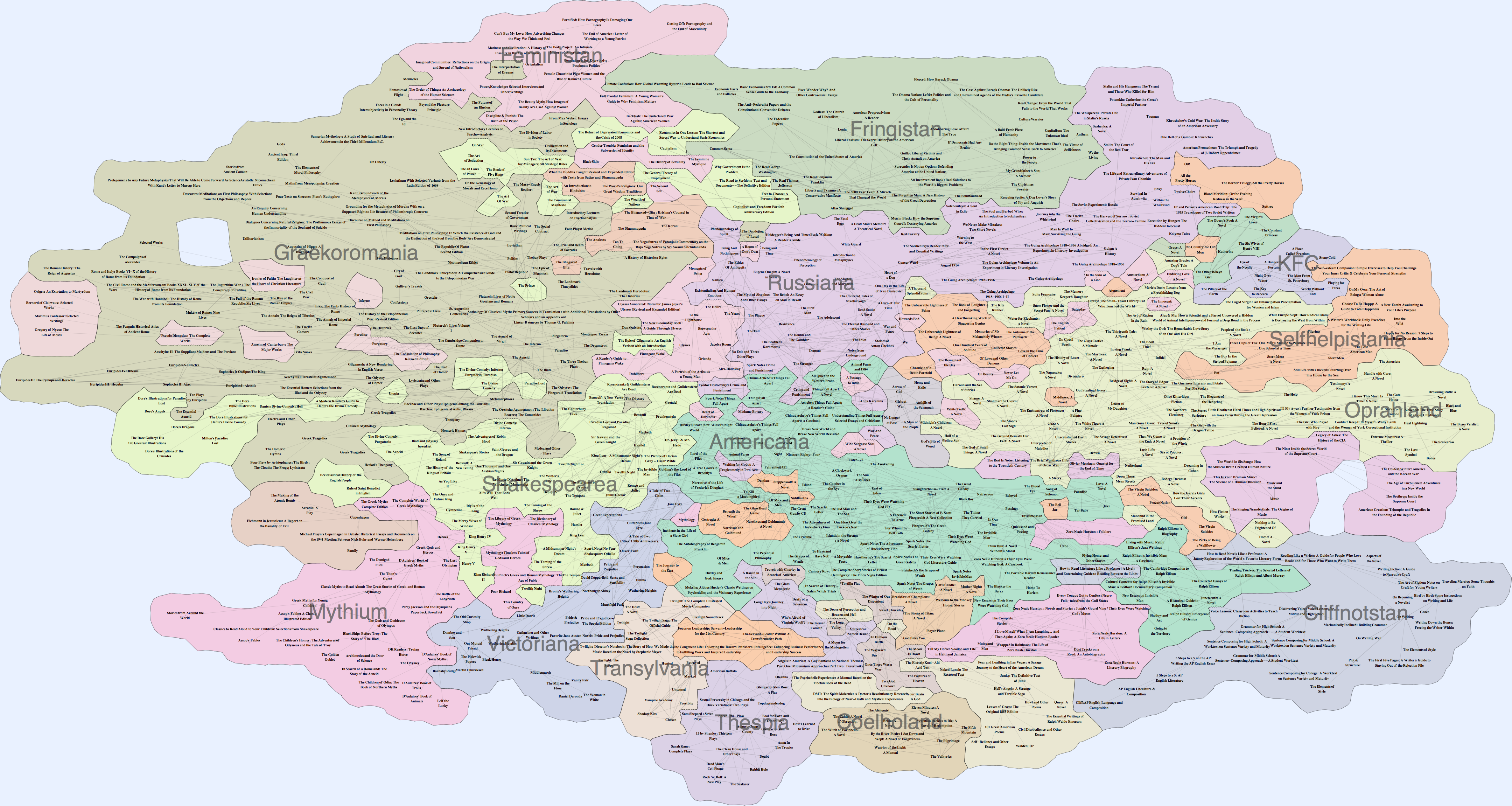
We don't mean to put anyone's work down as we are sure it's far more complex than just this, but this is a conclusion many writers have reached before (hence Wuthering Bites, for instance). According to The University of Arizona News,
Today, [Stephen Kobourov's] work is more involved, bringing clarity not only to linkages, but other connections. For example, based on Kobourov's mapping of Amazon.com, it appears that Emily Brontë's "Wuthering Heights" may serve as one of the gateway books for readers who end up developing a following for vampire-themed novels. (Monica Everett-Haynes)
Here's his BookLand map which looks like a highbrow version of Jasper Fforde's Fiction Island.

The Boston Globe wonders about what we expect to find when we visit a writer's house:
WHEN I went to London 30 years ago, I wanted to visit Charles Dickens’s house. I don’t know what I expected to find. The place was perfectly pleasant — rooms, furniture, some artifacts displayed in glass cases. But it also seemed weirdly empty. The thing I wanted wasn’t there. What are we looking for, when we visit a writer’s house? Sometimes it’s a landscape — the Brontës’ moors, Robert Frost’s New Hampshire pastures. (Joan Wickersham)
And indeed the Brontë moors are a recommended visit by Anglotopia for this bank holiday weekend in the UK.
The Yorkshire Dales have a whole host of exciting things to offer if you decide to spend your bank holiday there. Coach tours to Haworth, home of the Brontë Sisters, are extremely popular. You could visit the house they grew up in and even take a walk on to the famous moors where ‘Wuthering Heights’ is said to be set. Simply pop on your walking boots and set off across the moor, there is really no other place like it.
Flickr user sallycinnamon89 may whet you appetite with this picture too.

The Brontë Sisters has a post on Anne's spaniel Flossy.

Fiber Optics writes about Jane Eyre and A Restless Moment and The Clever Cottage both post about the 2011 adaptation of the novel.

Categories: , , , , , ,
12:03 am by M. in , ,    1 comment
A Spanish new edition of Jane Eyre:
Jane Eyre
Charlotte Brontë
Collection Austral Ediciones Especiales
Editorial Espasa
Publication: 03/06/2011
ISBN: 978-84-670-3696-1
And a Brazilian one
Jane Eyre
Charlotte Brontë
Translator:Heloisa Seixas
ISBN: 8577992012
Edições BestBolso
Grupo Editorial Record
Categories: , ,

Thursday, May 26, 2011

Thursday, May 26, 2011 11:27 am by Cristina in , , ,    No comments
Publishers Weekly has an article on BEA 2011 where
[Charlaine] Harris talked about the three most important books that inform her writing today—Edgar Allan Poe’s Collected Stories, Charlotte Brontë’s Jane Eyre, and Alexandre Dumas’s Three Musketeers. (Michael Coffey)
Another Brontëites is a 16-year-old student passionate about Chemistry who, The Hindu reports, also finds the time to read Emily Brontë.

Not sure about applying the adjective 'Brontëite' to him but Sports Grid considers football player Tiki Barber a Renaissance Man because
The Renaissance Man aspect of Barber shone through to Wertheim – he noted that in conversation, Barber “works in references ranging from Tony Soprano to Malcolm Gladwell.” But what also shone through was how some didn’t see his persona as entirely genuine. Said former Giants teammate Roman Oben:
“[W]e’d beat the Cowboys and fly home. Guys are yelling, playing cards and watching movies. Tiki’s sitting there, legs crossed, reading Wuthering Heights or whatever. Come on.” (Glenn Davis)
The North Leeds Life reviews Polly Teale's Brontë:
The set is dark and colourless – the only props being a door, a table and a couple of chairs. This is of no consequence as this is a play about words……. and lots of them. At one point they wonder why it is that they write – the answer was that it made life bearable. We watch as they wrestle both with their stories and their frustrations; their attempts to make some kind of living. (Muireann)
The Collegiate Times is not too thrilled about Jane Eyre 2011 while the columnist at the RoseHillPatch wants to go and see it even if her husband doesn't.

D'Encre et de Rêves writes in French about Jane Eyre and I ♥ reading posts about Wide Sargasso Sea. Flickr user tout_moi has uploaded a set of pictures taken at Haworth and the moors.

Categories: , , ,
12:03 am by M. in    No comments
"___" Temporarily Invisible is a joint exhibition currently at the Frankfurt Museum für Moderne Kunst:
The exhibition will present young artists who depict absence and ephemerality in their art. Their works direct the viewer’s gaze to blank spaces and visualize the non-existent, impalpable and invisible. Matthias Meyer’s film The Black Museum affords us a look behind the scenes at the Louvre. The paintings in the museum have been blackened out in the film. They thus become projection surfaces for the viewer’s imagination and, by concealing what constitutes their core value they heighten their claim to autonomy. In a similar manner Alicja Kwade’s blackened clock objects seem to deny us the opportunity to contemplate the passing of time. Ultimately, however, their invisibility increases our perception of time. The Transport Crates for Shadows by Wolfgang Plöger avail themselves of the formal language of Minimal Art. They materialize the incidence of light and the shadows cast by objects, thus recording an instant for eternity.
Mathias Meyer's installation Saved from Fire (2007-2008) contains Brontë elements:
Welche Literatur schon durch Flammen zerstört wurde, erforschte zwischen 2007 und 2008 der Künstler Matthias Meyer. Werke von Henry Miller, Mark Twain, Jean Cocteau oder Charlotte Brontë reiht er in seinem Buchobjekt "Saved from Fire" in drei kleinen Bücherregalen aneinander. Es scheint seltsam, welchen neuen Wert gedruckte Literatur bekommt, wenn sie Teil eines fremden, ihm übergeordneten künstlerischen Konzepts wird. Blättern oder lesen darf hier – ähnlich wie im Film – niemand. (Thomas Ungeheuer in Frankfurt Neue Press) (Translation)
Categories:

Wednesday, May 25, 2011

The Telegraph has a couple of articles on the British Library exhibition Out of this World: Science Fiction but not as you know it. The first article is more general whereas the second article focuses on the young Brontës' writings:
Although several hundred poems and prose exist, most of the works were lost. The three remaining works were donated to the British Library in the 1930s but this is the first time they’ve been identified as science fiction and exhibited in this manner. The Foundling, written by Charlotte, comes with illustrations by Branwell while poems of Gondal, were written by Emily.
Guest curator Andy Sawyer, Director of Science Fiction Studies MA at the University of Liverpool, said: “The Brontës are well known authors with no apparent association with science fiction but their tiny manuscript books, held at the British Library, are one of the first examples of fan fiction, using favourite characters and settings in the same way as science fiction and fantasy fans now play in the detailed imaginary ‘universes’ of Star Trek or Harry Potter". [...]
Emily, Charlotte, Anne and Branwell, all successful in their own right, are widely associated with bold romantic realism. The intricacy of their work precedes the minutae detail of JRR Tolkein and JK Rowling’s Harry Potter series and provides further, invaluable insight into their imaginations. (Morwenna Ferrier)
The Telegraph and Argus reports the news about the recent generous donation of several Brontëana items to the Brontë Parsonage Museum. Together with a picture of Charlotte's writing desk back home, the newspaper reports the reactions of Collections' Manager Ann Dinsdale and Brontë Parsonage Museum director:
“It’s extraordinary the way things have turned out. When we got the message that those items were to be donated to the museum, I was speechless,” said Ann Dinsdale, the museum’s collections manager.
“We would have been thrilled to have them on loan, but to actually be given them is wonderfully generous. I am not able to say who has donated them, but in future we hope they will let us release details.” [...]
Museum director Andrew McCarthy said: “A donation on this scale, with an item as significant as the writing desk used by Charlotte Brontë, is very rare. We’re delighted that these items are now where they belong, here in Haworth.” (Clive White)
The items will be on display as soon as next Tuesday May 31st.

Another Brontë-related event taking place in Yorkshire, Leeds in particular, these days is Shared Experience's revival of Polly Teale's Brontë (until May 28th at West Yorkshire Playhouse). The Yorkshire Post mentions it and includes a promotional picture of the actress who plays Charlotte dressed as Charlotte Brontë at Leeds Library.

An English teacher makes a confession in the Centre Daily Times:
Although I often read the teenage equivalent of “trashy” romance novels (no matter my adult opinions, I definitely would have been a “Twilight” fan), I could not love any assigned novel written by the Brontë sisters. (Katie Anderson)
The Daily examines the origins and uses of the word 'palaver' and quotes from Wuthering Heights:
Over time, the word seems to have shed some of its sadder heritage, and taken on, ironically, a lighter cast. In Emily Brontë’s “Wuthering Heights,” we find this example of its less-serious meaning, “There they were, like two babies, kissing and talking nonsense by the hour — foolish palaver that we should be ashamed of.” (Will Mari)
BlogCritics reviews Stella Gibbons's wonderful Cold Comfort Farm and mentions Wuthering Heights too:
First published in 1932 as a wonderful satire of its times, the humour and points made by the author are timeless, so even if some specifics might be lost on a contemporary audience, its overall impact is still strong and the subject matter still relevant. You see, Gibbons' targets are universal as she pokes fun at the artistic pretensions of the idle British rich, rural melodramas along the lines of Wuthering Heights, and other tales of steamy passion set amidst the wilds of Sussex farmlands. (Richard Marcus)
Meanwhile Variety shows that being made to read the Brontës while at school may have its uses, if only to indulge in this kind of metaphor:
The major networks just hosted another upfront week, and once again there was an uninvited guest.
That would be reality TV, arguably primetime's dominant genre, ratings-wise, conspicuous by its absence.
More than a decade after "Survivor" and "Big Brother" ushered in the modern unscripted era, such programming still remains an outcast -- treated at the upfronts a bit like the wife in "Jane Eyre." Everyone knows it's vital to the story, but during most presentations, it's kept safely locked out of view. (Brian Lowry)
The Brontë Parsonage Blog has a post on Blake Morrison's recent talk about his play We Are Three Sisters.

Miss Cavendish and Silver Screen Angels review Jane Eyre 2011 while The Reader 1991 posts about the actual novel. La Novice writes in French about Wuthering Heights 1992 and YouTube user Phantom Spooner has uploaded a mock trailer for 'Wuther My Heights'. Finally, Lifeonthecutoff's Blog reviews Ann Dinsdale's wonderful The Brontës at Haworth.

Categories: , , , , , , ,
A press release from the Brontë Parsonage Museum with very good and interesting news:
Generous donation of original Brontë relics to return to Brontë Parsonage Museum

Charlotte Brontë’s mahogany writing desk, a pen-holder and some sugar tongs are amongst the latest Brontë acquisitions to join the important collection of material owned by the Brontë Parsonage Museum in Haworth.

These rare Brontë items once formed part of a large and important collection of Brontëana amassed by William Law who sought out people that knew the Brontë family in order to enrich his own collection. After his death in 1901, these passed to his nephew, Sir Alfred Law, who sold some of the drawings and manuscripts at auction. Some of the personal Brontë items, including the selection given to the museum, were previously given as gifts to his nurse.

Sir Alfred Law died in 1939 and the present whereabouts of the remainder of this unique collection, which is known to have included manuscripts and books of great rarity and value, remains a mystery.

Along with these Brontë treasures donated to the Parsonage were; a wooden trunk, a display case, a black morocco stationary case, a pocket cigar case and copies of Brontë books- all previously owned by William Law himself.

It’s always exciting when new Brontë items come to light and when we’re able to add to the museum’s wonderful collection. But a donation on this scale, with an item as significant as the writing desk used by Charlotte Brontë, is very rare. We’re delighted that these items are now where they belong, here in Haworth; where they can be enjoyed by generations of visitors to the museum. We’re extremely grateful for such a generous donation.

Andrew McCarthy, Director, Brontë Parsonage Museum

The anonymous donor purchased these items from an auction at Sotheby’s in London on 17th December 2009 but decided that the appropriate place for them to be housed permanently would be the Parsonage museum.

The items will be on display from Tuesday 31st May.
Of course the news has been echoed by the Brontë Parsonage Blog and BBC News.  

Previous posts of ours that covered that particular auction can be found here and here.

Categories: ,

Tuesday, May 24, 2011

Tuesday, May 24, 2011 10:17 am by Cristina in , , , ,    No comments
WNYC is sharing a little gem which lay hidden in their archives:
Listen to a young Claire Bloom reading from a selection of letters by Emily, Anne and Charlotte Brontë in "The Brontë Sisters," a 1957 program submitted for consideration to the Peabody Awards.
[...] Francis Steegmuller provides narrative cohesiveness.
This reading was part of a WNYC Program called WNYC Annual Book Festival, which ran for five years from 1953 to 1957.


Do notice the (wrong) 'hay-worth' pronunciation for Haworth, though.
The Telegraph and Argus also looks to the past today:
50 years ago: More than 2,000 people had visited the Brontë Parsonage Museum in Haworth over Whit Sunday and the following Monday.
We find it quite interesting that a few days ago, news outlets expressed their surprise to find the Brontës in the exhibition Out of this World: Science Fiction but not as you know it at the British Library, which, incidentally is reviewed by Wharf and the Visit London blog. Yet the Evening Standard seems to consider the Brontës well-established in sci-fi:
The premise shouldn't be outlandish. All fiction is speculative fiction, and as SF readers weary of pointing out, if you "don't read science fiction" you miss out on works by Mary Shelley, Jonathan Swift, the Brontës, HG Wells, George Orwell, Margaret Atwood, Kazuo Ishiguro, JG Ballard and so on ad infinitum. (Sam Leith)
The Millions publishes the first paragraph of Jeffrey Eugenides's forthcoming novel The Marriage Plot, to be released in October.
To start with, look at all the books. There were her Edith Wharton novels, arranged not by title but date of publication; there was the complete Modern Library set of Henry James, a gift from her father on her twenty-first birthday; there were the dog-eared paperbacks assigned in her college courses, a lot of Dickens, a smidgen of Trollope, along with good helpings of Austen, George Eliot, and the redoubtable Brontë sisters...
The HopkintonPatch reviews a local production of the play Empty Page, Empty Stage where Jane Eyre puts in an appearance.

Jane Eyre 2011 is reviewed by Mixtapes & Cupcakes, A Restless Moment, O filme da minha vida (in Portuguese), The beginning of Mrs., Unconsciously Me, Simpythegimpy's Slippery Sunbeams of Sagacity and the high school journal The Phoenix. I Love Gooseberry has uploaded a Jane Eyre-related illustration. Peachy Reviews gives a 5/10 to Shirley. Sententiae posts about Agnes Grey.

Categories: , , , ,
The English folk band Mumford & Sons has written a song for the upcoming Andrea Arnold's film Wuthering Heights:
The Mumford & Sons track Enemy has been recorded for the end-title of a remake of Wuthering Heights. (...)
Mumford & Sons manager Adam Tudhope added the band became involved in writing for Wuthering Heights after director Andrea Arnold saw the group perform earlier this year. “The band saw the film and came out from the screening room very inspired. Two days later they had two songs which Andrea loved equally. It was a brilliant creative experience for everyone involved.” (Charlotte in Music Week)
Thanks to the anonymous reader that has alerted us to this in a comment to a previous post.

IndieWire's The Playlist relays the news as well.

Categories: , ,

Monday, May 23, 2011

Monday, May 23, 2011 10:59 am by Cristina in , , , ,    2 comments
A few book reviews mention Jane Eyre today.

Maureen Corrigan reviews Lawrence Block’s A Drop of the Hard Stuff for The Washington Post:
Sometimes, you open up a book, and you just know: You’re in the hands of a master. Different things can signal that a golden read is about to begin: the voice, for sure (Hello, Holden, Huck and Jane Eyre — I’m talking about you!); the atmosphere (see the prologue to “The Turn of the Screw”); or the setting (a day trip to Baskerville Hall or Thomas Mann’s Venice, anyone?).
The New Zealand Herald reviews Natasha Solomons's The Novel In The Viola:
Solomons describes the book as a "story of the sea, of love lost and found, and of a novel hidden inside a viola". Sources of inspiration included such masterpieces as Rebecca, Remains of the Day and novels such as Jane Eyre.
There's even a Jane and Mr Rochester element to the her story, set on the coast of Dorset. "I call him Mr Dorchester," Solomons says. "I wanted to write about the last days of a great country house but seen through the eyes of an outsider - hundreds of years drawing to a close.
"As it should do," she hastens to add, in case anyone should think she is stuck in a time warp. "Those houses need armies of servants, and [are based on] inequalities unacceptable in the modern world." (Frances Grant)
The Guardian reviews the children's book The Exiles in Love by Hilary McKay:
Romance is in the air, when Ruth falls for a bus driver. Yet her heart also yearns for the mysterious Mr Rochester, a character from Jane Eyre.
TGDaily is surprised to find that
there are still a number of classic movies that still aren't on DVD, or have gone out of print, including Orson Welles' Magnificent Ambersons and Chimes at Midnight, Greed, Wuthering Heights, Porgy and Bess, The Secret Life of Walter Mitty, Viva Zapata, and Kubrick's first film Fear and Desire, just to name a few. (David Konow)
The Telegraph has the blunder of the day in an article about hyperemesis gravidarum:
Charlotte Brontë is thought to have died of it in 1852. . . (Anna Tyzack)
True except for the fact that Charlotte Brontë died in 1855.

TimesRecordNews has an article on an Amtrak passenger who was kicked off an Amtrak train and was charged with disorderly conduct for talking on her cellphone for 16 hours. The columnist says,
I'm guessing by the time her fellow passengers watched Beard escorted off the train by Oregon police, they knew about her cousin's trouble with her boyfriend, her recent visit to her doctor, what she thought of the latest "Jane Eyre" film, and probably had acquired her secret recipe for tater tot casserole. (Lana Sweeten-Shults)
The film is actually reviewed by Vicky's Writings. Both Mis Lecturas Semanales (in Spanish) and Keith's 1001 Books Quest post about Agnes Grey. Word Mistery writes in Portuguese about Wuthering Heights and The Red Curtain Review discusses Cliff Richard's Heathcliff the Musical. Tantos Livros Tão Pouco Tempo (in Portuguese) writes about Wide Sargasso Sea. Świat między półkami reviews Jennifer Vandever's The Brontë Project in Polish.

Finally, the Brussels Brontë Blog has a post on Eric Ruijssenaars's comings and goings in New York.

Categories: , , , ,
12:01 am by M. in ,    No comments
The Dutch musical duo The Rossettis first album includes a musical setting of a Emily Brontë poem:
The Rossettis are Jan-Frans van Dijkhuizen and Mariska Reijmerink.
The Rossettis are a musical duo who aim to put English 19th century poems to music in order to make them known to an audience who may otherwise never come across this beautiful poetry.
The CD Letter to the World includes Shall earth no more inspire thee after a poem by Emily Brontë.

The album was presented last May 16 in Austerlitz. More information on dé Week Krant.

Categories: ,

Sunday, May 22, 2011

Sunday, May 22, 2011 12:15 pm by M. in , ,    No comments
The Boston Globe addresses a growing (and annoying) problem happening in the film projections of 2D films:
Many theaters misuse 3-D lenses to show 2-D films, squandering brightness, color. (...)
This particular night “Limitless,’’ “Win Win,’’ and “Source Code’’ all seemed strikingly dim and drained of colors. “Jane Eyre,’’ a film shot using candles and other available light, appeared to be playing in a crypt. A visit to the Regal Fenway two weeks later turned up similar issues: “Water for Elephants’’ and “Madea’s Big Happy Family’’ were playing in brightly lit 35mm prints and, across the hall, in drastically darker digital versions.The uniting factor is a fleet of 4K digital projectors made by Sony — or, rather, the 3-D lenses that many theater managers have made a practice of leaving on the projectors when playing a 2-D film.  (Ty Burr)
The same newspaper interviews writer Jamaica Kincaid:
Are you a fast reader?
Two books I just read, “A Box of Darkness’’ by Sally Ryder Brady and “Tiger Tiger’’ by Margaux Fragoso, I read in one sitting. They were beautiful. I wanted to read them so much I bought them on Kindle and read them right away. But there are some books I can never put on a Kindle, like “Jane Eyre.’’ The books seem trapped. (Amy Sutherland)
The Bowling Green Daily News interviews children's literature author Jennifer Trafton:
“I love any great story, no matter what genre it is,” Trafton said. “I want to laugh and catch a glimpse of some deep-down truth about life. I want to meet characters that linger in my memory for years afterward.” Her favorite books include the British classics “David Copperfield” by Charles Dickens and Charlotte Brontë’s “Jane Eyre”; in the realm of fantasy, Tolkien’s “The Lord of the Rings”; and in the category of contemporary literary fiction, Marilynne Robinson’s “Gilead” and Chaim Potok’s “My Name is Asher Lev.” (Libby Davies)
The Telegraph talks with Andrea Corr:
She reinvented herself as a theatre actress, playing an acclaimed Jane Eyre at the Gate in Dublin last year, and appeared in the Olivier Award-winning Dancing at Lughnasa at the Old Vic in London the year before. (...)
Both her part in Brian Friel’s play Dancing at Lughnasa and the role of Jane Eyre required her to be plain. Corr, experiencing an emotion that perhaps only the truly beautiful can understand, was thrilled with the idea of looking drab. (...)
Corr clearly took to the theatre. 'It was a great experience,’ she agrees. 'We finished [Jane Eyre] at the end of January and now it’s gone forever. That’s what I love about it. It isn’t recorded. Even if it’s a brilliant night it will disappear.  (Chrissy Iley)
San Francisco Chronicle recommends This is the Garden: My Anthology by Charles Elliott:
A thought-provoking collection of reflections by more than 75 authors, ranging from Charlotte Brontë to William Wordsworth.
An alert from Kingston Pike, TN:
Brontë Society — Discussion of “Jane Eyre” the film, the novel, the author, 7 p.m. Wednesday, May 25, Panera Bread, 4855 Kingston Pike. 865-681-7261. (Knox News)
The Tehama County Daily News mistakes Emily for Charlotte Brontë; Reviews of Jane Eyre 2011: winter pot kalanchoe, Movie Reviews for Mere Mortals, Metacognitive Potential, For the Love of Lit..., Scribblemaniac (who saw it in San Francisco); Sonia's Movie & Book Review Blog and Arco de reflejos (in Spanish) post about the original novel.

Categories: , ,